Tag: United Nations

  • Made-in-Africa Fashion Brand Pioneers Aim for Global Success

    Made-in-Africa Fashion Brand Pioneers Aim for Global Success

    By David SouthDevelopment Challenges, South-South Solutions

    SOUTH-SOUTH CASE STUDY

    African fashion brands have not always been the first place fashionistas turned to when shopping for new clothes or shoes in developed economies. While Africa has long been a source of inspiration in contemporary and traditional fashion, the continent has had a weak reputation for manufacturing and selling mass market global fashion brands.

    There are initiatives, such as Origin Africa (http://originafrica.org/), an ongoing campaign working to improve African trade by increasing the trade of textiles and apparels, cut flowers, specialty foods, home décor, and fashion accessories. Origin Africa matches African designers and entrepreneurs with experienced industry leaders to “facilitate, coordinate and advance ‘trade, not aid’ efforts”.

    While there are many places in Africa engaged in the global clothing manufacturing outsource industry – often paying very low wages – strong African fashion brands are often absent in most developed countries. Well, at least until now.

    Two recent examples have joined the well-publicized success of Ethiopia’s soleRebels, maker of rubber-soled shoes (solerebelsfootwear.co). SoleRebels became an Internet success story, harnessing the power of web-based sales to reach customers around the world.

    Now another Ethiopian shoe maker is also pushing its way into the global fashion scene. Ethiopian-made sneaker brand Sawa has just been picked up by the American retailer of preppy clothing J. Crew (jcrew.com). The successful catalogue and online clothing retailer has great clout when it comes to promoting a brand, and this should be a big boost to the reputation of African fashion labels.

    Sawa’s headquarters is in Paris, France (the physical home of much of the world’s fashion scene) but all its shoes are sourced and made in Addis Ababa, Ethiopia’s capital, and the company’s website is run from there.

    Sawa says the key to its success is to be a business first and foremost – not a charity.

    “Sawa project does not have the so-called generosity of brands which use Africa just to glorify themselves,” said Wendesen Birhanu, on the company website.

    “Sawa is a fashion brand which has taken the challenge to fabricate shoes in Africa. All the added value benefits the continent.”

    The company’s shoe factory is modern and has the workers positioned at their desks making the shoes. The brand logo proudly states “Made in Africa” on all the brown cardboard shoe boxes in a bold, red roundel stamp.

    Sawa also uses the slogan “vote with your feet” to show the connection between purchasing the shoes and supporting African business and manufacturing.

    The footwear, currently available in the United Kingdom, France and through J. Crew in the United States, has a distinctive rubber sole with the African continent embossed on the bottom – a clever design tweak ensuring the wearers will leave an interesting footprint wherever they walk.

    The styles available include Dr Bess, a vintage canvas and leather shoe in a low-cut silhouette. The Tsague is a vintage shoe with a mid cut like that used for basketball shoes.

    The shoes have been put through their paces in an independent quality assurance lab and each shoe’s details are explained on the Sawa website (http://www.sawashoes.com/index.php?option=com_content&view=article&id=2&Itemid=8&lang=en).

    They retail in Europe for between 75 euros and 115 euros a pair – a middle-market price – and come in eye-pleasing colours, from basic black to white to sand, dark blue, grey, brown, red and light blue.

    Small and medium enterprises (SMEs) (http://en.wikipedia.org/wiki/Small_and_medium_enterprises) have been identified as an essential part of Africa’s future prosperity and key to its ability to reduce poverty and achieve development objectives like the Millennium Development Goals (MDGs) (www.un.org/millenniumgoals).

    Obstacles to growth for SMEs include poor infrastructure, unreliable power supplies, unscaleable business models, low quality standards and poor quality branding and design.

    Developing manufacturing in Africa is key to improving incomes and wealth. Creating unique, branded products for overseas markets makes it possible to earn foreign currency and be able to benefit from consumers in other countries. The math is simple: once you have saturated the local market for your product, the only way to boost sales and profits is to seek new customers elsewhere. By selling to people in a country with a higher national income, it is possible to charge more and in turn earn more money for each product. In time, this can lead to significant income rises and in turn, human development gains as the spare cash can be put to improving local living conditions, acquiring education or better health services and consuming better quality food.

    Another important feature of selling to overseas customers is competition. Having to compete with the pick of the world’s top brands means a company must raise its game to stand a chance. The pressure forces the company to sharpen its product line, become more efficient, stick to strict quality control and embrace the latest thinking in design, marketing and information technologies.

    In short, an African company that can weather a few years successfully selling to overseas customers is going to be a fierce competitor back home.

    And, as has been forecast many times, the rise of Africa’s middle class consumers will be a big driver of economic growth in the next decade. If this middle-income consumer class buys lots of African-made consumer products, then the impact on job and wealth creation on the continent will be significant.

    Another fashion initiative boosting brand Africa is a partnership between Italian fashion lifestyle clothing retailer Diesel (diesel.com) and the Edun ethical fashion label (edun.com), founded by Ali Hewson and her husband Bono, singer with rock band U2.

    The collaboration offers a contemporary take on retro street wear from Africa’s past, while having all the garments made and sourced from Africa.

    In March 2013, Diesel+EDUN launched a 25-piece denim collection drawing its inspiration from African creativity. The collection uses raw, untreated denim sourced and manufactured in Uganda. It mixes up Malian textile prints for linings, with outside embroidery drawing on traditional Zulu weaving patterns. It also includes a denim jacket inspired by street wear from 1970s South Africa.

    Edun was originally set up to encourage greater trade with Africa as a way to address poverty and boost incomes. Begun in 2005, the brand has tried to overturn the perception that ethical and ecologically sound fashion can’t be fashionable and desirable too.

    Edun has sought to be “a creative force in contemporary fashion”, according to its website. In 2007, it launched a line dedicated to making t-shirts entirely made in Africa called Edun Live. Edun Live t-shirts “are entirely ‘Grow to Sew’ African. From cotton to finished tee, all production takes place in Africa.”

    Edun has the goal of producing 40 per cent of its fashion collection in Africa by 2013. It does this by “supporting manufacturers, infrastructure and community building initiatives”.

    All of Edun’s cotton is harvested to CCIU cotton standards. The Conservation Cotton Initiative Uganda (CCIU) is a cotton-farming program that helps to build sustainable farming communities in Northern Uganda.

    Edun is currently working in Kenya, Morocco, Madagascar, Uganda and Tunisia.

    The Diesel+EDUN (http://www.diesel.com/diesel+edun/) collaboration had its start at the beginning of 2012. After trips to East and West Africa by Diesel founder Renzo Rosso and Edun founders Ali Hewson and Bono, the idea was hatched to work together to “further apparel trade and development in Africa”. The goal is “bringing business to the continent and highlighting to the fashion world the possibility for sustainable trade and creative opportunity in Africa.”

    More than 5,000 farmers participated in the 2011/2012 CCIU program, and more than 8,000 have already enrolled in the 2012/2013 season, the website states.

    Edun is also working with Mikono Knits (Mikonoknits.com) to promote traditional African knitting techniques.  Founded in 2005 by Froydis Dybahl Archer, Mikono makes and sells hand-crocheted sweaters and tank tops from its Nairobi, Kenya workshop. The plan is to use the success of Mikono Knits to expand the number of underprivileged women the firm can hire to work for the business. The business currently employs 10 women and uses locally sourced organic cotton and wool, supporting the local economy.

    Beyond the actual clothing partnership and African-inspired fashion, there is a clever promotion campaign to raise awareness for the Diesel+EDUN line. Called Studio Africa (http://studioafrica.tumblr.com/), it is a marketing and perception-shaping initiative, “celebrating and promoting creativity in Africa”. It is doing this by promoting nine African artists to better communicate the African vibe of the collection and give the artists’ careers a boost. It is curated and edited by Okay Africa (http://www.okayafrica.com/), a cultural guide to “all the latest music/culture/politics coming from Africa and the Diaspora”.

    Published: March 2013

    Resources

    1) Africa Fashion International: African Fashion International (AFI) is the leading Fashion authority on the African continent and is committed to the promotion and development of the best South African design talent. Website: http://afi.za.com/

    2) Origin Africa: Origin Africa is an ongoing campaign and initiative dedicated to improving African trade. Comprised of producers, designers, small businesses, exporters, buyers and retailers, it is working to develop, guide and promote African trade in the following sectors: textiles/apparel, cut flowers, specialty foods, home décor, and fashion accessories. Website: http://originafrica.org/

    3) SoleRebels:  Ethiopia’s soleRebels profiled in Southern Innovator Magazine Issue 2. Website: http://www.scribd.com/doc/106055335/Southern-Innovator-Magazine-Issue-2-Youth-and-Entrepreneurship

    4) How we made it in Africa: A great website packed with inspirational people and stories on business success in Africa. Website: http://www.howwemadeitinafrica.com/

    5) Nigerian shoe and garment maker Fut Conceptus has been taking raw Nigerian leather that was once just sent overseas for export, and instead is turning out high-quality shoes and bags made in Nigerian factories. Website: futconceptus.com

    6) SME Toolkit South Africa: A website packed with resources and support for anyone starting a small business in Africa. Website: http://southafrica.smetoolkit.org/sa/en

    7) African Guarantee Fund for Small and Medium-sized Enterprises: The AGF provides guarantees and technical assistance to financial institutions in Africa with the objective of generating enhanced growth in the SME sector and increasing employment opportunities in the economy, particularly for youth. Website: http://www.afdb.org/en/topics-and-sectors/initiatives-partnerships/african-guarantee-fund-for-small-and-medium-sized-enterprises/

    8) Small and Medium Enterprise Support, East Africa: A blog promoting events and support for SMEs in East Africa. Website: http://smeseastafrica.blogspot.com/

    9) Integrating Developing Countries’ SMEs into Global Value Chains: A paper from UNCTAD (2010). Website: http://www.unctad.org/en/docs/diaeed20095_en.pdf

    Southern Innovator logo

    London Edit

    31 July 2013

    https://davidsouthconsulting.org/2021/02/09/african-fashions-growing-global-marketplace-profile/

    https://davidsouthconsulting.org/2021/01/05/afropolitan-african-fashion-scene-bursting-with-energy/

    https://davidsouthconsulting.org/2021/01/25/creating-green-fashion-in-china/

    https://davidsouthconsulting.org/2022/10/09/fashion-closes-gap-between-catwalk-and-crafts/

    https://davidsouthconsulting.org/2022/11/17/fashion-recycling-how-southern-designers-are-re-using-and-making-money/

    https://davidsouthconsulting.org/2022/11/16/favela-fashion-brings-women-work/

    https://davidsouthconsulting.org/2020/04/30/local-fashions-pay-off-for-southern-designers/

    https://davidsouthconsulting.org/2021/10/04/putting-quality-and-design-at-the-centre-of-chinese-fashion/

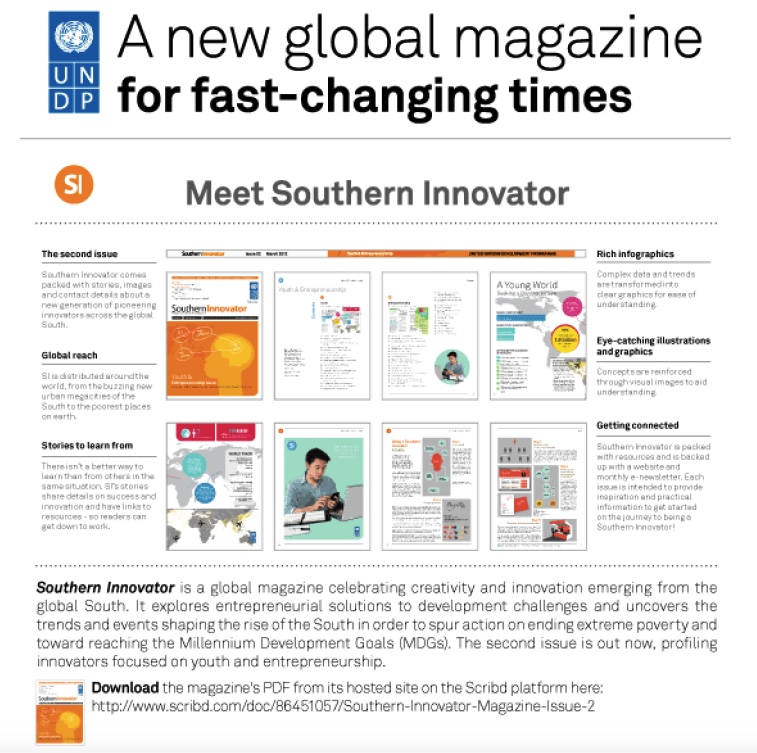
    Development Challenges, South-South Solutions was launched as an e-newsletter in 2006 by UNDP’s South-South Cooperation Unit (now the United Nations Office for South-South Cooperation) based in New York, USA. It led on profiling the rise of the global South as an economic powerhouse and was one of the first regular publications to champion the global South’s innovators, entrepreneurs, and pioneers. It tracked the key trends that are now so profoundly reshaping how development is seen and done. This includes the rapid take-up of mobile phones and information technology in the global South (as profiled in the first issue of magazine Southern Innovator), the move to becoming a majority urban world, a growing global innovator culture, and the plethora of solutions being developed in the global South to tackle its problems and improve living conditions and boost human development. The success of the e-newsletter led to the launch of the magazine Southern Innovator. 
    https://davidsouthconsulting.org/2021/03/05/southern-innovator-issue-2/

    Creative Commons License

    This work is licensed under a
    Creative Commons Attribution-Noncommercial-No Derivative Works 3.0 License.

    ORCID iD: https://orcid.org/0000-0001-5311-1052.

    © David South Consulting 2023

  • New Beer Helping to Protect Elephants

    New Beer Helping to Protect Elephants

    By David SouthDevelopment Challenges, South-South Solutions

    SOUTH-SOUTH CASE STUDY

    How to match the often conflicting goals of protecting animal habitats and supporting local economies? One clever solution may draw amusement but is actually a sharp marketing strategy to get attention for a product that is helping to preserve the elephants of Thailand’s Golden Triangle (http://en.wikipedia.org/wiki/Golden_Triangle_(Southeast_Asia).

    A beer flavored with a special ingredient – coffee beans that have passed through elephants – is generating profits that are plowed back into improving health services for the animals. The coffee beans excreted by elephants are roasted and turned into a high-quality coffee by a company in Thailand; this coffee is then used by a Japanese company to make a special beer brand that is getting attention and winning rave reviews.

    The elephant dung coffee beans used in the beer are called Black Ivory (http://www.blackivorycoffee.com) and come from Thailand’s Golden Triangle Asian Elephant Foundation (http://www.helpingelephants.org). According to The Drinks Business, the coffee beans retail for US $100 per 35 grams.

    The beans are of the Thai Arabica variety and grow at an elevation of 1,500 metres. Elephants consume the coffee cherries and excrete the beans as part of their diet. Once the elephants have excreted the beans in their faeces they are harvested, processed, sun dried and roasted.

    It takes 10,000 beans to make a kilogram of roasted coffee, according to the Black Ivory website. A total of 33 kilograms of coffee cherries are consumed by the elephants to make a kilogram of the Black Ivory coffee.

    Elephants in Thailand are used for various activties, from heavy work to providing rides for tourists. The riders of the elephants – called mahouts (http://en.wikipedia.org/wiki/Mahout) – and their wives also benefit from the manufacturing and sale of the coffee. The income is used to pay for health costs, school fees, food and clothing.

    Additionally, 8 per cent of the proceeds from the sale of the coffee beans pays for a veterinarian to provide care to the elephants. The money is also used to pay for their medicine and the setting up of a laboratory.

    Elephants are much-revered in Thailand and feature in the country’s national iconography. They are listed as Protected Animals under Thailand’s Conservation Act 1992 (FAO). Many believe they should be classified as endangered. The last survey on the population was conducted in 1991 and elephant numbers were recorded as 1,900 (FAO).

    The main threat to elephants comes from humans – in the form of poaching for the animals’ ivory tusks, their abuse in begging on the streets, and the destruction of forests where the elephants live.

    The natural habitat and feeding grounds for the elephants have shrunk over the past decades. It is estimated the forest area in Thailand shrank from 80 per cent to 20 per cent between 1957 and 1992. Causes include major infrastructure projects, increasing farmland and the building of large resorts, all encroaching on the elephants’ territory. Limited space means elephants increasingly come into conflict with humans and this can lead to them being poisoned or killed.

    But the success of the Japanese-brewed Kono Kuro beer is creating a new funding source for helping the elephants and doing some good.

    The beer is brewed by Sankt Gallen brewery (http://www.sanktgallenbrewery.com) in Kanagawa, Japan using the Black Ivory coffee beans, imparting the beer with an earthy flavour. It may sound like a gimmick, but consumers have remarked on the beer’s distinctive taste, and sales do not lie: it has been a quick success, selling out within minutes of its launch in Japan.

    The beer comes in dark bottles with a sandy coloured label elegantly illustrated with pictograms showing the process of turning the beans excreted by the elephants into beer. It is a humorous visual tale that makes the label stand out from other beer brands.

    Brewer Sankt Gallen calls it a “chocolate stout” because of its rich, earthy flavour (it does not contain any chocolate, however).

    Although bottles of the stout sold out after going on sale on the Sankt Gallen website, the brewery has said that it has plans to put the beer on tap at its new shop, which opened in Tokyo recently.

    Published: June 2013

    Resources

    1) Coffee Alamid: Ethically produces the coffee harvested from the droppings of civet cats in the Philippines. Website: http://www.botecentral.net/

    2) Save the Elephants: A campaign to stop the poaching of elephant ivory. Website: http://www.savetheelephants.org/

    3) BBC Nature: Background on elephants. Website: http://www.bbc.co.uk/nature/life/African_elephant

    4) WWF: Facts and background on elephants. Website: http://worldwildlife.org/species/elephant

    Southern Innovator logo

    London Edit

    31 July 2013

    Development Challenges, South-South Solutions was launched as an e-newsletter in 2006 by UNDP’s South-South Cooperation Unit (now the United Nations Office for South-South Cooperation) based in New York, USA. It led on profiling the rise of the global South as an economic powerhouse and was one of the first regular publications to champion the global South’s innovators, entrepreneurs, and pioneers. It tracked the key trends that are now so profoundly reshaping how development is seen and done. This includes the rapid take-up of mobile phones and information technology in the global South (as profiled in the first issue of magazine Southern Innovator), the move to becoming a majority urban world, a growing global innovator culture, and the plethora of solutions being developed in the global South to tackle its problems and improve living conditions and boost human development. The success of the e-newsletter led to the launch of the magazine Southern Innovator. 

    Creative Commons License

    This work is licensed under a
    Creative Commons Attribution-Noncommercial-No Derivative Works 3.0 License.

    ORCID iD: https://orcid.org/0000-0001-5311-1052.

    © David South Consulting 2023
  • African Media Changing to Reach Growing Middle Class

    African Media Changing to Reach Growing Middle Class

    By David SouthDevelopment Challenges, South-South Solutions

    SOUTH-SOUTH CASE STUDY

    Africa’s growing middle classes are being targeted by a new generation of media entrepreneurs. This growing group of Africans is ambitious and intelligent, and they want media that matches their aspirational ways. Clever media people are stepping up to feed this trend.

    The continent as a whole forms the 10th largest economy in the world. Of Africa’s more than 1 billion people, 900 million can be classified as part of the consumer economy. Out of this group, there a third – approximately 300 million people – make modest sums by Western standards, about US $200 a month, but have spare cash to buy things like mobile phones, DVDs and new clothes, or pay for better schools. They are the population that is overlooked when attention is focused only on the very poor living on less than US $2 a day.

    Pulitzer Prize-winning Nigerian journalist Dele Olojede is one of several African media pioneers re-shaping the continent’s media and taking it to the next level. Another is Godfrey Mwampembwa, whose popular puppet television show satirizes contemporary politics and current events and brings a welcome local flavour to a programming schedule packed with foreign imports.

    A book by University of Texas professor Vijay Mahajan, Africa Rising, details the phenomenon of Africa’s middle class consumer society. He calls this group of middle class consumers ‘Africa 2’, with the desperately poor called Africa 3s, and the extremely rich Africa 1s.

    This new group has expanded far beyond just the ruling elites and government workers. Many of its members work in the private sector, as secretaries, computer entrepreneurs, merchants and others who have benefited from consistent growth rates in many African countries.

    And because these people consume products and services – and advertising products and services are the lifeblood of private media – the opportunities are plentiful.

    “I’m convinced that Africa is going to be built by Africa 2s,” Mahajan told the Washington Post newspaper. “These are the people sending their kids to school . . . who are the most optimistic, the most forward-thinking.”

    Olojede, owner and publisher of Next newspaper (http://234next.com/csp/cms/sites/Next/Home/index.csp) in Nigeria’s biggest city, Lagos, has been able to grab readers by breaking original stories and offering a quality, well-designed publication. Launched in 2008, it has its sights set on going continent-wide by 2011.

    “There is a need for a newspaper for the African metropolitan middle classes, along the lines of the International Herald Tribune,” he told Monocle magazine.

    Olojede cut his teeth as a foreign editor for the US newspaper Newsday and has used this experience to make Next such a success.

    Next has become the number one news website in Nigeria’s highly competitive media scene.

    Wisely, Olojede put design at the centre of making his newspaper and website stand out from the competition. He commissioned the experienced newspaper design team of Garcia Media (http://garciamedia.com/blog/articles/in_west_africa_a_new_newspaper_is_born_—online_first) – who have designed for The Wall Street Journal, The Miami Herald and Die Zeit – to develop the template and prototypes.

    Kenyan economist James Shikwati (http://en.wikipedia.org/wiki/James_Shikwati) believes Africa’s middle-income consumers are also a driving force for political change.

    “It’s empowering,” he told the Washington Post. “If you give people a sense of freedom in the economic sector, then you deny it in the political sector, you have a problem.”

    Kenya-based newspaper cartoonist Gado (Godfrey Mwampembwa) has profited from this phenomenon. Fed up with TV channels sticking to a menu of foreign imports and dull news programmes, he looked to famous puppet TV shows Spitting Image (from Britain) and Les Guignols (from France) for inspiration. The result is the XYZ Show (http://xyzshow.com/blog), which features grotesque puppet caricatures of well-known public and political figures. The show’s blog makes for an excellent entry point into African TV programme-making and its ups and downs. The show is broadcast on Citizen TV in Kenya’s capital, Nairobi.

    “I moved to Nairobi in 1992 when I was 23,” Mwampembwa explained to Monocle. “The Daily Nation, the biggest newspaper in Kenya, had lost its editorial cartoonist so they ran a competition to look for his replacement. I sent in my drawings and came second.”

    “I took a year off in 2000-2001 to study film and animation in Vancouver. When I got back to Nairobi I started thinking about the sort of TV programme I would like to make. Kenya needed a show that would make fun of our politicians and expose hypocrisy and I thought a puppet show like Les Guignols or Spitting Image would be a great way to do it.”

    “We managed to raise funds for a pilot in 2007 and Citizen TV (http://www.facebook.com/pages/Citizen-TV-Kenya/261061365404), a private station, eventually agreed to broadcast a series.”

    Each episode costs US $16,740 and the puppets are US $3,600 to make. The programme-makers could only get money from foreign donors: the French, Dutch, and Finnish embassies and the Ford Foundation.

    Despite initial complaints from politicians, the show is preparing for its second season – and, Mwampembwa said, “there will be a lot of big stories for us to cover.”

    Making a popular TV show is not an easy thing to do. Mwampembwa maintains a furious work pace to straddle his many roles:

    “I have to draw a cartoon every day but editorial cartooning is not a nine-to-five job, it’s 24/7. Whenever I get ideas I have to sketch them.

    “It was a steep learning curve in the first season. The show is important for Kenyan TV and everything is done here in Nairobi. We won’t change any of the politics though. We are very hard-hitting and we will stay that way.

    “Over the years I’ve got nasty letters, emails and phone calls but that’s OK, it’s part of it.”

    As these media innovators show, there is nothing but opportunity for entrepreneurs feeding the hungry news and information appetite of the continent’s ambitious middle class.

    And Mwampembwa says becoming better informed doesn’t have to be dull: “We are informing the public but I’d like to think we are entertaining them too.”

    Published: September 2010

    Resources

    • Africa Rising: A book by Professor Vijay Mahajan on how Africa’s consumer economy is growing and growing. Website: http://tinyurl.com/2vk3m9n

    Development Challenges, South-South Solutions was launched as an e-newsletter in 2006 by UNDP’s South-South Cooperation Unit (now the United Nations Office for South-South Cooperation) based in New York, USA. It led on profiling the rise of the global South as an economic powerhouse and was one of the first regular publications to champion the global South’s innovators, entrepreneurs, and pioneers. It tracked the key trends that are now so profoundly reshaping how development is seen and done. This includes the rapid take-up of mobile phones and information technology in the global South (as profiled in the first issue of magazine Southern Innovator), the move to becoming a majority urban world, a growing global innovator culture, and the plethora of solutions being developed in the global South to tackle its problems and improve living conditions and boost human development. The success of the e-newsletter led to the launch of the magazine Southern Innovator. 

    Creative Commons License

    This work is licensed under a
    Creative Commons Attribution-Noncommercial-No Derivative Works 3.0 License.

    ORCID iD: https://orcid.org/0000-0001-5311-1052.

    © David South Consulting 2023

  • Protecting Threatened Fruits and Nuts in Central Asia

    Protecting Threatened Fruits and Nuts in Central Asia

    By David SouthDevelopment Challenges, South-South Solutions

    SOUTH-SOUTH CASE STUDY

    Between 94,000 and 144,000 plant species — a quarter to a half of the world’s total — could die out in the coming years, according to an estimate by Scientific American (2002).  Among them are vital food crops, threatened by a world in which climate change is causing more weather turbulence and diseases and viruses can spread rapidly and destroy crops.

    This scale of plant loss risks leaving the world’s food security dependent on fewer – and more vulnerable – domesticated species. The hunt is on for hardy plant species that can survive these ups and downs while protecting the world’s food security for this and the next generation.

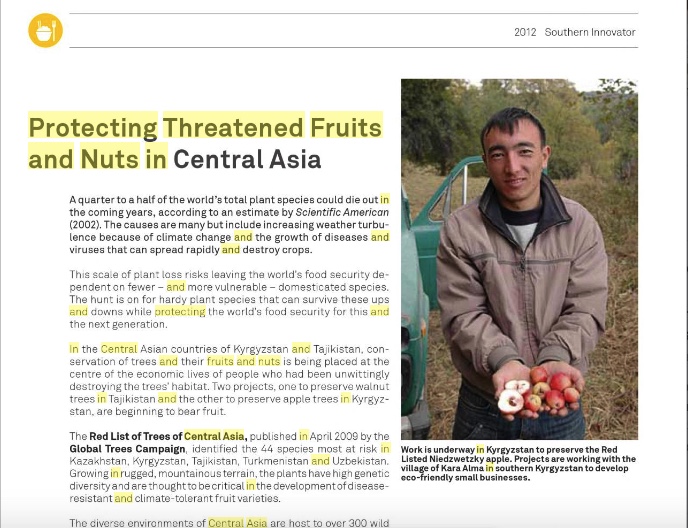
    In the Central Asian nations of Kyrgyzstan and Tajikistan, conservation of trees and their fruits and nuts are being placed at the centre of the economic lives of people who had been unwittingly destroying the trees’ habitat. Two projects, one to preserve walnut trees in Tajikistan, and the other to preserve apple trees in Kyrgyzstan, are beginning to bear fruit.

    The Red List of Trees of Central Asia published in April 2009 by the Global Trees Campaign (http://www.globaltrees.org/rl_centralasia.htm), identified the 44 species most at risk in Kyrgyzstan, Kazakhstan, Uzbekistan, Turkmenistan and Tajikistan. Growing in rugged, mountainous terrain, the plants have high genetic diversity and are thought to be critical in the development of disease-resistant and climate-tolerant fruit varieties.

    The diverse environments of Central Asia are host to over 300 wild fruit and nut species that are ancestors to the fruits and nuts we eat today, including wild apple, plum, pears, pistachios, cherry, apricot, and walnut.

    Many face extinction as local people — driven by the need for fire wood, or to earn an income — cut down this precious resource. The Red List estimates that over 90 percent of the trees in the fruit and nut forests across Central Asia have been destroyed in the past 50 years.

    The importance of these fruits and nuts can’t be over-emphasized: all the common varieties of apricot come from one living ancestor, the species Armeniaca vulgaris, now very rare in Central Asia. Central Asia’s Malus sieversii (http://en.wikipedia.org/wiki/Malus_sieversii) gave birth to today’s domestic apples. It spread its way around the world along the ancient Silk Road (http://en.wikipedia.org/wiki/Silk_Road). The name of Kazakhstan’s former capital city is Almaty (http://en.wikipedia.org/wiki/Almaty), which literally means ‘Grandfather of Apples’.

    Scientists have found genetic diversity and disease resistance greater in wild plant species that have not been domesticated, like Malus sieversii. Malus sieversii is highly resistant to Fire Blight (http://en.wikipedia.org/wiki/Fire_blight), a nasty disease that turns the fruits black (USDA).

    To stop this free-for-all in which resources are plundered to extinction and trees wiped out to be used for firewood, deals are being struck to guarantee local communities’ rights to exploit the trees as a resource, while also obligating them to preserve them.

    In Tajikistan, the walnut trade is a critical source of income for some villages, with most of the crop exported to Turkey. The country shares with Kyrgyzstan the world’s largest natural-growth walnut forest. But the use of short-term land leases discouraged long-term management, while local people were lacking any other sources of income and over-exploited the trees.

    Jilly McNaughton of British NGO Fauna and Flora International (www.fauna-flora.org), said the current situation “is not good, with use of the forest by local people both heavy and inadequately controlled.” “Collection of firewood and grazing are perhaps the biggest concerns,” she said. “There is very little natural regeneration of wild trees due to grazing and hay making in the forest. “As the walnut is valued as an income generating crop, other trees are cut for firewood and timber, meaning parts of the forest have become a park-like landscape with scattered large walnut trees.”

    Fauna and Flora International, which specializes in species preservation, is encouraging local people to work towards long-term leases and diversify their sources of income. The strategy includes encouraging other ways to make a living, including raising chickens, making clothes and bee keeping.

    As one villager said: “We have bought honey buckets and bees. Next year we will get a lot of honey – it will be a great income. We got a job.”

    The Red List of Trees found the causes of species’ destruction are multiple: over-exploitation, human development, pests and diseases, overgrazing, desertification and fires. Since the break up of the Soviet Union, funds have been short to help reverse these threats.

    The most threatened apple species in the Red List is the Niedzwetzky apple (Malus niedzwetzkyana) (www.globaltrees.org/kyrgyzstan_apple.htm).

    In Kyrgyzstan, work to preserve the Niedzwetsky apple is directly involving the community. Projects are working with the village of Kara Alma in southern Kyrgyzstan and government forest services to encourage eco-friendly small businesses to earn incomes and protect the forests.

    They have catalogued all 111 trees that still survive, and have set up a community-run nursery to grow more. The ambition is to expand this approach across the region, both preserving these great resources and bringing hope and employment to the people.

    Published: July 2009

    Resources

    • The Global Trees Campaign, a partnership between Fauna & Flora International, Botanic Gardens Conservation International and many other organisations around the world, aims to save threatened tree species through provision of information, conservation action and support for sustainable use. Website: www.globaltrees.org
    • The Red List of Trees of Central Asia: Has evaluated 96 of the region’s tree species, identifying 44 as globally threatened with extinction. Website: www.globaltrees.org/news_RLCA.htm
    • Association of Cities of Kyrgyz Republic. Website: www.citykr.kg/en/index.php
    • Planeta: One of the first ecotourism resources to go online (since 1994) and still offers plenty of information for those wanting to start a business. Website: www.planeta.com
    • Environmental Public Awareness Handbook: A thorough account with case studies of a successful two-year project in Mongolia to combine environmental protection with livelihoods. Website: http://tiny.cc/oZ9sA

    Development Challenges, South-South Solutions was launched as an e-newsletter in 2006 by UNDP’s South-South Cooperation Unit (now the United Nations Office for South-South Cooperation) based in New York, USA. It led on profiling the rise of the global South as an economic powerhouse and was one of the first regular publications to champion the global South’s innovators, entrepreneurs, and pioneers. It tracked the key trends that are now so profoundly reshaping how development is seen and done. This includes the rapid take-up of mobile phones and information technology in the global South (as profiled in the first issue of magazine Southern Innovator), the move to becoming a majority urban world, a growing global innovator culture, and the plethora of solutions being developed in the global South to tackle its problems and improve living conditions and boost human development. The success of the e-newsletter led to the launch of the magazine Southern Innovator. 

    Creative Commons License

    This work is licensed under a
    Creative Commons Attribution-Noncommercial-No Derivative Works 3.0 License.

    ORCID iD: https://orcid.org/0000-0001-5311-1052.

    © David South Consulting 2023