Tag: United Nations

  • Brazilian Solar-powered WiFi for Poor Schools

    Brazilian Solar-powered WiFi for Poor Schools

    By David SouthDevelopment Challenges, South-South Solutions

    SOUTH-SOUTH CASE STUDY

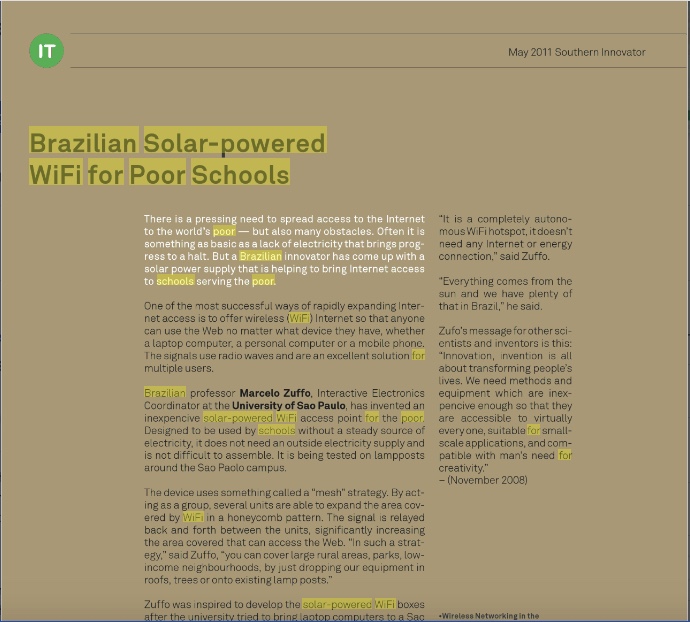
    There is a pressing need to spread access to the internet to the world’s poor — but also many obstacles. Often it is something as basic as a lack of electricity that brings progress to a halt. But a Brazilian innovator has come up with a solar power supply that is helping to bring internet access to schools serving the poor.

    Many initiatives are trying to bring inexpensive access to the internet to rural and remote regions around the world. Schools in poor areas are receiving laptop computers through schemes like the One Laptop Per Child project, but it is common that schools do not have a steady electricity supply to power the computers or the internet connection. One of the most successful ways of rapidly expanding access is to offer wireless (WiFi) internet so that anyone can use the Web, no matter what device they have, whether a laptop computer, a personal computer or a mobile phone. The signals use radio waves, and are an excellent solution for multiple users.

    Brazilian professor Marcelo Zuffo, Interactive Electronics Coordinator at the University of Sao Paulo, has invented a cheap solar-powered WiFi access point for the poor. Designed to be used by schools without a steady source of electricity, it doesn’t need outside electricity supply, and is not difficult to assemble. It is being tested on lampposts around the Sao Paolo campus.

    The device uses something called a ‘mesh’ strategy. By acting as a group, several units are able to expand the area covered by WiFi in a honeycomb pattern. The signal is relayed back and forth between the units, significantly increasing the area covered that can access the Web. “In such a strategy,” said Zuffo,”you can cover large rural areas, parks, low income neighbourhoods, by just dropping our equipment in roofs, trees or on to existing lamp posts.”

    Zuffo was inspired to develop the solar-powered WiFi boxes after the university tried to bring laptop computers to a Sao Paulo school, and found they didn’t have a steady electricity supply.

    “We came up with the idea of taking energy that is most plentiful and cheap, i.e. the sun,” he told the BBC. “We have a solar panel, a cheap motorcycle battery and a circuit that is responsible for energy management. We can have up to two days of full internet coverage and our goal is to increase that to 10 days – so that in the rainy season and the winter, you can have the internet for free.

    “The natural plan is to miniaturize the system so that we can save on costs. So by the end you can imagine these WiFi solar mesh devices being the size of a cellphone or playing card.”

    The low cost, solar-powered access point is ready as soon as it is unpacked and needs neither maintenance nor a power socket to get going.

    “It is a completely autonomous WiFi hotspot, it doesn’t need any internet or energy connection,” said Zuffo.

    “Everything comes from the sun and we have plenty of that in Brazil,” he said.

    The volunteer organization Green WiFi initiative is also developing solar powered technologies to bring ubiquitous internet access to the world’s poor.

    Zufo’s message for other scientists and inventors is this: “Innovation, invention is all about transforming people’s lives. We need methods and equipment which are cheap enough so that they are accessible to virtually every one, suitable for small scale applications, and compatible with man’s need for creativity.”

    The issue of inequality in access to the internet has stark consequences for global economic development. Already, according to the World Information Society Report 2007, “Europe has achieved the largest overall gain in digital opportunity over the last two years, followed by the Americas… Asia and Africa have witnessed smaller gains in digital opportunity. The implications for the digital divide are clear: digital opportunity is becoming more sharply divided by region, not less.”

    Published: November 2008

    Resources

    • Wireless Networking in the Developing World: A Practical Guide to Planning and Building Low-cost Telecommunications Infrastructure. Website:
    • World Information Society Report 2007: A progress report on pledges to bring digital opportunity to all. Website:
    • The Wireless Geographic Logging Engine: This is a website with maps tracking the presence of WiFi access around the globe. So far it maps over 10 million separate WiFi networks. Entrepreneurs only have to log into the website to start searching for wireless networks near them.
    • iTrike: The world’s first solar powered wireless internet rickshaw.
    • The KyaTera lab where the technology was developed. Website: http://kyatera.incubadora.fapesp.br/portal/research/laboratories/interactive-electronic-media

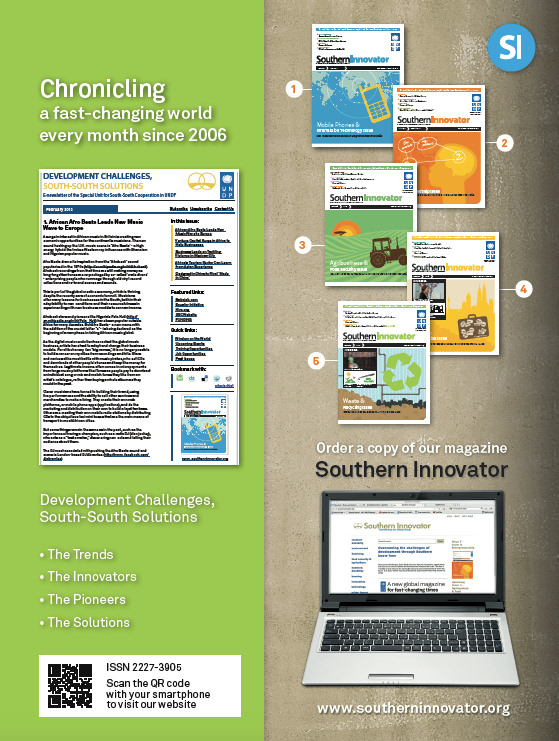
    Development Challenges, South-South Solutions was launched as an e-newsletter in 2006 by UNDP’s South-South Cooperation Unit (now the United Nations Office for South-South Cooperation) based in New York, USA. It led on profiling the rise of the global South as an economic powerhouse and was one of the first regular publications to champion the global South’s innovators, entrepreneurs, and pioneers. It tracked the key trends that are now so profoundly reshaping how development is seen and done. This includes the rapid take-up of mobile phones and information technology in the global South (as profiled in the first issue of magazine Southern Innovator), the move to becoming a majority urban world, a growing global innovator culture, and the plethora of solutions being developed in the global South to tackle its problems and improve living conditions and boost human development. The success of the e-newsletter led to the launch of the magazine Southern Innovator. 
    Creative Commons License

    This work is licensed under a
    Creative Commons Attribution-Noncommercial-No Derivative Works 3.0 License.

    ORCID iD: https://orcid.org/0000-0001-5311-1052.

    © David South Consulting 2023

  • Solar Power Bringing Light and Opportunity to the Poor

    Solar Power Bringing Light and Opportunity to the Poor

    By David SouthDevelopment Challenges, South-South Solutions

    SOUTH-SOUTH CASE STUDY

    Meeting the South’s energy needs will be crucial to achieving radical improvements in quality of life and human development. It is estimated that 1.7 billion people around the world lack electricity (World Bank), of whom more than 500 million live in sub-Saharan Africa.

    Africa’s greater global engagement and economic growth in the past few years has started to draw attention back to the continent’s dearth of reliable power sources and inadequate power infrastructure. With demand for electricity growing fast, it is people running small enterprises and organizations – especially in rural areas – who often get cut out.

    Being able to see at night unleashes a vast range of possibilities, but for the very poor, lighting is often the most expensive household expense, soaking up 10 to 15 percent of income.

    There’s a direct link between lighting and economic development. Each 1 per cent increase in available power will increase GDP by an estimated 2 to 3 per cent.

    A reliable power supply helps people to work longer, important for small businesses, and this increases the amount of wealth that can be created. Lit streets are safer at night, and lure people outside to do business and seek entertainment. It makes it easier for students to study into the night, and in consequence improve their grades.

    To take up this challenge, entrepreneurs are using different approaches across the South, to make solar power affordable and able to reach millions of poor people.

    Marrying new lighting technology such as compact fluorescent light bulbs (CFLs) and light emitting diodes (LEDs) with solar power generation, opens up the possibility to bring clean, portable, durable, low cost, high quality lighting to Africa’s poor. These new lighting systems also come with huge health and safety benefits, compared to gas alternatives.

    In Kenya, more than 80 percent of people lack access to the national grid and depend primarily on fossil fuels for their lighting needs, leading to respiratory diseases and environmental hazards associated with indoor air pollution.

    Kenyan solar entrepreneur Charles Rioba of Kodesha Mwangaza – Rent a Light is impressed by the interest in solar power solutions. An expert in renewable technologies with 15 years’ experience teaching in universities, he “realized that to reach the lower end of the market, one had to design an affordable solution.”

    “The biggest challenges faced are still affordability, and very little disposable income from the potential end users,” he said. “We are currently discussing with a number of micro institutions who have expressed interest on coming on board on rolling out the project.”

    Rioba’s business provides rental solar-charged Powerpacks designed to make electricity affordable for the majority of urban poor, rural households and slum dwellers. The rental system allows the consumer to rent a fully charged Powerpack from designated distributors in the neighbourhood, without having to invest in an off-grid power source, such as a solar panel. The project will set up 100 distribution agents and 10 service centers for the Powerpacks to reach approximately 8,000 households within 18 months. In addition the Powerpack will be used for mobile charging and powering radios, and hopes to create a new market concept for portable electrical energy distribution among the poor in Kenya.

    “My model targets to reach the lower end of the market,” Rioba said. “We are doing this by using existing businesses and groupings without creating new ones. We are also sourcing directly from the suppliers and we are working our project on numbers. In this way the margins are very low but aimed at achieving high usage hence return on investment.”

    Rioba has just been awarded funding by the World Bank’s Lighting Africa initiative, which aims to provide up to 250 million people in sub-Saharan Africa with access to non-fossil fuel based, low cost, safe, and reliable lighting products and associated basic energy services by the year 2030. It uses equipment that can weather long-term use in remote and difficult areas, trains people to service the equipment, and comes up with commercially viable business models to make all of this affordable to the rural poor.

    Rioba says that “for solar to be more attractive in Africa, there are a number of challenges. On the technology side, to make products which are both durable and affordable to the masses. Such new products such as LED lighting may ultimately reduce the size of the solar system and hence the cost.”

    In Laos, the rental mode is also proving effective. Only 48 percent of the country’s 5.7 million people have access to electricity, and most turn to firewood and kerosene for light and energy. Over 74 percent of people live on less than US $2 a day and could not afford to buy a solar-power system outright.

    The company Sunlabob rents solar-powered lanterns for prices beginning at 35,000 kip (US $3.80) per month, lower than the 36,000 to 60,000 kip (US $4.00 to US $6.60) per months households typically pay for kerosene fuel. After 10 hours’ use, the lanterns are recharged for a small fee from the village’s central solar-power collection facility. All fees go towards maintaining the central solar recharging station. The equipment is rented to a village-appointed Village Energy Committee, which sub-leases it to households at prices it sets. Rent covers all costs, including replacements and operational servicing costs. In the event of breakdowns, rent payments are suspended until repairs are made.

    Sunlabob has installed over 5,600 solar power systems since 2000 in over 450 villages and is also working in Cambodia and Indonesia.

    “Sunlabob really works well with local people,” says Bouathep Malaykham, head of the Lao Government Rural Electrification Program. “Because they are a private company they can make things happen quickly.”

    In Bangladesh, more than 230,000 households are now using solar power systems thanks to the government’s Infrastructure Development Company Ltd. (IDCOL), giving rise to opportunities for a whole new generation of entrepreneurs to make use of this new power supply for the poor. IDCOL is run by the Ministry of Finance, and is on course to install 1 million Solar Household Systems (SHS) using solar panels by 2012. The Bangladeshi government is hoping to bring electricity to all its citizens by 2020 – meaning this is now a prime time for entrepreneurs specializing in providing energy efficient products to the poor.

    The Executive Director of IDCOL, Ehsanl Haque, told a recent press conference: “SHS system, containing photo voltaic panels, battery, charge controller, solar lamp and switch, is a convenient mode for supply of power for small electrical loads such as lights, radio, cassette players and black and white TV.”

    It doesn’t provide electricity 24 hours a day, but Haque says even with a few hours of electricity available each day, the rural economy is being transformed. “Now they are using SHS for income-generating activities and working hours have been increased for small businessmen, weavers, tailors, hairdressers, and makers of handicraft items.”

    Among the many benefits of the electricity has been the ability to listen to radio and watch TV: an activity women reported made them feel safer at night.

    Published: September 2008

    Resources

    • Lighting Africa: this website run by the World Bank is a virtual business community and has forums, market intelligence, access to grants, network and partnership opportunities.
      Website: http://lightingafrica.org/index.cfm?Page=Home
    • D.light Design is dedicated to bringing modern lighting and power to over 1.6 billion people globally currently living without electricity. They aim to be the number one player in off-grid lighting and power solutions worldwide.
      Website: http://www.dlightdesign.com/
    • Solar Power Answers is a one-stop-shop for everything to do with solar power. It has a design manual and guides to the complex world of solar power equipment.
      Website: http://www.solar-power-answers.co.uk/index.php

    Development Challenges, South-South Solutions was launched as an e-newsletter in 2006 by UNDP’s South-South Cooperation Unit (now the United Nations Office for South-South Cooperation) based in New York, USA. It led on profiling the rise of the global South as an economic powerhouse and was one of the first regular publications to champion the global South’s innovators, entrepreneurs, and pioneers. It tracked the key trends that are now so profoundly reshaping how development is seen and done. This includes the rapid take-up of mobile phones and information technology in the global South (as profiled in the first issue of magazine Southern Innovator), the move to becoming a majority urban world, a growing global innovator culture, and the plethora of solutions being developed in the global South to tackle its problems and improve living conditions and boost human development. The success of the e-newsletter led to the launch of the magazine Southern Innovator. 
    Creative Commons License

    This work is licensed under a
    Creative Commons Attribution-Noncommercial-No Derivative Works 3.0 License.

    ORCID iD: https://orcid.org/0000-0001-5311-1052.

    © David South Consulting 2022

  • Iranian Savings Funds to Tackle Loan Drought

    Iranian Savings Funds to Tackle Loan Drought

    By David SouthDevelopment Challenges, South-South Solutions

    SOUTH-SOUTH CASE STUDY

    For entrepreneurs around the world, acquiring finance to start or expand a small business has become harder and harder as the global financial crisis has bitten hard. Across the globe, people with good ideas or successful businesses that need funds to expand are finding the door closed by traditional banks.

    As banks and governments have focused on reducing debt and building up cash reserves, it is small businesses and small-scale entrepreneurs – often without business or family connections – who suffer the most. Opportunities are being missed to create new jobs and enterprises and lift poor communities out of poverty.

    In that climate, the search is on for alternative ways to build up wealth. In Iran, a new phenomenon has arisen to address the lack of bank loans for small businesses brought about by the economic crisis. Iran is suffering under international sanctions as well as outstanding bank loans exceeding US $45 billion, according to the Financial Times.

    The domestic banking crisis this has provoked has resulted in a tightening of credit for loans.

    But in response, middle class Iranians are forming their own savings clubs to help each other with loans.

    The savings clubs work like this: each member buys a share in the club costing around US $2 per day (around US $620 over 10 months). Each share makes the saver eligible for one loan during the year. For example in a club of 30 Tehran taxi drivers, every month four members of the club receive US $600 each in loans. The fund lasts 10 months and each member is guaranteed one loan per share.

    “It is a savings fund and doesn’t have the uncertainty of the banking system, which might or might not give you a loan,” club member Ahmad told the Financial Times newspaper. As one of the drivers, he has four shares and is eligible for four loans.

    “My mother is also saving money in a fund of housewives among our female relatives.”

    The fund is managed by the head of the taxi agency and a driver who is a retired teacher. Both are trusted. “The retired teacher receives the money every day and puts a check mark by the names of those who pay. He is trusted by the head of the taxi agency, while other drivers respect him as an educated, honest man.”

    Savings clubs are also good for the local economy, helping people to be able to buy goods on loans they would never be able to purchase otherwise. Another driver used the fund to “buy the things we cannot afford under normal conditions, like a washing machine, for instance, for which we have zero chance to get bank loans.”

    Overdue loans by Iran’s banks grew by 66 percent from last year according to Asghar Abolhassani, the deputy economy minister.

    The Financial Times reported that an estimated 25 percent of bank loans are outstanding, making Iran’s banking system technically bankrupt. International sanctions are also blocking the country’s banks from accessing global financial markets for support.

    “Stagnation has gripped many parts of the economy,” said Hamid Tehranfar, the central bank’s director-general for banking supervision.

    Turning to savings clubs can be an excellent alternative saving and loans model, but it requires very specific trust guarantees in place to ensure the holder of the funds doesn’t just take the money. For those who can’t find somebody local they trust, there are a number of online social lending and fundraising alternatives for raising funds and borrowing money. These include Kiva (www.kiva.org), which connects poor people looking for loans with people around the world willing to lend.

    As the crisis continues and banks and governments hoard wealth for their own needs to pay down debt, alternative sources of loans will become ever more important for the poor.

    Published: April 2010

    Resources

    1) Zopa: “Where people meet to lend and borrow money.” Website: www.zopa.com

    2) Kiva: Kiva’s mission is to connect people, through lending, for the sake of alleviating poverty. Website: www.kiva.org

    3) Betterplace: Started in 2007, Betterplace is an online marketplace for projects to raise funds. It is free, and it passes on 100 percent of the money raised on the platform to the projects. Website: www.betterplace.org

    4) Kickstarter: Kickstarter is a funding platform for artists, designers, filmmakers, musicians, journalists, inventors, and explorers. Website: http://www.kickstarter.com/

    Development Challenges, South-South Solutions was launched as an e-newsletter in 2006 by UNDP’s South-South Cooperation Unit (now the United Nations Office for South-South Cooperation) based in New York, USA. It led on profiling the rise of the global South as an economic powerhouse and was one of the first regular publications to champion the global South’s innovators, entrepreneurs, and pioneers. It tracked the key trends that are now so profoundly reshaping how development is seen and done. This includes the rapid take-up of mobile phones and information technology in the global South (as profiled in the first issue of magazine Southern Innovator), the move to becoming a majority urban world, a growing global innovator culture, and the plethora of solutions being developed in the global South to tackle its problems and improve living conditions and boost human development. The success of the e-newsletter led to the launch of the magazine Southern Innovator. 
    Creative Commons License

    This work is licensed under a
    Creative Commons Attribution-Noncommercial-No Derivative Works 3.0 License.

    ORCID iD: https://orcid.org/0000-0001-5311-1052.

    © David South Consulting 2023

  • Latin American Food Renaissance Excites Diners

    Latin American Food Renaissance Excites Diners

    By David SouthDevelopment Challenges, South-South Solutions

    SOUTH-SOUTH CASE STUDY

    Food is essential for a good life and plays a critical part in overall human health and development. The better the quality of food available to the population, the better each individual’s overall health will be, and this will have a direct impact on mental and physical performance (http://www.sciencedirect.com/science/article/pii/S2213453012000055).

    An innovative restaurant can be the beginning of a taste and flavors renaissance as new foods are discovered and the recipes and foods are cross-marketed. It is an effective strategy that has worked around the world. The restaurant’s brand, in turn, becomes a valuable commodity that can be used to promote a range of products. For example, Brazil’s D.O.M. Restaurante has successfully used its strong reputation to help promote a range of food products drawn from the Amazon rainforest. There is money to be made in this and it can be a major boost to the incomes of food producers, especially small-scale farmers.

    As is being found across South America, a rediscovered love of local cuisines and indigenous culinary culture can also lead to profits and a growing global awareness of the continent’s varied foods and recipes.

    Innovators are playing with traditional cooking and locally available foods to come up with a modern Latin American cuisine that is getting people very excited.

    The latest country to benefit from this is Peru. The first Michelin star awarded to a Peruvian restaurant in Europe went to a restaurant in London, UK. The Michelin (http://travel.michelin.co.uk/michelin-guides-105-c.asp) star is awarded to a restaurant based on the quality of its food and its overall atmosphere and service.

    The London restaurant Lima (limalondon.com) is part of the global rise in awareness of Latin American food. It was launched by Venezuelan brothers Gabriel and Jose Luis Gonzalez in partnership with Peruvian chef Virgilio Martinez. Their signature dishes include sea bream ceviche (a lime-preserved raw fish dish) and suckling pig done in the “Andes” style.

    Martinez is also a chef consultant for the Central Restaurante (http://centralrestaurante.com.pe/es/) in Lima, Peru. It was named one of The World’s 50 Best Restaurants by S. Pellegrino (theworlds50best.com).

    Gabriel Gonzalez moved to London from Paris two years ago, and is surprised at how quickly he and his colleagues have made an impact.

    “It was definitely not expected. … It’s just incredible, it definitely sets a precedent for Peruvian food and gives it a stamp of credibility and a lot of promise, it’s just amazing,” he told the London Evening Standard.

    As another mark of the rising profile of Latin American food, the first edition of Latin America’s 50 Best Restaurants was held in Lima in September 2013 (theworlds50best.com/latinamerica/en/). In its press release, it said: “The evolution and robustness of gastronomy in Latin America has demanded recognition.”

    It comes after the first expansion of the awards to Asia with Asia’s 50 Best Restaurants, held in Singapore in February 2013.

    The ceremony in Peru is being seen as another vote of confidence in Peru’s innovative restaurant scene. Other acknowledgements of the country’s culinary success include winning in 2012 the World’s Best Culinary Destination by the World Travel Awards. The Organization of American States (OAS) also declared Peru’s cuisine part of America’s World Heritage (oas.org).

    The number of South American restaurants on the The World’s 50 Best Restaurants list increased to six in 2013, two more than in 2012. This year’s winners include the innovative Brazilian restaurant D.O.M  in Sao Paulo, and Astrid y Gaston (http://astridygaston.com/en/) in Lima.

    D.O.M. Restaurante’s (http://domrestaurante.com.br/pt-br/home.html) chef Alex Atala is a passionate champion of Brazil’s traditional ingredients and dishes. He trawls the Amazon rainforest for new taste sensations and then deploys them in his inventive dishes in the restaurant. D.O.M. was named the best restaurant in South America for four years in a row by The World’s 50 Best Restaurants.

    At Astrid y Gaston in Lima, an innovative take on menus shows how the restaurant stands out from the rest. The restaurant uses storytelling techniques to build up interest in its various menus. One example is the Winter 2013 Tasting Menu with its title El Viaje, meaning trip or journey. “It is a story told through a long sequence of courses divided into five acts, a mise en scène where we attempt to take the life experiences of a restaurant beyond its traditional gastronomic limits,” the restaurant says on its website.

    “During each of the five acts, the dishes, the music, the clothing, the decoration, the tableware and the book that accompanies this experience, will narrate the turning points that define this life journey”

    Astrid y Gaston is a partnership between a German and a Peruvian who set out to challenge the dominance of French haute cuisine and started the restaurant in 1994.

    “Twenty years later, much has happened with Peru and Peruvian cuisine. Unlike those times when inspiration was sought in foreign ingredients and recipes, when cooks locked themselves up in their kitchens and lived with suspicion of their peers, ignoring the farmers’ work and the social and ecological challenges of the environment, today’s cooking is fortunately getting a breath of fresh and beautiful air.”

    Another cuisine pioneer is Pujol (pujol.com.mx) in Mexico City, Mexico. It serves Mexican cuisine focused on local ingredients blending ancient and modern culinary techniques. The food is original and exciting: for starters, there is baby corn and chicatana ant, aguachile with chia seeds and avocado, suckling lamb taco, and for desert, fermented plantain, macadamia nuts, plantain vinegar and chamomile flower petals.

    The potential is enormous for marrying these restaurant innovators with the many small-scale farmers and food producers to boost awareness of their products and increase incomes across South and Central America.

    Published: November 2013

    Resources

    1) Latin American food pyramid: A guide to eating a healthy diet using common foods from Latin America. Website: http://www.foodpyramid.com/food-pyramids/latin-american-pyramid/

    2) Visit Peru: Peru Tourism Bureau: Includes extensive information on Peruvian food and cuisine. Website: http://visitperu.com/

    3) How functional foods play critical roles in human health by Guangchang Pang, Junbo Xie, Qingsen Chen and Zhihe Hu. Website: http://www.sciencedirect.com/science/article/pii/S2213453012000055

    Southern Innovator Issue 3: Agribusiness and Food Security: Website: http://books.google.com.au/books?id=-Y6Gnqx9PIcC&source=gbs_similarbooks_r&cad=2

    Development Challenges, South-South Solutions was launched as an e-newsletter in 2006 by UNDP’s South-South Cooperation Unit (now the United Nations Office for South-South Cooperation) based in New York, USA. It led on profiling the rise of the global South as an economic powerhouse and was one of the first regular publications to champion the global South’s innovators, entrepreneurs, and pioneers. It tracked the key trends that are now so profoundly reshaping how development is seen and done. This includes the rapid take-up of mobile phones and information technology in the global South (as profiled in the first issue of magazine Southern Innovator), the move to becoming a majority urban world, a growing global innovator culture, and the plethora of solutions being developed in the global South to tackle its problems and improve living conditions and boost human development. The success of the e-newsletter led to the launch of the magazine Southern Innovator. 

    Creative Commons License

    This work is licensed under a
    Creative Commons Attribution-Noncommercial-No Derivative Works 3.0 License.

    ORCID iD: https://orcid.org/0000-0001-5311-1052.

    © David South Consulting 2023