Tag: United Nations

  • Arab World Domain Name Opportunity Huge Economic Help

    Arab World Domain Name Opportunity Huge Economic Help

    By David SouthDevelopment Challenges, South-South Solutions

    SOUTH-SOUTH CASE STUDY

    With the so-called Arab Spring still unfolding across much of the Arabic-speaking world, it is easy to miss a rising new economic opportunity: The introduction of an Arabic domain name system for the Internet.

    The explosion in mobile phones in the Arab world has dramatically increased the number of people who can now access the Internet. One Arabic financial website put the number of people who can now access the Internet in one way or another in the Arab world as 75 million (www.nuqudy.com). As highlighted in the 2003 Arab Human Development Report (AHDR), Arabic-speaking countries have been at a knowledge disadvantage for some time: more than 270 million citizens have access to fewer books than other languages, slower growth economies, and greater illiteracy than the faster-growing emerging economies. At the time, the AHDR found there were just 18 computers per 1,000 people compared to a global average of 78. And just 1.6 percent of Arabs had Internet access, one of the lowest ratios in the world (AHDR 2003).

    Since the dawn of the Internet, Latin script has been used exclusively for top-level web domain names, the addresses that end .com, .org and so on. That has been a big obstacle for users of non-Latin script languages like Arabic. It is estimated just 10 percent of people in the Arab world speak English. Many of the resources on the Internet and its utility have been lost to these people. But by using Arabic domain names, there will be a consistency and no more guesswork.

    A typical problem in Latin transliterations of Arabic is the conundrum as to either using El or Al as the prefix to a word. This problem is eliminated when Arabic is used.

    The Arab world is also very mixed, including the resource-rich, cash-rich Gulf States – Kuwait, Qatar, United Arab Emirates, Saudi Arabia, Oman and Bahrain – and states with high rates of poverty such as Egypt, Djibouti and Yemen.

    The protests and uprisings this year in Tunisia, Egypt and elsewhere – with their Facebook pages and Twitter streams – have shown that a growing group of highly Internet-savvy young people is emerging in the Arab world. But for many without the education or the resources, access to knowledge still remains weak. But armed with Internet-capable mobile phones and Arabic language domain names, rapid change is now possible.

    The number of books published in Arabic is notoriously relatively low, and print runs are small. Arabic language books make up just 1.1 percent of world production.

    The AHDR reports have called this knowledge deficit a direct obstacle to human development in Arab countries.

    But things are changing and the rise of Arabic domain names offers the potential for an explosion in Arabic language Internet content.

    In May 2010 ICANN, the world’s Internet domain authority, decided to allow top-level domains in non-Latin script. For Arabic speakers, it started this program in Egypt, Saudi Arabia and the United Arab Emirates.

    As a sign of the importance of Arabic participation in future growth of the Internet, this year’s World Summit for the Information Society (WSIS) held in Geneva, Switzerland in May 2011 was sponsored by the United Arab Emirates (UAE).

    A catchy domain name has many advantages. For Arabic speakers, this means they can type in Arabic domain names for websites and even do it right to left, as they do in print.

    In 2009, the first Arabic domain name was grabbed by Egypt. As the Internet naming authority, the Internet Corporation for Assigned Names and Numbers (ICANN) (www.icann.org), started to allow the registering of non-Latin script names. The domain was for the Arabic word for Egypt or “.masr”.

    As an early adopter, Egypt sees it as an important part of bringing more Arabic speakers online. George Victor, from the Egyptian National Telecom Regulatory Authority, told the BBC: “We believe that this is a great step that will open new horizons for many e-services in Egypt, and it will have its direct impact, enlarging the number of online users.”

    Victor believes using Arabic builds trust.

    “Having a domain name in your own language is a point of having a local identity,” he said.

    “When talking about Arabic domain names, we are talking about having users which are not online now. People with languages disabilities – people who are having language as a barrier to connect online.”

    From now on Internet address names will be able to end with almost any word in any language, offering organizations around the world the opportunity to market their brand, products, community or cause in new and innovative ways.

    The advantages of registering an Arabic domain name are numerous. They include clear improvements to business and trade: an ability to protect a trademark, better communication with Arabic customers, better Arabic-language advertising opportunities, better memorability for Arabic domain names because they will be in the Arabic language, and greater access to Arabic customers.

    But there are also significant improvements to how the Internet functions in the Arabic world. Search results on Arabic search engines will be more precise with Arabic domain names; catchy, memorable domain names will be a spur to the advertising and marketing industries; and a more Arab-friendly Internet will draw in more Arabic-speaking Internet users, helping them to enjoy the fruits of this great technological advance just as speakers of other languages have.

    In March 2011, the Gulf state of Qatar enthusiastically started to offer Arabic domain names.

    “The launch of Qatar’s Arabic top-level domain names is a major milestone as we work to build a more digitally inclusive society,” said Dr. Hessa Al Jaber, Secretary General of the Supreme Council of Information and Communication Technology, which will manage Qatar’s Internet domain names through the Qatar Domains Registry.

    “As more organizations and individuals begin adopting Arabic domain names, the Internet will literally be opened up to broad new audiences. The Arab world represents a region with enormous potential for growth both in terms of usage and the creation of new digital content, especially Arabic content.”

    ICANN’s President and Chief Executive, Rod Beckstrom, sees this as a new phase for the Internet: “ICANN has opened the Internet’s naming system to unleash the global human imagination. Today’s decision respects the rights of groups to create new Top Level Domains in any language or script. We hope this allows the domain system to better serve all of mankind.”

    Published: July 2011

    Resources

    1) Watch the ICANN educational video “Get Ready for the Next Big Thing”, explaining how domain names work and what the changes mean. Website: http://www.icann.org

    https://davidsouthconsulting.org/2022/10/26/africa-to-get-own-internet-domain/

    https://davidsouthconsulting.org/2022/11/11/berber-hip-hop-helps-re-ignite-culture-and-economy/

    https://davidsouthconsulting.org/2020/12/04/data-surge-across-global-south-promises-to-re-shape-the-internet/

    https://davidsouthconsulting.org/2022/02/11/egyptian-youth-turns-plastic-waste-into-fuel/

    https://davidsouthconsulting.org/2022/11/11/innovation-cairos-green-technology-pioneers/

    https://davidsouthconsulting.org/2022/10/29/new-apps-make-driving-and-travelling-in-egypt-easier-safer/

    https://davidsouthconsulting.org/2022/10/21/preserving-beekeeping-livelihoods-in-morocco/

    https://davidsouthconsulting.org/2022/10/21/social-networking-websites-a-way-out-of-poverty/

    Development Challenges, South-South Solutions was launched as an e-newsletter in 2006 by UNDP’s South-South Cooperation Unit (now the United Nations Office for South-South Cooperation) based in New York, USA. It led on profiling the rise of the global South as an economic powerhouse and was one of the first regular publications to champion the global South’s innovators, entrepreneurs, and pioneers. It tracked the key trends that are now so profoundly reshaping how development is seen and done. This includes the rapid take-up of mobile phones and information technology in the global South (as profiled in the first issue of magazine Southern Innovator), the move to becoming a majority urban world, a growing global innovator culture, and the plethora of solutions being developed in the global South to tackle its problems and improve living conditions and boost human development. The success of the e-newsletter led to the launch of the magazine Southern Innovator. 

    Creative Commons License

    This work is licensed under a
    Creative Commons Attribution-Noncommercial-No Derivative Works 3.0 License.

    ORCID iD: https://orcid.org/0000-0001-5311-1052.

    © David South Consulting 2023

  • Perfume of Peace Helps Farmers Switch From Drug Trade

    Perfume of Peace Helps Farmers Switch From Drug Trade

    By David SouthDevelopment Challenges, South-South Solutions

    SOUTH-SOUTH CASE STUDY

    A tragedy in a time of war has led to a social enterprise that is creating jobs – and making the world smell a little better, too.

    The 7 Virtues perfume range was started by Canadian Barb Stegemann (http://www.barbstegemann.com/barb-stegemann-in-the-news.html) to harness the energy of social enterprise and women’s buying power to change the dynamic of war and misery created by conflict around the world.

    Stegemann ran a successful public relations company when she was inspired to do something after tragedy struck a good friend who was serving in Afghanistan with the Canadian Armed Forces as part of the NATO mission (http://www.isaf.nato.int/). Hit on the head with an axe while involved in a village meeting, Captain Trevor Greene was thought to be fatally injured but survived, though he is still unable to walk.

    The violent attack shocked Stegemann into action. The enterprise was founded not out of hatred and revenge, but as a way of addressing the serious economic problems and poverty of Afghanistan.

    Wanting to do something, Stegemann was referred to the Turquoise Mountain Foundation (turquoisemountain.org), which is based in Afghanistan’s capital, Kabul. The Turquoise Mountain Foundation is a social enterprise working in Afghanistan to regenerate the country’s traditional arts and historic areas in order to create jobs and boost skills.

    Stegemann was inspired by a farmer called Abdullah Arsala from Jalalabad in the eastern part of the country. He was growing the ingredients for making essential oils, rather than the much more lucrative opium poppies which are used to make the drug heroin and help fuel a vast global illegal drug trade. Heroin addiction ruins many lives around the world and often leads to crime and violence.

    The Turquoise Mountain Foundation did a study and found that if farmers could be paid US $9,912 for a litre of rose oil or US $7,994 for orange blossom oil it would be enough of a market incentive to lure them away from growing opium poppies.

    Stegemann decided to provide that incentive.

    Using her life savings, she established a perfume company. To start, Stegemann bought Arsala’s entire stock of orange blossom oil. After getting further investment through the Canadian television program Dragons’ Den – on which entrepreneurs compete for funding – she launched the company with two perfumes: Orange Blossom of Afghanistan and Noble Rose of Afghanistan.

    With the whole collection rebranded as The 7 Virtues (http://www.the7virtues.com/), the Afghanistan Orange Blossom went on sale at the prestigious Selfridges department store in London, U.K.

    Using Arsala as a go-between, 2,500 farmers in Afghanistan are now supplying essential oils for the perfumes.

    To further expand the concept, Stegemann has launched Middle East Peace (http://www.the7virtues.com/middle_east_peace.php), a perfume made from sweetie grapefruit oil from Israel with lime and basil oils from Iran.

    In Haiti, a country still recovering from the 2010 earthquake disaster and decades of grinding poverty and political and economic chaos, she has created a scent for men using fragrant grass.

    She hopes to also do the same for Rwanda and Syria.

    The perfumes are all-natural and are put together in Toronto, Canada. They are sold in stores in Canada and the United States, as well as Selfridges in London.

    The success has snowballed and a special gift pack has been put together for American Airlines.

    “I never imagined I’d end up on a beauty counter, but this is where the women are and we must connect with them if we are going to reverse this cycle of war and poverty,” Stegemann told The Sunday Times. “Imagine if there were 300 women like me doing things like this. We could make a real difference.”

    Published: November 2013

    Resources

    1) Centre for International Policy Studies: University of Ottawa: A focal point for scholarship and debate on international affairs in Canada. Website: http://cips.uottawa.ca/

    2) Post-war Reconstruction and Development Unit: The PRDU is an international centre of excellence for the study of post-conflict societies and their recovery. Website: http://www.york.ac.uk/politics/centres/prdu/

    3) Peacebuilding and post-conflict recovery: The experience of recent years has also led the United Nations to focus as never before on peacebuilding – efforts to reduce a country’s risk of lapsing or relapsing into conflict by strengthening national capacities for conflict management, and to lay the foundations for sustainable peace and development. Website: http://www.un.org/en/ecosoc/about/peacebuilding.shtml

    United Nations Office on Drugs and Crime: UNODC is a global leader in the fight against illicit drugs and international crime. UNODC is mandated to assist Member States in their struggle against illicit drugs, crime and terrorism. Website: http://www.unodc.org

    Development Challenges, South-South Solutions was launched as an e-newsletter in 2006 by UNDP’s South-South Cooperation Unit (now the United Nations Office for South-South Cooperation) based in New York, USA. It led on profiling the rise of the global South as an economic powerhouse and was one of the first regular publications to champion the global South’s innovators, entrepreneurs, and pioneers. It tracked the key trends that are now so profoundly reshaping how development is seen and done. This includes the rapid take-up of mobile phones and information technology in the global South (as profiled in the first issue of magazine Southern Innovator), the move to becoming a majority urban world, a growing global innovator culture, and the plethora of solutions being developed in the global South to tackle its problems and improve living conditions and boost human development. The success of the e-newsletter led to the launch of the magazine Southern Innovator. 
    Creative Commons License

    This work is licensed under a
    Creative Commons Attribution-Noncommercial-No Derivative Works 3.0 License.

    ORCID iD: https://orcid.org/0000-0001-5311-1052.

    © David South Consulting 2022

  • Shopping and Flying in Africa’s Boom Towns

    Shopping and Flying in Africa’s Boom Towns

    By David SouthDevelopment Challenges, South-South Solutions

    SOUTH-SOUTH CASE STUDY

    As economies across Africa grow, the continent still has a long way to go to create infrastructure to match people’s rising expectations of what a modern, prosperous life looks like.

    Africa’s current economic growth has mainly been driven by commodities and oil and gas exports. Critics say this boom has failed to bring tangible benefits to many of Africa’s poor, who feel left out of the prosperity.

    Trade has been flourishing not only because of exports to traditional markets in Europe and North America but also because of explosive growth in trade and investment between China and Africa.

    Two trends now underway are set to transform people’s wealth and living standards despite the many obstacles caused by the inequalities of current economic growth. The first is the rise and rise of retail shopping options

    looking to meet a strong appetite for consumer goods. And the second is the expansion of flying options on a continent notorious for its poor air links. Increasing investment in retail and flight networks will be a source of jobs, careers and wealth for the coming decade.

    The aviation sector supports 6.7 million jobs on the continent, according to TradeMark Southern Africa (http://www.trademarksa.org), and makes a US $67.8 billion contribution to Africa’s gross domestic product (GDP).

    But the woeful state of Africa’s air networks means that it is often cheaper for people to fly to other parts of Africa via European airports. And Africa has a long way to go to match air safety standards found elsewhere: there was one accident for every 305,000 flights involving Western-built jets in Africa last year (IATA) – nine times the global average.

    But Africa is now receiving the attention of the global airline industry. The Abuja Declaration (http://nigerianaviationnews.blogspot.co.uk/2012/07/aviation-safety-in-africa-abuja.html) aims to bring the African accident rate in line with the global average by 2015. And it is hoped the added competition and introduction of more global players will also raise standards and make flying in Africa safer, more convenient and cheaper.

    The experience of Europe and North America shows that increased air traffic brings a boost to economic growth.

    With more frequent, safer and more reliable air routes, business people will be able to move around and strike deals, tourists can get around and traders can cross borders without the hassle of navigating poor road networks.

    Airlines are lining up to compete on improving air links in Africa to capitalize on rising incomes and economic dynamism.

    The competition to serve the air passengers has heated up with the announcement of numerous new airlines, as well as well-established global carriers making plans to expand routes across Africa. Kenya Airways (http://www.kenya-airways.com/) has pledged to reach all of Africa’s countries by 2017 while also launching its own budget airline called Jambo Jet (http://www.ventures-africa.com/2012/06/kenya-airways-tolaunch-low-cost-airline-as-it-prepares-for-competition/).

    State-owned South African Airways (SAA) (http://www.flysaa.com/gb/en/) is also starting to expand its network to include every capital city in Africa. SAA will start by adding flights to Ivory Coast and the Democratic Republic of Congo, making it able to serve 26 African destinations. In the short term, it is doing this by halting flights between Cape Town and London, leaving that route to Virgin Atlantic and British Airways.

    Operating out of bases in Kenya, Tanzania, Ghana and Angola, a new African discount airline, FastJet (http://www.fastjet.com/) – with EasyJet (http://www.easyjet.com/en) founder Stelios Haji-Ioannou as its backer – is taking over Fly540 (http://www.fly540.com/) and adding 15 leased Airbus aircraft. It will launch flights to Ghana, Kenya, Tanzania and Angola. According to Kenya’s Nation newspaper, the plan is to replicate the success of EasyJet connecting Europe and North Africa with cheap flights in sub-Saharan Africa.

    Analysts believe the entry of an aggressive and experienced player like Haji-Ioannou will shake up competition within African aviation.

    Other global players lining up to expand in Africa include Emirates, Etihad, Qatar Airways, Turkish Airlines and Korea Air, which has already started flying between South Korea and Kenya’s capital, Nairobi. This is being seen as a boost to the trade in electronics goods between the two countries.

    The added excitement in the African air industry has also prompted Air Uganda (http://www.air-uganda.com/) and RwandaAir (http://www.rwandair.com/) to increase their destinations. Qatar Airways (http://www.qatarairways.com/uk/en/homepage.page) will start flying in November 2012 to Maputo, Mozambique three times a week, increasing to 20 the number of destinations the airline serves, according to the Nation.

    And while Emirates has a 41 per cent share of the African market, African player Ethiopian Airlines (http://www.flyethiopian.com/en/default.aspx) ambitiously wants to become Africa’s largest airline by 2025.

    For shoppers, West Africa is experiencing a boom in new retail spaces being developed, according to a report from Euromonitor International (http://www.euromonitor.com) (http://www.howwemadeitinafrica.com/ghana-%E2%80%93-africas-new-retail-hotspot/18544/). The advantages of creating and developing modern retail spaces are numerous: hygienic shopping environments with greater safety and security attract multinational and global brands, which tend to create lots of long-term jobs.

    Euromonitor International has identified Ghana as the next hotspot for retailers. The country is seen to have the right business environment in place that is attractive to foreign investors. It also has the right mix of political stability, cultural tolerance and rising prosperity.

    The country is now being seen as the gateway to West Africa’s market of 250 million consumers. Ghana is able to leverage its position as a gateway into landlocked nations and on its strong ties with English-speaking powerhouses like Britain and the United States.

    On top of these strategic advantages, the country has focused on upgrading retail spaces in the capital, Accra. The Accra Mall (http://www.accramall.com/), opened in 2007, is considered the most modern shopping mall in Ghana.

    Euromonitor found Ghana’s retail industry grew by 14 per cent between 2006 and 2011.

    Euromonitor found companies like multinational Unilever and PZ Cussons believed basing their operations in Ghana was a big advantage.

    “The presence of such manufacturers provides a good opportunity for retailers as they can source these manufacturers’ products cheaper locally rather than importing them,” it said.

    Euromonitor identified three other African countries as potential retail marketplaces. This includes Zambia, a potential agribusiness powerhouse. It is already developing a strong reputation in beef through its Zambeef (http://www.zambeefplc.com/) operation. South African companies have done well in Zambia, including Shoprite, Pick n Pay, Mr Price and the Foschini Group. Much of the action is around the capital, Lusaka.

    Rwanda is known for its ease of doing business and there is activity going on in residential areas, roads, hotels, offices and retail spaces. The capital, Kigali, has a new modern, shopping mall, The Union Trade Centre, with a 24-hour store.

    Angola has been benefiting from peace since the end of its civil war in 2002. Foreign companies have been attracted to Angola from South Africa, Portugal and Brazil. The Belas Shopping Mall (http://belasshopping.com/website/) opened in 2007 in the capital, Luanda, followed by the Ginga Shopping Mall on the city’s outskirts in 2011.

    Published: August 2012

    Resources

    1) How we made it in Africa: A great website packed with inspirational people and stories on business success in Africa. Website: http://www.howwemadeitinafrica.com/

    Development Challenges, South-South Solutions was launched as an e-newsletter in 2006 by UNDP’s South-South Cooperation Unit (now the United Nations Office for South-South Cooperation) based in New York, USA. It led on profiling the rise of the global South as an economic powerhouse and was one of the first regular publications to champion the global South’s innovators, entrepreneurs, and pioneers. It tracked the key trends that are now so profoundly reshaping how development is seen and done. This includes the rapid take-up of mobile phones and information technology in the global South (as profiled in the first issue of magazine Southern Innovator), the move to becoming a majority urban world, a growing global innovator culture, and the plethora of solutions being developed in the global South to tackle its problems and improve living conditions and boost human development. The success of the e-newsletter led to the launch of the magazine Southern Innovator. 

    Creative Commons License

    This work is licensed under a
    Creative Commons Attribution-Noncommercial-No Derivative Works 3.0 License.

    ORCID iD: https://orcid.org/0000-0001-5311-1052.

    © David South Consulting 2023

  • Making Bamboo Houses Easier to Build

    Making Bamboo Houses Easier to Build

    By David SouthDevelopment Challenges, South-South Solutions

    SOUTH-SOUTH CASE STUDY

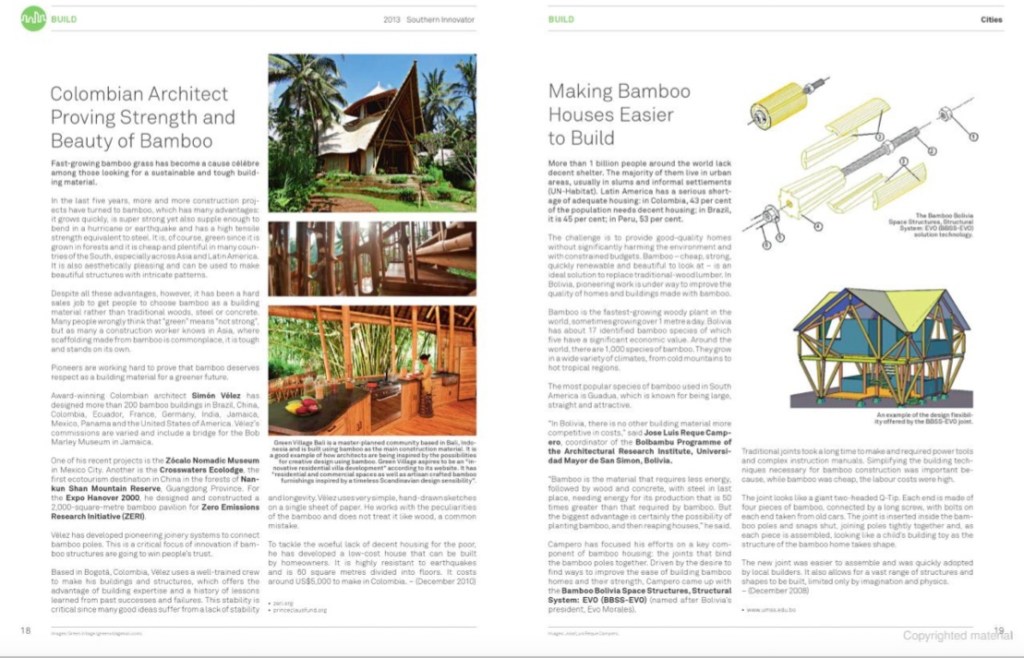
    More than 1 billion people around the world lack decent shelter. Of these, the majority live in urban areas, usually in slums and informal settlements (UN-HABITAT). Latin America has a serious shortage of adequate housing: in Colombia, 43 percent of the population needs decent housing; in Brazil, 45 percent; Peru, 53 percent.

    The challenge is to provide good quality homes without significantly harming the environment – and with constrained budgets. Bamboo – cheap, strong, quickly renewable and beautiful to look at (http://en.wikipedia.org/wiki/Bamboo) – is an ideal solution to replace traditional wood lumber. In Bolivia, pioneering work is underway to improve the quality of homes and buildings made with bamboo.

    Bamboo is the fastest growing woody plant in the world, sometimes growing over 1 metre a day. Bolivia (http://en.wikipedia.org/wiki/Bolivia) has about 17 identified bamboo species, of which five have a significant economic value. Around the world, there are 1,000 species of bamboo. They grow in a wide variety of climates, from cold mountains to hot tropical regions.

    Once called the “poor man’s timber” – a temporary building material to replace once there is more money – bamboo is now getting the respect it deserves. Bamboo for housing has a long history in Latin America, stretching back 4,500 years to ancient civilizations. In Asia, it has long been a traditional construction material. But most of the existing bamboo dwellings in Latin America are 50 to 100 years old.

    The most popular species of bamboo used in South America is Guadua, which is known for being large, straight and attractive.

    “In Bolivia, there is no other building material more competitive in costs,” said Jose Luis Reque Campero, coordinator of the Bolbambu Programme of the Architectural Research Institute, Universidad Mayor de San Simon, Bolivia (http://www.umss.edu.bo/).

    “Bamboo is the material that requires less energy, followed by wood and concrete, with steel in last place, needing energy necessary for its production 50 times greater than that required by bamboo.”

    Campero also says bamboo is much less expensive than traditional building materials.

    “But the biggest advantage is certainly the possibility of planting bamboo, and then reaping houses,” he said.

    Campero has focused his efforts on a key component of bamboo housing: the joints that bind the bamboo poles together. Driven by the desire to find ways to improve the ease of building bamboo homes and their strength, Campero came up with the Bamboo Bolivia Space Structures, Structural System: EVO (BBSS-EVO) (named after Bolivia’s president, Evo Morales – http://en.wikipedia.org/wiki/Evo_Morales).

    Traditional joints took a long time to make and required power tools and complex instruction manuals. Simplifying the building techniques necessary for bamboo construction was important because, while bamboo was cheap, the labour costs were high.

    The joint looks like a giant two-headed Q-Tip. Each end is made of four pieces of bamboo, connected by a long screw with bolts on each end taken from old cars. The joint is inserted inside the bamboo poles and snaps shut, joining poles tightly together and, as each piece is assembled, looking like a child’s building toy as the structure of the bamboo home takes shape.

    The new joint was easier to assemble and was quickly adopted by local builders. It also allows for a vast range of structures and shapes to be built, limited only by imagination and physics.

    Devising joints made from bamboo has the advantage of avoiding the weight and cost of bringing in concrete, especially to remote areas.

    “The manufacturing process is fully in the workshop and indoors,” said Campero, “which in addition to allowing a degree of quality control in production, improves working conditions for staff and protects the material.”

    The whole building process adheres to “the principles of the famous phrase: ‘do-it-yourself’.”

    The Evo joint allows for flexibility and easy assembly and disassembly, enabling the builder to move around parts of the structure and not be wedded to the original structural plan. This has the advantage of customizing the building to its physical location.

    Working in the tropical forests of Cochabamba (http://en.wikipedia.org/wiki/Cochabamba), Campero has been testing his designs with the local people, who were looking to improve the tourist infrastructure in the resort town of Cristal Mayu.

    Costa Rica in Central America – ironically a country without indigenous bamboo plants – has used its National Bamboo Project of Costa Rica (http://www.unesco.org/most/centram1.htm) to prove it is possible to both cultivate bamboo and use it to provide housing for the poor, confirming the wisdom of millions of people: bamboo is economical, convenient, safe and looks great.

    Campero has received a great deal of interest in his innovations and is looking for funding partners in 2009 to take his work further.

    He has this advice for other builders and designers: “Stick to developing local technologies, use what you have and innovate, use native materials and the local environment for the development of elements, components and construction systems. Don’t rely on advanced technology tools for manufacture, and stay in harmony with the human need for creativity.”

    Published: December 2008

    Resources

    • UNEP, the UN’s Environment Programme, has produced a report on bamboo biodiversity and how it can be preserved. Website: http://www.unep-wcmc.org
    • The Asian Development Bank is using its Markets for Poor programme to link bamboo products to marketplaces, helping poor communities. Website:http://www.markets4poor.org/
    • The United Nations Human Settlements Programme, UN-HABITAT, is the United Nations agency for human settlements. It is mandated by the UN General Assembly to promote socially and environmentally sustainable towns and cities with the goal of providing adequate shelter for all. Website: www.unhabitat.org

    https://davidsouthconsulting.org/2022/10/26/bamboo-becomes-transport-option-for-the-south/

    https://davidsouthconsulting.org/2022/10/26/colombian-architect-proving-strength-and-beauty-of-bamboo/

    https://davidsouthconsulting.org/2021/11/11/decent-and-affordable-housing-for-the-poor/

    https://davidsouthconsulting.org/housing/

    https://davidsouthconsulting.org/2022/11/16/housing-innovation-in-souths-urban-areas/

    https://davidsouthconsulting.org/2021/11/11/housing-solution-for-worlds-growing-urban-population/

    https://davidsouthconsulting.org/2021/02/12/rebuilding-after-chinese-earthquake-beautiful-bamboo-homes/

    https://davidsouthconsulting.org/2022/11/17/tiny-homes-to-meet-global-housing-crisis/

    Development Challenges, South-South Solutions was launched as an e-newsletter in 2006 by UNDP’s South-South Cooperation Unit (now the United Nations Office for South-South Cooperation) based in New York, USA. It led on profiling the rise of the global South as an economic powerhouse and was one of the first regular publications to champion the global South’s innovators, entrepreneurs, and pioneers. It tracked the key trends that are now so profoundly reshaping how development is seen and done. This includes the rapid take-up of mobile phones and information technology in the global South (as profiled in the first issue of magazine Southern Innovator), the move to becoming a majority urban world, a growing global innovator culture, and the plethora of solutions being developed in the global South to tackle its problems and improve living conditions and boost human development. The success of the e-newsletter led to the launch of the magazine Southern Innovator. 

    Creative Commons License

    This work is licensed under a
    Creative Commons Attribution-Noncommercial-No Derivative Works 3.0 License.

    ORCID iD: https://orcid.org/0000-0001-5311-1052.

    © David South Consulting 2023