Tag: UNOSSC

  • African Entrepreneur Wants to Bring Order to Urban Chaos

    African Entrepreneur Wants to Bring Order to Urban Chaos

    By David SouthDevelopment Challenges, South-South Solutions

    SOUTH-SOUTH CASE STUDY

    All over the global South, urban and semi-urban areas are growing at a furious pace. Great swathes of mega-regions – places where large cities blend seamlessly into smaller towns and villages creating a giant economic hub – are becoming key economic and opportunity drivers in developing countries. One of the downsides of this rapid growth and economic vitality is the chaos and confusion brought by frenetic change. Into this busy landscape steps the fast-moving new world of everywhere computing, where computers exchange information with almost everything in the environment. A Ghanaian information technology pioneer and entrepreneur is changing perceptions about Africa by using the new technology of Semacodes – and proving a semblance of order can arise from the chaos and bustle of the street.

    Semacode – a smart 2D barcode – was developed by Canadian Simon Woodside and is a tool to make everywhere computing a possibility. It works by embedding a web address into a 2D barcode called a tag which can be affixed to buildings, street lamps, and other landmarks. If one would like to know more information regarding the area they are in, all they need to do is find the nearest Semacode and use their internet-enabled camera phone to scan and read the code. A camera phone containing the Semacode’s Software Development Kit (SDK) detects and decodes the tag and sends the user the web address using the phone’s built-in browser. The user quickly learns what businesses and services are in the area and what the current street name is.

    With code developed in Ghana called Semafox, one can create Semacodes for objects and contexts using a web browser – (http://sohne.net/semafox/). It is now being adapted by Ghanaian entrepreneur Guido Sohne to solve the common African problem of chaotic cityscapes brought about by rapid change, high turnover of businesses and changing street names. This handy tool has the power to revolutionise how people communicate and do business in the South, and a rival technology using a similar concept – QR code – is already widespread in Japan. Semacode also has its own user-contributed community website, Semapedia, to produce semacodes for any object or building.

    *~~~~~~~~~~~~~~~~~~~~~*

    Sohne is a computer code developer working for CoreNett – a Ghanaian electronic transaction processing company – and has been working on developing the code underlying the semacodes, and also piloting its application on the streets of Accra, the capital. Sohne (a former Kofi Annan ICT Centre for Excellence developer-in-residence), is an excellent example of how an IT innovator in the South is linking up early in a new technology’s development to help develop and evolve it.“It is rare to find African-created technology being used today in Western cyberspace,” concludes Sohne. It “is indeed a step forward for African technology as well as an indication of the benefits of collaborative development based on liberal software licensing such as open source software.”

    Published: June 2007

    Resources

    • You can download the Semacode reader software, here. This includes software for mobile phones and computer servers.
    • The latest stories and updates on Semacode can be found here.
    • A thorough explanation of rival technology QR Codes and their impact in Japan and how they work, can be found here. At present, QR Codes are used in a variety of ways, from linking to content and advertising in magazines and newspapers, to food product labels, public transportation signage, and as a way to communicate between people on the street.

    https://davidsouthconsulting.org/2020/12/04/big-data-can-transform-the-global-souths-growing-cities/

    https://davidsouthconsulting.org/2020/12/11/cyber-cities-an-oasis-of-prosperity-in-the-south/

    https://davidsouthconsulting.org/2020/12/04/data-surge-across-global-south-promises-to-re-shape-the-internet/

    https://davidsouthconsulting.org/2022/02/17/digital-mapping-to-put-slums-on-the-map/

    https://davidsouthconsulting.org/2022/10/09/entrepreneurs-use-mobiles-and-it-to-tackle-indian-traffic-gridlock/

    https://davidsouthconsulting.org/2022/09/27/india-2-0-can-the-country-make-the-move-to-the-next-level/

    https://davidsouthconsulting.org/2021/03/04/indian-id-project-is-foundation-for-future-economic-progress/

    https://davidsouthconsulting.org/2021/03/31/new-weapon-against-crime-in-the-south/

    https://davidsouthconsulting.org/2021/02/18/what-is-the-un-doing-with-your-data/

    Creative Commons License

    This work is licensed under a
    Creative Commons Attribution-Noncommercial-No Derivative Works 3.0 License.

    ORCID iD: https://orcid.org/0000-0001-5311-1052.

    © David South Consulting 2023

  • Indian Entrepreneur Brings Dignity to Poor Women

    Indian Entrepreneur Brings Dignity to Poor Women

    By David South, Development Challenges, South-South Solutions

    SOUTH-SOUTH CASE STUDY

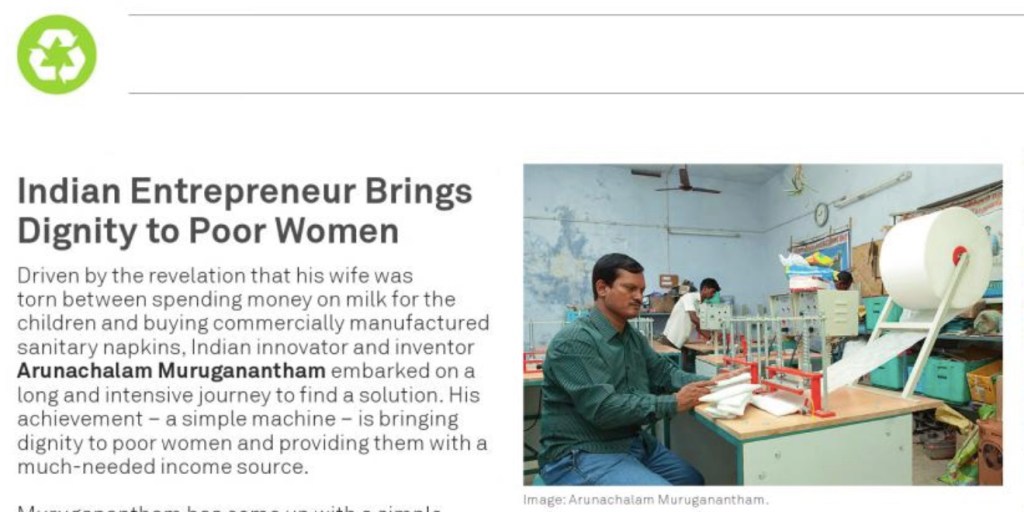
    Driven by the revelation that his wife was torn between spending money on milk for the children and buying commercially manufactured sanitary napkins, Indian innovator and inventor Arunachalam Muruganantham embarked on a long and intensive journey to find a solution. His achievement – a simple machine – is bringing dignity to poor women and providing them with a much-needed income source.

    This is a story of a man who was considered crazy for his persistence and made many personal sacrifices to achieve his goal. The innovation is both a technological and a business solution. Muruganantham has come up with a simple machine to manufacture affordable hygienic sanitary napkins for poor women. It works by turning the pulp of pine wood into the flat, white sanitary pads (http://en.wikipedia.org/wiki/Sanitary_napkin) commonly used by women during their monthly menstruation. The machine’s simplicity means it can be expanded easily to other communities and is designed to fit well with the way women’s cooperatives work and help them earn an income.

    Muruganantham sees it is a business model that “can deliver livelihood, hygiene and dignity to poor women, and help them strengthen society,” according to his website.

    The manufacturing process produces the sanitary napkins in just five steps. This simple intervention is revolutionizing women’s health in India by giving them an alternative to using found and unhygienic rags every month when they menstruate.

    It took Muruganantham four years of research to create a patented machine that sells for between US $1,332 and US $5,330. It can make 120 sanitary pads an hour. Each one sells for 10 rupees (US 18 cents). By comparison, the multinational company Procter & Gamble sells its product for 30 rupees (US 54 cents) a packet.

    Two multinationals dominate the marketplace for sanitary napkins in India: Procter & Gamble and Johnson & Johnson, with the Stayfree and Carefree brands.

    Muruganantham’s machine was awarded the best innovation national award by the former President of India, Prathiba Patil, in 2009.

    Like many innovators and inventors, his work at first was little understood by others and meant he had to plough a lonely furrow. But his persistence paid off and is now receiving attention from countries across the global South.

    Apart from its technological simplicity, the idea is to make it easy for women to form cooperatives and businesses to boost their incomes. India has seen the concept of so-called Ladies Self Help Groups (SHGs) (http://en.wikipedia.org/wiki/Self-help_group_%28finance%29) become more popular as a source of income. One of the problems they encounter is finding a successful business to undertake. The machine invented by Muruganantham is being seen as a good business model for the SHGs to follow. The key is the simplicity of operating the machine, the growing and stable market for the product, and its affordable and competitive price.

    Typical businesses that can be set up using the machine can employ 10 women.

    Muruganantham set up his main business, Jayaashree Industries (motto: ‘new inventions… small is beautiful’) (http://newinventions.in/aboutus.aspx), after his education was disrupted due to family problems and he took up a job in a welding shop.

    At first, he had a difficult time convincing people of the utility of the machine. He enlisted his wife to help with the marketing of the new napkins to nearby women. He says the advantage of his business model is that it turns the making of the napkins into a sustainable, grassroots activity. It provides an essential commodity for poor women at an affordable price, removing middlemen and using a simple, non-chemical technology.

    It also cuts down on expensive transport costs by keeping manufacturing local.

    Over 225 machines have been delivered to 14 Indian states and also to Nigeria, Ethiopia, Kenya, Uganda, Nepal and Bangladesh.

    And while Muruganantham is focused on making the machine a success, he is already looking forward to working on his next big invention. The only question is: what will it be?

    Resources

    1) Women’s Health: A website packed with facts and advice from the UK’s National Health Service. Website: http://www.nhs.uk/livewell/women1839/Pages/Women1839home.aspx

    Creative Commons License

    This work is licensed under a
    Creative Commons Attribution-Noncommercial-No Derivative Works 3.0 License.

    ORCID iD: https://orcid.org/0000-0001-5311-1052.

    © David South Consulting 2021

  • Disrupted! Whatever happened to Southern Innovator Issue 6?

    Disrupted! Whatever happened to Southern Innovator Issue 6?

    Subscribe to continue reading

    Subscribe to get access to the rest of this post and other subscriber-only content.

  • Issue 6 Will Launch In Autumn 2014: Get On Board! | 28 July 2014

    Issue 6 Will Launch In Autumn 2014: Get On Board! | 28 July 2014

    Issue 6 of Southern Innovator will tackle the theme of science, technology and innovation. Looking ahead, we are also seeking long-term funding for the magazine to take us to 2016 and also to enable us to scale to a level of reach we feel is necessary to have significant impact across the global South. To date, Southern Innovator has been ‘lean and mean’, run on a small budget with a tiny team. The editorial team is based in London, UK, the design team in Reykjavik, Iceland and the UN team in New York. This has worked well because it has forced us to be prudent with resources and to be very creative. But we have reached the physical limitations of this approach, and, to be frank, feel we are not living up to the potential of the magazine because we do not have the people and team to reach scale. As an example, we can only afford to publish in the English language, which means we miss out on billions of non-English speakers. We would like to have regional issues and bureaus, to be able to leverage the SI brand to offer a range of resources and products that are truly transformational for innovators, to stage events that bring together like-minded individuals, and to come out more frequently and regularly. 

    If our potential sponsors and advertisers could see what I see when the magazine reaches readers, I do not think they would hesitate to get on board and support the magazine. Often innovators feel like they are plowing a lonely furrow, unsupported, isolated. Or are enjoying significant local success but can see how what they have learned can help others but lack the time or means to share their wisdom and experience.

    That “a ha” moment when we meet somebody who tells us the magazine “gets them” is especially rewarding. Most recently, this happened over and over again at the Global South-South Development Expo held in Nairobi, Kenya towards the end of 2013.

    Hollywood has given the world the highly entertaining Iron Man series of films. The fictional Tony Stark dazzles us with his inventions and his awesome innovator’s ocean-side lair. If you liked that film, then you will love what we see happening all around the global South and feature in the magazine. Most of our innovators lack the flashy resources and wealth of a Tony Stark but they are no less innovative and creative, often working in the harshest conditions on the planet. They are our ‘Iron Men’ and ‘Iron Women’.

    Help us to further share the innovator’s spirit of Southern Innovator and transform the world, one good idea at a time!

    Disrupted! Whatever happened to Southern Innovator Issue 6?

    This work is licensed under a Creative Commons Attribution 4.0 International License.

    ORCID iD: https://orcid.org/0000-0001-5311-1052.

    © David South Consulting 2021