Tag: UNOSSC

  • African Innovation Eco-system Taking Shape

    African Innovation Eco-system Taking Shape

    By David SouthDevelopment Challenges, South-South Solutions

    SOUTH-SOUTH CASE STUDY

    How to increase the rate of innovation in Africa? And specifically, innovation that actually improves people’s lives and reduces poverty. It is a hard question to answer, but some are putting in place the building blocks of a 21st century innovation culture by riding the information technology revolution as it rolls across Africa.

    The transformative story of mobile phones in Africa has captured the attention of the world. Technologies like mobile phone payment systems developed in Africa are now being rolled out around the globe.

    But there is more to come as undersea cables increase the communications links between African nations and the rest of the world. New undersea cables including TEAMs, Seacom and Eastern Africa Submarine Cable System (EASSy) (eassy.org) are vastly increasing the continent’s Internet capacity and bandwidth (http://en.wikipedia.org/wiki/Bandwidth_%28computing%29).

    These communications links will revolutionize the type and scale of innovation that can happen in Africa.

    As websites like AfriGadget (afrigadget.com) amply prove, there is already an entrenched do-it-yourself innovation culture hard-wired into daily life on the continent. While impressively resourceful and able to make the most of often very little, this innovation culture is often confined to a narrow geographical area. And this is the difference the new information technologies will make: They will allow this energetic and resourceful innovators’ culture to develop businesses and business models that can reach beyond narrow geographical parameters.

    New technologies will also accelerate the spread of new ideas and solutions.

    Across the continent, ways and means are being stitched together that enable people to transcend borders and old divisions and obstacles to connect with like-minded collaborators, seek out funding and take ideas from dreams to schemes and eventually to continent- and world-straddling levels.

    According to the Deloitte 2011 East Africa Private Equity Confidence Survey: Promising 2012, “Many investors see East Africa’s strong growth potential as a driver of better investment performance than in South Africa: This is a huge shift in private equity attitudes toward Africa, which have been historically focused on South Africa. East African investment potential is seen as roughly on par with West Africa, where similar growth dynamics are at play.”

    Identifying the elements that are making this innovation culture flourish came under analysis in a recent post on the Afrinnovator website (afrinnovator.com). Afrinnovator is dedicated to “telling the stories of African startups, African innovation, African made technology, African tech entrepreneurship and entrepreneurs.”

    While it is well known that new infrastructure, better governance, new policies, and new services like mobile phones and mobile money have made a big difference in shifting perceptions of Africa from despair to optimism, Afrinnovator found there were other key ingredients to this innovation renaissance.

    Afrinnovator argues there are four elements that have come together to change circumstances for innovators on the continent: education, mentoring and incubators, funding, and showcase events.

    Afrinnovator found education was critical to the quality of emerging technological innovations. Information and communication technology (ICT) education has moved from just computer science courses to a vast array of options, from bachelors degrees to masters programmes.

    For mentoring and incubators, Afrinnovator found hubs and incubators are providing places for young educated people to go to and get down to work.

    Examples include iHub (http://ihub.co.ke/pages/home.php), mLab East Africa (http://mlab.co.ke/pages/home.php), ccHub (Co-Creation Hub Nigeria) (http://cchubnigeria.com/about-cchub/), Lusaka, Zambia’s Bongohive (bongohive.com), iLab Africa (http://ilabafrica.ac.ke/) NaiLab (http://nailab.co.ke/) iBid Labs (http://ibidlabs.com/) and Uganda’s HiveColab (http://hivecolab.org/), among others. These places offer like-minded fellowship and access to mentors to take them on the journey from “idea to viable profitable business.”

    According to Business Daily Africa, “There are more than 3,000 software developers who have come up with both mobile and personal computer-based software applications that are changing lives across the continent.”

    A transformation in funding access has seen a renaissance in new thinking that is transforming tech start-ups into viable businesses. Kenya has the Kenya ICT Board (http://www.ict.go.ke/) and it awards US $50,000 through its Tandaa grant programme (https://sites.google.com/a/ict.go.ke/tandaa/).

    Because of this enthusiastic local support, the World Bank is now committing a US $55 million grant targeting Kenya’s technology innovators to be distributed through the Kenya ICT Board.

    East Africa also saw 16 new investor funds launch in 2011 alone. They include early-stage investor funds like eVentures Fund Africa (eVA) (http://www.eva-fund.com/), which calls itself “the first venture capital firm investing in African SME’s active in digital media.” Another is Kenya-based 88mph (http://www.humanipo.com/88mph), with its “focus on startups targeting the East African mobile and web market.”

    In Kenya, the World Bank money will be used to help technology developers bring to market simple solutions in health and education.

    According to the World Bank (http://tinyurl.com/cm3g2rf), “Kenya has put in place the second-fastest broadband on the continent (after Ghana), which has reduced the wholesale internet capacity prices by over 90% and increased internet penetration from 3% to 37% of the population in the past decade. Today, about 90% of Kenyan adults have or have the use of a mobile phone.”

    And the final game-changer, according to Afrinnovator, is “showcase events.”

    These events give investors and potential partners the opportunity to meet start-ups and explore their new ideas.

    Examples include DEMO (http://www.demo.com/ehome/index.php?eventid=29414&amp😉 – which connects the idea people with the money people – and Pivot East in East Africa (http://pivoteast.com/). Pivot East provides 25 technology entrepreneurs with the opportunity to make a pitch in front of investors. DEMO is working with USAID, Microsoft, Nokia and others to launch DEMO Africa in Nairobi, Kenya from 21 to 22 October 2012.

    Afrinnovator concludes: “This is the last virgin tech landscape left on the planet. The best time to become a player in the African technology innovation ecosystem is now.”

    Published: July 2012

    Resources

    1) Read more about Africa’s evolving innovation system. Website: http://afrinnovator.com/blog/2012/06/13/the-innovation-ecosystem-in-eastafrica/

    2) Southern Innovator: Youth and Entrepreneurship Issue. Website: http://www.scribd.com/doc/86451057/Southern-Innovator-Magazine-Issue-2

    3) Southern Innovator: Mobile Phones and Information Technology Issue. Website: http://www.scribd.com/doc/57980406/Southern-Innovator-

    Magazine-Issue-1

    4) Notes from ‘Understanding Broadband Demand in Africa: Internet Going Mobile’. Website: http://www.oafrica.com/mobile/notes-from-understanding-broadband-demandin-africa-internet-going-mobile/

    5) Deloitte Private Equity Survey 2012. Website: deloitte.com
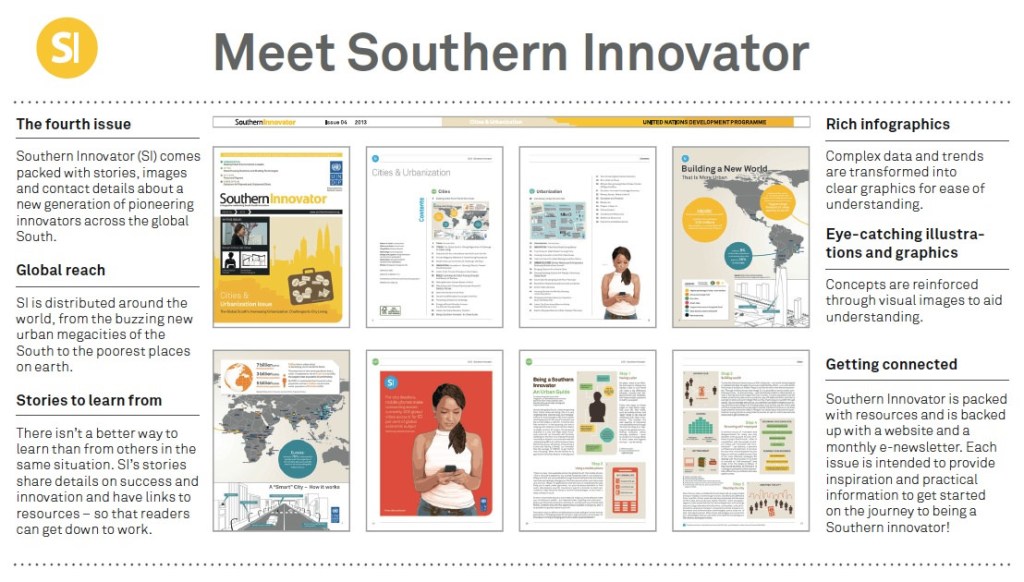
    Development Challenges, South-South Solutions was launched as an e-newsletter in 2006 by UNDP’s South-South Cooperation Unit (now the United Nations Office for South-South Cooperation) based in New York, USA. It led on profiling the rise of the global South as an economic powerhouse and was one of the first regular publications to champion the global South’s innovators, entrepreneurs, and pioneers. It tracked the key trends that are now so profoundly reshaping how development is seen and done. This includes the rapid take-up of mobile phones and information technology in the global South (as profiled in the first issue of magazine Southern Innovator), the move to becoming a majority urban world, a growing global innovator culture, and the plethora of solutions being developed in the global South to tackle its problems and improve living conditions and boost human development. The success of the e-newsletter led to the launch of the magazine Southern Innovator.  

    Creative Commons License

    This work is licensed under a
    Creative Commons Attribution-Noncommercial-No Derivative Works 3.0 License.

    ORCID iD: https://orcid.org/0000-0001-5311-1052.

    © David South Consulting 2023
  • Cool Food for the Poor

    Cool Food for the Poor

    By David SouthDevelopment Challenges, South-South Solutions

    SOUTH-SOUTH CASE STUDY

    A whole wave of high-tech, innovative products are now being developed and marketed for the world’s poor. These products are designed to raise the quality of life of poor people and treat them as a market with real needs, rather than a mass of people to be ignored.

    One of the major challenges of the 21st century is finding ways to make these products affordable for the poor – bringing significant development gains in health and quality of life – without increasing the burden on the world’s environment. In India, this vast new market is rapidly coming alive, with new marketing channels reaching deep into the country’s slums and aided by a lively media scene turning people on to new products.

    India is turning its large number of well-trained engineers and product designers to the task of making relevant products for the country’s millions of rural poor.

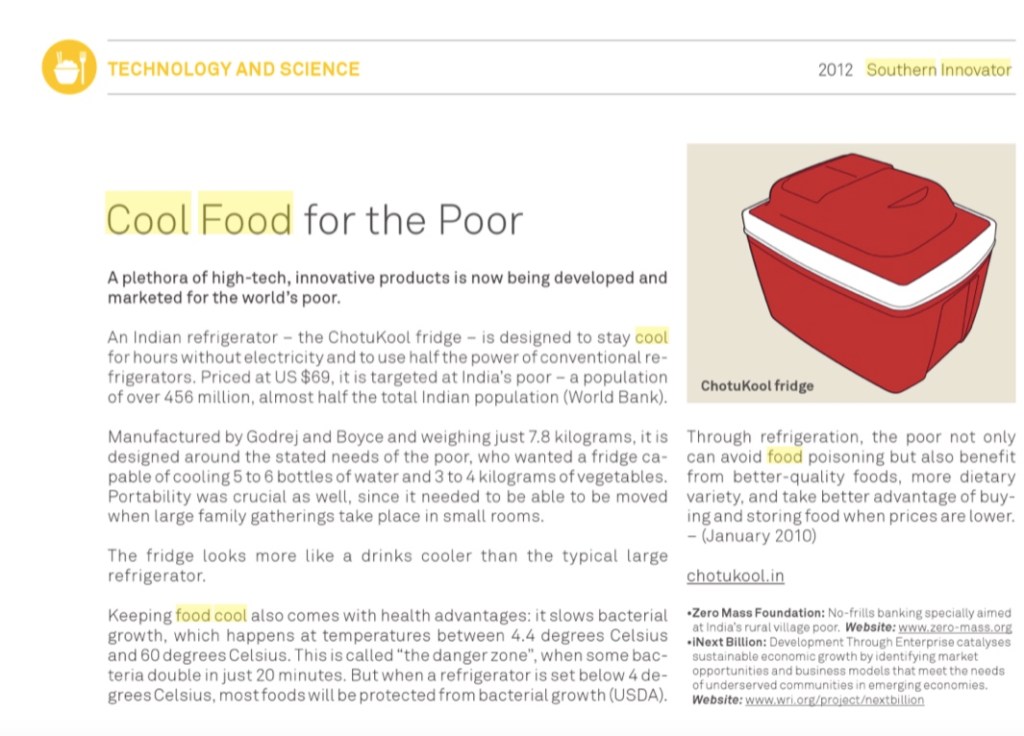
    An Indian refrigerator – the ChotuKool fridge (http://www.new.godrej.com/godrej/godrej/index.aspx?id=1) – is designed to stay cool for hours without electricity and to use half the power of conventional refrigerators. Priced at US $69, it is targeted at India’s poor – a population of over 456 million, almost half the total Indian population (World Bank).

    Manufactured by Godrej and Boyce and weighing just 7.8 kilograms, it is designed around the stated needs of the poor, who wanted a fridge capable of cooling 5 to 6 bottles of water and 3 to 4 kilograms of vegetables. Portability was crucial as well, since it needed to be moved when large family gatherings take place in small rooms.

    As a video shows (http://www.youtube.com/watch?v=dtCRlynp0bM), the fridge looks more like a drinks cooler than the typical large refrigerator. It works by replacing the standard compressor motor found in most fridges with a battery-powered heat exchanger.

    A group of village women was involved in the design process from the beginning. The fridges are being distributed by a microfinance group.

    While people in developed countries take it for granted they will have both a refrigerator and a steady supply of electricity, the world’s poor have few options for keeping food cool.

    There is a strong economic advantage to refrigeration: many farmers have to throw away vegetables or sell at high discounts because they are quickly spoiling in the heat. By refrigerating, they can keep them fresh and get the higher price. For somebody living on less than US $2 a day, this is a big economic boost.

    Keeping food cool also comes with health advantages: it slows bacterial (http://en.wikipedia.org/wiki/Bacteria) growth, which happens at temperatures between 4.4 degrees Celsius and 60 degrees Celsius. This is called ‘the danger zone’, when some bacteria double in just 20 minutes. But when a refrigerator is set below 4 degrees Celsius, most foods will be protected from bacteria growth (USDA).

    Through refrigeration, the poor not only can avoid food poisoning, but also benefit from better quality foods, more dietary variety, and better take advantage of buying and storing food when prices are lower. For example, eggs in a refrigerator can last for up to five weeks. Fresh fish can be stored unfrozen for up to two days.

    The quality of life improvements from refrigeration are obvious. But with conventional refrigerators costly and dependent on a steady supply of electricity, the poor will not buy them.

    An Indian government survey in 2007/08 found daily pay in rural areas ranged from 45 rupees a day (US $1) to 110 rupees a day (US $2.40). This means the ChotuKool fridge costs between one and two month’s wages for a rural worker.

    Some argue even the cost of the ChotuKool is still too prohibitive to many poor people. And there are other initiatives out there to offer low-tech solutions to cooling food.

    In Nigeria, grassroots inventor Mohammed Bah Abba has designed a cooler called the Zeer (http://practicalaction.org/?id=zeerpots). It works like this: two ceramic earthenware pots of different sizes are arranged one inside the other. The space between the pots is filled with wet sand and kept moist. The user then places their drinks or vegetables inside and covers with a damp cloth. As the water from the moist sand evaporates (http://en.wikipedia.org/wiki/Evaporation), the air inside the centre pot is cooled several degrees, enough to preserve some foods and drinks.

    Another Indian innovation is also targeting the rural poor consumer: a water filter. Called the Swach water purifier (http://www.tata.com/article.aspx?artid=TtOdcdNuSRk=), it is aimed at households and stands just less than 1 metre (just over 3 feet) in height. The filter is designed to do bulk water purification and is the result of 10 years’ research. It is aimed at the one billion people in the world who do not have access to clean water. It will sell for 1,000 rupees (US $21.50).

    It is very slick and modern in design, with a mix of white and clear plastic, resembling the commonly used Brita (http://www.brita.net/) water filters found in many homes. It works by using ash from rice milling to filter out bacteria. The ash is impregnated with silver particles to kill germs that cause diarrhoea, cholera and typhoid. It is able to purify 3,000 litres of water before the cartridge needs to be replaced.

    It is manufactured by the Indian industrial giant Tata.

    “It was the pressing need of people trapped by the effects of natural disasters such as the (2004 Indian Ocean) tsunami that saw the deployment of one of the earliest versions of this product,” said Tata vice chairman S. Ramadorai. “A key part was the insight that a natural material like rice husk can be processed to significantly reduce water-borne germs and odours when impure water is passed through it.”

    Published: January 2010

    Resources

    1) Indian Firms Shift Focus to the Poor: An article in the Wall Street Journal on this new trend. Website: http://online.wsj.com/article/SB125598988906795035.html?mod=relevancy

    2) Zero Mass Foundation: No-frills banking specially aimed at India’s rural village poor. Website: http://www.zero-mass.org/

    3) iNext Billion: Development Through Enterprise catalyzes sustainable economic growth by identifying market opportunities and business models that meet the needs of underserved communities in emerging economies. Website: http://www.wri.org/project/nextbillion

    Development Challenges, South-South Solutions was launched as an e-newsletter in 2006 by UNDP’s South-South Cooperation Unit (now the United Nations Office for South-South Cooperation) based in New York, USA. It led on profiling the rise of the global South as an economic powerhouse and was one of the first regular publications to champion the global South’s innovators, entrepreneurs, and pioneers. It tracked the key trends that are now so profoundly reshaping how development is seen and done. This includes the rapid take-up of mobile phones and information technology in the global South (as profiled in the first issue of magazine Southern Innovator), the move to becoming a majority urban world, a growing global innovator culture, and the plethora of solutions being developed in the global South to tackle its problems and improve living conditions and boost human development. The success of the e-newsletter led to the launch of the magazine Southern Innovator.  

    Creative Commons License

    This work is licensed under a
    Creative Commons Attribution-Noncommercial-No Derivative Works 3.0 License.

    ORCID iD: https://orcid.org/0000-0001-5311-1052.

    © David South Consulting 2023

  • African Infrastructure Dreams Back on Agenda

    African Infrastructure Dreams Back on Agenda

    By David SouthDevelopment Challenges, South-South Solutions

    SOUTH-SOUTH CASE STUDY

    Africa’s patchy infrastructure is not keeping pace with the continent’s economic growth.

    Satellite photos of Africa at night show a place where light is concentrated overwhelmingly in the South – primarily South Africa – and in the North, with a sprinkling of lights on the west and east coasts (http://geology.com/articles/satellite-photo-earth-at-night.shtml).

    This is just one visually arresting way to view the much larger problem of the continent lacking 21st-century infrastructure – from roads to airports to sewage and water services to harbors and rail connections. All are in desperate need of an upgrade.

    The World Bank says only one in four people has access to electricity in sub-Saharan Africa. According to the International Energy Agency (IEA), the region will require more than US $300 billion in investment to achieve universal electricity access by 2030.

    This lack of modern infrastructure is clashing with Africa’s impressive economic growth in recent years. The continent will be home to seven of the 10 fastest growing economies in the world by 2015, according to the IMF. Yet still too much of this is a reflection of a booming resource economy, which sounds impressive in numbers, but still leaves much of the continent’s population living in a day-to-day world of underdevelopment and poverty.

    Africa desperately needs further investment in infrastructure. The good news is that a mix of positive developments is coming together to breathe life into efforts to upgrade the continent.

    One is a new campaign to mobilize Africa’s wealthiest to stump up the necessary funds to conduct feasibility studies to lay the groundwork for a big boost to infrastructure spending in the coming years. Another is a flurry of new pledges from the United States to spend more in Africa to increase access to energy – a necessary precondition to improvements to living standards. China, too, is to continue to grow its already substantial investments in Africa.

    For innovators, better infrastructure across Africa will make it easier to export products, connect with markets and customers and gain access to new technologies and products available to others around the world.

    The Made in Africa Foundation (madeinafricafoundation.co.uk) hopes to turn to Africa’s wealthy global community to help with funding the feasibility studies required to unleash a new wave of infrastructure spending and building across the continent.

    Africa takes up 30 million square kilometers (UNEP), is home to approximately 15 per cent of the world’s population and has 60 per cent of the world’s potential agricultural land. Yet, just 34 per cent of Africa can be reached by road and only 30 per cent has access to electricity. One estimate has placed the cost of meeting Africa’s power and transport needs at US $28 trillion by 2050.

    That is a vast amount of money, and nobody will commit those sums unless they know that work has gone into planning for this infrastructure and that people are thinking long-term. This is where the Made in Africa Foundation wants to make a difference: it is hoping to get Africa’s wealthy to contribute US $400 million to fund feasibility studies which in turn will kick-off a US $68 billion first phase in investment into roads, railways, ports and energy.

    “In 2009, there was (US) $150bn (billion) available to spend, but no bankable infrastructure projects in Africa,” that these funds could be directed towards, said the Foundation’s George Brennan. “These figures should make us angry – the problem is not the availability of funding but the fact that projects are not in a condition to be funded.”

    Just as a global diaspora of Indians and Chinese have been instrumental in economic growth and development in India and China in the past two decades, so it is hoped the same formula can be applied to the equally substantial, successful and wealthy African diaspora.

    “African Americans spend (US) $1 trillion every year in their economy, but what do they spend on Africa? About 0.01 percent,” said Chris Cleverly, Director of the Made in Africa Foundation. “They have the wherewithal to make profound differences – personally, and by lobbying their pension funds, investment advisers and government to invest in Africa on the basis that it provides good returns.

    “It was China and India’s diasporas that developed them – it is the same with Africa’s now.”

    Ozwald Boateng (http://ozwaldboateng.co.uk), the dynamic Ghanaian-descended London tailor who built his reputation on a quirky and modern take on traditional British bespoke suits, took the lead along with the Ugandan Prince Hassan Kimbugwe (http://www.cdrex.com/prince-hassan-kimbugwe/1251509.html) and former British barrister Chris Cleverly.

    Boateng’s reputation and fame rose along side the buzzing British capital throughout the 2000s. But now he is reaching back to Africa to lead a campaign to substantially raise the level of investment in the continent’s creaking, antiquated or non-existent infrastructure.

    He is trying to rally Africa’s wealthiest business leaders to contribute to creating a 21st-century African infrastructure of roads, railways, ports and power supplies. Made in Africa is tackling the fact many big global investors are willing to invest in Africa but find it difficult to do so. Much has to be done before an investor can come along and start, for example, building a new road network or airport. Local governments need to do the initial site survey and environmental impact studies and develop a larger vision for where they would like their country to go and how its cities are to develop.

    The campaign got underway with a star-studded gala event earlier this year in Marrakech, Morocco, at the African Banker Awards (http://www.ic-events.net/awards/african_banker_awards_2013/). It also comes with a film, Our Future, Made in Africa, to help explain the campaign and the company.

    Some of the people who attended included Nigerian philanthropist Tony Elumelu, Angola’s richest woman Isabel dos Santos and Sudanese telecoms mogul Mo Ibrahim.

    “This is the start of fully understanding what Africa can do for itself,” said Boateng. “The Chinese managed to build a railway across China; the Japanese have the bullet train – we need to get past thinking about why it’s difficult to create the roads and railways that Africa needs and just get on with it.”

    The Foundation is being supported by the African Development Bank (http://www.afdb.org/en/), a long-time supporter of African infrastructure investment through loans and technical assistance.

    An additional boost to African development comes from a recent U.S. government pledge to spend US $7 billion over the next five years in Africa to improve access to energy. Energy is the needed fuel for any significant improvements to human development over the long-term.

    U.S. President Barack Obama announced “Power Africa” (http://www.whitehouse.gov/the-press-office/2013/06/30/fact-sheet-power-africa) while he was in Cape Town, South Africa on his recent African tour. At the heart of Power Africa is the pledge to double access to power in Africa. According to medical journal The Lancet, 3.5 million Africans die every year due to indoor air pollution – a figure larger than those who die every year from malaria and HIV/AIDS combined. The pollution results from the fumes caused by burning fuel for cooking, warmth and light.

    President Obama promised the funding to help governments in Ethiopia, Ghana, Kenya, Liberia, Nigeria and Tanzania. The funds will be used to boost access to electricity for 20 million households. Funds will also be used to help Angola and Mozambique modernize their energy export sectors.

    Power Africa will act as a go-between to encourage links and deals between American energy companies and African partners.

    On top of this, Power Africa is being supplemented by an additional US $10 billion in private sector contributions, including a commitment from the General Electric Company to bring 5,000 megawatts of affordable energy to Tanzania and Ghana.

    In total, the US estimates it will take US $300 billion in additional funds to bring full power to sub-Saharan Africa.

    For the past decade, the biggest change in Africa’s infrastructure story has come from the growing role played by China. China has become Africa’s largest single trading partner, with bilateral trade reaching US $166 billion in 2011 – a jump of 33 per cent from 2010. The total volume was valued at $198.5 billion in 2012 and is expected to surpass $380 billion by 2015.

    And much, much more has been promised to come: China’s President Xi Jinping (http://en.wikipedia.org/wiki/Xi_Jinping) renewed a pledge to offer US $20 billion in loans to Africa in March 2013 (Reuters). Much of this is going to electricity-generation projects.

    Published: July 2013

    Resources

    1) China in Africa: The Real Story is a blog tracking the relationship and digging up the real numbers on what is happening. Website: http://www.chinaafricarealstory.com/

    2) The China-Africa Development Fund (CADFund) will invest US $2.4 billion in African projects, according to its President Chi Jianxin. Website: http://www.cadfund.com/en/

    3) Map of Africa’s major infrastructure: The image shows how infrastructure in Africa is growing rapidly, but is still largely concentrated in coastal regions and those with large mineral deposits. This means that rural and isolated populations often do not have access to modern energy and the benefits that it can bring. Website: http://www.one.org/us/2011/05/10/map-of-africas-major-infrastructure/

    4) Dead Aid by Dambisa Moyo. In the past 50 years, more than US $1 trillion in development-related aid has been transferred from rich countries to Africa. Website: http://www.dambisamoyo.com/books-and-publications/book/dead-aid

    Find more in Southern Innovator Issue 4: Cities and Urbanization

    https://g.co/kgs/y2K5Hy

    Development Challenges, South-South Solutions was launched as an e-newsletter in 2006 by UNDP’s South-South Cooperation Unit (now the United Nations Office for South-South Cooperation) based in New York, USA. It led on profiling the rise of the global South as an economic powerhouse and was one of the first regular publications to champion the global South’s innovators, entrepreneurs, and pioneers. It tracked the key trends that are now so profoundly reshaping how development is seen and done. This includes the rapid take-up of mobile phones and information technology in the global South (as profiled in the first issue of magazine Southern Innovator), the move to becoming a majority urban world, a growing global innovator culture, and the plethora of solutions being developed in the global South to tackle its problems and improve living conditions and boost human development. The success of the e-newsletter led to the launch of the magazine Southern Innovator.  

    Creative Commons License

    This work is licensed under a
    Creative Commons Attribution-Noncommercial-No Derivative Works 3.0 License.

    ORCID iD: https://orcid.org/0000-0001-5311-1052.

    © David South Consulting 2023

  • China’s Booming Wine Market Can Boost South

    China’s Booming Wine Market Can Boost South

    By David SouthDevelopment Challenges, South-South Solutions

    SOUTH-SOUTH CASE STUDY

    A great South-South opportunity has emerged with the recent boom in wine drinking in China and the pursuit of quality tastes. Matching high-quality wine producers from the global South – including South Africa, Chile, Morocco, and Lebanon – with China’s thirsty wine drinkers could deliver a major income boost.

    In the past year China has become the world’s fastest-growing wine market with newly wealthy seeking sophisticated tastes and young working women seeking the health benefits of wine (http://www.healthtree.com/articles/red-wine/). Yearly wine consumption in China is expected to increase by 20 percent to 126.4 million cases by 2014, a fact that is grabbing the attention of old and new-world wine producers.

    Women are driving China’s growing market for wine, which is perceived as a symbol of affluence, a benefit to health – in moderation – and good for the skin. A new report from the International Wine and Spirit Research (IWSR) group says wine consumption in China and Hong Kong jumped 100 per cent between 2005 and 2009, from 46.9 million to 95.9 million cases.

    Import taxes have been reduced as China entered the World Trade Organization (WTO), and this has prompted foreign wine brands to lunge into the market.

    The government is trying to get people to switch away from high-strength alcoholic drinks by increasing the tax on them.

    Awareness and experience varies widely amongst the winemakers of the global South. Some countries, such as South Africa, Chile and Argentina, have long-standing international reputations for producing quality wine, and use sophisticated branding and marketing campaigns to connect with their customers. But other countries, including Lebanon, Tunisia and Zimbabwe, have lower profiles and do not pack the same brand punch. But all these countries help show the role viticulture can play in economic development. By tapping into this Chinese wine drinking boom, they could reap rich rewards.

    In Lebanon, viticulture – the harvesting of grapes for wine (http://en.wikipedia.org/wiki/Viticulture) – has prospered despite the country’s wars and instability.

    Lebanon has a long and illustrious history of winemaking stretching back 5,000 years. The modern Lebanese wine industry dates itself from 1857, when Jesuit monks at Ksara in the Bekaa Valley began importing vines from Algeria. After World War I, when the French took control of Lebanon, its vineyards expanded to satisfy France’s thirsty imperial troops.

    Then Lebanon was hit by the brutal civil war of the 70s and 80s. And things have remained unstable and uncertain since.

    But despite this, well established businesses like Ksara (http://www.ksara.com.lb/), Kefraya (http://www.chateaukefraya.com/) and Musar (http://www.chateaumusar.com.lb/english/cave.aspx), and small boutique producers, thrive.

    Massaya (http://www.massaya.com/old/wine.htm) is one of Lebanon’s most dynamic and successful wineries, owned by brothers Sami and Ramzi Ghosn. Both are Christians like many of the Lebanese winemakers. They have been able to succeed in an area fraught with tension from past conflicts.

    Another winery is using the business to revive a community and restore old skills. In the hills east of Beirut, the BBC found Naji Boutros – who used to be an investment banker in London – and his wife Jill. Boutros started Chateau Belle-Vue in Bhamdoun (http://www.chateaubelle-vue.com/), in the village where he grew up. As well as producing wine, the Chateau finances community projects and a library.

    The two kings in the global South of wine exports are South Africa and Chile. Both countries have very strong brand awareness in export markets and both have triumphed after years of boycotts due to the political situations in the respective countries (Chile’s military dictatorship and South Africa’s Apartheid regime).

    Wine-making is one of South Africa’s oldest industries and plays a key part in the economy (http://www.wine.co.za/), with exports growing from less than 50 million litres in 1994 to more than 400 million litres in 2008 – year-on-year growth of 17 percent.

    Since the end of the racist Apartheid regime (http://en.wikipedia.org/wiki/South_Africa_under_apartheid) in the mid-1990s, various government and industry initiatives have begun to reverse the iniquities of the country’s wine-making industry. South Africa has been pioneering switching black Africans on to the pleasures and profits of wine making and drinking.

    Like Argentina, Chile (http://www.winesofchile.org/) has a strategic plan for its wine industry by 2020. It hopes to be “the Number One producer of sustainable and diverse premium wines from the New World by the year 2020.”

    Chile – recovering from the severe earthquake on February 27, 2010 – uses a sophisticated marketing strategy to promote its wines, including websites, social networking media and events and tastings. Since 2007, it has unified its marketing efforts under one umbrella organization, the Vinos de Chile, and it also offers wine tourism to further develop a close relationship with drinkers, The Wines of Chile Experience (http://www.chilewinetourism.com/), launched in 2010.

    Chile’s neighbour Argentina (http://www.winesofargentina.org/) is the world’s fifth largest producer of wine,

    The country has seen its domestic consumption of wine shrink as tastes changed, and has also experienced very extreme economic fluctuations. It has had to raise its game in order to earn income from exporting. This has been a spur to the wine industry and it has seen growth since 1996.

    Wine growing has a long history in Argentina, going back to its Spanish colonial foundations in the 1500s. Argentineans drank large quantities of wine domestically in the 1970s but this tailed off in the later decades.

    That had been balanced by a great export success with wines from the malbec grape. The flavour of this wine and its brand image has proven to be a weighty ambassador for Argentinean wines in general. By keeping a competitive price, Argentinean wine has flourished during the global economic crisis as people have moved to less expensive brands. The country cleverly has a wine marketing strategy based on Australia’s experience. This is an ambitious plan with the goal of capturing 10 percent of the global wine market share by 2020.

    Argentina also aggressively pursues new markets by visiting them regularly and doing wine promotions and tastings with potential customers. It also brings people to the country to visit the wineries and experience Argentinean culture and food.

    In North Africa, Algeria, Tunisia and Morocco have a long history cultivating wine and have been winning awards since the 1859 Fall Exposition in Paris. Over the years quality control was an issue as political and economic factors disrupted access to global markets. But in the last few years governments have been working to support the industry and regain its past reputation.

    Winemaking in North Africa goes back to the Romans and the Phoenicians. Despite Islam prohibiting the consumption of alcohol, the industry has survived. The industry is currently being re-organized to make the most of a free trade agreement with the European Union.

    Tunisia has a long, rich winemaking heritage known the world over. About half of Tunisia’s vineyards are dedicated to producing grapes for wine production rather than for sale as table grapes.

    Over the last 20 years, Les Vignerons de Carthage, a cooperative of 10 cellars located in the Cap Bon region of Northern Tunisia, have been working under the leadership of Belgacem D’Khili, a Bordeaux trained oenologist to improve and maintain wine quality.

    They have kept the old vines, persevered with hand-harvesting and traditional techniques, but have modernised the cellar equipment, the storage and overall approach to hygiene.

    North African wines are being collectively marketed by resellers like Cotes d’Afrique (http://www.cotes-d-afrique.co.uk/tunisianwine/history.aspx).

    Morocco, too, has become a respected wine maker and has a robust domestic wine-drinking market. Morocco’s oldest winery, Celliers de Meknes (http://www.lescelliersdemeknes.net/), told the Global Post how it handles the delicacies of wine-making in a majority Muslim country.

    “We are tolerated,” said Jean-Pierre Dehut, the export manager for Celliers de Meknes. “But the tolerance requires that we stay within certain boundaries.”

    Celliers de Meknes sells some 30 million bottles of wine per year — 25 million in Morocco.

    A little-known wine producer, Zimbabwe has been producing wines since the early 1950s and commercially since 1965, according to Zimbabwe Tourism. Production peaked in the 1980s and later suffered from an export ban. Despite the country’s economic and political problems, the wine industry has grown. New techniques, equipment and grape varietals have been introduced and winemakers have been trained in Germany, Australia and South Africa. Regular visits from outside consultants have helped with raising standards.

    Apart from economic problems the industry struggled with viruses and climate. But since the 1990s the industry has started to win international wine competitions

    One of the successful wineries is Mukuyu Winery (http://www.africanbeersandwine.com/pages/wine.html), which produces an average of 1.5 million litres per year from 100 hectares under vines. Over the past 13 years, Mukuyu wines have won Silver and Bronze medals at the International Wine and Spirit Competition in London, and regional wine tasting competitions in South Africa.

    Published: January 2011

    Resources

    1) China Wines Information Website: A website with the latest news and events on China’s fast-growing wine market. Website: http://www.wines-info.com/en/index.aspx

    2) Interwine China 2011: The 6th China (Guangzhou) International Wine and Spirits Exhibition and World Famous Wine Expo, May 25th to 27th, 2011. Website: http://www.interwine.org/interwine/pages/2010/index.interwine

    3) Shenzhen International Wine Hub: Shenzhen International Wine Hub is located in downtown Longgang, and is designed to provide an unprecedented one-stop platform for all wine-related business, integrating product exhibition, wine trading, wine information and statistics publishing, wine knowledge training, quality examination and evaluation, wine culture showcasing as well as food and recreation. Website: http://www.szwinehub.com/en/

    4) Zimbabwe Tourism: Website: http://www.zimbabwetourism.net/index.php?option=com_content&view=article&id=119&Itemid=144

    5) Soweto Wine Festival: Website: http://www.sowetowinefestival.co.za/About.htm

    Development Challenges, South-South Solutions was launched as an e-newsletter in 2006 by UNDP’s South-South Cooperation Unit (now the United Nations Office for South-South Cooperation) based in New York, USA. It led on profiling the rise of the global South as an economic powerhouse and was one of the first regular publications to champion the global South’s innovators, entrepreneurs, and pioneers. It tracked the key trends that are now so profoundly reshaping how development is seen and done. This includes the rapid take-up of mobile phones and information technology in the global South (as profiled in the first issue of magazine Southern Innovator), the move to becoming a majority urban world, a growing global innovator culture, and the plethora of solutions being developed in the global South to tackle its problems and improve living conditions and boost human development. The success of the e-newsletter led to the launch of the magazine Southern Innovator.  

    Creative Commons License

    This work is licensed under a
    Creative Commons Attribution-Noncommercial-No Derivative Works 3.0 License.

    ORCID iD: https://orcid.org/0000-0001-5311-1052.

    © David South Consulting 2023