Tag: UNOSSC

  • Grassroots Entrepreneurs Now Have Many Ways to Fund their Enterprises

    Grassroots Entrepreneurs Now Have Many Ways to Fund their Enterprises

    By David SouthDevelopment Challenges, South-South Solutions

    SOUTH-SOUTH CASE STUDY


    In the past, African entrepreneurs were extremely limited in the options for funding their plans. They had to rely on often ineffective national banks or local networks based on political, tribal or family connections to secure funding for enterprises. That has now changed, and there is an explosion in new thinking on business start-ups and how best to help grassroots entrepreneurs.

    Concepts such as socially responsible investing, social enterprises and fair trade have opened up new frontiers for business development. All focus on the so-called triple bottom line: people, planet, profit. Economist Milton Friedman’s refrain that the only social responsibility of business was to increase profits, is being proven wrong. Some even go as far as to say social enterprise is the model for the 21st century.

    “There’s lots of money to be made here,” said James Baderman of What If, an innovation company in the UK that employs 300 people and devotes 10 percent of its profits to helping social enterprises develop and grow. “There are huge opportunities; just look at the double-digit growth in fair trade and organic goods over the past decade. Consumers are increasingly making choices based on the ethical nature of products.”

    Many in the social enterprise movement believe breaking the cycle of poverty and economic stagnation requires more than charity; it requires the creation of sustainable businesses that will pay local taxes and employ local people. They have also adopted and adapted the techniques used by multinational companies to improve the desirability of their products. A key part of these new socially responsible businesses is branding and marketing.

    In Kenya, the UK’s Traidcraft (www.traidcraft.co.uk) – an organization that fights poverty through a wide range of trade-related activities combining a development charity with a trading company – is working with the Kenya Organic Agriculture Network to develop markets for Kenyan herbs, spices and related products in local and international markets. These include gums, resins (e.g. frankincense), herbs such as coriander, oregano, garlic and lemon grass; spices such as paprika, chillies, rosemary, lemon balm, and essential oils such as pepper tree oil, sinoni oil, and megalocapus oil – all grown in marginalised, arid areas.In another development focused on Kenya – but applicable across Africa – is being led by the UK-based Mark Leonard Trust (http://markleonard.net/). Called the Mainstreaming African Crafts project, it seeks to boost demand for Kenyan craft products in the UK market. It will build demand by focusing on growth areas (such as baskets, jewellery, leather), emphasizing the distinctiveness of African craft products and support product development in line with identified market trends. The aim is to launch a branded Kenyan product range at an international trade fair in 2008.

    Along with improving the branding and marketing of social enterprises and fair trade businesses, funding options are becoming more varied. One new source of funding for budding social entrepreneurs is the William James Foundation’s 4th Annual Socially Responsible Business Plan Competition. It awards winners who develop business plans that blend people, planet and profit together with over US $40,000 in cash and expert advice to make sure it is spent well. Past winners have included business ventures as varied as an Afghan company that sends SMS text messages on security alerts, to others making hand-made organic clothing and portable vaccine packs for remote areas.

    “We’re at a tipping point wherein the entrepreneur who builds in long-term values of sustainability is the one who will be successful,” said Ian Fisk, executive director of the William James Foundation and a long-time sustainable business activist through Net Impact (http://www.netimpact.org/index.cfm). “Most of what people think of as environmental and social activism in business is simply long-term thinking about energy costs and human resources. There are thousands of good ideas out there. The foundation wants to find those that are attached to solid business plans and help them succeed.”

    The success of this approach has also attracted the attention of multinational companies like the oil company Shell. At the Shell Foundation (www.shellfoundation.org), they look at all the enterprises they support from a hardnosed, business perspective. Rather than seeing a producer who needs to produce, they look first at the market and the consumer, and then work backwards to get the producer to make the appropriate products that will sell. “No micro-enterprise is sustainable unless there is a viable route to market,” said Sharna Jarvis, Programme Manager for the Shell Foundation. “The problem with the standard model for micro-finance is that it begins with the producer, not the consumer. It is all about what someone wants to make – there is not enough emphasis on whether anyone will buy it.”

    A new internet search engine has also been launched that is seeking a new way to create a steady flow of funds to nonprofit enterprises working to reduce poverty. Called GoodSearch (www.GoodSearch.com), it plows 50 percent of its advertising revenue (about a penny a search) back into nonprofits selected by its users. Powered by the well-known portal Yahoo!, if for example 1,000 supporters just searched twice a day, it would raise US $7,300 a year for an organization.

    Published: February 2007

    Resources

    • The Fairtrade Foundation (FTF) helps farmers and other producers to earn a decent living and obtain good healthcare and education. Fair Trade Resource Network: http://fairtraderesource.org/about.html
    • Unltd (pronounced Unlimited), a charity supporting social entrepreneurs: www.unltd.org.ukExcellent resource to link with branded social enterprises and all the resources required to get started: www.socialenterprise.org.uk
    • Equitrade helps businesses in poor countries to develop finished or part-finished products to sell in rich countries: www.equitrade.org
    • The 4th Annual Socially Responsible Business Plan Competition is open to for-profit business (or business ideas) with at least one member who is a current student or has graduated within the past five years.
    • For more information contact: www.williamjamesfoundation.org or email ian.fisk@williamjamesfoundation.org.

    https://davidsouthconsulting.org/2021/02/04/cuban-entrepreneurs-embracing-changes-to-economy/

    https://davidsouthconsulting.org/2022/10/09/entrepreneurs-use-mobiles-and-it-to-tackle-indian-traffic-gridlock/

    https://davidsouthconsulting.org/2022/10/20/ghana-oil-rich-city-sparks-entrepreneurs-and-debate/

    https://davidsouthconsulting.org/2022/11/11/havanas-restaurant-boom-augers-in-new-age-of-entrepreneurs/

    https://davidsouthconsulting.org/2022/11/15/indonesia-best-for-entrepreneurs/

    https://davidsouthconsulting.org/2020/12/20/mobile-phones-engineering-souths-next-generation-of-entrepreneurs/

    https://davidsouthconsulting.org/2020/12/17/mongolias-musical-entrepreneurs-led-way-out-of-crisis-2018/

    https://davidsouthconsulting.org/2021/02/11/turning-street-children-into-entrepreneurs/

    Development Challenges, South-South Solutions was launched as an e-newsletter in 2006 by UNDP’s South-South Cooperation Unit (now the United Nations Office for South-South Cooperation) based in New York, USA. It led on profiling the rise of the global South as an economic powerhouse and was one of the first regular publications to champion the global South’s innovators, entrepreneurs, and pioneers. It tracked the key trends that are now so profoundly reshaping how development is seen and done. This includes the rapid take-up of mobile phones and information technology in the global South (as profiled in the first issue of magazine Southern Innovator), the move to becoming a majority urban world, a growing global innovator culture, and the plethora of solutions being developed in the global South to tackle its problems and improve living conditions and boost human development. The success of the e-newsletter led to the launch of the magazine Southern Innovator.  

    https://davidsouthconsulting.org/2021/03/05/southern-innovator-issue-2/

    Creative Commons License

    This work is licensed under a
    Creative Commons Attribution-Noncommercial-No Derivative Works 3.0 License.

    ORCID iD: https://orcid.org/0000-0001-5311-1052.

    © David South Consulting 2023
  • Entrepreneurs Use Mobiles and IT to Tackle Indian Traffic Gridlock

    Entrepreneurs Use Mobiles and IT to Tackle Indian Traffic Gridlock

    By David SouthDevelopment Challenges, South-South Solutions

    SOUTH-SOUTH CASE STUDY

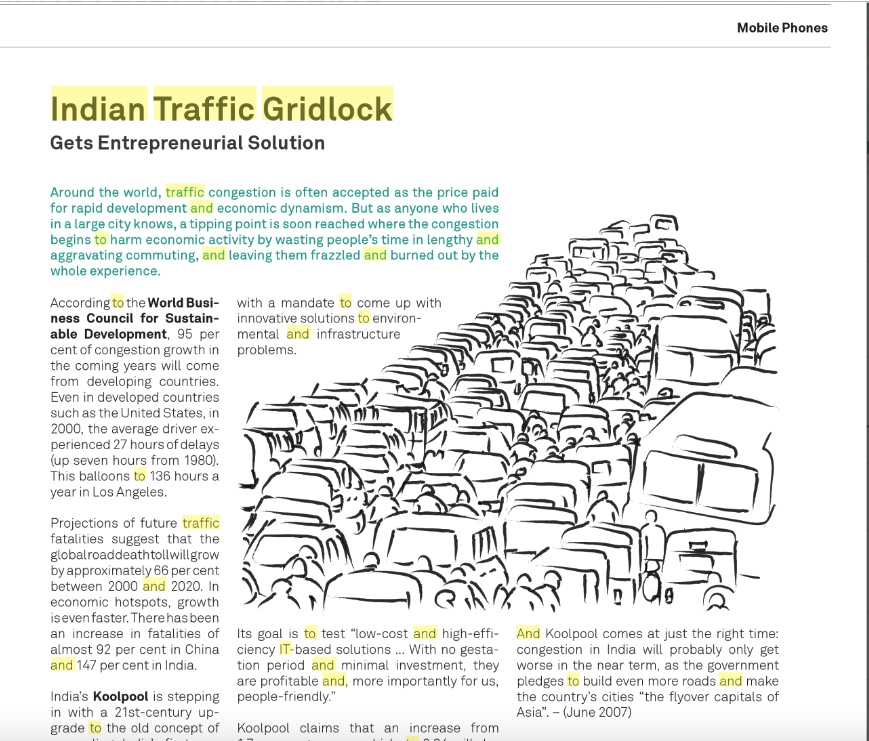
    Around the world, traffic congestion is often accepted as the price paid for rapid development and economic dynamism. But as anyone who lives in a large city knows, a tipping point is soon reached where the congestion begins to harm economic activity by wasting people’s time in lengthy and aggravating commuting, and leaving them frazzled and burned out by the whole experience. According to the World Business Council for Sustainable Development, 95 percent of congestion growth in the coming years will come from developing countries. Even in developed countries like the United States, in 2000, the average driver experienced 27 hours of delays (up seven hours from 1980) (MIT Press). This balloons to 136 hours in Los Angeles.

    Developing countries are growing their vehicle numbers by between 10 and 30 percent per year (World Bank). In economic hotspots, growth is even faster. In India, the cities of Delhi, Mumbai, Kolkata and Bangalore account for five percent of the nation’s population but have 14 percent of the total registered vehicles. In the Islamic Republic of Iran, Kenya, Mexico and Chile, 50 percent of cars are in the capital cities (www.peopleandplanet.net).

    India’s Koolpool is stepping in with a 21st century upgrade to the old concept of carpooling. India’s first carpooling service (in which drivers share rides to reduce congestion and save money) uses the power of the country’s mobile phone network to link up people by SMS (short message service) text. Already launched in Mumbai, it is being rolled out in other cities as well.

    Koolpool surveyed Indian drivers and found that the average car only had two passengers. Koolpool is an idea from the Mumbai Environmental Social Network (MESN), a registered charity with the mandate to come up with innovative solutions to environmental and infrastructure problems. Its goal is to prove “low-cost and high efficiency IT-based solutions are the way of the future. With no gestation period and minimal investment, they are profitable and more importantly for us, people friendly.” Koolpool claims that an increase from 1.7 passengers per vehicle to 2.04 will decrease travel time and pollution levels by 25 percent. It also claims to be the first carpooling service to combine SMS text messaging and IT.

    Ride-givers send a text message to Koolpool just before going down a major road. Koolpool then sends a list of ride seekers on the route, their membership identifications, the designated stopping point for pick-up, number of riders and login time. If there are no ride givers on that route, then ride seekers are pooled together to get a taxi and share the costs. Members of Koolpool pay an annual membership fee and exchange credits by mobile phone between ride seekers and ride givers, which are then redeemed at gas stations for petrol.

    And Koopool comes at just the right time: congestion in India will probably only get worse in the near term, as the government pledges to build even more roads and make the country’s cities “the flyover capital of Asia”.

    In Kolkata, says Sudarsanam Padam, former director of the Central Institute of Road Transport in the city of Pune, the average speed during peak hours in the central business district (CBD) area is as low as seven km/hr. Bangalore currently has average speeds of about 13-15 km/hr in its CBD, but this is expected to go down to three to eight km/hr in the next 15 years, according to the city’s police traffic commissioner, M N Reddi.

    Published: June 2007

    Resources

    • Mobility 2001: World Mobility at the End of the Twentieth Century and its Sustainability published by the World Business Council for Sustainable Development.
    • Another Indian car pooling business allows people to post requests for rides on an internet bulletin board, Car Sales India.
    • Another solution to traffic congestion has been the motorcycle taxi. Beginning in Thailand, motorcycle taxis can now be found in Cambodia, India and the UK. Read more at here.
    • SENSEable City: A project at the Massachusetts Institute of Technology’s SENSEable City Laboratory to use the new generation of sensors and hand-held electronics to change how cities are understood and navigated. This includes creating real-time maps of cities that can then be used to help with avoiding traffic congestion and other problems.
    • Read more about India’s traffic congestion problem by India’s only science and environment biweekly online newsletter, Down to Earth.

    Development Challenges, South-South Solutions was launched as an e-newsletter in 2006 by UNDP’s South-South Cooperation Unit (now the United Nations Office for South-South Cooperation) based in New York, USA. It led on profiling the rise of the global South as an economic powerhouse and was one of the first regular publications to champion the global South’s innovators, entrepreneurs, and pioneers. It tracked the key trends that are now so profoundly reshaping how development is seen and done. This includes the rapid take-up of mobile phones and information technology in the global South (as profiled in the first issue of magazine Southern Innovator), the move to becoming a majority urban world, a growing global innovator culture, and the plethora of solutions being developed in the global South to tackle its problems and improve living conditions and boost human development. The success of the e-newsletter led to the launch of the magazine Southern Innovator.  

    Creative Commons License

    This work is licensed under a
    Creative Commons Attribution-Noncommercial-No Derivative Works 3.0 License.

    ORCID iD: https://orcid.org/0000-0001-5311-1052.

    © David South Consulting 2022

  • Next Generation of Innovation for the Grassroots

    Next Generation of Innovation for the Grassroots

    By David SouthDevelopment Challenges, South-South Solutions

    SOUTH-SOUTH CASE STUDY

    Taking inspiration from science fiction sagas like the TV show Star Trek, the next generation of innovation is already taking shape in the South. A group of innovative facilities called Fab Labs (short for Fabrication Laboratory) in Ghana, India, Kenya, South Africa and Costa Rica are applying cutting-edge technology to address the everyday needs of people.

    Like the futuristic “replicator” in Star Trek, Fab Labs allow people to design and produce what they need there and then. The labs are mushrooming throughout the South as people get the innovation bug.

    Originally an idea from the Massachusetts Institute of Technology’s Center for Bits and Atoms, which sponsors nine of the labs, Fab Labs let people use digital technology to build physical objects, from eyeglass frames to toys and computer parts. Fab Labs empower local invention by turning education, problem-solving and job creation into a creative process.

    Started by Professor Neil Gershenfeld, Fab Labs use US $20,000 worth of computers, open source design software, laser cutters, milling machines and soldering irons, letting people harness their creativity to build things they need, including tools, replacement parts and essential products unavailable in the local market.

    With minimal training, children and adults are designing and making their own toys, jewellery and even computer circuit boards with the machines. It turns people from consumers into inventors.

    “Instead of bringing information technology to the masses, the Fab Labs bring information technology development to the masses,” said Gershenfeld.

    In Ghana, the Takoradi Technical Institute in the southwest of the country hosts a Fab Lab, allowing a wide variety of people to use the “replicator” – from local street children to tribal chiefs – to make a wide range of products. The Ghana lab has several projects on the go, including antennae and radios for wireless internet networks and solar-powered machinery for cooking, cooling and cutting. The labs have found that the younger the users, the faster the skills are picked up.

    John Silvester Boafo, principal at the Takoradi Technical Institute, is proud of what he calls a fu-fu pounder. “In a Ghanaian home, the main dish is fu-fu,” he told the BBC. “Fu-fu is made of plaintain and cassava, which are cooked. After they are cooked, they are put into a mortar and pounded by hand. People go through hard labour just to get a meal to eat. So, we thought we could fabricate this machine to alleviate the hard labour they use in pounding.”

    They are also working on portable hand-held chargeable solar panels for televisions and refrigerators.

    In Pabal, in the western part of Maharashtra, India, a Fab Lab was established at the Vigyan Ashram in 2002 and is now working on developing agricultural instruments. They are also testing milk for quality and safety, and tuning diesel engines to run more efficiently, especially with bio fuels. Another lab in Bithoor in the state of Uttar Pradesh (operated with the Indian Institute of Technology, Kanpur) is working on 3-D scanning and printing for rural artisans, such as producing wooden blocks used in Chikan embroidery.

    In South Africa, officials are in the process of setting up four labs. The first is in the capital Pretoria, home to Africa’s first “science park”. The second is in the township of Shoshanguve, a very poor community with high unemployment.

    “We have these very high-tech small start-up companies that are excited by the proximity of the lab,” said Sushil Borde, head of the government agency charged with rolling out the four labs. “The companies say, ‘We have these brilliant ideas, we have these business models, but we don’t know how to get these ideas into tangible products.”

    Borde hopes the network of Fab Labs will enable South African entrepreneurs and engineers to test their ideas and “fast track the process of growth and development.”

    Seventeen-year-old Kenneth Chauke has been able to build a robot in the Fab Lab in Pretoria, he told the Christian Science Monitor.

    IT supervisor Nthabiseng Nkadimeng at the Fab Lab in Shoshanguve, has been encouraging South African youth to dream expansively about new technology. “We want to encourage innovation,” she told the Christian Science Monitor. “A lot of the kids, right now, they’re making toys. That’s okay, it’s a start. But eventually we want them to do things that haven’t been done before.”

    “It’s the idea that if you’re somewhere in rural South Africa, and you want something for solar energy, you can go to a Fab Lab and make your own,” said Naas Zaayman, who works for the government on coordinating the Fab Lab strategy.

    Published: October 2007

    Resources:

    • id21 Insights: A series of articles by the UK ’s Institute of Development Studies on how to make technology and science relevant to the needs of the poor:
    • Biography: Professor Neil Gershenfeld
    • eMachineShop: This remarkable service allows budding inventors to download free design software, design their invention, and then have it made in any quantity they wish and shipped to them: Amazing!

    https://davidsouthconsulting.org/2022/02/17/african-digital-laser-breakthrough-promises-future-innovation/

    https://davidsouthconsulting.org/2022/10/05/african-innovation-eco-system-taking-shape/

    https://davidsouthconsulting.org/2021/05/18/african-innovation-helps-make-banking-transactions-safer/

    https://davidsouthconsulting.org/2022/10/10/bringing-the-invention-and-innovation-mindset-to-young-kenyans/

    https://davidsouthconsulting.org/2020/04/25/china-looking-to-lead-on-robot-innovation/

    https://davidsouthconsulting.org/2022/10/24/flurry-of-anti-poverty-innovations/

    https://davidsouthconsulting.org/2021/03/24/frugal-innovation-trend-meets-global-souths-innovation-culture/

    https://davidsouthconsulting.org/2022/10/09/grassroots-entrepreneurs-now-have-many-ways-to-fund-their-enterprises/

    https://davidsouthconsulting.org/2017/10/18/innovation-agenda-and-timeline-2007-2015/

    https://davidsouthconsulting.org/2022/11/11/innovation-cairos-green-technology-pioneers/

    https://davidsouthconsulting.org/2020/04/27/innovation-from-the-global-south/

    https://davidsouthconsulting.org/2020/12/14/innovation-in-growing-cities-to-prevent-social-exclusion/

    https://davidsouthconsulting.org/2022/04/28/innovation-in-the-slums-can-bring-peace-and-prosperity/

    https://davidsouthconsulting.org/2021/03/04/innovation-villages-tackling-mdgs/

    https://davidsouthconsulting.org/2021/10/22/innovations-in-green-economy-top-three-agenda/

    https://davidsouthconsulting.org/2022/10/27/kenyan-mobile-phone-innovations/

    https://davidsouthconsulting.org/2021/03/02/new-3d-technology-makes-innovation-breakthrough-and-puts-mind-over-matter/

    https://davidsouthconsulting.org/2016/04/14/southern-innovator-and-the-growing-global-innovation-culture-14-april-2016/

    https://davidsouthconsulting.org/2022/04/08/technological-innovation-alive-in-brazil/

    https://davidsouthconsulting.org/2022/09/26/3d-home-printing-landmark-10-houses-in-a-day/

    https://davidsouthconsulting.org/2022/09/26/3d-printing-gives-boy-a-new-arm-in-sudan/

    https://davidsouthconsulting.org/2021/01/02/a-undp-success-story-grassroots-environmental-campaign-mobilizes-thousands-in-mongolia-1998/

    Development Challenges, South-South Solutions was launched as an e-newsletter in 2006 by UNDP’s South-South Cooperation Unit (now the United Nations Office for South-South Cooperation) based in New York, USA. It led on profiling the rise of the global South as an economic powerhouse and was one of the first regular publications to champion the global South’s innovators, entrepreneurs, and pioneers. It tracked the key trends that are now so profoundly reshaping how development is seen and done. This includes the rapid take-up of mobile phones and information technology in the global South (as profiled in the first issue of magazine Southern Innovator), the move to becoming a majority urban world, a growing global innovator culture, and the plethora of solutions being developed in the global South to tackle its problems and improve living conditions and boost human development. The success of the e-newsletter led to the launch of the magazine Southern Innovator.  

    https://davidsouthconsulting.org/2021/03/05/southern-innovator-issue-1/

    https://davidsouthconsulting.org/2021/03/05/southern-innovator-issue-2/

    Creative Commons License

    This work is licensed under a
    Creative Commons Attribution-Noncommercial-No Derivative Works 3.0 License.

    ORCID iD: https://orcid.org/0000-0001-5311-1052.

    © David South Consulting 2023

  • Africa’s Fast-Growing Cities: A New Frontier of Opportunities

    Africa’s Fast-Growing Cities: A New Frontier of Opportunities

    By David SouthDevelopment Challenges, South-South Solutions

    SOUTH-SOUTH CASE STUDY

    According to a new report by the International Institute for Environment and Development, Africa now has a larger urban population than North America and 25 of the world’s fastest growing big cities. Europe’s share of the world’s 100 largest cities has fallen to under 10 percent in the past century.

    Counter to common misperceptions about what is luring people to big cities, the report’s author, David Satterthwaite, said it isn’t because governments and aid are attracting them: government “policies leave much to be desired as they tend to neglect the urban poor, leading to high levels of urban poverty, overcrowding in slums and serious health problems. Governments should see urbanisation as an important part of a stronger economy and their expanding urban population as an asset, not as a problem.”

    But global perceptions of Africa are changing. The Mo Ibrahim Foundation has listed the most efficiently run African economies, with a strong correlation between good governance and higher growth rates (Mauritius, Seychelles, Botswana, South Africa, Namibia, Ghana and Senegal).

    In most of urban French West Africa, extensive interviews with micro-entrepreneurs and micro-finance practitioners found that most operating micro-enterprises in the informal economy are entrepreneurs by necessity, and that their most basic needs drove their business activities and behaviours. Success was held back by lack of capital, poor training, and a general aversion to risk (Faculty of Management, Dalhousie University).

    While access to capital has been identified as the key factor in opportunity, entrepreneurs aren’t even waiting for microfinance institutions to help them. “I started this business of selling chips (French fries) two years ago using money we raised as a group of 30 women,” said Mary Mwihaki, 27, who lives in the Mathare slum area outside Nairobi.

    Each member of her group of women contributes about US 30 cents a day and the resulting US $9 is given to a different member of the group on a rotating basis, she told IRIN news agency. Mwihaki waited three months to raise the US $27 she needed. She joins many other women across the country taking the same approach to raising capital.

    For some entrepreneurs, it is just the proximity to a buzzing urban atmosphere that is a spur to action. One clothes seller told the African Executive he has been able to make enough money to get a house built just selling second hand clothing. Twenty-three-year-old Henry Mutunga in Nairobi, Kenya takes advantage of the high turnover of the city’s Machakos Country bus terminal to sell second hand clothes.

    “After months of searching for a job, I asked myself, ‘Why am I wasting the business studies knowledge I acquired in school?’ I was not comfortable being left in the house every morning, with nothing to do, while my uncle went to work in order to feed me and pay the house rent. I got hooked to the urban mentality and tried my hand at selling trousers.”

    Now with two employees, he is able to rent his own house, and is able to use extra money to have his own house built. He urges other youth to become employers, not employees.

    At the technological end of entrepreneurship, in Nairobi, Kenya, Mumbi’s Dial-a-Cab company is joining 20 fleet firms in the country to adopt a new mobile phone-based vehicle-tracking technology developed by two young African IT entrepreneurs, Waweru Kimani and Paul Mahiaini. The technology allows management to know how low fuel is, which car has gone where, when a car has been hijacked, what car doors are open, how long it has been stopped, and where it is located. Impressively, it also allows management to stop the car at the touch of a button if it has been stolen. It costs US $570 to install, and costs US $40/month to use.

    Other entrepreneurs are piggy backing their success on the booming housing markets in Angola, Ivory Coast, Liberia, Nigeria, Congo, Mali, Morocco, Tunisia, Botswana, Ghana, Mozambique, Rwanda, Kenya, Mauritius, Uganda, Algeria, Egypt, Senegal: all creating enormous opportunities for entrepreneurs providing other services, like furniture, appliances, insurance, landscaping, security, architecture etc.

    And the giant US internet search engine Google is now setting up operations in West Africa, based in Dakar – a sure sign that they see this as a new boom market. And Indian investment in Africa has also dramatically shot up this year, according to mergers and acquisitions magazine, The Deal. In 2005, US $81 million was invested in Africa. In 2006, US $340 million; and in 2007, US $294 million.

    Published: November 2007

    Resources

    Development Challenges, South-South Solutions was launched as an e-newsletter in 2006 by UNDP’s South-South Cooperation Unit (now the United Nations Office for South-South Cooperation) based in New York, USA. It led on profiling the rise of the global South as an economic powerhouse and was one of the first regular publications to champion the global South’s innovators, entrepreneurs, and pioneers. It tracked the key trends that are now so profoundly reshaping how development is seen and done. This includes the rapid take-up of mobile phones and information technology in the global South (as profiled in the first issue of magazine Southern Innovator), the move to becoming a majority urban world, a growing global innovator culture, and the plethora of solutions being developed in the global South to tackle its problems and improve living conditions and boost human development. The success of the e-newsletter led to the launch of the magazine Southern Innovator.  

    Creative Commons License

    This work is licensed under a
    Creative Commons Attribution-Noncommercial-No Derivative Works 3.0 License.

    ORCID iD: https://orcid.org/0000-0001-5311-1052.

    © David South Consulting 2023