Tag: UNOSSC

  • Colombian Architect Proving Strength and Beauty of Bamboo

    Colombian Architect Proving Strength and Beauty of Bamboo

    By David SouthDevelopment Challenges, South-South Solutions

    SOUTH-SOUTH CASE STUDY

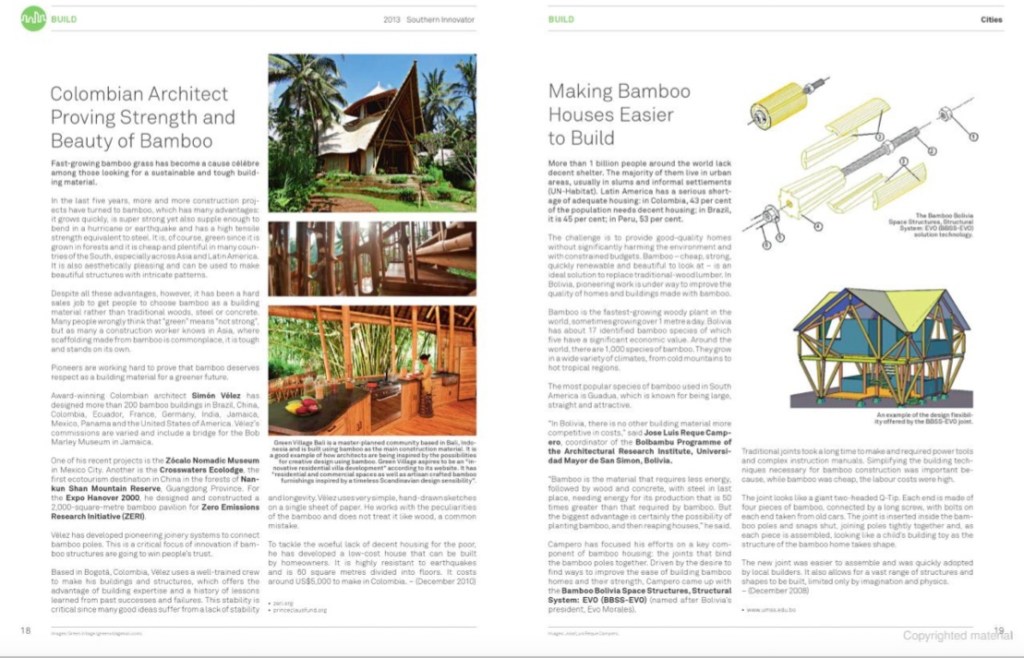
    Fast-growing bamboo grass (http://en.wikipedia.org/wiki/Bamboo) has become a cause celebre amongst those looking for a sustainable and tough building material.

    In the last five years, more and more construction projects have turned to bamboo. It has many advantages: it grows quickly, is super-strong yet also supple enough to bend in a hurricane or earthquake and has a high tensile strength (http://en.wikipedia.org/wiki/Ultimate_tensile_strength) equivalent to steel. It is, of course, green since it is grown in forests, and is cheap and plentiful in many countries of the South, especially across Asia and Latin America.

    It is also aesthetically pleasing and makes beautiful structures with intricate patterns.

    But despite all these advantages, it has been a hard sales job to get people to choose bamboo as a building material rather than traditional woods, steel or concrete. Many people wrongly think green means not strong. But as many a construction worker knows in Asia, where scaffolding made from bamboo is commonplace, it is tough and stands on its own.

    Pioneers are working hard to prove bamboo deserves respect as a building material for a greener future.

    Award-winning Colombian architect Simón Vélez has designed more than 200 bamboo buildings in Germany, France, the United States, Brazil, Mexico, China, Jamaica, Colombia, Panama, Ecuador, and India.

    Vélez’s commissions are varied, and include a bridge for the Bob Marley Museum in Jamaica.

    One of his recent projects is the Zócalo Nomadic Museum (http://en.wikipedia.org/wiki/Nomadic_Museum) in Mexico City. Another is the Crosswaters Ecolodge (http://www.asla.org/2010awards/370.html), the first ecotourism destination in China in the forests of Nankun Shan Mountain Reserve, Guangdong Province. For the Expo Hanover 2000, he designed and constructed a 2000-square-meter bamboo pavilion for ZERI (Zero Emissions
    Research Initiative) (http://www.zeri.org/).

    Vélez has developed pioneering joinery systems to connect bamboo poles together. This is a critical focus of innovation if bamboo structures are going to win people’s trust.

    Based in Bogotá, Colombia, Vélez uses a well-trained crew to make his buildings and structures. This has the advantage of building expertise and a history of lessons learned from past successes and failures. That stability is a critical insight: many good ideas suffer from a lack of stability and longevity. He uses very simple, hand-drawn sketches on a single sheet of paper. He works with the peculiarities of the bamboo and does not treat it like wood: a common mistake.

    To tackle the woeful lack of decent housing for the poor, he has developed a low-cost house that can be built by home-owners. It is highly resistant to earthquakes and is 60 square metres divided on two floors. It costs
    around US $5,000 to make in Colombia.

    Winner of the Prince Claus Fund (http://www.princeclausfund.org/en/index.html), Vélez’s work promotes sustainable development, introducing new ideas on ecological issues and questions. The Fund calls him an architect “whose aesthetic and technical innovations have considerably expanded the possibilities of bamboo as a building material, providing a challenge to prevailing architectural trends.”

    With more than 1 billion people around the world lacking decent shelter, many see plentiful bamboo as a key part of the solution. Most people with poor quality housing live in urban areas, usually in slums and informal settlements (UN-HABITAT). Latin America has a serious shortage of adequate housing: in Colombia, 43 percent of the population needs decent housing; in Brazil, 45 percent; Peru, 53 percent.

    The challenge is to provide good quality homes without significantly harming the environment – and with constrained budgets. Bamboo – cheap, strong, quickly renewable and beautiful – is an ideal solution to replace traditional wood lumber.

    Bamboo is the fastest growing woody plant in the world, sometimes growing over 1 metre a day. Around the world, there are 1,000 species of bamboo. They grow in a wide variety of climates, from cold mountains to hot tropical regions.

    Once called the “poor man’s timber” – a temporary building material to replace once there is more money – bamboo is now getting the respect it deserves. Bamboo for housing has a long history in Latin America, stretching back 4,500 years to ancient civilizations. In Asia, it has long been a traditional construction material. But most of the existing bamboo dwellings in Latin America are 50 to 100 years old.

    The most popular species of bamboo used in South America is Guadua, which is known for being large, straight and attractive.

    Thoughtful and methodical pioneers like Vélez are proving bamboo has a viable future as a building material that will tackle the housing needs of the world’s poor and the fast-growing cities of the South.

    Published: December 2010

    Resources

    Development Challenges, South-South Solutions was launched as an e-newsletter in 2006 by UNDP’s South-South Cooperation Unit (now the United Nations Office for South-South Cooperation) based in New York, USA. It led on profiling the rise of the global South as an economic powerhouse and was one of the first regular publications to champion the global South’s innovators, entrepreneurs, and pioneers. It tracked the key trends that are now so profoundly reshaping how development is seen and done. This includes the rapid take-up of mobile phones and information technology in the global South (as profiled in the first issue of magazine Southern Innovator), the move to becoming a majority urban world, a growing global innovator culture, and the plethora of solutions being developed in the global South to tackle its problems and improve living conditions and boost human development. The success of the e-newsletter led to the launch of the magazine Southern Innovator. 

    Creative Commons License

    This work is licensed under a
    Creative Commons Attribution-Noncommercial-No Derivative Works 3.0 License.

    ORCID iD: https://orcid.org/0000-0001-5311-1052.

    © David South Consulting 2023

  • Business as a Tool to Do Good

    Business as a Tool to Do Good

    By David SouthDevelopment Challenges, South-South Solutions

    SOUTH-SOUTH CASE STUDY

    The United States’ fast-paced and highly inventive technology sector is re-shaping philanthropy and proving it is possible to do good and make money at the same time. The approach taken by these philanthropists is flavoured by their experiences in the cut-throat world of technology, where innovation is a necessity and where re-invention and risk are de rigeur. They share many of these qualities, counter intuitively, with millions of the world’s poor as they struggle day in and day out to survive and get ahead.

    Differing from the Fairtrade movement – whose origins are in NGOs seeking guaranteed fair price for goods – so-called ‘venture philanthropists’ and ‘social entrepreneurs’ focus more on profit and growth. They draw their inspiration from the online networks that have rocked the business world in the past few years, and look to apply a model of constant innovation.

    The past ten years have seen non-profits more and more adopt the language and methods of business. For ‘venture philanthropists’ and ‘social entrepreneurs’, business is the tool to do good. By breaking out of the narrow view of philanthropy as about giving away money, it becomes possible to see the connections between doing good and making good money, venture philanthropists argue. And as more people think this way, more tools are emerging to make it easier and easier to do.

    The highly successful online auction house Ebay’s founders Jeff Skoll and Pierre Omidyar are part of a wave of new thinking from California’s high-tech Silicon Valley that is shaping the way huge sums of private capital get invested in social change.

    ‘Venture philanthropists’ focus on a small portfolio of grantees that make the most of the investment. By giving them large, long commitments, including money for infrastructure such as staff and computers, they don’t spend all their time fundraising. And unlike traditional philanthropists, they get in their offices and work with them like partners instead of waiting for annual reports, and they hold the grantees to quantifiable goals.

    The success of Nobel Prize winner Mohammed Yunus and his microcredit bank, Grameen, has spawned an even more ambitious venture. The Omidyar Network – led by billionaire Omidyar – calculated it would take between US $50 and US $60 billion to provide micro-lending services to the entire world’s poor. The Network is currently putting together the financing to launch this new micro-lending facility across the world. According to Omidyar, private capital is functionally limitless. Look at it that way, he said recently to the Los Angeles Times, and “$60 billion is nothing.”

    Billing itself as a nonprofit venture capital firm, the Acumen Fund uses the principles of design to solve the problems of the poor. Just as the Procter & Gambles (PG) and Motorolas (MOT) of the corporate world conduct extensive ethnographic research on consumers, Acumen finances companies that create systems from the bottom up. “Start with the individuals,” said founder Jacqueline Novogratz. “Build systems from their perspective. Really pay attention, and then see if they can scale.”

    Under Novogratz’s leadership, the New York-based fund manages $20 million in investments in companies that fall within three portfolios: health, water, and housing. It’s not a lot of money compared with any of the traditional venture funds in Silicon Valley. But Acumen’s goal is not to launch initial public offerings. Rather, Novogratz and her team are building prototypes for new business models that measure returns in social benefits as well as monetary rewards.

    “We are betting on entrepreneurs, we look for a strong management team,” said Brian Trelstad, Chief Investment Officer of the Acumen Fund. “We currently have US $20 million in investments in six countries. We hope to take that to US $100 million in the next five years. We are beginning to see a really rich pipeline developing in our investment countries and more high quality investment opportunities coming our way. We are looking for people who are passionate about their approach and who continue to build their business from the perspective of the people in need.”

    Larry Page and Sergey Brin, the founders of the successful search engine Google, started their philanthropic wing, Google.org, following Ebay’s example. They endowed Google.org with stock now worth about US $1 billion. Then they followed Omidyar’s example and set themselves up as a for-profit network.

    “In the old American business model, the relationships between a firm and its investors, bank, suppliers and customers tended to be very arm’s length,” says Annalee Saxenian, dean of UC Berkeley’s School of Information. “You would make a deal and report back after some specified period of time. The new business model is much more engaged. Everyone learns from one another, and there is a continuous flow of information. The firms are more specialized, but they see each other as collaborators.”

    The approach, just like in the pell mell pace of the computer industry, is relentless. Just as computer software and hardware manufacturers follow a constant improvement and innovation cycle, so can social entrepreneurs.

    Published: March 2007

    Resources

    • The Skoll Centre for Social Entrepreneurship at Oxford’s Said Business School, hosts the Skoll World Forum every year to promote entrepreneurial solutions to social problems.
    • Ashoka: Ashoka is the global association of the world’s leading social entrepreneurs. It identifies and invests in leading social entrepreneurs with innovative and practical ideas at the launch stage. They then receive a living stipend for three years to focus on their ideas.
    • Social Ventures Partners: While only focused on the Seattle, USA area, SVP offers a model that can be applied throughout the global South. The vision of the founders was to build a philanthropic organization using a venture capital model, where partners actively nurture their financial investments with guidance and resources.
    • Generation Investment Management: Started in 2004 with former US vice president Al Gore, they only focus on investments that are long-term, sustainable and that they really believe in.
    • Omidyar Network: Started by Ebay’s founders, it funds for-profits and non-profits who promote equal access to information, tools and opportunities, and encourage shared interests and a sense of ownership among participants.
    • Skoll Foundation: The mission of the Foundation is to seek out social entrepreneurs who are already implementing successful programs on a small scale, and then through three-year awards, support the continuation, replication or extension of the program. Issues funded are: tolerance and human rights, health, environmental sustainability, economic and social equity, institutional responsibility, and personal security.
    • SV2: Silicon Valley Social Venture Fund: A partnership of successful technology entrepreneurs, it pools funds to support social entrepreneurs by giving money and giving time – venture philanthropy.
    • Google.org: It uses the talent, technology and financial resources of the successful search engine to tackle global poverty.
    • Acumen Fund: A non-profit venture fund that invests in market-based solutions to global poverty. The Fund supports entrepreneurial approaches to developing affordable goods and services for the 4 billion people in the world who live on less than $4 a day.
    • TechnoServe: Helps budding entrepreneurs turn good business ideas into thriving enterprises. With funding from the Google Foundation, they are launching a Business Plan Competition and an Entrepreneurship Development Program in Ghana.

    Development Challenges, South-South Solutions was launched as an e-newsletter in 2006 by UNDP’s South-South Cooperation Unit (now the United Nations Office for South-South Cooperation) based in New York, USA. It led on profiling the rise of the global South as an economic powerhouse and was one of the first regular publications to champion the global South’s innovators, entrepreneurs, and pioneers. It tracked the key trends that are now so profoundly reshaping how development is seen and done. This includes the rapid take-up of mobile phones and information technology in the global South (as profiled in the first issue of magazine Southern Innovator), the move to becoming a majority urban world, a growing global innovator culture, and the plethora of solutions being developed in the global South to tackle its problems and improve living conditions and boost human development. The success of the e-newsletter led to the launch of the magazine Southern Innovator. 

    Creative Commons License

    This work is licensed under a
    Creative Commons Attribution-Noncommercial-No Derivative Works 3.0 License.

    ORCID iD: https://orcid.org/0000-0001-5311-1052.

    © David South Consulting 2023

  • Creative and Inventive Ways to Aid the Global Poor

    Creative and Inventive Ways to Aid the Global Poor

    By David SouthDevelopment Challenges, South-South Solutions

    SOUTH-SOUTH CASE STUDY

    As the saying goes, “necessity is the mother of invention”. Poverty can be a major spur to invention, and invention a route out of poverty – but only if the poor in the developing world can get the recognition, capital and support for navigating the legal and bureaucratic hurdles that will inevitably stand in their way. Thankfully many new initiatives acknowledge this.

    Contrary to popular perception, the poor do have buying power, as has been documented by Massachusetts Institute of Technology (MIT) professors Abhijit Banerjee and Esther Duflo in their paper “The Economic Lives of the Poor”. Surveying 13 countries, they found those living on less than a dollar a day, the very poor, actually spent 1/3 of their household income on things other than food, including tobacco, alcohol, weddings, funerals, religious festivals, radios and TVs. The researchers also found that the poor increasingly used their spending power to seek out private sector options when the public sector failed to provide adequate services. As awareness of global poverty has grown in the past decade, a new wave of scientists, inventors and entrepreneurs has started to apply their considerable brain power to tackling the everyday problems of the poor.

    Afrigadget, a website celebrating African ingenuity and inventions, serves as a goldmine for small-scale entrepreneurs looking for inspiration. All the inventions on the website share something in common: they are grassroots, homemade and handmade solutions to everyday problems of the poor. Examples of inventions profiled on the website include multi-machines, basically a 3-in-1 machine used as a metal lathe, mill and drill press, all built by hand from old car engine parts; a US $100 bicycle motor that gets 50 kilometres per liter made in Kisumu, Kenya; hand-made African wire toys; do-it-yourself telephone handsets which are then used to run roadside phone booths as a small business; and Malawian homemade windmills used to generate electricity for both home use and as a business to recharge mobile phone and radio batteries.

    Another African invention tackles the urgent need for inexpensive or free common toilets that are self-financing. In the Kibera slum of Nairobi, Kenya, where 60 percent of the city’s inhabitants live, the lack of decent toilet facilities has led to the widespread use of so-called “flying toilets”, plastic bags filled with excrement and then flung as far away as possible. The resulting build-up turns the streets into a foul-smelling sludge in the rainy season and causes disease outbreaks like diarrhoea and typhoid fever. Up to now, conventional attempts to provide communal toilets have failed to resolve the problem, because they charge too much to use. But an innovative solution has been developed: bio-latrines that capture the methane gas produced by the toilets for sale as gas for cooking, heating and lighting, and the sludge for fertilizer. A joint initiative between a Kenyan company, Globology Limited, and the NGOs Umande Trustand Ushirika Roho Safi Laini Saba, it is partly funded by the Swedish International Development Agency (SIDA). The toilets are used by 500 people a day and are self-financing from the profits made by the sale of the gas and fertilizer.

    In India, social entrepreneurs have stepped in to help the rural poor navigate the Indian government bureaucracy. Drishtee, an internet service provider – offers a fast-track to government services used by the poor in rural villages through its e-government services information kiosk. Using a franchise model, it has branches spread out through 160 locations in the country and serves 1.5 million people. Drishtee’s niche is that it saves the poor the exhausting and draining time and long travel normally required to access any government services. Drishtee’s “ask a government employee” service brings government to the poorest people.

    Operating out of New Zealand and South Africa, Ecologics is an engineering company focused on developing appropriate technologies for sustainable livelihoods in developing countries. All their inventions are built around the principles of low maintenance and costs, and ease of use. Its African operations are based in South Africa and run under the Black Economic Empowerment (BEE) scheme. It builds step powered pumps, the Step Action Water Pump which works just like a gym step exercise machine and is a highly efficient way to power the pump – for small scale mining and agricultural irrigation. The pumps can deliver 5,000 to 6,000 litres of water per hour, weigh just 11 kilograms, and have been field tested in Fiji, Lesotho and South Africa.

    Published: April 2007

    Resources

    • NextBillion.net: Hosted by the World Resources Institute, it identifies sustainable business models that address the needs of the world’s poorest citizens.
    • A paper on social lending via the web: PDF version
    • African Inventors Museum: The International African Inventors Museum promotes positive images and self-esteem in children and adults and teaches people of all nationalities about the contributions that Africans throughout the world have given to society.
    • AU-WIPO Prize: The AU-WIPO is an initiative of the Africa Union Commission and the World Intellectual Property Organization. It is a leading continental award in Africa honoring the scientists and technologists whose efforts are towards addressing critical problems in Africa and the attainment of the Millennium Development Goals.
    United Nations e-newsletter Development Challenges, South-South Solutions visited the Berlin, Germany headquarters of start-up betterplace.org in 2009. It was the dawn of the Berlin digital tech boom.

    Development Challenges, South-South Solutions was launched as an e-newsletter in 2006 by UNDP’s South-South Cooperation Unit (now the United Nations Office for South-South Cooperation) based in New York, USA. It led on profiling the rise of the global South as an economic powerhouse and was one of the first regular publications to champion the global South’s innovators, entrepreneurs, and pioneers. It tracked the key trends that are now so profoundly reshaping how development is seen and done. This includes the rapid take-up of mobile phones and information technology in the global South (as profiled in the first issue of magazine Southern Innovator), the move to becoming a majority urban world, a growing global innovator culture, and the plethora of solutions being developed in the global South to tackle its problems and improve living conditions and boost human development. The success of the e-newsletter led to the launch of the magazine Southern Innovator. 

    Creative Commons License

    This work is licensed under a
    Creative Commons Attribution-Noncommercial-No Derivative Works 3.0 License.

    ORCID iD: https://orcid.org/0000-0001-5311-1052.

    © David South Consulting 2023

  • Many Positive Trends for Africa in 2010

    Many Positive Trends for Africa in 2010

    By David SouthDevelopment Challenges, South-South Solutions

    SOUTH-SOUTH CASE STUDY

    While 2009 saw the global economic crisis spread around the world, the story is more complex and more hopeful than many believe. For Africa, various trends are pointing to positive economic development in 2010, despite the continent’s numerous political, social and environmental challenges. Pragmatism is driving stronger economic ties between Africa and the rest of the world, while long-running trends are delivering opportunity to millions despite setbacks.

    The Standard Chartered bank (http://research.standardchartered.com/Pages/home.aspx) believes sub-Saharan Africa will jolt itself out from the 1 percent growth it had in 2009, to reach 4.7 percent growth in 2010 and 5.7 percent in 2011 (http://research.standardchartered.com/researchdocuments/Pages/ResearchArticle.aspx?&R=66952). The reason? The world’s strong appetite for commodities and food, which will continue to draw in business. And much of this business will be done by that powerhouse of the global South, China.

    The fact that China is trading better infrastructure – roads, rail and ports – for commodities means other businesses can also benefit from the improving environment. Throughout the downturn in 2009, China actually increased its investments in Africa.

    The United States is also trying to increase its economic relationship with Africa. It wants a third of its oil imports to come from West Africa by 2015.

    And the competition for food in the world, as countries address the global food crisis, has seen companies from the Middle East to Asia to Britain purchasing land in Africa to grow more food.

    The Annansi Chronicles blog on African business and culture trends (www.annansi.com) has come up with a list of the big trends to watch out for on the continent in 2010. They build upon many of the patterns that have emerged in the past few years in Africa.

    The blog predicts that Africa will increasingly be an innovation incubator. Concepts like the bottom of the pyramid – where the poor are seen as an unserved marketplace of needs – will draw more private companies in to innovate new products and services. Already, products and services trialled in Africa are then launched in other places in the world. One example has been mobile phone banking. The blog sees the challenge for Africa as finding ways to increase innovation and harness its economic benefits within the continent, and to direct resources to the African pioneers out there who need money and infrastructure support to grow their ideas.

    Mobile phones will continue to be the source of opportunity in Africa in 2010. Get ready for more businesses to take advantage of the move from analog to digital in Africa, as fibre optic cables continue to expand. Just as the introduction of broadband internet in developed countries gave birth to new businesses like You Tube (www.youtube.com), so it will create new opportunities in Africa. The key to growing the prosperity from this is to see governments and the private sector better connect with African technology pioneers, as can be found in hot spot countries like Ghana.

    Along with technology comes content. And the people to make the content interesting and attractive will be Africa’s so-called ‘creative class’: savvy young African entrepreneurs and thinkers. They have drawn on the rising urbanization of the continent and greater international travel to explore new ways of representing African culture. This has come forward in the explosion in media, fashion, music and design. The blog believes the 2010 FIFA World Cup in South Africa (http://www.fifa.com/worldcup) is going to thrust the world’s attention on to Africa’s creative class: a global media burst that will be an opportunity not to be missed.

    And this will also challenge global perceptions of “brand Africa.” Already, the world’s tourists flow to Africa in greater numbers, defying decades of negative media publicity. Brand Africa will be up for grabs in 2010.

    And finally, while China has been the big story in terms of economic investment in Africa, India will start to make more moves to catch up by flexing its information technology muscles. Look for more joint partnerships between African countries and Indian technology companies.

    In short, Africa has as many positive trends for 2010 as negative ones. It is just a matter of focusing on the good so the negative will not have a fighting chance in 2010.

    Published: January 2010

    Resources

    1) Design Indaba: See the latest on the catwalks in all-day fashion shows; attend short films, talks and product launches; be enticed to buy from more than 260 exhibitors and hobnob with the designers in person. Above all, be awed by the creative spirit of innovative South Africans. Website: http://www.mobileactive.org

    2) Maker Faire Africa: African pioneers in grassroots innovation offer inspiring inventions. Website: http://makerfaireafrica.com/

    3) Arise Africa Fashion Week: The place to be seen and to see. Website: http://www.africanfashioninternational.com/africaFashionWeek/

    https://davidsouthconsulting.org/2020/12/15/development-challenges-south-south-solutions-newsletter-2007-2010-2/

    https://davidsouthconsulting.org/2022/11/29/new-magazine-13-october-2010/

    https://davidsouthconsulting.org/2022/11/28/new-website-on-the-way-16-september-2010/

    https://davidsouthconsulting.org/2022/12/01/off-to-the-printers-with-a-new-name-southern-innovator-14-may-2010/

    https://davidsouthconsulting.org/2022/11/01/southern-innovator-magazine-2010-2014/

    https://davidsouthconsulting.org/2021/02/22/team-southern-innovator-phase-1-development-2010-2015/

    https://davidsouthconsulting.org/2021/10/28/2010-development-challenges-south-south-solutions/

    https://davidsouthconsulting.org/2022/10/25/2011-trends-for-the-south/

    Development Challenges, South-South Solutions was launched as an e-newsletter in 2006 by UNDP’s South-South Cooperation Unit (now the United Nations Office for South-South Cooperation) based in New York, USA. It led on profiling the rise of the global South as an economic powerhouse and was one of the first regular publications to champion the global South’s innovators, entrepreneurs, and pioneers. It tracked the key trends that are now so profoundly reshaping how development is seen and done. This includes the rapid take-up of mobile phones and information technology in the global South (as profiled in the first issue of magazine Southern Innovator), the move to becoming a majority urban world, a growing global innovator culture, and the plethora of solutions being developed in the global South to tackle its problems and improve living conditions and boost human development. The success of the e-newsletter led to the launch of the magazine Southern Innovator. 

    Creative Commons License

    This work is licensed under a
    Creative Commons Attribution-Noncommercial-No Derivative Works 3.0 License.

    ORCID iD: https://orcid.org/0000-0001-5311-1052.

    © David South Consulting 2023