Tag: UNOSSC

  • Reality Television Teaches Business Skills in Sudan

    Reality Television Teaches Business Skills in Sudan

    By David SouthDevelopment Challenges, South-South Solutions

    SOUTH-SOUTH CASE STUDY

    Learning how to thrive in a market economy does not necessarily come naturally. But for young people who have grown up under a different economic system or known nothing but economic chaos, learning business skills can give them the tools to get on in life.

    With youth unemployment rates high around the world, it is clear many young people may never get the jobs they expect unless they start businesses themselves.

    In 2013, 73.4 million young people were out of work, an increase of 3.5 million from 2007. A report by the International Labour Organization (ilo.org) found persistent unemployment around the world in the wake of the global economic crisis, a proliferation of temporary jobs and growing youth discouragement in advanced economies; and poor quality, informal, subsistence jobs in developing countries. School-to-work transition surveys of developing countries showed that youth are far more likely to land low-quality jobs in the informal economy than jobs paying decent wages and offering benefits.

    High youth unemployment often has nothing to do with poor educational achievement (many unemployed youth have high school educations or university degrees), but is often caused by other factors, including lack of access to capital, rigid labour markets, skills mismatched to demand in the economy (for example construction and building trades), or a gap between personal aspirations and the true state of the country’s economic development.

    But rather than despair, it is possible to show youth how to turn things around and use business skills to re-shape economies in their favor. Youth tend to bring to the economy energy and drive combined with new ideas and experiences calibrated to the demands of the 21st century. By harnessing this, youth can find a unique space in the marketplace. In turn, young people can lead in reviving damaged economies and making their countries wealthier and healthier. Many youth have grown up around the emerging digital economy and the use of mobile phones. Being comfortable with the 21st century digital economy will unleash many economic opportunities that favor youth.

    The British Council says that “creative entrepreneurship is considered the most efficient model for youth in the developing world who are facing huge difficulties in finding employment”. The entrepreneurship or creative investment industry is one of the fastest-growing sectors in the world.

    Understanding what works for youth business entrepreneurship has become a specialty in its own right. Using the media to teach skills and inspire youth to action is one proven approach.

    One recent example is a successful television programme from the Republic of the Sudan. Called Mashrouy (mashrouy.com), it is modeled on reality TV programmes such as The Apprentice, which features serial U.S. entrepreneur Donald Trump (http://www.bbc.co.uk/programmes/b00q3fkq) and the BBC’s Dragon’s Den (http://www.bbc.co.uk/programmes/b006vq92), where contestants pitch their ideas to a panel of judges to see if they can get funding for their business idea.

    In Mashrouy, 12 contestants battled it out to see who had the best business idea. They undertook various challenges and the original 12 were whittled down to three contestants. Live on air in December 2013, viewers voted for their favorite contestant and the winner (https://www.facebook.com/Mashrouy) received a prize of 200,000 SDG (US $35,211), while the second prize winner received 150,000 SDG (US $26,408) and the third prize winner received 100,000 SDG (US $17,605). All three were then taken to London in the United Kingdom to meet other creative entrepreneurs and receive valuable business advice.

    The Sudanese show (http://sudan.britishcouncil.org/our-work/mashrouy) is supported by the British Embassy and the British Council, and is working with the Sudanese Young Businessmen Association and major Sudanese companies to spread the idea of entrepreneurship among the youth of Sudan.

    Sudan suffered a brutal civil war on and off throughout the 2000s, leading to the partition of the original country into the Republic of the Sudan and the new nation of South Sudan in 2011.

    Faced with Sudan’s serious youth unemployment – as high as 34 per cent – and a fragile economy, the TV show’s producers wanted to encourage youth to start businesses.

    The contest was aimed at youth between 18 and 40 and appeared on the Blue Nile (http://bnile.tv/blue.html) channel.

    “At a time of national economic hardship, it has kindled the imagination of Sudanese youth,” wrote journalist Isma’il Kushkush (https://twitter.com/ikushkush) in The New York Times.

    For the show, a panel of experts picked 12 projects out of 2,500 applications. Each of the 12 finalists was given a chance to do a “pitch,” giving a quick summary of their business idea and trying to get the panel excited about the idea and its potential. The idea that generated the most excitement won.
    The 12 pitches included an idea for an ostrich farm and a plan to export spicy peanut butter. The winner, 32-year-old Samah al-Gadi, wants to use a locally available weed-like river plant to make bags and furniture. She said she got up the courage to be on the show from a supportive mother.

    “Amid ululations, screams and clapping, a jubilant Ms. Gadi raised both hands above her scarf-covered head, flashing victory signs,” The New York Times said. “Her mother, sitting at a dinner table, was brought to tears.”

    The women-owned social enterprise Making Cents International (makingcents.com), based in Washington, D.C., USA, has been gathering resources on youth entrepreneurship since 1999. It has put together a custom “curricula to develop the mindset, skillset, and toolset that enable entrepreneurs and enterprises to participate in profitable markets; financial institutions to serve new populations; and individuals to obtain meaningful work”.  This is available in 25 languages. It also hosts the Global Youth Economic Opportunities Conference in Washington, DC, held this year from 6 to 8 October 2014 (http://youtheconomicopportunities.org/conference).

    Published: April 2014

    Resources

    1) Khartoum Teaching Centre: The British Council is a world leader in English language training and teaching. It offers general English courses for adult learners of all levels, totaling 60 hours of tuition over 10 weeks. Website: http://sudan.britishcouncil.org/learn-english/courses

    2) Start-up Chile innovation fund: Start-Up Chile is a program created by the Chilean Government, executed by Corfo via InnovaChile, that seeks to attract early stage, high-potential entrepreneurs to bootstrap their startups in Chile, using it as a platform to go global. Website: startupchile.org

    3) Global Youth Economic Opportunities Conference 2014: From 6 to 8 October Youth entrepreneurship conference in Washington, D.C., USA. Website: youtheconomicopportunities.org/conference

    4) Making Cents International: The Youth Economic Opportunities learning platform is the first community of practice and knowledge exchange portal developed by and for the youth economic opportunities sector. Website: youtheconomicopportunities.org

    5) Mongolian Rock Pop book: A book published by UNDP in the Mongolian language on how the country’s rock and pop musicians led on business innovation using creative marketing and publicity during the country’s turbulent transition during the 1990s. Website: http://tinyurl.com/p25scqq

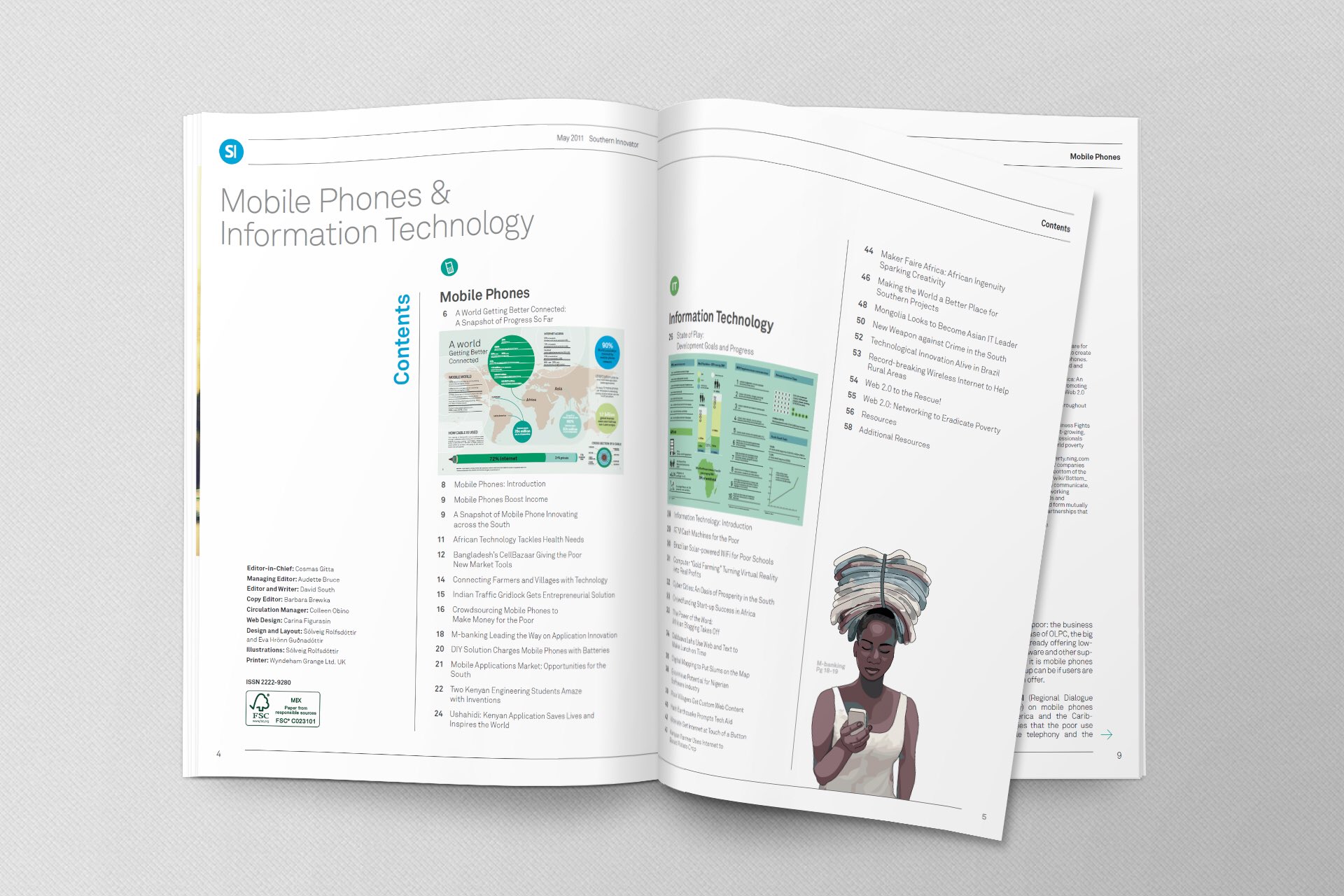
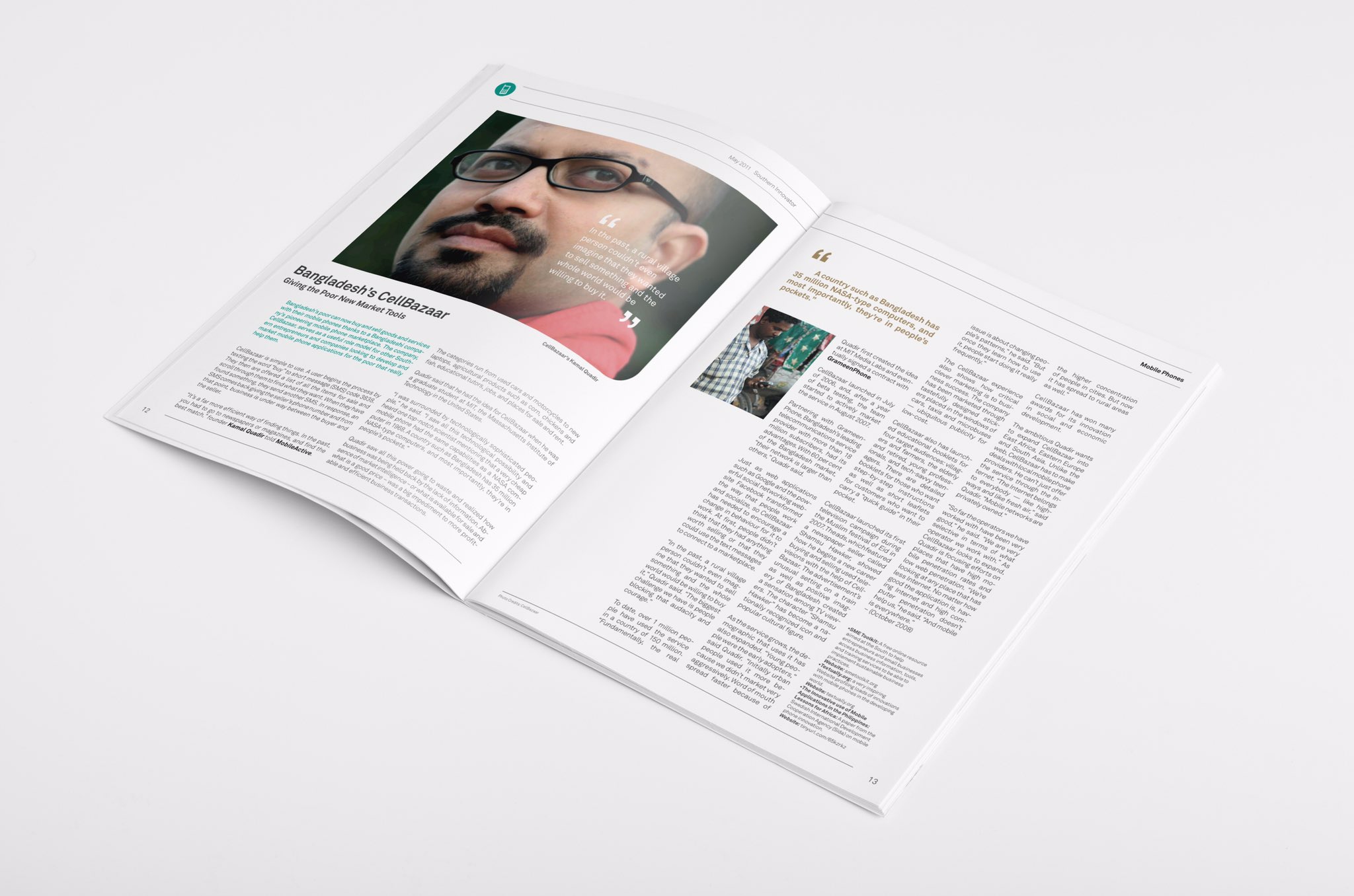
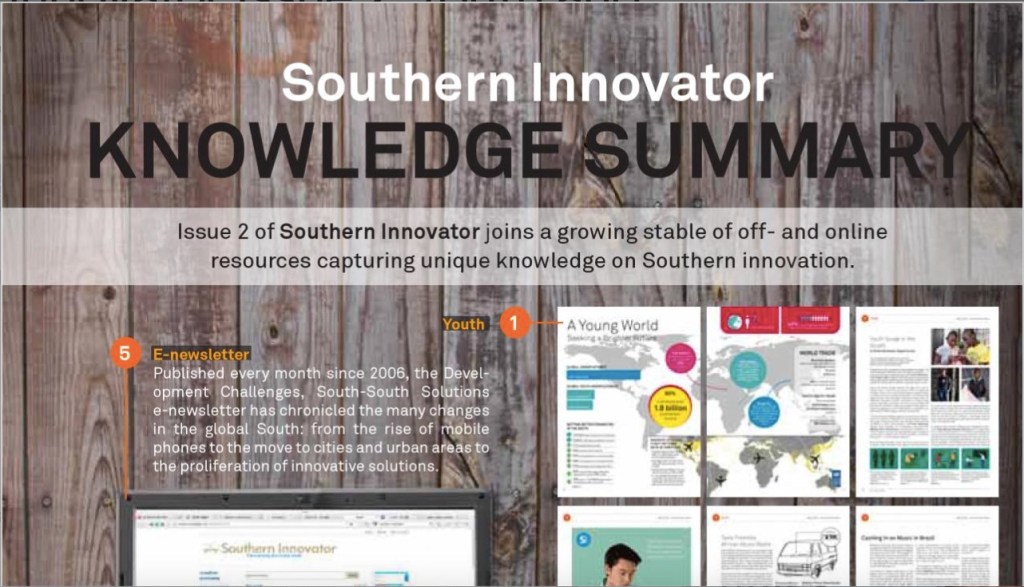
    Development Challenges, South-South Solutions was launched as an e-newsletter in 2006 by UNDP’s South-South Cooperation Unit (now the United Nations Office for South-South Cooperation) based in New York, USA. It led on profiling the rise of the global South as an economic powerhouse and was one of the first regular publications to champion the global South’s innovators, entrepreneurs, and pioneers. It tracked the key trends that are now so profoundly reshaping how development is seen and done. This includes the rapid take-up of mobile phones and information technology in the global South (as profiled in the first issue of magazine Southern Innovator), the move to becoming a majority urban world, a growing global innovator culture, and the plethora of solutions being developed in the global South to tackle its problems and improve living conditions and boost human development. The success of the e-newsletter led to the launch of the magazine Southern Innovator. 

    https://davidsouthconsulting.org/2021/03/05/southern-innovator-issue-2/

    Creative Commons License

    This work is licensed under a
    Creative Commons Attribution-Noncommercial-No Derivative Works 3.0 License.

    ORCID iD: https://orcid.org/0000-0001-5311-1052.

    © David South Consulting 2023

  • Arab World Domain Name Opportunity Huge Economic Help

    Arab World Domain Name Opportunity Huge Economic Help

    By David SouthDevelopment Challenges, South-South Solutions

    SOUTH-SOUTH CASE STUDY

    With the so-called Arab Spring still unfolding across much of the Arabic-speaking world, it is easy to miss a rising new economic opportunity: The introduction of an Arabic domain name system for the Internet.

    The explosion in mobile phones in the Arab world has dramatically increased the number of people who can now access the Internet. One Arabic financial website put the number of people who can now access the Internet in one way or another in the Arab world as 75 million (www.nuqudy.com). As highlighted in the 2003 Arab Human Development Report (AHDR), Arabic-speaking countries have been at a knowledge disadvantage for some time: more than 270 million citizens have access to fewer books than other languages, slower growth economies, and greater illiteracy than the faster-growing emerging economies. At the time, the AHDR found there were just 18 computers per 1,000 people compared to a global average of 78. And just 1.6 percent of Arabs had Internet access, one of the lowest ratios in the world (AHDR 2003).

    Since the dawn of the Internet, Latin script has been used exclusively for top-level web domain names, the addresses that end .com, .org and so on. That has been a big obstacle for users of non-Latin script languages like Arabic. It is estimated just 10 percent of people in the Arab world speak English. Many of the resources on the Internet and its utility have been lost to these people. But by using Arabic domain names, there will be a consistency and no more guesswork.

    A typical problem in Latin transliterations of Arabic is the conundrum as to either using El or Al as the prefix to a word. This problem is eliminated when Arabic is used.

    The Arab world is also very mixed, including the resource-rich, cash-rich Gulf States – Kuwait, Qatar, United Arab Emirates, Saudi Arabia, Oman and Bahrain – and states with high rates of poverty such as Egypt, Djibouti and Yemen.

    The protests and uprisings this year in Tunisia, Egypt and elsewhere – with their Facebook pages and Twitter streams – have shown that a growing group of highly Internet-savvy young people is emerging in the Arab world. But for many without the education or the resources, access to knowledge still remains weak. But armed with Internet-capable mobile phones and Arabic language domain names, rapid change is now possible.

    The number of books published in Arabic is notoriously relatively low, and print runs are small. Arabic language books make up just 1.1 percent of world production.

    The AHDR reports have called this knowledge deficit a direct obstacle to human development in Arab countries.

    But things are changing and the rise of Arabic domain names offers the potential for an explosion in Arabic language Internet content.

    In May 2010 ICANN, the world’s Internet domain authority, decided to allow top-level domains in non-Latin script. For Arabic speakers, it started this program in Egypt, Saudi Arabia and the United Arab Emirates.

    As a sign of the importance of Arabic participation in future growth of the Internet, this year’s World Summit for the Information Society (WSIS) held in Geneva, Switzerland in May 2011 was sponsored by the United Arab Emirates (UAE).

    A catchy domain name has many advantages. For Arabic speakers, this means they can type in Arabic domain names for websites and even do it right to left, as they do in print.

    In 2009, the first Arabic domain name was grabbed by Egypt. As the Internet naming authority, the Internet Corporation for Assigned Names and Numbers (ICANN) (www.icann.org), started to allow the registering of non-Latin script names. The domain was for the Arabic word for Egypt or “.masr”.

    As an early adopter, Egypt sees it as an important part of bringing more Arabic speakers online. George Victor, from the Egyptian National Telecom Regulatory Authority, told the BBC: “We believe that this is a great step that will open new horizons for many e-services in Egypt, and it will have its direct impact, enlarging the number of online users.”

    Victor believes using Arabic builds trust.

    “Having a domain name in your own language is a point of having a local identity,” he said.

    “When talking about Arabic domain names, we are talking about having users which are not online now. People with languages disabilities – people who are having language as a barrier to connect online.”

    From now on Internet address names will be able to end with almost any word in any language, offering organizations around the world the opportunity to market their brand, products, community or cause in new and innovative ways.

    The advantages of registering an Arabic domain name are numerous. They include clear improvements to business and trade: an ability to protect a trademark, better communication with Arabic customers, better Arabic-language advertising opportunities, better memorability for Arabic domain names because they will be in the Arabic language, and greater access to Arabic customers.

    But there are also significant improvements to how the Internet functions in the Arabic world. Search results on Arabic search engines will be more precise with Arabic domain names; catchy, memorable domain names will be a spur to the advertising and marketing industries; and a more Arab-friendly Internet will draw in more Arabic-speaking Internet users, helping them to enjoy the fruits of this great technological advance just as speakers of other languages have.

    In March 2011, the Gulf state of Qatar enthusiastically started to offer Arabic domain names.

    “The launch of Qatar’s Arabic top-level domain names is a major milestone as we work to build a more digitally inclusive society,” said Dr. Hessa Al Jaber, Secretary General of the Supreme Council of Information and Communication Technology, which will manage Qatar’s Internet domain names through the Qatar Domains Registry.

    “As more organizations and individuals begin adopting Arabic domain names, the Internet will literally be opened up to broad new audiences. The Arab world represents a region with enormous potential for growth both in terms of usage and the creation of new digital content, especially Arabic content.”

    ICANN’s President and Chief Executive, Rod Beckstrom, sees this as a new phase for the Internet: “ICANN has opened the Internet’s naming system to unleash the global human imagination. Today’s decision respects the rights of groups to create new Top Level Domains in any language or script. We hope this allows the domain system to better serve all of mankind.”

    Published: July 2011

    Resources

    1) Watch the ICANN educational video “Get Ready for the Next Big Thing”, explaining how domain names work and what the changes mean. Website: http://www.icann.org

    https://davidsouthconsulting.org/2022/10/26/africa-to-get-own-internet-domain/

    https://davidsouthconsulting.org/2022/11/11/berber-hip-hop-helps-re-ignite-culture-and-economy/

    https://davidsouthconsulting.org/2020/12/04/data-surge-across-global-south-promises-to-re-shape-the-internet/

    https://davidsouthconsulting.org/2022/02/11/egyptian-youth-turns-plastic-waste-into-fuel/

    https://davidsouthconsulting.org/2022/11/11/innovation-cairos-green-technology-pioneers/

    https://davidsouthconsulting.org/2022/10/29/new-apps-make-driving-and-travelling-in-egypt-easier-safer/

    https://davidsouthconsulting.org/2022/10/21/preserving-beekeeping-livelihoods-in-morocco/

    https://davidsouthconsulting.org/2022/10/21/social-networking-websites-a-way-out-of-poverty/

    Development Challenges, South-South Solutions was launched as an e-newsletter in 2006 by UNDP’s South-South Cooperation Unit (now the United Nations Office for South-South Cooperation) based in New York, USA. It led on profiling the rise of the global South as an economic powerhouse and was one of the first regular publications to champion the global South’s innovators, entrepreneurs, and pioneers. It tracked the key trends that are now so profoundly reshaping how development is seen and done. This includes the rapid take-up of mobile phones and information technology in the global South (as profiled in the first issue of magazine Southern Innovator), the move to becoming a majority urban world, a growing global innovator culture, and the plethora of solutions being developed in the global South to tackle its problems and improve living conditions and boost human development. The success of the e-newsletter led to the launch of the magazine Southern Innovator. 

    Creative Commons License

    This work is licensed under a
    Creative Commons Attribution-Noncommercial-No Derivative Works 3.0 License.

    ORCID iD: https://orcid.org/0000-0001-5311-1052.

    © David South Consulting 2023

  • Africa to Get Own Internet Domain

    Africa to Get Own Internet Domain

    By David SouthDevelopment Challenges, South-South Solutions

    SOUTH-SOUTH CASE STUDY

    Africa is in the midst of an Internet revolution that is set only to accelerate. The continent is one of the last places to experience the information technology revolution that has swept the world in the past two decades.

    Africa has been at a disadvantage for several reasons, the most basic of which has been the lack of bandwidth capacity available from the undersea cables that connect other continents to the Internet. A map showing the world’s undersea cable links says it all: the majority of traffic goes between Europe and the United States (http://www.telegeography.com/telecom-resources/telegeography-infographics/submarine-cable-map/).

    But this is changing: a glance at recent developments with the launching of the Seacom, EASSy, MainOne and other cables shows a continent getting better connected by the year (http://manypossibilities.net/african-undersea-cables/).

    With seven out of the 10 fastest-growing economies in the world between 2011 and 2015 projected to be in sub-Saharan Africa, the conditions are ripe to grow African Internet businesses. For example, Ghana, with its booming information technology sector, boasted 13 percent economic growth last year, among the fastest in the world.

    In eight of the past 10 years, sub-Saharan Africa has grown faster than Asia (The Globe and Mail).

    While Africa has come late to the Internet party, the continent can benefit from two decades of experience elsewhere to avoid making the mistakes others have. Africa can upload tried and tested Internet platforms and can also create new, Africa-specific platforms that tackle the continent’s own needs and challenges.

    One of the ways to make the most of the opportunities presented by the Internet is to have an Africa-specific Internet domain name. A domain name (http://en.wikipedia.org/wiki/Domain_name) is the suffix placed after the period in Internet URL (uniform resource locator) (http://en.wikipedia.org/wiki/Uniform_resource_locator) addresses. Common ones familiar to most people who use the Internet include .com (for commercial websites), .org (for non-profit websites and organizations), .co.uk (for British businesses) or .ca (for Canadian organizations).

    The dot Africa (.africa) domain name will be available in the next 15 months according to the Internet Corporation for Assigned Names and Numbers (ICANN) (http://www.icann.org/). It is currently reviewing 500 African organizations that have expressed interest in managing the domain name registrations, and will choose one at the beginning of 2013.

    Countries such as Kenya and South Africa – two places in Africa with booming information technology sectors – are hoping to make the most of the new dot Africa domain name.

    The idea is to use the dot Africa domain name to build a stronger brand for the continent’s Internet that will be bigger than the individual country domain names. Sophia Bekele, executive director of DotConnectAfrica, told CNN the suffixes for individual African countries had proven unpopular during the decade since their introduction.

    Her organization found that 80 per cent of African domain name registrants had opted for “.com” or “.org” suffixes, which were price competitive, reliable to register and had wide recognition.

    The country-level domain names suffered from being “usually owned by governments, and governments are typically not very good at marketing,” she told CNN.

    Bekele’s research found young developers involved in creating local content felt a stronger affinity with the “.africa” suffix than to the “.com” domains. And the new suffix will let companies unify their presence across the continent under a single online brand.

    A major benefit of the “.africa” domain will be that proceeds from African domain registrations remain on the continent, rather than flowing offshore. DotConnectAfrica says it plans to reinvest surpluses into developing the African Internet sector.

    The African Union Commission (http://www.au.int/en/commission) is also looking to register the .afrique (French language websites) and .afriqia (Arabic language websites).

    The AUC’s head of information society, Moctar Yedaly, told CNN the commission’s vision for the .africa domain is not just commercial.

    “It may well be a very good business in terms of money generating. If it may generate some revenue we can use for the development of ICT in Africa, then that is all very good, but that’s not my primary goal,” he told CNN. “My primary goal is to ensure the identity of Africa, the image, the culture are well-maintained.”

    Published: October 2012

    Resources

    1) The Wikipedia page on the .africa initiative. Website: http://en.wikipedia.org/wiki/.africa

    2) ICANN: To reach another person on the Internet you have to type an address into your computer — a name or a number. That address must be unique so computers know where to find each other. ICANN coordinates these unique identifiers across the world.  Website: http://www.icann.org/

    3) DotConnectAfrica, a non-profit organization registered in Mauritius, is one of the is trying win the right to manage the dot africa name space for businesses and individuals across the continent. Website: http://www.dotconnectafrica.org/

    4) Dot.Africa: Dot.Africa is specialised in realising internet access for international organisations with sites in Africa. Website: http://www.dotafrica.com/about/index.html 

    https://davidsouthconsulting.org/2022/11/21/africa/

    https://davidsouthconsulting.org/2022/11/11/african-breakthroughs-to-make-life-better/

    https://davidsouthconsulting.org/2022/11/19/african-culture-as-big-business/

    https://davidsouthconsulting.org/2022/10/26/arab-world-domain-name-opportunity-huge-economic-help/

    https://davidsouthconsulting.org/2022/10/04/the-brck-kenyan-developed-solution-to-boost-internet-access/

    https://davidsouthconsulting.org/2022/11/23/kenyan-farmer-uses-internet-to-boost-potato-farm/

    https://davidsouthconsulting.org/2022/10/17/mapping-to-protect-kenyas-environment-the-emazingira-solution/

    https://davidsouthconsulting.org/2020/11/30/nollywood-booming-nigerian-film-industry/

    https://davidsouthconsulting.org/2021/03/09/the-power-of-the-word-african-blogging-and-books/

    https://davidsouthconsulting.org/2022/03/30/riverwood-kenyan-super-fast-super-cheap-filmmaking/

    https://davidsouthconsulting.org/2022/10/10/wireless-internet-culture-helping-zimbabwe-economy-recover/

    Development Challenges, South-South Solutions was launched as an e-newsletter in 2006 by UNDP’s South-South Cooperation Unit (now the United Nations Office for South-South Cooperation) based in New York, USA. It led on profiling the rise of the global South as an economic powerhouse and was one of the first regular publications to champion the global South’s innovators, entrepreneurs, and pioneers. It tracked the key trends that are now so profoundly reshaping how development is seen and done. This includes the rapid take-up of mobile phones and information technology in the global South (as profiled in the first issue of magazine Southern Innovator), the move to becoming a majority urban world, a growing global innovator culture, and the plethora of solutions being developed in the global South to tackle its problems and improve living conditions and boost human development. The success of the e-newsletter led to the launch of the magazine Southern Innovator. 

    Creative Commons License

    This work is licensed under a
    Creative Commons Attribution-Noncommercial-No Derivative Works 3.0 License.

    ORCID iD: https://orcid.org/0000-0001-5311-1052.

    © David South Consulting 2023

  • Perfume of Peace Helps Farmers Switch From Drug Trade

    Perfume of Peace Helps Farmers Switch From Drug Trade

    By David SouthDevelopment Challenges, South-South Solutions

    SOUTH-SOUTH CASE STUDY

    A tragedy in a time of war has led to a social enterprise that is creating jobs – and making the world smell a little better, too.

    The 7 Virtues perfume range was started by Canadian Barb Stegemann (http://www.barbstegemann.com/barb-stegemann-in-the-news.html) to harness the energy of social enterprise and women’s buying power to change the dynamic of war and misery created by conflict around the world.

    Stegemann ran a successful public relations company when she was inspired to do something after tragedy struck a good friend who was serving in Afghanistan with the Canadian Armed Forces as part of the NATO mission (http://www.isaf.nato.int/). Hit on the head with an axe while involved in a village meeting, Captain Trevor Greene was thought to be fatally injured but survived, though he is still unable to walk.

    The violent attack shocked Stegemann into action. The enterprise was founded not out of hatred and revenge, but as a way of addressing the serious economic problems and poverty of Afghanistan.

    Wanting to do something, Stegemann was referred to the Turquoise Mountain Foundation (turquoisemountain.org), which is based in Afghanistan’s capital, Kabul. The Turquoise Mountain Foundation is a social enterprise working in Afghanistan to regenerate the country’s traditional arts and historic areas in order to create jobs and boost skills.

    Stegemann was inspired by a farmer called Abdullah Arsala from Jalalabad in the eastern part of the country. He was growing the ingredients for making essential oils, rather than the much more lucrative opium poppies which are used to make the drug heroin and help fuel a vast global illegal drug trade. Heroin addiction ruins many lives around the world and often leads to crime and violence.

    The Turquoise Mountain Foundation did a study and found that if farmers could be paid US $9,912 for a litre of rose oil or US $7,994 for orange blossom oil it would be enough of a market incentive to lure them away from growing opium poppies.

    Stegemann decided to provide that incentive.

    Using her life savings, she established a perfume company. To start, Stegemann bought Arsala’s entire stock of orange blossom oil. After getting further investment through the Canadian television program Dragons’ Den – on which entrepreneurs compete for funding – she launched the company with two perfumes: Orange Blossom of Afghanistan and Noble Rose of Afghanistan.

    With the whole collection rebranded as The 7 Virtues (http://www.the7virtues.com/), the Afghanistan Orange Blossom went on sale at the prestigious Selfridges department store in London, U.K.

    Using Arsala as a go-between, 2,500 farmers in Afghanistan are now supplying essential oils for the perfumes.

    To further expand the concept, Stegemann has launched Middle East Peace (http://www.the7virtues.com/middle_east_peace.php), a perfume made from sweetie grapefruit oil from Israel with lime and basil oils from Iran.

    In Haiti, a country still recovering from the 2010 earthquake disaster and decades of grinding poverty and political and economic chaos, she has created a scent for men using fragrant grass.

    She hopes to also do the same for Rwanda and Syria.

    The perfumes are all-natural and are put together in Toronto, Canada. They are sold in stores in Canada and the United States, as well as Selfridges in London.

    The success has snowballed and a special gift pack has been put together for American Airlines.

    “I never imagined I’d end up on a beauty counter, but this is where the women are and we must connect with them if we are going to reverse this cycle of war and poverty,” Stegemann told The Sunday Times. “Imagine if there were 300 women like me doing things like this. We could make a real difference.”

    Published: November 2013

    Resources

    1) Centre for International Policy Studies: University of Ottawa: A focal point for scholarship and debate on international affairs in Canada. Website: http://cips.uottawa.ca/

    2) Post-war Reconstruction and Development Unit: The PRDU is an international centre of excellence for the study of post-conflict societies and their recovery. Website: http://www.york.ac.uk/politics/centres/prdu/

    3) Peacebuilding and post-conflict recovery: The experience of recent years has also led the United Nations to focus as never before on peacebuilding – efforts to reduce a country’s risk of lapsing or relapsing into conflict by strengthening national capacities for conflict management, and to lay the foundations for sustainable peace and development. Website: http://www.un.org/en/ecosoc/about/peacebuilding.shtml

    United Nations Office on Drugs and Crime: UNODC is a global leader in the fight against illicit drugs and international crime. UNODC is mandated to assist Member States in their struggle against illicit drugs, crime and terrorism. Website: http://www.unodc.org

    Development Challenges, South-South Solutions was launched as an e-newsletter in 2006 by UNDP’s South-South Cooperation Unit (now the United Nations Office for South-South Cooperation) based in New York, USA. It led on profiling the rise of the global South as an economic powerhouse and was one of the first regular publications to champion the global South’s innovators, entrepreneurs, and pioneers. It tracked the key trends that are now so profoundly reshaping how development is seen and done. This includes the rapid take-up of mobile phones and information technology in the global South (as profiled in the first issue of magazine Southern Innovator), the move to becoming a majority urban world, a growing global innovator culture, and the plethora of solutions being developed in the global South to tackle its problems and improve living conditions and boost human development. The success of the e-newsletter led to the launch of the magazine Southern Innovator. 

    Creative Commons License

    This work is licensed under a
    Creative Commons Attribution-Noncommercial-No Derivative Works 3.0 License.

    ORCID iD: https://orcid.org/0000-0001-5311-1052.

    © David South Consulting 2022