Tag: United Nations

  • Creating Green Fashion in China

    Creating Green Fashion in China

    By David SouthDevelopment Challenges, South-South Solutions

    SOUTH-SOUTH CASE STUDY

    China is the world’s largest manufacturer (Euromonitor) and the largest clothing maker, producing a quarter of all textiles and clothing. It is a global fashion production hub, and many major global clothing brands have their products made there – whether they admit it or not.

    Although most people probably do not give it a second thought, the fashion and clothing industries can be highly polluting and exploitive. The use of toxic fertilizers to boost cotton yields leaves behind a legacy of contaminated soil and water tables. Dyes used to colour clothing also can be toxic and pollute water. For people working in this industry – many of whom are women – conditions can vary widely and include low pay and high stress.

    According to the Ethical Fashion Forum, “it is difficult for companies sourcing from China to be sure of fair working practices. There have been many reports of low wages, long hours, and unfair working conditions in factories in China.”

    But one innovative fashion brand is out to transform the way the garment business works in China and to develop a template that could be used in other places such as Africa.

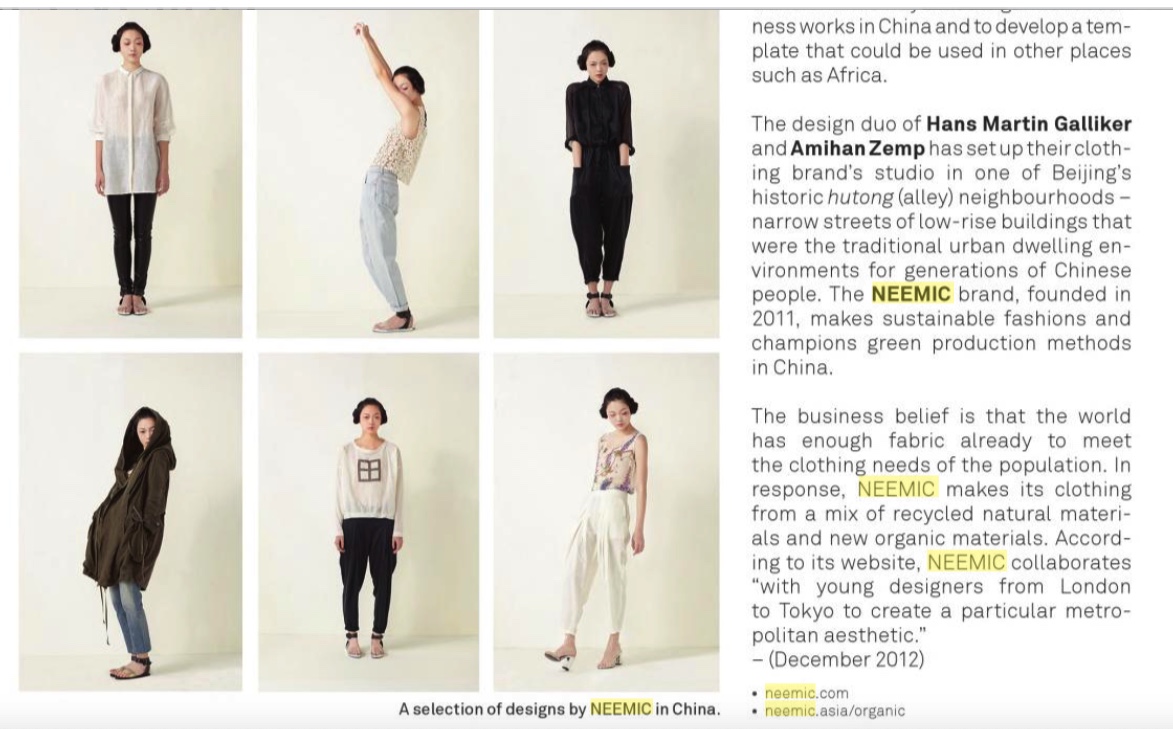
    The design duo of Hans Martin Galliker and Amihan Zemp has set up their clothing brand’s studio in one of Beijing’s historic hutong (alley) neighbourhoods – narrow streets of low-rise buildings that were the traditional urban dwelling environments for generations of Chinese people. The NEEMIC (neemic.com) brand, founded in 2011, makes sustainable fashions and champions green production methods in China.

    The business’s belief is that the world has enough fabric already to meet the clothing needs of the population. In response, NEEMIC makes its clothing from a mix of recycled natural materials and new organic materials. According to its website, NEEMIC collaborates “with young designers from London to Tokyo to create a particular metropolitan aesthetic.”

    “We use the finest natural fabrics for a perfectly comfortable feel,” Galliker said. “We pick the finest natural materials from leftovers of the industry, recycle used clothes, and strive to order new fabrics only from certified organic producers.”

    Hans Martin Galliker began as a farming apprentice in his native Switzerland, and brings a practical bent to his approach to fashion. He draws on his knowledge of farming and agriculture to create a unique eco-conscious fashion product in China.

    Galliker got his start in fashion working for a brand in Shenzhen, southern China. He worked with the organic farms there, and this inspired him to explore sustainability in fashion design and ways of introducing the principles of fair trade to the fashion and textile industries in China.

    Galliker is passionate about taking a different attitude to fashion: “There are many fashion brands and many of them are … meaningless,” he told the China Daily newspaper. “They do fashion which looks more or less … the same, which has no creativity and does a lot of harm to the environment.

    “Growing cotton is highly chemicals and labour-intensive, which degrades the soil and pays people very low salaries. And the dyeing and colouring processes pollute rivers and people receive low salaries but have to work long hours. The whole textile industry is really bad for the environment.”

    NEEMIC has completed three collections of clothing since it was founded in 2011.

    “We started selling some of our designs at a boutique in Beijing that focuses on upcycling fashion. People like it and want to buy more,” said Galliker.

    Upcycling is the process of converting waste material into new products (http://en.wikipedia.org/wiki/Upcycling).

    And to counter any negative perceptions that organic cotton clothing can only ever be unfashionable, Galliker is out to prove it is possible to create stylish organic clothing.

    On top of building the brand, Galliker also works to educate the industry and change ways. He is also setting up a branch in China of the Hong Kong Organic Textile Association (http://neemic.asia/organic), which encourages fashion designers to jointly buy organic materials. He also publishes a website on sustainable agricultural practices in China, with details on current policies on organic farming.

    “It is very normal for Chinese farmers to use many fertilizers, but the environment is going bad and consumers do not like this kind of farming,” Galliker points out. “For farmers, it’s not meaningful to produce only to make money to live a decent life. It should be more than that.”

    The NEEMIC operation is lean: the Beijing studio does all the designing of the clothes, programming of the multilingual websites and runs the online shopping and payment sites.

    For now, the goal is to not only increase the use of organically grown materials but also to introduce the fair trade concept into China.

    “In two years we want to do fair trade production,” Galliker said.

    And he has Africa in his sights with his green fashion template.

    “In the long term we will have many successful projects here or non-profit companies … a lot of creative force and investment so that we can help rural regions in Africa to do sustainable agriculture projects.”

    Published: December 2012

    Resources

    1) Ethical Fashion Forum: The Ethical Fashion Forum is the industry body dedicated to a sustainable future for fashion. A not for profit organisation, EFF aims to make it easy for fashion professionals to integrate sustainability at the heart of what they do. Website: http://www.ethicalfashionforum.com/

    2) Hong Kong Organic Textile Association: Its mission is to promote organic textiles in Hong Kong Website: http://www.facebook.com/HKOrganicTextileAssociation

    3) Tips on how to upcycle. Website: http://www.independent.co.uk/property/interiors/the-insider–how-to-upcycle-without-much-effort-2343100.html

    4) How to create a Lookbook for a fashion brand. Website: http://noisetteacademy.com/2011/05/creating-a-lookbook/

    “We are proud to present our first book entry in David South’s 5th Issue of the Southern Innovator Magazine. The general focus of this paper is to show the rise of the south as a strong economic power, this year’s issue is focussing on the dilemma of strong population growth and limited resources with the focus on waste and recycling issues for example the elephant dung paper production in Thailand, the banning of plastic bags in Uganda or the creation of green fashion in China.” https://neemic.asia/ecological-news/neemic-southern-innovator-book

    https://davidsouthconsulting.org/2021/02/09/african-fashions-growing-global-marketplace-profile/

    https://davidsouthconsulting.org/2021/01/05/afropolitan-african-fashion-scene-bursting-with-energy/

    https://davidsouthconsulting.org/2022/10/09/fashion-closes-gap-between-catwalk-and-crafts/

    https://davidsouthconsulting.org/2022/11/17/fashion-recycling-how-southern-designers-are-re-using-and-making-money/

    https://davidsouthconsulting.org/2022/11/16/favela-fashion-brings-women-work/

    https://davidsouthconsulting.org/2020/04/30/local-fashions-pay-off-for-southern-designers/

    https://davidsouthconsulting.org/2022/10/24/made-in-africa-fashion-brand-pioneers-aim-for-global-success/

    https://davidsouthconsulting.org/2021/10/04/putting-quality-and-design-at-the-centre-of-chinese-fashion/

    https://davidsouthconsulting.org/2021/03/05/southern-innovator-issue-5/

    Development Challenges, South-South Solutions was launched as an e-newsletter in 2006 by UNDP’s South-South Cooperation Unit (now the United Nations Office for South-South Cooperation) based in New York, USA. It led on profiling the rise of the global South as an economic powerhouse and was one of the first regular publications to champion the global South’s innovators, entrepreneurs, and pioneers. It tracked the key trends that are now so profoundly reshaping how development is seen and done. This includes the rapid take-up of mobile phones and information technology in the global South (as profiled in the first issue of magazine Southern Innovator), the move to becoming a majority urban world, a growing global innovator culture, and the plethora of solutions being developed in the global South to tackle its problems and improve living conditions and boost human development. The success of the e-newsletter led to the launch of the magazine Southern Innovator.  

    Follow @SouthSouth1

    Google Books: https://books.google.co.uk/books?id=q1KeBgAAQBAJ&dq=development+challenges+december+2012&source=gbs_navlinks_s

    Slideshare: http://www.slideshare.net/DavidSouth1/development-challengessouthsouthsolutionsdecember2012issue

    Southern Innovator Issue 1: https://books.google.co.uk/books?id=Q1O54YSE2BgC&dq=southern+innovator&source=gbs_navlinks_s

    Southern Innovator Issue 2: https://books.google.co.uk/books?id=Ty0N969dcssC&dq=southern+innovator&source=gbs_navlinks_s

    Southern Innovator Issue 3: https://books.google.co.uk/books?id=AQNt4YmhZagC&dq=southern+innovator&source=gbs_navlinks_s

    Southern Innovator Issue 4: https://books.google.co.uk/books?id=9T_n2tA7l4EC&dq=southern+innovator&source=gbs_navlinks_s

    Southern Innovator Issue 5: https://books.google.co.uk/books?id=6ILdAgAAQBAJ&dq=southern+innovator&source=gbs_navlinks_s

    Creative Commons License

    This work is licensed under a
    Creative Commons Attribution-Noncommercial-No Derivative Works 3.0 License.

    ORCID iD: https://orcid.org/0000-0001-5311-1052.

    © David South Consulting 2023

  • Record-breaking Wireless Internet to Help Rural Areas

    Record-breaking Wireless Internet to Help Rural Areas

    By David SouthDevelopment Challenges, South-South Solutions

    SOUTH-SOUTH CASE STUDY

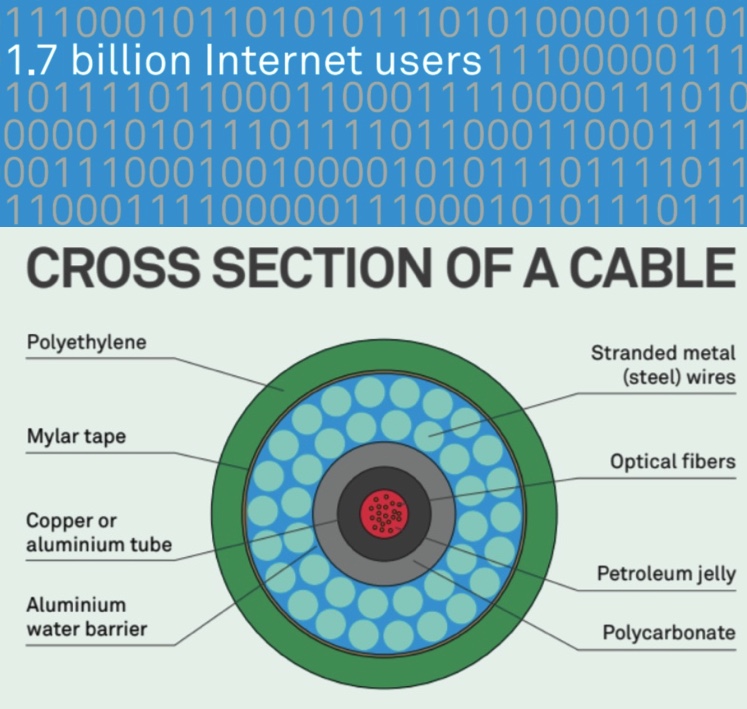
    Many initiatives seek to bring inexpensive access to the internet to rural and remote regions around the world. One of the most successful ways to rapidly expand access is to offer wireless internet so that anyone can use a laptop computer, a PC or a mobile phone to quickly access the Net. Access to wireless internet is being rolled out in cities around the world with so-called ‘hot spots’, but the thornier issue of improving access in rural or remote regions could get better, thanks to a Venezuelan team.

    The rapid expansion of mobile phones has done much to reduce the digital divide in Africa, for example, where the number has grown from just 15 million in 2000 to more than 160 million by the end of 2006, according to the International Telecommunications Union. This rapid growth has paid off: Morocco, Senegal, Ghana, Gabon and Cote d’Ivoire are in the top ten gainers of the Digital Opportunity Index, 2004-2006 (http://www.itu.int). The proliferation of Wi-Fi-enabled mobile phones combined with the spread of inexpensive wireless access has the potential to close the digital divide between rural and urban areas.

    The issue of inequality in access to the internet has stark consequences for global economic development. Already, according to the World Information Society Report 2007, “Europe has achieved the largest overall gain in digital opportunity over the last two years, followed by the Americas… Asia and Africa have witnessed smaller gains in digital opportunity. The implications for the digital divide are clear: digital opportunity is becoming more sharply divided by region, not less.”

    As the Digital Divide campaign learned, it is more important to keep in mind “Internet kiosks or rental of cell phones and other devices hold great promise for the poor. But shared use is a complement to a strategy that involves giving each person their own wireless device. Eventually, the price of such devices will be low enough so that everyone can have their own device.”

    A Venezuelan team led by Ermanno Pietrosemoli, president of the Latin American networking association Escuela Latinoamericana de Redes, has broken the world record for unamplified broadcasting of a Wi-Fi (wireless internet) signal. The signal was broadcast in June from two mountains 282 kilometres apart in the Venezuelan Andes. Importantly, they did this using equipment costing only just over US $360, while producing a signal strong enough to send video messages. The former record was 220 kilometres set in 2005.

    The consequence of this achievement for entrepreneurs is important: It means inexpensive wireless signals can now reach further into remote and rural regions for a small investment.

    “We we’re able to transmit voice and video with both,” said Professor Pietrosemoli. “280 kilometres is pushing the envelope, but the same technique can be used at distances of some 150 kilometres by people with some basic training provided there is uninterrupted line of sight between the end points. This usually means shooting from hills or using them as repeater points. For distances up to 80 kilometres, towers can be used to provide connectivity even in flat land”

    Pietrosemoli is willing to train people in the techniques he has developed for transmitting wireless over large distances (https://wireless.ictp.it or www.eslareed.org.ve).

    The advantages of this approach include cost and simplicity. The more commercial WiMax technology costs more and is usually installed by large companies. Pietrosemoli’s technique is for people who lack those technical and financial advantages.

    “I have been installing wireless networks for some 20 years,” he continued, “and reckon that wireless is the only viable alternative to ameliorate the digital divide in developing countries. For rural areas, the challenge is to use as little repeater sites as possible, as each repeater adds costs, delay and powering issues.”

    Pietrosemoli said the only other obstacle to setting these networks up is the availability of unlicensed radio frequency spectrum in the 2,4 and 5 Ghz bands. The International Telecommunications Union has recommended that countries make these free for the use of data networks, but some countries are still blocking this.

    Published: July 2007

    Resources

    Southern Innovator Issue 1: Mobile Phones & Information Technology.
    Creative Commons License

    This work is licensed under a
    Creative Commons Attribution-Noncommercial-No Derivative Works 3.0 License.

    ORCID iD: https://orcid.org/0000-0001-5311-1052.

    © David South Consulting 2023
  • Pax Chaotica: A Re-evaluation of Post-WWII Economic and Political Order

    Pax Chaotica: A Re-evaluation of Post-WWII Economic and Political Order

    Paper delivered to the School of Politics and Government, Birkbeck College, University of London, London, UK, 2000

    “The strongest is never strong enough to maintain his mastery at all times unless he transforms his strength into right and obedience into duty…Yielding to force is an act of necessity, not of will; at the very most, it is an act of prudence (Rousseau 1762).” 

    By David South

    This paper analyses the following proposition: the key post-war institutions were neither an intended, nor an adequate, response to the economic and political challenges of the post-1945 world.

    There is ample evidence to show that the plethora of post-war institutions were  intended, and were a deliberate consequence of American policy-makers seeking to control the geo-political fallout of the most catastrophic conflict of human history, World War II.

    In many respects institutions such as the United Nations, the International Monetary Fund and the World Bank were a sophisticated and modern approach to a new global order minus the old imperial powers. They were an act of significant imagination and inspiration drawn from a long tradition in asserting the rule of law over the rule of anarchy; the rights of the weak over the tyranny of the strong.

    However, these institutions have repeatedly failed to meet the economic and political challenges of the past 55 years. The commitment of the United States to these bodies tailed off after World War II, and America displayed a lack of will to mature them beyond a dependence on American initiative and action.

    There is substantial evidence to support the argument that the hegemony of Pax Americana over the last half century undermined the evolution of these institutions, sustaining a chaotic world order that has not delivered prolonged peace or prosperity for a large number of the world’s citizens and that these institutions were ill prepared to confront the collapse of the Soviet Union at the end of the 1980s.

    This paper will explore the inadequacies of the global institutions to meet two key aspirations of the post-war world: conflict resolution and avoidance and economic prosperity based on free markets and democratic regimes.

    I will argue that, while this period avoided a major conflagration on the scale of the world wars, it was not a period of peace. Regional conflicts, costly both in terms of human life and of finance, plagued every one of the years since World War II. This has been called a period of Pax Americana (Knutsen 1999). I will argue that, rather than a period of global harmony and prosperity anchored by the American hegemon, it has been a period of Pax Chaotica, a “macabre dance of death in which the rulers of the superpowers mobilize their own populations to support harsh and brutal measures directed against victims within what they take to be their respective domains, where they are ‘protecting their legitimate interests,’” as Noam Chomsky describes it (Chomsky 1995: 207). Pax Chaotica is a period in which there is an illusion of stability offered by a hegemon, but in which the hegemon’s military, economic and moral superiority is unable to secure actual peace and prosperity in the world. The hegemon is out of balance, its military and economic superiority in predominance, while its moral superiority and credibility wanes and withers on the vine.

    I will analyse how adequate the global institutions were in the context of the concept of hegemony — in particular the hegemony of the United States, which has not relinquished this hegemony to the global institutions it initially set up. I will conclude that the 1990s has been a period of half measures, incremental attempts at bolstering the concept of international security by the community of nations, but that those attempts, as in the case of the Gulf War or in Kosovo, have been still under the direction of the United States.

    Making up a master plan: The deliberate development of the institutions

    The post-war master plan was comprehensive, and included the International Bank for Reconstruction and Development (World Bank), the International Monetary Fund, the International Trade Organisation (superseded by the General Agreement on Tariffs and Trade as the instrument of freer trade) and the United Nations. A clutch of security organisations was also established after the war, including NATO. As Knutsen aptly puts it:

    WITH MEMORIES OF THE INTERWAR RECESSION AND THE NEW DEAL FRESHLY IN MIND, ALREADY, IN THE FIRST YEARS OF THE WAR THEY BEGAN TO DESIGN STABILISING POSTWAR INSTITUTIONS OF INTERNATIONAL FINANCE AND TRADE — THE IBRD, THE IMF AND THE ITO. … THEY SOUGHT TO SET UP THE MOST IMPORTANT POSTWAR INSTITUTIONS BEFORE THE CONDITIONS OF PEACE WERE EVEN RAISED. THEY RUSHED THE CONFERENCES ON THE UN, IBRD, IMF AND ITO INTO SESSION BEFORE GERMANY AND JAPAN SURRENDERED. (KNUTSEN 1999: 203)

    The founding of the United Nations and the Bretton Woods institutions (the International Monetary Fund and the International Bank for Reconstruction and Development, later the World Bank) marked a turning point in world history. The United States had been attempting to exert greater control on the global order since the first 14 proposals of President Woodrow Wilson during World War I. As European powers declined at the beginning of the 20thcentury, liberal American policymakers saw an opportunity for the US to assert its hegemony over the world and re-write the rules of economic engagement along American lines. The two world wars only made the US wealthier and wealthier: in World War I, by providing armaments to both sides of the conflict; in World War II by joining with Canada as the armament and resource engine for the allied war effort.

    In many ways, the new institutions represented a forward-thinking and idealistic policy compared to a global order marked by imperial rivalries. It captured contemporary ideas on economic theory, projected a universalist Lockean ideal that all men from all nations are equal, and it was injected with the idealism and energy of the world’s largest democracy and the strongest market economy.

    Franklin Roosevelt, like Woodrow Wilson, saw America’s engagement in the world  war as a struggle to contain European-style militarism, imperialism and exclusive trade blocs. America’s aim, in both wars, was to preserve the conditions for liberal world order — for a democratic system of politics and an economic system based on free-market principles. Wilson and Roosevelt both sought to liberalize world trade. And they both sought to use America’s leading position in world politics to bring other countries into line with America’s policy. (Knutsen 1999: 193)

    These institutions ensured that the US had an influence on every facet of world affairs post World War II. It could merge its political and economic goals and ensure it had a stake in the recovery from the war. This played very well when it came to shoring up domestic support in the United States.

    Under a World Bank controlled by Americans, development assistance could be focused precisely where America’s core corporations saw the greatest opportunity. And so long as the recipients of America’s foreign aid used it to buy American exports core corporations could venture into global trade confident of receptive markets. Through such means, the playing field of global commerce was sufficiently tipped in America’s direction so that by the mid-1950s even the National Association of Manufacturers could be persuaded to support tariff reduction. (Reich 1992: 64)

    The institutions were philosophically strong, too. Learning from Machiavelli that human relations can be cynical, ruthless and riddled with power agendas, the United Nations offered a peaceful forum to resolve these disputes and a theoretically far more transparent alternative than what had come before. As Weber emphasised, modern states helped to promote capitalist development. With that in mind, the Bretton Woods institutions laid the groundwork for a global financial structure pegged to the US dollar and promoting an American view of free markets.

    Hegemony theory and Pax Americana

    I argue that these global institutions have shown themselves to be hampered and inadequate when faced with serious political and economic challenges. The root cause is a weakness that is most often cited as their strength: the United States.

    Hegemonic stability has been characterised by the emergence of successive dominant liberal powers (Gilpin 1987: 66). What Strange calls “structural power” is essential to the establishment of hegemony over world affairs, since it “confers the power to decide how things shall be done, the power to shape frameworks within which states relate to each other, relate to people, or relate to corporate enterprises (Strange 1998: 25).”

    The post-World War II global institutions are an excellent example of the intersection of politics and economy; institutions like the United Nations seek to wield influence in both the political sphere and the economic, most particularly through the Bretton Woods institutions. Hegemonic world order exists, Knutsen suggests, “when the major members of an international system agree on a code of norms, rules and laws which helps govern the behaviour of all. This agreement reflects the rhetorical skills of a particular great power (Knutsen 1999: 49).” This is what happened towards the end of World War II, as the United States wrote the new world order according to its own rules.

    As further evidence of US supremacy, the new global rules were constructed so as to force America’s superpower rivals, the USSR and China, to join “its” institutions, not the other way around (though Taiwan stood in for the People’s Republic in the United Nations, against the protests of the USSR, until 1971).

    The US became the hegemon because the Soviet Union had very little to offer, either in terms of economic assistance or of political freedoms.

    Historians now understand that potential clients encouraged the United States to become a hegemon at the end of World War II: the term “empire by invitation” has come to characterize what happened. The Soviet bid for postwar influence lacked any comparable legitimacy, and so quickly came up against a condition that creates major difficulties for hegemons, which is lack of consent. (Gaddis 1992: 177)

    Do as I say, not as I do: The rise and fall of the hegemon’s moral advantage

    A large part of the credibility of the US hegemony was bolstered by its moral advantage vis-à-vis other nations. A heady cocktail of democratic freedoms, economic success and military might led many other nations to believe the US and its institutions had got it right where others had failed.

    As Strange notes: “President Truman had followed up in his augural address to the Congress with the firm promise of American help to peoples seeking freedom and a better material life. Moral authority based on faith in American intentions powerfully reinforced its other sources of structural power (Strange 1994: 32).”

    Supporters of US hegemony, like John G. Ruggie, believe the hegemon must be liberal-minded. Otherwise:

    IF THE OTHER STATES BEGIN TO REGARD THE ACTIONS OF THE HEGEMON AS SELF-SERVING AND CONTRARY TO THEIR OWN POLITICAL AND ECONOMIC INTERESTS, THE HEGEMONIC SYSTEM WILL BE GREATLY WEAKENED. IT WILL ALSO DETERIORATE IF THE CITIZENRY OF THE HEGEMONIC POWER BELIEVES THAT OTHER STATES ARE CHEATING, OR IF THE COSTS OF LEADERSHIP BEGIN TO EXCEED THE PERCEIVED BENEFITS. (GILPIN 1987: 73)

    The US steadily weakened its credibility and moral advantage in both the areas of conflict resolution and avoidance, and in promoting economic prosperity.

    Conflict resolution and avoidance

    The US was seen as willing to distort global institutions to fight its ideological — and real — battles with the Soviet Union, and its proxies around the world. The US’s credibility as a promoter of peace and security was severely hampered by the Korean War, the Vietnam War and a dubious record of support for undemocratic regimes and guerrilla movements. These conflicts were intended to “contain” the Soviet Union and the spread of communism and to support regimes that were friendly to free markets. This was played out in a cynical cat-and-mouse game with the Soviet Union, where both sides avoided direct confrontation with each other and used third countries to wage their ideological battles.

    Gaddis takes an overly generous view of the Cold War high-wire act, but it is worth being reminded:

    BUT THE 1950S AND 1960S DID SEE A REMARKABLE SEQUENCE OF POTENTIALLY DANGEROUS CONFRONTATIONS — DIENBIENPHU, 1954; QUEMOY-MATSA, 1955; HUNGARY-SUEZ, 1956; LEBANON, 1958; BERLIN, 1958-59; THE U2 INCIDENT, 1960; CUBA, 1961; BERLIN, 1961; LAOS, 1961-62; THE CUBAN MISSILE CRISIS, 1962 — EVERYONE OF WHICH WAS RESOLVED WITHOUT MAJOR MILITARY INVOLVEMENT BY EITHER SUPERPOWER. THE SAME COULD NOT BE SAID OF KOREA IN 1950, OR OF VIETNAM AND AFGHANISTAN LATER ON. (GADDIS 1992: 33)

    Other than actually being drawn in as a combatant, as in the case of the Korean War, the UN became more of a sideline observer and critic than a robust resolver of conflicts. The UN was critically flawed from the beginning and abrogated its commitment to collective security. It also proved ineffective when confronted with crisis. As Strange points out, one of the biggest weaknesses in the founding of the UN was the Charter. In Article 2, Paragraph 7, all matters of domestic consideration were the business of a state, and in Article 51 states were allowed to form alliances for individual or collective self-defence, “thus reopening the door to a security structure based on alliances and counter-alliance rather than on collective responsibilities for the maintenance of peace between states (Strange 1994: 52).”

    The UN was also hampered from developing a collective security maturity by the Security Council. The five permanent members used the veto to control resolutions, with the USSR and the US the most prolific abusers. The US had a total of 69 vetoes from 1945 to 1994; the USSR had 116.

    The fall of the Soviet Union at the end of the 1980s marked the beginning of a new period of instability in large parts of the world. The spotlight is once again on the UN to become an arbiter of conflict; once again it is most active when it is pushed by the United States to act when the US feels there is an interest to be served. This has been the case in the major UN missions in the 1990s, from the Gulf War (oil reserves), to the former Yugoslavia (European security). The UN proved to be ineffective where there was no naked US interest putting pressure on the organisation to act, as in the case of Rwanda. Strange remarks that this has had a demoralising effect on those who seek a security structure upholding international law and the universal rights of man.

    The fear that either the world organization would merely be the tool of one or other great power (as indeed it was the tool of the United States in the early 1950s) or that it would be ineffectual — as both the League and the UN have proved to be in the face of grave threats to international peace and order — have been enough to kill any realistic hopes of managing a transition from the present security structure to a multilateral or confederal one. (Strange 1994:52)

    Economic prosperity

    The second half of the 20th century has been hailed as a period of unprecedented global prosperity. Global gross national product rose from US $300 billion to US $2 trillion from 1945 to 1970 (Reich 1992: 64), though much of this was concentrated in a handful of countries. The major challenge of the 20th century has been the task of spreading prosperity around the world; to more evenly distribute the gains than can be reaped from advances in science and technology. The collapse of the colonial powers left large numbers of underdeveloped nations grappling with independence.

    With the collapse of the Bretton Woods arrangements in the early 1970s, and the emergence of deregulation in financial flows in the world, the US abrogated much of its responsibility for micro-managing global development. The market was now to do all the work, and being the modern age, rapid capital flows were to make the market work efficiently.

    Like the experience with conflict resolution and avoidance, the economic project has been mixed. A dependence on the market has not avoided a dependence on the economic fortunes of the global hegemon. As the US ship rises and sinks, so does the rest of the world. The Global economic system, Panic notes:

    WAS RUN BY THE DOMINANT ECONOMIC POWER AFTER THE SECOND WORLD WAR: THE UNITED STATES. IN THAT SENSE, ITS FORTUNES, LIKE THOSE OF THE CLASSICAL GOLD STANDARD, WERE DIRECTLY LINKED TO THOSE OF THE RELATIVE ECONOMIC PERFORMANCE AND POLICIES OF THE COUNTRY RESPONSIBLE FOR THE LARGEST SHARE OF WORLD INDUSTRIAL PRODUCTION, TRADE, AND FINANCE AT THE TIME — PRECISELY THE OUTCOME THAT THOSE ATTENDING THE BRETTON WOODS CONFERENCE HAD BEEN ANXIOUS TO AVOID. (PANIC 1995: 46)

    By 1994, total world exports were more than 14 times greater than in 1950; output was five times greater than in 1950 (Dicken 1999: 24). But the economic achievements ring hollow if the well-being of the whole planet is taken into consideration. By 1995, 60 percent of the manufacturing in the world occurred in three countries — the United States, Japan and Germany (UNIDO 1996). While manufacturing in developing countries had quadrupled to 20 percent of global output, it was concentrated in a few developing countries with strong ties to the US.

    There is a direct connection between US interests and who does well economically. Western Europe was reconstructed rapidly with US money, and Germany became an industrial powerhouse again. The defeated Japan was restored as Asia’s wealthiest nation with American investment and advice. In 1945, 71 percent of world manufacturing was concentrated in four countries. Developed countries were host to 2/3 of foreign direct investment (Dicken 1999: 21). Most FDI is now concentrated in industrial, developed countries.

    There is a direct link between the failures of the UN and the global economy. The weakness of the international security arrangements also have an impact on economies. Vast sums of money are re-directed towards weapons purchases and away from human needs. For many smaller economies, this is a punishing drain on national resources and the funds are often borrowed from elsewhere. As Chomsky noted in the 1980s, “The fact is that both of the superpowers — and many lesser powers as well — are ruining their economies and threatening world peace, indeed human survival, by a mindless commitment to military production for themselves and for export (Chomsky 1995: 209).”

    There are concrete examples of developing countries that have achieved significant development gains, reaping the gains of peace and freer world trade. A group of 18 developing countries enjoyed growth rates in the 1990s of over five percent (DFID 2000: 66). This is attributed to more open trade policies compared to other developing countries (though many other countries have been equally open to trade, like Mongolia, but have not reaped the same benefits). China has enjoyed unprecedented growth, but it also has increasing rates of unemployment and violent unrest in its western regions. Sub-Saharan Africa’s 600 million population generates exports no greater than Malaysia’s 20 million (DFID 2000: 67).

    In regard to the World Trade Organization (WTO), the majority of its 140 members are developing countries. Not a perfect organisation, its agenda is dominated by a few wealthy nations, but the alternative of a world of bilateral trade deals hangs as a spectre if it fails. As the DFID report, Eliminating World Poverty: Making Globalisation Work for the Poor, points out:

    DESPITE PROGRESS OVER THE LAST 50 YEARS, DEVELOPED COUNTRIES MAINTAIN SIGNIFICANT TARIFF AND NON-TARIFF BARRIERS AGAINST THE EXPORTS OF DEVELOPING COUNTRIES…TOTAL DEVELOPING COUNTRY GAINS FROM A 50 PER CENT CUT IN TARIFFS, BY BOTH DEVELOPED AND DEVELOPING COUNTRIES, WOULD BE IN THE ORDER OF $150 BILLION — AROUND THREE TIMES AID FLOWS. (DFID 2000: 69)

    Conclusion

    The postwar world order and the use of global institutions to build it, was a deliberate policy of the United States. It, however, proved only a half measure and the over-dependence on the United States ensured that these institutions were hampered when confronted with economic and political crises. As I have argued, a state of Pax Chaotica was the result.

    For Pax Chaotica to end, there needs to be a renewed effort by the United States to shore up global institutions and to develop a concrete plan to ensure that the global institutions become the global hegemon in every sense of the word. There have been incremental moves in this direction, including attempts to pay dues owed by the US to the UN.

    There needs to be a complete shift from the realist American interests of Pax Chaotica to the interests of the community of nations. In fact, there is an opportunity for a convergence of core American values — respect for individual liberty, freedom of expression, democracy — with the goals of the global institutions.

    As for international institutions, they must show themselves to not only be just, but also to be seen to be just. Institutions can no longer work in the shadows as they have in the past. Well-educated, wealthy protesters in Western countries will no doubt continue to demand transparency.

    In The Interests Of The Exploited?: The Role Of Development Pressure Groups In The UK

    A Steppe Back?: Economic Liberalisation And Poverty Reduction In Mongolia

    The Sweet Smell Of Failure: The World Bank And The Persistence Of Poverty

    DSC web address in green_mini (1)

    ORCID iD: https://orcid.org/0000-0001-5311-1052.

    © David South Consulting 2017