Urban populations across the South are growing fast: by 2030, some 5 billion people around the world will live in cities. This year will be the first year in which urban dwellers (3.3 billion people) will outnumber rural residents for the first time (UNFPA).
Africa now has a larger urban population than North America and 25 of the world’s fastest growing big cities. Asia and Africa’s cities are growing by an incredible 1 million people a week, with 72 per cent of the population in sub-Saharan Africa living in slum conditions.
How well people dwell is integral to their mental and physical health. Most squatters and slum dwellers – a category that includes half the urban population of Africa, a third in Asia and a fourth in Latin America and the Caribbean – live in makeshift homes made from whatever they can get their hands on. These dwellings are usually unsafe and vulnerable to fire, floods, and earthquakes. On top of this, these sprawling slums can be depressingly grim to look at for those living there.
In Brazil’s Sao Paulo neighbourhood of Heliopolis – the largest of the city’s 400 favelas, or shantytowns – the majority of its dwellings are made from cement and brick. It is stigmatised as the ugliest part of the city, yet a unique initiative has transformed perceptions of the area – and brought pride to its residents. The project offers a model for slum areas looking to make the next leap up the ladder of development. Heliopolis first sprang up in the 1970s, wedged between highways and roads. Plagued by crime, there is a wide spread in incomes and urbanisation among the 120,000 residents packed into the one-and-a-half square mile. Older parts have many services, while newer areas lack basics like plumbing and electricity.
Well-known Sao Paulo-based Brazilian architect Ruy Ohtake (http://www.geocities.com/capitolhill/3836/saopaulo.html) mobilised the 6,000 residents to use a fixed palette of six colours – from bright yellow to deep purples – to create a look described as akin to an Italian hill town.
“Ohtake told a newspaper that Heliopolis was the ugliest part of the city, so we went to him and asked him to figure out how to make it beautiful,” Geronino Barbosa, director of the Heliopolis community group UNAS, told the design magazine Dwell.
Ohtake, famous for his hotel designs and renovating former colonial areas, rose to the challenge: “I believe in beauty as a social function, so what better way to exercise that belief,” he said. To avoid the initiative feeling like something being imposed from on high, the plan did not go ahead until the residents were happy. And to make sure they felt they owned the results, they did all the painting themselves. The result is a river of colour running through a landscape of dreary, unfinished brick homes jammed between streets and factories. The Italian hill town-effect leaves pedestrians experiencing a surprise as they turn through the streets, happening upon hidden plazas and little bars.
“Our dream is to expand this project to the entire favela,” said Barbosa. “People love their painted houses. One of our participants told me that her house has been transformed into a sort of Carnival parade.”
“Who doesn’t want to live in a beautiful house?” said UNAS’ head, Joao Miranda, to Dwell. “We want the same things as everyone else.”
Another architect has tackled the problem of how to create inexpensive but durable and beautiful homes for the poor. Iranian-born architect Nader Khalili (http://www.calearth.org/) has created what he calls ‘super adobe’ dwellings inspired by traditional Iranian rural homes. The cone-shaped homes are made from sandbags piled one on top of the other in a circular pattern. A basic home is three rooms of 400 square feet, and can be built by five people (with only one needing skills), within weeks. Being sandbags, the homes can easily be dismantled and moved or adapted to meet new space needs.
Khalili first fell in love with the sand adobe homes of Iran in the 1970s. He had been on a journey to find a home design that was both environmentally harmonious and could be built anywhere in the world quickly and cheaply. But while the original Iranian sand adobe is easily destroyed by earthquakes and bad weather, the ‘super adobes’ are earthquake, hurricane and flood resistant. They are now being built across the Americas , Asia and Africa.
“You can never build one of these that doesn’t look beautiful,” he said. “Just as you have never seen an ugly tree or an ugly flower.”
Published: January 2008
Resources
Builders Without Borders: Is an international network of ecological builders who advocate the use of straw, earth and other local, affordable materials in construction. Website:http://builderswithoutborders.org/
Tsunami-Safe House: A design for Prajnopaya Foundation: a project coordinated by the SENSEable City Laboratory, a new research initiative between the Department of Urban Studies and Planning and the Media Lab at the Massachusetts Institute of Technology in Boston. Website:http://senseable.mit.edu/tsunami-prajnopaya/
Interest in organic food and farming is high, and organics have become a growing global industry. The worldwide market for organic food grew by more than 25 per cent between 2008 and 2011, to US $63 billion, according to pro-organic group the Soil Association. That is an impressive accomplishment given the backdrop of the global economic crisis, and evidence that people value quality food, even in tough times.
One Kenyan company is hoping to help farmers benefit from this global surge in interest in organic food. The company is selling a healthy alternative to chemical fertilizers and is hoping it will soon be able to source its products in Kenya, too.
BioDeposit (http://biodeposit.lv/index.php?page=elixir-3) sells soil conditioner and natural fertilizer made from two ingredients: peat found in marshlands and silt dredged up from lakes, which is called sapropel (http://en.wikipedia.org/wiki/Sapropel). This naturally occurring resource is rich in all the elements required for abundant crops and has the added benefit of not poisoning the soil and water table when used on farmer’s fields.
It is sold as a solution to the multiple pressures hitting farmers, from chaotic weather patterns to soil damage and decreasing yields. It offers a way to boost farm productivity without damaging the soil in the long term.
In 2011 the amount of farmland that was organic reached 37.2 million hectares in 162 countries – but this is still just 0.86 per cent of the world’s agricultural land (Research Institute of Organic Agriculture and International Federation of Organic Agriculture Movements). If BioDeposit has its way, Kenyan farmers could help to grow the number of hectares being farmed organically.
Presenting the solution in October 2013 at the Global South-South Development Expo (southsouthexpo.org) at the headquarters of the UN’s Environment Programme (UNEP) in Nairobi, Kenya, BioDeposit communications and media chief Nelly Makokha (http://ke.linkedin.com/pub/nelly-makokha/29/a08/634), explained that the company is hoping to bring the technology behind BioDeposit to Kenya, if they can get permission.
At present, the source materials for the products are dredged from lakes in Latvia in Eastern Europe. Because of the political structures of Kenya, it means a long political process is ahead to gain permission to dredge any of the country’s lakes. BioDeposit’s Latvian scientists conducted research on the potential for Lake Naivasha (http://en.wikipedia.org/wiki/Lake_Naivasha) in the Rift Valley and claim it has enough deposits to provide Kenya’s farmers with organic fertilizer for the next 200 years.
“If the government agrees, the fertilizer is basically cheaper than any other fertilizer the farmer [will] have ever used in a long time,” said Makokha. “It will be pocket-friendly for them. As they earn more money from the more yields, they are spending less on the fertilizer.
“Our slogan is ‘smart agriculture for health and wealth’ – health in terms of you become organically grown, and if you are looking for organic certification, we will organize that for the certifiers. Right now most countries are looking for organic food and cannot find it.
“So when you become organic that means you earn more money on your products so it means you are healthy and you are wealthy!”
The fertilizer comes in 12 milliliter packets that cost 200 Kenyan shillings (US $2.30). A farmer would need two packets for each quarter acre of farmland.
Based on a Russian discovery from the early 20th century, BioDeposit draws on naturally occurring resources.
Its products include BioDeposit Agro, described as a “biologically active soil conditioner,” and BioDeposit Elixir, described as a “humic plant growth stimulator.” The Elixir is a “sustainable, water-soluble” concentrate made from peat and can be used to soak seeds prior to planting, increasing the germination cycle. For the farmer, it means more seedlings in a shorter time. It also can be poured on compost piles to boost humic content to speed compost decay. Peat is formed from above-ground marsh plants, either on the surface or under a layer of water.
BioDeposit Agro is made from sapropel from the sediment at the bottom of freshwater lakes. It is a renewable, naturally-occurring resource as it has been formed from the accumulated settling of plants such as reeds, algae, trees, grasses and animals over time as they decay.
Unlike other chemical fertilizers, using the BioDeposit product does not require special protective clothing and does not harm human health. Children are also not at risk if they accidentally ingest the product.
“Most farmers have small farms – quarter acre, half acre, at most three acres,” said Makokha. “For a quarter acre you spend five dollars and you get more yields. Two of them would be approximately five dollars – that’s enough for a whole season – so it is pocket friendly.”
And if the company is able to harvest the material in Kenya, it would be even cheaper.
“You can imagine if we dredge here – probably (get the cost down to) a dollar – so it makes more sense for the farmers.”
The dredging has another positive impact: it helps with managing flooding by making the lake deeper once the silt is dredged out, making life better and safer for people living nearby.
BioDeposit has been operating in Kenya for a year and, Makokha said, “the response is awesome.”
BioDeposit organizes workshops for farmers through cooperative societies, helping to guide farmers through the whole process of becoming organically certified.
The company believes its products will help avert problems such as what happened recently when the European Union prevented some flowers – a major source of overseas income for Kenyan farmers – from entering the EU because of banned pesticides.
Cleverly, BioDeposit does most of its business digitally through mobile phones. It conducts its business with sales representatives by phone and conducts training by phone as well. All payments and bank transfers are done by phone using the M-PESA system (http://www.safaricom.co.ke/?id=257).
“It is the easiest way to do business in Kenya,” said Makokha. “Everybody right now owns a mobile phone. When we get the M-PESA, we transfer directly to the account. You get the money and transfer to the bank account and you are done, very easy for everybody … doing wonders for us.”
5) Integrating Ethno-Ecological and Scientific Knowledge of Termites for Sustainable Termite Management and Human Welfare in Africa by Gudeta W. Sileshi et al, Ecology and Society, Volume 14, Number 1. Website: http://www.ecologyandsociety.org/vol14/iss1/art48
6) Soil Association: The Soil Association was founded in 1946 by a group of farmers, scientists and nutritionists who observed a direct connection between farming practice and plant, animal, human and environmental health. Website: http://www.soilassociation.org/marketreport
7) Research Institute of Organic Agriculture: FiBL is an independent, non-profit, research institute with the aim of advancing cutting-edge science in the field of organic agriculture. Website: http://www.fibl.org/en/fibl.html
International Federation of Organic Agriculture Movements: Since 1972, IFOAM has occupied an unchallenged position as the only international umbrella organization of the organic world, i.e. all stakeholders contributing to the organic vision. Website: http://www.ifoam.org/
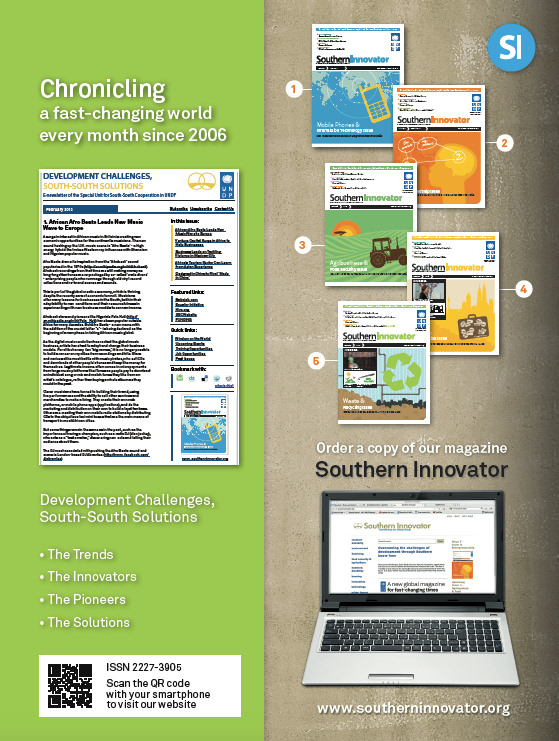
Development Challenges, South-South Solutions was launched as an e-newsletter in 2006 by UNDP’s South-South Cooperation Unit (now the United Nations Office for South-South Cooperation) based in New York, USA. It led on profiling the rise of the global South as an economic powerhouse and was one of the first regular publications to champion the global South’s innovators, entrepreneurs, and pioneers. It tracked the key trends that are now so profoundly reshaping how development is seen and done. This includes the rapid take-up of mobile phones and information technology in the global South (as profiled in the first issue of magazine Southern Innovator), the move to becoming a majority urban world, a growing global innovator culture, and the plethora of solutions being developed in the global South to tackle its problems and improve living conditions and boost human development. The success of the e-newsletter led to the launch of the magazine Southern Innovator.
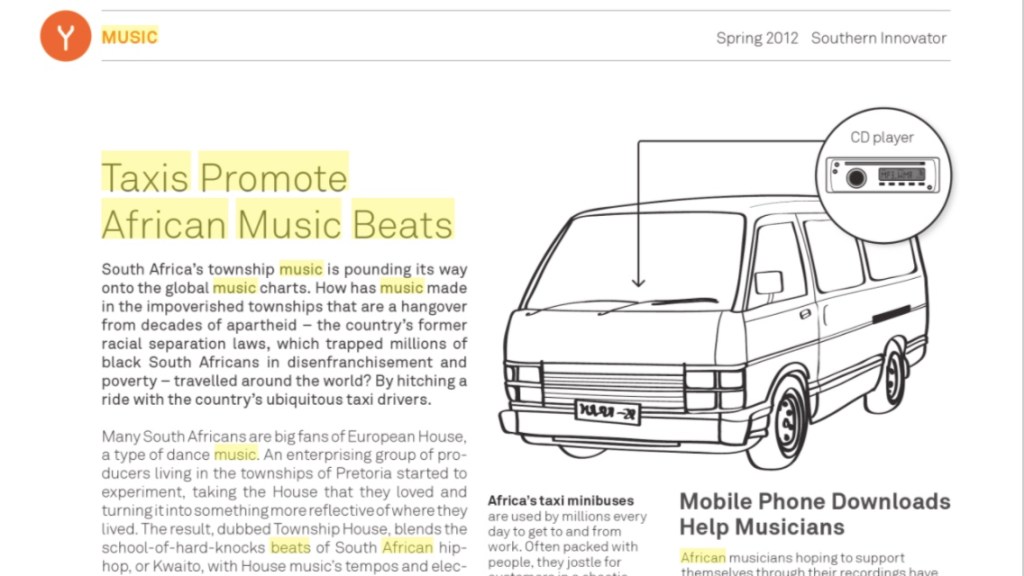
African musicians hoping to support themselves through their recordings have always had to contend with the added burden of poor copyright control over their work. While musicians in the West are supported by a highly regulated regime of copyright protection – ensuring some to become the richest people in their respective countries – most African musicians have had to stand back and watch their work being copied, sold and exchanged with little chance of seeing any royalties. Global audiences know of the success of artists like Fela Kuti, Youssou N’Dour, Manu Dibango and Miriam Makeba, but most African musicians can look forward to scant earnings from recording their music.
Anyone who has walked through the markets of Africa will know there are plenty of pirated CDs for sale, yet it is of no use to a musician who never sees the money. Poverty is endemic amongst African musicians as a result of this loss of income. While music is a global business worth US $40 billion according to the Recording Industry Association of America, pirated music in Africa is rampant – some estimates by the Recording Industry of South Africa put it at over 80 percent of available music. How much money is being lost can be judged from the estimated daily income of a pirate music vendor in Africa, ranging between Euro 762 and Euro 2,744.
But a solution to this problem is being pioneered in Botswana in southern Africa. A partnership between mobile phone provider Orange Botswana and Small House Records/Mud Hut Studios, ensures musicians get a slice of the profit pie. Managing director Solomon Monyame of Small House Records has signed a contract with Orange to share the profits from ring tone and song downloads to mobile phone subscribers. With more than 76.8 million people currently subscribing to mobile phone services in Africa, and the number growing by about 58 percent each year for the last five years, the potential royalties market for African musicians is vast if this initiative is replicated across the continent.
In the paper “Development Goes Wireless” to be published in the spring 2007 issue of the journal of the Institute of Economic Affairs, lead researcher Karol Boudreaux of George Mason University’s Mercatus Center and Enterprise Africa!, discovered mobile phones and mobile phone companies can give artists a new way to control royalties for their work. She found that in the absence of effective copyright control mechanisms – as is the case in many African countries – the mobile phone company can step in to save the day.
“When you walk through the markets there you see so much music available on the street, but there is little intellectual property rights protection,” she said.
“In other countries, like the UK, you have strong intellectual property rights protection, but this just isn’t the case in much of Africa. The mobile phones are a very good way to get around this problem as long as cell phone providers are willing to make the contracts. Botswana is very lucky in that they have a very good contract environment, but this isn’t necessarily the case in other countries. It is a win-win for music providers and mobile companies.”
The NetTel@Africa project started by USAID and the Center to Bridge the Digital Divide, in partnership with many African and US universities, is also championing copyright protection strategies.
How important creative industries are becoming to economic development is slowly being recognized. It is now seen as an important component of modern post-industrial, knowledge-based economies, but equally also a way for economically underdeveloped countries to generate wealth. Not only are they thought to account for higher than average growth and job creation, they are also vehicles of cultural identity and play an important role in fostering cultural diversity. Initiatives like UNESCO’s Global Alliance for Cultural Diversity attempt to document this phenomenon and back it up with hard numbers.
UNESCO also has a project to establish musicians’ cooperatives across Africa. As such, the musicians are able to pool their production resources, which are individually insufficient to ensure the economic viability of a small or medium-sized business. In Burkina Faso, a co-operative is working with the International Labour Organisation. Click here for more information.
Festivals like Mali’s annual Festival in the Desert in the oasis of Essakane, 65 kilometers from Timbuktu, is an example of how African musicians are finding their own way to reach audiences. Targeted above all to promote African and Malian Music inside the continent, the Festival has also boosted international tourism to the region and almost 10 percent of last year’s 6,000 visitors came from outside of Africa.
Another initiative for African musicians is the DigiArts Africa network. It was founded by UNESCO and aims to increase communication between artists, industries and educators, make musicians self-sustainable, use the ICT industries to support and contribute to cultural activities, and better promote African musicians within and outside Africa. Click here for more information.
Well-known Senegalese musician Thione Seck is blunt about the economic effect of piracy on his income.
“Were there no piracy, I could have bought an island, seeing the number of songs that I composed in more than 30 years of my career”, he told a local newspaper.
According to Abdoul Aziz Dieng, president of the Senegal Music Works Association (AMS) and Chairman of the Board of the Senegalese Copyright Office (BSDA) (www.mali-music.com), out of 10 Senegalese artists’ CDs available on the local market, “only two are legal”. For audio cassettes, the ratio is three pirate copies out of every five sold.
Opportunities to combat piracy and generate income are also not limited to just musicians. Filmmakers in Africa are starting to learn how to exploit the opportunities thrown up by the fast-expanding mobile phone networks on the continent. Already a phenomenon in South Africa (www.filmmaker.co.za), director Aryan Kaganof is in the process of releasing SMS Sugar Man, a feature length movie shot entirely with mobile devices. The movie will be beamed to cell phones in three-minute clips over 30 days.
What are the effects of Piracy?
Artist
No royalty payments, no money to live
Record companies
No return on investments. Staff retrenchments
Retailers
Cannot compete with low prices. Staff retrenchments
Consumers
Many copies are of inferior quality. If tracks are missing or the sound quality is poor, no exchange or refunds
May be contributing to “organized crime” syndicates which are heavily involved in international music piracy
Southern Innovator issues 1 and 5 at the Bangladesh workshop on public service innovation, 9-11 December 2017, and the launch of the South-South Network.
The following blog report does not reflect the views of the UNOSSC or UNDP.
Dateline: Dhaka, Bangladesh (9-11 December 2017) – From 9-11 December 2017, I participated in the Workshop on Innovations in Service Delivery: The Scope for South-South and Triangular Cooperation held in Dhaka, Bangladesh. Hosted by the a2i (access to information) division of the Bangladesh Prime Minister’s Office, the implementing unit for Digital Bangladesh, it was convened by the Government of Bangladesh and the United Nations Office for South-South Cooperation (UNOSSC).
I was asked to do a presentation for the health component of the Workshop on my past experience in public sector digital innovation. This work stretches back to the beginning of the roll out of the Internet in the late 1990s. I chose three projects I have led that had a large and significant impact in the digital public space: the UN Mongolia development web portal I launched and ran for two years (1997-1999), the GOSH Child Health Web Portal I launched and ran for two years (2001-2003) and the Southern Innovator brand I launched for the UNOSSC (2010-2015).
I also joined a panel discussion as Senior Partner representing the David South Consulting/David South International consultancy at the end of the last day (we have worked with the UNOSSC since 2007 and with UNDP since 1997 – a timeframe which saw the rise of the Internet and the mobile and information technology revolution take the global South by storm).
As the Workshop invitation letter says, “The digitization of service delivery, user-centric methodologies, and experimentation geared towards improvement in service delivery, and the data revolution may have originated in developed countries but is now of increasing relevance for the developing world. To respond to rapidly rising expectations of the citizens, governments in both developing and developed countries are embracing approaches and tools to adopt more citizen-centric approaches in their service delivery. These practices are establishing a culture of citizen-centric innovation within governments, breaking silos of operations and helping move towards a whole-of-government planning and execution.”
According to the a2i, Bangladesh has the “world’s largest government web portal” comprising over 25,000 government websites for 43,000 government offices (Bangladesh’s population was over 162 million as of 2016 – World Bank). Bangladesh has one of the highest population densities in the world and is considered the 8th most populace country in the world (Wikipedia). In total, these government websites receive 60 million plus hits a month, according to the a2i, from an online population of 79.7 million people, nearly half the population.
A lot is at stake: According to the World Bank (which has been supporting the country since 1972), “Bangladesh has made substantial progress in reducing poverty, supported by sustained economic growth. Based on the international poverty line of $1.90 per person per day, Bangladesh reduced poverty from 44.2 percent in 1991 to 18.5 percent in 2010, and is projected to decrease to 12.9 percent in 2016.
“The country achieved the MDG 1 on halving poverty five years ahead of time, with 20.5 million people rising out of poverty during the 1991-2010 period. In parallel, life expectancy, literacy rates and per capita food production have increased significantly. Progress was underpinned by strong economic growth, with 6 percent plus growth over the decade and reaching to 7.1 percent growth in 2015/2016. Rapid growth enabled Bangladesh to reach the lower middle-income country status in 2014.
“However, sustained growth has rapidly increased the demand for energy, transport and urbanization. Insufficient planning and investment have resulted in increasingly severe infrastructure bottlenecks.”
Arriving in the capital, Dhaka, on the 9th of December, it was clear to see what the World Bank is highlighting: the “severe infrastructure bottlenecks”. Just like other megacities, Dhaka is clogged with traffic and suffers from the air pollution this causes (one of the worst cities for this in Asia). But these are just the visible signs of success if you think about it (as frustrating as that might be), as booming economies combined with rapid urbanisation, if not planned well, tend to lead to traffic congestion and high levels of air pollution.
The country’s rising living standards since 2000 and impressive gains in the provision of information and mobile technology services and connectivity, reveal a country brimming with potential and capable of getting a handle on its many development challenges. The streets are visibly lined with small and medium enterprises and there are construction projects in various states of completion all around Dhaka. At the airport, glossy posters advertise many real estate developer’s dreams and show-off the heavy construction equipment for sale or lease from China and Russia.
The population no longer suffers from food crises such as the 1974 famine, which killed 1.5 million people (Christian Science Monitor). According to the UN, Bangladesh cut chronic hunger by half since 2000 and is considered one of the success stories from the past 10 years that the rest of the developing world can look to as they push to eliminate hunger by 2030 as part of the SDGs (Sustainable Development Goals) (https://www.csmonitor.com/USA/Foreign-Policy/2015/0617/From-famine-to-food-basket-how-Bangladesh-became-a-model-for-reducing-hunger). Clearly, Bangladesh is a country that can get things done when it draws on the power of its population.
According to Digital Bangladesh, with a deadline of 2021, it has achieved half its goals to get the population online and its economy and government services online. In 2017, the country made US $800 million from exporting ICT (information and communication technologies) products and services. It is currently building 12 hi-tech parks with the ambitious goal to export US $10 billion in ICT services from them by 2030 and make US $5 billion by 2021.
The streets of Dhaka.
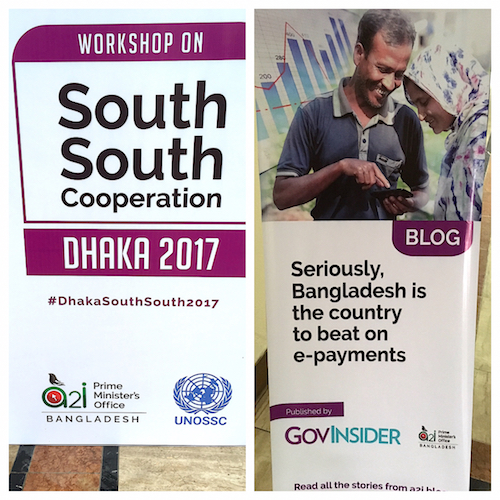
Workshop
Sharing ideas at the Workshop.
Speaking at the Workshop, Anir Chowdhury, Policy Advisor to the Access to Information (a2i) Programme of the Prime Minister’s Office, believes the concept of South-South Cooperation (SSC) is about enlightened self-interest but at present there is no framework for SSC in Bangladesh and most cooperation is ad hoc. If global South countries are not cooperating, then they are just re-inventing the wheel, he added. SSC is about avoiding feeling each country has to make it own their own: SSC can facilitate development leapfrogging and prevent leaving country success to chance. However, there needs to be better ways to communicate Southern solutions.
And Bangladesh has a good story to tell to the global South: To date, Bangladesh’s digital public service delivery has saved the country US $2 billion in cost for government services plus 1 billion man days in time spent trying to carry out tasks using government services, according to the a2i. With this success under their belts, the hope is to market Bangladesh as a world leader in innovation. To go from MDGs poster child to leader of the global South.
UNOSSC Director and Envoy of the UN Secretary-General on SSC, Jorge Chediek (https://www.unsouthsouth.org/about/unossc-director/), emphasised the need to tell stories of how South-South is changing the world; the pressing need to change the narrative around the global South in order to be able to achieve the 2030 agenda.
It was an honour to be invited to present my three case studies on public sector digital innovation (GOSH Child Health Portal, Southern Innovator Magazine and the UN/UNDP Mongolia Development Portal). All three share the same characteristics: a public demand for digital resources and a need to create high-quality content on limited budgets and to build public confidence in those resources. These projects were also engaging with enormous complexity and needed to find a way to simplify this for online readers.
I was impressed by the level of debate at the Workshop, and how Bangladesh’s digital initiatives are communicated (the excellent use of infographics and simple step-by-step explanations), and the overall excitement and energy around digital and the digital economy in Bangladesh. But, importantly, the foresight to give attention to the coming wave of automation and robotics (the so-called fourth industrial revolution) and how this will affect Bangladesh.
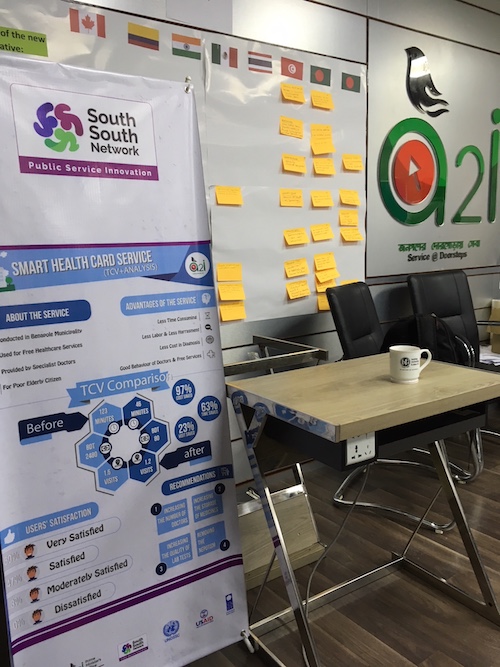
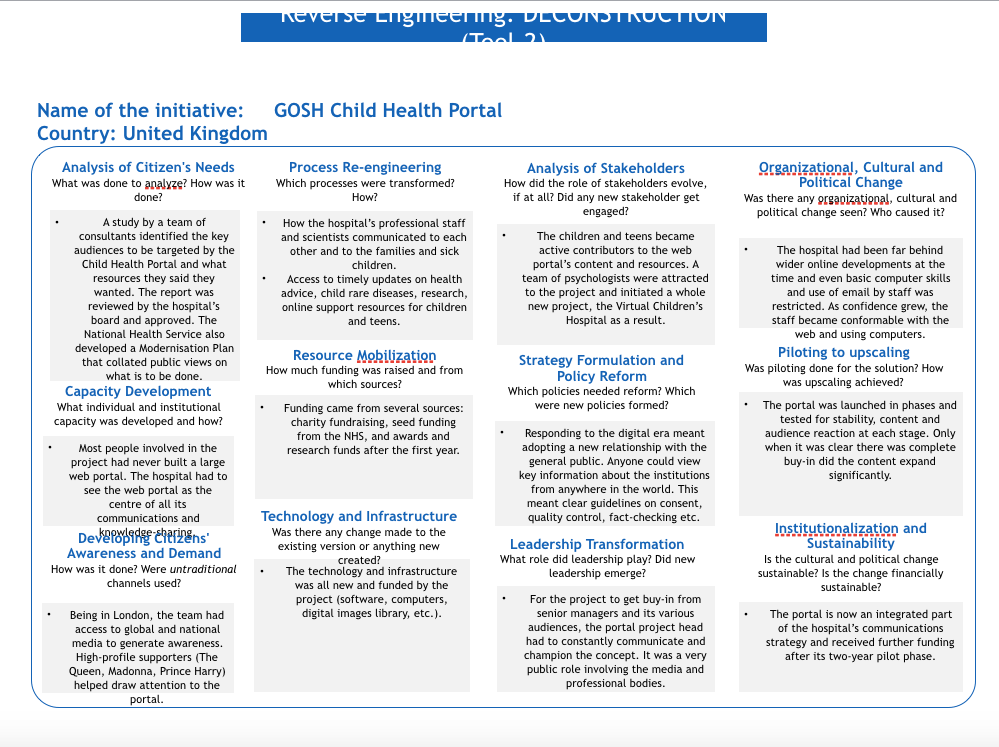
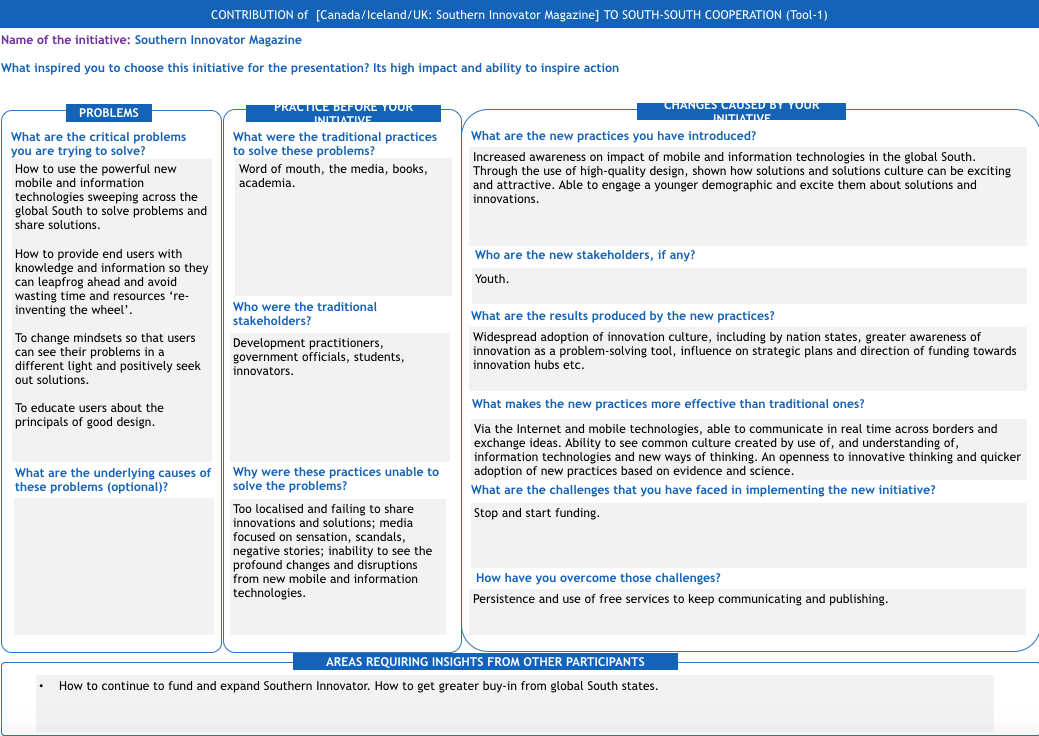
In the health workshop, we shared two projects for the reverse engineering component: the GOSH Child Health Portal and the magazine Southern Innovator (link to PowerPoint). Using the Reverse Engineering tool (see images below), each project was broken down as to how it worked and also what was its contribution to South-South Cooperation.
I shared experience from the early days of digital public innovation in the late 1990s. This has included applying digital to crisis recovery, healthcare modernisation in the early 2000s, and the campaign to achieve the MDGs (Millennium Development Goals), as well as during the mobile/information technology and social media revolution in the global South, which took off after 2007.
Issues discussed here included the recent online fake news scandals and how important it is for the public sector to offer the antidote to this with quality, factual digital information and resources. The GOSH Child Health Portal was one good example, where it entered the crowded online medical and health information marketplace and succeeded in drawing a large online audience by offering high-quality, peer-reviewed resources, thoroughly fact-checked and proofread and presented using high-quality online design. By the end of the project’s two-year timeframe, it was receiving over 7 million hits a month and was acknowledged as a trusted global source in child health. The content is cited in many books and papers, as well.
Reverse engineering GOSH Child Health Web Portal, 2001-2003.
Throughout the Workshop, I heard over and over again about the urgent need for a more cohesive platform for sharing Southern innovations and initiatives. Many complained this was currently very fragmented. While there are many media and development organisations documenting innovations and stories, there is no one-stop shop for countries to go to.
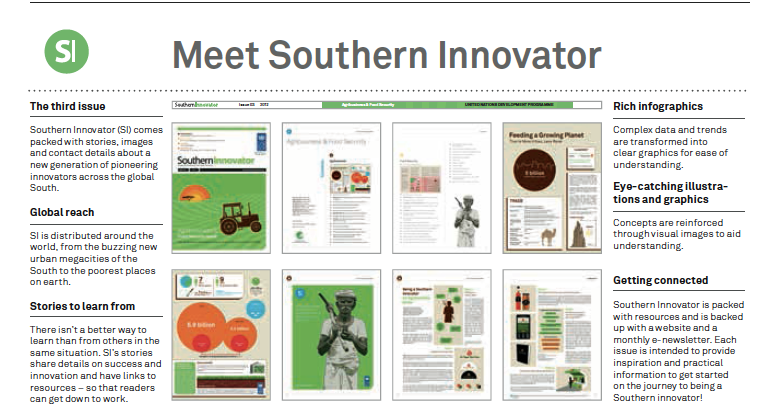
The Southern Innovator brand (incubated and developed by the UNOSSC) is a good example of what can be achieved with a more cohesive and strategic approach. Southern Innovator, first launched in 2011 by the UNOSSC, was able to leverage its limited resources to reach a large global audience via the web and social media. The brand became established with innovators and five issues were published (from 2011 to 2015). An Action Plan for scaling-up the Southern Innovator brand was also developed with the UNOSSC in 2015 (but awaits funding).
The original Southern Innovator website (southerninnovator.org, now southerninnovator.com) did fulfil the role of offering a one-stop shop for stories on global South innovation and these stories were widely cited in websites, papers and books on the global South. But the terrain has shifted radically in the global South – and at the UN – since Southern Innovator’s launch in 2011. With the widespread adoption of mobile and digital technologies, the opportunities to communicate innovator solutions have never been better but require a more sophisticated approach to be effective. In fact, we now exist in a world where the solutions already exist to the major problems affecting the global South (and even the funding is available through many sources). The problem is not the lack of solutions, innovators or technologies and business models to resolve problems (both e-newsletter Development Challenges, South-South Solutions and Southern Innovator proved this) but how people can access these resources and in a format that makes sense to them and is available when they are searching for a solution. With modern computing technologies, this is no longer an unsolvable problem. And the people to connect with to do this also already exist in the global South. What is missing is a coherent and cohesive approach. The multiplicity of development actors in this case are hampering effective action by dissecting and scattering resources, leaving end-users confused and poorly communicated with in many cases. As an example, there was a definite need to assist people in understanding how the 17 SDGs can fit into practical actions and a definite psychological need for simplicity: a problem highlighted by former UNDP head Helen Clark back in 2015 (https://www.theguardian.com/global-development/2015/jul/07/sustainable-development-goals-will-be-hard-sell-for-united-nations).
For UNDP, with its human development approach and presence in most countries, an opportunity exists to rapidly accelerate development gains and shorten the time it takes to recover when disaster or conflict strikes. Something that came out of the Workshop is the presence of excellent examples of global knowledge sharing already underway for decades around the world. Think of the scientific community in general (working on vast projects such as the CERN facility in Switzerland), or aerospace industries, or the global adoption of the principles of air safety managed by IATA in Montreal, Canada, or sport – all proof countries do successfully share knowledge and adopt common, high standards when they feel it is a priority and necessity. No country wants to be frozen out of flight routes, for example.
Reverse engineering the Southern Innovator magazine brand, 2010-2015.
Panel Discussion
At the closing panel discussion, I was asked how to engage more donors to be part of the South-South Network. I said there is a need to get people excited and show why the South-South Network is different; how it is related to the Sustainable Development Goals (SDGs). There needs to be a communications strategy and to establish some ambitious first goals that are original: to show that this is part of a clear trend. International aid and development is a crowded space so there is a need to show how the Network would tackle the challenges of the global South in the 21st century head-on, with a more effective solution. And of course, I championed the existing and successful Southern Innovator brand developed by the UNOSSC since 2010 as, potentially, part of this communications strategy.
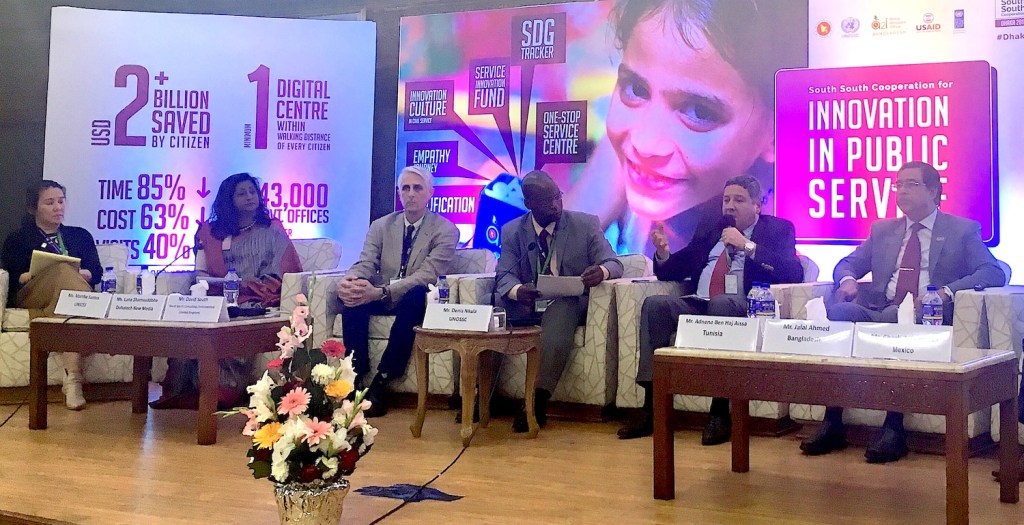
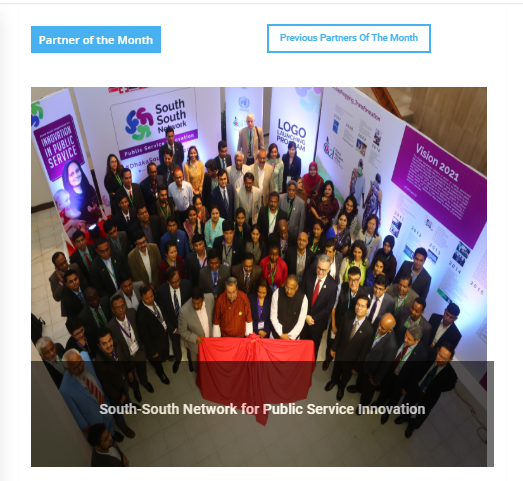
Senior Partner David South is third from the left on the panel. Photo: Yoko Shimura.Senior Partner David South is centre at back with the South-South Network for Public Service Innovation, Dhaka, Bangladesh, 2017.
Finally
This impressive embracing of e-initiatives and all things digital was visibly missing at the airport. On the way in, long lines and then a confusing scramble to buy a visa created confusion for visitors. As the first impression for visitors, this could be a great place to show-off Bangladesh’s digital capabilities.
And finally, as the World Bank says, this all about job creation and increased living standards: “The World Bank has identified job creation as the country’s top development priority. Bangladesh needs to create more and better jobs for the 2.1 million youths entering the job market every year. But to do so, Bangladesh will need to remove the barriers to higher growth posed by low access to reliable and affordable power, poor transportation infrastructure, limited availability of serviced land, rapid urbanization and vulnerability to climate change and natural disasters, among others.”
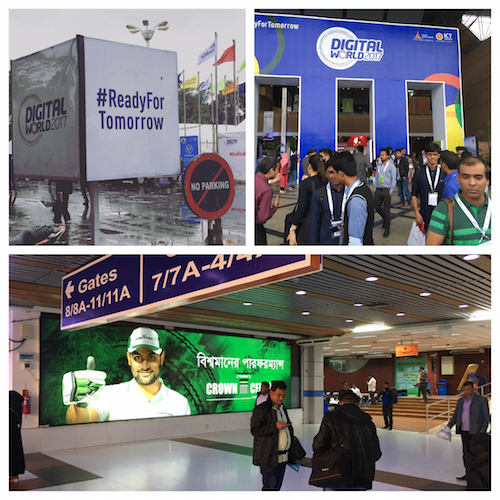
Bangabandhu International Conference Center hosting Digital World 2017 and Dhaka’s Shahjalal International Airport.
















You must be logged in to post a comment.