Tag: United Nations

  • Bamboo Becomes Transport Option for the South

    Bamboo Becomes Transport Option for the South

    By David SouthDevelopment Challenges, South-South Solutions

    SOUTH-SOUTH CASE STUDY

    The sturdy bamboo plant (http://en.wikipedia.org/wiki/Bamboo) is enjoying a revival around the world as a building material. A strong, fast-growing and highly renewable woody plant, it is becoming increasingly popular as people seek out less environmentally wasteful alternatives to steel and other materials.

    But who would have thought bamboo taxis would turn up on the scene?

    A fleet of bamboo taxis is now plying the streets in Tabontabon, a municipality in The Philippines that is home to 10,000 people, most of them rice farmers.

    Bamboo can sometimes grow more than 1 metre a day. While in Asia, it has long been a traditional construction material, people are now turning to it to make transportation vehicles. In The Philippines, there are 62 species of bamboo, up to 15 of which are suitable for industrial applications.

    So-called habal-habal motorcycles, the most popular form of transportation in the town, are also the source of many accidents and are uncomfortable on sunny days or when it rains. A covered taxi service is both a safer and a more comfortable alternative.

    The town’s mayor, Rustico Balderian, took the initiative to build a fleet of bamboo taxis. He set four criteria the new taxis had to meet: they should be low-cost, fuel efficient, safe and environmentally friendly. The bamboo has a higher tensile strength (http://en.wikipedia.org/wiki/Tensile_strength) than steel, which also requires vast quantities of energy to produce.

    The taxis are 90 percent made of bamboo and are built by unemployed youth. They are divided into Eco 1 (a model that seats 20 people and runs for eight hours on one gallon of coco-biodiesel from coconuts) (http://cocobiodiesel.blogspot.com/), and Eco 2, which seats eight people, has a stereo and sound system, and also runs for eight hours on a gallon of coco-biodiesel.

    Both are made by the Tabontabon Organic Transport Industry [TOTI] (http://totieco.multiply.com/).

    Making vehicles out of bamboo is a serious endeavour that also has been under development in Japan. In 2008, Kyoto University’s Venture Business Laboratory (VBL) unveiled a unique single-seat electric vehicle equipped with a body made from bamboo. The vehicle was developed under the Kyoto Electric Car Development Project, which is one of the laboratory’s major initiatives. Nicknamed Bamgoo, this eco-car’s body is made of braided rods of bamboo, one of the local specialty products of the area.

    Other bamboo modes of transport in the South include bamboo bicycles in Ghana. A partnership between an American bike designer and a Ghanaian government initiative is taking advantage of this local resource to manufacture bicycles for the local market – and as a source of export income.

    Not only are the Ghanaian builders harvesting bamboo to make bikes for the domestic market, they are also offering a sophisticated online shopping service for the overseas market. People from around the world can now buy Ghanaian bikes using a website (http://www.bamboosero.com). Customers can choose frame builders by their specialty – cargo bike, mountain bike or road bike – and then order it online. The completed bikes are quality checked and then distributed by Calfee Design in California, USA. This approach keeps the middlemen out of the transaction, and means more money gets back to the bike builder.

    Meanwhile in Cambodia, the legendary bamboo railway is a people’s solution to the poor service offered by the established railway system. In the northwest of the country near the second city of Battambang, an entire railway system has been built using bamboo.

    The bamboo trains, called ‘noris’ or ‘lorries’ by the locals, are driven by a electric generator engine. Passengers sit on a bamboo platform placed on two sets of wheels. The bamboo train reaches speeds of over 40 km/h.

    “We’re very careful,” 18-year-old Sok Kimhor, a 10-year veteran of the bamboo trains, told the BBC. “We look out for children and animals running across the lines, and we have to slow down when other trains come along.”

    There is just one track, so when two trains meet, one has to be taken off the track to pass.

    The regular rail service runs only once a week to the capital, Phnom Penh. This makes the bamboo train the only alternative for many people to get around. While the main railway station is deserted, the bamboo service is a hive of activity.

    “They’re very safe – a motorbike taxi is too fast, and if I use one of those I sometimes get dizzy and fall off,” said Sao Nao as she sat on the rails with a small group of people. “On a bamboo train I can sit down and go to sleep. You can’t do that on a motorbike.”

    Design for Development (http://designfordevelopment.org/) is also turning to bamboo for a transport solution. The Canadian NGO is working in Kenya on making five emergency medical transportation devices (EMTD), or ambulances, to move local people to health clinics or hospitals. Bamboo is locally available and they hope to set up a workshop and make the ambulances using local labour.

    Published: August 2009

    Resources

    1) A slideshow of the bamboo taxis. Website:http://totieco.multiply.com/photos/album/2/ECO2

    2) UNEP, the UN’s Environment Programme, has produced a report on bamboo biodiversity and how it can be preserved. Website: http://www.unep-wcmc.org

    3) The Asian Development Bank is using its Markets for Poor programme to link bamboo products to marketplaces, helping poor communities. Website:http://www.markets4poor.org/

    4) A blog describing the use of coco-biodiesel in the Philippines. Website: http://cocobiodiesel.blogspot.com/

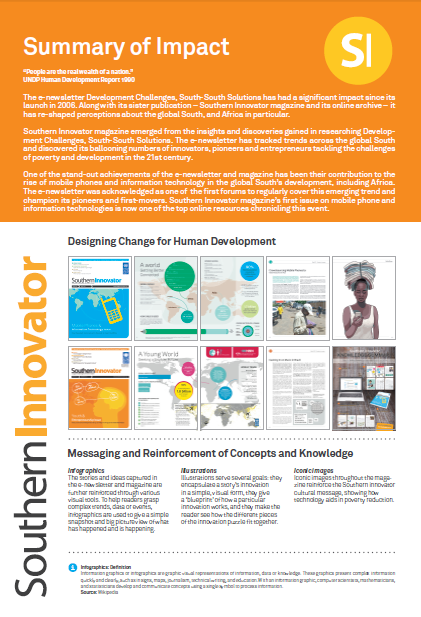
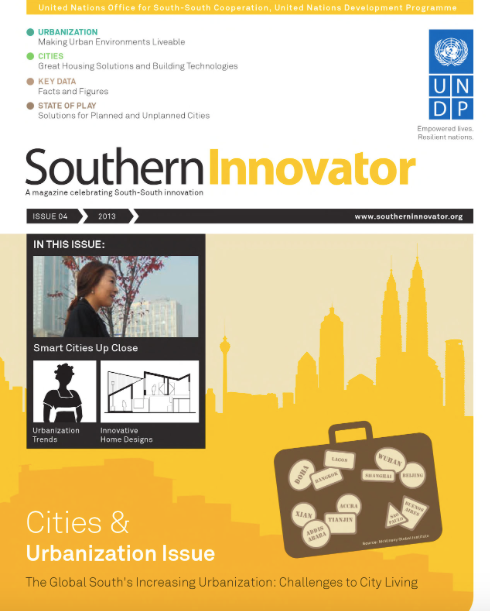
    Development Challenges, South-South Solutions was launched as an e-newsletter in 2006 by UNDP’s South-South Cooperation Unit (now the United Nations Office for South-South Cooperation) based in New York, USA. It led on profiling the rise of the global South as an economic powerhouse and was one of the first regular publications to champion the global South’s innovators, entrepreneurs, and pioneers. It tracked the key trends that are now so profoundly reshaping how development is seen and done. This includes the rapid take-up of mobile phones and information technology in the global South (as profiled in the first issue of magazine Southern Innovator), the move to becoming a majority urban world, a growing global innovator culture, and the plethora of solutions being developed in the global South to tackle its problems and improve living conditions and boost human development. The success of the e-newsletter led to the launch of the magazine Southern Innovator. 

    Creative Commons License

    This work is licensed under a
    Creative Commons Attribution-Noncommercial-No Derivative Works 3.0 License.

    ORCID iD: https://orcid.org/0000-0001-5311-1052.

    © David South Consulting 2023

  • Colombian Architect Proving Strength and Beauty of Bamboo

    Colombian Architect Proving Strength and Beauty of Bamboo

    By David SouthDevelopment Challenges, South-South Solutions

    SOUTH-SOUTH CASE STUDY

    Fast-growing bamboo grass (http://en.wikipedia.org/wiki/Bamboo) has become a cause celebre amongst those looking for a sustainable and tough building material.

    In the last five years, more and more construction projects have turned to bamboo. It has many advantages: it grows quickly, is super-strong yet also supple enough to bend in a hurricane or earthquake and has a high tensile strength (http://en.wikipedia.org/wiki/Ultimate_tensile_strength) equivalent to steel. It is, of course, green since it is grown in forests, and is cheap and plentiful in many countries of the South, especially across Asia and Latin America.

    It is also aesthetically pleasing and makes beautiful structures with intricate patterns.

    But despite all these advantages, it has been a hard sales job to get people to choose bamboo as a building material rather than traditional woods, steel or concrete. Many people wrongly think green means not strong. But as many a construction worker knows in Asia, where scaffolding made from bamboo is commonplace, it is tough and stands on its own.

    Pioneers are working hard to prove bamboo deserves respect as a building material for a greener future.

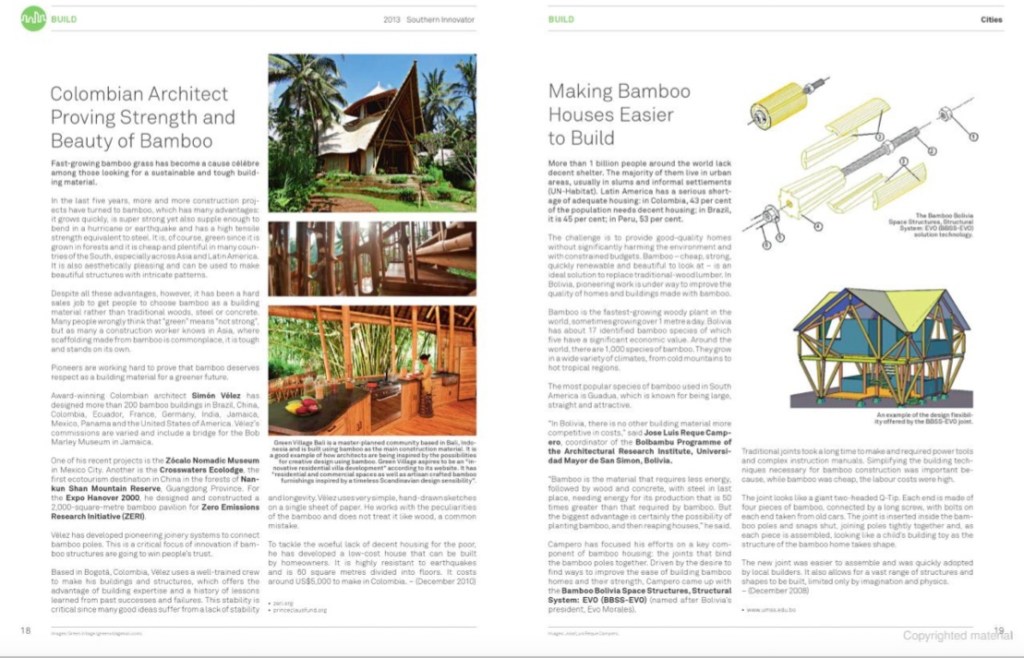
    Award-winning Colombian architect Simón Vélez has designed more than 200 bamboo buildings in Germany, France, the United States, Brazil, Mexico, China, Jamaica, Colombia, Panama, Ecuador, and India.

    Vélez’s commissions are varied, and include a bridge for the Bob Marley Museum in Jamaica.

    One of his recent projects is the Zócalo Nomadic Museum (http://en.wikipedia.org/wiki/Nomadic_Museum) in Mexico City. Another is the Crosswaters Ecolodge (http://www.asla.org/2010awards/370.html), the first ecotourism destination in China in the forests of Nankun Shan Mountain Reserve, Guangdong Province. For the Expo Hanover 2000, he designed and constructed a 2000-square-meter bamboo pavilion for ZERI (Zero Emissions
    Research Initiative) (http://www.zeri.org/).

    Vélez has developed pioneering joinery systems to connect bamboo poles together. This is a critical focus of innovation if bamboo structures are going to win people’s trust.

    Based in Bogotá, Colombia, Vélez uses a well-trained crew to make his buildings and structures. This has the advantage of building expertise and a history of lessons learned from past successes and failures. That stability is a critical insight: many good ideas suffer from a lack of stability and longevity. He uses very simple, hand-drawn sketches on a single sheet of paper. He works with the peculiarities of the bamboo and does not treat it like wood: a common mistake.

    To tackle the woeful lack of decent housing for the poor, he has developed a low-cost house that can be built by home-owners. It is highly resistant to earthquakes and is 60 square metres divided on two floors. It costs
    around US $5,000 to make in Colombia.

    Winner of the Prince Claus Fund (http://www.princeclausfund.org/en/index.html), Vélez’s work promotes sustainable development, introducing new ideas on ecological issues and questions. The Fund calls him an architect “whose aesthetic and technical innovations have considerably expanded the possibilities of bamboo as a building material, providing a challenge to prevailing architectural trends.”

    With more than 1 billion people around the world lacking decent shelter, many see plentiful bamboo as a key part of the solution. Most people with poor quality housing live in urban areas, usually in slums and informal settlements (UN-HABITAT). Latin America has a serious shortage of adequate housing: in Colombia, 43 percent of the population needs decent housing; in Brazil, 45 percent; Peru, 53 percent.

    The challenge is to provide good quality homes without significantly harming the environment – and with constrained budgets. Bamboo – cheap, strong, quickly renewable and beautiful – is an ideal solution to replace traditional wood lumber.

    Bamboo is the fastest growing woody plant in the world, sometimes growing over 1 metre a day. Around the world, there are 1,000 species of bamboo. They grow in a wide variety of climates, from cold mountains to hot tropical regions.

    Once called the “poor man’s timber” – a temporary building material to replace once there is more money – bamboo is now getting the respect it deserves. Bamboo for housing has a long history in Latin America, stretching back 4,500 years to ancient civilizations. In Asia, it has long been a traditional construction material. But most of the existing bamboo dwellings in Latin America are 50 to 100 years old.

    The most popular species of bamboo used in South America is Guadua, which is known for being large, straight and attractive.

    Thoughtful and methodical pioneers like Vélez are proving bamboo has a viable future as a building material that will tackle the housing needs of the world’s poor and the fast-growing cities of the South.

    Published: December 2010

    Resources

    Development Challenges, South-South Solutions was launched as an e-newsletter in 2006 by UNDP’s South-South Cooperation Unit (now the United Nations Office for South-South Cooperation) based in New York, USA. It led on profiling the rise of the global South as an economic powerhouse and was one of the first regular publications to champion the global South’s innovators, entrepreneurs, and pioneers. It tracked the key trends that are now so profoundly reshaping how development is seen and done. This includes the rapid take-up of mobile phones and information technology in the global South (as profiled in the first issue of magazine Southern Innovator), the move to becoming a majority urban world, a growing global innovator culture, and the plethora of solutions being developed in the global South to tackle its problems and improve living conditions and boost human development. The success of the e-newsletter led to the launch of the magazine Southern Innovator. 

    Creative Commons License

    This work is licensed under a
    Creative Commons Attribution-Noncommercial-No Derivative Works 3.0 License.

    ORCID iD: https://orcid.org/0000-0001-5311-1052.

    © David South Consulting 2023

  • Many Positive Trends for Africa in 2010

    Many Positive Trends for Africa in 2010

    By David SouthDevelopment Challenges, South-South Solutions

    SOUTH-SOUTH CASE STUDY

    While 2009 saw the global economic crisis spread around the world, the story is more complex and more hopeful than many believe. For Africa, various trends are pointing to positive economic development in 2010, despite the continent’s numerous political, social and environmental challenges. Pragmatism is driving stronger economic ties between Africa and the rest of the world, while long-running trends are delivering opportunity to millions despite setbacks.

    The Standard Chartered bank (http://research.standardchartered.com/Pages/home.aspx) believes sub-Saharan Africa will jolt itself out from the 1 percent growth it had in 2009, to reach 4.7 percent growth in 2010 and 5.7 percent in 2011 (http://research.standardchartered.com/researchdocuments/Pages/ResearchArticle.aspx?&R=66952). The reason? The world’s strong appetite for commodities and food, which will continue to draw in business. And much of this business will be done by that powerhouse of the global South, China.

    The fact that China is trading better infrastructure – roads, rail and ports – for commodities means other businesses can also benefit from the improving environment. Throughout the downturn in 2009, China actually increased its investments in Africa.

    The United States is also trying to increase its economic relationship with Africa. It wants a third of its oil imports to come from West Africa by 2015.

    And the competition for food in the world, as countries address the global food crisis, has seen companies from the Middle East to Asia to Britain purchasing land in Africa to grow more food.

    The Annansi Chronicles blog on African business and culture trends (www.annansi.com) has come up with a list of the big trends to watch out for on the continent in 2010. They build upon many of the patterns that have emerged in the past few years in Africa.

    The blog predicts that Africa will increasingly be an innovation incubator. Concepts like the bottom of the pyramid – where the poor are seen as an unserved marketplace of needs – will draw more private companies in to innovate new products and services. Already, products and services trialled in Africa are then launched in other places in the world. One example has been mobile phone banking. The blog sees the challenge for Africa as finding ways to increase innovation and harness its economic benefits within the continent, and to direct resources to the African pioneers out there who need money and infrastructure support to grow their ideas.

    Mobile phones will continue to be the source of opportunity in Africa in 2010. Get ready for more businesses to take advantage of the move from analog to digital in Africa, as fibre optic cables continue to expand. Just as the introduction of broadband internet in developed countries gave birth to new businesses like You Tube (www.youtube.com), so it will create new opportunities in Africa. The key to growing the prosperity from this is to see governments and the private sector better connect with African technology pioneers, as can be found in hot spot countries like Ghana.

    Along with technology comes content. And the people to make the content interesting and attractive will be Africa’s so-called ‘creative class’: savvy young African entrepreneurs and thinkers. They have drawn on the rising urbanization of the continent and greater international travel to explore new ways of representing African culture. This has come forward in the explosion in media, fashion, music and design. The blog believes the 2010 FIFA World Cup in South Africa (http://www.fifa.com/worldcup) is going to thrust the world’s attention on to Africa’s creative class: a global media burst that will be an opportunity not to be missed.

    And this will also challenge global perceptions of “brand Africa.” Already, the world’s tourists flow to Africa in greater numbers, defying decades of negative media publicity. Brand Africa will be up for grabs in 2010.

    And finally, while China has been the big story in terms of economic investment in Africa, India will start to make more moves to catch up by flexing its information technology muscles. Look for more joint partnerships between African countries and Indian technology companies.

    In short, Africa has as many positive trends for 2010 as negative ones. It is just a matter of focusing on the good so the negative will not have a fighting chance in 2010.

    Published: January 2010

    Resources

    1) Design Indaba: See the latest on the catwalks in all-day fashion shows; attend short films, talks and product launches; be enticed to buy from more than 260 exhibitors and hobnob with the designers in person. Above all, be awed by the creative spirit of innovative South Africans. Website: http://www.mobileactive.org

    2) Maker Faire Africa: African pioneers in grassroots innovation offer inspiring inventions. Website: http://makerfaireafrica.com/

    3) Arise Africa Fashion Week: The place to be seen and to see. Website: http://www.africanfashioninternational.com/africaFashionWeek/

    https://davidsouthconsulting.org/2020/12/15/development-challenges-south-south-solutions-newsletter-2007-2010-2/

    https://davidsouthconsulting.org/2022/11/29/new-magazine-13-october-2010/

    https://davidsouthconsulting.org/2022/11/28/new-website-on-the-way-16-september-2010/

    https://davidsouthconsulting.org/2022/12/01/off-to-the-printers-with-a-new-name-southern-innovator-14-may-2010/

    https://davidsouthconsulting.org/2022/11/01/southern-innovator-magazine-2010-2014/

    https://davidsouthconsulting.org/2021/02/22/team-southern-innovator-phase-1-development-2010-2015/

    https://davidsouthconsulting.org/2021/10/28/2010-development-challenges-south-south-solutions/

    https://davidsouthconsulting.org/2022/10/25/2011-trends-for-the-south/

    Development Challenges, South-South Solutions was launched as an e-newsletter in 2006 by UNDP’s South-South Cooperation Unit (now the United Nations Office for South-South Cooperation) based in New York, USA. It led on profiling the rise of the global South as an economic powerhouse and was one of the first regular publications to champion the global South’s innovators, entrepreneurs, and pioneers. It tracked the key trends that are now so profoundly reshaping how development is seen and done. This includes the rapid take-up of mobile phones and information technology in the global South (as profiled in the first issue of magazine Southern Innovator), the move to becoming a majority urban world, a growing global innovator culture, and the plethora of solutions being developed in the global South to tackle its problems and improve living conditions and boost human development. The success of the e-newsletter led to the launch of the magazine Southern Innovator. 

    Creative Commons License

    This work is licensed under a
    Creative Commons Attribution-Noncommercial-No Derivative Works 3.0 License.

    ORCID iD: https://orcid.org/0000-0001-5311-1052.

    © David South Consulting 2023

  • Indian City Slum Areas Become Newly Desirable Places to Live

    Indian City Slum Areas Become Newly Desirable Places to Live

    By David SouthDevelopment Challenges, South-South Solutions

    SOUTH-SOUTH CASE STUDY

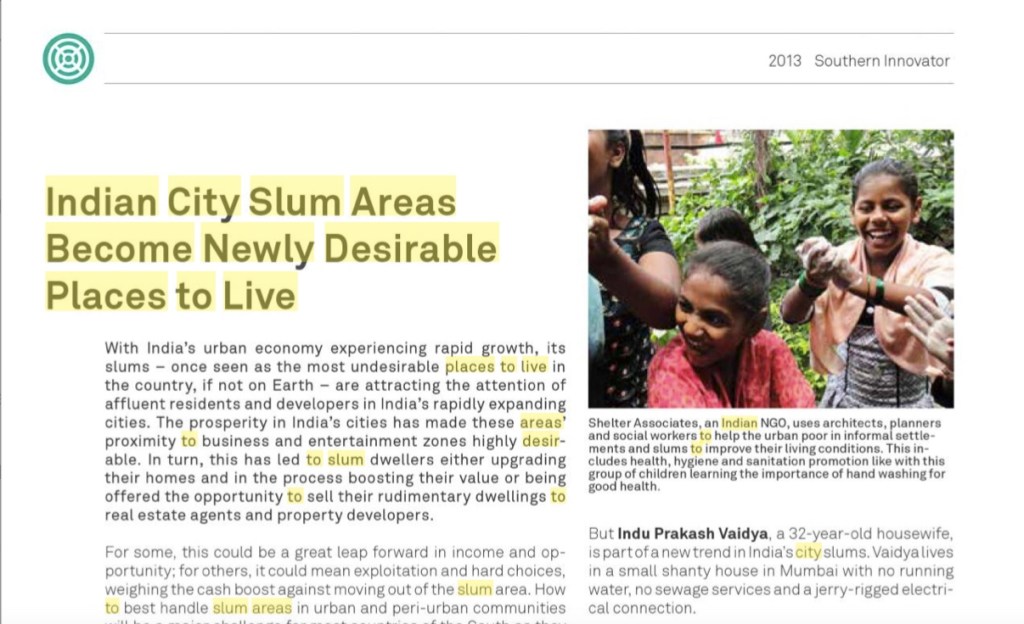
    With India’s urban economy experiencing rapid growth, its slums – once seen as the most undesirable places to live in the country, if not on Earth – are attracting the attention of affluent residents and developers inIndia’s rapidly expanding cities. The prosperity inIndia’s cities has made these areas’ proximity to business and entertainment zones highly desirable. In turn, this has led to slum dwellers either upgrading their homes and in the process boosting their value, or being offered the opportunity to sell their rudimentary dwellings to real estate agents and property developers.

    For some, this could be a great leap forward in income and opportunity; for others, it could mean exploitation and hard choices, weighing up the cash boost against moving out of the slum area.

    How to best handle slum areas in urban and peri-urban communities will be a major challenge for most countries in the South as they continue to urbanize.

    India’s phenomenal economic growth rate – forecast to be 7.9 percent this year by the Asian Development Bank, after averaging 7.7 percent per year over the past decade – has been the force behind an expanding middle class population, now estimated at 50 million people (McKinsey). Forecasts see it swelling from 5 percent ofIndia’s population to 40 percent by 2025.

    With 30 percent of the population living in urban areas and cities contributing 60 percent of the country’s GDP and 90 percent of government revenues (Wall Street Journal), city-dwellers’ fate is critical to the functioning of the economy.

    According to the 2001 Indian census, slums make up 25 percent of all housing and 26 percent of urban households lack access to sanitation facilities.

    But Indu Prakash Vaidya, a 32-year-old housewife, is part of new trend inIndia’s city slums. Vaidya lives in a small shanty house in Mumbai with no running water, no sewage services and a jerry-rigged electrical connection.

    Vaidya’s home is a just a single room for the five people in her family. They sleep on the cement floor and the ‘kitchen’ is a two-burner gas stove. The dwelling is so poorly constructed that they have to move around inside the room when it rains outside to avoid getting soaked.

    But her humble home has been valued at US $24,000 by people looking to buy it.

    According to real estate agent Hari Ram, the average price of a 91 square metre shanty home in Mumbai is now US $46,000.

    “Shanties as small as 120 square feet… are as expensive as US $93,000,” Dinesh Prabhu, a construction company owner, told NDTV television.

    Sixty percent of Mumbai’s 21 million people live in slums. And many are now finding themselves the subject of a property boom. This has led to the bizarre spectacle of luxury high-rise buildings sprouting up in a sea of slum housing. The slums are attracting the attention of those with money because many busy city workers face long commutes and are desperate for homes closer to work and entertainment areas.

    The value of living close to the action is summed up by one slum dweller:

    “People would kill to be in a place like this,” said slum dweller Sundar. “There are four local train stations close by. And the bus stop is a stone’s throw away.”

    Some say this real estate boom offers enormous potential for the poor.

    “All I can say is, given the current real-estate rates, those slums are invaluable,” said Sharad Mahajan of the Pune-based nonprofit organization Mashal (http://mashalindia.org).  Mashal focuses on the problem of urban shelter and also implements housing projects. It has been working in the Dharavi slum area with theMaharashtra government on its redevelopment. The slum is well-known for its representation in the film Slumdog Millionaire, and the area is next to the Bandra-Kurla Complex business district of Mumbai. Mashal has been mapping the area, home to 60,000 families, to make sure the redevelopment is fair to the families living there.

    Land tenure is an issue however. Many slum dwellers do not have official title to the land they live on. Over time, they have become semi-official places to live as governments have hooked many up to electricity and drinking water. Issues of corruption and exploitation are also other problems that need addressing if this real estate windfall is to actually benefit slum dwellers.

    Typical slum dwellers are day labourers and poor migrants. But others are people who good easily afford to live somewhere else but don’t want the long commutes to work.

    “It is simpler and less expensive to live here,” said Sankaralingam, a plastic merchant, who estimates his annual income at around US $9,300: an amount that could get him a home somewhere nicer.

    For Indu Prakash Vaidya, the dilemma – to sell or not to sell – makes for some painful choices. While her current home is prone to flooding during the rainy season, she feels she would have nowhere else to go if she sold the home.

    Yet the pressure to sell is great and elemental.

    “I have three children, and their education and well-being need to be taken care of. Financial constraints can push me to sell this shanty in the future, then where will I live? I will have nowhere to go,” she told NDTV. 

    Published: December 2011

    Resources

    1) New documentary Urbanized gives a passionate over-view of the challenges facing the rapidly urbanizing world around us. Website: http://urbanizedfilm.com/

    Development Challenges, South-South Solutions was launched as an e-newsletter in 2006 by UNDP’s South-South Cooperation Unit (now the United Nations Office for South-South Cooperation) based in New York, USA. It led on profiling the rise of the global South as an economic powerhouse and was one of the first regular publications to champion the global South’s innovators, entrepreneurs, and pioneers. It tracked the key trends that are now so profoundly reshaping how development is seen and done. This includes the rapid take-up of mobile phones and information technology in the global South (as profiled in the first issue of magazine Southern Innovator), the move to becoming a majority urban world, a growing global innovator culture, and the plethora of solutions being developed in the global South to tackle its problems and improve living conditions and boost human development. The success of the e-newsletter led to the launch of the magazine Southern Innovator. 

    Creative Commons License

    This work is licensed under a
    Creative Commons Attribution-Noncommercial-No Derivative Works 3.0 License.

    ORCID iD: https://orcid.org/0000-0001-5311-1052.

    © David South Consulting 2023