UNESCO’s Kronberg Declaration on the Future of Knowledge Acquisition and Sharing is blunt: the future of learning will increasingly be mediated by technology, and traditional educational processes will be revolutionized. Acquiring factual knowledge will decrease and instead people will need to find their way around complex systems and be able to judge, organize and creatively use relevant information.
According to Abdul Waheed Khan, UNESCO’s Assistant Director General for Communications and Information, “Lack of access to knowledge increasingly accentuates marginalization and economic deprivation, and we need to join efforts to bridge these gaps”
More and more initiatives are stepping in to break down barriers in the exchange of information and knowledge, and break out from the gatekeepers. The advent of Web 2.0 and its user-contributed resources is making this happen.
Connexions sees itself as the partner to go with the free and low-cost laptops being distributed by the One Laptop Per Child Project to schoolchildren in the developing world. Connexions is a Web 2.0 website that allows teachers and educators to upload their learning materials by subject for sharing with anyone who wants them. All content is broken down into modules for easy access. The content can be mixed to build courses, and adapted to suit local conditions. It represents a cornucopia of knowledge, ranging from mathematics to engineering to music lessons.
The content’s adaptability is its charm – users can add additional media like video and photos and modify and add on-the-ground case studies to really bring the material to life for students. The ability to re-mix and re-contextualise into the local circumstances is critical to get take-up of these resources argues Connexions.
Open Educational Resources is a global teaching and learning sharing website. It is all about getting teachers to open up and share their knowledge with other teachers. It contains full courses, course modules, syllabi, lectures, homework assignments, quizzes, lab and classroom activities, pedagogical materials, games and simulations, It is run by ISKME,an independent, non-profit educational think tank whose mission is to understand and improve how schools, colleges, and universities, and the organizations and agencies that support them, build their capacity to systematically collect and share information
Another excellent way to share information is the online publishing tool Lulu. While it is free to publish – whether a book, photo book, brochure, artwork, digital media, DVD and e-books – it does cost the person who wants to download or order a printed and bound copy. The creator of the content gets to choose how much should be charged and what is a fair price. The beauty of this website is the ability for anyone to publish and to bypass the limitations of traditional publishing.
Once you have created your content, and taken the decision to share it with the world, you can also make sure it is copyright protected so that nobody accept you makes money from it. It is aimed at authors, scientists, artists and educators, and lets them protect their work for free. The Creative Commons initiative allows repeat use for free of the content as long as the user attributes its source to its original author. Any content you publish online will be given a logo clearly stating what rights it has.
Published: August 2007
Resources
Professor Richard Baraniuk explains his concept in a video: click here to view
The Creative Commons provides free tools that let authors, scientists, artists and educators to easily define what rights they will allow people to have who use their work. The website has all the tools (including logos) to get started licensing work: www.creativecommons.org
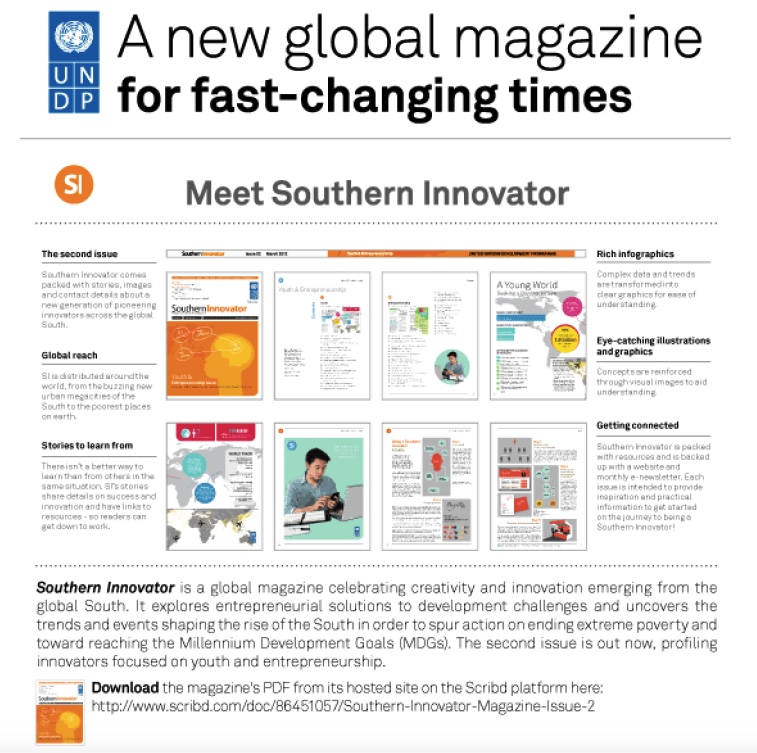
Development Challenges, South-South Solutions was launched as an e-newsletter in 2006 by UNDP’s South-South Cooperation Unit (now the United Nations Office for South-South Cooperation) based in New York, USA. It led on profiling the rise of the global South as an economic powerhouse and was one of the first regular publications to champion the global South’s innovators, entrepreneurs, and pioneers. It tracked the key trends that are now so profoundly reshaping how development is seen and done. This includes the rapid take-up of mobile phones and information technology in the global South (as profiled in the first issue of magazine Southern Innovator), the move to becoming a majority urban world, a growing global innovator culture, and the plethora of solutions being developed in the global South to tackle its problems and improve living conditions and boost human development. The success of the e-newsletter led to the launch of the magazine Southern Innovator.
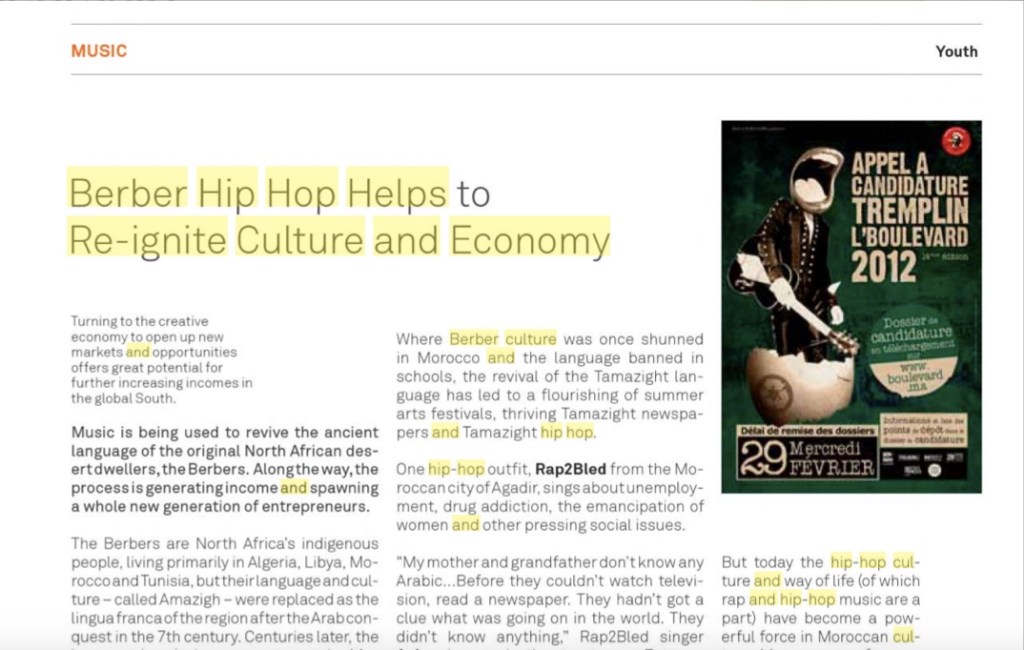
Music is being used to revive the ancient language of the original North African desert dwellers, the Berbers (http://en.wikipedia.org/wiki/Berber_people). And in the process, it is spawning a whole new generation of entrepreneurs and generating income.
The Berbers are North Africa’s indigenous people, primarily living in Morocco, Algeria, Libya, and Tunisia, but their language and culture – called Amazigh – were replaced as the lingua franca of the region after the Arab conquest in the 7th century. But all these years later, the language is enjoying resurgence under Morocco’s king, Mohammed VI, who is helping to promote the language through television programming and a new law making teaching of the language compulsory in schools by 2010.
Amazigh people – the name means “free humans” or “free men” – total more than 50 million. Their group languages, called Tamazight, are spoken by several million people across North Africa, with the largest number in Morocco.
Where once Berber culture was shunned in Morocco and the language banned in schools, the revival of the Tamazight language has led to a flourishing of summer arts festivals, thriving Tamazight newspapers _ and Tamazight hip hop.
One hip-hop outfit, Rap2Bled from the Moroccan city of Agadir, stick to social issues, singing about unemployment, drug addiction and the emancipation of women.
“My mother and grandfather don’t know any Arabic…Before they couldn’t watch television, read a newspaper. They hadn’t got a clue what was going on in the world. They didn’t know anything,” Rap2Bled singer Aziz, who goes by the street name Fatman, told to Radio Netherlands Worldwide.
“But now there is a TV channel in our local dialect and a newspaper. But our aim is to put the language on the map by fusing it with hip hop. More than 60 per cent of young Moroccans only listen to rap and western music. So we thought why not fuse Berber with that and make it really accessible?”
Just 10 years ago, rap and hip hop were virtually unknown in Morocco, with only a small group of hip hop aficionados listening to big American stars like Dr Dre, Tupac Shakur and Notorious BIG.
But today hip hop culture and way of life (of which rap and hip hop music are a part) have become a powerful force in Moroccan culture. Moroccan rap focuses on local issues like unemployment and injustice and is ubiquitous on radio and TV.
The Casa Crew, from Casablanca, has become so successful since their beginnings in 2003 that their fan base stretches to Spain and Algeria.
“First of all, to designate rap simply as mere ‘music’ deprives it of its real impact,” Caprice from the Casa Crew (http://casa-crew-00.skyrock.com/), told the Arab Media News, Menassat.
“Rap is a life style, and mainly a culture of convictions. The fact that rap is spreading in countries like Morocco is an excellent sign. On the one hand, it’s proof that the youth are starting to react, to think they have the right to express themselves in any way they see fit, without anyone judging them or denying them of that right. On the other hand, the development of rap means that the space for artistic freedom is growing particularly when considering that a majority of Arab rappers are dealing with subjects that we were forbidden to speak about a few years ago.”
The Amazigh revival industry centres around large music festivals. Timitar Festival in Agadir (http://www.moroccofestivals.co.uk/timitar.html) gets crowds surpassing 500,000, with more than 40 artists. Morocco’s biggest festival helps Amazigh artists meet world musicians and learn how to reach music fans outside of Morocco.
Another pioneer of Morocco’s music industry is Mohamed ‘Momo’ Merhari, a young music entrepreneur and winner of the British Council’s International Young Music Entrepreneur of the Year award in 2008 (http://www.creativeconomy.org.uk/).
Momo is a music consultant and co-founder of the “Boulevard des Jeunes Musiciens” (http://www.boulevard.ma/), the largest contemporary music festival in North Africa, featuring 50 bands over four days, and reaching a live audience of 130,000 people. The annual event showcases new talent from the worlds of hip hop, rock and jazz fusion from all over the region.
In January, Morocco’s culture minister Touriya Jabrane promised to introduce a range of measures to financially support Moroccan musicians, composers and the industry as whole.
The United Nations of Hip Hop: A web portal for African hip hop news, music and resources. Website:http://www..unitednationsofhiphop.com/
The Timitar music festival happens every year in July in Morocco’s Agadir. It brings together Amazigh musicians with other African and world musicians. Website:http://www.festival-timitar.com/timitar.html
The annual Amazigh Film Festival happens every year in January in Los Angeles, California, USA. Website: http://www.tukshop.biz/
Development Challenges, South-South Solutions was launched as an e-newsletter in 2006 by UNDP’s South-South Cooperation Unit (now the United Nations Office for South-South Cooperation) based in New York, USA. It led on profiling the rise of the global South as an economic powerhouse and was one of the first regular publications to champion the global South’s innovators, entrepreneurs, and pioneers. It tracked the key trends that are now so profoundly reshaping how development is seen and done. This includes the rapid take-up of mobile phones and information technology in the global South (as profiled in the first issue of magazine Southern Innovator), the move to becoming a majority urban world, a growing global innovator culture, and the plethora of solutions being developed in the global South to tackle its problems and improve living conditions and boost human development. The success of the e-newsletter led to the launch of the magazine Southern Innovator.
In the last 50 years, the domestication of high technology – bringing cheaper access to everything from personal computers to digital cameras and applications like global positioning systems (GPS) – has transformed millions of lives and the way business is done. In the next 50 years, biotechnology is set to do the same.
One aspect of biotechnology, genetic engineering (GE), has been lambasted by protest groups for being “unnatural” and driven by profit and the privatisation of nature. It has been seen as the domain of the big and powerful and remote from everyday needs. But now Africa is pioneering new approaches that are rooted in the real challenges faced by African people – and proving world-class scientific research can take place in Africa.
One initiative in South Africa aims to help small and medium sized farmers save their maize (corn) crops. The Food and Agriculture Foundation estimates that 854 million people in the world do not have sufficient food for an active and healthy life, and food security is a serious issue in Africa.
Maize streak viruses (MSV) are geminiviruses that destroy maize crops, and are a big problem throughout sub-Saharan Africa and the Indian Ocean islands. It leaves characteristic yellow-white streaks across the plant’s leaves, and produces deformed corn cobs, often severely dwarfed. Over half of the food supply for people in sub-Saharan Africa comes from maize, but MSV can wipe out an entire farmer’s crop.
Scientists at the University of Cape Town (www.uct.ac.za), South Africa, and the South African seed company PANNAR Pty Ltd have developed a resistant variety of maize that they hope will alleviate food shortages as well as promote the reputation of genetically engineered (GE) foods in Africa.
The MSV-resistant maize is the first GE crop developed and tested solely by Africans. Field trials will soon begin to make sure there are no unintended consequences on the environment and animal life dependent on maize.
Maize arrived in Africa in the 1500s from Mexico, and quickly displaced native food crops like sorghum and millet. Maize streak virus is an endemic pathogen of native African grasses, and is passed on to maize plants by leaf hopping insects.
The technology being developed can also be applied to other geminiviruses, like Wheat dwarf virus (WDV), sugarcane streak virus, barley, oats and millet. The scientists hope this development will prove the safety of GE foods, and address the criticism it is only a profit-driven technology by selling the seeds for minimal profit to subsistence farmers.
“If the GE maize turns out to be as hardy in the field as in the greenhouse,” said Dr Dionne Shepherd, who leads the research, “it could have a great impact on small and medium sized farmers. These are the farmers who need it the most, since they can’t afford preventative measures such as insecticides to control the leafhopper which transmits the disease. When small scale farmers lose 100 per cent of their crop (which they often do) due to maize streak disease, they not only lose any income they would have obtained selling their excess maize, but they also lose a massive chunk of their annual food supply.”
Other African institutions are working on GE crops with international partners, but, Shepherd, says, “The reason the MSV-resistant maize could improve the reputation of GE in Africa, is that international biotech partners, especially in the private sector, are generally not interested in solving problems that are unique to Africa, and Africans are therefore suspicious of their motives when they try to sell or even give away GE food.”
“MSV is endemic to sub-Saharan Africa, and our MSV-resistant maize was developed by Africans for Africa with no ulterior motives, which will hopefully make Africans accept the technology.”
“I think it should attract more funding, because once international funders see that world-class research can happen in Africa, they may be more willing to commit funds.”
In another development, African science is tackling the scourge of malaria on the continent. Caused by a parasite carried by mosquitoes, it kills more than a million people a year and makes 300 million more seriously ill (World Health Organisation). Ninety per cent of the deaths are in Africa south of the Sahara, and most are children.
While bed nets, insecticides and anti-malarial drugs are effective, the disease has become resistant to some drugs and work on a vaccine is slow.
Research in Kenya has found an effective way to both provide food and destroy mosquito larvae. The Nile tilapia – a highly nutritious fish – has long been known to feed on mosquito larvae. But nobody has made the connection between this fact and the fight against malaria. Francois Omlin, a researcher at the International Centre of Insect Physiology and Ecology in Nairobi, Kenya (www.icipe.org), has conducted the first field tests to prove this approach.
“The tilapia species was never tested in the field for its ability to eat mosquito larvae,” he told Reuters.
Ten days after introducing the tilapia to a pond, they had destroyed most of the larvae and after 41 weeks the number of mosquitoes fell by 94 per cent, according to Omlin.
This means two important goals can be served by harvesting tilapia fish: greater access for Africans to the nutritious fish, and a dramatic reduction in mosquito-borne malaria.
Published: September 2007
Resources
International Centre of Insect Physiology and Ecology: www.icipe.org.
Development Challenges, South-South Solutions was launched as an e-newsletter in 2006 by UNDP’s South-South Cooperation Unit (now the United Nations Office for South-South Cooperation) based in New York, USA. It led on profiling the rise of the global South as an economic powerhouse and was one of the first regular publications to champion the global South’s innovators, entrepreneurs, and pioneers. It tracked the key trends that are now so profoundly reshaping how development is seen and done. This includes the rapid take-up of mobile phones and information technology in the global South (as profiled in the first issue of magazine Southern Innovator), the move to becoming a majority urban world, a growing global innovator culture, and the plethora of solutions being developed in the global South to tackle its problems and improve living conditions and boost human development. The success of the e-newsletter led to the launch of the magazine Southern Innovator.
The vast Amazon rainforest has inspired a cuisine pioneer in Brazil. Combining the sensual pleasures of fine dining and the joy of tasting new flavours with a pursuit of sustainable and profitable local farming, a chef is inventing a new Brazilian cuisine and showing the way to create sustainable incomes.
The kitchens of chef Alex Atala are as much a laboratory of food experimentation as a place to cook meals. He applies French and Italian cooking styles to traditional Brazilian dishes and ingredients. Since opening his restaurant D.O.M in 1999 in Sao Paulo, Atala has relentlessly pursued – through adventurous journeys around Brazil and into the Amazon rainforest – new flavours, foods and cuisines native to the country. When he started out, he was surprised to discover the lack of knowledge about native Brazilian ingredients, both within the country and outside. He has turned himself into a champion for local communities, helping them turn local foods into sources of income.
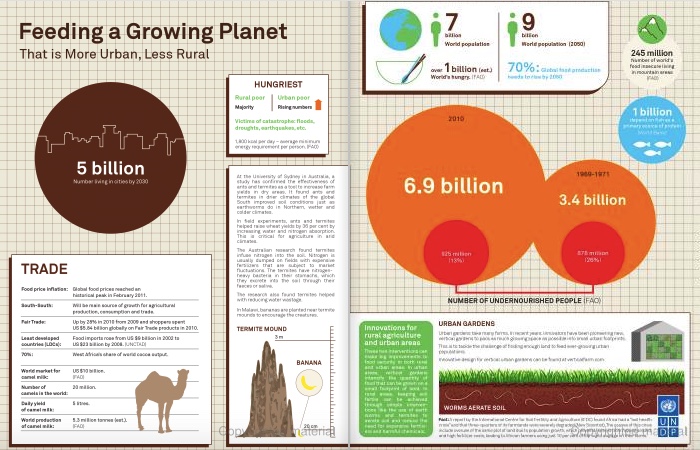
Brazil, home to the largest portion of the Amazon rainforest, is hoping to become the world’s biggest food producer – it is currently second after the United States – addressing a major global problem and providing income for Brazil’s farmers.
The challenge is to increase food production – providing income for Brazil’s farmers and helping address a major global problem – without destroying the Amazon’s complex ecosystem.
Amazonia, the region that takes in the mighty Amazon River and the vast Amazon rainforest, is home to the most diverse range of plant and animal species in the world (http://en.wikipedia.org/wiki/Amazon_Rainforest). Brazil is currently debating legislation to ease restrictions on how small farmers can use land in the Amazon rainforest. It would loosen regulations on farming near river banks and hilltops. Many working in Brazil’s agricultural industry believe the country is not living up to its potential. They say Brazil could surpass the United States as an agricultural producer if allowed to use all its arable land.
This is a crucial debate not only for the future of the environment, but also for humanity. World demand for food keeps rising as populations increase and living standards rise in many countries, such as China. Another trend at work is increasing global urbanization, where more people are leaving agriculture as a business to live in cities and peri-urban areas to pursue a better quality of life. These growing megacities will need vast amounts of food to feed their populations.
Brazil has, in recent years, increased the amount of territory designated as a protected area in the Amazon forest.
The National Institute for Space Research in Brazil (http://www.inpe.br/ingles/index.php) has satellite photographs showing deforestation in the Amazon at its slowest pace for two decades. But more recent reports show deforestation accelerating again in 2011.
Sao Paulo’s D.O.M. Restaurante (http://www.domrestaurante.com.br) – the name is an acronym for the Latin phrase “God, the best and greatest” – has used the rainforest’s rich harvest of foods to create an award-winning destination restaurant that prioritises sustainable sources. It was ranked seventh in this year’s S. Pellegrino World’s 50 Best Restaurants list.
Atala says on his website he “is bringing a new sustainable Brazilian cuisine to the world’s attention.” His motto is “It is necessary to cook and eat as a citizen.”
The restaurant celebrates small-scale producers when sourcing food products (http://www.domrestaurante.com.br/#/en-us/menu/ingredientes). One pioneering food producer Atala works with is DRO Ervas e Flores (herbs and flowers) (http://www.droervaseflores.com). Located in the city of Cequilho, it grows edible herbs and flowers for restaurants. The flowers cultivated by DRO serve mainly to decorate plates, but can also be eaten. At the company farm, the flowers produced include violas, begonias, borago, monks cress, chrysanthemums, pumpkin flowers, coriander flowers, sweet alyssum, mini roses, basil flowers, roses, rockets and violets.
One notable success has been the Amazonian root priprioca. Once it was used only for cosmetics, but Atala has turned it into an essence for cooking. He has conducted original research into uses for the root, which is produced by small communities in the Amazon.
Other Brazilian foods he champions include black rice, an unusual variety sought after for its health benefits. It has 30 percent more fibre and 20 percent more protein than white rice, and less fat and calories than brown rice. The black rice used at D.O.M is produced in the Paraiba Valley in Sao Paulo state by Chicao Ruzene (http://www.arrozpreto.com.br), who researches new varieties on the rice farm.
Jambu, a herb from the Amazon, gives an electrical sensation when it is chewed. Tucupi, a yellowish liquid from pressed wild manioc tuber, is used to season typical Amazonian dishes made with fish, fowl and ducks.
Already well known in his native Brazil, Atala has become the country’s first internationally known celebrity chef and standard-bearer for the “New Brazilian Gastronomy.”
His origins are inspiring: a former DJ and punk, he sold his records and went on a trip backpacking in Europe when he was 18. He made a living as a painter and dishwasher until a friend convinced him to go to catering school. Upon graduation, he worked in some of the top restaurants in Italy and France. This apprenticeship left Atala skilled in the techniques of French cuisine – considered one of the most disciplined and methodical in the world – and he returned in 1994 to Brazil.
The restaurant has ultra-modern design and the sleek kitchen is home to a collection of Amazonian art. Atala acts as an ambassador for the country’s cuisine and flavours to the world. He opened a second restaurant in 2009, Dalva e Dito (http://www.dalvaedito.com.br), which celebrates home cooking by mothers and grandmothers and features only local produce.
Atala’s inclusion of ‘wild’ ingredients has inspired other chefs. His expeditions into the Amazon continue to discover and study the biodiversity of the rainforest and the culinary culture of its inhabitants.
His long-term agenda is to boost local farmers and food production and to increase the availability of ‘wild’ foods in the nation’s supermarkets. If he gets his way, people around the world will be eating the Brazilian way.
“French, Italian, Spanish and Japanese chefs, for example, have their own cuisine and give value to their terroir (local) produce,” Atala explained his passion to The World’s 50 Best Restaurants. “We have to do the same in Brazil! Our ingredients are exotic now, but can become popular in the near future.”
3) Winner of a UN Habitat award, the Brazilian farmer’s cooperative Cooperhaf: Cooperativa de Habitacao dos Agricultores Familiares has put together what it calls a “social technology” combining housing and farm diversification to support family farmers. Website:http://www.cooperhaf.org.br
4) Eat Smart in Brazil: How to Decipher the Menu, Know the Market Foods and Embark on a Tasting Adventure by Joan Peterson, Publisher: Ginko Press. Website:http://www.ginkgopress.com/
Development Challenges, South-South Solutions was launched as an e-newsletter in 2006 by UNDP’s South-South Cooperation Unit (now the United Nations Office for South-South Cooperation) based in New York, USA. It led on profiling the rise of the global South as an economic powerhouse and was one of the first regular publications to champion the global South’s innovators, entrepreneurs, and pioneers. It tracked the key trends that are now so profoundly reshaping how development is seen and done. This includes the rapid take-up of mobile phones and information technology in the global South (as profiled in the first issue of magazine Southern Innovator), the move to becoming a majority urban world, a growing global innovator culture, and the plethora of solutions being developed in the global South to tackle its problems and improve living conditions and boost human development. The success of the e-newsletter led to the launch of the magazine Southern Innovator.








 David South Consulting
You must be logged in to post a comment.