The task is huge: 2.6 billion people, or 41 percent of the world’s population, is without access to basic sanitation. As a result, most have to make do and defecate or urinate wherever they can. In crowded urban areas, the result is an unpleasant source of disease and filth that fouls living spaces and sickens or kills many people.
In Indian cities, between one-quarter and one-half of the population, mostly slum-dwellers, has inadequate or no provision for sanitation.
Many government-built communal toilet blocks are in a sad state. They are overburdened by queues of people that can stretch a mile-long in the mornings. They can also be too expensive for many slum dwellers. Often government-built toilet blocks are in disrepair after just three months, and people return to defecating in the streets.
In 2008, the International Year of Sanitation (http://esa.un.org/iys/), more than 330 million people in India do not have access to proper sanitation facilities. And in the case of the remote town of Musiri in Tamil Nadu state, many residents relieve themselves on river banks, leading to infectious diseases like diarrhoea.
But an ingenious scheme is keeping streets clean and people relieved. Rather than viewing human waste as an expensive problem and annoyance, poor residents are being paid up to a dollar a month to use public toilets. By paying people to use the toilets, the government avoids having to run campaigns to get people to change their habits.
“In fact, many of us started using toilets for urination only after the ecosan (ecological sanitation) toilets were constructed in the area,” S. Rajasekaran, a truck cleaner, to The Times of India.
The urine is being collected to be used as a crop fertilizer by the state’s agricultural university (http://www.tnau.ac.in/ ). About 150 residents use the eco-sanitation toilet daily. It is designed to collect faeces as well: it too is used as fertilizer.
“We’re motivating people to know the value of their urine,” Marathi Subburaman, who came up with the novel idea, told CNN. “The urine that is collected goes into fields for paddy crops, and of course the faeces becomes good compost in a matter of months.”
Subburaman’s non-profit Society for Community Organization and People’s Education (SCOPE) has teamed up with Tamil Nadui Agricultural University and are studying how much urine is needed to fertilize a field.
“Next year, we can install urine banks so we can sell the urine to farmers,” he said.
The locals are given cards and each trip is recorded. At the end of the month, the cards are handed in and the money collected.
The average amount paid out is based on the assumption most people need to go twice a day.
If some get cheeky and try to make more money from pretending they need to go to the toilet, there is a solution: “If they ask to go three, four times a day, then something’s wrong,” Subburaman said. “We ask them to go to a doctor.”
Another successful model is the Indian NGO SPARC (Society for Promotion of Area Resource Centres) (http://www.sparcindia.org/). SPARC is an Indian NGO established in Mumbai in 1984 that began working with women pavement dwellers.
It has been designing and building toilet blocks in Indian cities, bringing access to toilets and washing facilities to hundreds of thousands of poor urban Indians. It has built toilet blocks for 400,000 people in eight Indian cities. It trains community groups to build, manage and maintain the toilet blocks. It has also proven that local groups can take on the management and costs of providing toilet facilities.
Resources
World Toilet Organization: The global non-profit organization committed to improving toilet and sanitation conditions. Website:http://www.worldtoilet.org
World Toilet College: Established in 2005, the World Toilet College (WTC) started as a social enterprise, with the belief that there is a need for an independent world body to ensure the best practices and standards in toilet design, cleanliness, and sanitation technologies are adopted and disseminated through training. Website:http://www.worldtoilet.org/ourwork3.asp
Official website for the 2008 International Year of Sanitation. Website:http://esa.un.org/iys/
Waste has expert knowledge on domestic solid and liquid waste management and sanitation issues. Its website offers a comparison of designs and methods for toilets. Website:http://www.ecosan.nl/page/353
Development Challenges, South-South Solutions was launched as an e-newsletter in 2006 by UNDP’s South-South Cooperation Unit (now the United Nations Office for South-South Cooperation) based in New York, USA. It led on profiling the rise of the global South as an economic powerhouse and was one of the first regular publications to champion the global South’s innovators, entrepreneurs, and pioneers. It tracked the key trends that are now so profoundly reshaping how development is seen and done. This includes the rapid take-up of mobile phones and information technology in the global South (as profiled in the first issue of magazine Southern Innovator), the move to becoming a majority urban world, a growing global innovator culture, and the plethora of solutions being developed in the global South to tackle its problems and improve living conditions and boost human development. The success of the e-newsletter led to the launch of the magazine Southern Innovator.
The global food crisis continues to fuel food price inflation and send many into hunger and despair. Around the world, solutions are being sought to the urgent need for more and cheaper food. Right now there are 862 million undernourished people around the world (FAO), and U.N. Secretary General Ban Ki-moon has called for food production to increase 50 percent by 2030 just to meet rising demand.
The crisis is forcing many countries to turn to other food sources to feed their populations. As the price of poultry, cows, sheep,pigs and seafood rises, rodents are coming more and more into the picture, in particular, rats (http://en.wikipedia.org/wiki/Rat). For example, in Africa, farming the cane rat is seen as a better option than chickens, because they are easier to care for.
Using rats as a food source draws either disgust or amusement from many, but eating rat meat has a long history. Rats are being actively farmed and processed for food in countries as culturally diverse as Nigeria, Cambodia and India.
In Thailand, fast-food vendors are enjoying a rat boom, selling them poached, fried, grilled or baked. They claim they are tastier than other meats and are healthy because they come from rice fields.
In Cambodia, spicy rat dishes are increasingly appearing on menus as people can’t afford more expensive meats. Inflation has pushed the price of beef out of the reach of the poor. A kilogram of rat meat now sells for around 5,000 riel (US $1.22), up from 1,200 riel (US $0.29) last year. But beef goes for 20,000 riel (US $4.88) a kilo.
“Many children are happy making some money from selling the animals to the markets, but they keep some for their family,” agriculture official Ly Marong told The Guardian newspaper. “Not only are our poor eating it, but there is also demand from Vietnamese living on the border with us.”
Cambodians have found it easier to catch rats as the rodents flee flooding in the Mekong Delta. Marong says Cambodia is exporting more than 1 tonne of live rats a day to Vietnam – a newly booming income source for the country.
In India, the secretary of the state for welfare in the state of Bihar (http://en.wikipedia.org/wiki/Bihar) has called for more rat harvesting and eating to beat the rising prices of food. Vijay Prakash sees another benefit to rat eating: killing the rats will help keep the population under control and reduce the amount of grain stocks being devoured by the voracious little eaters.
At present, over 50 percent of Bihar’s grain stock is destroyed by rats.
Practical Prakash realises he has a sales job on his hands, and is currently meeting with hotels and restaurants to include rat on the menus and make the dishes appetising.
“Some socially deprived people in Bihar have always consumed rat meat. If they can eat rats, why can’t the rest of the people?” he told India’s The Week. “This will help in mitigating the global food crisis. We are sure that it will work wonders.”
In Bihar, the traditional rat eaters are called the Musahars – a group looked down upon as ‘untouchables’ in India’s caste system of social hierarchy – who have always made their living by hunting rats in the rice paddy fields.
“We’d like to have a network with other experts to boost the rat meat business” said Prakash. “We will encourage and help the Musahars to organize rat farms in order to commercialise rat meat. The government has decided to engage the Musahars in commercialisation of rat meat for their overall development.”
Estimates place the number of Musahars at 2.3 million people, many of whom are considered the most deprived and marginalised in Indian society.
While Bihar is in the north-east of India, rat eating in the South of India has reduced the amount of chicken eaten.
In the rural south-eastern part of Bangladesh, villagers have had to turn to rats as a food source because they have done so much damage to the local crops.
Deploying hill traps during the once-in-50-years bamboo blooming season, the villagers try to stop the rats from eating the seeds. The seeds are so nutritious for the rats, it causes them to breed four times faster than normal. The growing rat population then moves on to eating the local crops of rice, ginger, turmeric and chillies.
The rats are now so plentiful, they have become a major food source.
But as is being shown in Africa, rats, and in particular, cane rats, do not have to be a meat of desperation. Large cane rats have long been eaten as bush meat – a Food and Agricultural Organization report found rat made up over 50 percent of the locally produced meat eaten in some parts of Ghana.
Now a concerted effort is underway to change the perception of cane rat and even turn it into an exportable meat.
Cameroon’s first commercial cane rat (http://en.wikipedia.org/wiki/Cane_rat) farm opened this year in the capital, Yaounde. It is meant to be a training farm to show others how to commercially raise cane rat for food. The feisty rats are very large, the size of a small dog. They are said to taste “succulent, tender, sweet.” Cameroonian rat-meat entrepreneurs are also very ambitious, telling the BBC they want to win people over to cane rat meat around the world. One day, they would like to see cane rat as an acceptable meat that can be served on airplanes and in the finest restaurants.
Pioneering work in developing techniques for breeding cane rats in captivity has been going on at the University of Ibadan in Nigeria (http://www.ui.edu.ng/) since 1973. It has been so successful, commercial large-scale rat farming is growing in Southern Nigeria.
Farmer Ade Olayiwola of Ibadan, Nigeria (http://en.wikipedia.org/wiki/Ibadan) told the Tribune Agriculture journal that cane rats are a high-profit, low-stress animal to farm.
“It is more assuring than the poultry business which could bring fortune to you in the day, but could also bring unexpected problems suddenly, to the extent that if care is not taken, one may run into serious financial crisis as well as other problems,” he said.
Resources
The UN’s Food and Agriculture Organization has produced guidelines and a paper on the proper care and raising of cane rats for food production. It is based on experiments conducted in the 1980s in Benin. Website:http://www.fao.org/DOCREP/U5700T/u5700T0k.htm
Development Challenges, South-South Solutions was launched as an e-newsletter in 2006 by UNDP’s South-South Cooperation Unit (now the United Nations Office for South-South Cooperation) based in New York, USA. It led on profiling the rise of the global South as an economic powerhouse and was one of the first regular publications to champion the global South’s innovators, entrepreneurs, and pioneers. It tracked the key trends that are now so profoundly reshaping how development is seen and done. This includes the rapid take-up of mobile phones and information technology in the global South (as profiled in the first issue of magazine Southern Innovator), the move to becoming a majority urban world, a growing global innovator culture, and the plethora of solutions being developed in the global South to tackle its problems and improve living conditions and boost human development. The success of the e-newsletter led to the launch of the magazine Southern Innovator.
In the Mongolian language, the book explores how Mongolia’s vibrant rock and pop music scene led on business innovation and entrepreneurship in the country during the transition years (post-1989). Written by an ethnomusicologist, it details the key moments and events in this story, while splicing the narrative with first-person interviews with the major players.
MTV is available on cable television, bootleg CDs blare from kiosks and the latest news on the Spice Girls is available in one of dozens of entertainment newspapers. Despite the flood of foreign music it is local musicians who the youth turn to to voice their new-found freedoms, dreams and angst. Pop music researcherPeter Marsh swings to the new beat of the steppe…
It is something that would have horrified the old socialist leaders. Pop singer T. Ariunaa – Mongolia’s answer to Madonna – is doing what she does best: pushing the barriers of what a performer can and can’t do. Notorious in the local press as “Mongolia’s Queen of the Erotic,” she struts onto the stage of the Non-Stop – one of the newest and trendiest disco clubs in the Mongolian capital, Ulaanbaatar – wearing a black silk robe over black lingerie bikini underwear. Jumping into her hit song, “Telephone Number”, she sings the lines,
When you begin to take off your shirt, I am happy you’re staying;
When your hot breath is near me, the lights go out,
Cheekily writhing her torso, seductively opening and closing her robe, she teases her audience. And her audience, mostly Mongolian youth from the late teens to early thirties, take it all in with good humour, smiling and giggling. Whether they like her music or not, they appreciate what she’s doing and are having fun. The message of free expression is reflective of the enormous changes in attitudes over this decade.
“I like Ariunaa very much,” says 30-year-old Sukhbaatar, a graphic designer. Wearing a dress shirt, slacks and noticebly shiny shoes, he’s sitting with his two friends, glasses of beer in hand, watching the show. “She has a powerful voice,” he says gesticulating towards the stage. “She has a peculiar style, and this kind of style should be developed in Mongolia.
“But we don’t admire her as a singer,” he says with a wry laugh.
Not long ago, when this landlocked Northeast Asian nation was still subject to Soviet-backed socialist rule, pop-rock musicians like Ariunaa would never have been allowed to bring such explicit expressions of ‘the erotic’ anywhere near the public stage. Ariunaa’s boldness and charisma, which have made her one of Mongolia’s most well-known and controversial young pop stars, show something of the new openness and growing diversity that characterizes the emerging popular music industry in capitalist Mongolia. There are girl bands like Spike, boy bands like Nomiin Talst and Camerton and pop divas like Saraa.
A typical concert in Ulaanbaatar, like this one at the Non-Stop – a converted public gymnasium which opened earlier this year – consists of a succession of live Mongolian bands interspersed with breaks for dancing to Western pop, disco and techno music. The styles of music in these concerts fall into what the Mongolians call pop-rock, which ranges from rock ‘n’ roll, soft rock, and heavy metal rock to techno, hip-hop and rap. Mongolian music fans today now have a wide choice of styles to choose from.
Someone who would know about this well is the ‘elder statesman’ of rock, D. Jargalsaikhan. Wearing leather cowboy boots, sequined leather pants and a leather jacket, and with his black hair streaming down over his shoulders, Jargalsaikhan sees the new diversity of groups as a positive sign of the times, as he said in a recent newspaper interview.
“In the stores today there are maybe 10 different varieties of sausage: salted, unsalted, spiced and so on. You can then look at them all and then choose the one you want, like spiced sausage. It’s the same thing with the music business in Mongolia today. In the era of the market economy many different bands and singers have come out, and the listeners can choose the recordings of those bands and music styles that they like. … The most important thing is that the other bands or styles of singers should not be ignored. All of them have a wish to do something. Usually, those who criticize different styles or forms of music are people with too much time on their hands.”
Although turning 40 this year, Jargalsaikhan is not a man with too much time on his hands. As head of the Mongolian Singer’s Association, his many responsibilities keep him on the run. In between numerous breaks to answer calls on his cell phone, Jargalsaikhan tells me about being a rocker in the 1970s and ’80s, which he terms the “Golden Era” of rock in Mongolia, and the difficulties they faced. “Because Mongolia was ruled by one party, the Revolutionary [Socialist] Party [from 1921 to 1990], there was little foreign influence allowed into the country. Rock and pop were not to be found on the [state-controlled] radio or TV, and aside from records and cassettes brought into the country by individuals coming from Europe and Russia, people here had very little experience with the music. … It was easier for the early rock-pop musicians to take examples from folk music, which was close to them, which they had been listening to since their childhood.” Much of the early music included settings of popular folk songs and melodies in the rock genre. And the youth, eager for alternatives to the state-sponsored cultural offerings, found the music to their liking.
The popularity of this early rock-pop, or so-called folk-pop groups soon drew the attention of the socialist party, which saw opportunities to use the music for the purpose of advancing its mission in Mongolia. In exchange for the state government’s granting of musical instruments, rehearsal and performance spaces, and concert and touring opportunities, the early bands were closely watched, their actions restricted by suspicious government officials. “Everything was planned by the government, and we had to do what it had planned,” says Jargalsaikhan. “For example, when we were abroad, we couldn’t go to the discos nor arrive at the hotel late. We couldn’t go where we wanted. There were conflicts between the singers and musicians and the government representatives [sent to oversee the tour]. If I spoke to foreigners, I would be considered a spy. Who I spoke with was also controlled. At that time, the social condition in Mongolia was like that of North Korea today.”
Considered by the government to be a “capitalist art,” the direct imitation of Western rock was not allowed. Mongolian bands instead had to create a unique Mongolian style of the music that drew from traditional folk or classical musical and literary traditions. Band members were often compelled to compose songs to lyrics written by members of the powerful Mongolian Union of Writers. “It was difficult for musicians to play their own compositions, and they were often forbidden to do so,” recalls Jargalsaikhan. “For the concert programmes, our songs had to include the topics of Mongolia and the Soviet Union, as well as the Mongolian love for Nature or for Father and Mother. … The topic of love between a man and woman was considered to be too personal for the public stage, and was almost forbidden.”
But rock and pop musicians gained more and more freedoms of expression as political and social reforms were introduced in Mongolia throughout the 1980s. “The rock-pop musicians of the 1970s became more skilled and their abilities improved,” says Jargalsaikahn. “They began to compose at the level of professional composers. Also, the older generations wanted to give more artistic freedoms to the youth at the same time as the Party controls were being lifted.” And the youth, in turn, were more intent on creating traditions of music of their own generation. “The young rock-pop musicians wanted to hand-down their own music to the next generation-their own pop-rock art.
Jargalsaikhan gained fame throughout Mongolia for his 1988 song “Chinggis Khan,” when he was lead singer of the band by the same name. Making use of traditional folk music instruments alongside of the group’s electric guitars, synthesizers and drums, the song praises the 13th century Mongolian leader as a great, if historically misunderstood, man who always had in mind the good of the Mongolian nation–and this at a time when expressing such sentiments could have landed him in prison. “I had to show my civil courage to sing this song. But many of my friends and fellow composers encouraged me to write and perform it.”
His was the voice of a new generation, one seeking more freedoms to express Mongolian identity in new ways. The efforts of many musicians of his generation contributed to the popular political movements and protests that eventually led, in 1990, to the downfall of the socialist government and the introduction of democratic and market economic reforms throughout the nation.
In the new social and cultural climate of the late-1980s and early ’90s, musicians saw it as their responsibility to introduce Western rock music and popular culture to Mongolia. Besides Jargalsaikhan’s Chinggis Khan (“soft rock”), other groups came onto the popular music scene, including bands like Haranga (“heavy-metal/grunge”) and Hurd (“metal rock”).
The leader and percussionist of the group Hurd (“Speed”), D. Ganbayar, saw it as a national service to his people to introduce his group’s unique form of Western-style rock. “The Mongolian people, and especially the youth, don’t want [their bands] to imitate Western rock art. They want a pop-rock with its own specific character, music that’s different from other types of Western rock-pop, music with its own national character.” Wearing a leather jacket and black hair down to his chest, Ganbayar, moves to the edge of his chair. “No one but us will introduce this kind of music to the Mongolian people. We serve our people. It’s our duty to introduce Western music to the Mongolian people through the Mongolian language and Mongolian melodies. We want to show that Mongolian rock-pop has its own unique character.”
Nearing a decade of life, Hurd continues to experiment with new sounds and performance styles. They recently softened their driving, heavy metal style in two “Unplugged” concerts given at another new disco club in Ulaanbaatar, Top Ten, a cavernous warehouse located in a former cultural centre. This was the first time any rock group had tried such a concert idea in Mongolia. Even on acoustic guitars, however, the group, consisting of a bass, two guitars, drums, percussion and keyboards, managed to fill the club with their sound and fury. Their fans packed the house, and the lead singer, Tumurtsog, needed little effort to get them to sing along with him on many songs.
Hurd and Haranga are still very popular groups in Mongolia, but in the past years few new heavy metal or hard rock groups have come onto the pop-rock scene here. Instead, a new generation of popular singers and music groups have been working their way up and into the limelight of the concert stages. These are youths that mostly eschew the long hair and leather jackets of the older groups in favor of short, styled hair and suits and ties. The music would be recognized in the West as techno, hip-hop, and pop along the lines of the Backstreet Boys, Celene Dion and the Spice Girls, and is almost always electronically produced in recording studios and then backgrounded to the singers and dancers themselves on stage with the use of a tape player.
Mostly in their late teens and early 20s, these performers appeal to Mongolian audiences with their singing, dancing and stage presence. One of the most popular of the current crop of bands is Har Sarnai (“Black Rose”), a “hip-hop techno” male duo, famous for their dancing, nationalistic song lyrics and sometimes outrageous clothes and hair styles.
In their concerts they often come out on stage wearing specially designed silken dels (traditional Mongolian robes worn by both men and women), with sunglasses and big bushy black and gray colored wigs on their heads. As the heavy techno beat of one of their most famous songs, “Alarm,” begins, they launch into their synchronized dance routines and lyrics, which exhort Mongolians to wake up from their dreaming and set to work producing a new society. Their audiences watch from their tables-as Mongolians hardly ever dance while the bands are performing-clearly enjoying the show.
“Har Sarnai is my favorite band,” says 19-year-old Buyanbaatar, a student at the Mongolian State University. “I like how different they are. Their clothes, their behavior on stage is different. And the songs that they sing, their dances and their clothes and style are all well suited together.”
Even older youth, like Sukhbaatar, age 30, mirror these sentiments. “I like Har Sarnai because I like their style and their dancing very much. I also like their unique styles of hair.” His friend Tsooj, age 31, adds, “In America you have rap bands, like New Kids [on the Block], and they dance really well. We like dancing very much. We are not too old for this!”
To both of them, the infectiousness of the new music pop scene transcends traditional age definitions. “I started to listen to music from the Beatles and other foreign bands. But now it’s become very nice in Mongolia. It’s just impossible not to be a fan because we are young people. We don’t think we are old. We are young enough, and we are here to support our favorite bands, and we will scream and whistle with everyone else!”
How audience members of different age groups can mix together at concerts and share such similar tastes in musical genres is perhaps unique to Mongolia. “One of the reasons why even the older generations like the new bands of the younger generations,” says Norov-Aragcha, a professional artist, aged 38, “is that in their youth, when they were 18 or 20, such bands didn’t exist here. We like new things like the younger people, and this music is new to Mongolia.”
But while he appreciates the new opportunities that the new bands have to perform their music in Mongolia, Norov-Aragcha adds that something is certainly missing from their music. “I like Ariunaa, and appreciate what she does. But all these bands and singers [of the young generation], although they have their own styles, they are generally on one level. None of them stands out from the rest. Maybe because of my profession, I prefer something new, something very different from the others. Haranga and Jargalsaikhan, they are our generation. They have feelings, they are making efforts with their music, and they are honest to their music. In their time [late-1980s and early 1990s] it was very difficult, but they did it. They have real talent, real feeling in their music.”
“Now I’m looking at all these new bands and singers, but still the one that I want hasn’t appeared. … That is, something which suits today’s conditions and atmosphere. … Something very powerful, very hard. Something like a Kurt Cobain.”
While not new to Mongolia, pop-rock’s growing diversity certainly is. The general feeling these days seems to be one of celebration of its freedoms and appreciation of its diversity, without the isolation of audiences into genres that is typical in the West. Given the difficulties Mongolia’s youth now face as they struggle to adapt to a society undergoing enormous change, a Mongolian “Kurt Cobain” may be just around the corner.
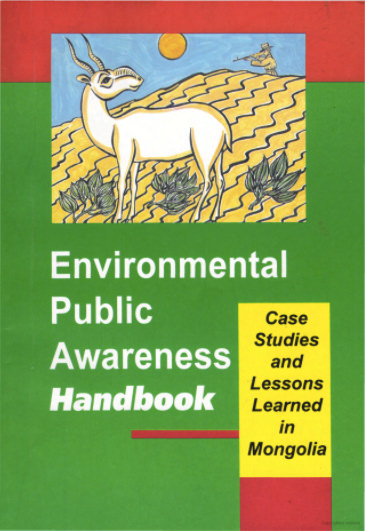
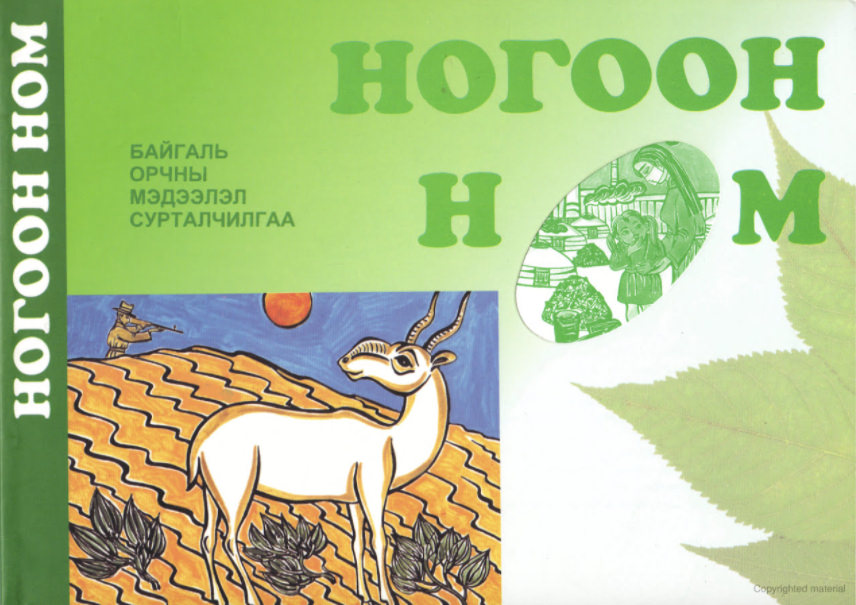
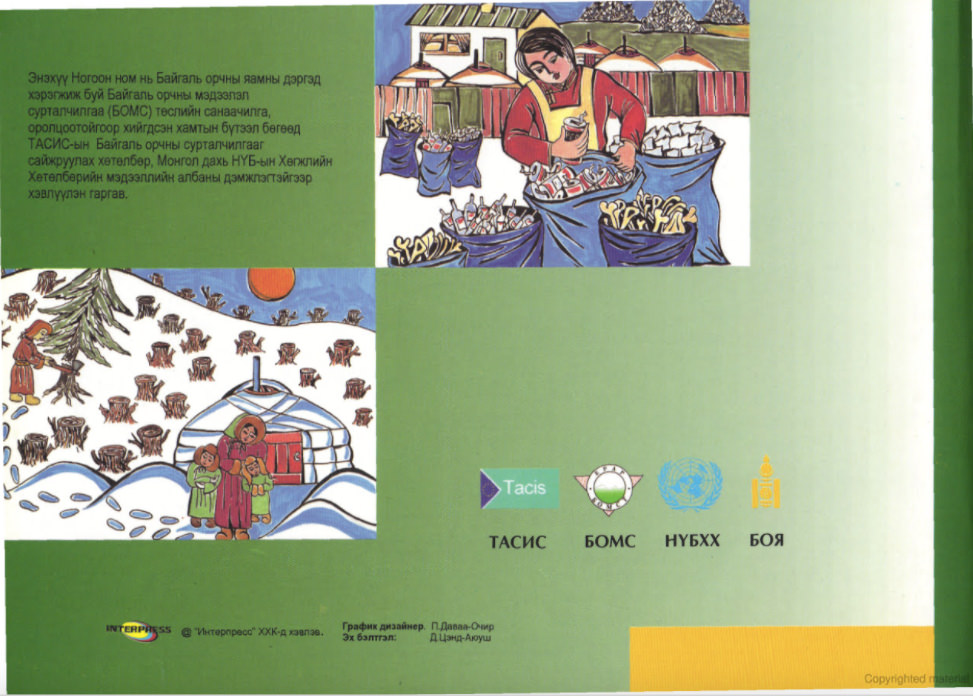
The Environmental Public Awareness Handbook: Case Studies and Lessons Learned in Mongolia was published in 1999 by the UNDP Mongolia Communications Office. The EPAP Handbook and the Mongolian Green Book were funded by the European Union’s TACIS programme.
Ferguson and his Mongolian colleagues had spent two years mobilizing Mongolians across the country to take practical steps to address the country’s environmental problems as part of the Environmental Public Awareness Programme (EPAP). Few people had as much first-hand knowledge of the country and its environmental challenges as they did.
In its 2007 Needs Assessment, the Government of Mongolia found the EPAP projects “had a wide impact on limiting many environmental problems. Successful projects such as the Dutch/UNDP funded Environmental Awareness Project (EPAP), which was actually a multitude of small pilot projects (most costing less than [US] $5,000 each) which taught local populations easily and efficiently different ways of living and working that are low-impact on the environment.”
Robert Ferguson’s The Devil and the Disappearing Sea: Or, How I Tried to Stop the World’s Worst Ecological Catastrophe (Publisher: Raincoast Books, 2004).













 David South Consulting
You must be logged in to post a comment.