Tag: UNDP

  • The real Mongolian gets the nod from Western fashion designers

    The real Mongolian gets the nod from Western fashion designers

    Mongolia’s top fashion designer, Solyolmaa, gives Ger a quick lesson on Mongolian clothing

    Interview by A. Delgermaa, Ger Magazine, Modern Life, Issue 2, May 12, 1999

    Last year’s fashion runways were dominated by one influence: Mongolian traditional design. If a designer wanted to show they were boldly embracing natural fibres and furs, then the refrain ” my show is all Mongolian” would be proudly boasted to the media. The country has become a synonym for sartorial flare and rugged beauty. It also doesn’t hurt that one of Mongolia’s top exports, cashmere wool, is in vogue, from Japan to Europe to the United States. After years of being isolated from the west under the umbrella of the Soviet Union, Mongolian fashion is proudly strutting the catwalks of the world.

    Her square glasses reminiscent of Yves Saint Laurent (ysl.com), Mongolia’s top designer, Soyolmaa, talked to Ger about the ubiquitous nature of traditional clothes in the late 1990s. “There are few countries who still wear the national costume these days. Mongolia is one of them,” she says sitting regally in the studio of her home, surrounded by models draped in dresses for her latest collection: a tribute to the style and attitude of Mongolia’s ancient queens. 

    “Because the design of Mongolian national clothes is highly developed, no further changes are needed.” As head of the Mongolian National Designers’ Union, she has spent many years trying to find ways to improve the national costume to “no effect” she adds.

    Busy tailors come and go, checking designs. The studio is crowded with four tailors and the models (not to mention this reporter). Two clients patiently wait in the hallway to see her. In a country where the soldiers and police wear uniforms designed by Pierre Cardin, it is no surprise Mongolians aren’t slouches when it comes to clothes. While budgets may be tight and the shops far from world standard, people still find a way to dress with flair.

    It is still common to see the traditional del – a cloak of either wool, leather or silk – worn by men and women of all ages, even in the capital. As herders are quick to say, the del serves many practical purposes. It is padding for long rides on the steppe, it is a makeshift tent in bad weather, it is a warm blanket, and for women, a nod to modesty when nature calls on the open steppe. While it is standard wear for older generations, younger urban Mongolians turn to the del on special occasions like school graduation ceremonies.

    Last year collections by Christian Dior (Dior.com), Chanel (chanel.com), UNGARO and Pierre Cardin (pierrecardin.com) all paid homage to Mongolian design, typically characterized by variations on the del cloak, flamboyant displays of fur and knee-high boots.

    “Asian styles are now having a big impact on world fashion design,” continues Soyolmaa. 

    “It is because Asian clothes offer pure, simple patterns with eye-catching colours and adornments. There is a trend towards purism in the fashion world. They like high collars, askew lapels, loose sleeves and nudarga (long sleeves). The bright colors of Asia are showing up throughout Western design. You can see the askew lapel and high collar and bright colors from Christian Dior to Chanel.”

    The Mongolian national costume is a classic example of purism. The pattern is very simple, with no separate sleeves or shoulder parts, and very economical with little waste of cloth.

    And why did this style evolve over the generations? Soyolmaa has a simple answer: “It is because of the harsh weather of Mongolia.” The askew lapel doesn’t let wind pierce the body, nudarga or long sleeves don’t make arms cold in the minus 30 to 40 degrees Celsius winters. Winter dels have fur interiors, using wolf, fox, sheep or lamb’s wool. From ancient times to now, Mongolian men wear wolf fur coats in winter when guarding horses at night.

    There are about a hundred styles of hat. Loovuus, made of fox fur with a cloth top, is a common hat in winter. The back part is open. “Fox fur is very dense. Without an open back one feels too hot and it causes high blood pressure and a headache,” according to Soyolmaa. The extraordinary design of boots with pointed toes is suitable for riding a horse while leaving enough dead air space to keep the toes warm.

    Soyolmaa takes difference with those who claim “Fashion sense ends in Mongolia.” “It might because they have nothing to compare it with. But now that fashion shows are available on cable TV, Mongolians are learning how to compare Mongolian fashion and models with the global standard.” For Soyolmaa, as it is the time for Asian fashion, it is also the time for Asian models. 

    “Irina Pantieva, the world’s top model is Mongolian. She is from the Buriat Republic (a province of Russia directly north of Mongolia and populated by a large number of people of Mongolian heritage).” She says Mongolian models are ready to take on the world.

    To the soothing sounds of Enigma, Mongolia’s top models parade Soyolmaa’s tributes to Mongolian queens in early May at the Las Vegas Entertainment Centre, a former communist-era cinema. Long silk dresses are complemented with furs and enormous hats, at times evoking Cleopatra, at other times something from a Dr. Seus cartoon, some hats reaching a meter high. Judging by the audience’s reaction and the quality of Soyolmaa’s creations, the time has come for Mongolian designers to take centre stage on the world fashion scene.

    Creative Commons License

    This work is licensed under a
    Creative Commons Attribution-Noncommercial-No Derivative Works 3.0 License.

    ORCID iD: https://orcid.org/0000-0001-5311-1052.

    © David South Consulting 2024
  • Cashmere is king but Mongolia still struggles to reap the benefit

    Cashmere is king but Mongolia still struggles to reap the benefit

    By A. Delgermaa, Ger Magazine, Modern Life, Issue 2, May 12, 1999

    A Mongolian cashmere designer once opined that Mongolians are lucky that most goats in the country are capable of producing fine cashmere. And while Chinese cashmere dominates the marketplace, Mongolian cashmere is by far the purest and finest.

    About 30 cashmere companies contributes tens of millions of dollars a year to the country’s wealth (though nobody is quite sure how much because most cashmere sales go unreported to the government). But the revenue isn’t what it used to be due to problems in the domestic industry and a drop in the world price. Z. Ayur, chief secretariat of the Gobi company, thinks it doesn’t have to be that way.

    “Unfortunately we lose half of our raw cashmere to China,” he says.”

    “The Chinese buy cashmere at a high price, not depending on the quality. This means national manufacturers lack raw cashmere to process into garments.”

    He thinks raw cashmere exports should be banned or subject to a duty of 100 to 150 per cent. Mongolia’s weak infrastructure plays a part as well. It is cheaper for herders to travel to the Chinese border with cashmere than to bring it to the capital, Ulaanbaatar. Often when they are at the border with China, they are subjected to some hard bargaining by Chinese brokers, who exploit the fact herders can’t afford to walk away empty handed. 

    Cashmere has always been considered a luxury and expensive. But in the past two years it has lost its fusty image as only for old people. Trendy designs have attracted a vast market of younger cashmere consumers. “I guess in the past it was dear and expensive and designs weren’t very appealing to the younger set,” thinks Gerelmaa, the chief designer of Gobi company. 

    The Gobi company is one of the few state enterprises left over from the socialist period that still makes money (and is due for privatization this year – a prime pick for foreign investors). 

    In 1972 the United Nations funded projects to experiment with starting a cashmere garment industry in Mongolia. This innovative thinking led to a joint Japanese-Mongolian venture in 1981 to start the first cashmere manufacturer, Gobi. These days it still produces one third of the country’s cashmere products. 

    Mongolian Wool and Cashmere Federation head Tsendmaa is optimistic about the drop in the world market price.” It will soon go back up again,” she says with confidence. “The reserve of cashmere in the world will run out soon. What happened with the drop in prices is typical of any industry when it overproduces.” What worries her most is the flood of Mongolian cashmere going to China, where Chinese workers process and knit the garments and reap the job benefits.

    While cashmere is still known for its use in classic turtle, crew and v-neck jumpers, things have changed. “Before we mostly exported classic styles in off-white, brown, grey, black, bark, blue or dark red to Japan or Germany,” continues Tsendmaa. “Now Americans order more fashionable cashmere for the young. The designs of short jumpers that expose bare chests and waists are cheap to produce (less material) and suitable for young fashions.” 

    Italian, French or Belgian customers are fussier and demand greater variety in designs. These countries determine the vogue for cashmere wear and use the most high tech knitting technology.

    Contemporary cashmere fashion in France or Italy can combine fur or silk. Colours have also been revamped, with the young going for light blue, light pink, snow white, off-white and light green. Italians and Americans like metal grey with rose or pink. Mixing up the colours in sporty stripes and lines is also popular.

    Cashmere is very practical, warm and light. “It is not suitable for the office,” says Gerelmaa.” Cashmere wear is more suitable to wear for a night out or just for hanging out. But of course it is not for sport!” 

    Fashionable Mongolian cashmere is becoming a strong competitor to Chinese, Italian, Scottish or American cashmere. “The raw material is pure and the design is more fashionable.”

    And a happy Gerelmaa likes the sound the cash register makes in Japan: “In Japan classic Mongolian style is sold for more than US $1,200 in the Takashimaya Store, in GINZA.”

    Now if more of that kind of hard cash found its way back to Mongolia, the country would definitely be better off. 

    Creative Commons License

    This work is licensed under a
    Creative Commons Attribution-Noncommercial-No Derivative Works 3.0 License.

    ORCID iD: https://orcid.org/0000-0001-5311-1052.

    © David South Consulting 2024
  • Meat, milk and Mongolia: Misunderstood and often maligned, the Mongolian diet does make sense

    Meat, milk and Mongolia: Misunderstood and often maligned, the Mongolian diet does make sense

    By N. Oyunbayar, Ger Magazine, Modern Life, Issue 2, May 12, 1999

    “A stroll down any Mongolian residential street is usually the first introduction to a visitor of the savoury odours of the traditional meals of this country. If you are invited into somebody’s ger (or traditional tent dwelling) or apartment, you will probably have an opportunity of tasting buuz, khuushuur and bansh.

    “These Mongolian national meals are made with minced meat seasoned with garlic or onion (it can be anything from mutton to beef to camel to horse to gazelle) covered with flour and steamed in boiling water, fried in oil and boiled in water. For many visitors to the country the vast quantities of meat consumed can at first be surprising. But it is not long before a visitor finds their favourite Mongolian food, be it buuz, khuushur or a number of other treats. A Canadian living in Ulaanbaatar once told me, “the Mongolian national food contains a lot of meat, but I like the buuz.

    “The meat-dependent diet arises from the need for hearty food to stave off the cold and long winters. Traditionally nomadic herders, Mongolians have for centuries been dependent on mostly animal products for their dietary staples. Now after over nine years of transition, the traditional diet has been used as a shield against hunger and for the wealthy, subject to the influence of imported foreign foods and cuisine. When the Russians pulled the plug on Mongolia’s aid in 1991, the economy went into a severe crisis. For many Mongolians it was their first experience of serious hunger. The staple traditional diet of meat, milk and flour saw many people through this crisis, when food imports from the former Soviet Union dropped off.

    “Mongolians traditionally have turned to foods that are high in protein and minerals, relying less on more seasonable foods like vegetables and fruits. This means a diet heavy on meat and dairy products, the latter when sour in the summer time thought to clean the stomach. It isn’t just about meat though. Mongolians do also eat cereal, barley and natural fruits and plants native to the country.

    “Out of necessity Mongolians have found creative and ingenious ways to use the milk of all five of the domestic animals in the country: sheep, cattle, goats, camels and horses. Orom is the cream that forms on top of boiled milk; aaruul are dried curds and can be seen baking in the sun on top of gers in the summer; eetsgii is the dried cheese; airag is fermented milk of mares (female horses); nermel, is the home-brewed vodka that packs a punch; tarag, is the sour yogurt; shar tos, melted butter from curds and orom, and tsagaan tos, boiled orom mixed with sometimes flour, natural fruits or eesgii. The method of drying the dairy products is common in preparing them. The Mongolians prepare enough dairy products for the long winter and spring.

    “The traditions of using, producing and preparing these foods are stronger outside the main cities, where the population is more reliant on the vast herds for food. B. Baljmaa (Mongolians generally use their first names), a dietitian and nutritionist at the National Nutrition Research Centre, says there is a genetic compatability for the food.

    ‘Before 1992 there wasn’t much research in this area. But now we know from our research that Mongolians are better able to absorb foods with more acid. So, traditional food should be kept in the country.’

    “Since 1997 Mongolians have seen a substantial increase in the variety and quantity of imported foods, many of which were only thought of as exotic 10 years ago. Since the start of 1999 the Soviet-style market stalls now compete against western-style supermarkets, with trolleys and shelves proudly saying “Made in Mongolia.” In markets like Dalai Eej, Dorvon Uul, Food Land and Mercury it is possible to buy delicious prepared and canned foods, candies, biscuits, and unknown and unused before by Mongolians, products like oranges, bananas, plums and American chickens.

    “On top of the canteens and cafes serving Mongolian food, there are now many restaurants, canteens, bakeries and tea shops which serve meals from Russia, Italy, India, China, Japan, Korea, England, France, Senegal and Turkey. Most of these restaurants are located in the capital, Ulaanbaatar. Mongolians have taken to the new tastes. “I think Mongolians like roasted chicken and fish when they go to the foreign sit-down restaurants, and hot dogs and pizzas in the fast foods shops,” says I. Narantsetseg and her husband J.Battulga. Both were dining in the Seoul restaurant, and are happy they can go out for food: “it is a very good thing that there are opening a lot of restaurants where friends and family can go and enjoy food in comfort.”

    “Isobe Hiroshi, manager of Seketei, a high-end Japanese restaurant, told me “only 20 per cent of our customers are Mongolians. The vast majority of our clients are foreign, especially Japanese people who are working and traveling here. I think Mongolians have still not grown used to sushi and sashimi, the raw fish prepared in our restaurant. But I hope we will welcome more and more Mongolians in the future.”

    “The traditional diet in the cities is more changed, more european. And with comes its own dangers for Mongolians says the Nutrition Centre’s Baljmaa:

    ‘There is a big problem of importing poisonous foods and food which probably will cause the nutrition-related diseases common in more developed countries,” she continues.”While the trend around the world amongst health-conscious people is towards natural products for their food, some Mongolians use some food which can cause troubles for their health. For example, fast food made with more oil, salt and sugar are considered the biggest dangers for human health. On the plus side prices for these imported foods are higher and only the wealthiest people can afford them; the poor people can’t buy and eat it no matter how much they desire. This means their poverty is protecting their health. We should boost our efforts to raise awareness on what foods protect your health.’

    “Help in improving nutrition awareness a poster portraying a ger details the food habits of Mongolians and the nutritional value of common foods.

    “Now I want to present to you recipes of processing and preparing some Mongolian national products and meals:

    “From ancient times, Mongolians use abundant and peculiar methods of processing meat and preparing food.. One of the more popular methods of processing the meat is to prepare borts (dried meat) for use in winter. Borts is made from the meat of cows, goats and camels. Here is a recipe for camel borts presented by Dr. Sh. Tserenpuntsag who engages in the research of the meat.

    1. Separate the meat from its layer of fat, as fat will spoil in drying.
    2. Cut meat into strips about 20-30 centimeters long and two to five centimeters thick.
    3. Hang to dry in a well-ventilated room.
    4. Leave for four to five months.
    5. Cut into small strips for use in any dish you like.

    “If soaked in water, the meat will expand up to two and half times in size. It should then be cooked for 18 minutes.

    “The main method of cooking the meals of the Mongolians is boiling and steaming, considered the most healthy method in cooking by researchers the world over. Here is a recipe for buuz from the Nutrition Centre. It is considered one of the national meals of the Mongolians and is cooked by steaming and is a good fast food.”

    Creative Commons License

    This work is licensed under a
    Creative Commons Attribution-Noncommercial-No Derivative Works 3.0 License.

    ORCID iD: https://orcid.org/0000-0001-5311-1052.

    © David South Consulting 2024
  • Digital Transition (And Transformation) In International Development | 1997 – 2016

    Digital Transition (And Transformation) In International Development | 1997 – 2016

    UNDP Mongolia Communications Coordinator (1997-1999): David South

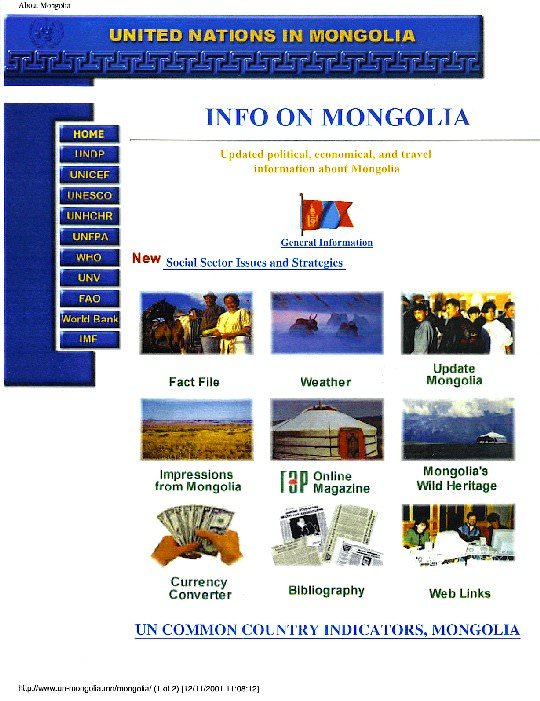
    I launched this portal in 1997, in the middle of a major economic crisis in Mongolia. This award-winning (winner in 1998 of the People’s Choice WebSite 500 award and the CyberTeddy Top 500 Website award) and pioneering United Nations Mongolia development web portal was singled out by UN headquarters as an example of what a country office website should be like.

    At this time, Mongolia was still recovering from the chaotic and turbulent transition from Communism to free markets and democracy begun at the start of the 1990s, called by some “one of the biggest peacetime economic collapses ever” (Mongolia’s Economic Reforms: Background, Content and Prospects, Richard Pomfret, University of Adelaide, 1994). There was a thirst for information: access to the Internet was still limited and access to mobile phones was just the preserve of the rich. As a legacy of the past, information, especially that about the outside world and the country’s true economic and social conditions, was restricted. During the years of Communism, even simple travel from one place to the next was strictly regulated.

    While today we can take it for granted the world’s information arrives in seconds via the Internet on mobile and smart phones and devices, this just was not the case in the late 1990s in Mongolia.

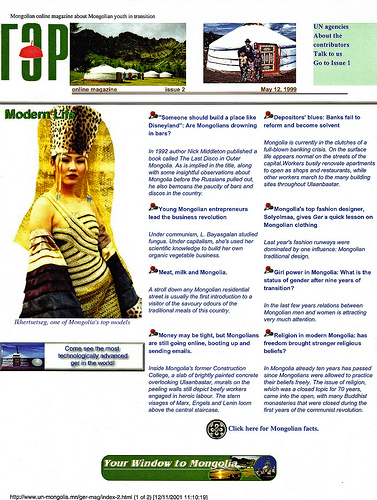
    The UN/UNDP Mongolia development web portal addressed the urgent need to communicate what was happening in the country during a major crisis, and to transparently show what the UN was doing to address the crisis. It made critical data on the country’s development easy to find, and informed the wider world about the country and its people and culture. While the Internet had only just arrived in Mongolia, from the start the UNDP Mongolia Communications Office was experimenting with this powerful new technology to reach a global audience. This included Mongolia’s first web magazine, Ger (launched in 1998).
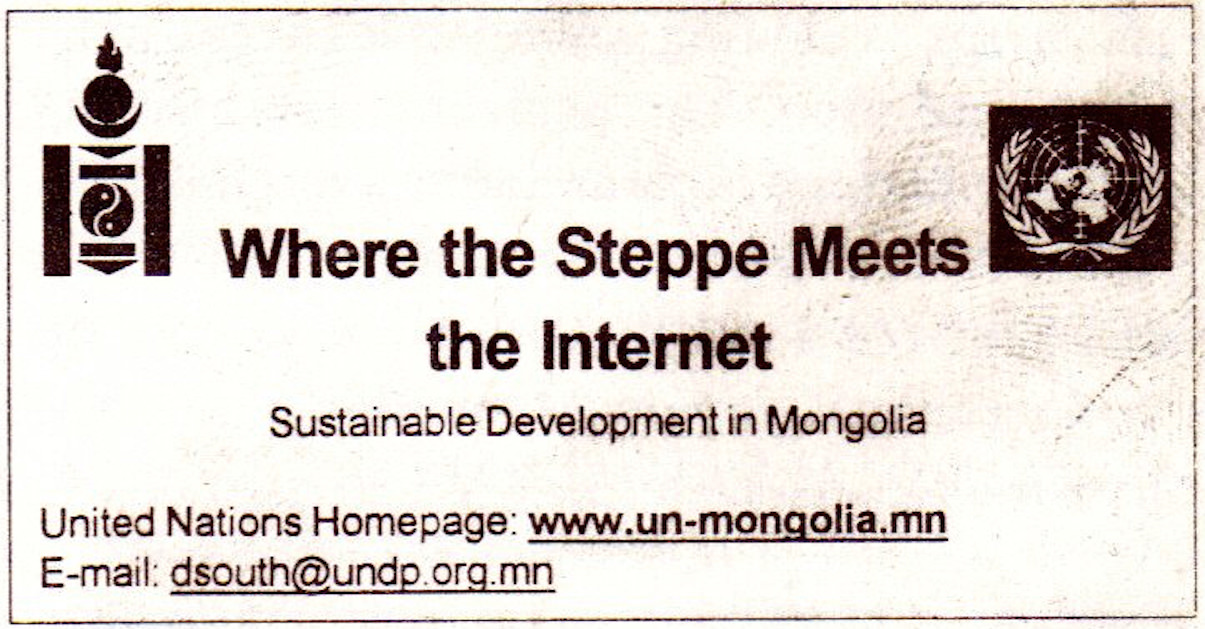
    After the http://www.un-mongolia.mn website launched in 1997, a media campaign began to inform readers of its presence. This ad appeared regularly in magazines, newsletters and newspapers.

    Ger Magazine was launched on September 9, 1998 (Ger is the Mongolian word for both the traditional tent dwelling and home). The theme of youth in the transition was explored by a combined team of Mongolian and foreign journalists. The Ger Magazine project had basically three goals: first, raise the quality of journalism in the country, secondly, introduce the country to a wider global audience and, thirdly, by being the country’s first online magazine, prove the Internet was an effective way to communicate. 

    Issue 1 of the magazine investigated what life was like for youth during the transition years (post-1989). Stories tackled the struggle to find work in the free market, the booming pop music scene and how it is leading the way in business entrepreneurship, reproductive health, the basics on Mongolian culture, and vox pop views from Mongolian youth.
    Issue 2 of the magazine investigated modern life in Mongolia during transition. The team of journalists were hitting their stride by this issue. Stories probed the proliferation of bars and the problem of alcoholism, corrupt banking practices and the loss of savings, how the young were the country’s leading entrepreneurs, Mongolia’s meat and milk diet, “girl power” and the strong role played by women, the burgeoning new media, the rise and rise of Buddhism, and Mongolia’s dynamic fashion designers (this article inspired foreign fashion designers to embrace the Mongolian ‘look’ in the next season’s designs).

    https://en.wikipedia.org/wiki/Ger_(magazine)

    The UN/UNDP Mongolia homepage quickly became the top resource for development news on Mongolia in the late 1990s.
    “A UN System site. A very nice, complete, professional site. Lots of information, easily accessible and well laid out. The information is comprehensive and up-to-date. This is a model of what a UNDP CO web site should be.”
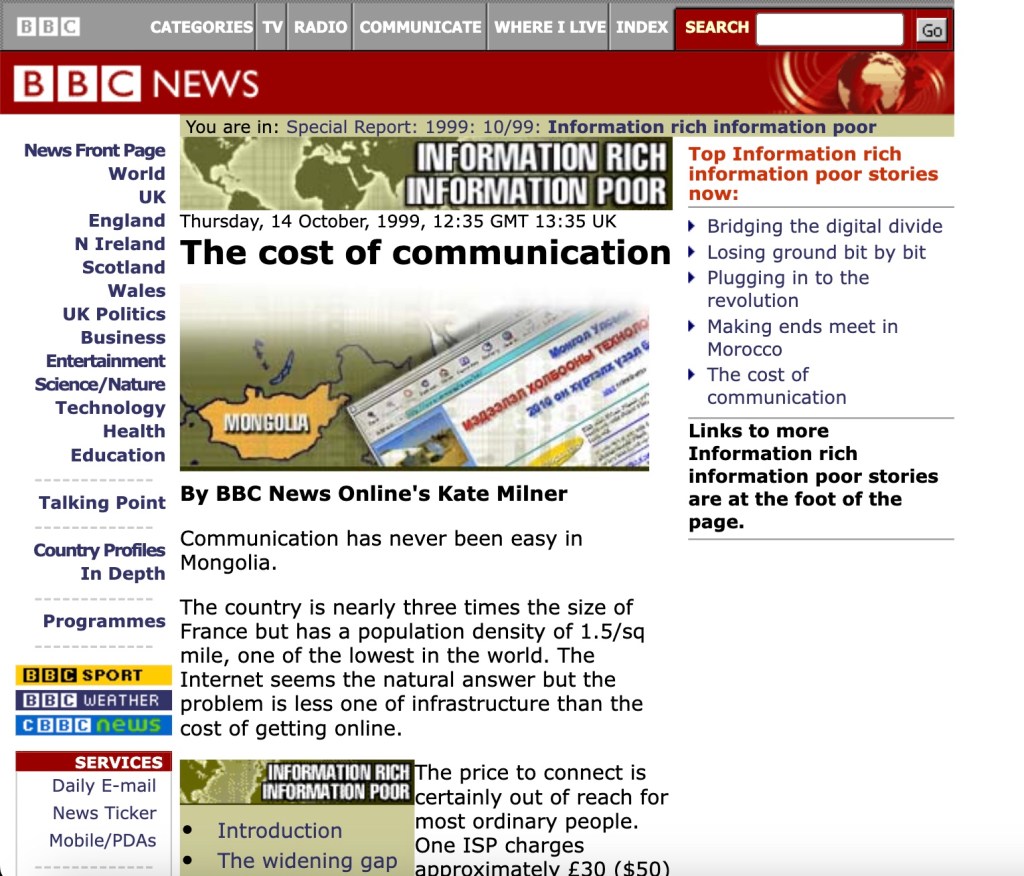
    “Information Rich Information Poor: The cost of communication”, BBC News Online, Thursday, 14 October 1999.
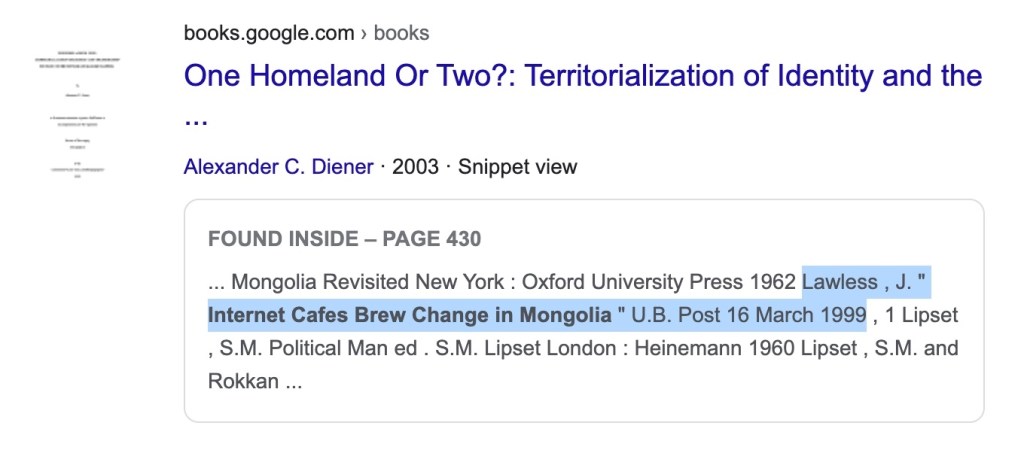
    “Internet Cafes Brew Change in Mongolia”, UB Post 16 March 1999 by Jill Lawless, cited in One Homeland or Two?: Territorialization of Identity and the Migration Decision of the Mongolian-Kazakh Diaspora by Alexander C. Diener, 2003.
    United Nations Cyber Center Ulaanbaatar, Mongolia: UNDP Mongolia established the first public internet cafe in its former headquarters as part of the UNDP Mongolia Communications Office hub in the late 1990s.
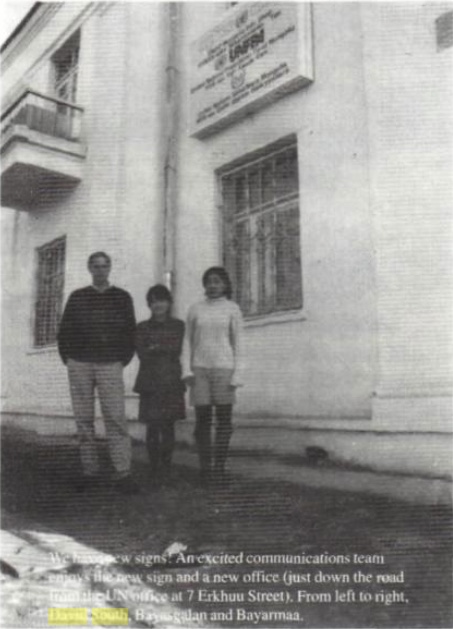
    David South photographed outside the UNDP Mongolia Communications Office with team members Bayasgalan and Bayarmaa (Source:Blue Sky Bulletin, October-November 1998). The new sign (above right) accompanied the inauguration of the first UN public access services for Mongolians, including the UN Info Shop and the United Nations Cyber Center. The award-winning team won in 1998 the People’s Choice WebSite 500 award and the CyberTeddy Top 500 Website award for their work on the United Nations portal at http://www.un-mongolia.mn and the pioneering first UN online magazine, Ger.

    Consultant (1999-2017): David South

    In 2000, the Kiev-based UN Ukraine team had to improve the design and capability of the mission website to handle new content and online services. There was a strong demand for information on country conditions and how to support the UN’s work (for example, on HIV/AIDS). It was a dangerous time to be involved in any online communications and the media and online communicators were routinely threatened with violence and even death.
    Whilst with a UK-based international development consultancy, I worked on the drafting and online launch in 2000 of the World Bank’s Task Force on Higher Education and Society report, Higher Education in Developing Countries: Peril and Promise. At the time, it was still rare to see reports made user friendly for the world’s web audience. As a survey in 2014 discovered, a shocking third of the Bank’s publications are never downloaded, 40 per cent were downloaded just 100 times, and only 13 per cent were downloaded more than 250 times in their lifetime (The Washington Post).
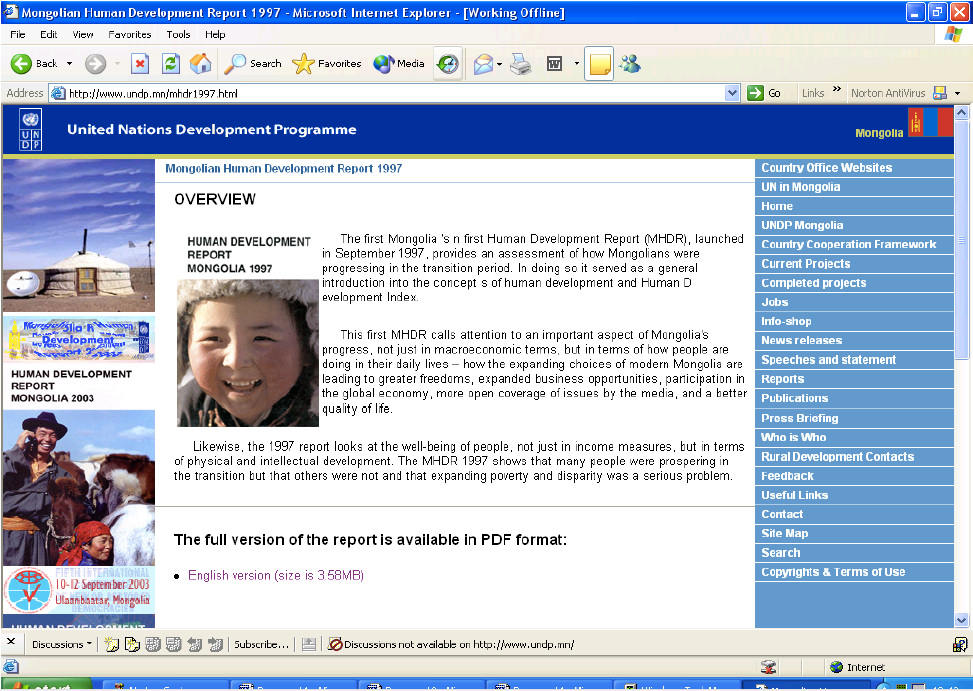
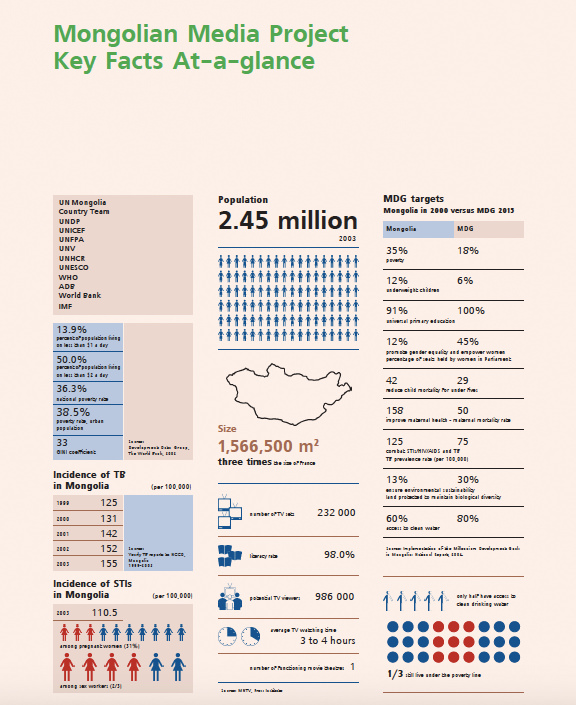
    As the Millennium Development Goals (MDGs) were being communicated, the link between the powerful new digital and mobile/information technologies and development goals became explicit in information materials. The cleaner and more modern design introduced with Mongolia’s first human development report in 1997, continued in future publications and online, as can be seen in this screen grab from 2003 and that year’s human development report. The first use of infographics was also introduced in a report on the MDGs for UNDP Mongolia in 2005. Importantly, a country that had been isolated from the non-Communist world for decades, was now routinely using the Internet to tell its stories and post development data.
    Human Development Infographics: Infographics have proven a useful visual aid for communicating human development concepts. This example was created for a UNDP Mongolia report during missions undertaken in 2005.
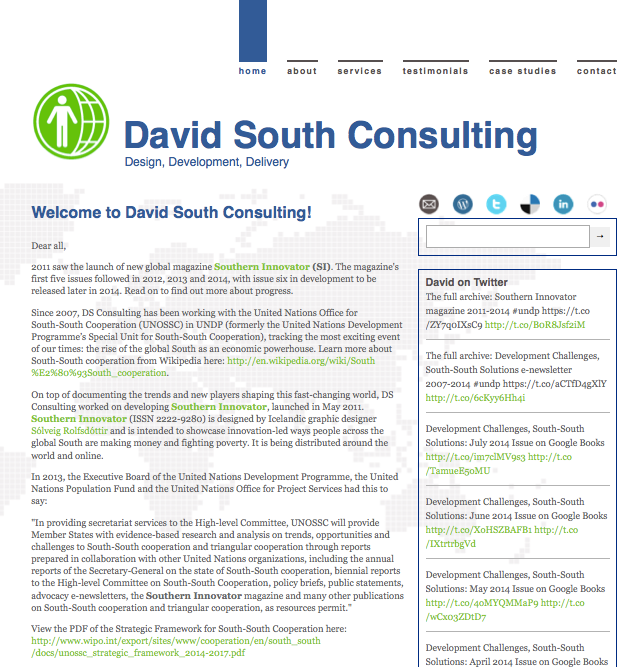
    Five years prior to the MDGs deadline in 2015, the David South Consulting website went live (2010). Featuring a new branding and design, it signaled a new design phase more comfortable with developments in social media and online and mobile content sharing. Designed by Solveig Rolfsdottir, one of Iceland’s top graphic designers and illustrators, the website’s design was intentially made compatible with the new global magazine, Southern Innovator (also designed by Solveig Rolfsdottir).
    The online story archive for Southern Innovator was launched by the United Nations Office for South-South Cooperation (UNOSSC) in 2011. Organized by theme, the stories were cited in blogs, books and reports around the world.
    The new template for the United Nations e-newsletter Development Challenges, South-South Solutions was launched in 2011 and designed by Solveig Rolfsdottir. It included a QR code for mobile and smartphone users to connect to the Southern Innovator website.
    In 2016 the mobile-friendly version of the David South Consulting website was launched.
    Creative Commons License

    This work is licensed under a
    Creative Commons Attribution-Noncommercial-No Derivative Works 3.0 License.

    ORCID iD: https://orcid.org/0000-0001-5311-1052.

    © David South Consulting 2024