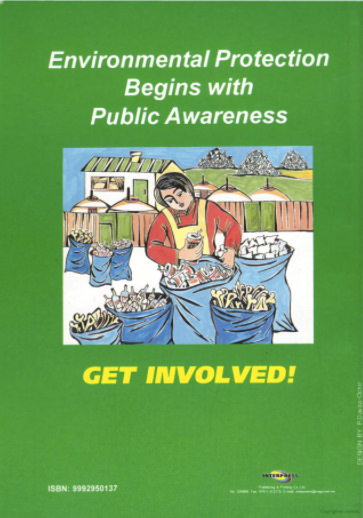
In the Mongolian language, the book details effective ways to live in harmony with the environment while achieving development goals. Based on three years’ work in Mongolia – a Northeast Asian nation coping with desertification, mining, and climate change – the book presents tested strategies.
Environmental Public Awareness Handbook: Case Studies and Lessons Learned in Mongolia
Environmental Public Awareness Handbook: Case Studies and Lessons Learned in Mongolia by Robert Ferguson.Environmental Public Awareness Handbook: Case Studies and Lessons Learned in Mongolia by Robert Ferguson.
Mongolian Green Book by Robert Ferguson et al.Mongolian Green Book by Robert Ferguson et al.
More books by Rob Ferguson:
The Devil And The Disappearing Sea: Or, How I Tried To Stop The World’s Worst Ecological Catastrophe (Raincoast Books).
Mongolian Rock and Pop Book
Mongolian Rock and Pop Book: Mongolia Sings its Own Song by Peter Marsh.
Mongolian Rock and Pop Book: Mongolia Sings its Own Song by Peter Marsh.
Pop music helps fuel Mongolia’s market economy by Oyuntungalag.As cited in the book Collaborative Nationalism: The Politics of Friendship on China’s Mongolian Frontier by Uradyn E. Bulag (Rowman & Littlefield Publishers, 2010).
Mongolia Update 1998
Mongolia Update 1998 by David South and G. Enkhtungalug.
Other
Wild East: Travels in the New Mongolia
Wild East: Travels in the New Mongolia by Jill Lawless (ECW Press, 2000) is one of many books featuring content and resources resulting from the two-year publishing programme of the UNDP Mongolia Communications Office (1997-1999).
Wild East: Travels in the New Mongolia by Jill Lawless.Wild East: Travels in the New Mongolia by Jill Lawless.A review of Wild East: Travels in the New Mongolia in the journal Mongolian Studies (2002) by Alicia J. Campi.“Yet Ulaanbaatar is often ignored or downplayed in Western accounts (see, for example, Croner (1999) and Severin (1991); but see Lawless (2000) for a partial exception). Most Westerners who visit Mongolia seem anxious to get out to the countryside, to see the “real” Mongolia of nomads …” from Truth, History and Politics in Mongolia by Christopher Kaplonski (2004).
In Their Own Words: Selected Writings by Journalists on Mongolia, 1997-1999
In their own words: Selected writings by journalists on Mongolia, 1997-1999 by David South and Julie Schneiderman.
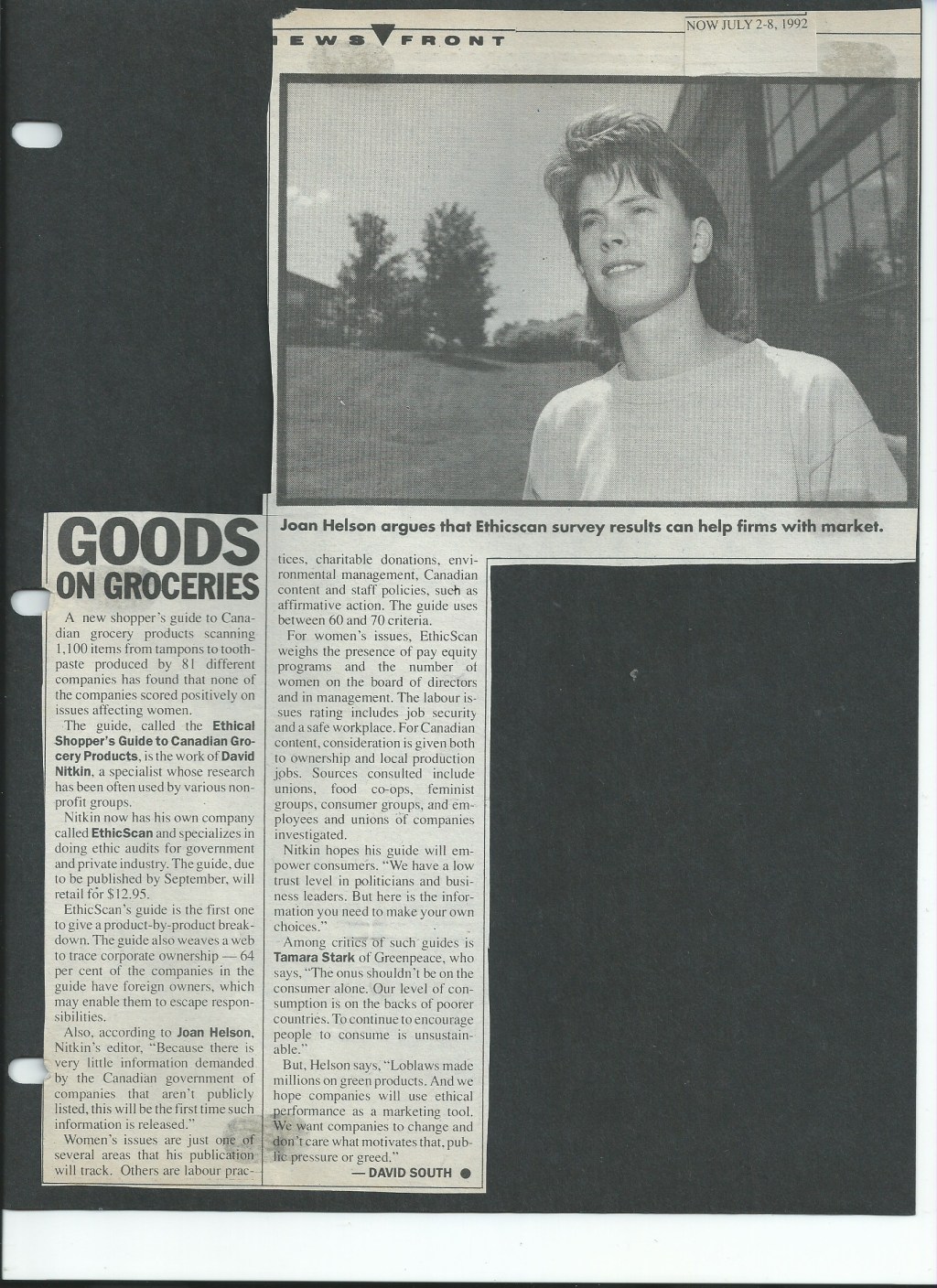
Where social activists have tried and failed to get Canadian corporations to change their behaviour towards the environment, labour, women and minorities, EthicScan Canada – a for-profit consulting and research firm – steps in.
Toronto-based EthicScan acts as a consultant on ethical issues to both government and private businesses and produces a guide for investors. Its latest project hit the bookstores last fall. The Ethical Shopper’s Guide to Supermarket Products rates products according to companies’ ethical performance. “EthicScan is the only company in Canada doing this,” says senior writer Joan Helsen. “Companies respond to us differently because we are – like them – a business. We have a very good reputation for doing strong research and presenting the facts.”
Non-profit groups have produced similar guides. In the US, perhaps the best known is the American Council on Economic Priorities’ Shopping for a Better World. Here in Canada, both Pollution Probe’s Green Consumer Guide and the Ontario Public Interest Research Group’s The Supermarket Tour offer educational information.
But The Ethical Shopper’s Guide is the first guide in Canada to give a product-by-product breakdown, and to detail the web of corporate ownership. It lists more than 1,200 brand-name products from baby food to soft drinks, with the manufacturer’s “grade” for each ethical category. The guide also profiles 87 companies, with an “honour roll” of 37 corporations.
All of this can be confusing. Oxo gets an F for “women’s issues” and F+ for “environmental management,” but scores A+ on “progressive staff policies” and “environmental performance.” (Apparently. “environmental management” has to do with company structures for dealing with environmental issues while “environmental performance” measures how much it actually pollutes.) What aspect of Oxo’s ethical behaviour do you reward or punish?
EthicScan’s approach fits current advertising trends. Nissan tells us it is just trying to build cars we can live with. Loblaws puts “Green” on everything from plastic garbage bags to tubes of shampoo. But once idea-starved ad copywriters move on to the next gimmick, EthicScan may find that the relationship between ethics and profit isn’t as straightforward as its grading system suggests.
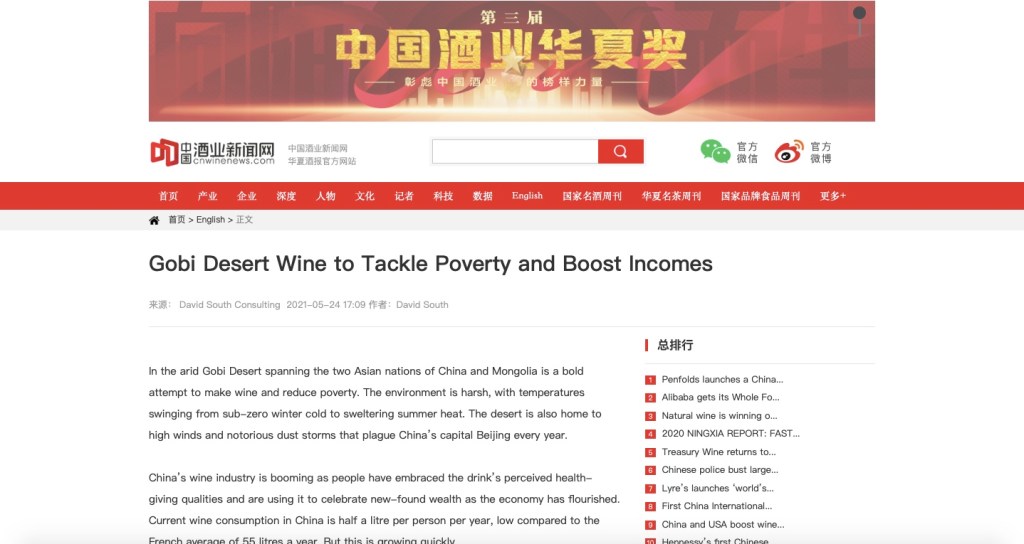
In the arid Gobi Desert spanning the two Asian nations of China and Mongolia is a bold attempt to make wine and reduce poverty. The environment is harsh, with temperatures swinging from sub-zero winter cold to sweltering summer heat. The desert is also home to high winds and notorious dust storms that plague China’s capital Beijing every year.
China’s wine industry is booming as people have embraced the drink’s perceived health-giving qualities and are using it to celebrate new-found wealth as the economy has flourished. Current wine consumption in China is half a litre per person per year, low compared to the French average of 55 litres a year. But this is growing quickly.
One innovative winery is using this wine boom to tackle poverty and increase local wealth.
Chateau Hansen (hansenwine.com) in Inner Mongolia has been operating since the 1980s, but recent expansion and modernization have significantly increased its earning power and the number of people it employs. Located in an area with high levels of poverty, it has developed a successful wine business in the desert by tapping the plentiful water supplies from the Yellow River. The area is now considered one of the best for growing wine grapes in China.
Located near Wuhai city (http://en.wikipedia.org/wiki/Wuhai), 670 kilometres west of Beijing, Chateau Hansen has 250 hectares of Merlot, Cabernet Sauvignon and Cabernet Gernischt grapevines.
The vines are buried under the sand to protect them from the harsh weather in the winter.
“The lowest temperature gets down to is below -20 degrees C (Celsius), but in summer, it can reach 38 or 40 degrees C (102 or 104 F),” Li Aixin, Chateau Hansen’s head of viticulture, told MSNBC. “Here the four seasons are good for the growth of the grapes, but in the winter we need to bury them in the earth” to keep them from freezing. Hansen has been ambitious in its approach. It has a European-style chateau, hotel and even a French wine expert, Bruno Paumard, on site to help with the wine making. The chateau’s cellar now stores 1,000 barrels of wine.
Paumard arrived in China in 2005. He has thrown himself into Chinese culture and tasted and tested the country’s wines. Hansen has produced 400,000 bottles of wine, mostly sold in China, where red wine drinking has become a big part of the culture of celebration.
Hansen sells the majority of its wine to government organizations and regional enterprises. It has seen its profits double to 100 million yuan (US $18 million) in 2011 and hopes sales will double again in 2012.
“Eighty per cent of the market in China is really the local governments who encourage the enterprises in their cities to consume red wine, of a certain brand, at their banquets in the place of Chinese ‘baijiu’ for their incessant and never-ending toasts,” said Paumard, referring to China’s home-grown rice wine. “So it’s actually a market that’s totally unique.”
Hansen’s Cotes du Fleuve Jaune du Desert de Gobi has become one of the biggest award-winning wines in China. It received a bronze medal from the International Wine Challenge of Blaye, near Bordeaux, France.
China now stands as the world’s fifth-largest consumer of wine (International Wine and Spirit Research study) (http://www.iwsr.co.uk/). The market in China is forecast to grow by 54 per cent from 2011 to 2015, adding up to a billion bottles.
In this busy marketplace, Hansen prides itself on being organic. It also has the goal of turning the arid desert into green vineyards using irrigation from the Yellow River and groundwater. It wants to create employment and raise living standards in the region and is fitting into a national strategy to raise living standards for poor regions.
There is a training programme for the around 400 workers employed by the winery. No pesticides are used and only sheep dung is used as a fertilizer provided by 3,000 sheep on site. Trees also play a role in providing humus (http://en.wikipedia.org/wiki/Humus) for the vines. There is also accommodation in a nearby village for the employees.
There are 250 hectares of vineyards and the grapes are harvested by hand. Expansion began in 2001 when the chateau and winery were built. It is strategically located just 500 metres from an airport and the chateau has a luxury hotel. Around 20,000 people visit a year, according to Hansen’s website, bringing in further income for the winery. The winery also uses Mongolian culture and cuisine as a selling point to attract tourists.
The chief executive of Hansen is Han Jianping, who made his first fortune in real estate development.
Han believes that “the momentum of growth in the wine industry is huge.”
“With a great foundation of more than 1 billion people as we have in China, and (the industry) growing at 20 or 30 per cent a year, there is a huge potential for more growth,” he said.
Republished in 2021 in cnwinenews.com.
Resources
1) China Wine Online: An information service that also produces the China Wine Business magazine and runs the China Wine Study Tour. Website: http://www.winechina.com/en/index.asp














 David South Consulting
You must be logged in to post a comment.