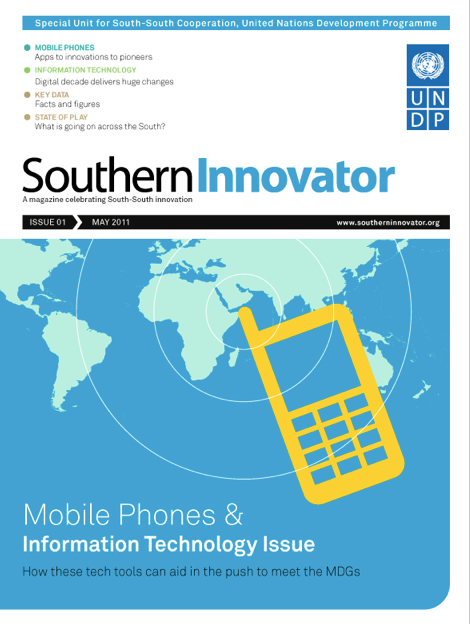
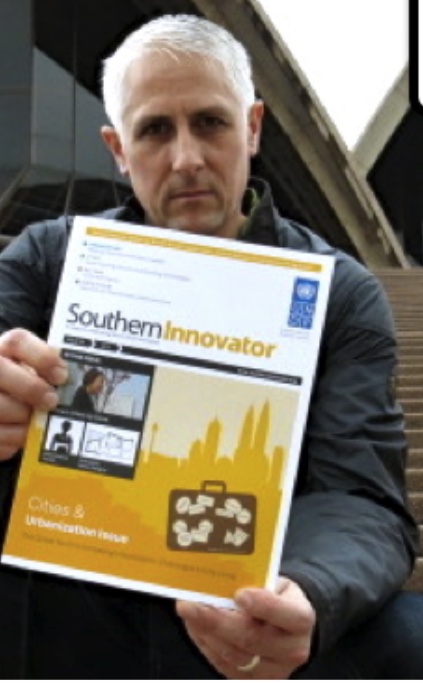
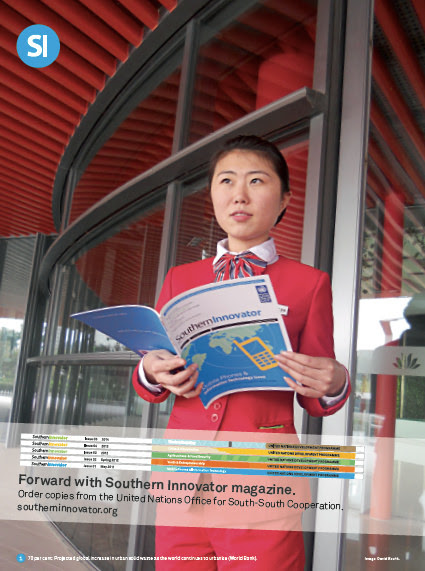
Work began in 2010 to develop what became the United Nations magazine Southern Innovator. A highly talented global team of international development and design professionals based in New York and London collaborated with an Icelandic studio to create an innovation media brand showcasing global South innovators inspired by the mobile and information technology revolutions. It was launched in 2011 at the UN General Assembly in New York.
“Dr. Cosmas Gitta is a senior UN consultant and the former Assistant Director for Policy and UN Affairs at the UN Office for South-South Cooperation, where he oversaw the convening of various intergovernmental and interagency forums as well as the preparation of related reports and studies, including the biennial reports of the Secretary-General on the state of South-South cooperation. He was Editor-in-Chief of the magazine Southern Innovator and an e-newsletter, Development Challenges, South-South Solutions, both of which are media to share information on development related innovations with partners around the world. He was for many years Managing Editor of Cooperation South, a print and electronic development journal promoting collaboration among developing countries. Mr. Gitta holds a PhD in international and comparative education from Columbia University and he has lectured on human rights education at his alma mater, and on a range of other subjects at various campuses of the City University of New York.” (From Integral Leadership Review)
David South is the founder and senior partner for David South International and David South Consulting. He has worked around the world for the United Nations and has led a number of groundbreaking projects for major institutions. Clients have included the United Nations Office for South-South Cooperation (UNOSSC), the United Nations Development Programme (UNDP), the Great Ormond Street Hospital for Children (GOSH)/Institute of Child Health (ICH)/National Health Service (NHS), Harvard Institute for International Development, UNICEF, World Bank, USAID, and the Hannah Institute for the History of Medicine, among others.
He has worked for, or side-by-side, with many high-level senior professionals and executives. These experienced professionals had roles under close public scrutiny and needed to show the impact of their work to a tight deadline.
He has been the editor for the United Nations magazine Southern Innovator since 2010. He also researched and wrote the influential United Nations e-newsletter Development Challenges, South-South Solutions (2007-2014). He has over two decades’ experience in media and journalism (developing strong relationships with many top journalists and media professionals), health and human development, and the role innovation plays in transforming major organisations while getting the most from people tackling complex problems in challenging environments.
Launched in May 2011, the new global magazine Southern Innovator (ISSN 2222-9280) is about the people across the global South shaping our new world, eradicating poverty and working towards the achievement of the Millennium Development Goals (MDGs).
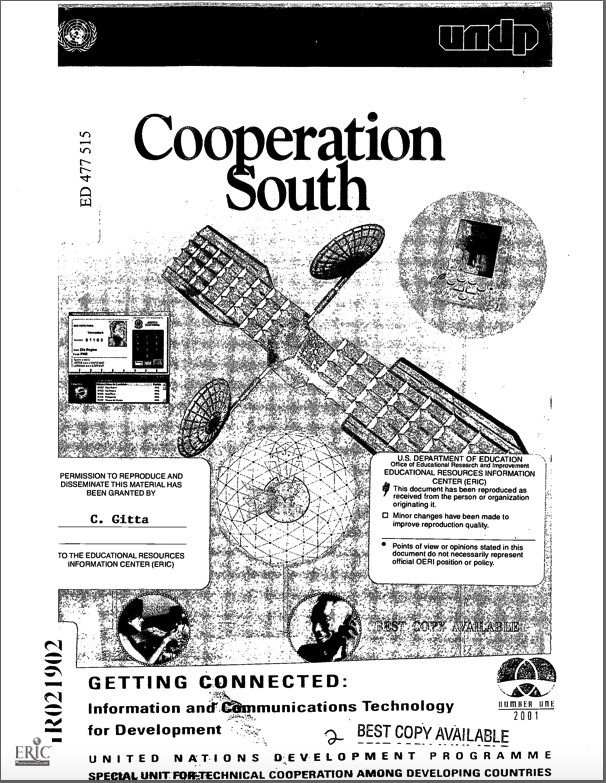
Cooperation South, Getting Connected: Information and Communications Technology for Development, Number 1, 2001, United Nations Development Programme, ISSN-0259-3882. The team behind Cooperation South joined up with a team from Canada/UK/Iceland to create Southern Innovator Magazine (ISSN 2222-9280). Both publications highlighted the innovators behind the global South’s connectivity revolution.
The pace of change across the South has been blistering. Over the past decade, the overall population has moved from being primarily rural to majority urban. In the process, rural communities have suffered, as they have seen their young and ambitious leave in droves seeking a better life in cities.
More than 200 million Chinese farmers have moved to cities in recent years. It’s easy to see why. Chinese farms are tiny, with the average rural household farming just 0.6 hectares. And incomes are low compared to the cost of living: average annual income was just US$606 in 2007, a third of city salaries.
But it is possible to improve the quality of life in rural areas and in turn boost economic fortunes.
In China, projects that upgrade homes to modern standards while respecting traditional designs and architecture are breathing new life into rural communities. A return to the age-old technique of using earth as the principal building material is saving energy and keeping house costs low.
The tradition of packing earth to build a wall dates back to some of the earliest stretches of the Great Wall of China in 220 BC.
Currently it is estimated that half the world’s population-approximately 3 billion people on six continents – lives or works in buildings constructed of earth.
This traditional building technique is being used in the reconstruction effort to build new homes after the May 12, 2008 earthquake in Sichuan Province. The earthquake left millions of people homeless in the country’s worst natural disaster in 30 years, and has made low-cost but efficient house building critical.
In western China, villages have been entirely rebuilt from scratch. The application of research and science to the traditional designs – roofs in the pagoda style, with buildings arranged around courtyards – enabled the development of homes that are energy efficient to run, and are more hygienic and earthquake safe. In Yongren County of Yunnan Province, over 7,000 mountain dwellers were moved to better farming land and over 2,000 homes were built in the new village of BaLaWu. Over 30 of the homes were built using rammed earth by the Xi-an team.
“The original homes had very low living quality,” said team member Hu Rong Rong of the Green Building Research Centre of Xi’an University of Architecture and Technology (http://www.xauat.edu.cn/jdeg/about.html), which oversees building of the new homes. “The architecture layout of the indoor space and courtyard was not reasonable. In the courtyard the areas for living, raising livestock, storing and processing crops were mixed up. The indoor environment was not comfortable. It was cold in the houses during winter and hot during summer. Most of the rooms lacked natural lighting and were dark in the daytime.
“In the poor areas, many people still live in earth houses because of the low cost. However, most of the earth houses have low living quality.
“After we finished the project, through our design, the living quality was improved very much. The dwellers were satisfied with their new houses.”
Land reform in China has brought more hope to the country’s 750 million rural poor, many of whom live on less than US$1 a day. It is hoped that giving the rural poor more control over their lives will bring an improvement in agricultural production, food security and economic prosperity. Reforms also mean the poor have more secure land rights.
Hu said gaining the trust and buy-in of the villagers was critical to the success of the project.
“We built the first home as a demonstration. After we finished, the villagers could experience the advantages of the new home. Most of them decided to use our design and they could choose the one they liked from several proposals.”
Poverty is a big problem in the villages. Incomes are very low, at 2000 RMB per year (US $290). Hu said “families were given a house-building allowance of 8000 RMB (US $1,160) to meet the cost of building materials – and the land was free for them to use.”
“The villagers built the houses by self-help. We helped them to design and build the houses for free,” Hu said.
The houses are pioneering in using natural sources to provide light, heat, waste disposal and gas for cooking and heating.
“We used natural material like earth as a main building material to get good thermal mass and also to reduce CO2 emission,” Hu said.
“We designed a simple family sewage-purge-pool and marsh-gas-well system to reduce pollution and get energy from wastes.”
Using rammed earth has a long history in China. Across Western China, there are many buildings constructed with rammed earth. And using earth has many advantages when resources are scarce or expensive: “Earth buildings avoid deforestation and pollution, and can achieve low energy costs throughout their lifetime,” said Hu.
“With living standards increasing, more and more people would like to use burned bricks and concrete to build new houses, which will consume more energy and bring pollution,” said Hu.
But like any technology, the application of modern science and environmental knowledge to the traditional designs, can reap huge improvements in the quality of the homes and comfort levels. And win people back to the benefits of rammed earth dwellings.
“Building with earth materials can be a way of helping with sustainable management of the earth’s resources,” said Hu.
And Hu is adamant the new, environmentally designed homes respect the wisdom of traditional design.
“The new earth house design should consider the local culture. It should be proved that both the house style and the construction technique can be accepted by the users.”
Published: December 2008
Resources
The Rural Development Institute focuses on land rights for the poor and has a series of articles on China’s land reforms. Website:www.rdiland.org
Rural DeveIopment Institute has recently been given an award from the World Bank’s Development Marketplace competition to create Legal Aid and Education Centres in China’s countryside. Website:www.rdiland.org/PDF/092808_WorldBankComp.pdf
A blog gives more details on the Chinese rammed earth project. Website:www.51xuewen.com
Earth Architecture, a book and blog on the practice of building with earth, including contemporary designs and projects. Website:www.eartharchitecture.org
I had read the other day the following headline from Bloomberg: World’s Worst Air Has Mongolians Seeing Red, Planning Action. As far back as 1999, such a health and environmental tragedy was foreseen by a highly successful UNDP environment project. As its Canadian adviser Robert Ferguson said to UNDP News at the time, “Mongolia’s environment is endangered by a range of problems that are on the brink of exploding.”
He knew what he was talking about: Ferguson and his Mongolian colleagues had spent two years mobilizing Mongolians across the country to take practical steps to address the country’s environmental problems as part of the Environmental Public Awareness Programme (EPAP). Few people had as much first-hand knowledge of the country and its environmental challenges as they did.
In its 2007 Needs Assessment, the Government of Mongolia found the EPAP projects “had a wide impact on limiting many environmental problems. Successful projects such as the Dutch/UNDP funded Environmental Awareness Project (EPAP), which was actually a multitude of small pilot projects (most costing less than [US] $5,000 each) which taught local populations easily and efficiently different ways of living and working that are low-impact on the environment.”
UNDP News: Networking Publication of UNDP Staff Worldwide April/May 1999
A UNDP Success Story
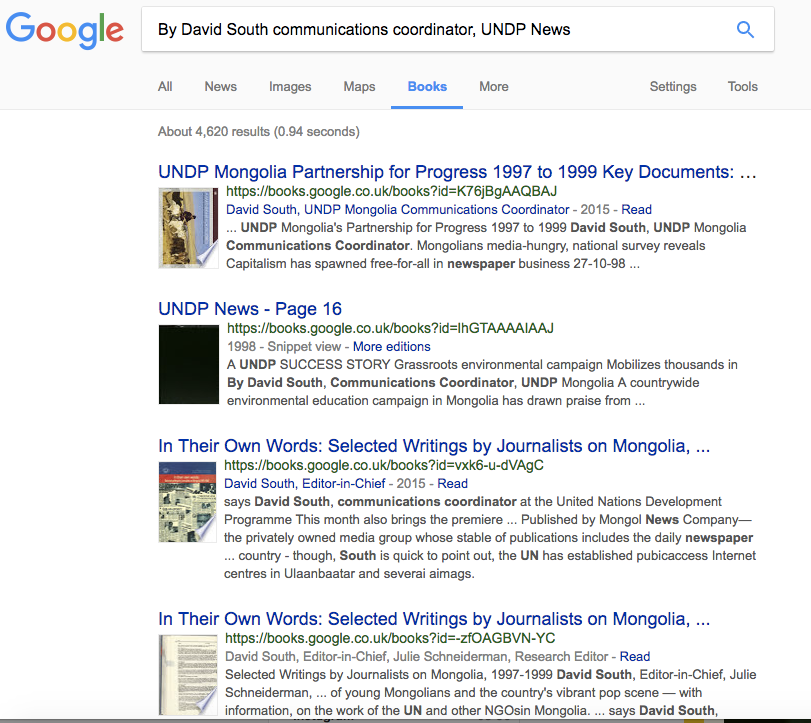
By David South, Communications Coordinator, UNDP Mongolia
Grassroots environmental campaign mobilizes thousands in Mongolia
A countrywide environmental education campaign in Mongolia has drawn praise from around the world, most especially for its ability to mobilize thousands of people and produce hundreds of advocacy materials.
Robert Ferguson, a UNV Information Specialist from Canada, has just finished a two-year assignment advising on the Environmental Public Awareness Programme. The project, implemented by UNDP, proved that civil society is alive and very well in Mongolia, despite 70 years of Communism and the hardships of transition to a free-market economy.
For the first-time visitor to Mongolia, it is easy to be dazzled by the view: the expansive steppe, the sparse population with a sprinkling of nomadic tents, the enormous herds of sheep, goats and cows. First impressions tend toward the belief that Mongolia is an unspoiled paradise where nomads have roamed for thousands of years. The reality is considerably different. The 600,000-plus capital of Ulaanbaatar, or Red Hero, is densely populated, urban and home to the country’s remaining factories and electrical power plants. In winter, pollution from power plants and coal stoves in the traditional tents, or gers, where half of the city’s population still lives, chokes the population and causes numerous respiratory problems.
While Mongolia has space to spare – the population is 2.4 million, plus 32 million head of livestock, in a territory the size of Western Europe – a long list of threats are taking their toll on this harsh but beautiful country.
“Mongolia’s environment is endangered by a range of problems that are on the brink of exploding,” says Robert Ferguson. “As these problems are not yet out of control, this country is in a very good position for grassroots initiatives that can help communities to realize their environmental problems and understand possible ways to keep them under control …
… On one cold autumn day, Ferguson and his colleagues are visiting a project in the shantytown of Chingeltei in the north of the capital. A majority of Ulannbaatar’s population live in neighbourhoods like this, where the mix of traditional gers, wooden cottages and newly built Mongolian monster homes gives a vivid example of the transition years. The population has exploded as more and more Mongolians seek out their dreams in the capital.
The Environmental Public Awareness Programme, or EPAP, uses small grants of between $1,000 and $2,000 to start awareness projects with local NGOs. After two years, nearly 100 small projects have been implemented – yet the original project document had only proposed 15 projects. According to Ferguson, the project team, which includes Sumiya and Davaasuren, were struck by the wellspring of enthusiasm they were tapping.
… Garbage is strewn liberally on the dusty streets. Inspired by recycling campaigns in his native Canada, Ferguson encouraged local women to start the Blue Bag Project. Local women proudly show off their streets – garbage-free – as they collect pop and beer bottles and animal bones to turn in for cash at the local recycler. This is just one EPAP project that has galvanized grassroots action. Back in the EPAP at the Stalinesque Ministry of Nature and Environment, Ferguson continues …
…. were all weak. What was needed was a means to take the right to public participation and an understanding of these laws to community organizations and let them develop public awareness campaigns that get the information out.”
The Programme has exceeded expectations …
…. “The response we got to our initial call for interested environmental groups was unexpected,” says Ferguson. “NGOs came from nowhere. And they embraced the idea …
… In October last year, EPAP launched the Mongolian Green Book, a pocket-sized environmental awareness handbook for NGOs. More recently Ferguson completed a Handbook on Environmental Public Awareness to share Mongolia’s experiences with others who care about the environment…
… The workshop is an immediate follow-up to the launching of the network through a workshop attended by 12 members in December 1998…
… with such enthusiasm that we pursued more money and nearly doubled the funding for small public awareness problems.”
Note: This is just an excerpt from the story. This issue of UNDP News featured contributions from UN Secretary-General Kofi Annan, Danny Glover, Nadine Gordimer and Amartya Sen.
The highly successful EPAP project was profiled in UNDP News in April/May 1999. This issue of UNDP News featured contributions from then UN Secretary-General Kofi Annan, Danny Glover, Nadine Gordimer and Amartya Sen.
The highly successful EPAP project was profiled in UNDP News in April/May 1999. This issue of UNDP News featured contributions from then UN Secretary-General Kofi Annan, Danny Glover, Nadine Gordimer and Amartya Sen.Many resources are available online to explore Mongolia’s 1990s transition experience.The Environmental Public Awareness Handbook: Case Studies and Lessons Learned in Mongolia, published in 1999 by the UNDP Mongolia Communications Office.The Mongolian Green Book was published in 1999 by the UNDP Mongolia Communications Office.The EPAP Handbook and the Mongolian Green Book were published by the UNDP Mongolia Communications Office and funded by the European Union’s TACIS programme. European Union. europa.eu
Robert Ferguson’s The Devil and the Disappearing Sea: Or, How I Tried to Stop the World’s Worst Ecological Catastrophe (Publisher: Raincoast Books, 2004).
“The former head of the Communist Party in Inner Mongolia has been sentenced to life imprisonment for taking bribes that have led to pollution of the Mongolian steppe and the oppression of Mongolian herders. According to the judgment, published yesterday, by Beijing News, Liu Zhozhi, who had been expelled from the party before trial, used his eight years in power to pocket up to 8.17 million Yuan (over one million euros).”
Read more on the connection between corruption and air pollution levels here:
The story reports on a child health crisis in the country’s capital, Ulaanbaatar, because “Many ger households burn coal or even trash to keep warm and the smog they produce has led to a surge in respiratory and heart disease and stoked anger and protests.”
And “Pollution levels in Ulaanbaatar” have “become worse than that in cities such as Beijing and New Delhi”, according to the UNICEF report.
In 2018, Time published a story titled “Life in the Most Polluted Capital in the World”. This consequence of poor development policy stands in stark contrast to just a few years earlier, when the Mongolian President was awarded the 2012 Champions of the Earth award for “leadership that had a positive impact on the environment” and in 2013 was named as Global Host for World Environment Day 2013 because Mongolia “is prioritizing a Green Economy shift across its big economic sectors such as mining and promoting environmental awareness among youth”. Awards and meetings are clearly not enough. Update on Tuesday, August 28, 2018 at 3:35AM by David South
The importance of reducing exposure to urban air pollution is being backed up with more studies and evidence. What we have seen in the past 20 years of globalization has been a big push to encourage urbanization and denser urban living conditions. But, unfortunately for human health and well-being, this has not been connected to a strategy to reduce urban air pollution. In fact the opposite has been happening in many cities.
Urban air pollution has increased from various sources, in developed countries from vehicles, in particular those burning diesel fuel, and in developing countries, from not only vehicles but also households burning fuel for heating and cooking.
A new book to be launched in April 2019 by journalist Beth Gardiner (@Gardiner_Beth), “Choked: The Age of Air Pollution and the Fight for a Cleaner Future” (Granta) (University of Chicago Press), explores today’s global air pollution crisis in the world’s cities. Gardiner is an environmental journalist who writes for The New York Times, The Guardian and other publications (bethgardiner.com).
The UK cover for Choked: The Age of Air Pollution and the Fight for a Cleaner Future (Granta, 2019).
Listed in the Financial Times’ “What we’ll be reading in 2019”
“A compelling book about a critical subject” Elizabeth Kolbert, Pulitzer Prize-winning author of The Sixth Extinction
“Air pollution kills seven million people every year, causing heart attacks, strokes, cancer, dementia and more. In Choked, Beth Gardiner travels the world to tell the story of this modern-day plague, exposing the political decisions and economic forces that have kept so many of us breathing dirty air.”














You must be logged in to post a comment.