Prostitution is called the world’s oldest profession, and can be found in one form or another in every country and society. And where poverty is rife and women have few economic choices, it flourishes. But it also flourishes in societies and economies undergoing rapid change, and where people move around more and more, as in the South’s fast-growing cities.
The money to be made trafficking people for the sex trade is huge. Sex trafficking is organized crime’s fastest growing business, with up to two million people worldwide – mostly women and children – trafficked into the sex trade every year (UN). Approximately 80 percent of today’s trafficked people around the world are female, and up to 50 percent are under the age of 18 (The New Global Slave Trade by Ethan B. Kapstein).
It is difficult to gauge the total number of prostitutes in the South: often, many women drift in and out of the profession for economic reasons. In Cambodia for example, Oxfam (http://www.oxfam.org.uk/) has put the number as high as 300,000 to 500,000, with one third of the sex workers below the age of 18. In India, there are more than 7 million prostitutes (UNICEF). It’s thought more than a third are forced into the sex trade, and most are under the age of 18. Many are between 12 and 15 years old.
In India, Mumbai’s Kamathipura (http://www.netphotograph.com/viewset.php?id=23) area is called Asia’s biggest home to brothels: over 150,000 prostitutes work there. The women can make as little as 10 rupees (US 23 cents) per customer, and many have been sold by sex traffickers. But prostitutes in Kamathipura are being helped to get out of the poverty trap that leads them into sex work. Population Services International (www.psi.org) has set up bank accounts for the women working as prostitutes in the area so they can start saving to be able to buy their way to a better life. By saving as little as 10 rupees with each deposit, the women are able to set aside money and keep it safe from theft and from the pimps and madams who run the brothels.
“It has helped a lot,” Reena, who moved to the area from Calcutta, told the Independent newspaper. “Now no one can steal the money.”
“I was tricked here. I was in love with a man and came here with him. But when I got here he sold me,” said Simla, 42, from Nepal. Simla has two children outside the red light district and the money she saved was for school fees. Simla wants her children to avoid her fate: “I was fooled into this. I will not allow my children to do it,” she said.
The bank accounts work like this: one of the women walks around the area with an envelope and a notebook. She gathers money from the sex workers, which is then deposited into a single bank account under the Sangini co-operative. When one of the women wants to get some money, it is returned by the cooperative. To date, over 2,500 women have deposited more than US $157,477.
How does this money-saving help the women? Apart from slowly building up some wealth, it also gives them power; the power to say “no” to a customer who refuses to use a condom or who is abusive. It takes away a bit of the daily desperation that forces so many women to do things they don’t want to just to survive another day.
And it is important their savings grow if they are to have a better future: competition is getting fiercer as the crisis in India’s rural areas drives more women to the cities. And more turn to prostitution to survive. This has its own market dynamics: younger women become the desired commodity and older prostitutes see their incomes go down – a young woman can charge 100 rupees (US $2.31) for sex, while older women only get 30 rupees (US 69 cents).
Resources
Coalition Against Trafficking in Women – Asia Pacific: international network of feminist groups, organizations and individuals fighting the sexual exploitation of women globally. Website: http://www.catw-ap.org/
UN.GIFT: Global Initiative to Fight Human Trafficking: this website is packed with resources, including an anti-trafficking toolkit. Website: http://www.ungift.org/
Anti-Trafficking Alliance: A charity founded in 2005 to prevent, tackle and eliminate forced abduction and trafficking into sexual slavery and to empower survivors. Website: http://www.atalliance.org.uk/
More on the role played by sex work in an economic crisis (especially as a survival and/or resilience strategy), or when there are high levels of poverty present in a country:
Risks and resiliency of women engaged in sex work in Mongolia
As a reporter for two Financial Times newsletters, New Media Markets and Screen Finance, I covered the rapidly growing UK (and Scandinavian) television and new media markets and the expanding film-financing sector in Europe.
The digital revolution in filmmaking over the last decade has given birth to an African success story: Nollywood – Nigeria’s answer to Hollywood, uses low-cost digital filmmaking and editing to tell local stories — in the process making money and creating thousands of jobs.
This do-it-yourself (DIY), straight-to-DVD and video market has in just 13 years ballooned into a US $250 million-a-year industry employing thousands of people. In terms of the number of films produced each year, Nollywood is now in third place behind India’s Bollywood and America’s Hollywood. Despite rampant pirating of DVDs and poor copyright controls, directors, producers, actors, stars, vendors and technicians are all making a living in this fast-growing industry.
The power of creative industries to create jobs and wealth has been a focus of UNESCO, through its Global Alliance for Cultural Diversity. UNESCO has been in the forefront in helping African countries re-shape their policies to take cultural industries into consideration. The promotion of cultural industries also has been incorporated into the New Partnership for Africa’s Development (NEPAD).
What is particularly attractive about Nollywood to the poor in the South is its rough-and-ready approach to filmmaking: combining low-cost digital cameras and film editing software on personal computers, with small budgets and fast turn-around times. Films are made on location using local people. These factors make getting into filmmaking accessible and within reach of more people.
Nollywood grew out of frustration, necessity and crisis: in the late 1980s and early 1990s, Nigerian cities became crime hotbeds. People were terrified to go out on the streets, and this led to the closing down of many movie theatres. Desperate for entertainment at home – and unsatisfied with foreign imports from India and the West – Nigerians turned to telling their own stories to stave off the boredom of staying in.
The film credited with sparking off the industry is 1992’s Living in Bondage – a huge financial hit credited with raising the level of professionalism and production values in Nigerian cinema.
Now, between 500 and 1,000 feature-length movies are made each year, selling well across the continent of Africa. Average productions take 10 days and cost around US $15,000 (www.thisisnollywood.com). Nollywood stars are famous throughout Africa – and Nigeria culturally dominates West Africa just as the US does the world. It is estimated there are 300 producers and that 30 titles go to shops and market stalls every week. On average, a film sells 50,000 copies: a hit will sell several hundred thousand. With each DVD costing around US $2, it is affordable to most Nigerians and very profitable for the producers.
“These are stories about Africa, not someone else’s,” well-known actor Joke Silva told the Christian Science Monitor.
Focused on Africa, the films’ themes revolve around AIDS, corruption, women’s rights, the occult, crooked cops and prostitution. They do so well because they speak directly to the lives of slum-dwellers and rural villagers.
“We are telling our own stories in our way, our Nigerian way, African way,” said director Bond Emeruwa. “I cannot tell the white man’s story. I don’t know what his story is all about. He tells his story in his movies. I want him to see my stories too.”
The big brands – Sony, Panasonic, JVC and Canon – all produce cameras capable of high-definition digital filmmaking and these have become the staple tools of this filmmaking revolution.
More and more, the films are capitalising on the large African diaspora around the world, on top of Africa’s large internal market. And this is offering a step-up into the global marketplace for Nigerian directors and producers.
The Nollywood phenomemon has been documented in the documentary This is Nollywood, directed by Franco Sacchi, a teacher from the Center of Digital Imaging Arts at Boston University.
The prospects for the industry are only looking up: the Nigeria in the Movies project has been launched to help grow the industry, establish standards, improve distribution and broaden its international appeal and awareness. It also offers filmmaking grants for neophyte filmmakers.
Of course, filmmaking can be a tricky business: authorities in largely Muslim northern Nigeria have imposed 32 restrictions on the local film industry — nicknamed “Kannywood” after the city of Kano. A six-month ban lost the industry US $29 million and put thousands out of work: a sign of the economic importance of this DIY filmmaking business. The message is clear: filmmakers need to be sensitive to the cultural norms of the communities in which they work.
Kannywood, started in 1992, has 268 production companies and 40 editing studios, employing over 14,000 people.
Adim Williams is one Nigerian director who is getting an international audience. He spends about US $40,000 on films that take two weeks to shoot. He has already secured an American release of a comedy, Joshua. Another director, Tunde Kelani, is regularly featured at international film festivals, where Nollywood screenings are more common.
And some, like young director Jeta Amata, believe Nollywood’s cheap, fast-production, DIY approach has a lot to teach Hollywood, with its expensive filmmaking and ponderous production cycles.
The global charity Camfed (dedicated to eradicating poverty in Africa through the education of girls and empowerment of women) has projects to teach women filmmaking skills. Website:http://uk.camfed.org
Festival Panafricain du Cinema et de la Television de Ouagadoogou 2009: Africa’s biggest film festival. Website:http://www.fespaco.bf/
Naijarules: Billing itself as the “largest online community of lovers and critics of Nollywood”, an excellent way to connect with all the players in the business. Website: http://www.naijarules.com/vb/index.php
Nollywood Foundation: Based in the US, aims to bring Nigerian films and culture to an international audience and to promote new films and new media. Website:http://www.nollywoodfoundation.org/home.php
Development Challenges, South-South Solutions was launched as an e-newsletter in 2006 by UNDP’s South-South Cooperation Unit (now the United Nations Office for South-South Cooperation) based in New York, USA. It led on profiling the rise of the global South as an economic powerhouse and was one of the first regular publications to champion the global South’s innovators, entrepreneurs, and pioneers. It tracked the key trends that are now so profoundly reshaping how development is seen and done. This includes the rapid take-up of mobile phones and information technology in the global South (as profiled in the first issue of magazine Southern Innovator), the move to becoming a majority urban world, a growing global innovator culture, and the plethora of solutions being developed in the global South to tackle its problems and improve living conditions and boost human development. The success of the e-newsletter led to the launch of the magazine Southern Innovator.
One of the many stories we covered on Africa’s fast-growing cities from 2007. It was witnessing first-hand Africa’s innovators and their adaptive use of mobile and information technologies that inspired us to give birth to Southern Innovator’s first issue.
They’ve sold their hip clothing designs out of their basement and out of the back of their car. Now the young designers and marketers behind Toronto’s Too Black Guys can boast that their wares are being sold out of film-maker Spike Lee’s shop in Brooklyn, as well as five other funky U.S. stores from Washington to L.A.
Neither of the co-owners studied fashion – Adrian, 24, holds a BA in economics and Robert, 23, studied marketing at community college. Still, they have designed their own T-shirts, jeans, baseball caps and sweatshirts, and the message is at least as important as the medium.
“They forgot to ask my name and called me negro,” reads a typical shirt. Earl Smith, the manager at Lee’s Brooklyn shop, says he loves the clothes but adds that customers often ask his staff to explain what the thought-provoking garments mean.
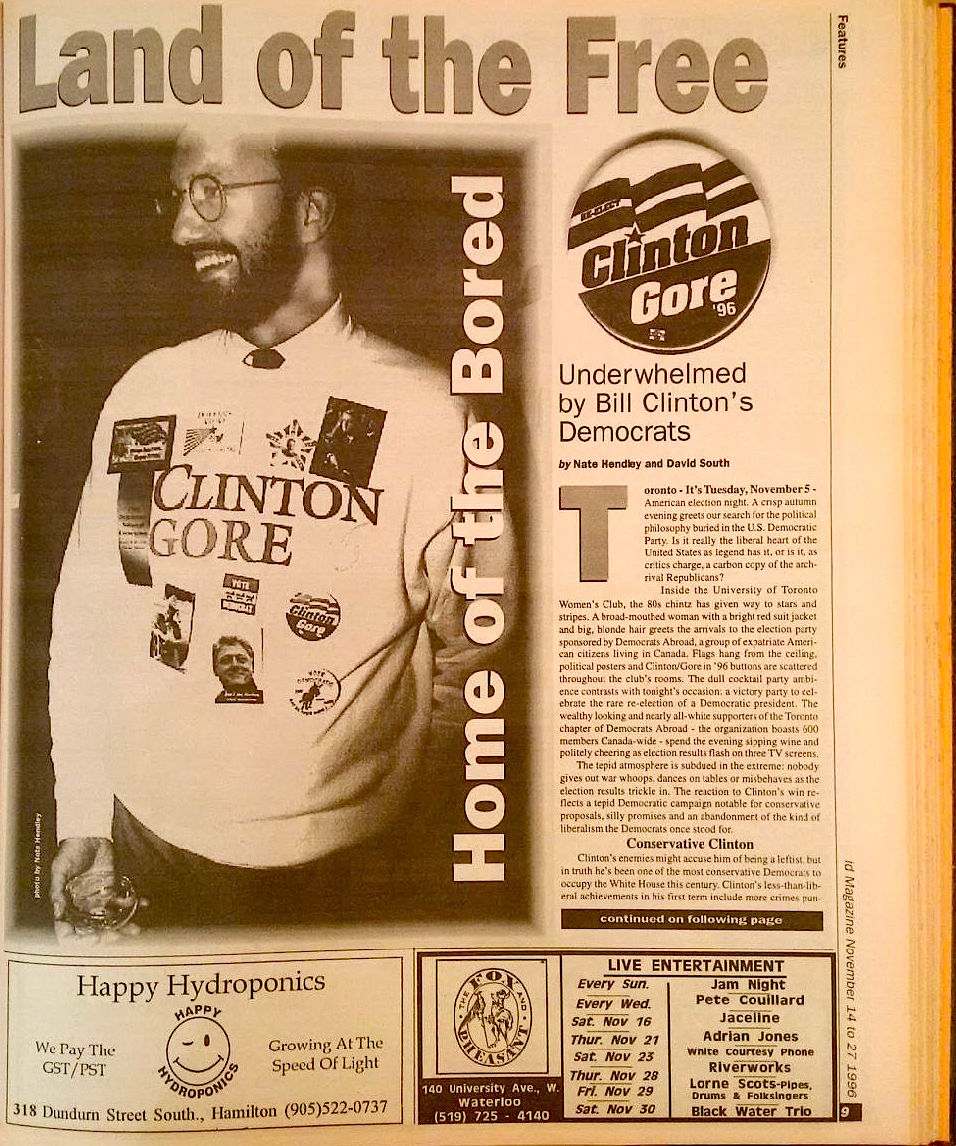
Toronto – It’s Tuesday, November 5 – American election night. A crisp autumn evening greets our search for the political philosophy buried in the US Democratic Party. Is it really the liberal heart of the United States as legend has it, or is it, as critics charge, a carbon copy of the arch-rival Republicans?
Inside the University of Toronto Women’s Club, the 80s chintz has given way to stars and stripes. A broad-mouthed woman with a bright red suit jacket and big, blonde hair greets the arrivals to the election party sponsored by Democrats Abroad, a group of expatriate American citizens living in Canada. Flags hang from the ceiling, political posters and Clinton/Gore in ’96 buttons are scattered throughout the club’s rooms. The dull cocktail party ambience contrasts with tonight’s occasion: a victory party to celebrate the rare re-election of a Democratic president. The wealthy looking and nearly all-white supporters of the Toronto chapter of Democrats Abroad – the organization boasts 600 members Canada-wide – spend the evening sipping wine and politely cheering as election results flash on three TV screens.
The tepid atmosphere is subdued in the extreme: nobody gives out war whoops, dances on tables or misbehaves as the election results trickle in. The reaction to Clinton’s win reflects a tepid Democratic campaign notable for conservative proposals, silly promises and an abandonment of the kind of liberalism the Democrats once stood for.
Conservative Clinton
Clinton’s enemies might accuse him of being a leftist, but in truth he’s been one of the most conservative Democrats to occupy the White House this century. Clinton’s less-than-liberal achievements in his first term include more crimes punishable by the death penalty, a promised additional 100,000 police on the streets, “V-Chip” technology in television sets, an intensification of the war on drugs and an abandonment of federal responsibility for welfare. Clinton’s re-election campaign featured promises to encourage school kids to wear uniforms, a vow to get even tougher on drug use by such measures as forcing teenagers to pass urine tests before issuing them driver’s licenses, and a recommitment to eliminating the US federal deficit.
The mostly monied professionals at the party are well aware of Clinton’s rightward turn since taking office in 1992, but put the president’s conservative leanings down to pragmatic politics.
“Am I disappointed in Clinton?” asks Bill Cronau, the past chair of Democrats Abroad and self-professed liberal. “Sure, but I’m not surprised that Clinton became more conservative. He is a Southerner after all.”
Arkansas-born Clinton used law and order issues “to chop GOP off,” adds Cronau, an insurance manager for Manulife, on the president’s theft of the Republican’s thunder.
The closest thing at the party to an actual living American politician is Tom Ward. Ward, with a detached air and the glow of a politician, soon attracted an audience when he entered the room. Ward twice ran unsuccessfully to become a Democratic congressman for Indiana, and agrees that overall Clinton has been “a disappointment as a liberal.”
He also agrees the president has moved far more to the right than previous Democratic presidents such as Jimmy Carter or Lyndon Johnson. Still, Ward, who has lived in East York since 1989, gives Clinton liberal kudos for his attempted passage of health care reforms. Yet Clinton’s proposed health care plan fell apart in 1994 following intense debate and criticism from the Republicans. Ward says he would try to introduce Canadian political ideas such as universal health care and stricter gun control were he to return to Indiana for a third run at Congress.
Canada or Clinton?
Joan Sumner, a psychologist originally from New York City, says she was initially impressed by Canada’s health care system, and by Clinton’s attempt at passing similar legislation in the US. But now she’s having second thoughts.
The Republicans, under Ronald Reagan and George Bush “decimated the health care system in the United States,” she says. “To run a medical practice became like running a business. It became difficult to collect from the insurance companies, who were reluctant to pay for psychiatric care.”
Sumner, who works with people who have “closed-head injuries,” has lived in Canada for 11 years. At the time she arrived, she found Canada’s health care system in good shape. “Now it’s a disaster and going from bad to worse. Truth be told, I am thinking of looking back across the border, especially with Clinton’s second term. The federal Liberals and the provincial government have no commitment to the people of Ontario.”
She complains about the extent of America’s influence on the Canadian political system.
Mike Harris, she fears, is borrowing his ideas from conservative Republican governor Christine Todd Williams in New Jersey. She would prefer Harris to look to liberals like former New York governor Mario Cuomo for inspiration. Unfortunately, Cuomo’s version of liberalism is out of fashion in both Canada and the United States these days.
While nearly everyone at the party expresses displeasure with Clinton’s turn to the right, few can explain why they supported him over his Republican challenger, Bob Dole.
In one corner is a bearded man in a white sweatshirt littered with Clinton/Gore campaign buttons. This super-supporter is Tim Wilkins, a Toronto social worker originally from Florida. When asked what policies attracted him to support the Democrats, Wilkins becomes flustered and unable to give any specifics.
“Been with the Democrats since 1988,” says Wilkins. “I could not identify with the Republicans at all. I think Bush was a very poor selection, and when he selected Dan Quale as his running mate, I thought ‘my Lord, you’ve just blown that ticket.’ The Republicans are just too right-wing, completely out of touch with Americans. And that’s an example of what’s happening tonight. Bob Dole and (running mate) Jack Kemp are completely out of touch. They have no agenda, no economic plan.”
Clinton and Chretien
Byron Toben, a Montreal Democrat, thinks a Clinton win will cement the close personal relationship between Clinton and prime minister Jean Chretien.
“Clinton and Chretien have something of a mutual admiration society going,” says Toben, who does immigration work, helping US citizens to move to Canada. “Clinton and Chretien are both on the same wavelength.”
Anne Kerr, the Canadian-born wife of Tom Ward, also agrees. She says Clinton’s victory is important to Canada because Liberals have more in common with the Democrats than the Republicans.
True enough, both Chretien and Clinton represent parties traditionally viewed as left-of-centre. Both men ran on vaguely liberal platforms for election, and both turned sharply conservative after deciding that deficit-reduction was more important than social spending or government activism. The federal Liberals in Canada and the Democrats in the United States now support conservative agendas that aren’t too much different than the platforms of their right-wing rivals. The biggest difference between the two nations, as Ward points out, is that the United States now lacks any major left-wing party such as the New Democrats. The Greens, running as a left-wing alternative to the Democrats, with consumer crusader Ralph Nader as their candidate, pulled in slightly more than a half-million votes on November 5. That is more than other minor parties such as the Libertarians or US Taxpayers Party, but hardly enough to convince Clinton to turn sharply leftwards in his second term.
Disappointment with Clinton’s first term aside, the Democrats Abroad party briefly jolts awake towards the end of the evening when Clinton’s re-election is confirmed. Champagne corks are popped by the club’s wait staff, but nobody is in a hurry to grab a glass. The mood becomes slightly effervescent as tipsy Democrats grow more animated, only to be hit with some mind-numbing post-victory speeches by the group’s executive. After a few toasts, the moment passes and a steady stream of Democrats slips out, thankful their man had won over Bob Dole, becoming the first Democratic president to win a second consecutive term in office since Franklin Roosevelt in 1936.
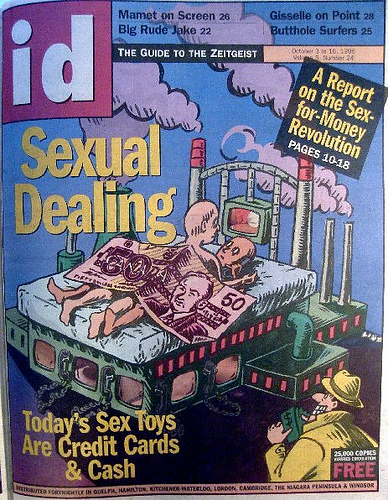
Id Magazine was published in Guelph, Canada in the 1990s.







 David South Consulting
You must be logged in to post a comment.