It was the late 1990s. Mongolia was still recovering from “one of the biggest peacetime economic collapses ever” (Mongolia’s Economic Reforms: Background, Content and Prospects, Richard Pomfret, University of Adelaide, 1994). But it was the country’s young musicians who were showing the way out of the crisis, setting an example for entrepreneurship in the new, free-market economy that emerged in the country after 1990.
As UNDP Communications Officer N. Oyuntungalag wrote in the Blue Sky Bulletin (BSkyB) newsletter, “A thriving pop and rock scene has emerged over the last four years. .. The energy of these musicians and singers has not gone unnoticed by the burgeoning advertising market. Pop bands are promoting many things, from face creams to beer. … [but] there has been little serious writing on the business of popular music.”
As the book’s author, American ethnomusicologist Peter Marsh, said in an interview with UNDP’s Blue Sky Bulletin newsletter, “we thought our book would provide important ideas about the direction and nature of the nation’s development.
“My impression about Mongolian pop-rock is that it is a lively, diverse and at times innovative Mongolian art form that closely reflects many of the hopes, fears and aspirations of its primary audience, Mongolian youth.”
The book still stands as an unusual and innovative contribution to thinking around the role played by youth in development and business and in crisis recovery.
Google Books Key Words: авдаг адил аль англи аялан байж байлаа байх байхад байхгүй бараг барууны бас бензин Бид нар бидний биз бизнес бий биш болох бөгөөд бусад бүжиг бүр бүтээлчид бүх гадаад гадаадад
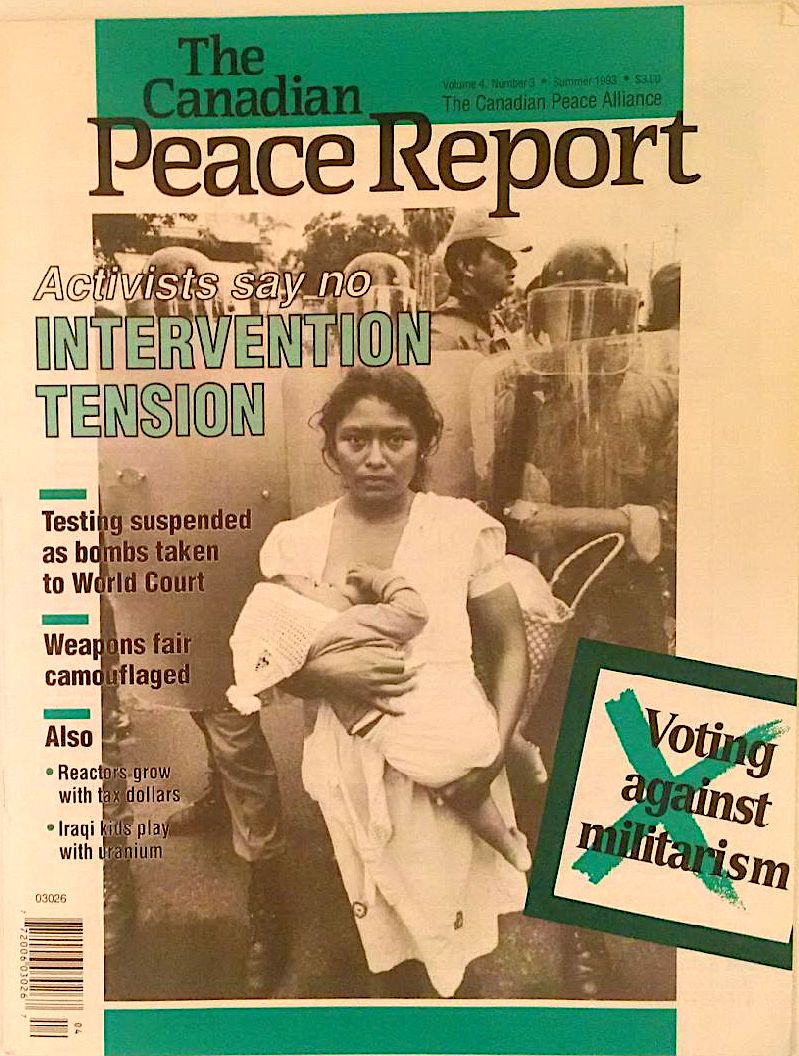
More than 80,000 people swarmed Parliament Hill on May 15 at an Action Canada Network and Canadian Labour Congress rally against free trade and other federal policies. In a paper issued just before, the Canadian Centre for Policy Alternatives criticizes Canadian military spending as “carried over from a cold war that no longer exists. At the same time, our assistance to poor nations is actually falling.”
When a federal election is called, peace groups across Canada plan to be heard. They see the defence department’s $11.3-billion yearly budget – amidst cuts to social programs and calls for even more restraint – as ripe for a hot election battle over government priorities.
A recent Gallup poll conducted for the Canadian Peace Alliance found broad support across all political allegiances for cutbacks to military spending. The CPA also wants daily life demilitarized, with duties like search and rescue turned over to civilian agencies.
Local groups are mostly awaiting a date for the election, expected about late October, but national groups are already planning. Some groups will fight the Conservative Party’s backing of the North American Free Trade Agreement (NAFTA), which they fear will lead to further military integration of Canada and the United States.
The Peace Alliance is working on action and information kits targetting military spending versus social needs, and is developing an election logo. It’s also building up to a national action day.
The idea is to stimulate local and regional activity, coordinator Gideon Forman says. “Kits will help member groups organize actions during the election campaign. They will have information on, among other things, the plan to buy deluxe helicopters, military spending in general and the cost of social needs.
“We will give local groups suggestions for local events and assist with media work.”
Project Ploughshares has produced a short booklet of questions to ask candidates, “but not a repeat of the Election Priorities Project” of the 1988 election, says researcher Bill Robinson. The booklet suggests calling for cuts in military spending, cancelling the EH-101, limiting Canada’s participation in military operations, and abolishing nuclear weapons.
Also nationally, the Action Canada Network (to which the Peace Alliance belongs) met with groups from across the country in Winnipeg in mid-June to finalize election plans, which may include a radio ad campaign. National chair Tony Clarke would like local activists to dog the party leaders across the country, as progressive groups did to Ontario’s Liberals during the province’s 1990 election.
“We will definitely make the link between a range of issues and the (Canada-U.S.) Free Trade Agreement and NAFTA, which we have to get rid of,” says Clarke. “We will be working very hard on jobs and arguing for a job strategy.”
Responding to the Gulf War two years ago (Action Canada Dossier #30), Clarke warned that Canada is “tied in closer than we have ever been before to the permanent war economy” of the U.S.. With a quarter of its output related to the military, the U.S. used militaristic diplomacy to justify maintaining defence budgets, he says. The trade agreements’ guarantees of U.S. access to Canadian energy resources confirm that “we are locking ourselves into what can only be described as Fortress North America.”
Maude Barlow of the Council of Canadians, a network ally, denounced the helicopter purchase during the Peace Alliance’s March 8 lobby of Parliament. Soon after, then defence minister Kim Campbell appeared to waver on the number of helicopters to be bought, but succeeded in winning the Tory leadership without it becoming a major issue. However, Liberal leader Jean Chretien promises to cancel the contract.
At CUSO’s national office, Marc Allain says the development agency will work with the CPA around military spending and the ‘copter purchase.
To Peter Davison of the Halifax Peace Action Network, the stakes are clear and the passion to fight the issues simply awaits a polling date.
“Never has the guns-or-butter issue been more prominent in our society,” says Davison. “Conservative economic policies have been collapsing around the globe. We’re seeing desperate restraint and universal trusts being violated – health care, education, pensions.
“It’s bizarre that we can still conceptualize $6 billion for helicopters to fight submarines – an absurd twist away from meeting human needs.”
Terry Gardner says Science for Peace’s mandate bars entering the election fray, but says the group is planning a high-level panel in the fall on NAFTA and militarization of Canadian culture.
“We’re going to be asking candidates in our area for conversion and reduction in military spending,” says J.J. Verigin of the Doukhobour peace and disarmament committe in British Columbia. He says his MP has been supportive of chopping the choppers.
Verigin found fact sheets helpful and says the CPA does a good job of getting out beyond the urban areas. But he would like the Alliance “to propose something that engages the electorate’s intellect as the gut.”
“We have a general intent to intervene in the election, but we’re not quite clear exactly how,” says North Bay Peace Alliance organizer Brennain Lloyd. “We’re considering a regional information package, something like the Election Priorities Project, that our groups could use.”
Being armed with the facts helps reach the public and pins down candidates, Lloyd says. She applauds the CPA’s idea of producing action kits that her group could integrate into its own.
Toronto’s ACT for Disarmament won’t be working specifically on the election, but may participate in actions, says organizer Maggie Helwig. “Groups have certain things they focus on, and certain ways of operating. Other people do better at elections.”
In Montreal, Judith Berlyn of Westmount Initiative for Peace says, “We will be doing locally what has been developed by the Canadian Peace Alliance as a whole – go to all-candidates meetings, get the mike and ask the questions. We will be raising issues. Last time our candidate had never heard of low-level flying.”
Berlyn feels many people, including activists, often think they don’t know enough to speak publicly. But with information kits, “we know more than the candidates do.”
While approving the CPA’s focus on military spending, Berlyn says it would be a mistake to over-emphasize the helicopters. “Everybody has [already] picked up on that; it’s a good concrete example of insane military spending.”
She also finds the public receptive to informative and succinct pamphlets advocating alternatives to a militarized economy. A Coalition to Oppose the Arms Trade pamphlet is a good model, she says.
“It has four concrete proposals of what the government can do to convert military industries – money that now goes to subsidizing the manufacturing of weapons can be turned into conversion subsidies.”
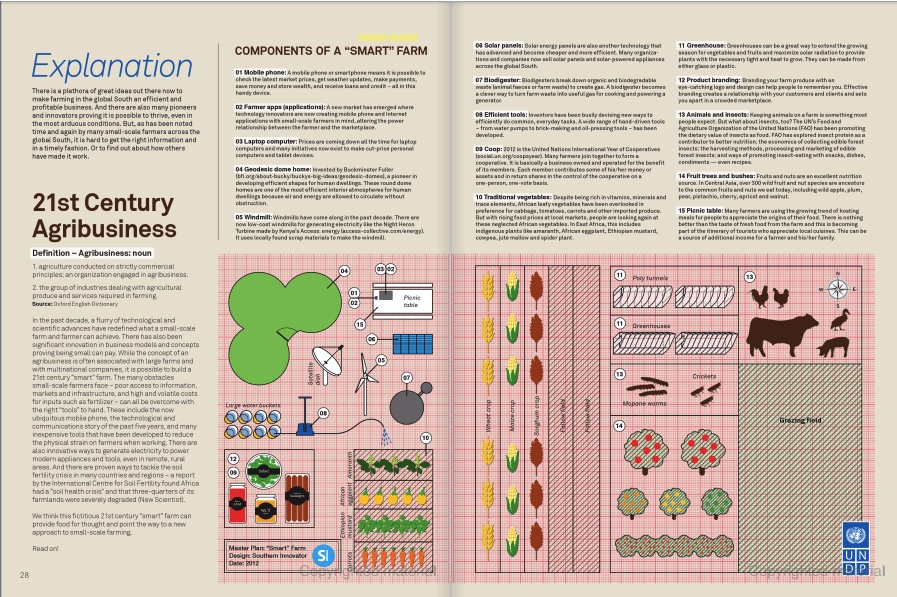
Increasing the agricultural productivity of Africa is critical for the continent’s future development, and the world’s. Two-thirds of Africans derive their main income from agriculture, but the continent has the largest quantity of unproductive – or unused – potential agricultural land in the world.
This means the continent has the potential to become the world’s new breadbasket – but there is a problem. A report by the International Centre for Soil Fertility and Agriculture (IFDC) found the continent had a “soil health crisis” and that three-quarters of its farmlands were severely degraded (New Scientist). The causes of this crisis include overuse of the same plot of land due to population growth, which prevents farmers moving around, and high fertilizer costs, leading to African farmers using just 10 per cent of the world average on their farms.
But a new study shows that an existing practice by some African farmers could help solve this dilemma if it was adopted by the majority.
At the University of Sydney in Australia, a study has confirmed the effectiveness of ants and termites as a tool to increase farm yields in dry areas. It found ants and termites in drier climates of the global South improved soil conditions just as earthworms do in northern, wetter and colder climates. Both termites and ants, by burrowing their way through the soil, carve out tunnels that make it easier for plants to shoot their roots outwards in search of water.
In field experiments, ants and termites helped raise wheat yields by 36 per cent by increasing water and nitrogen absorption. This is critical for agriculture in arid climates.
While termites wreak havoc on crops such as maize (corn) and sugarcane, they are very useful for other African crops.
The Australian research found termites infuse nitrogen into the soil. Nitrogen is usually dumped on fields with expensive fertilizers that are subject to market fluctuations. The termites have nitrogen-heavy bacteria in their stomachs, which they excrete into the soil through their faeces or saliva.
The research also found termites helped with reducing water wastage.
This research reinforces what has long been known to some African farmers. Long-held farmer tradition in parts of West Africa uses termites to enhance soil by placing wood on the earth to attract them. By burying manure in holes near newly planted grains, farmers in Burkina Faso attract termites to the soil.
In Malawi, bananas are planted near termite mounds to encourage the creatures. In southern Zambia, soil from termite nests is harvested and used as top soil on agricultural land.
If more farmers adopted this practice, Africa could simultaneously address its chronic malnutrition and hunger problem and contribute to the world’s food needs. As the McKinsey Global Institute (MGI) found, “With 60 percent of the world’s uncultivated arable land and low crop yields, Africa is ripe for a ‘green revolution’ like those that transformed agriculture in Asia and Brazil.”
McKinsey estimated that Africa’s agricultural output could increase from US $280 billion a year now to US $500 billion by 2020 and as much as US $880 billion by 2030.
The UN recently declared that the world’s population has reached 7 billion. That is many mouths to feed and presents Africa with a dilemma and an opportunity.
And as urban growth accelerates across the global South – the world is now a majority urban place – there is a huge profit to be made from providing food to growing urban populations.
The time to act is now, as there have been reports from African farmers that they are seeing harvests declining by 15 to 25 per cent. And the picture gets gloomier: many farmers think their harvests will drop by half over the next five years.
Given that there are 2,600 different species of termites now recognised in the world (UNEP) and with over 660 species, found in Africa, it is by far the richest continent in termite diversity (Eggleton 2000) and they are proof that an affordable solution is close at hand to the current crisis.
Published: January 2012
Resources
1) World Vegetable Center: The World Vegetable Center is the world’s leading international non-profit research and development institute committed to alleviating poverty and malnutrition in developing countries through vegetable research and development. Website:http://www.avrdc.org
2) Songhai Centre: a Benin-based NGO that is a training, production, research, and development centre in sustainable agriculture. Website:http://www.songhai.org/english
5) African Alliance for Capital Expansion: A management consultancy focused on private sector development and agribusiness in West Africa. Website:http://www.africanace.com/v3
6) Ants and termites increase crop yield in a dry climate by Theodore A. Evans, Tracy Z. Dawes, Philip R. Ward and Nathan Lo, Nature Communications 2, Article number: 262
7) Integrating Ethno-Ecological and Scientific Knowledge of Termites for Sustainable Termite Management and Human Welfare in Africa by Gudeta W. Sileshi et al, Ecology and Society, Volume 14, Number 1. Website:http://www.ecologyandsociety.org/vol14/iss1/art48
Bangladesh’s poor can now buy and sell goods and services with their mobile phones, thanks to a Bangladeshi company’s pioneering mobile phone marketplace. The company, CellBazaar, serves as a useful role model for other Southern entrepreneurs and companies looking to develop and market mobile phone applications for the poor that really help them.
CellBazaar is simple to use: A user begins the process by texting the word “buy” to short message (SMS) code 3838. They then are offered a list of all the items for sale and scroll through them to find what they want. When they have found something, they send another SMS. In response, an SMS comes back telling the seller’s phone number. And from that point, business is underway between the buyer and the seller.
“It’s a far more efficient way of finding things. In the past you have to go to newspapers, magazines, and find the best match,” founder Kamal Quadir told MobileActive.
The categories run from used cars and motorcycles, to new laptops, agricultural products like corn, chickens and fish, educational tutors, jobs, and places for sale and rent.
“I was surrounded by technologically sophisticated people,” he said. “I saw all this technological possibility and heard one top-notch scientist mentioning that a very cheap mobile phone had the same capabilities as a NASA computer in 1968. A country like Bangladesh has 35 million NASA-type computers, and most importantly, they’re in people’s pockets.”
Quadir saw all this power going to waste, and realized how business was being held back by the lack of information. Absence of market intelligence – or what is available for sale and what is a good price – was a big impediment to more profitable and efficient business transactions.
Quadir first created the idea at MIT Media Labs and eventually signed a contract with GrameenPhone. CellBazaar launched in July of 2006, and, after a year of beta testing, the team started to actively market the service in August 2007.
CellBazaar can also be accessed through its website. This has the advantage of making what is a very local market an international market.
Partnering with Grameen Phone, Bangladesh’s leading telecommunications service provider with more than 18 million subscribers, had its advantages. With 60 percent of the Bangladesh market, “their network is larger than others,” Quadir said.
Just as web applications like Google and the powerful social networking website Facebook (www.facebook.com) transformed the way people work and socialize, so CellBazaar has needed to encourage a change in behaviour for it to work. At first, people didn’t think they had anything worth selling, or that they could use the text messages to connect to a marketplace.
“In the past, a rural village person couldn’t even imagine that they wanted to sell something and the whole world would be willing to buy it,” Quadir said. “The biggest challenge we have is people blocking that audacity and courage.”
To date, over 1 million people have used the service out of a country of 150 million people. “Fundamentally the real issue is about changing people’s patterns,” he said. “But once they learn how to use it, people start doing it really frequently.”
The CellBazaar experience also shows how critical clever marketing is to business success. The company has been marketed through tastefully designed stickers placed in the windows of cars, taxis and microbuses — ubiquitous and continuous publicity for low cost.
CellBazaar also has launched educational booklets for four target audiences: villagers and farmers, the elderly and retired, young professionals, and tech-savvy teenagers. There are detailed booklets for those who want step-by-step instructions, as well as short leaflets for customers who want to carry a “quick guide” in their pocket.
CellBazaar launched its first television campaign during the Muslim festival of Eid in 2007. The ads featured a newspaper seller called Shamsu Hawker, and show how he begins a new career buying and selling used televisions with the help of CellBazaar. The advertisement’s unusual setting on a train, as well as positive imagery of Bangladesh, created a sensation among TV viewers. The character “Shamsu Hawker” has become a nationally recognized icon and popular cultural figure.
As the service grows, the demographic that uses it has also expanded. “Young people were the early adopters,” said Quadir. “Initially urban people used it more, because we didn’t market very aggressively. Word of mouth spread faster because of the higher concentration of people in cities. But now it has spread to rural areas as well.”
CellBazaar has won many awards for its innovation in social and economic development.
The ambitious Quadir wants to expand CellBazaar into East Africa, Eastern Europe, and South Asia. Unlike the web, CellBazaar has to make deals with local mobile phone providers. He can’t just offer the service through the internet. “The Internet belongs to everybody — like highways and like fresh air,” said Quadir. “Mobile networks are privately owned.”
“So far the operators we have worked with have been very good,” he said. “We are very selective in terms of what operator we work with.” As CellBazaar looks to expand, Quadir is focusing efforts on places that have high mobile penetration rates and low web penetration. “We’re looking at any place that has less internet. No matter how good the application is, having internet and high computer penetration doesn’t help us,” he said. “And mobile is everywhere.”
The same lesson is being learned around the world. A study of grain traders in Niger found that “cell phones reduce grain price dispersion across markets by a minimum of 6.4 percent and reduce intra-annual price variation by 10 percent.” According to the study, “The primary mechanism by which cell phones affect market-level outcomes appears to be a reduction in search costs, as grain traders operating in markets with cell phone coverage search over a greater number of markets and sell in more markets.”
Mobile phones are now the fastest growing consumer product in history. Portio Research estimates that between 2007 and 2012 the number of mobile subscribers will grow by another 1.8 billion, mostly in emerging economies like India and China.
Informa Telecoms and Media estimates mobile networks now cover 90 per cent of the world’s population – 40 per cent of whom are covered but not connected. With such reach, finding new applications for mobile phones that are relevant to the world’s poor and to developing countries is a huge growth area. It is estimated that by 2015, the global mobile phone content market could be worth over US $1 trillion, and basic voice phone calls will account for just 10 per cent of how people use mobile phones.
Leonard Waverman of the London Business School has estimated that an extra 10 mobile phones per 100 people in a typical developing country, leads to an extra half a percentage point of growth in GDP per person.
The experience in the Philippines has shown that the best way to drive fast take up of mobile phone services is to offer something very practical and connected to personal income.
“The most significant lesson learned so far,” said Shawn Mendes, lead author on the report, The Innovative Use of Mobile Applications in the Philippines: Lessons for Africa, “is that m-Banking, rather than more altruistic applications such as m-Health and m-Education, has delivered the greatest benefits to people in developing countries.”
SME Toolkit: A free online resource aimed at the South to help entrepreneurs and small businesses access business information, tools, and training services to be able to implement sustainable business practices. Website:http://www.smetoolkit.org/smetoolkit/en
Entrepreneurial Programming and Research on Mobiles: EPROM, part of the Program for Developmental Entrepreneurship within the MIT Design Laboratory, aims to foster mobile phone-related research and entrepreneurship. Key activities include development of new applications for mobile phone users worldwide. Website:http://eprom.mit.edu/
The innovative use of mobile applications in the Philippines Lessons for Africa: A paper from the Swedish International Development Cooperation Agency (Sida) on mobile phone innovation. Website:http://www.sida.se/sida/jsp/sida.jsp?d=118&a=33306&language=en
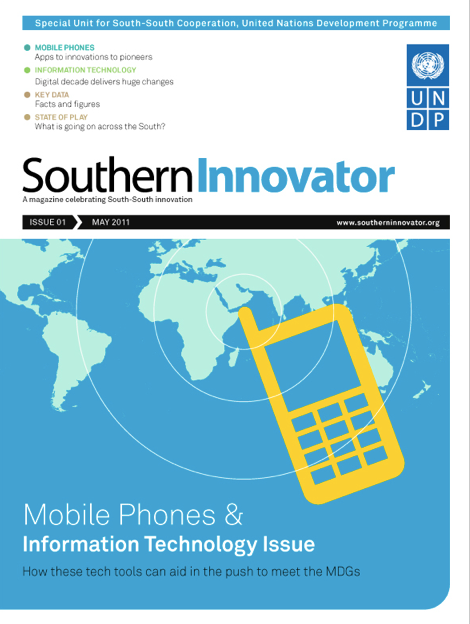
Development Challenges, South-South Solutions was launched as an e-newsletter in 2006 by UNDP’s South-South Cooperation Unit (now the United Nations Office for South-South Cooperation) based in New York, USA. It led on profiling the rise of the global South as an economic powerhouse and was one of the first regular publications to champion the global South’s innovators, entrepreneurs, and pioneers. It tracked the key trends that are now so profoundly reshaping how development is seen and done. This includes the rapid take-up of mobile phones and information technology in the global South (as profiled in the first issue of magazine Southern Innovator), the move to becoming a majority urban world, a growing global innovator culture, and the plethora of solutions being developed in the global South to tackle its problems and improve living conditions and boost human development. The success of the e-newsletter led to the launch of the magazine Southern Innovator.










You must be logged in to post a comment.