Tag: David South Consulting

  • Mobile Phones: Engineering South’s Next Generation of Entrepreneurs

    Mobile Phones: Engineering South’s Next Generation of Entrepreneurs

    By David SouthDevelopment Challenges, South-South Solutions

    SOUTH-SOUTH CASE STUDY

    Technology is fuelling unprecedented growth in productivity in Asia, with sub-Saharan Africa languishing behind (International Labour Organization). But the growth in mobile phones could help close this gap, as home-grown entrepreneurs are stepping up to exploit this new opportunity.

    Mobile phone applications are proving a boon to small businesses and entrepreneurs. They are now putting power in the hands of individuals, making it easier to invent new ways of doing things, transfer money, organise business accounts, provide services, sell things, and keep in touch and up-to-date.

    Technology has been the common factor in increases in productivity around the world, and with the rapid rise in mobile phone use, especially in Africa, it looks as if this handy device augers in the next wave of innovation.

    And technology and mobile phones in particular, are creating a whole new route to wealth: “The switch.. frees people from geography,” Gregory Clark, an economic historian at the University of California, Davis told The Christian Science Monitor. “Singapore can be as rich as Canada, even though Singapore has no land.”

    Technology is seen to be opening a new phase in economic competition in services, embracing a wide range of fields, from banking to tourism to healthcare. And it is entrepreneurs who will be at the forefront of making this happen. The majority (59 per cent) of the world’s 2.4 billion mobile phone users live in developing countries (MIT) – making it the first telecommunications technology in history to have more users there than in the developed world. The number of African mobile phone users passed 200 million at the beginning of this year (www.ovum.com), making it the fastest growing mobile phone market. It has increased at an annual rate of 65 per cent – twice the global average (MIT Media Laboratory).

    In Kenya in 2005, the government’s Economic Survey found the small business sector, which employs the majority of workers in the nation of 32 million people, created 437,900 jobs – mostly down to the boom in mobile phones. According to the Massachusetts Institute of Technology (MIT), adding an additional 10 mobile phones per 100 people boosts a typical developing country’s GDP growth by 0.6 per cent. The boost comes from the innovative use of mobile phone technology by local entrepreneurs.

    At the University of Nairobi, the SMS Boot Camp (SMS is the text messaging system on mobile phones) is breeding the next generation of African technology entrepreneurs. Working in partnership with MIT, the student entrepreneurs are working on an impressive list of projects, which can be found online at eprom.mit.edu. The projects are varied, and include perfecting prototype ways to collect medical data on mobiles, accurately tracking phone user’s profiles (habits, friend networks etc.), improving communication between Kenyan hospitals and the centralised blood banks in the country, and quick ways to install applications on all of Kenya’s mobile phone SIM cards.

    One graduate, Mohammed Temam Ali in Addis Ababa, is now working on a project for the Ethiopian Telecommunications Company. Another is working for Kenyan mobile phone download service, Cellulant.

    Nathan Eagle, a visiting lecturer at the University of Nairobi, has been working with the students on the projects: “Phones are starting to be used as a surrogate for all sorts of technology we take for granted in the West. Credit cards, TVs, radios, computers, etc… In the small Kenyan village where I’m writing this email, I can pay for the taxi ride home with my mobile — we’re even scheduled to be getting a Wimax network (wireless internet) here next year. Talk about leapfrog…”

    “I’m also advising a small group of newly graduated Rwandan hackers who are building an SMS-based payment system for electricity.”

    But Eagle says the obstacles can still be huge: “Government corruption and red-tape. SMS is illegal in Ethiopia… it is pretty frustrating when you go over to teach an ‘sms bootcamp’ class.”

    In India, where there are 185 million mobile phone subscribers, computer science doctoral student and founder of Ekgaon Technologies, Tapan Parikh, has founded a business specifically targeting developing mobile phone-based information systems for small businesses in the developing world. Working in rural India, the applications are designed to make it easier for business owners to manage their own operations in an efficient and transparent way, and also to build strong connections both with established financial institutions and their customers. By making it easier to access finance, and also to get a better price, these businesses will stand a better chance of flourishing, it is believed.

    One of his applications is called Cam (named after the phone’s camera). It is a toolkit that makes it simple to use phones to capture images and scan documents, enter and process data, and run interactive audio and video.

    Parikh is also using these applications to improve micro-finance. Targeting Indian self-help groups (15 to 20 people who pool their capital together, usually women), the application (called SHG MIS – self-help group management and information system) uses the phone’s camera to enter data, uploading it to online databases, and a package of Web-based software for managing data and reporting to the institution that lent the money.

    “In these groups, things are often done in a somewhat ad hoc manner, using informal documentation,” Parikh says, “which can lead to instability and impermanence and contribute to the kinds of tensions that lead small groups to fall apart.” The software gives groups a more systematic method of documenting decisions, tracking financial performance over time, and collecting information on loan effectiveness. Parikh has developed his applications around the needs and behaviour of the users.

    This next wave of entrepreneurs will be joining a growing list of made-in-the-South mobile phone innovators like ARYTYG-Cash and Smart Money in the Philippines; WIZZITand MTN Mobile Money in South Africa; M-Pesa in Kenya; Celpay in Zambia and the Democratic Republic of Congo.

    Published: September 2007

    Resources

    • Key Indicators of the Labour Market, 2007: www.ilo.org
    • Commission for Africa report on mobile phones and development: www.commissionforafrica.org
    • The Massachusetts Institute of Technology and the University of Nairobi are training the next generation of mobile phone entrepreneurs with their “SMS Boot Camp”, focused on developing applications for African phone users: eprom.mit.edu.
    • Entrepreneurs can track the growth of the mobile phones market here: www.wirelessintelligence.com

    Development Challenges, South-South Solutions was launched as an e-newsletter in 2006 by UNDP’s South-South Cooperation Unit (now the United Nations Office for South-South Cooperation) based in New York, USA. It led on profiling the rise of the global South as an economic powerhouse and was one of the first regular publications to champion the global South’s innovators, entrepreneurs, and pioneers. It tracked the key trends that are now so profoundly reshaping how development is seen and done. This includes the rapid take-up of mobile phones and information technology in the global South (as profiled in the first issue of magazine Southern Innovator), the move to becoming a majority urban world, a growing global innovator culture, and the plethora of solutions being developed in the global South to tackle its problems and improve living conditions and boost human development. The success of the e-newsletter led to the launch of the magazine Southern Innovator.

    Four issues of Southern Innovator Magazine.
    Creative Commons License

    This work is licensed under a
    Creative Commons Attribution-Noncommercial-No Derivative Works 3.0 License.

    ORCID iD: https://orcid.org/0000-0001-5311-1052.

    © David South Consulting 2022

  • Mobile Phones Bring the Next Wave of New Ideas from the South

    Mobile Phones Bring the Next Wave of New Ideas from the South

    By David SouthDevelopment Challenges, South-South Solutions

    SOUTH-SOUTH CASE STUDY

    Informa Telecoms and Media estimates mobile networks now cover 90 per cent of the world’s population – 40 per cent of whom are covered but not connected.

    The rapid growth in take-up has made mobile phones the big success story of the 21st century. With such reach, finding new applications for mobile phones that are relevant to the world’s poor and to developing countries is a huge growth area. It is estimated that by 2015, the global mobile phone content market could be worth over US $1 trillion: relegating basic voice phone calls to just 10 per cent of how people use mobile phones.

    Leonard Waverman of the London Business School has estimated that an extra 10 mobile phones per 100 people in a typical developing country, leads to an extra half a percentage point of growth in GDP per person.

    The experience of the US $100 laptops from the One Laptop Per Child Project (OLPC) offers an important lesson on making technology work for the poor: the business model has to come first. In the case of OLPC, the big computer manufacturers are already offering low-cost laptops with extensive software and other support: and out-selling OLPC. And it is mobile phones that are proving how fast take-up can be if users are willing to pay for the service on offer.

    A new report by the DIRSI (Regional Dialogue on the Information Society) on mobile phones and poverty in Latin America and the Caribbean, unearths the strategies the poor use to access and use mobile telephony, and the main barriers to increasing usage. It also looks at how mobile phones have improved the lives of the poor.

    The poor use them to strengthen social ties, increase personal security, and improve business and employment opportunities. Few share their phones and most own them. The only exceptions are Colombia and Peru, where the incentive is to share ownership. Most importantly, the study found that mobile phones are not a luxury good, but the most cost-effective solution to many problems.

    Some 250 million Indians today have mobile phones. Many of them are people who make just US $2 or US $3 a day. More and more are getting access to computers and the internet, even in villages.

    India’s Mapunity is pioneering ways to reduce the stress and anguish of the daily commute to work – something that seriously erodes people’s quality of life and affects their health. Owner Madhav Pai is using SMS technology to improve transportation in Bangalore by providing the Bangalore Traffic System’s information on bus routes, locations and congestion – all in real time – to mobile phones. The service is free for subscribers to Airtel, and at a small cost for others.

    The service works by collecting information on cell phone signal density to build up a map of congestion at different intersections in the city. Tracking congestion has had two benefits: it not only shows where the trouble spots are, it has also enabled mobile phone companies to know where to place extra relay towers to boost capacity and reduce network overload.

    This technology effectively turns the mobile phone into a GPS (global positioning system) mapper, with real-time updates.

    The company is incubated at the N S Raghavan Centre for Entrepreneurial Learning at the Indian Institute of Management, Bangalore.

    In Nairobi, Kenya computer science graduate Billy Odero’s MoSoko uses an SMS text bulletin board system for buying and selling via mobile phones. He got the idea when he had to move out of his university dormitory and needed to sell things to the other students. He was also interested in finding an apartment to share with other newly graduated students somewhere downtown. Tired of sifting through irrelevant ads on bulletin boards, Billy developed an SMS bulletin board system to help connect buyers and sellers in Nairobi. Sellers text into the MoSoko SMS gateway with information regarding the type of item they would like to sell (a bicycle, TV, couch), their location, and the asking price for the item. This information is stored in a database and can be easily accessed via SMS by potential buyers.

    More ingenuity can be found in Fultola, Bangladesh. A modest internet café with just four workstations it may be, but remarkably all four can access the internet: through just one mobile phone. This is all possible because of something called an EDGE-enabled (Enhanced Data Rates for GSM Evolution) mobile phone. One of the computers acts as a web server, while the other three workstations are connected to a small device no larger than a cigarette packet. All of this is wireless and possible because of the EDGE-enabled Motorola clamshell mobile phone using a USB cable connection to the server. The project is being supported by the Ndiyo ProjectGrameen Phone and Grameen Telecom.

    People use the internet centre to keep in touch with relatives, check market prices, and seek job opportunities or access government websites. The project was co-ordinated by a team working for the GSM Association, the global confederation of mobile phone operators. The aim was to explore the extent to which mobile networks could provide Internet connectivity in developing countries, and to demonstrate the extent to which mobile telephony can increase access to online resources.

    In Ghana, mPedigree uses mobiles to fight counterfeit drugs. The plague of counterfeit medicines in Africa kill thousands, and it is estimated between 10 and 25 per cent of all drugs sold in the developing world are fakes (BASCAP – Business Action to Stop Counterfeiting and Piracy). And in Africa, this may be over 50 per cent (USFDA).

    mPedigree founder Ashifi Gogo started his company to use mobile phones to protect people against counterfeit drugs and vaccines. “Buying medicine here is like Russian roulette,” said Gogo. “I don’t want people to have to choose between a drug that’s safe and more expensive and a drug that’s cheap and not genuine. Those choices shouldn’t be there.”

    Ghanaian Gogo (also a graduate of Dartmouth’s Thayer School of Engineering), lets consumers send an SMS to mPedigree to verify if a drug is legitimate while they are thinking about buying it in the drug store or the street market. The consumer types in the serial number found on the drug’s packet to a short code (a five-digit number similar to the ones used to top-up mobile phone credits). The consumer then receives an SMS response verifying the drug’s authenticity.

    To publicise the service, mPedigree advertises in parallel with existing drug promotion campaigns by legitimate pharmaceutical companies. It is also getting publicity help from the local mobile phone provider, Mobile Content in Ghana.

    Gogo hopes to expand the service to Nigeria and Mozambique – and eventually the rest of Africa.

    Gogo is really enjoying the whole experience of setting up this business: “It’s fun!” he said. “It just feels so good doing this work.”

    Published: December 2007

    Resources

    • IdeaMamaClub: This online invention and business start-up incubator connects inventors and social entrepreneurs with investors, creative support and global business networks.
    • Stockholm Challenge Awards 2008: An initiative of the Global Knowledge Partnership (GKP), it has four categories and looks for innovative projects in ICT.
    • Terranet: A Swedish company, it has developed a way to make calls between a network of cellphones in a geographically close area, free. A powerful development for entrepreneurs in the South looking for free calls. They are piloting this technology in Ecuador.
    • SME Toolkit: A free online resource aimed at the South to help entrepreneurs and small businesses access business information, tools, and training services to be able to implement sustainable business practices.
    • Entrepreneurial Programming and Research on Mobiles: EPROM, part of the Program for Developmental Entrepreneurship within the MIT Design Laboratory, aims to foster mobile phone-related research and entrepreneurship. Key activities include: development of new applications for mobile phone users worldwide.

    https://davidsouthconsulting.org/2022/10/09/a-new-mobile-phone-aimed-at-the-poor/

    https://davidsouthconsulting.org/2020/04/30/crowdsourcing-mobile-phones-to-make-the-poor-money/

    https://davidsouthconsulting.org/2020/05/01/diy-solution-charges-mobile-phones-with-batteries/

    https://davidsouthconsulting.org/2022/10/09/entrepreneurs-use-mobiles-and-it-to-tackle-indian-traffic-gridlock/

    https://davidsouthconsulting.org/2022/06/15/indian-mobile-phone-application-innovators-empower-citizens/

    https://davidsouthconsulting.org/2022/11/01/innovative-mobile-phone-applications-storm-south/

    https://davidsouthconsulting.org/2022/10/27/kenyan-mobile-phone-innovations/

    https://davidsouthconsulting.org/2022/10/10/mobile-applications-market-opportunities-for-south/

    https://davidsouthconsulting.org/2022/03/08/mobile-phone-microscopes-to-revolutionize-health-diagnostics/

    https://davidsouthconsulting.org/2022/04/06/mobile-phone-peacekeeping/

    https://davidsouthconsulting.org/2020/12/12/mobile-phone-shopping-to-create-efficient-markets-across-borders/

    https://davidsouthconsulting.org/2020/12/20/mobile-phones-engineering-souths-next-generation-of-entrepreneurs/

    https://davidsouthconsulting.org/2020/12/12/mobile-phones-new-market-tools-for-the-poor/

    https://davidsouthconsulting.org/2022/10/31/new-kenyan-services-to-innovate-mobile-health-and-farming/

    https://davidsouthconsulting.org/2021/11/09/ring-tones-and-mobile-phone-downloads-are-generating-income-for-local-musicians-in-africa/

    https://davidsouthconsulting.org/2021/03/24/solar-powered-mobile-clinics-to-boost-rural-healthcare-in-africa/

    David South Consulting first launched in Toronto, Canada in 1991. In 2010 it had a brand re-launch, with a new logo and website developed in Reykjavik, Iceland using 100% renewable energy.

    Development Challenges, South-South Solutions was launched as an e-newsletter in 2006 by UNDP’s South-South Cooperation Unit (now the United Nations Office for South-South Cooperation) based in New York, USA. It led on profiling the rise of the global South as an economic powerhouse and was one of the first regular publications to champion the global South’s innovators, entrepreneurs, and pioneers. It tracked the key trends that are now so profoundly reshaping how development is seen and done. This includes the rapid take-up of mobile phones and information technology in the global South (as profiled in the first issue of magazine Southern Innovator), the move to becoming a majority urban world, a growing global innovator culture, and the plethora of solutions being developed in the global South to tackle its problems and improve living conditions and boost human development. The success of the e-newsletter led to the launch of the magazine Southern Innovator.  

    https://davidsouthconsulting.org/2021/03/05/southern-innovator-issue-1/

    Creative Commons License

    This work is licensed under a
    Creative Commons Attribution-Noncommercial-No Derivative Works 3.0 License.

    ORCID iD: https://orcid.org/0000-0001-5311-1052.

    © David South Consulting 2023

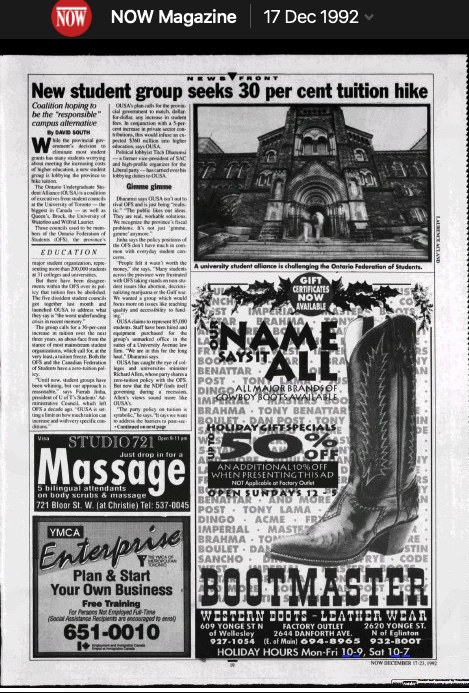
  • New Student Group Seeks 30 Percent Tuition Hike

    New Student Group Seeks 30 Percent Tuition Hike

    Coalition hoping to be the “responsible” campus alternative

    By David South

    Now Magazine (Toronto, Canada), December 17-23, 1992

    While the provincial government’s decision to eliminate most student grants has many students worrying about meeting the increasing costs of higher education, a new student group is lobbying the province to hike tuition.

    The Ontario Undergraduate Student Alliance (OUSA) is a coalition of executives from student councils at the University of Toronto – the biggest in Canada – as well as Queen’s, Brock, the University of Waterloo and Wilfred Laurier.

    Those councils used to be members of the Ontario Federation of Students (OFS), the province’s major student organization, representing more than 200,000 students at 31 colleges and universities.

    But there have been disagreements within the OFS over its policy that tuition fees be abolished. The five dissident student councils got together last month and launched OUSA to address what they say is “the worst underfunding crisis in recent memory.”

    The group calls for a 30-per-cent increase in tuition over the next three years, an about-face from the stance of most mainstream student organizations, which call for, at the very least, a tuition freeze. Both the OFS and the Canadian Federation of Students have a zero-tuition policy.

    “Until now, student groups have been whining, but our approach is reasonable,” says Farrah Jinha, president of U of T’s Students’ Administrative Council, which left OFS a decade ago. “OUSA is setting a limit on how much tuition can increase and with very specific conditions.”

    OUSA’s plan calls for the provincial government to match, dollar-for-dollar, any increase in student fees. In conjunction with a 5-per-cent increase in private sector contributions, this would infuse an expected $360 million into higher education, says OUSA.

    Political lobbyist Titch Dharamsi – a former vice-president of SAC and high-profile organizer for the Liberal party – has carried over his lobbying duties to OUSA.

    Gimme gimme

    Dharamsi says OUSA isn’t out to rival OFA and is just being “realistic.” “The public likes our ideas. They are real, workable solutions. We recognize the province’s fiscal problems. It’s not just ‘gimme, gimme’ anymore.”

    Jinha says the policy positions of the OFS don’t have much in common with everyday student concerns.

    “People felt it wasn’t worth the money,” she says. “Many students across the province were frustrated with OFS taking stands on non-student issues like abortion, decriminalizing marijuana or the Gulf war. We wanted a group which would focus more on issues like teaching quality and accessibility to funding.”

    OUSA claims to represent 85,000 students. Staff have been hired and equipment purchased for the group’s unmarked office in the suites of a University Avenue law firm. “We are in this for the long haul,” Dharamsi says.

    OUSA has caught the eye of colleges and universities minister Richard Allen, whose party shares a zero-tuition policy with the OFS. But now that the NDP finds itself governing during a recession, Allen’s views sound more like OUSA’s.

    “The party policy on tuition is symbolic,” he says. “It says we want to address barriers to post-secondary education.”

    Student quits

    One student representative on U of T’s Students’ Administrative Council, Jason Zeidenberg, resigned when SAC decided to join OUSA.

    “The process hasn’t involved students,” says Zeidenberg. “It is a policy for student politicians, not students. OUSA has no constitution, no financial structure, no mechanism for individual students to bring questions forward. It is an undemocratic, fly-by-night institution.

    “Until they justify their expenditures, they are under suspicion of being a front group to legitimize policies like raising tuition.”

    OUSA isn’t legally obliged to incorporate itself or provide a constitution or accountable executive. The group operates much like a club, with member council executives making decisions collectively, and funds coming out of member unions’ budgets.

    Joining OFS requires a student referendum, but because of OUSA’s quasi-ad-hoc status, no such vote is needed to join the new group.

    Dharamsi says this approach is cost-effective and flexible. He says OUSA has spent around $10,000 to date, but can’t offer a fixed budget.

    Zeidenberg hs organized several college and faculty student unions at U of T to demand that SAC hold a referendum about membership in OUSA.

    Craft doesn’t feel that OUSA is a threat. “I’m not losing sleep over it,” he says. “We’re considered the representatives of students in Ontario.”

    Recently, however, the University of Western Ontario pulled out of OFS and is currently negotiating with OUSA about joining. Western’s departure takes another 20,000 students and precious dollars with them, and funding cuts have led OFS to lay off staff.

    This cover is by great Canadian political cartoonist and illustrator Jack Lefcourt. Always funny, Jack captures well the corporate take-over of the country’s universities and the introduction of the catastrophic debt culture that leaves so many students in a financial pickle. It was also Id’s first student issue. Id Magazine: Student Issue, “The guide to the zeitgeist”, Ontario, 1996, Features Editor: David South.

    https://davidsouthconsulting.org/2021/01/26/aid-organization-gives-overseas-hungry-diet-food-diet-giant-slim-fast-gets-tax-write-off-for-donating-products/

    https://davidsouthconsulting.org/2022/11/16/canadian-magazines-newspapers-1990s/

    https://davidsouthconsulting.org/2021/06/01/case-study-2-watch-magazine-1994-and-1996-2/

    https://davidsouthconsulting.org/2021/07/20/case-study-3-id-magazine-1996-1997-2/

    https://davidsouthconsulting.org/2020/12/18/counter-accusations-split-bathurst-quay-complex-issues-of-sexual-assault-racism-at-centre-of-local-dispute/

    https://davidsouthconsulting.org/2020/12/11/false-data-makes-border-screening-corruptible/

    https://davidsouthconsulting.org/2020/12/10/one-world-youth-conferences-mongolia-1998-1999/

    https://davidsouthconsulting.org/2022/11/11/online-free-knowledge-sharing/

    https://davidsouthconsulting.org/2020/12/18/peaceniks-questioning-air-raid-strategy-in-bosnia/

    https://davidsouthconsulting.org/2020/12/12/somali-killings-reveal-ugly-side-of-elite-regiment/

    https://davidsouthconsulting.org/2021/02/05/study-says-jetliner-air-quality-poses-health-risks-cupe-takes-on-airline-industry-with-findings-of-survey/

    https://davidsouthconsulting.org/2020/12/11/top-reporters-offer-military-media-handling-tips/

    Creative Commons License

    This work is licensed under a
    Creative Commons Attribution-Noncommercial-No Derivative Works 3.0 License.

    ORCID iD: https://orcid.org/0000-0001-5311-1052.

    © David South Consulting 2023

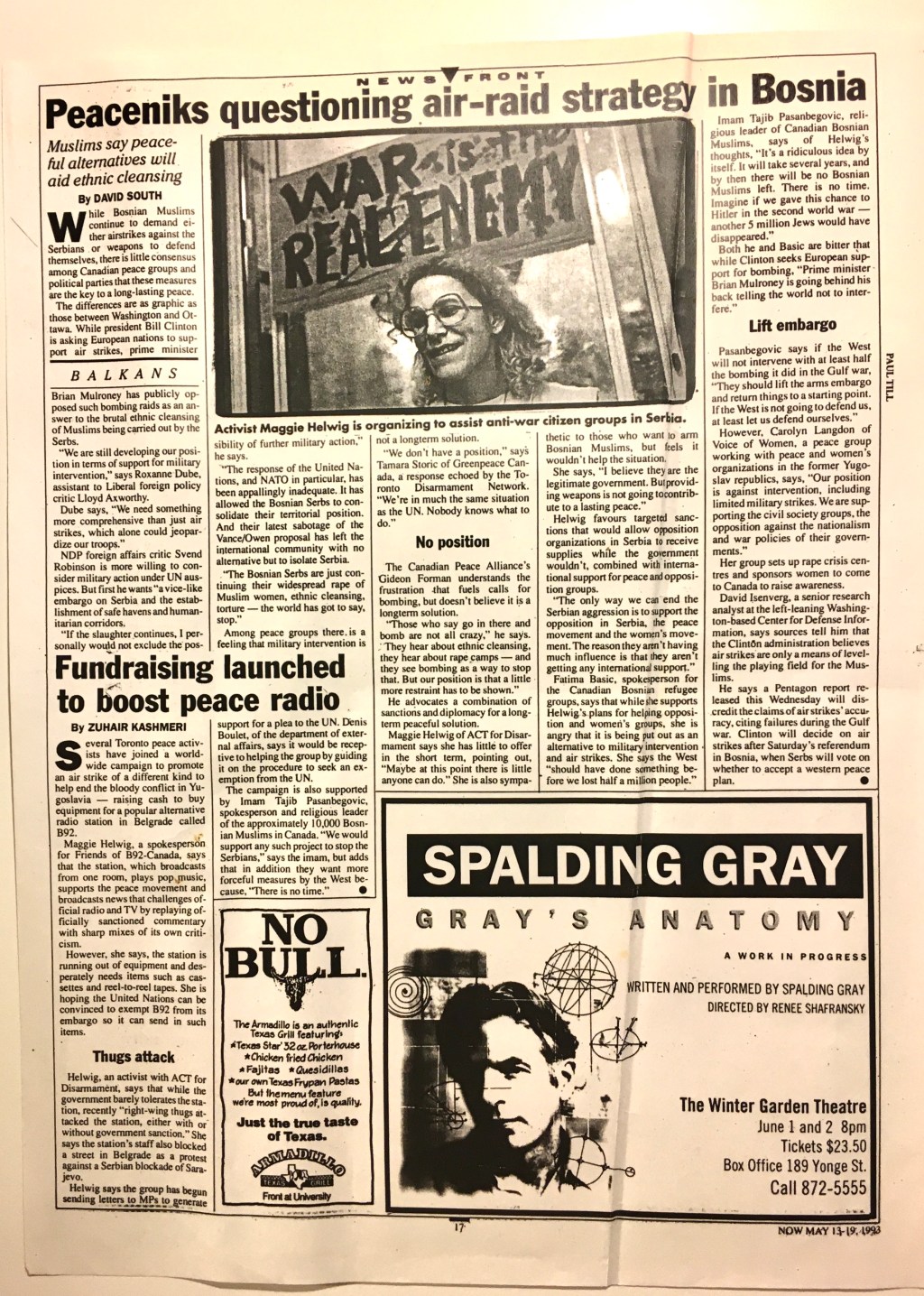
  • Peaceniks Questioning Air-Raid Strategy In Bosnia

    Peaceniks Questioning Air-Raid Strategy In Bosnia

    Muslims say peaceful alternatives will aid cleansing

    By David South

    Now Magazine (Toronto, Canada), May 13-19, 1993

    While Bosnian Muslims continue to demand either airstrikes against the Serbians or weapons to defend themselves, there is little consensus among Canadian peace groups and political parties that these measures are the key to a long-lasting peace.

    The differences are as graphic as those between Washington and Ottawa. While president Bill Clinton is asking European nations to support air strikes, prime minister Brian Mulroney has publicly opposed such bombing raids as an answer to the brutal ethnic cleansing of Muslims being carried out by the Serbs.

    “We are still developing our position in terms of support for military intervention,” says Roxanne Dube, assistant to Liberal foreign policy critic Lloyd Axworthy.

    Dube says, “We need something more comprehensive than just airstrikes, which alone could jeopardize our troops.”

    NDP foreign affairs critic Svend Robinson is more willing to consider military action under UN auspices. But first he wants “a vice-like embargo on Serbia and the establishment of safe havens and humanitarian corridors.

    “If the slaughter continues, I personally would not exclude the posibility of further military action,” he says.

    “The response of the United Nations, and NATO in particular, has been appallingly inadequate. It has allowed the Bosnian Serbs to consolidate their territorial position. And their latest sabotage of the Vance/Owen proposal has left the international community with no alternative but to isolate Serbia.

    “The Bosnian Serbs are just continuing their widespread rape of Muslim women, ethnic cleansing, torture – the world has got to say, stop.”

    Among peace groups there is a feeling that military intervention is not a longterm solution.

    “We don’t have a position,” says Tamara Storic of Greenpeace Canada, a response echoed by the Toronto Disarmament Network. “We’re in much the same situation as the UN. Nobody knows what to do.”

    No position

    The Canadian Peace Alliance’s Gideon Forman understands the frustration that fuels calls for bombing, but doesn’t believe it is a longterm solution.

    “Those who say go in there and bomb are not all crazy,” he says. “They hear about ethnic cleansing, they hear about rape camps – and they see bombing as a way to stop that. But our position is that a little more restraint has to be shown.”

    He advocates a combination of sanctions and diplomacy for a longterm peaceful solution.

    Maggie Helwig of ACT for Disarmament says she has little to offer in the short term, pointing out, “Maybe at this point there is little anyone can do.” She is also sympathetic to those who want to arm Bosnian Muslims, but feels it wouldn’t help the situation.

    She says, “I believe they are the legitimate government. But providing weapons is not going to contribute to a lasting peace.”

    Helwig favours targeted sanctions that would allow opposition organizations in Serbia to receive supplies while the government wouldn’t, combined with international support for peace and opposition groups.

    “The only way we can end the Serbian aggression to to support the opposition in Serbia, the peace movement and the women’s movement. The reason they aren’t having much influence is that they aren’t getting any international support.”

    Fatima Basic, spokesperson for the Canadian Bosnian refugee groups, says that while she supports Helwig’s plans for helping opposition and women’s groups, she is angry that it is being put out as an alternative to military intervention and air strikes. She says the West “should have done something before we lost half a million people.”

    Imam Tajib Pasanbegovic, religious leader of Canadian Bosnian Muslims, says of Helwig’s thoughts, “It’s a ridiculous idea by itself. It will take several years, and by then there will be no Bosnian Muslims left. There is not time. Imagine if we gave this chance to Hitler in the second world war – another 5 million Jews would have disappeared.”

    Both he and Basic are bitter that while Clinton seeks European support for bombing, “Prime minister Brian Mulroney is going behind his back telling the world not to interfere.”

    Life embargo

    Pasanbegovic says if the West will not intervene with at least half the bombing if did in the Gulf War, “They should life the arms embargo and return things to a starting point. If the West is not going to defend us, at least let us defend ourselves.”

    However, Carolyn Langdon of Voice of Women, a peace group working with peace and women’s organizations in the former Yugoslav republics, says, “Our position is against intervention, including limited military strikes. We are supporting the civil society groups, the opposition against the nationalism and war policies of their governments.”

    Her group sets up rape crisis centres and sponsors women to come to Canada to raise awareness.

    David Isenverg, a senior research analyst at the left-leaning Washington-based Center for Defense Information, says sources tell him that the Clinton administration believes air strikes are only a means of levelling the playing field for the Muslims.

    He says a Pentagon report released this Wednesday will discredit the claims of air strikes’ accuracy, citing failures during the Gulf War. Clinton will decide on air strikes after Saturday’s referendum in Bosnia, when Serbs will vote on whether to accept a Western peace plan.

    Now Magazine (Toronto, Canada), May 13-19, 1993.
    Creative Commons License

    This work is licensed under a
    Creative Commons Attribution-Noncommercial-No Derivative Works 3.0 License.

    ORCID iD: https://orcid.org/0000-0001-5311-1052.

    © David South Consulting 2021