Tag: David South Consulting

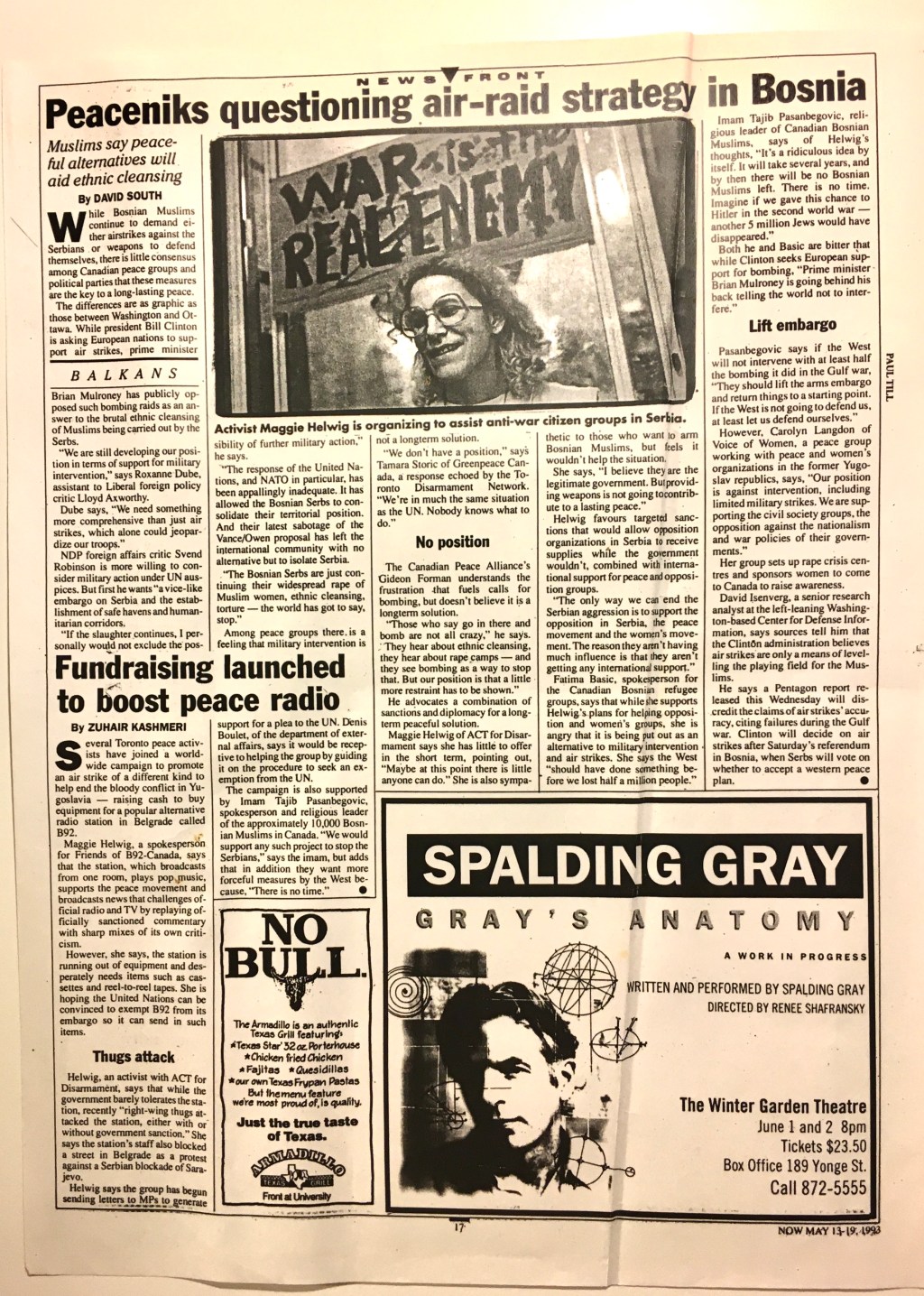
  • Peaceniks Questioning Air-Raid Strategy In Bosnia

    Peaceniks Questioning Air-Raid Strategy In Bosnia

    Muslims say peaceful alternatives will aid cleansing

    By David South

    Now Magazine (Toronto, Canada), May 13-19, 1993

    While Bosnian Muslims continue to demand either airstrikes against the Serbians or weapons to defend themselves, there is little consensus among Canadian peace groups and political parties that these measures are the key to a long-lasting peace.

    The differences are as graphic as those between Washington and Ottawa. While president Bill Clinton is asking European nations to support air strikes, prime minister Brian Mulroney has publicly opposed such bombing raids as an answer to the brutal ethnic cleansing of Muslims being carried out by the Serbs.

    “We are still developing our position in terms of support for military intervention,” says Roxanne Dube, assistant to Liberal foreign policy critic Lloyd Axworthy.

    Dube says, “We need something more comprehensive than just airstrikes, which alone could jeopardize our troops.”

    NDP foreign affairs critic Svend Robinson is more willing to consider military action under UN auspices. But first he wants “a vice-like embargo on Serbia and the establishment of safe havens and humanitarian corridors.

    “If the slaughter continues, I personally would not exclude the posibility of further military action,” he says.

    “The response of the United Nations, and NATO in particular, has been appallingly inadequate. It has allowed the Bosnian Serbs to consolidate their territorial position. And their latest sabotage of the Vance/Owen proposal has left the international community with no alternative but to isolate Serbia.

    “The Bosnian Serbs are just continuing their widespread rape of Muslim women, ethnic cleansing, torture – the world has got to say, stop.”

    Among peace groups there is a feeling that military intervention is not a longterm solution.

    “We don’t have a position,” says Tamara Storic of Greenpeace Canada, a response echoed by the Toronto Disarmament Network. “We’re in much the same situation as the UN. Nobody knows what to do.”

    No position

    The Canadian Peace Alliance’s Gideon Forman understands the frustration that fuels calls for bombing, but doesn’t believe it is a longterm solution.

    “Those who say go in there and bomb are not all crazy,” he says. “They hear about ethnic cleansing, they hear about rape camps – and they see bombing as a way to stop that. But our position is that a little more restraint has to be shown.”

    He advocates a combination of sanctions and diplomacy for a longterm peaceful solution.

    Maggie Helwig of ACT for Disarmament says she has little to offer in the short term, pointing out, “Maybe at this point there is little anyone can do.” She is also sympathetic to those who want to arm Bosnian Muslims, but feels it wouldn’t help the situation.

    She says, “I believe they are the legitimate government. But providing weapons is not going to contribute to a lasting peace.”

    Helwig favours targeted sanctions that would allow opposition organizations in Serbia to receive supplies while the government wouldn’t, combined with international support for peace and opposition groups.

    “The only way we can end the Serbian aggression to to support the opposition in Serbia, the peace movement and the women’s movement. The reason they aren’t having much influence is that they aren’t getting any international support.”

    Fatima Basic, spokesperson for the Canadian Bosnian refugee groups, says that while she supports Helwig’s plans for helping opposition and women’s groups, she is angry that it is being put out as an alternative to military intervention and air strikes. She says the West “should have done something before we lost half a million people.”

    Imam Tajib Pasanbegovic, religious leader of Canadian Bosnian Muslims, says of Helwig’s thoughts, “It’s a ridiculous idea by itself. It will take several years, and by then there will be no Bosnian Muslims left. There is not time. Imagine if we gave this chance to Hitler in the second world war – another 5 million Jews would have disappeared.”

    Both he and Basic are bitter that while Clinton seeks European support for bombing, “Prime minister Brian Mulroney is going behind his back telling the world not to interfere.”

    Life embargo

    Pasanbegovic says if the West will not intervene with at least half the bombing if did in the Gulf War, “They should life the arms embargo and return things to a starting point. If the West is not going to defend us, at least let us defend ourselves.”

    However, Carolyn Langdon of Voice of Women, a peace group working with peace and women’s organizations in the former Yugoslav republics, says, “Our position is against intervention, including limited military strikes. We are supporting the civil society groups, the opposition against the nationalism and war policies of their governments.”

    Her group sets up rape crisis centres and sponsors women to come to Canada to raise awareness.

    David Isenverg, a senior research analyst at the left-leaning Washington-based Center for Defense Information, says sources tell him that the Clinton administration believes air strikes are only a means of levelling the playing field for the Muslims.

    He says a Pentagon report released this Wednesday will discredit the claims of air strikes’ accuracy, citing failures during the Gulf War. Clinton will decide on air strikes after Saturday’s referendum in Bosnia, when Serbs will vote on whether to accept a Western peace plan.

    Now Magazine (Toronto, Canada), May 13-19, 1993.
    Creative Commons License

    This work is licensed under a
    Creative Commons Attribution-Noncommercial-No Derivative Works 3.0 License.

    ORCID iD: https://orcid.org/0000-0001-5311-1052.

    © David South Consulting 2021

  • Mongolia’s Musical Entrepreneurs Led Way Out Of Crisis | 2018

    Mongolia’s Musical Entrepreneurs Led Way Out Of Crisis | 2018

    Publisher: UNDP Mongolia Communications Office/Press Institute of Mongolia

    Managing Editor: David South

    Editorial Advisors: Ts. Enkhbat, Mustafa Eric, David South

    Author and Researcher: Peter Marsh, Indiana University

    Copy Editor: N. Oyuntungalag

    Production Editor: B. Bayarma

    Published: 1999

    ISBN 99929-5-018-8

    It was the late 1990s. Mongolia was still recovering from “one of the biggest peacetime economic collapses ever” (Mongolia’s Economic Reforms: Background, Content and Prospects, Richard Pomfret, University of Adelaide, 1994). But it was the country’s young musicians who were showing the way out of the crisis, setting an example for entrepreneurship in the new, free-market economy that emerged in the country after 1990.

    As UNDP Communications Officer N. Oyuntungalag wrote in the Blue Sky Bulletin (BSkyB) newsletter, “A thriving pop and rock scene has emerged over the last four years. .. The energy of these musicians and singers has not gone unnoticed by the burgeoning advertising market. Pop bands are promoting many things, from face creams to beer. … [but] there has been little serious writing on the business of popular music.”  

    As the book’s author, American ethnomusicologist Peter Marsh, said in an interview with UNDP’s Blue Sky Bulletin newsletter, “we thought our book would provide important ideas about the direction and nature of the nation’s development.

    “My impression about Mongolian pop-rock is that it is a lively, diverse and at times innovative Mongolian art form that closely reflects many of the hopes, fears and aspirations of its primary audience, Mongolian youth.”

    The book still stands as an unusual and innovative contribution to thinking around the role played by youth in development and business and in crisis recovery.   

    Google Books Key Words: авдаг адил аль англи аялан байж байлаа байх байхад байхгүй бараг барууны бас бензин Бид нар бидний биз бизнес бий биш болох бөгөөд бусад бүжиг бүр бүтээлчид бүх гадаад гадаадад

    Other publications by Peter K. Marsh: 

    The Horse-head Fiddle and the Cosmopolitan Reimagination of Tradition in Mongolia by Peter K. Marsh, Routledge, 25 Sept. 2008.

    Journal Article Review. Reviewed Works: Mongolian Bling by Benj Binx, Nubar Ghazarian; Live from UB by Lauren Knapp, Dulguun Bayasgalan. Review by Peter K. Marsh, Ethnomusicology, Vol. 62, No. 1 (Winter 2018), pp. 157-162. 

    Moving the World Through Two Strings: The Horse-head Fiddle and the Cosmopolitan Reimagination of Tradition in Mongolia by Peter K. Marsh, Indiana University, 2002. 

    Our generation is opening its eyes: hip-hop and youth identity in contemporary Mongolia by Peter Marsh, Central Asian Survey, Volume 29, 2010 (https://doi.org/10.1080/02634937.2010.518013).

    From Culture and Customs of Mongolia by Timothy Michael May (2009).

    Interviews with Peter K. Marsh: 

    “Culture and art – immunity for any nation during globalization”, Baljmaa.T, The Mongol Messenger, 2020-05-13.

    More on this topic here: Why Does China Have 1.4 Billion People and No Good Bands? – Mongolia rocks out while its giant neighbor slumbers.

    More on the development of contemporary Mongolian music and its rising global profile: 

    The Unexpected Rise Of The Hu: The Mongolian Heavy Metal Band Resurrecting Rock

    With more YouTube views than Stormzy, this metal band is a surprising smash hit – and they’ve only just begun. by Eleanor Peake

    More music writing by David South

    “You Can’t Have A Bird If You Want To Be The Biggest Band In The World”: Oasis Has Arrogance, A Pile Of Attitude And The Best Album Of 1994

    ORCID iD: https://orcid.org/0000-0001-5311-1052.

    © David South Consulting 2021

  • Elect Peace

    Elect Peace

    By David South

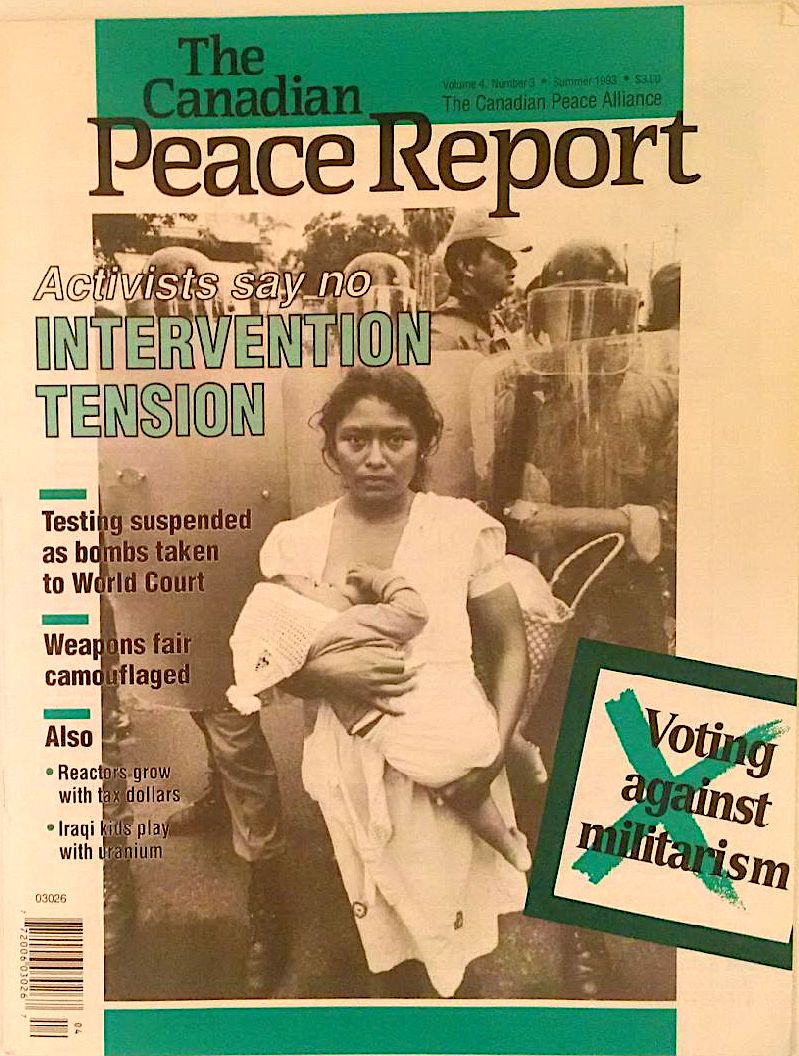
    The Canadian Peace Report, Summer 1993

    More than 80,000 people swarmed Parliament Hill on May 15 at an Action Canada Network and Canadian Labour Congress rally against free trade and other federal policies. In a paper issued just before, the Canadian Centre for Policy Alternatives criticizes Canadian military spending as “carried over from a cold war that no longer exists. At the same time, our assistance to poor nations is actually falling.” 

    When a federal election is called, peace groups across Canada plan to be heard. They see the defence department’s $11.3-billion yearly budget – amidst cuts to social programs and calls for even more restraint – as ripe for a hot election battle over government priorities. 

    A recent Gallup poll conducted for the Canadian Peace Alliance found broad support across all political allegiances for cutbacks to military spending. The CPA also wants daily life demilitarized, with duties like search and rescue turned over to civilian agencies. 

    Local groups are mostly awaiting a date for the election, expected about late October, but national groups are already planning. Some groups will fight the Conservative Party’s backing of the North American Free Trade Agreement (NAFTA), which they fear will lead to further military integration of Canada and the United States. 

    The Peace Alliance is working on action and information kits targetting military spending versus social needs, and is developing an election logo. It’s also building up to a national action day. 

    The idea is to stimulate local and regional activity, coordinator Gideon Forman says. “Kits will help member groups organize actions during the election campaign. They will have information on, among other things, the plan to buy deluxe helicopters, military spending in general and the cost of social needs. 

    “We will give local groups suggestions for local events and assist with media work.”

    Project Ploughshares has produced a short booklet of questions to ask candidates, “but not a repeat of the Election Priorities Project” of the 1988 election, says researcher Bill Robinson. The booklet suggests calling for cuts in military spending, cancelling the EH-101, limiting Canada’s participation in military operations, and abolishing nuclear weapons. 

    Also nationally, the Action Canada Network (to which the Peace Alliance belongs) met with groups from across the country in Winnipeg in mid-June to finalize election plans, which may include a radio ad campaign. National chair Tony Clarke would like local activists to dog the party leaders across the country, as progressive groups did to Ontario’s Liberals during the province’s 1990 election. 

    “We will definitely make the link between a range of issues and the (Canada-U.S.) Free Trade Agreement and NAFTA, which we have to get rid of,” says Clarke. “We will be working very hard on jobs and arguing for a job strategy.”

    Responding to the Gulf War two years ago (Action Canada Dossier #30), Clarke warned that Canada is “tied in closer than we have ever been before to the permanent war economy” of the U.S.. With a quarter of its output related to the military, the U.S. used militaristic diplomacy to justify maintaining defence budgets, he says. The trade agreements’ guarantees of U.S. access to Canadian energy resources confirm that “we are locking ourselves into what can only be described as Fortress North America.”

    Maude Barlow of the Council of Canadians, a network ally, denounced the helicopter purchase during the Peace Alliance’s March 8 lobby of Parliament. Soon after, then defence minister Kim Campbell appeared to waver on the number of helicopters to be bought, but succeeded in winning the Tory leadership without it becoming a major issue. However, Liberal leader Jean Chretien promises to cancel the contract.

    At CUSO’s national office, Marc Allain says the development agency will work with the CPA around military spending and the ‘copter purchase. 

    To Peter Davison of the Halifax Peace Action Network, the stakes are clear and the passion to fight the issues simply awaits a polling date. 

    “Never has the guns-or-butter issue been more prominent in our society,” says Davison. “Conservative economic policies have been collapsing around the globe. We’re seeing desperate restraint and universal trusts being violated – health care, education, pensions.

    “It’s bizarre that we can still conceptualize $6 billion for helicopters to fight submarines – an absurd twist away from meeting human needs.”

    Terry Gardner says Science for Peace’s mandate bars entering the election fray, but says the group is planning a high-level panel in the fall on NAFTA and militarization of Canadian culture. 

    “We’re going to be asking candidates in our area for conversion and reduction in military spending,” says J.J. Verigin of the Doukhobour peace and disarmament committe in British Columbia. He says his MP has been supportive of chopping the choppers. 

    Verigin found fact sheets helpful and says the CPA does a good job of getting out beyond the urban areas. But he would like the Alliance “to propose something that engages the electorate’s intellect as the gut.”

    “We have a general intent to intervene in the election, but we’re not quite clear exactly how,” says North Bay Peace Alliance organizer Brennain Lloyd. “We’re considering a regional information package, something like the Election Priorities Project, that our groups could use.”

    Being armed with the facts helps reach the public and pins down candidates, Lloyd says. She applauds the CPA’s idea of producing action kits that her group could integrate into its own. 

    Toronto’s ACT for Disarmament won’t be working specifically on the election, but may participate in actions, says organizer Maggie Helwig. “Groups have certain things they focus on, and certain ways of operating. Other people do better at elections.”

    In Montreal, Judith Berlyn of Westmount Initiative for Peace says, “We will be doing locally what has been developed by the Canadian Peace Alliance as a whole – go to all-candidates meetings, get the mike and ask the questions. We will be raising issues. Last time our candidate had never heard of low-level flying.”

    Berlyn feels many people, including activists, often think they don’t know enough to speak publicly. But with information kits, “we know more than the candidates do.”

    While approving the CPA’s focus on military spending, Berlyn says it would be a mistake to over-emphasize the helicopters. “Everybody has [already] picked up on that; it’s a good concrete example of insane military spending.”

    She also finds the public receptive to informative and succinct pamphlets advocating alternatives to a militarized economy. A Coalition to Oppose the Arms Trade pamphlet is a good model, she says. 

    “It has four concrete proposals of what the government can do to convert military industries – money that now goes to subsidizing the manufacturing of weapons can be turned into conversion subsidies.”

    https://davidsouthconsulting.org/2020/12/15/continental-drift-and-military-complexities/

    https://davidsouthconsulting.org/2022/04/06/mobile-phone-peacekeeping/

    https://davidsouthconsulting.org/2021/07/28/pavlovs-army-this-magazine-august-1992/

    https://davidsouthconsulting.org/2023/01/17/war-peace-and-development-may-2018/

    Creative Commons License

    This work is licensed under a
    Creative Commons Attribution-Noncommercial-No Derivative Works 3.0 License.

    ORCID iD: https://orcid.org/0000-0001-5311-1052.

    © David South Consulting 2023

  • African Farming Wisdom Now Scientifically Proven

    African Farming Wisdom Now Scientifically Proven

    By David SouthDevelopment Challenges, South-South Solutions

    SOUTH-SOUTH CASE STUDY

    Increasing the agricultural productivity of Africa is critical for the continent’s future development, and the world’s. Two-thirds of Africans derive their main income from agriculture, but the continent has the largest quantity of unproductive – or unused – potential agricultural land in the world.

    This means the continent has the potential to become the world’s new breadbasket – but there is a problem. A report by the International Centre for Soil Fertility and Agriculture (IFDC) found the continent had a “soil health crisis” and that three-quarters of its farmlands were severely degraded (New Scientist). The causes of this crisis include overuse of the same plot of land due to population growth, which prevents farmers moving around, and high fertilizer costs, leading to African farmers using just 10 per cent of the world average on their farms.

    But a new study shows that an existing practice by some African farmers could help solve this dilemma if it was adopted by the majority.

    At the University of Sydney in Australia, a study has confirmed the effectiveness of ants and termites as a tool to increase farm yields in dry areas. It found ants and termites in drier climates of the global South improved soil conditions just as earthworms do in northern, wetter and colder climates. Both termites and ants, by burrowing their way through the soil, carve out tunnels that make it easier for plants to shoot their roots outwards in search of water.

    In field experiments, ants and termites helped raise wheat yields by 36 per cent by increasing water and nitrogen absorption. This is critical for agriculture in arid climates.

    While termites wreak havoc on crops such as maize (corn) and sugarcane, they are very useful for other African crops.

    The Australian research found termites infuse nitrogen into the soil. Nitrogen is usually dumped on fields with expensive fertilizers that are subject to market fluctuations. The termites have nitrogen-heavy bacteria in their stomachs, which they excrete into the soil through their faeces or saliva.

    The research also found termites helped with reducing water wastage.

    This research reinforces what has long been known to some African farmers. Long-held farmer tradition in parts of West Africa uses termites to enhance soil by placing wood on the earth to attract them. By burying manure in holes near newly planted grains, farmers in Burkina Faso attract termites to the soil.

    In Malawi, bananas are planted near termite mounds to encourage the creatures. In southern Zambia, soil from termite nests is harvested and used as top soil on agricultural land.

    If more farmers adopted this practice, Africa could simultaneously address its chronic malnutrition and hunger problem and contribute to the world’s food needs. As the McKinsey Global Institute (MGI) found, “With 60 percent of the world’s uncultivated arable land and low crop yields, Africa is ripe for a ‘green revolution’ like those that transformed agriculture in Asia and Brazil.”

    McKinsey estimated that Africa’s agricultural output could increase from US $280 billion a year now to US $500 billion by 2020 and as much as US $880 billion by 2030.

    The UN recently declared that the world’s population has reached 7 billion. That is many mouths to feed and presents Africa with a dilemma and an opportunity.

    And as urban growth accelerates across the global South – the world is now a majority urban place – there is a huge profit to be made from providing food to growing urban populations.

    The time to act is now, as there have been reports from African farmers that they are seeing harvests declining by 15 to 25 per cent. And the picture gets gloomier: many farmers think their harvests will drop by half over the next five years.

    Given that there are 2,600 different species of termites now recognised in the world (UNEP) and with over 660 species, found in Africa, it is by far the richest continent in termite diversity (Eggleton 2000) and they are proof that an affordable solution is close at hand to the current crisis.

    Published: January 2012

    Resources

    1) World Vegetable Center: The World Vegetable Center is the world’s leading international non-profit research and development institute committed to alleviating poverty and malnutrition in developing countries through vegetable research and development. Website:http://www.avrdc.org

    2) Songhai Centre: a Benin-based NGO that is a training, production, research, and development centre in sustainable agriculture. Website:http://www.songhai.org/english

    3) Marketing African Leafy Vegetables: Challenges and Opportunities in the Kenyan Context by Kennedy M. Shiundu and Ruth. K. Oniang. Website:http://www.ajfand.net/Issue15/PDFs/8%20Shiundu-IPGR2_8.pdf

    4) 2050: Africa’s Food Challenge: Prospects good, resources abundant, policy must improve: A discussion paper from the Food and Agricultural Organization (FAO). Website:http://www.fao.org/wsfs/forum2050/wsfs-background-documents/issues-briefs/en

    5) African Alliance for Capital Expansion: A management consultancy focused on private sector development and agribusiness in West Africa. Website:http://www.africanace.com/v3

    6) Ants and termites increase crop yield in a dry climate by Theodore A. Evans, Tracy Z. Dawes, Philip R. Ward and Nathan Lo, Nature Communications 2, Article number: 262

    7) Integrating Ethno-Ecological and Scientific Knowledge of Termites for Sustainable Termite Management and Human Welfare in Africa by Gudeta W. Sileshi et al, Ecology and Society, Volume 14, Number 1. Website:http://www.ecologyandsociety.org/vol14/iss1/art48

    8) State of the World 2011: Innovations that Nourish the Planet. Website: http://www.worldwatch.org/sow11

    9) Soil health crisis threatens Africa’s food supply. Website:http://www.newscientist.com/article/dn8929-soilhealth-crisis-threatens-africas-food-supply.html

    Creative Commons License

    This work is licensed under a
    Creative Commons Attribution-Noncommercial-No Derivative Works 3.0 License.

    ORCID iD: https://orcid.org/0000-0001-5311-1052.

    © David South Consulting 2023