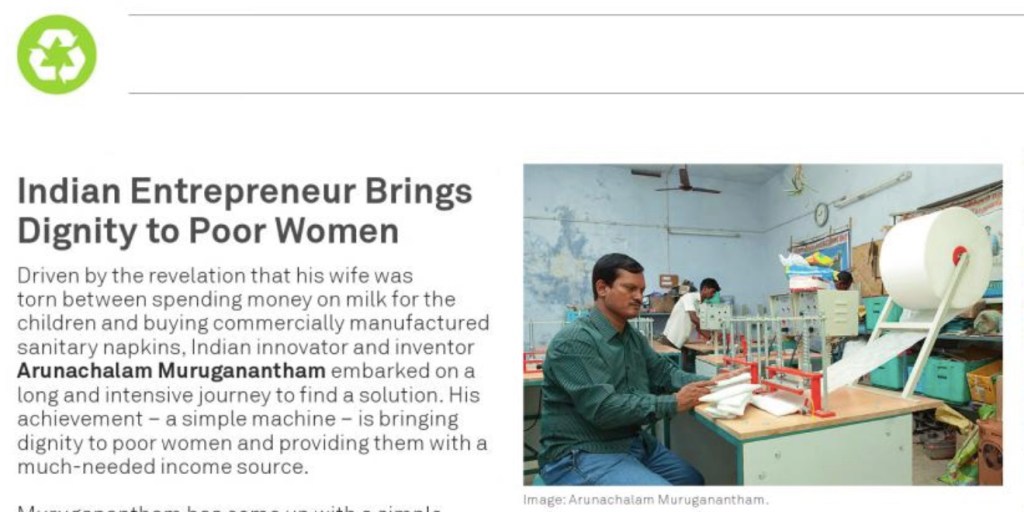
Driven by the revelation that his wife was torn between spending money on milk for the children and buying commercially manufactured sanitary napkins, Indian innovator and inventor Arunachalam Muruganantham embarked on a long and intensive journey to find a solution. His achievement – a simple machine – is bringing dignity to poor women and providing them with a much-needed income source.
This is a story of a man who was considered crazy for his persistence and made many personal sacrifices to achieve his goal. The innovation is both a technological and a business solution. Muruganantham has come up with a simple machine to manufacture affordable hygienic sanitary napkins for poor women. It works by turning the pulp of pine wood into the flat, white sanitary pads (http://en.wikipedia.org/wiki/Sanitary_napkin) commonly used by women during their monthly menstruation. The machine’s simplicity means it can be expanded easily to other communities and is designed to fit well with the way women’s cooperatives work and help them earn an income.
Muruganantham sees it is a business model that “can deliver livelihood, hygiene and dignity to poor women, and help them strengthen society,” according to his website.
The manufacturing process produces the sanitary napkins in just five steps. This simple intervention is revolutionizing women’s health in India by giving them an alternative to using found and unhygienic rags every month when they menstruate.
It took Muruganantham four years of research to create a patented machine that sells for between US $1,332 and US $5,330. It can make 120 sanitary pads an hour. Each one sells for 10 rupees (US 18 cents). By comparison, the multinational company Procter & Gamble sells its product for 30 rupees (US 54 cents) a packet.
Two multinationals dominate the marketplace for sanitary napkins in India: Procter & Gamble and Johnson & Johnson, with the Stayfree and Carefree brands.
Muruganantham’s machine was awarded the best innovation national award by the former President of India, Prathiba Patil, in 2009.
Like many innovators and inventors, his work at first was little understood by others and meant he had to plough a lonely furrow. But his persistence paid off and is now receiving attention from countries across the global South.
Apart from its technological simplicity, the idea is to make it easy for women to form cooperatives and businesses to boost their incomes. India has seen the concept of so-called Ladies Self Help Groups (SHGs) (http://en.wikipedia.org/wiki/Self-help_group_%28finance%29) become more popular as a source of income. One of the problems they encounter is finding a successful business to undertake. The machine invented by Muruganantham is being seen as a good business model for the SHGs to follow. The key is the simplicity of operating the machine, the growing and stable market for the product, and its affordable and competitive price.
Typical businesses that can be set up using the machine can employ 10 women.
Muruganantham set up his main business, Jayaashree Industries (motto: ‘new inventions… small is beautiful’) (http://newinventions.in/aboutus.aspx), after his education was disrupted due to family problems and he took up a job in a welding shop.
At first, he had a difficult time convincing people of the utility of the machine. He enlisted his wife to help with the marketing of the new napkins to nearby women. He says the advantage of his business model is that it turns the making of the napkins into a sustainable, grassroots activity. It provides an essential commodity for poor women at an affordable price, removing middlemen and using a simple, non-chemical technology.
It also cuts down on expensive transport costs by keeping manufacturing local.
Over 225 machines have been delivered to 14 Indian states and also to Nigeria, Ethiopia, Kenya, Uganda, Nepal and Bangladesh.
And while Muruganantham is focused on making the machine a success, he is already looking forward to working on his next big invention. The only question is: what will it be?
In the Mongolian language, the book details effective ways to live in harmony with the environment while achieving development goals. Based on three years’ work in Mongolia – a Northeast Asian nation coping with desertification, mining, and climate change – the book presents tested strategies.
“We will be asking: is bribery business as usual at the UN?”, US Attorney Preet Bharara, October 2015
Disrupted!! Issue 6 of Southern Innovator never came about and here is the story of why. One part of the story is very positive and inspiring; the other part is disappointing and frustrating (though always a risk when working in the international realm).
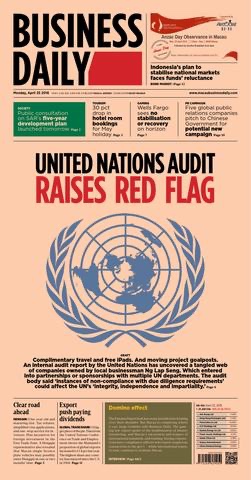
First, the disappointing and frustrating part. We had been working with the UNOSSC (the funder of Southern Innovator) on a scale-up plan which would provide the funds for the brand to better chronicle the global South innovator culture of the 21st century. We had not anticipated various individuals involved with the UNOSSC not only acting in bad faith, but actually being involved with a multinational network to bribe UN officials and launder money into the United States, as was exposed during arrests by US authorities in late 2015 in New York (home of the UNOSSC and the UN’s headquarters). As we found out, gradually, through media coverage and court trial testimonies and confessions under oath by co-conspirators following the arrests, there was a fundamental conflict of interest between the work we were doing and the UNOSSC’s funding relationship with an entity that had its own news agency working out of the United Nations, South-South News. South-South News was established and funded by an Interpol Watch List individual, flagged up as a person not to do business with because of his involvement with human and sex trafficking and international criminal networks. South-South News’ executives pushed for the building of a new “Geneva of Asia” for the UN in Macau, which would also host the UNOSSC’s annual Global South-South Development Expo (GSSD Expo). As confessed by the executives of South-South News, the news agency was established to facilitate bribes to UN officials and launder money into the United States – violating the Foreign Corrupt Practices Act (FCPA). This bribery and corruption case led to the UNOSSC’s budget being suspended pending two internal UN audits.
For the first time, setting a legal precedent, an FCPA case involving bribery and money laundering at the United Nations went all the way to the U.S. Supreme Court. Wrongly, many senior UN officials believe their diplomatic status affords them immunity to legal prosecution, especially under the FCPA. However, this case was a successful enforcement of the FCPA, appealed all the way to the U.S. Supreme Court. The question remains: will future FCPA enforcement actions at the international level test the protection of ‘diplomatic immunity’?
“The FCPA is explicit in defining ‘foreign official’ to include ‘any officer or employee . . . of a public international organization.’ The FCPA defines a public international organization as an organization designated by Executive Order pursuant to Section 1 of the International Organizations Immunities Act (22 U.S.C. § 288) or by Executive order of the President. This includes any ‘public international organization in which the US participates pursuant to any treaty or under the authority of any Act of Congress authorizing such participation or making an appropriation for such participation.’ (22 U.S.C. § 288). For instance, The UN was declared a public international organization by Executive Order 9698 in 1946.”
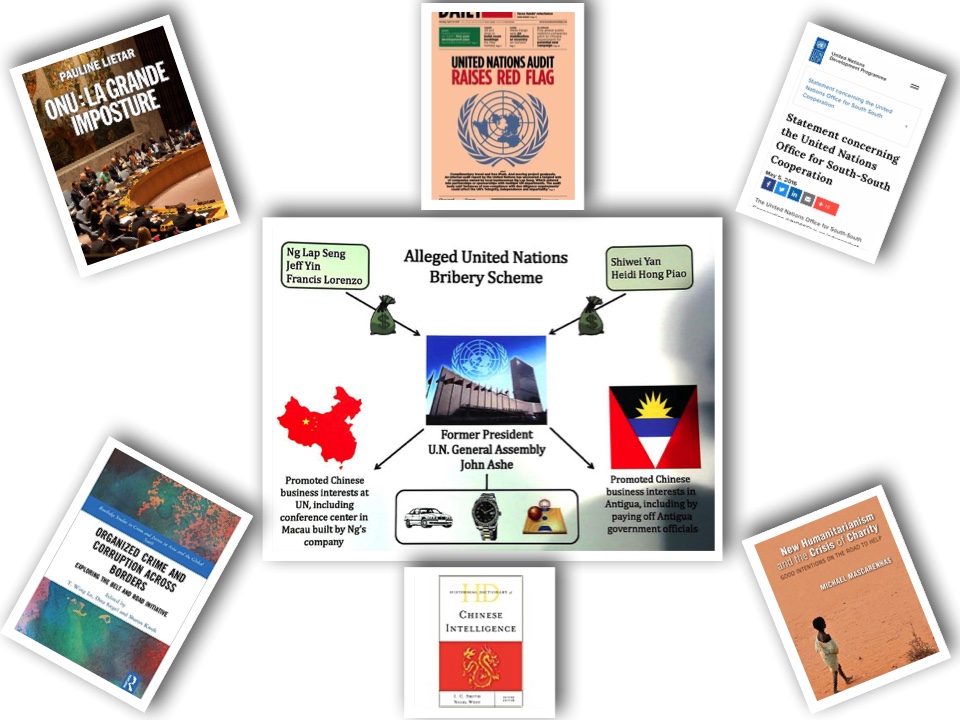
Books covering the 2015 United Nations SDGs bribery scandal: ONU: La Grande Imposture, Organized Crime and Corruption Across Borders, New Humanitarianism and the Crisis of Charity: Good Intensions on the Road to Help, Historical Dictionary of Chinese Intelligence.
“What a tremendous magazine your team has produced! It’s a terrific tour de force of what is interesting, cutting edge and relevant in the global mobile/ICT space… Really looking forward to what you produce in issues #2 and #3. This is great, engaging, relevant and topical stuff.” Rose Shuman, Founder & CEO, Open Mind and Question Box
And now the positive and inspiring part: Southern Innovator evolved from the e-newsletter Development Challenges, South-South Solutions, first launched in 2006 (and we came on board to research and write stories in 2007). Much has happened since, including the Global Financial Crisis, and the global financial system re-boot that occurred afterwords. Both the e-newsletter and the magazine Southern Innovator fall into the category of ‘crisis media’: media used to bring together a response where the old methods and methodologies no longer work and something has caused system failure. Back in 2007, there was little discussion in the media about the global South, innovation, innovators, social entrepreneurship, and the mobile and information technology revolution occurring in the global South. Both the e-newsletter and the magazine identified a global 21st-century innovator culture that was unique since it was being fuelled by the rapid adoption of mobile and information technologies, often in places with high levels of poverty and turmoil.
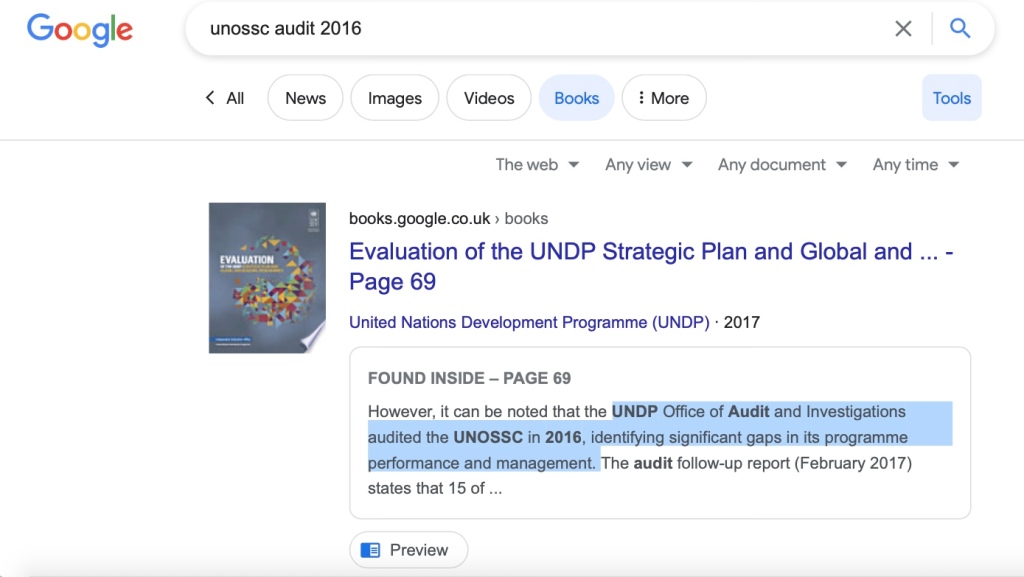
According to the Final evaluation of the performance of the United Nations Office for South-South Cooperation under its strategic framework, 2014-2017, in light of the adoption of the 2030 Agenda for Sustainable Development, prepared by Marcia Brewster, Consultant for the United Nations Office for South-South Cooperation (UNOSSC):
“The reviewer observed that, although the Policy and UN Coordination Unit had produced all of the reports requested by intergovernmental bodies, especially for the High-level Committee, it had not been able to produce many of the publications (evidence-based analytical reports) that had previously been within its purview. Such publications included Southern Innovator magazine and the monthly e-newsletter “Development Challenges, South-South Solutions”. In the case of Southern Innovator, one issue (No. 5 on waste and recycling) was published during the four-year period of the framework but did not have wide online distribution, and issue No. 6 was awaiting funds for publication. The e-newsletter was last issued in July 2014 even though the reviewer found it a good way to communicate with focal points at the national and inter-agency levels. In fact, the shortage of funds for those knowledge products was the main reason that they had ceased being produced during the evaluation period.”
“With respect to the analytical reports previously produced by the Office, such as Southern Innovator, they have not been produced in recent years owing to lack of funding.”
From the beginning, the e-newsletter and magazine were about changing perspectives and inspiring action. And so they have. Rather than say so in my words, I shall offer the words of others as we received them:
“Great economic and business reporting! Very helpful for us.”Africa Renewal, Africa Section, Strategic Communications Division, United Nations Department of Public Information
“I just went over your June newsletter. It’s very well done and far reaching. Congratulations!” Violette Ruppanner, Director, 3D -> Trade – Human Rights – Equitable Economy, Geneva, Switzerland
“Just to let you know I enjoyed the newsletter a lot – it was interesting to learn about things going on that I would never otherwise find out about, and also the listing of future conferences and events proved very useful.” IanSanderson, Deloitte, Geneva, Switzerland
“Congratulations on another great newsletter that’s packed with fascinating information! I really enjoy getting it each month.” Whitney Harrelson, Making Cents, Washington D.C.
Blogger Taline Haytayan from Brighton, England, found a case study on story telling in the South particularly interesting: “I came across this interesting article entitled ‘The South Has a Good Story to Tell’, which talks about storytelling in developing countries, and its use as a critical tool for passing on history, while teaching morals and ethics – so I would like to share it here with you. It’s a nice surprise to see that this article appears in UNDP’s South to South Cooperation unit newsletter. It gives an overview of storytelling in a number of countries, such as the movement of urban storytellers in Colombia, inspired by Italo Calvino; tale-spinners in Argentina; the halakis, or storytelling sages, of Morocco; and digital storytelling by women in South Africa.” (http://talinita.blogspot.com/2008/05/south-has-good-story-to-tell.html)
“A few weeks ago, David South, Development consultant and author of UNDPs Development Challenges, South-South Solutions Newsletter, came by the betterplace office to take a look at our work. When I asked him how he had come about betterplace.org, he answered: he found me on twitter! So much for the twitter-scepticts.” Joana Breidenbach, betterplace.org, Berlin, Germany (http://blog.betterplace.org/en/2009/09/15/690/)
“This is a WONDERFUL site. I read–and at least bookmarked to read again–your stories with the photo of the homeless gentleman “will write HTML code for food,” and of the young African girl who was hungry, and how they are predicting (and it seems inevitable) famine an a high voltage bolt in the poverty percentages. … your writing is phenomenal–the few stories that I have seen are actually SUPERIOR in their professional, technical, and relevant accounts. Their VERY interesting, and I unfortunately have not seen other sources of news lately (other than from my school’s library database, and old Public Broadcasting documentaries). God has blessed your works, and I am thankfully blessed by them!” Sincerely, J. (Au) Whi, (from NowPublic site)
“Many thanks for sending me a copy of your interesting work. I read just one article in Spanish thus far but found it well written and useful. For us here in Colombia, it will be most useful having regular access to your publication and, of course, I am pleased that the articles are in Spanish as well as French and English. I hope that one day I might invite you to take a closer look at the Arranque Automático operation in Colombia and perhaps invite you to do a write-up on the technique and its ample theoretical foundations.” David Cuanespero Boriol, Colombia
“What a tremendous magazine your team has produced! It’s a terrific tour de force of what is interesting, cutting edge and relevant in the global mobile/ICT space… Really looking forward to what you produce in issues #2 and #3. This is great, engaging, relevant and topical stuff.” Rose Shuman, Founder & CEO, Open Mind and Question Box
“Question Box was featured in Southern Innovator, a new publication of UNDP that profiles some of the most innovative ideas coming out of the global South. We were pleased to see many friends in the sector profiled as well, such as Ushahidi, Medic Mobile, and TxtEagle. Take a look at the magazine, as it is a great primer on ICT and mobile innovation from around the globe.” Question Box News.
“Looks great. Congratulations. It’s Brill’s Content for the 21st century!” Conan Tobias, Managing Editor, Canadian Business
What they are saying about SI on Twitter: From @CapacityPlus Nice job RT @ActevisCGroup: RT @UNDP: Great looking informative @SouthSouth1 mag on South-South Innovation; @UNDP Great looking informative @SouthSouth1 mag on South-South Innovation; @JeannineLemaireGraphically beautiful & informative @UNDP Southern Innovator mag on South-South Innov.
“Beautiful, inspiring magazine from UNDP on South-South innovation. Heart is pumping adrenaline and admiration just reading it”
“Thank you David – Your insight into the issues facing us a[s] [a] “global Village” is made real in the detail of your article – 10 out of 10 from the moladi team.” Moladi, South Africa (http://www.moladi.net/index.htm)
“The magazine looks fantastic, great content and a beautiful design!”
“Btw, I really enjoyed reading them, impressive work & a great resource. Looking forward to Issue 6. My best wishes to you & your team at SI.”
“… great magazine, nice design.”
2014 proved a significant year for our work, as Southern Innovator is cited in various strategy documents as a resource contributing to a shift in funding priorities at the United Nations and other international development funders, and the adoption of South-South innovation as a key part of the UN’s work. The e-newsletter and magazine are also cited in many papers and books and are clearly contributing to a better understanding of the 21st-century global South innovator culture.
By 2015, Southern Innovator was still drawing praise for its timely resources on South-South innovation and innovators:
“@SouthSouth1 is one of the best sources out there for news and info on #solutions to #SouthSouth challenges.” Adam Rogers, Assistant Director, Regional Representative, Europe, United Nations Office for South-South Cooperation (UNOSSC)
Issue 6 of Southern Innovator will tackle the theme of science, technology and innovation. Looking ahead, we are also seeking long-term funding for the magazine to take us to 2016 and also to enable us to scale to a level of reach we feel is necessary to have significant impact across the global South. To date, Southern Innovator has been ‘lean and mean’, run on a small budget with a tiny team. The editorial team is based in London, UK, the design team in Reykjavik, Iceland and the UN team in New York. This has worked well because it has forced us to be prudent with resources and to be very creative. But we have reached the physical limitations of this approach, and, to be frank, feel we are not living up to the potential of the magazine because we do not have the people and team to reach scale. As an example, we can only afford to publish in the English language, which means we miss out on billions of non-English speakers. We would like to have regional issues and bureaus, to be able to leverage the SI brand to offer a range of resources and products that are truly transformational for innovators, to stage events that bring together like-minded individuals, and to come out more frequently and regularly.
If our potential sponsors and advertisers could see what I see when the magazine reaches readers, I do not think they would hesitate to get on board and support the magazine. Often innovators feel like they are plowing a lonely furrow, unsupported, isolated. Or are enjoying significant local success but can see how what they have learned can help others but lack the time or means to share their wisdom and experience.
That “a ha” moment when we meet somebody who tells us the magazine “gets them” is especially rewarding. Most recently, this happened over and over again at the Global South-South Development Expo held in Nairobi, Kenya towards the end of 2013.
Hollywood has given the world the highly entertaining Iron Man series of films. The fictional Tony Stark dazzles us with his inventions and his awesome innovator’s ocean-side lair. If you liked that film, then you will love what we see happening all around the global South and feature in the magazine. Most of our innovators lack the flashy resources and wealth of a Tony Stark but they are no less innovative and creative, often working in the harshest conditions on the planet. They are our ‘Iron Men’ and ‘Iron Women’.
Help us to further share the innovator’s spirit of Southern Innovator and transform the world, one good idea at a time!












 David South Consulting
You must be logged in to post a comment.