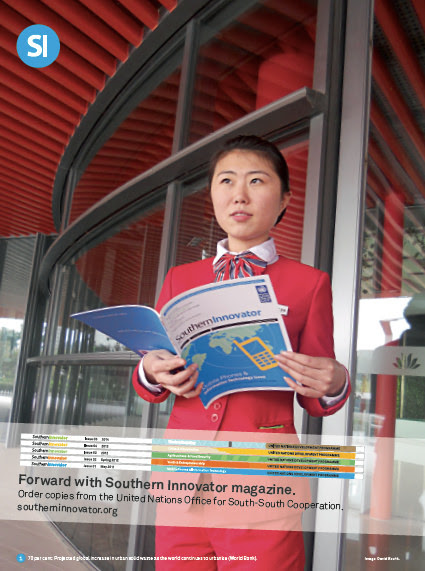
Beginning in 2011 and ending in 2014, each issue of Southern Innovator was launched at the annual Global South-South Development Expo (GSSD Expo) run by the United Nations Office for South-South Cooperation (UNOSSC). The issues (there were five) would connect with that year’s Expo theme and were intended to reinforce the solutions presented at the Expo, as well as those solutions discovered through research for the influential United Nations e-newsletter Development Challenges, South-South Solutions. An Expo was not run in 2015 for the following reason: U.S. Finds Macau Billionaire Guilty in U.N. Bribery Case.
Studies have shown the importance of reading to real change. Not just online, but in paper form. The retention of information and knowledge is greater when a person reads something in a book or a magazine. Another factor is quality design (which makes the published material both attractive and effective). Trashy, gaudy or slap-dash design, while it has its place and context, is not suitable for well-funded, transparent, public organizations seeking to communicate across borders in a professional manner. Southern Innovator was designed following the UN and UNDP design guidelines at the time, while also adhering to the UN Global Compact and the UN Consultants Remuneration Guidelines. The content was also written to follow those guidelines as well as the Plain English Campaign, which seeks to reduce the presence of “gobbledygook, jargon and misleading public information”. On top of this, the magazine benefited from experience: the experience of one of Iceland’s top graphic designers and illustrators, the team based at the UNOSSC in New York who oversaw the editing and proof reading, and the researcher, editor and writer who has led many successful and award-winning publishing ventures, including during “one of the biggest peacetime economic collapses ever”.
“What a tremendous magazine your team has produced! It’s a terrific tour de force of what is interesting, cutting edge and relevant in the global mobile/ICT space… This is great, engaging, relevant and topical stuff.” Rose Shuman, Founder & CEO, Open Mind and Question Box, Santa Monica, CA, U.S.A.
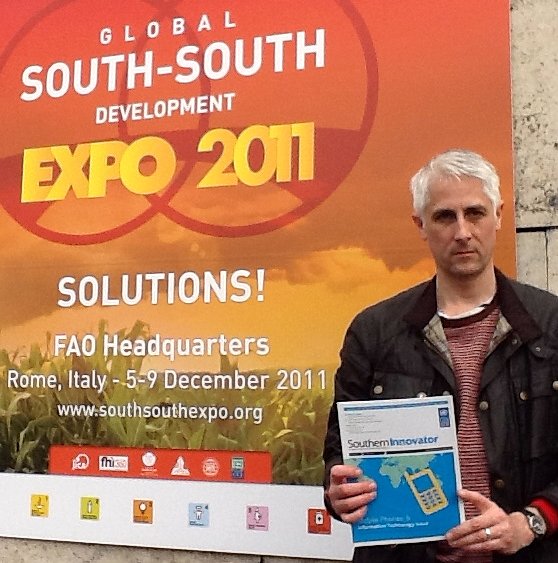
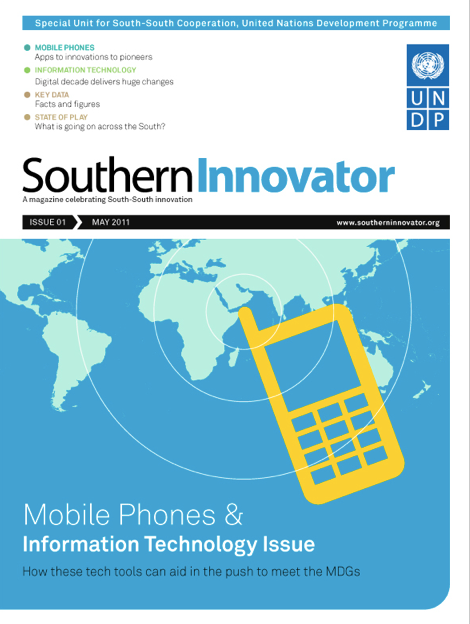
Southern Innovator Issue 1: Mobile Phones and Information Technology was published in 2011 and launched at the Expo in Rome, Italy.
Southern Innovator Issue 2: Youth and Entrepreneurship was published in 2012 and launched at the Expo in Vienna, Austria.Southern Innovator Issue 3: Agribusiness and Food Security was published in 2012 and launched at the Expo in Vienna, Austria.Southern Innovator Issue 4: Cities and Urbanization was published in 2013 and launched at the Expo in Nairobi, Kenya (the first time in Africa).
Issue 6 of Southern Innovator was to be on the theme of science, technology and innovation. Southern Innovator Issue 5: Waste and Recycling was published in 2014 and launched at the Expo in Washington, D.C.
Expertise: Project evaluation, strategy, project management, project delivery, UN system, MDGs, research papers, media strategies and digital media strategies.
Locations: Ulaanbaatar, Mongolia, Kiev, Ukraine, Pretoria, South Africa, Ashgabat, Turkmenistan 2000 to 2006
From 1999, I worked as a consultant for United Nations (UN) missions in Africa, Asia, Central Asia and Eastern Europe, for USAID Mongolia and for a UK-based international development consultancy.
About
Was the United Nations being effective and reflecting the potential for change in the mobile and information technology age? What needed to change? Who were the policy innovators?
This work included overseeing various digital media projects, including the strategic re-development of the UN Ukraine web portal, aiding in the rolling out of the media campaign for the Millennium Development Goals (MDGs) in Mongolia, including the first use of infographics in the Mongolia UN mission, advising on strategies for youth engagement in development goals in South Africa, and support to the UN mission in Turkmenistan as it finalised its United Nations Development Assistance Framework (UNDAF) with the government and also work with UNICEF there. What I learned during this period proved crucial to the insights and thinking reflected in two highly influential United Nations publications, e-newsletter Development Challenges, South-South Solutions, and Southern Innovator magazine (developed in 2010).
This period was particularly advantageous because I had a front-row seat to the unfolding digital and mobile information technology revolution sweeping across the emerging markets and the global South. I also had insight into what worked and didn’t in international development as well as the UN system. I also learned a great deal about development challenges first-hand in highly varied countries, how the Millennium Development Goals (MDGs) were actually being rolled out, and met amazing people who were challenging existing precepts on how to do development. All of this work proved very useful later on.
I have either travelled to, or worked and lived, in many countries, enhancing my global perspective and affording me a valuable trove of knowledge that has in turn informed my work in international development. I have always paid attention to the level of development in the country, how it has organized itself, the quality of its design, and how it interacts with other countries for trade and relations. The countries visited to date include: Antigua and Barbuda, Australia, Azerbaijan, Belgium, Canada, China, Cuba, Denmark, Domenica, Finland, France, Germany, Greece, Guadalupe, Haiti, Hong Kong, Iceland, Ireland, Israel, Italy, Japan, Kenya, Luxembourg, Malaysia, Mexico, Monaco, Mongolia, Montseratt, Morocco, the Netherlands, Norway, Philippines, Portugal, Russia, Singapore, South Africa, South Korea, Spain, Sweden, Switzerland, Thailand, Tunisia, Turkey, Turkmenistan, Ukraine, the United Kingdom, the United States of America, Vatican City. A fascinating mix of countries – some holders of top place on the UN’s Human Development Index – and others where human development is at its worst. Seeing with your own eyes what works and what does not is highly illuminating, while knowing first-hand how human development can be improved is critical for giving informed advice.
Timeline
1999/2000: USAID Mongolia (design and publicity strategy for business development brochure, US Mongol (Mongolia) Construct and US tour, work with Riverpath Associates in the UK on communications strategies and the drafting of papers for the American Foundation for AIDS Research, the Global Fund to Fight AIDS, Tuberculosis and Malaria, UNCTAD, Harvard Institute for International Development, and the preparation of the report and launch strategy for the World Bank’s Task Force on Higher Education.
2000: UN Ukraine: strategic re-development of the UN Ukraine web portal and incorporation of the Millennium Development Goals (MDGs).
2004: UN Mongolia (media campaign for MDGs) and UN South Africa (evaluation of youth NGO associated with the University of Pretoria and its projects and providing a strategic marketing plan).
2005: UN Mongolia (media campaign for MDGs) and UN Turkmenistan (finalising its United Nations Development Assistance Framework – UNDAF).
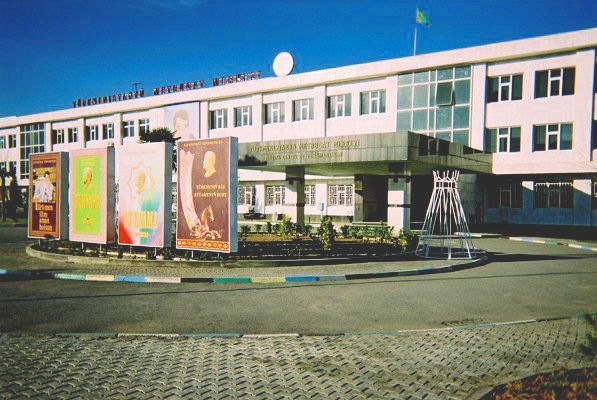
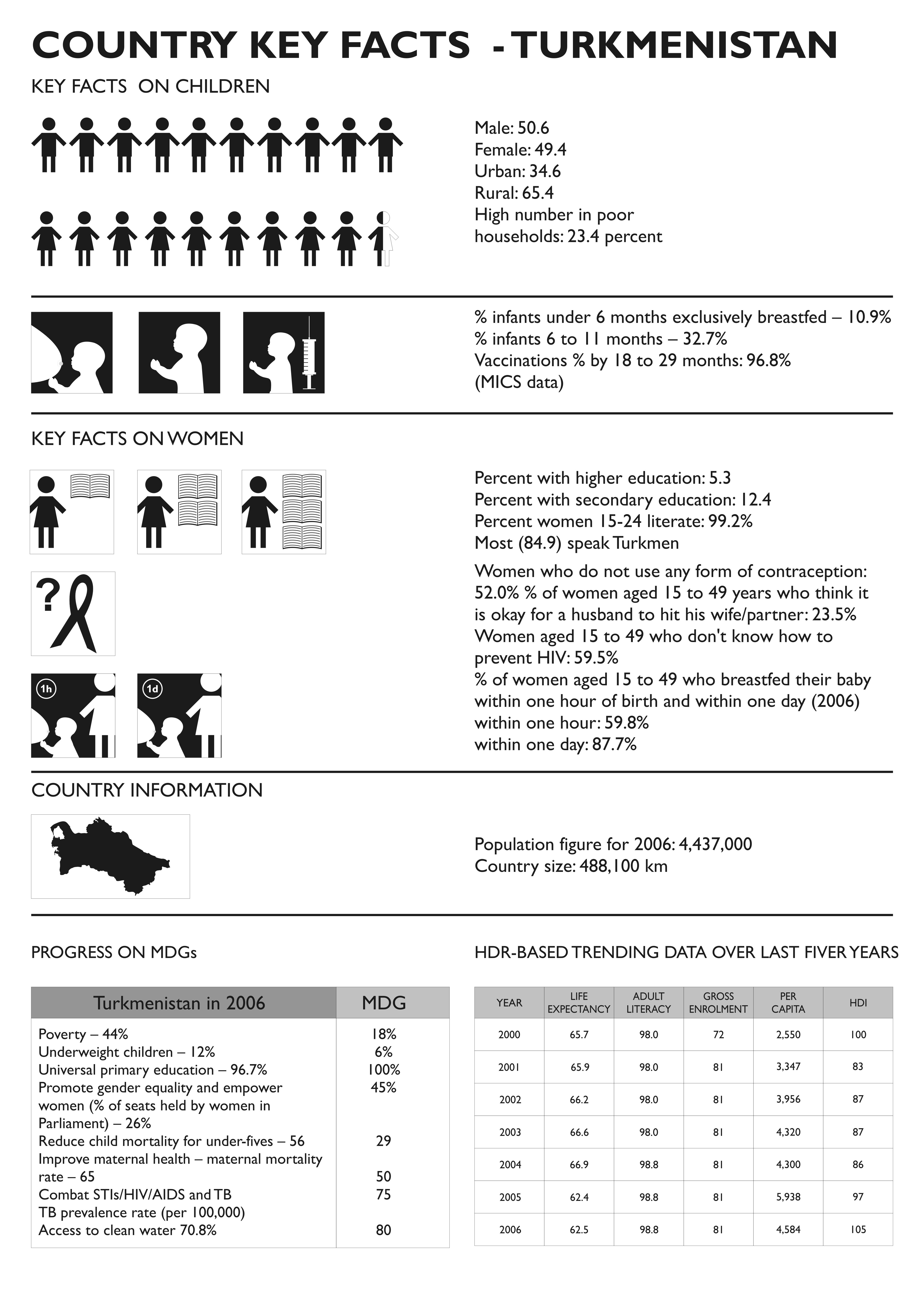
Rukhnama publishers in Turkmenistan’s capital, Ashgabat (2005). Photo: David SouthAn infographic commissioned for UN Turkmenistan MDGs report (2006).
“I highly recommend Mr. David South as a communications consultant who gets results.” Brian DaRin, Representative/Director, USAID Investment & Business Development Project, Global Technology Network/ International Executive Service Corps-Mongolia, 23 September 1999
Impact
Micro
working as a communications consultant for UN missions – Ukraine, South Africa, Mongolia, Turkmenistan
redeveloping mission websites, preparing content, reports, advising on communications strategy
working with local designers on new ways to present development data through inforgraphics (2005/2006)
Macro
in the course of travel and work, seeing the unfolding impact of the global communications revolution, in particular the rapid roll-out and take-up of mobile technologies, and the urgent need for the UN system to take this on board. Also witnessed firsthand the grassroots solutions revolution brought about by information and mobile technologies and the Internet, which needed to be fully embraced by the UN
Resources
A Marketing and e-Marketing Strategy – the New SASVO, Prepared from December 2004 to February 2005 for the Southern African Student Volunteers (University of Pretoria).
Pioneering work to boost diets across the global South is turning to the smallest of fish. While small in size, tiny fish are packed with nutrition when eaten whole, as they are in many cultures. Often these fish come packed with vitamin A, iron, zinc, calcium, protein and essential fats – all necessary elements to eradicate malnutrition and hidden hunger, especially among women and children.
It is estimated that 684,000 child deaths worldwide could be prevented by increasing access to vitamin A and zinc (WFP).
Iron deficiency is the most prevalent form of malnutrition worldwide, affecting an estimated 2 billion people. Iron deficiency is impairing the mental development of 40 to 60 per cent of children in developing countries (UNICEF). The World Health Organization says that eradicating iron deficiency can improve national productivity levels by as much as 20 percent.
Vitamin A deficiency affects approximately 25 per cent of the developing world’s pre-schoolers. It is associated with blindness, susceptibility to disease and higher mortality rates, and leads to the death of approximately 1 to 3 million children each year (UN).
This devastating evidence shows the need to find effective food solutions to eradicate these nutrient deficiencies. Access to affordable nutrient-rich food is also key to social and political stability. Already, there is serious unrest in many countries around the world because of food-price inflation.
Finding ways to boost nutritional health that are sustainable, low-cost and do not require substantial use of resources will have the best success in the poorest areas.
A number of studies suggest one solution may be eating more small fish. In many countries, these species are eaten as part of the diet, but often not in large enough quantities to address hunger and malnutrition. Small fish species are a remarkable food source because they are usually eaten whole, bringing greater nutritional benefits.
A study conducted between 2010 and 2013 in Bangladesh and Cambodia by Dr. Shakuntala Haraksingh Thilsted, Senior Nutrition Adviser to WorldFish (worldfishcenter.org), found that the eating of small fish in both countries gave a significant boost to daily diets and massively improved nutrition and health. The project, called Linking Fisheries and Nutrition: Promoting Innovative Fish Production Technologies in Ponds and Wetlands with Nutrient-dense Small Fish Species, was supported by the International Fund for Agricultural Development.
People in both countries still currently suffer from undernutrition and micronutrient deficiencies.
In rural areas of Bangladesh and Cambodia it found 50 to 80 per cent of total fish consumed were small fish. The quantities consumed during each meal were small but they occurred in diets frequently. Typically, they were eaten whole, with the head, viscera (internal organs) and bones consumed. This meant consuming small fish packed a punch, giving the eater a dose of calcium, vitamin A, iron and zinc.
More specifically, the study found the iron-rich Mekong flying barb (Esomus longimanus) (http://www.iucnredlist.org/details/169546/0) – eaten as part of a meal of rice and sour soup with its head intact in Cambodia – could provide 45 per cent of the daily iron requirement for a woman.
Malnutrition is also a serious problem in Bangladesh. Half the population lives below the poverty line and diets are poor in delivering necessary vitamins and minerals. This is damaging to peoples’ physical and mental health.
The study found existing fish aquaculture methods in Bangladesh were inefficient. But new technologies provide an opportunity to increase the quantity of fish harvested and increase household incomes. By using highly efficient low-risk polyculture systems – basically combining small, nutrient-dense fish with high-value fish such as carp or freshwater prawn – it is possible to significantly increase the quantity of fish produced.
Another one of the new techniques includes increasing pond depth, which conserves broodfish (http://en.wikipedia.org/wiki/Broodstock). Broodfish are the mature fish used for the production of eggs or sperm and are also called spawners.
The study estimated a production of 10 kilograms per pond per year of fish spread across the 4 million small ponds in Bangladesh has the potential to meet the recommended dietary intake for 6 million children in the country.
The work in Bangladesh to boost the production of small fish has inspired similar initiatives in Sunderbans, West Bengal, India and in Terai, Nepal. Initiatives in Cambodia and Kenya have also developed meals for young children by combining powdered rice or maize with small fish.
And in Africa, some are calling for more use of aquaculture as an alternative to dwindling fish sources. For sub-Saharan Africans, fish can make up 22 per cent of the protein in their diet.
As populations on the continent quickly rise, marine fisheries are beginning to be over-exploited. The Food and Agriculture Organization of the United Nations and WorldFish are calling for an aquaculture revolution on the continent to move away from the old approach of just using ponds located on farms. To make a real impact, both organizations argue, there needs to be a partnership between smallholder farmers and others to build a commercial fish farming sector.
“Per capita fish supplies in Africa are dwindling,” Malcolm Beveridge, director for aquaculture at WorldFish, one of the 15 CGIAR research centers (Consultative Group on International Agricultural Research) (http://www.cgiar.org/cgiar-consortium/research-centers/), that generate and disseminate knowledge, technologies, and policies for agricultural development. “In Malawi, they fell from 10 kilograms to 6 kilograms per person between 1986 and 2006. Aquaculture has the potential to increase supplies of this affordable nutritious food for poor and vulnerable consumers,” he told The Guardian.
Published: July 2013
Resources
1) Scaling Up Nutrition: Scaling Up Nutrition, or SUN, is a unique movement founded on the principle that all people have a right to food and good nutrition. It unites people – from governments, civil society, the United Nations, donors, businesses and researchers – in a collective effort to improve nutrition. Website: http://scalingupnutrition.org/
2) The WorldFish Center: WorldFish, a member of the CGIAR Consortium, is an international, non-profit research organization dedicated to reducing poverty and hunger by improving fisheries and aquaculture. Website: http://www.worldfishcenter.org/
3) Bangladesh Shrimp and Fish Foundation: Bangladesh Shrimp and Fish Foundation (BSFF) is a non-profit private research and advocacy organization created through a USAID project. Website: http://www.shrimpfoundation.org/
4) Aquaculture for the Poor in Cambodia – Lessons Learned: The project was implemented by the WorldFish Center with financial support from the Ministry of Foreign Affairs (Government of Japan). Website: http://www.worldfishcenter.org/resource_centre/WF_2769.pdf
5) Global Aquatics: The website design is a bit dated but it is packed with the basics on aquaculture. Website: http://growfish.com/
Development Challenges, South-South Solutions was launched as an e-newsletter in 2006 by UNDP’s South-South Cooperation Unit (now the United Nations Office for South-South Cooperation) based in New York, USA. It led on profiling the rise of the global South as an economic powerhouse and was one of the first regular publications to champion the global South’s innovators, entrepreneurs, and pioneers. It tracked the key trends that are now so profoundly reshaping how development is seen and done. This includes the rapid take-up of mobile phones and information technology in the global South (as profiled in the first issue of magazine Southern Innovator), the move to becoming a majority urban world, a growing global innovator culture, and the plethora of solutions being developed in the global South to tackle its problems and improve living conditions and boost human development. The success of the e-newsletter led to the launch of the magazine Southern Innovator.
What to do when your food production enterprise is just not making much money? It is a common problem in the global South, where farmers and fishers often struggle to survive and can face the threat of bankruptcy and destitution when trying to provide essential food for their communities.
Some fish farmers in Uganda – many of them women – were caught up in this dilemma, unable to find a way to make a good income from the fish they were harvesting.
But a lucky hire for one fish cooperative, in the form of a humble secretary, has turned into a business and food success story that is getting set to jump across borders in Africa.
Lovin Kobusingya is the former secretary and university graduate who, through tenacity and ingenuity, has built a business selling fish sausages that has become a hit in Kampala, Uganda in East Africa.
Through trial and error, Kobusingya came upon the idea of turning the fish into sausages. The product, basically unknown in Uganda before, became a tidy solution to the dilemma of how to sell fish at a premium price that could boost the income of the farmers.
She joins the growing number of female entrepreneurs in Africa. Africa has the highest rate of female entrepreneurship in the world, according to the World Bank, which says two-thirds of women in Africa are in the labour force.
The 29-year-old mother of two set up Kati Fish Farms (http://katifarms.org) and Kati Farm Supplies Ltd. and now sells 500 kilograms of fish sausage a day.
Located in the country’s capital, Kampala, Kati Farm Supplies Ltd. prepares and sells a wide range of food products made with chicken, beef, fish, pork, goat, lamb and honey.
Kobusingya is notable not only for her success as a food entrepreneur, but also for the way she has generated attention and excitement around her business and products.
According to Kenya’s Nation newspaper, Kobusingya boosted her profile by gaining customers in Uganda’s hotels.
She graduated six years ago from Makerere University in Kampala (http://mak.ac.ug) and originally planned to go into banking. Like many graduates, she found it hard to break into the sector and get a steady job. After a year of frustrating job hunting, she found a position as a secretary with a fish cooperative society.
“I got a job after a rigorous interview,” she told the Nation. “It was not well-paying.
“The most challenging part of the job was dealing with fish farmers, who were grappling with an unsteady market for their produce.”
Despite all the problems facing the fish industry, Kobusingya became inspired to do something about it. Rather than just hoping market prices would turn in favour of the fish farmers, she diversified the cooperative’s products to add value to the raw fish ingredients.
“Most of our members were women who had taken up aquaculture (fish farming),” she said. “At the time, this was still a novelty.”
It is a tale of trial and error, as Kobusingya tells it.
“We tried selling our products, such as fish feeds, and even selling directly to consumers. But I felt that there was something more we could do to help the farmers even more.”
Becoming frustrated with the constraints of her role, she decided to start the business on top of her day job. She started buying fish directly from the farmers, filleting it herself and selling it to customers.
Yet, still fish was not selling and going to waste.
Then the eureka moment came: make fish sausages. This had never been done in Uganda and she set about undertaking research on the Internet to learn how to do it.
“I assembled bits and pieces of information from the Net on how to make the sausages,” Kobusyingya said.
“Everywhere I went seeking more information, people thought I was out of my mind.
“Nobody had heard of fish sausages but I received support from the Uganda Industrial Research Institute in 2011. They helped me to develop a formula for the product,” she said.
With the new product developed, Kobusingya tried selling it to the hotels in Kampala. And this was the crucial moment when her fortunes changed: people were excited by the new and novel product.
The first orders earned her US $800 and with that jolt of cash, she was able to launch the product in February 2012.
Production started at 100 kilograms of fish sausage a day. By the third month, she was able to produce 500 kilograms a day. And because the product is so popular, she is running hard to meet demand from hotels, food outlets and institutions.
Expanding into selling smoked fish and frozen chicken and beef, she is now working with 470 fish farmers, most of whom are women.
“This business has motivated farmers throughout Uganda,” she said.
“The enterprise, now worth about Ush50 million (US $19,230), has 16 permanent employees,” she said.
She also took the fish sausages on the road and introduced them to the SmartFish trade event in Lusaka, Zambia, where they became a hit with attendees.
SmartFish (http://www.smartfish-coi.org/#!home/mainPage) is funded by the European Union through the European Development Fund and is implemented by the Indian Ocean Commission in partnership with regional trade organizations. The objective of the event was to increase trade within the region.
With her confidence further boosted by the positive international reaction, Koubusingya is exploring how to sell into Kenya, Tanzania, Rwanda and Burundi.
“I always knew I was a businesswoman,” she told The New York Times. “When I was in high school, I used to sell illegal sweets. And I made money.”
“I am very happy and proud” of being a female entrepreneur. “When I was young, they said: ‘A woman is a woman – a man should take care of you.’ But women are actually contributing a lot more than men. We always find ourselves multitasking,” when juggling work and a family.
Published: November 2012
Resources
1) SmartFish: The SmartFish Programme aims at contributing to an increased level of social, economic and environmental development and deeper regional integration in the ESA-IO region through improved capacities for the sustainable exploitation of fisheries resources. Website: http://fisheries.ioconline.org/smartfish.html
3) Uganda Industrial Research Institute: Uganda Industrial Research Institute is Uganda Government’s lead agency for industrialization. Website: http://www.uiri.org/
Development Challenges, South-South Solutions was launched as an e-newsletter in 2006 by UNDP’s South-South Cooperation Unit (now the United Nations Office for South-South Cooperation) based in New York, USA. It led on profiling the rise of the global South as an economic powerhouse and was one of the first regular publications to champion the global South’s innovators, entrepreneurs, and pioneers. It tracked the key trends that are now so profoundly reshaping how development is seen and done. This includes the rapid take-up of mobile phones and information technology in the global South (as profiled in the first issue of magazine Southern Innovator), the move to becoming a majority urban world, a growing global innovator culture, and the plethora of solutions being developed in the global South to tackle its problems and improve living conditions and boost human development. The success of the e-newsletter led to the launch of the magazine Southern Innovator.














 David South Consulting
You must be logged in to post a comment.