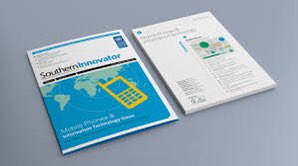
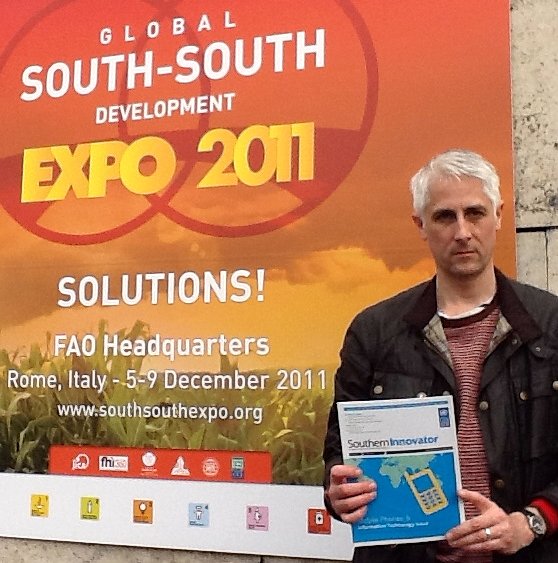
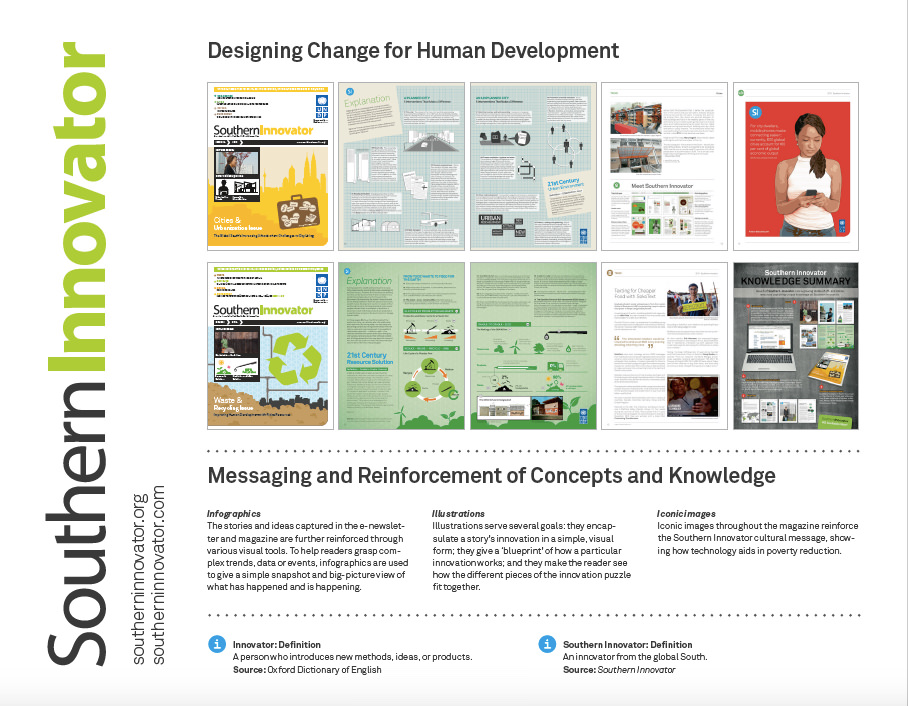
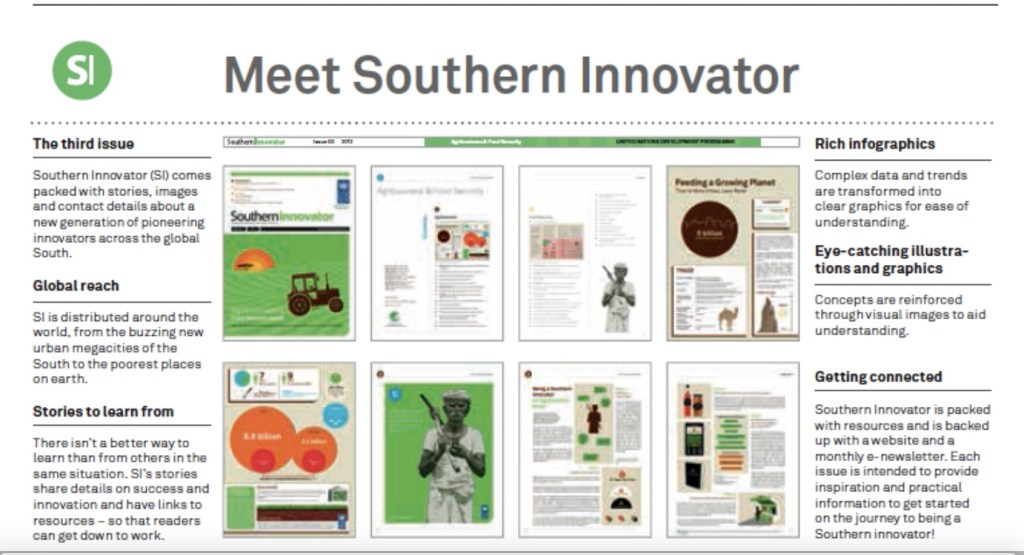
Launched in May 2011, the new global magazine Southern Innovator (ISSN 2222-9280) is about the people across the global South shaping our new world, eradicating poverty and working towards the achievement of the Millennium Development Goals (MDGs).
India is in the midst of the biggest national identification project in the country’s history. The aim is for every Indian to receive a voluntary electronic identification card containing his or her details and a unique number. Called an Aadhaar, it is a 12-digit unique number registered with the Unique Identification Authority of India (http://uidai.gov.in) (UIDAI). The project joins a growing trend across the global South to map populations in order to better achieve development goals.
About one-third of the world’s urban dwellers live in slums, and the United Nations estimates that number will double by 2030 as a result of rapid urbanization in developing countries. How to improve slum-dwellers’ living conditions and raise their standard of living is the big challenge of the 21st century.
With just four years to go until the 2015 deadline to meet the Millennium Development Goals (http://www.undp.org/mdg), and the current economic downturn reversing some gains, any tool that can make development decisions more precise has to be a benefit.
Innovators are turning to the opportunities afforded by digital technologies to reach slums and poor areas. The approaches vary, from India’s national identification system to new ways of using mobile phones and Internet mapping technologies. With mobile phones now available across much of the global South, and plans underway to expand access to broadband internet even in poorly served Africa, it is becoming possible to develop a digital picture of a slum and poor areas and map population needs.
Put to the right use, this powerful development tool can fast-track the delivery of aid and better connect people to markets and government services. In a country of severe regional disparities and caste (http://en.wikipedia.org/wiki/Caste) divisions, the national identification number has the advantage of not documenting people in a way that would bring prejudice.
India’s Aadhaar is intended to serve a number of goals, from increasing national security to managing citizen identities, facilitating e-governance initiatives and tackling illegal immigration. While critics of ID schemes complain about the civil liberties implications of national identity card projects (www.bigbrotherwatch.org.uk), it is a fact that countries that want to increase the social benefits available to their citizens need to understand who those citizens are, where they live and what their social needs are. India’s problem to date has been a lack of knowledge of its citizens: many millions exist in a limbo world of not being known to local authorities.
The unique number is stored in a database and contains details on the person’s demographics (name, age, etc.) and biometrics (http://en.wikipedia.org/wiki/Biometrics) – a photograph, 10 fingerprints and an iris scan. Residents in an area find out about the Aadhaar through various sources, from local media to local government agencies. An ‘Enrolment Camp’ is established in the area where people go to register, bringing anything they have that can prove their identity. The biometric scanning takes place here. ID cards are issued between 20 and 30 days later.
On January 13, 2011 the project declared it had registered its millionth person, a 15-year-old named Sukrity from North Tripura. The goal is to register 600 million people in the next four years.
One of the immediate advantages to many poor people is gaining access to banking services for the first time, because an Aadhaar number is accepted as sufficient ID to open a bank account. The identification authority says the scheme will be “pivotal in bringing financial services to the millions of unbanked people in the country, who have been excluded so far because of their lack of identification.”
The Times of India reported in 2010 that Khaiver Hussain, a homeless man in an addiction treatment programme, was able to get a bank account after receiving the identification number. He was able to open an account with the Corporation Bank along with 27 other homeless people. Having a bank account has removed the fear he had of being robbed of his meagre savings while he slept.
Another homeless day labourer, Tufail Ahmed from Uttar Pradesh, said “This passbook and the UID card have given people like me a new identity. It has empowered us.” He has been able to use the saved money to rent a room with four other day labourers.
In countries where no national ID card schemes exist, people are turning to other methods to register and map populations in order to improve their living conditions.
In Kenya and Brazil, digital mapping projects are underway using mobile phones to paint a picture of the population living in slum areas and shanty towns. An NGO called Map Kibera (www.mapkibera.org) began work on an ambitious project to digitally map Africa’s largest slum, Kibera in Nairobi, Kenya. The Map Kibera project uses an open-source software programme, OpenStreetMap (www.openstreetmap.org), to allow users to edit and add information as it is gathered.
Powerful tools now exist to aid digital mapping. Google Maps (www.maps.google.com) is one example.
While the project is impressively ambitious – and it remains to be seen if it is completed as planned – the economic and development implications of this vast data collection and national identification are enormous. It will enable very accurate identification of markets and needs and also of development challenges and needs. This should lead to many business innovations in the country in coming years and also draw in more business from outside the country.
Published: April 2011
Resources
1) Ushahidi is a website that was developed to map reports of violence in Kenya after the post-election fallout at the beginning of 2008. The new Ushahidi Engine has been created to use the lessons learned from Kenya to create a platform that allows anyone around the world to set up their own way to gather reports by mobile phone, email and the web – and map them. It is being built so that it can grow with the changing environment of the web, and to work with other websites and online tools. Website:http://blog.ushahidi.com/
2) Google Android: Get inventing! This software enables anyone to start making applications for mobile phones. And it offers a platform for developers to then sell their applications (apps). Website:www.android.com
“Unique Identity for All”: Biometric identity is being rolled out across the planet. HSB is one of the many players in this fast-growing data collection sector.
Development Challenges, South-South Solutions was launched as an e-newsletter in 2006 by UNDP’s South-South Cooperation Unit (now the United Nations Office for South-South Cooperation) based in New York, USA. It led on profiling the rise of the global South as an economic powerhouse and was one of the first regular publications to champion the global South’s innovators, entrepreneurs, and pioneers. It tracked the key trends that are now so profoundly reshaping how development is seen and done. This includes the rapid take-up of mobile phones and information technology in the global South (as profiled in the first issue of magazine Southern Innovator), the move to becoming a majority urban world, a growing global innovator culture, and the plethora of solutions being developed in the global South to tackle its problems and improve living conditions and boost human development. The success of the e-newsletter led to the launch of the magazine Southern Innovator.
By 2014, Southern Innovator had published five issues and become a recognised global innovation brand.
The global economic crisis that began to roll across the world in September 2008 is threatening gains made against poverty and hunger all over the South. As Kevin Watkins from UNESCO’s Global Monitoring Report told the Financial Times, “With the slowdown in growth in 2009, we estimate that the average income of the 391 million Africans living on less than US $1.25 a day will take a 20 percent hit.”
How well millions of people survive the economic turmoil will depend on how local communities respond. And there are innovating communities across the South that show it is possible to succeed. By studying the microcosm of test villages, where quantifiable results are being tracked, lessons are being learned on how to achieve the Millennium Development Goals (http://www.undp.org/mdg/).
The challenge of matching improving living standards and quality of life with environmental sustainability has been taken up by one village in Colombia. The technologies it has developed over the past few decades have been adopted around the country.
In Las Gaviotas, Colombia a unique experiment was hatched at the end of the 1960s: to see if a village could survive – and even thrive – while eschewing fossil fuels and industrial agriculture. It found its first test in the oil crisis of the early 1970s. For Las Gaviotas’ survival, meeting energy needs became paramount.
One of the simple concepts the community applied is a take on the physical reality that energy is never created or destroyed, it just moves from one medium to another. Las Gaviotas believes in using all the sources for energy that can be found in a local area first, before seeking out others.
Founded by development specialist Paolo Lugari,Las Gaviotas(http://www.friendsofgaviotas.org) is located in a desert region of Colombia. The area covers a vast territory comprising three-fifths of the country but is home to just 10 percent of the population. To Lugari, the harsh environment is a challenge to be overcome. To begin to reverse the arid environment at Las Gaviotas, the villagers reversed the dry climate by planting trees.
This had the effect of increasing local rainfall by 10 percent, making it possible to do other economic activities.”The only deserts that exist in this world are deserts of the imagination,” Lugari told the New York Times.
The 200 people living in Las Gaviotas have been able to get by without guns, police, a mayor, cellphones, television or the Internet. Nobody uses a job title — instead the adults in the community rotate jobs.
While the villagers do not use many of the technological tools people associate with modern life and prosperity, they do have a culture of invention. The inventions they have come up with include a solar kettle for sterilizing water and a 8,012 hectare pine forest which is harvested for resin to make biofuel for trucks and motorcycles. The resin is also used to make varnishes and linseed oil.
For years Colombia’s ongoing civil war raged around the community. Violent drug traffickers and private armies destabilized the country for decades. But despite this mayhem, Las Gaviotas has attracted rural peasants seeking to double their wages (US $500 a month) and enjoy the quiet life away from the war.
“We try to live a quiet life, depending on nothing but our own labor and ingenuity,” said Teresa Valencia, a teacher who has lived in Las Gaviotas for three decades.
Other products developed by the village included a turbine powered by a small, one metre high dam that produced 10 kilowatts of electricity, a windmill that was able to spin despite light breezes, and a pump strong enough to draw water from the hard-to-reach savannah water table.
Pride of place was the village’s hospital. Despite hot temperatures and high humidity, the hospital used clever technologies like subsurface tunnels and double ventilation systems in the walls to cool its operating theatre. The roof slid off to allow ultraviolet sunlight to disinfect rooms. After healthcare reforms in Colombia, the hospital was closed. Undefeated, the village turned the hospital’s kitchen into a potable water bottling facility, and reduced the need for hospital visits by making sure everyone in the area had access to clean water.
The community’s approach inspired scientists and architects, who came to design homes, laboratories and factories for Las Gaviotas.
One significant success has been the windmill-driven water pumps developed by Las Gaviotas. Invented by Jorge Zapp, head of the mechanical engineering department of Bogota’s Universidad de Los Andes, it is a lightweight windmill unit weighing barely 45 kilograms. The blades use the airfoil found on airplane propellers to make the most of light breezes.
In the 1980s, UNDP hired the Gaviotas team to install water and windmill pumps in other places in Colombia. Thousands have now been installed in Colombia and the design has been copied throughout Latin America.
Other inventions include a solar-powered kitchen, a water pump powered by a children’s see-saw, and a zeppelin that floats above the savannah plains to detect forest fires.
While the community has been able to forge a success, it can’t avoid the ups and downs of the global economy entirely. Competition from cheap imports of pine resin have pushed down the price the community can charge.
But in a topsy-turvy world, and surrounded by a civil war, what Las Gaviotas has achieved still seems impressive. “We have survived,” said Andrea Beltran. “Maybe, at this time and place in Colombia, that is enough.”
More recently, a much-publicized experiment is also underway in the Millennium villages. The Millennium Villages (http://www.millenniumvillages.org/index.htm) is a joint project between Columbia University’s The Earth Institute and UNDP, and is a bold experiment working with villages in Africa to identify and test solutions to help in achieving the Millennium Development Goals (http://www.undp.org/mdg/).
Britain’s Guardian newspaper has also been sponsoring and tracking changes in the villages of Katine sub-county in Uganda (http://www.guardian.co.uk/katine). Comprising 25,000 people, the project began in October 2007, and is conducted in partnership with the African Medical and Research Foundation (Amref) and Farm-Africa in Katine.
What is useful to people looking for solutions is the way the project is being tracked in detail on the newspaper’s website.
In India, the Model Village India (www.modelvillageindia.org.in) concept pioneered by Rangeswamy Elango, a head of the village of Kuthampakkam near Chennai, has now expanded to 30 model villages. Its approach is about being positive, eschewing griping about problems and instead getting down to work to solve them. Its success is based on an ancient Indian self-organizing model, the Panchayat, and Elango has modernized it to become what he calls The “Network Growth Economy Model” – a direct challenge to the “special economic zones that benefit only capitalist owners,” he said.
Gaviotas: A Village to Reinvent the World – 10th Anniversary Edition by Alan Weisman details further the achievements of the village (www.amazon.com)
Published: November 2009
Resources
1) Unleashing India’s Innovation: Toward Sustainable and Inclusive Growth, a report by the World Bank. Website:http://www.worldbank.org/
2) NextBillion.net: Hosted by the World Resources Institute, it identifies sustainable business models that address the needs of the world’s poorest citizens. Website: http://www.nextbillion.net/news
3) Model Village India: Drawing on self-organizing methods used in India since 1200 BC, the Model Village India is based around India’s democratic system of Panchayats: a village assembly of people stemming back to pre-colonial times. Website:http://www.modelvillageindia.org.in
4) Maker Faire: The African Maker Faire has tapped into Africa’s well-entrenched do-it-yourself development culture. It went looking for more inventors like those celebrated on the website AfriGadget (http://www.afrigadget.com/), with its projects that solve “everyday problems with African ingenuity.” The Faire works with the participants to share their ideas and to find ways to make money from their ideas. Website:http://makerfaireafrica.com/
5) eMachineShop: This remarkable service allows budding inventors to download free design software, design their invention, and then have it made in any quantity they wish and shipped to them: Amazing! Website:http://www.emachineshop.com/
6) The red dot logo stands for belonging to the best in design and business. The red dot is an internationally recognized quality label for excellent design that is aimed at all those who would like to improve their business activities with the help of design. Website: http://www.red-dot.de
Development Challenges, South-South Solutions was launched as an e-newsletter in 2006 by UNDP’s South-South Cooperation Unit (now the United Nations Office for South-South Cooperation) based in New York, USA. It led on profiling the rise of the global South as an economic powerhouse and was one of the first regular publications to champion the global South’s innovators, entrepreneurs, and pioneers. It tracked the key trends that are now so profoundly reshaping how development is seen and done. This includes the rapid take-up of mobile phones and information technology in the global South (as profiled in the first issue of magazine Southern Innovator), the move to becoming a majority urban world, a growing global innovator culture, and the plethora of solutions being developed in the global South to tackle its problems and improve living conditions and boost human development. The success of the e-newsletter led to the launch of the magazine Southern Innovator.
Most people haven’t heard of Olam International, but they know the brands they work for and they more than likely eat their produce. The story of Olam (http://www.olamonline.com) – a global food supply company in ‘agri-products’ that got its start in Nigeria – shows how a Southern brand can grow and go global, and overcome the difficulties of cross-border trade.
Olam supplies well-known global food brands including Cadbury (chocolate), Nestle, Lavazza (coffee), Mars (chocolate), Tchibo and Planters (peanuts).
Olam not only survived its startup in Nigeria, it has thrived, trading around Africa and across the globe, becoming a major supplier to the world’s top food brands.
The quantity of agri-products harvested in the world is 5.2 billion metric tonnes. In that market, Olam is a significant producer of cashews, peanuts, spices, beans, coffee, cocoa, sheanuts, packaged foods, rice, wheat, barley, sugar, cotton, wood, and rubber. It is already the world’s largest supplier of cashew nuts and sesame nuts and in the top three for peanuts. Olam’s cashew business in Africa provides work for 17,000 people, 95 percent of whom are women.
Olam also uses its success to play a critical role in securing the world’s food supply and has specialized in meeting the food needs of the world’s rapidly growing population, especially in China and India. Between 2001 and 2007, annual increases in the global consumption of agricultural commodities were larger than during the 1980s and 1990s. Higher incomes are leading to higher consumption of proteins like meat. And as meat demand rises, so does the demand for grain and protein feeds to produce the meat. It takes two kilograms of grain to produce one kilogram of chicken, four kilograms of produce for one kilogram of pork, and eight kilograms of produce for one kilogram of beef.
Chris Brett, Olam’s senior vice president and head of corporate social responsibility and sustainability, said the company tries to blend business success with wider social goals.
“We are one of the few businesses investing in rural environments and am tackling the problem of urbanization,” said Brett in Olam’s London office – the company’s global headquarters is in Singapore.
In 2008, it won the World Business Development Award for its contribution to achieving the Millennium Development Goals (MDGs) (http://www.un.org/millenniumgoals/).
Olam also has been recognized for its contribution to global food security. By providing farmers with credit to help build their communities, it has also been able to revive declining rural economies and help stem the outflow of farmers to the big cities and urban slums.
“Many countries are afraid to lend to farmers,” Brett said. “We gather the farmers together in groups of 500 and Olam manages the loan while a local bank receives the money. Defaults have been low and farmers are building up a credit rating. In this way, farming becomes a business not just a subsistence existence.”
The dramatic changes taking place in African countries – especially rapid urbanization that has made the continent home to 25 of the world’s fastest growing cities (International Institute for Environment and Development) – means there is an urgent need to increase food production and stabilize rural economies to support farming.
Olam International, started in 1989 in Nigeria by its India-born CEO Sonny George Verghese has many lessons for any Southern entrepreneurs who have their sights set high.
After developing its skills in exporting cashew nutsfrom Nigeria, Olam moved into cotton, cocoa and sheanuts. From 1993 to 1995, the company explored ways of taking their skills into other countries and different products. It was a period of rapid expansion into other African countries including Benin, Togo, Ghana, Cote d’Ivoire, Burkina Faso and Senegal.
Olam now operates in 26 African countries.
There has been a renaissance in South-South trade in recent years before the current economic crisis, growing by an average of 13 percent per year between 1995 and 2007. By 2007, South-South trade made up 20 percent of world trade.
Olam started with one product, got its supply right, and then started looking around and seeing what other products and services it could offer, applying already-tested expertise and supply skills – what the company calls the ‘Olam DNA’.
Olam claims its success has come from building strong relationships with farmers to guarantee high standards for the food products. The company does this by tightly tracking its stock and its quality. Olam then uses the information to analyze risks to the supply network. The company also keeps both warehouses and field managers close to the farmers. Olam estimates 65 percent of its profit comes from managing the journey from farmer’s field to factory gate.
Its selling point to customers is the ability to guarantee the entire journey from farmer’s field to factory gate, taking on all the risk and stress for ensuring the product is of the right standard and delivered on time.
Its niche is to provide the food products required by some of the world’s top food brands. The company has grown from just one product in Nigeria and two employees in 1989, to directly employing over 10,000 people worldwide and supplying 20 products in 60 countries, according to Brett. He says the company, which had a total 2008 turnover of US $5.75 billion, was “born out of Africa.”
Brett says the company is now “investing heavily in Africa in processing and distribution centres” – proof that a success story feeds back into more success and investment. It has been able to use its profits to go back and buy up failing businesses and former state-run enterprises, and modernize them. Olam now grows the food, processes it, and transports it to market.
Olam actively works with international donors, global NGOs like Technoserve (farmer business development), WWF (environmental impact of supply chain), and the Bill and Melinda Gates Foundation (cocoa and cashew farmers).
Olam, however, has received criticisms for its past practices. The global environmental group Greenpeace attacked its logging in the Democratic Republic of Congo (DRC) (http://www.greenpeace.org.uk/tags/olam), and the International Finance Corporation (IFC) divested its holdings from Olam for it trading illegally cut timber.
Olam and the Gates Foundation project are working with 200,000 cocoa farmers in West Africa to double their incomes. In Ghana, cocoa farming has become synonymous with poverty and perceived as an occupation of last resort. The work force is rapidly aging and the industry will die out if it doesn’t become more profitable and attractive to young people.
“We want the farmers to be profitable, the transporters to be profitable,” Brett said. “We believe a supply chain does not work if one player takes too much.”
And what advice does Olam have for budding food producers and growers? “Catchy, simple brands work. Our Mama Mia pasta caught the wave of the Abba revival.”
“Our Tasty Tom brand became very popular in Africa so we extended the brand into other products than just tomato paste. You reduce the cost of advertising by extending the brand name.”
“We feel SMEs (small, medium enterprises) growth is critical because it would give us more support. If more people invested in SMEs, we would have more people to do business with. We want to be able to make deals: they could be entrepreneurs.
“If you can add extra value it costs nothing but time.”
Brett advises budding SMEs: “It’s all about quality: trust and shared business ethics like formal contracts. When you have those, the bigger brands will give you support.”
Development Challenges, South-South Solutions was launched as an e-newsletter in 2006 by UNDP’s South-South Cooperation Unit (now the United Nations Office for South-South Cooperation) based in New York, USA. It led on profiling the rise of the global South as an economic powerhouse and was one of the first regular publications to champion the global South’s innovators, entrepreneurs, and pioneers. It tracked the key trends that are now so profoundly reshaping how development is seen and done. This includes the rapid take-up of mobile phones and information technology in the global South (as profiled in the first issue of magazine Southern Innovator), the move to becoming a majority urban world, a growing global innovator culture, and the plethora of solutions being developed in the global South to tackle its problems and improve living conditions and boost human development. The success of the e-newsletter led to the launch of the magazine Southern Innovator.











 David South Consulting
You must be logged in to post a comment.