Category: Blogroll

  • Province For Sale: Step Right Up For An Opportunity To Buy What You Already Paid For

    Province For Sale: Step Right Up For An Opportunity To Buy What You Already Paid For

    “This is not being driven by fiscal or ideological motivation, though that may seem funny.” Conservative advisor James Small

    By David South

    Id Magazine (Canada), December 12 to December 26, 1996

    It is looking more and more like the Conservative government will launch a massive privatization campaign by the middle of next year. And it is becoming clear how key government assets such as Ontario Hydro, liquor stores and public broadcaster TVO will end up in private hands. The prevailing ideology of key advisors to the Harris government, including influential financial heavyweights at Canada’s top underwriters, is leaning towards a free-for-all where the highest bidder will win. 

    To date, the government has been coy about its plans, occassionally making vague threats that certain services need to be “looked at.” Assets that could go on the block include road maintenance, jails and the Ontario Clean Water Agency. In August, the government appointed former banker Rob Sampson as the minister for privatization. His days as vice-president of corporate finance at Chase Manhattan make him a popular candidate with the suit, tie and blouse crowd on Toronto’s Bay Street. 

    While Sampson is so far surrounded by only a handful of advisors, the plan is to create a privatization agency that will supervise each sell-off after getting the go-ahead from Cabinet. 

    Sampson’s policy advisor James Small, sums up the government’s attitude: “This is not being driven by fiscal or ideological motivation, though that may seem funny. We can do better for less, even though that may sound trite.”

    The government’s taxpayer-is-always-right attitude means it believes the best option is to float the newly privatized companies on the stock market, letting the highest bidder win. 

    “We have sophisticated investors in Ontario,” continues Small. “[Privatization] is not driving us to expand shareholders in Ontario. Can we, as taxpayers, benefit? What will give the best results. It is not ideological. In Canada we have a consumer culture and a very mature social structure. The market will determine what people will pay for things. We didn’t get elected to sell the family silver.

    “There has been 16 years of this happening. But is Margaret Thatcher the way to go? One of the advantages for Ontarians is that we can pick and choose the best approach. It’s difficult to point to one part of the world, one way we could provide better service.”

    Shareholder Democracy

    A concept popularized by British prime minsiter Margaret Thatcher in the 1980s, shareholder democracy actually saw the light of day in British Columbia back in 1979. Then, premier Bill Bennett embarked on an ambitious scheme to give every citizen of the province, including children, five shares in the British Columbia Resources Investment Corporation, a mining and logging company. Out of a population of 2.4 million, 2.07 million applied for the shares. While that idealistic experiment eventually failed as a series of bad deals pushed the share price down and arrogant executives pissed people off, it was a bold initiative. 

    Similar schemes have been used in Eastern Europe to increase private ownership in the economy. 

    But it is looking more and more like the government is going to try and avoid even a semblance of giving Ontarians a fair shake, by selling shares on the stock market to whoever can afford them. While the NDP and unions are opposed to privatization for some very good reasons, they are missing out on an opportunity to push the government to divide the shares up amongst all Ontarians (not necessarily a big stretch for the NDP, who brought us toll highways). 

    Shareholder democracy has developed two broad – and opposing – interpretations. For the left, a shareholder democracy in its truest sense is public ownership. For right-wing idealists, it means a nation of share owners playing the stock market with all the aggressiveness and greed of free-market capitalists. 

    Like any ideal, the reality is far more disappointing. Any small-time stock holder will tell you about arrogant CEOs and board members not listening to them. Ask any Ontarian on the street, and they will tell you about arrogant and incompetent civil servants who aren’t listening to them. 

    There is a more radical and fairer approach to privatization that would suit the populist rhetoric of the Conservatives. It involves selling shares along the lines of WWII war bonds. This solution would satisfy left-wing concerns the rich would run away with all the loot, while massively increasing share ownership in Ontario and raising funds to improve services and infrastructure. By selling millions of shares cheaply, and forbidding the trading of those shares, millions of Ontarians could reap the benefits of profit-making assets. This scheme would be contingent on reorganizing those agencies to become profitable, but could avoid a fire sale of taxpayer-funded agencies to wealthy corporations and investors. If critics of the government took the opportunity to guide the Conservatives, when a privatization is announced, towards mass share ownership, some good would come of it. 

    With all its scandals, bad publicity, grotesque executive salaries and inconsistent service that has turned privatization into a dirty word in the UK, the fact is share ownership did go up. In 1979 when Conservative prime minister Margaret Thatcher was elected, shares were owned by 2.5 million people; by 1992, 11 million people had shares or a quarter of the population. Narrowly defined, that is a success. 

    But the mainstream financial community loathes the idea for obvious reasons. At consultants KPMG, corporate evaluater John Kingston symbolizes the opposition to anything other than a straight sell-off at the stock exchange. “Issuance of shares to employees doesn’t put any new money into the coffers, like in the Eastern European example of gifting shares,” he says. “But selling shares to the public does provide some compensation. They must satisfy taxpayers by getting the right amount.”

    “I think if government is going to privatize then it is a good time to do it,” says Deloitte and Touche’s Jim Horvath, a veteran of privatizations in Argentina, Hungary and Brazil, who supports a quick sell. “The stock market is up. There are a lot of deep pockets looking for investments.”

    The mantra for an open sale will get louder as each privatization approaches. But such a sale does have its disadvantages. 

    Advantages of an open sale: 

    Can get the highest price. Use the funds to pay down debt or a one-time only increase in funds for something like health care. Argue protecting taxpayers’ interests by selling for the best price. The asset could raise funds on the stock market to improve infrastructure/services. Once in private hands, future governments will have a hard time trying to buy assets back. 

    Disadvantages of an open sale: 

    Taxpayers are also consumers; they could get screwed by any increase in rates. There is no guarantee the government will use funds for public good (maybe they will build another casino?). Any pay-off is once only, whereas the LCBO for example, makes money every year. Government could make a mistake and sell for too low a price. 

    Government Agenda

    Two factors could significantly slow down the government’s ability to launch privatizations. The Conservatives have relished making cuts to government services despite labour unrest, but it has shown little skill at the more intellectual task of implementing a new philosophy. Major planks of their Common Sense Revolution, such as workfare, are bogged down and in chaos. Privatization will need a sophisticated sales job to counter-attack the slick television and newspaper ads unions have been running for the past year attacking privatization. Encouraging mass share ownership would show that leadership the government sorely needs. 

    The second liability is its own ambitious agenda. Already the Legislature has had to extend its term to try and deal with a backlog in reforms, including chopping another $3 billion, rearranging how government services are delivered and fighting the province’s doctors. But if it must privatize, then the honourable thing to do is to offer mass ownership. To do otherwise will show Ontario isn’t even capable of the heights of imagination some of Eastern Europe’s new democracies have shown. 

    Note: I debated this topic on CBC TV’s Face Off after this was published. 

    Cover headline: “The Harris Tories have an opportunity to turn Ontario into a shareholder democracy. Will they take it?”

    This work is licensed under a Creative Commons Attribution 4.0 International License.

    ORCID iD: https://orcid.org/0000-0001-5311-1052.

    © David South Consulting 2025

  • Afro Coffee: Blending Good Design and Coffee

    Afro Coffee: Blending Good Design and Coffee

    By David SouthDevelopment Challenges, South-South Solutions

    SOUTH-SOUTH CASE STUDY

    The importance of good design and a strong brand in the success of a business cannot be emphasised enough. That extra effort and thought can take a business from local success to regional and even global success. As consultants KPMG make clear, “For many businesses, the strength of their brands is a key driver of profitability and cash flow “. Yet the majority of small businesses fail to think about their brand values or how design will improve their product or service.

    The case of Afro Coffee from Cape Town, South Africa shows how a small and humble café can raise its ambitions and its profits. It re-vamped its modestly successful café into a brand with global ambitions. By undertaking a thorough and comprehensive brand development inspired by the colourful vibe of Africa, Afro Coffee has built a consistent image from the design of its café and shop to its wide range of branded teas, coffees and fashion wear – all sold in the café, on the web and through distribution deals with other shops.

    “It started out as a café in downtown Cape Town,” said founder Grant Rushmere. “Our concept was to harness a Pan African view of contemporary urban Africa. The pop art nature of African design inspired us to create our own brand of coffee instead of the usual Italian coffee that most cafes use. Our goal was to refocus people to the origins of coffee – that it in fact originated in Africa before being discovered by the Arabs and from Yemen, exported around the world. Many people don’t know this, so we attempt to capture and celebrate this African spirit in our packaging and all we do.”

    Afro Coffee had started out as a simple café. But after a major re-design and adoption of a new concept, the café has become a global brand and expanded into a branch in Europe. By infusing the spirit of Africa and its design aesthetics into all aspects of the café and its products – coffee, tea, fabrics, fashion – Afro Coffee has been able to develop a seamless image that is unforgettable.

    Rushmere was joined by two Austrian partners to help with building the new brand and facilitating its global launch. “Design and branding have been a passion of mine,” said Rushmere. “and these are realized through the Afro Coffee brand and the fun merchandising we develop. One of my partners has an international network of advertising agencies and the other has developed and owns a world-leading brand. With their experience, I will continue to guide the development of Afro Coffee.”

    Afro Coffee’s website includes a video tour of the café and introduction to the ‘Afro dude’ character and a short cartoon video adventure. To help develop customer loyalty, the café has live bands three times a week from across Africa.

    “Our mission is to communicate the joys of Africa through our Afro Cafes and our Afro-branded products. The fact that the African people are so wonderfully not self-conscious at all, with their humour and freedom and their style and design. Hopefully we can convey this spirit and enhance the lives of people who consume our product and sip coffee listening to Afro Tunes at our cafes. For South Africa, we try to show just how cool Afro culture actually is and instil a sense of confidence into people to make them realize what they already are – lofty ideals but we’ll have a go!”

    As the brand developed, a range of teas were produced using only African teas like Rooibos, a non-caffeine root. The next to come was fabrics based on West African religious clothing. They became table cloths and were so popular, they moved into combining them with leather to make Afro Bags – all part of expressing the lifestyle that inspires the brand.

    Distribution deals have been done to distribute the teas and coffees throughout South Africa and in Europe. The clothing range is now available on their online store (www.afrocoffee.com).

    Its African-infused design for its coffee stand won the Design Indaba 2007 Award, South Africa’s design magazine and exhibition. Also designed by Peet Pienaar, it is inspired by Ghanaian woodwork and Kenyan coffee. The stand is a giant stiletto shoe stacked with tins of teas and coffees and an over-sized radio that doubles as a counter top.

    Afro Coffee is proof a small business can grasp a bigger concept and in turn become a bigger success. It has been so successful, it has opened a new branch in Austria, begging the question: maybe this once-humble café is on the road to being an African Starbucks?

    Published: July 2007

    Resources

    • Afro Coffee’s award-winning display stand can be viewed at http://www.designindaba.com/
    • Brandchannel: The world’s only online exchange about branding, packed with resources, debates and contacts to help businesses intelligently build their brand.
    • Small businesses looking to develop their brand can find plenty of free advice and resources here: www.brandingstrategyinsider.com
    • Dutch Design in Development: Dutch designers are able to offer free support to new and small businesses in developing countries looking to export products to Europe.

    Each issue of Southern Innovator shows the role design has played in the success of the innovators profiled.

    Baker Cookstoves – Designing for the African Customer

    Contact me if you wish to receive a copy/copies of the magazine for distribution. Follow @SouthSouth1.

    Southern Innovator Issue 1

    Southern Innovator Issue 2

    Southern Innovator Issue 3

    Southern Innovator Issue 4

    Southern Innovator Issue 5

    Southern Innovator Issue 6

    Innovator Stories and Profiles

    Citing Southern Innovator

    Finding Southern Innovator

    Press Release 1

    Press Release 2

    Press Release 3

    Southern Innovator Impact Summaries | 2012 – 2014

    “The e-newsletter Development Challenges, South-South Solutions proved to be a timely and prescient resource on the fast-changing global South, tracking the rise of an innovator culture driven by the rapid adoption of mobile phones and information technology …

    “In 2010, work began on the development of the world’s first magazine dedicated to the 21st-century innovator culture of the global South. My goal was to create a magazine that would reach across countries and cultures, meet the UN’s standards, and inspire action. Southern Innovator was the result. Mr. [David] South played a vital role in the magazine’s development from its early conception, through its various design prototypes, to its final global launch and distribution.

    “Both the e-newsletter and magazine raised the profile of South-South cooperation and have been cited by readers for inspiring innovators, academics, policy makers and development practitioners in the United Nations and beyond.

    “I highly recommend Mr. [David] South as a thoughtful, insightful, analytical, creative and very amicable person who has the unique ability to not only grasp complex problems but also to formulate a vision and strategy that gets things done. … ” Cosmas Gitta, Former Assistant Director, Policy and United Nations Affairs at United Nations Office for South-South Cooperation (UNOSSC) in UNDP

    “I think you [David South] and the designer [Solveig Rolfsdottir] do great work and I enjoy Southern Innovator very much!” Ines Tofalo, Programme Specialist, United Nations Office for South-South Cooperation

    Team | Southern Innovator Phase 1 Development (2010 – 2015)

    https://davidsouthconsulting.org/2021/03/20/accessing-global-markets-via-design-solutions/

    https://davidsouthconsulting.org/2022/09/29/the-battle-for-indias-coffee-drinkers-in-buzzing-economy/

    https://davidsouthconsulting.org/2021/10/03/civet-cat-coffee-brews-filipino-opportunity/

    https://davidsouthconsulting.org/2021/01/08/haitian-coffee-becoming-a-hit-with-american-connoisseurs/

    https://davidsouthconsulting.org/2022/10/24/kenyan-products-a-global-success-story/

    https://davidsouthconsulting.org/2022/10/24/made-in-africa-fashion-brand-pioneers-aim-for-global-success/

    https://davidsouthconsulting.org/2022/10/14/rwandan-coffee-brand-boost/

    https://davidsouthconsulting.org/2022/11/11/woman-restaurant-entrepreneur-embraces-brand-driven-growth/

    https://davidsouthconsulting.org/2021/03/05/southern-innovator-issue-2/

    Creative Commons License

    This work is licensed under a
    Creative Commons Attribution-Noncommercial-No Derivative Works 3.0 License.

    ORCID iD: https://orcid.org/0000-0001-5311-1052.

    © David South Consulting 2023

  • Southern Innovator Magazine

    Southern Innovator Magazine

    Estimated Reading Time: 2 mins

    “What a tremendous magazine your team has produced! It’s a terrific tour de force of what is interesting, cutting edge and relevant in the global mobile/ICT space… Really looking forward to what you produce in issues #2 and #3. This is great, engaging, relevant and topical stuff.”

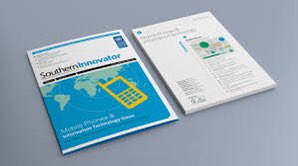
    Southern Innovator was initially launched in 2011 with the goal of inspiring others (just as we had been so inspired by the innovators we contacted and met). The magazine seeks to profile stories, trends, ideas, innovations and innovators overlooked by other media. The magazine grew from the monthly e-newsletter Development Challenges, South-South Solutions published by the United Nations Office for South-South Cooperation (UNOSSC) since 2006.

    https://sites.google.com/davidsouthconsulting.org/southern-innovators/home

    Issue 6’s theme has been decided on: it will focus on Science, Technology and Innovation. For this issue, Southern Innovator is seeking invitations from cutting-edge knowledge and science innovators in the global South to view their work. Time is tight, so don’t miss this opportunity to let the whole global South know about your work. In the past, Southern Innovator has visited green pioneers in Cuba, a smart city in South Korea and an eco-city in China.

    Contact me if you wish to receive a copy/copies of the magazine for distribution. Follow @SouthSouth1.

    Southern Innovator Issue 1

    Southern Innovator Issue 2

    Southern Innovator Issue 3

    Southern Innovator Issue 4

    Southern Innovator Issue 5

    “Beautiful, inspiring magazine from UNDP on South-South innovation. Heart is pumping adrenaline and admiration just reading it”

    Southern Innovator Issue 6

    Innovator Stories and Profiles

    Citing Southern Innovator

    Finding Southern Innovator

    Press Release 1

    Press Release 2

    Press Release 3

    Southern Innovator Impact Summaries | 2012 – 2014

    “The e-newsletter Development Challenges, South-South Solutions proved to be a timely and prescient resource on the fast-changing global South, tracking the rise of an innovator culture driven by the rapid adoption of mobile phones and information technology …

    “In 2010, work began on the development of the world’s first magazine dedicated to the 21st-century innovator culture of the global South. My goal was to create a magazine that would reach across countries and cultures, meet the UN’s standards, and inspire action. Southern Innovator was the result. Mr. [David] South played a vital role in the magazine’s development from its early conception, through its various design prototypes, to its final global launch and distribution.

    “Both the e-newsletter and magazine raised the profile of South-South cooperation and have been cited by readers for inspiring innovators, academics, policy makers and development practitioners in the United Nations and beyond.

    “I highly recommend Mr. [David] South as a thoughtful, insightful, analytical, creative and very amicable person who has the unique ability to not only grasp complex problems but also to formulate a vision and strategy that gets things done. … ” Cosmas Gitta, Former Assistant Director, Policy and United Nations Affairs at United Nations Office for South-South Cooperation (UNOSSC) in UNDP

    “I think you [David South] and the designer [Solveig Rolfsdottir] do great work and I enjoy Southern Innovator very much!” Ines Tofalo, Programme Specialist, United Nations Office for South-South Cooperation

    Team | Southern Innovator Phase 1 Development (2010 – 2015)

    According to zoominfo in 2023, Southern Innovator is one of the Popular Searches online for the United Nations Office for South-South Cooperation (UNOSSC).

    Like our content? Help contribute to the costs of keeping it online. 

    Scan code with your phone and help us out.

    https://davidsouthconsulting.org/southern-innovator-scale-up-fundraiser/

    ORCID iD: https://orcid.org/0000-0001-5311-1052.

    © David South Consulting 2021

  • Mongolia Prepares For A Magazine Explosion | 1998

    Mongolia Prepares For A Magazine Explosion | 1998

    Story: Jill Lawless

    Publication: UB Post

    Date: 08/09/1998

    Ulaanbaatar (Mongolia) – Mongolian newsstands are bursting at the seams. But while the content of the country’s publications is varied, their form is not. Newsprint rules this country’s publishing industry. The few glossy magazines for sale are imports from Russia.

    When the democratic revolution unleashed the tide of free expression in the early 1990s, a flood of newspapers poured forth. It made sense. The cheap-and-cheerful technology of newsprint is low-tech, accessible and inexpensive. Suddenly everyone could be a publisher. 

    But Mongolia’s increasingly sophisticated media landscape is about to go “glossy”. Tomorrow (September 9) sees the launch of Ger (Home), Mongolia’s first on-line magazine. A bilingual quarterly funded by the United Nations, it combines entertainment – articles on the changing sexual attitudes of young Mongolians and the country’s vibrant pop scene – with information on the work of the UN and other NGOs in Mongolia.

    “We want something that will tell the stories of Mongolians and their experiences over the last eight years – both to Mongolians and to the rest of the world,” says David South, communications coordinator at the United Nations Development Programme.

    This month also brings the premiere issue of Tusgal (Strike), billed as the first full-colour, general-interest magazine in the new Mongolia. Published by Mongol News Company – the privately owned media group whose stable of publications includes the daily newspaper Onoodor and The UB Post – it offers a lively mix of sport, culture and celebrity articles, also aimed primarily at the young.

    These two publications are just the top of the stack. Mongolia’s two best-known printing houses, Admon and Interpress, are said to be working on titles of their own.

    Mongolia’s quick-to-learn capitalists see a gap – and they want to fill it. 

    “In Mongolia there are many newspapers, but no world-class magazines,” says Tusgal’s editor-in-chief, Do. Tsendjav. “On the streets you can see a lot of publications that aren’t exactly magazines but you can’t call newspapers, either – newspapers that appear every 10 days or two weeks.

    “We want to fill this space. We want to produce the first colour magazine that will reach world standards, something close to Time or Newsweek.” 

    “There’s an enormous thirst for quality journalism, quality publications that are interesting to look at, top photojournalism – all the things newspapers don’t cover,” adds South. 

    “We’ve seen newspapers moving to more colour, more photographs, and that shows a desire for quality.”

    That quality comes at a price. Tusgal, with 70 colour pages, will sell for between Tg 1500 and Tg 2000 – not much cheaper than an American publication like Time, and too expensive for many Mongolians. 

    With only 1000 Internet subscribers in Mongolia, Ger has an even smaller market within the country – though South is quick to point out, the UN has established public-access Internet centres in Ulaanbaatar and several aimags. 

    And he says a print version is planned to follow. 

    “Distribution is the big problem right now,” he says. 

    “We have to see how we can organize distribution to reach the whole country. I know more magazines will be launched soon in Mongolia, and hope a distribution network may grow out of that.”

    The editors know Mongolia’s magazine market and magazine technology are in their infancy. Although companies like Admon and Interpress get more sophisticated equipment by the month, the capacity to produce quality publications is still limited – the first issue of Tusgal has been printed outside Mongolia. 

    Human resources need to develop as well, Tsendjav admits. 

    “To produce a monthly magazine you need highly qualified journalists. We don’t have that right now. We’re still seeking them out.”

    But he is confident this will change – and quickly, too, if the pace of development in the past eight years is anything to go by. 

    “During socialism, Mongolia had many magazines, but it all stopped after 1990,” notes Tsendjav. “It was a question of economics.

    “At first we don’t think we can earn money from this. If you want to make money you have to wait two or three years. So what we are aiming for at first is to build a readership.

    “I think in two or three years, living standards will improve. People will have more money to spend on things like magazines. But we don’t want to wait for people to get enough money. We want to be the first, so people will develop an interest.

    “There will be competition. Nowadays a lot of business-people understand the importance of the media. I welcome competition. It’ll make us work harder. It’s good for everybody.”

    From In Their Own Words: Selected Writings by Journalists on Mongolia, 1997-1999

    Read a story by Jill in The Guardian (9 June 1999): Letter from Mongolia | Herding instinct 

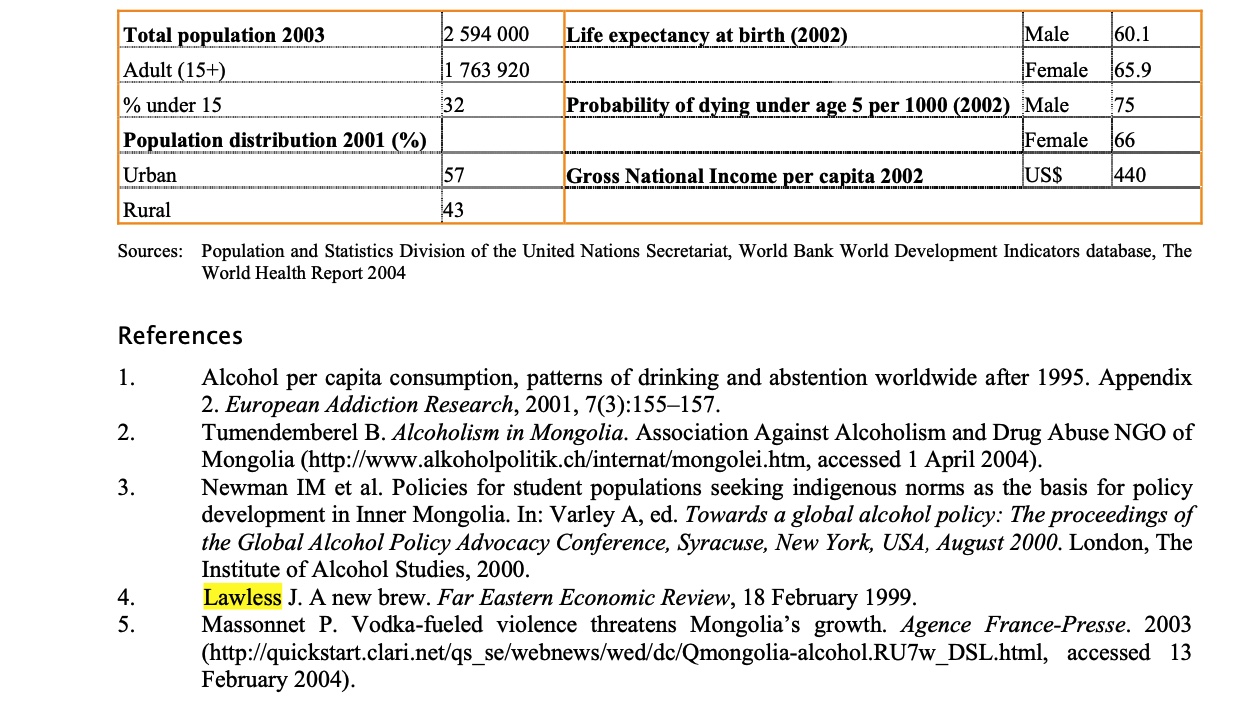
    Jill’s story for the Far Eastern Economic Review is cited in the WHO Global Status Report on Alcohol 2004.

    Wild East: Travels in the New Mongolia by Jill Lawless offers a vibrant account of what it was like to be a journalist in Mongolia in the late 1990s.

    ORCID iD: https://orcid.org/0000-0001-5311-1052.

    © David South Consulting 2018