“Lawless introduces us to Mongolia’s tabloid press, to teenage mineworkers, sharp-eyed young hustlers, nomads whose only possessions are their livestock, Mongolian wrestlers and Mongolian horse races.” Toronto Star
“This readable and reportorial book is the perfect antidote to … those tiresomely difficult, pointlessly dangerous, and essentially fake expeditions undertaken against the advice of local people who know better.” The Georgia Straight, Vancouver
“Wryly funny and wide-spectrum account of Mongolia’s tumultuous rebirthing into the 21st century. Half the population lives in Soviet apartment blocks and watches satellite TV but the other half still eek a living from the exquisite, barren hills while living in nomadic felt tents. Of course, I’d much rather be in the tents… but whatever your preference, you will definitely enjoy Ms. Lawless’ writing. She was editor of an Ulaan Baator newspaper for two years, and she tells it like it is. Very highly recommended.” Mongolian Buryat Civilisation Bookstore
“Jill Lawless’ book is not a scholarly tome per se, yet it is of definite value to the contemporary Mongolian scholar … Lawless’ period is 1997-1999, the heart of the tumultuous and ill-spent years of Democratic Coalition Government… a period of great hopes for democratic flowering and free market enterprise leading the nation to prosperity and progress.” Alicia J. Campi in Mongolian Studies
Historical dictionary of Mongolia, by Alan J. K. Sanders, Scarecrow Press, 2003.
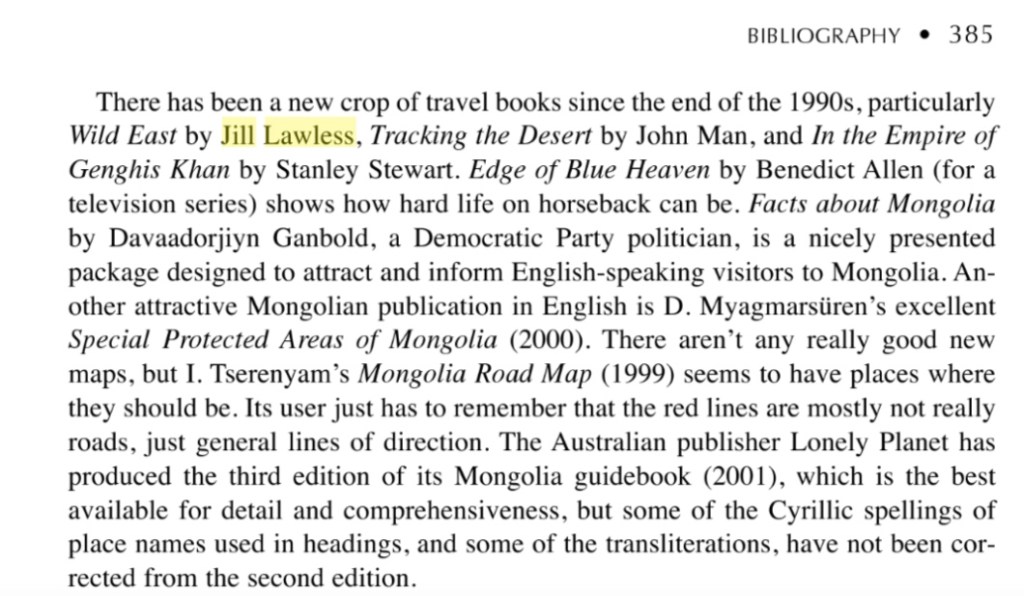
“Others sent me Jill Lawless’s Wild East: The New Mongolia, a compilation of pieces she wrote when she was editor of Mongolia’s English-language newspaper, the UB Post, during Mongolia’s transition from a socialist people’s republic to young democracy. With the wind shaking the frame of my ger, I lit the stove and read what these and other writers claimed to have found just outside my flapping felt walls.
“By the time veteran journalist Jasper Becker’s Mongolia: Travels in an Untamed Land arrived, I had put aside books written since Mongolia opened up to the West in the early 1990s. Most Western travellers and writers discovered the same sights from the back of a borrowed horse. Only Lawless had investigated the place over time on its own terms. The others, full of pith and vinegar and a standard set of assumptions about what they would find, built books on flights of fancy – golfing across Mongolia, following the path of medieval monks, ‘rediscovering shamanism’ – that were flimsier even than those that had set me in motion. The books were as exciting as museum diorama, papier-mâché models of their ‘medieval’ travels and capitalist fantasies.” Three Years in Mongolia: Trying to be a Travel Writer, Luke Meinzen, Kill Your Darlings, 10 April 2012
Tensions were high as the Global Financial Crisis (2007-2008) roiled the world economy.
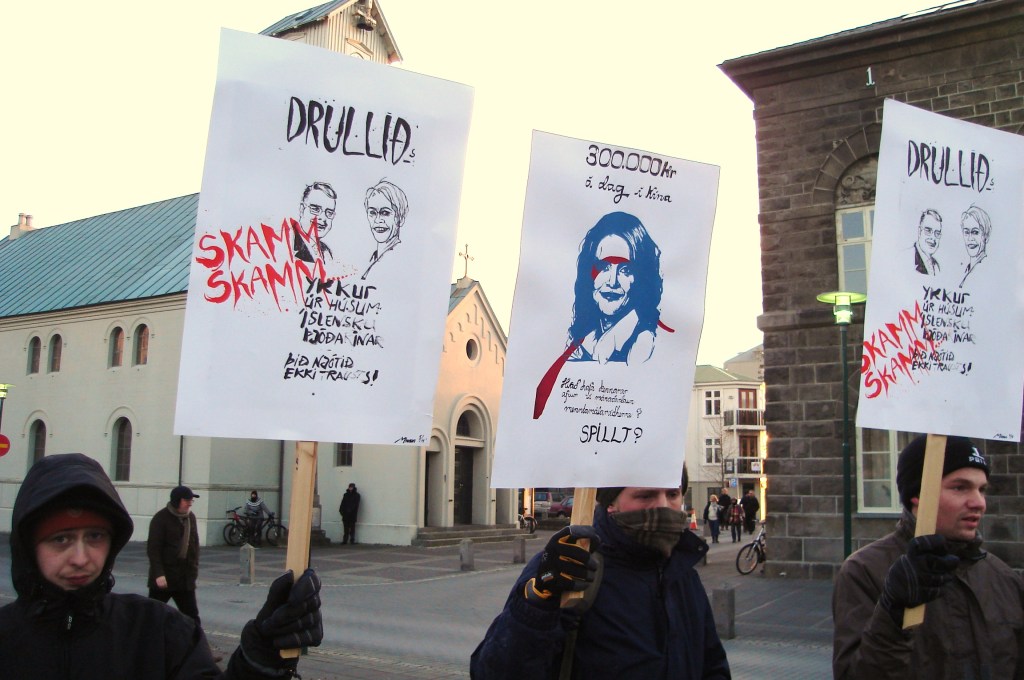
The unfolding Global Financial Crisis (GFC) in 2008, while caused by the collapse of the financial system, also presented an opportunity to apply the lessons learned in the late 1990s. The crisis was a roller coaster ride and provided a front row seat to what happens when too much debt and fraud overwhelms the financial system. A conference in Switzerland on African trade opportunities in 2008 was disrupted by the crisis as participants received frantic calls from London and New York and grabbed their bags and fled. Later that year I joined Associated Press foreign correspondent Jill Lawless in Reykjavik, Iceland as demonstrations erupted resulting from the collapse of the country’s banks.
Just as now (2021) 2009 was a year in which the questions revolved around receiving a vaccine (for H1N1) and how best to affirm a person’s identity and citizenship.
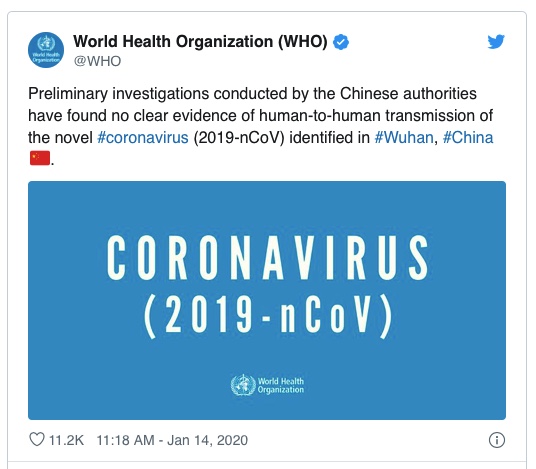
This timeline is an aid to decision-making during the recovery from the pandemic and how to better prepare for outbreaks in the post-COVID-19 pandemic policy environment.
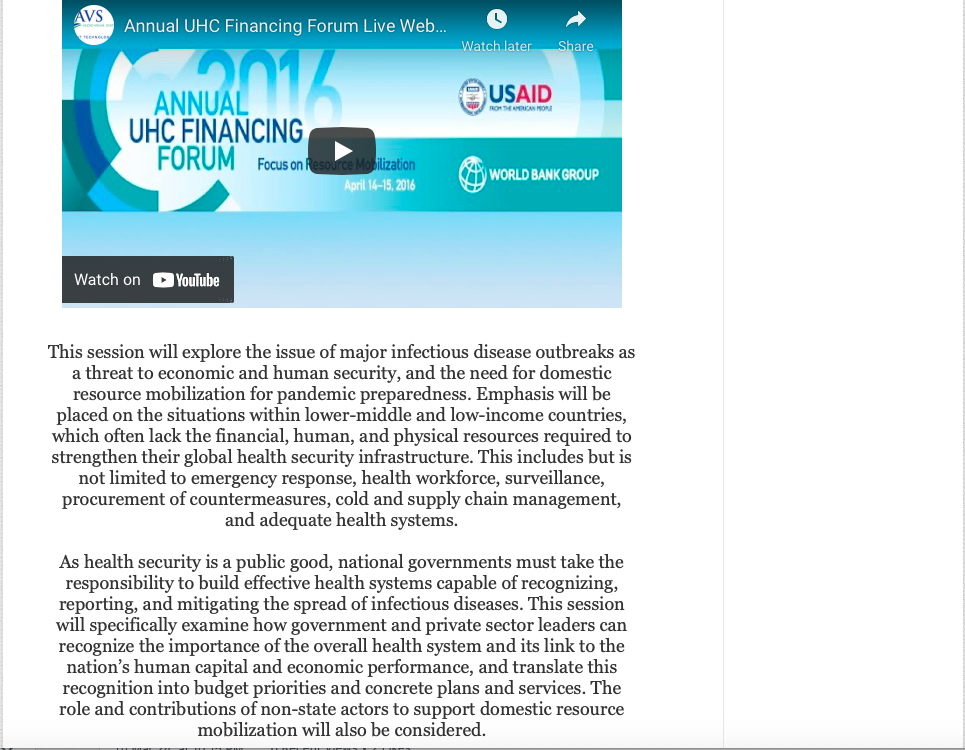
“This session will explore the issue of major infectious disease outbreaks as a threat to economic and human security, and the need for domestic resource mobilization for pandemic preparedness. Emphasis will be placed on the situations within lower-middle and low-income countries, which often lack the financial, human, and physical resources required to strengthen their global health security infrastructure. This includes but is not limited to emergency response, health workforce, surveillance, procurement of countermeasures, cold and supply chain management, and adequate health systems.”
“The exercise illustrated areas where public/private partnerships will be necessary during the response to a severe pandemic in order to diminish large-scale economic and societal consequences.
In recent years, the world has seen a growing number of epidemic events, amounting to approximately 200 events annually. These events are increasing, and they are disruptive to health, economies, and society. Managing these events already strains global capacity, even absent a pandemic threat. Experts agree that it is only a matter of time before one of these epidemics becomes global—a pandemic with potentially catastrophic consequences. A severe pandemic, which becomes “Event 201,” would require reliable cooperation among several industries, national governments, and key international institutions.”
“This book develops an examination and critique of human extinction as a result of the ‘next #pandemic’ and turns attention towards the role of pandemic catastrophe in the renegotiation of what it means to be human.”
“Anyone with a real interest in business and global trade will have been in London last week. To look on as the government tried to enact Brexit legislation? No — to attend the World Chinese Entrepreneurs Convention.”
“… It is 30 years old, but came to Europe for the first time only last week. …
“3,000 delegates from Chinese-owned businesses representing a large part of world trade were at the ExCel centre in Docklands for three days.
“What’s a girl to do when she gets an invitation to the key dinner for this event?.”
“ONCE YOU’RE IN THE MIDST OF A SEVERE PANDEMIC, YOUR OPTIONS ARE VERY LIMITED. THE GREATEST GOOD CAN HAPPEN WITH PRE-PLANNING.” Eric Toner, Senior scholar, Johns Hopkins Center for Health Security
The scenarios foresaw leaky travel bans, a scramble for vaccines and disputes between state and federal leaders, but none could anticipate the current levels of dysfunction in the United States.
“A Canadian team of scientists has successfully isolated a strain of the coronavirus and grown samples in a lab to help study the pathogen responsible for the deadly global pandemic.
“Researchers from Sunnybrook Research Institute, McMaster University and the University of Toronto, all in Canada, isolated the virus from two specimens and then cultivated it in a secure containment facility.”
“It appears that what you might well call Chinese agents infiltrated one of the highest prized national security elements when it comes to biosecurity and biodefence,” said Christian Leuprecht, a security expert and professor at the Royal Military College and Queen’s University.
“The phrase ‘global health’ appears ubiquitously in contemporary medical spheres, from academic research programs to websites of pharmaceutical companies. In its most visible manifestation, global health refers to strategies addressing major epidemics and endemic conditions through philanthropy, and multilateral, private-public partnerships. This book explores the origins of global health, a new regime of health intervention in countries of the global South born around 1990, examining its assemblages of knowledge, practices and policies.
The volume proposes an encompassing view of the transition from international public health to global health, bringing together historians and anthropologists to analyse why new modes of “interventions on the life of others” recently appeared and how they blur the classical divides between North and South. The contributors argue that not only does the global health enterprise signal a significant departure from the postwar targets and modes of operations typical of international public health, but that new configurations of action have moved global health beyond concerns with infectious diseases and state-based programs.
The book will appeal to academics, students and health professionals interested in new discussions about the transnational circulation of drugs, bugs, therapies, biomedical technologies and people in the context of the “neo-liberal turn” in development practices.”
Good ideas are plentiful, but how to fund life-improving projects has always been a thorny issue. Judging how effective a project is can also be fraught with debate and contention. Over the past two decades, the number of NGOs in the global South has exploded (http://lboro.ac.uk/gawc/rb/rb144.html). The best of them offer the local knowledge and understanding required to make development gains. But unlike NGOs in the North, many lack the powerful fundraising capabilities of the big global NGO brands.
An exciting new initiative based in Germany, but already featuring hundreds of projects from across the South, is using the power of the internet to directly connect projects and donors.
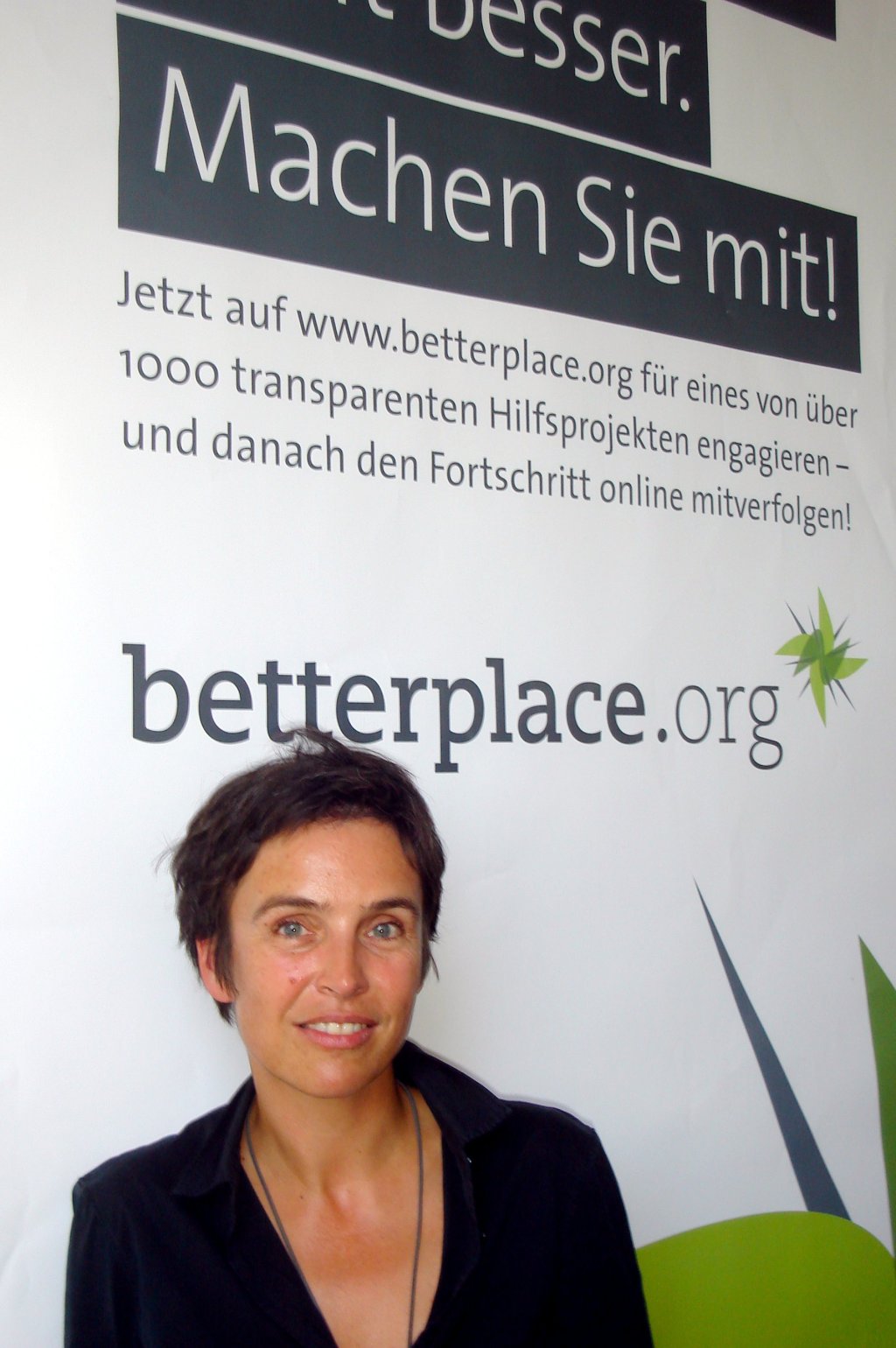
Joana Breidenbach, an anthropologist, author and co-founder of betterplace.org (www.betterplace.org), says NGOs are emerging in India and other countries of the South to challenge the big Northern global NGOs.
“Why wouldn’t you want to donate to these Southern NGOs? There are more entrepreneurs and local approaches which are better.
“Betterplace gives local institutions a platform to express themselves.”
Started in 2007, betterplace is an online marketplace for projects to raise funds. It is free, and it passes on 100 percent of the money raised on the platform to the projects. The foundation that runs betterplace supports its overheads by offering additional services that people can pay for if they wish. It works in a way similar to the online marketplace eBay (http://www.ebay.com): NGOs post their project, set up an account, blog about their achievements and successes and needs, and receive donations direct to their bank account when they come in.
Breidenbach points out up to a third of any NGO’s income is spent on fundraising. In Germany, that represents more than Euro 1.3 billion out of over Euro 4 billion in private donations – money that could have gone directly into the hands of the people needing help.
With betterplace, donators can surf through the projects and pick the one they want. Already, more than 100 large corporations trawl through betterplace seeking projects to fund to meet their corporate social responsibility (CSR) obligations (http://en.wikipedia.org/wiki/Corporate_social_responsibility).
“I find it very exciting to introduce a good and innovative NGO to a corporate sponsor,” Breidenbach said.
Breidenbach says betterplace’s ultimate goal is “to transfer the donation market online.” It hopes to change the rules in donation and charity in the same way blogs and the search engine Google changed the way people publish and search for information.
“This provides better transparency, feedback,” Breidenbach said. “Now (with betterplace) donors and organizations can cut out the middlemen. A lot of established organizations do not like this too much.”
Over the past decade, new concepts like social entrepreneurs and venture philanthropy have emerged to straddle the delicate line between social good and private profit. Betterplace joins this wave of new thinking about how to do development better.
In the 20 months since betterplace went online more than 1,500 projects have joined. They are now averaging between 20 to 35 new projects joining every week.
Betterplace is a simple open-plan office on the top floor of a Berlin warehouse beside the city’s Spree river. The small team (http://www.betterplace.org/about_us/team) work on laptop computers. A blackboard on the wall details in bright colours a running tally of the projects that have joined.
Breidenbach gives the example of a mother in Cameroon who is using betterplace to raise the school fees for her children. The mother blogs about the children’s progress and has been able to raise the fees for a year and a half.
“People are now directly connected to somebody in need.”
“Right now the functionality (of the website) does not allow people getting in contact publicly and we want to enable this knowledge transfer in 2010. If you want to build a well in Cameroon then you could search for the best technology and to contact other people who are doing similar projects to learn from them.”
Success on betterplace is by no means certain. “The experience of the project managers has been as varied as development work is – some have done really well, raising thousands of Euros over the website – others have received no funding at all,” Breidenbach said.
But betterplace provides tools to give the projects the best chance possible. “Projects can present their work, breaking it down in a transparent way (in order to let supporters know exactly what is needed for their realization), there are sound payment processes in place and project managers can give feedback through their project blog, supporters can download project widgets etc., all supplied free of charge.”
Breidenbach has other tips for making betterplace work for a project: post details in English when creating a profile, break down the project into much smaller, low-cost goals (few people are willing to make large donations) – this also has the advantage of receiving payments straight away when they are small. Tell a good story about the project, and try and use actual testimonials from the people affected. Blog and update regularly with photos and videos to keep people engaged. Also avoid copying and pasting text from a previous grant application.
“We have the numbers to show that projects which give regular feedback and have a lively web of trust receive more donations than others, which are not very active.”
“Don’t think you can just go on to betterplace and the money starts rolling in,” said Breidenbach.
The betterplace platform places all projects seeking funds on the same level, allowing individuals and small NGOs to compete equally with the big, branded global NGOs with their websites and sophisticated fundraising operations.
“All the big NGOs have their own websites,” continues Breidenbach. “But it is the small initiatives that often don’t have a website or know how to use Pay Pal etc. (http://www.paypal.com). We are very useful for smaller NGOs.”
“Another big advantage is that we are a real marketplace: whatever your interests (as a potential donor), you will find a project tackling this issue on the platform.”
But what about fraud and people seeing betterplace as a coin-making machine rather than a way to make the world a better place?
“We have a feeling for dodgy projects. We check the IP address. We have a number of trust mechanisms in place (and are currently working on enlarging them). Thus projects on betterplace can create trust through their good name … But we also include something which I would call network-trust: In our web of trust different kinds of stakeholders of an organization or a project have a voice and can publicly state what they think of it. Thus beneficiaries of a project can say if the project has done them good or has been counterproductive, people who have visited the project on the ground can describe what they have seen etc. … we hope to give a much denser and more varied impression of social work and give donors (a terribly badly informed group of people), the basis for a much more informed choice.
“If a contributor to a project is dissatisfied with the project’s outcome … she can either directly contact the project manager via betterplace, or openly voice her concern on the project page for other potential donors to see her views.”
For now, betterplace is still only useful to people who have access to the internet and have a bank account (necessary for the money transfers). But in the future betterplace hopes to have mobile phone interactivity and more features to expand who they can reach.
“We are also re-working our site to make it more intuitive and easier to use for people without computer skills,” Breidenbach said. “In the pipeline is also a knowledge backbone, enabling people to access knowhow about development and social innovation issues and exchange views and experiences. This will be very useful for projects in the South as so many people are working on the same issues without knowing about it. They could learn a lot from each other, without the “help” of the north.”
With internet broadband in Africa set to take off, according to the report Africa Connect: Undersea Cables to Drive an African Broadband Boom (http://www.pyr.com/downloads.htm?id=5&sc=PR090309_INSAME1.6), even more people will soon be able to make the most of initiatives like betterplace.
Published: September 2009
Resources
1) CSR Wire: This is a news service with all the latest news, reports and events and where companies announce their CSR (corporate social responsibility) programmes and how much they are contributing. A great resource for any NGO looking to make a targeted appeal for funds. Website:http://www.csrwire.com/
2) Alibaba: Alibaba.com is an online marketplace started in China but is now global. It allows businesses from all over the world to trade with each other, make deals and find funding. Website:http://www.alibaba.com/
Development Challenges, South-South Solutions was launched as an e-newsletter in 2006 by UNDP’s South-South Cooperation Unit (now the United Nations Office for South-South Cooperation) based in New York, USA. It led on profiling the rise of the global South as an economic powerhouse and was one of the first regular publications to champion the global South’s innovators, entrepreneurs, and pioneers. It tracked the key trends that are now so profoundly reshaping how development is seen and done. This includes the rapid take-up of mobile phones and information technology in the global South (as profiled in the first issue of magazine Southern Innovator), the move to becoming a majority urban world, a growing global innovator culture, and the plethora of solutions being developed in the global South to tackle its problems and improve living conditions and boost human development. The success of the e-newsletter led to the launch of the magazine Southern Innovator.
“A few weeks ago, David South, Development consultant and author of UNDP’s Development Challenges, South-South Solutions Newsletter, came by the betterplace office to take a look at our work. When I asked him how he had come about betterplace.org, he answered: he found me on twitter! So much for the twitter-scepticts. Read the article about how we can Make the World a Better Place for Southern Projects. (As the UNDP always publishes the newsletter on its South to South Website only months later, here is the link via David South’s blog).”











You must be logged in to post a comment.