Category: Archive

An archive of published content for media and clients.

  • African Fashion’s Growing Global Marketplace Profile

    African Fashion’s Growing Global Marketplace Profile

    By David SouthDevelopment Challenges, South-South Solutions

    SOUTH-SOUTH CASE STUDY

    Tales of African global fashion successes have multiplied in the last few years. African fashion is seeing its profile rise as more and more shows and festivals boost awareness of the continent’s designs, designers and models. In turn, African fashion and design is being taken more seriously as an income and job generator, and as a sector able to weather the ups and downs of the global economy: people always need to wear clothes.

    If the global fashion industry were a country, it would rank 7th in global GDP (gross domestic product) (Fashion Performance Network).

    In 2011, the apparel retail industry was worth an estimated US $1.1 trillion, and that could grow to US $1.3 trillion by 2016. And the sector is expanding in the global South. It is forecast that India and China combined will be as big a fashion market as the United States by 2015.

    One visible aspect of this is the plethora of African fashion weeks that have sprung up.

    Launched in 2011, African Fashion Week in London (africafashionweeklondon.com), or AFWL, is a reflection of how far things have come and how much higher the profile of African fashion now is.

    The mission behind AFWL is “to promote emerging and established African designers and African-inspired designers from across the globe.” The number of attendees grew from 4,700 in the first year to 20,000 in 2012.

    In 2012 it partnered with Côte d’Ivoire Fashion Week (https://www.facebook.com/pages/Cote-dIvoire-Fashion-Week/364950310210789), which will hold its third annual event in December 2013. This partnership has meant fashion designers from Côte d’Ivoire can benefit from the higher international profile of appearing at African Fashion Week in London. The theme in 2012 was “Ivorian Textile Products on the American Market.”

    “London is one of the most important fashion capitals around the world,” said Côte d’Ivoire Fashion Week’s founder and CEO, Coulibaly Severin on the AFWL website. “It is a great honour for us and the African continent to have a professional international platform to promote African Fashion industry actors, African heritage, African values, African textiles through Africa Fashion Week London.”

    The idea is to use the fashion week as a bridge to access the European market.

    With the right support, African fashion businesses have huge potential for growth.

    A distinctive “Afropolitan” aesthetic (http://afropolitanaesthetic.tumblr.com/) has grown as a phenomenon since 2005, influencing global urban design trends. It can be characterized as urban, sophisticated, tailored and boldly African in its use of colours and patterns. British designer Paul Smith (http://www.paulsmith.co.uk/uk-en/shop/) has been one of many designers to be inspired by the afropolitan look.

    While African fashion trends have always influenced the global fashion business, the challenge has been to create viable global African fashion brands that can compete in the global marketplace and in turn create sustainable jobs in Africa.

    Pioneers are showing that it can be done.

    Featured at Africa Fashion Week in London in 2011, the Nigerian fashion brand Mmabon (mmabon.com) is now looking to pioneer new ways to buy and sell clothing in Africa. The company, which sells affordable casual and custom apparel, is launching a mobile phone app for all devices and is building its own Internet e-commerce website as well. Mmabon had been engaging with customers through Facebook and the BlackBerry smartphone, but realized it could offer a much better experience for customers through an app and an e-commerce website. This shows the future for fashion in Africa is going mobile and going online.

    Founded by Elizabeth Idem-Ido, Mmabon is capitalizing on the fact Internet access is improving in Nigeria and is turning to online advertising to drum up customers. The fashion brand is trying to reach 16 to 34 year olds, of which 8 million are believed to be currently on Facebook in Nigeria, according to Idem-Ido.

    There is a cultural change underway in the country: people are increasingly feeling comfortable doing commerce online and on mobile phones.

    “Nigerian youths are now more willing to buy products over the Internet, unlike five years ago, with the likes of konga.com and jumia.com revolutionizing the online retail scene in Nigeria,” Idem-Ido, who is also a trained lawyer, told VC4Africa (https://vc4africa.biz/).

    Konga (Konga.com) is Nigeria’s largest online mall. Opened in 2012, it offers a wide range of products for order across Nigeria. Jumia.com calls itself the “the biggest online shopping mall in Africa”, operating in Morocco, Egypt, Ivory Coast, Nigeria and Kenya. Another player is Ecwid (ecwid.com), which bills itself as an e-commerce solution for small businesses that “is a revolutionary shopping cart that seamlessly integrates with your existing website. It can also be added to your page on social media networks, such as Facebook or mySpace”.

    Idem-Ido’s experience with Mmabon over the past two years shows how online marketing can be an effective – and cost-effective – way to broaden a company’s customer base.

    “As a business, we have not physically met with 80 per cent of our current customers,” she said. “Orders have been achieved from referrals, BlackBerry Messenger contacts and our official Facebook page. Online marketing improves our visibility without owning a prime-location store and reminds, assures our already existing customers on why we are their preferred brand.”

    Her fashion business began humbly as a part-time t-shirt printing hobby for her friends. Then people started ordering custom-designed t-shirts, and so she began a journey exploring fabrics in local and foreign markets.

    Mmabon is now the official merchandiser for the Calabar Festival 2013-2015 (calabarfestival.com), the biggest street carnival in West Africa. Taking place in Calabar, Cross River State, Nigeria, it attracts a million people.

    Mmabon is receiving help from Venture Capital for Africa, or VC4Africa (https://vc4africa.biz/), a community of entrepreneurs and investors helping to build companies in Africa, to raise further investment to grow the brand and the business.

    Another success benefiting from international exposure is Malian designer Boubacar Doumbia (http://www.ndomo.net/english/index.html), who is currently making fabrics for design-savvy British furniture and home furnishings store Habitat. The prints with African themes have proven a hit with Habitat customers.

    Working from a new studio in Burkina Faso’s capital, Ouagadougou, Doumbia (https://www.ashoka.org/fellow/boubacar-doumbia) is a leading advocate of bogolan (http://www.malimali.org/what-is-bogolan/), a Malian traditional textile dyeing process using mud.

    He uses locally grown cotton, which is first dyed using plant-based dyes. A chemical reaction occurs when the iron in the mud is applied to the fabric and turns the existing plant dye black after three applications, or grey after two applications. The mud is washed off and the fabrics are placed in the sun to dry. It is a sustainable and chemical-free approach to dyeing fabrics and also creates vibrant patterns that have caught the attention of people in Europe and elsewhere.

    Other outlets who have become enamored with African patterns and themes in Britain include Darkroom Boutique, House of Fraser and the V&A Museum, The Guardian newspaper reported.

    As an Ashoka fellow (ashoka.org) – Ashoka is the largest network of social entrepreneurs worldwide – Boubacar is using the craft as a way to boost skills and opportunities for youth in Mali. He has “overhauled the traditional model of youth apprenticeship in Mali by putting young people in a central, entrepreneurial role from the outset. Rather than simply train students in the methods of textile production, he teaches professional, people and life skills, and encourages his apprentices to become self-sufficient, creative, and innovative”, according to the Ashoka website.

    Elsewhere, African fashion style pioneer Gilles Belinga (https://www.facebook.com/GillesBelinga) has become a fashion phenomenon in China. The former communications engineering student had a deeply personal conversion to fashion and style upon arriving in Beijing; the buzzing and vibrant Chinese capital captured his heart.

    “I discovered my talent and passion for fashion in China,” he told China Daily.

    “I’ve also been given many opportunities here, so I want to pursue my fashion dream in China.”

    The Cameroon native has a distinctly afropolitan take on fashion – elegant, tailored suits, strong colours, and a gentleman’s manner – and this fashionable posture landed him modeling work in fashion shows.

    He arrived in China in 2008 after his parents divorced and he went from being in a wealthy family back home to having to do any job he could get to survive. He started out in Tianjin, China – an industrial city with a large high-technology sector – and then moved to Beijing to study.

    It was there that he fell in love with the city’s fashion scene and hasn’t looked back.

    “I never attended fashion school in Africa, but in Beijing, in this fashionable environment I realized that I like drawing clothes, matching colors and mixing fabrics,” he said.

    “There are so many fabrics here, which has given me the chance to try out different things. Sometimes you might have a talent in you, but you might not discover that talent if you’re not in a place where it can come out.”

    He now designs clothes and has them made by local tailors.

    “When I design clothes for clients, I look at the whole person and what kind of message they want to deliver to people,” he said. “Then I check their skin color and think about style and fabric.”

    He defies the elitist take on fashion that can be promulgated by fashion magazines and thinks good fashion is for everyone.

    “I believe the way you dress sends a message to people about how you want them to think about you.”

    He finds Beijing is full of opportunities and he is regularly stopped in the city’s trendy Sanlitun (http://en.wikipedia.org/wiki/Sanlitun) neighbourhood and asked to be in fashion shows.

    “In China, you don’t know who you are going to meet. You could be anywhere and meet someone who can change your life.”

    And he plans to perfect his skills and designs in China and then take them back to Cameroon one day.

    And maybe, in time, Belinga will be the next big fashion thing.

    Published: October 2013

    Resources

    1) African Fashion Week London: AFWL celebrates London’s unique and diverse cultural heritage, topped with the flamboyant mixing of Western and African culture through fashion at the same time promoting Africa’s rich ethnic culture and interpreting it into contemporary designs. Website: africafashionweeklondon.com

    2) Gentlemen of Bacongo by Daniele Tamagni, Paul Smith and Paul Goodwin, Publisher: Trolley. Website: amazon.com

    The Afropolitan: A magazine and website from South Africa packed with content from an afropolitan perspective. Website: afropolitan.co.za/

    Association of African Designers in Diaspora: The Association of African Designers in the Diaspora is the non-profit social enterprise arm of Africa Fashion Week London that supports emerging designers with the aim to make a positive contribution to society through fashion and creativity. Website: http://africafashionweeklondon.com/africafashionweek/association-of-african-designers-in-diaspora/

    The Creative Economy: How People Make Money From Ideas by John Howkins, Publisher: Penguin. Website: creativeeconomy.com/book.htm

    Creative Economy Report Website: This annual report offers a snapshot of the state of the global creative economy and its key trends. Website: http://unctad.org/en/Pages/Publications/Creative-Economy-Report-%28Series%29.aspx

    7) Copyright + Creativity = Jobs and Economic Growth: WIPO Studies on the Economic Contribution of the Copyright Industries (WIPO 2012). Website: http://www.ip-watch.org/weblog/wp-content/uploads/2012/02/WIPO-Copyright-Economic-Contribution-Analysis-2012-FINAL-230-2.pdf

    8) The Afropolitan Shop: The Afropolitan Shop is an online boutique founded by Beverly Lwenya, that desires to tell an African Design Story. It began as a blog in 2007 called The Afropolitan Network, which highlighted stories and images of the African Diaspora. The Afropolitan Shop is now a growing global brand, specializing in handmade and designer accessories such as jewelry, bags and shoes. Website: theafropolitanshop.com/

    Creative Commons License

    This work is licensed under a
    Creative Commons Attribution-Noncommercial-No Derivative Works 3.0 License.

    ORCID iD: https://orcid.org/0000-0001-5311-1052.

    © David South Consulting 2023

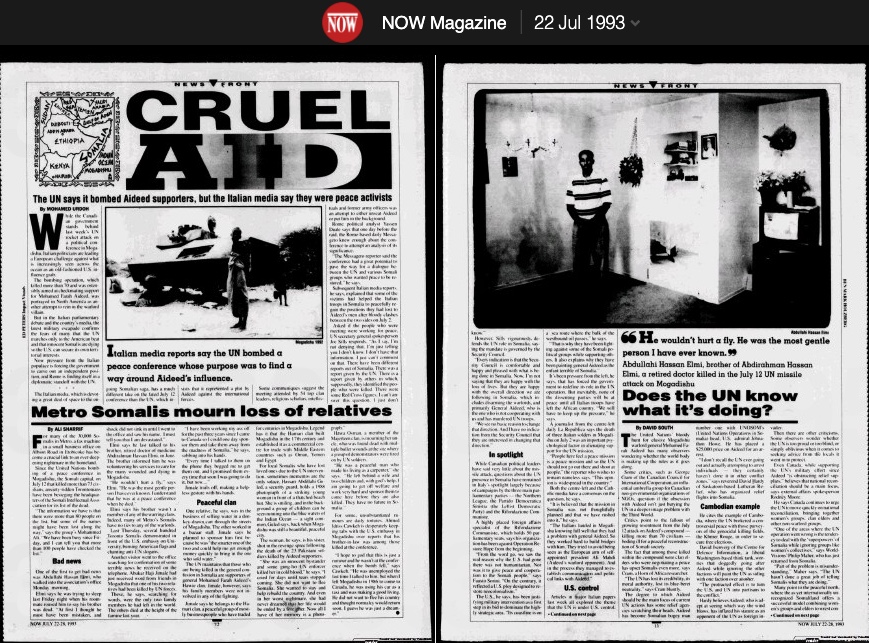
  • Does the UN know what it’s doing?

    Does the UN know what it’s doing?

    By David South

    Now Magazine (Toronto, Canada), July 22-28, 1993

    The United Nations’ bloody hunt for elusive Mogadishu warlord general Mohamed Farah Aideed has many observers wondering whether the world body is making up the rules as it goes along.

    Some critics, such as George Cram of the Canadian Council for International Cooperation, an influential umbrella group for Canadian non-governmental organizations of NGOs, question if the obsession with Aideed isn’t just burying the UN in a deeper image problem with the Third World.

    Critics point to the fallout of growing resentment from the July 12 attack on Aideed’s compound – killing more than 70 civilians – boding ill for a peaceful reconstruction of Somali society.

    The fact that among those killed within the compound were clan elders who were negotiating a peace has upset Somalis even more, says Cram, a Horn of Africa researcher.

    “The UN has lost its credibility, its moral authority, lost its blue-beret neutrality,” says Cram bluntly.

    The degree to which Aideed should be the main focus of current UN actions has some relief agencies scratching their heads. Aideed has become Somalian bogey man number one with UNOSOM’s (United Nations Operations in Somalia) head, US Admiral Johnathon Howe. He has placed a $25,000 price on Aideed for an arrest.

    “I don’t recall the UN ever going out and actually attempting to arrest individuals – they certainly haven’t done it in other conflict zones,” says reverend David Hardy of Saskatoon-based Lutheran Relief, who has organized relief flights into Somalia.

    Cambodian example

    He cites the example of Cambodia, where the UN brokered a controversial peace with those purveyors of the genocidal killing fields, the Khmer Rouge, in order to secure free elections.

    David Isenverg of the Center for Defense Information, a liberal Washington-based think tank, worries that doggedly going after Aideed while ignoring the other factions will paint the UN as siding with one faction over another.

    “The protracted effect is to turn the US and UN into partisans to the conflict.”

    Hardy believes Aideed, who is adept at seeing which way the wind blows, has inflated his stature as an opponent of the UN as foreign invader.

    Then there are other criticisms. Some observers wonder whether the UN is too proud or too blind, or simply oblivious when it comes to seeking advice from the locals it went in to protect.

    Even Canada, while supporting the UN’s military effort since Aideed “is obstructing relief supplies,” believes that national reconciliation should be a main focus, says external affairs spokesperson Rodney Moore.

    He says Canada continues to urge the UN to move quickly on national reconciliation, bringing together women’s groups, clan elders and other non-warlord groups.

    “One of the areas where the UN operation went wrong is the tendency to deal with the ‘superpowers’ of Somalia while ignoring groups like women’s collectives,” says World Visions’ Philip Maher, who has just returned from Somalia.

    “Part of the problem is misunderstanding,” Maher says. “The UN hasn’t done a great job of telling Somalis what they are doing.”

    Many point to the peaceful north, where the as yet internationally unrecognized Somaliland offers a successful model, combining women’s groups and elders to wrest control.

    “Does the UN know what it’s doing?”: Now Magazine, July 1993. This incident was the basis of the 2001 film Black Hawk Down. 

    More on this story here: Somali Killings Reveal Ugly Side Of Elite Regiment

    More investigative journalism here: 

    Peaceniks Questioning Air-Raid Strategy In Bosnia

    Study Says Jetliner Air Quality Poses Health Risks: CUPE Takes On Airline Industry With Findings Of Survey

    https://davidsouthconsulting.org/2020/04/22/state-of-decay-haiti-turns-to-free-market-economics-and-the-un-to-save-itself/

    https://davidsouthconsulting.org/2021/02/18/what-is-the-un-doing-with-your-data/

    Creative Commons License

    This work is licensed under a
    Creative Commons Attribution-Noncommercial-No Derivative Works 3.0 License.

    ORCID iD: https://orcid.org/0000-0001-5311-1052.

    © David South Consulting 2023

  • “Cock Tales” too much for Hamilton

    “Cock Tales” too much for Hamilton

    By David South

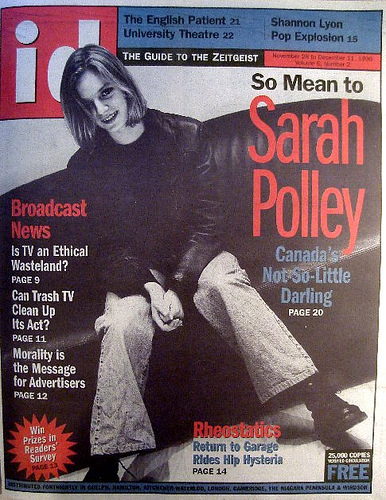
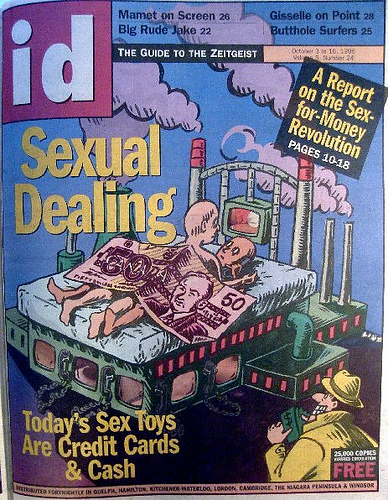
    Id Magazine (Canada), October 3-16, 1996

    Steeltown is a little less hot now that View, Hamilton’s alternative weekly, has dropped a controversial sex columnist in the face of complaints from distributors. The fracas has raised a thorny issue: to what extent should a newspaper stand behind a controversial writer?

    My Messy Bedroom, a weekly column by Montreal journalist Josey Vogels, mixes graphic language and humour in its look at sexuality. The dispute erupted over a column in the August 22 issue entitled Cock Tales 1 (Cock Tales 2 will not run in View). 

    A surprised and angry Vogels says she only found out her column had been dropped when id called her in September. Vogels believes the problem was with the frank discussion by men of their sexual tastes. “Maybe it was the opening line. ‘Mouth on my cock, finger in my butt, looking me in the eyes,’ then a joke: ‘Would you like fries with that?’”

    Vogels maintains View knew what it was getting into when it picked up the syndicated column in June, 1995. “You can’t say you want a column because of its nature, then say you don’t like it.”

    Vogels says she co-operated in the past when the magazine asked her to tone down a column. “But there is a line where my integrity is at stake.”

    Tucked away among five pages of classified ads, My Messy Bedroom was the only piece of journalism with a sexual theme in View

    Editor Veronica Magee says View received complaints that children were reading the column, and some distributors refused to carry the paper. In a rambling editorial in the September 5 issue, Magee defends the decision to drop the column, saying it was time the paper made some changes. 

    Magee writes that Vogels’ column taught “sexuality is something clean, not dirty,” but admits some urban weeklies aren’t so urban, and must cater to a more conservative, suburban readership. “Hamilton is a conservative city,” she claims. 

    In an interview with id, Magee admitted View’s attitude towards the column was “what can we get away with – let’s push the limit.

    “Some people argue she should have known better. Although I’m sure people will believe we are making the writer suffer for a decision we made, that is not the intent.”

    But the publisher and editor of View offer conflicting explanations of who actually pulled the column. “It was a collective decision,” says Magee. 

    Sean Rosen, one of View’s two publishers, told id the magazine had been considering dropping the column for some time. But Rosen says the decision was solely Magee’s. “The editor decided it had run its course, trying to be sensational for the sake of being sensational.”

    Books by author and sex columnist Josey Vogels: More Love & Sex from My Messy Bedroom (Vehicule Press: 1998) ; My Messy Bedroom: Love & Sex in the 90’s (Vehicule Press: 1998)

    Read more on the 1990s sex economy here: From Special Report: Sexual Dealing: Today’s Sex Toys Are Credit Cards & Cash: A Report On The Sex-For-Money Revolution 

    Other stories from the special feature: 

    “Barely Legal”: Scummy New Generation of Mags Evades Anti-paedophilia Laws by Nate Hendley

    Randy for the People: Conservative Ontario City Home to Porn Empire by Nate Hendley

    Is Stripping Worth It? by Cynthia Tetley

    Those Old Crusaders: Pornography and the Right by Eric Volmers

    Feminists for Porn by Nate Hendley

    The Sex Trade Down the Ages by Fiona Heath

    Update: It is over 20 years since this Special Report was published. It forecast the significant role the Internet was to play in the growth of sex content and the sex industry and vice versa. Here is an interesting overview of the situation in 2020. The Internet is for Porn – It always was, it always will be.

    “One of the biggest and most interesting things happening in the consumer web right now is running almost completely under the radar. It has virtually zero Silicon Valley involvement. There are no boastful VCs getting rich. It is utterly absent from tech’s plethora of twitters, fora and media (at least, as they say, “on main”). Indeed, the true extent of its incredible success has gone almost completely unnoticed, even by its many, many, many customers.

    I’m talking, of course, about OnlyFans.”

    Read more on the 1990s sex economy here: From Special Report: NMM (New Media Markets) Spotlight On The Emergence Of Satellite Porn Channels In The UK

    ORCID iD: https://orcid.org/0000-0001-5311-1052.

    © David South Consulting 2021

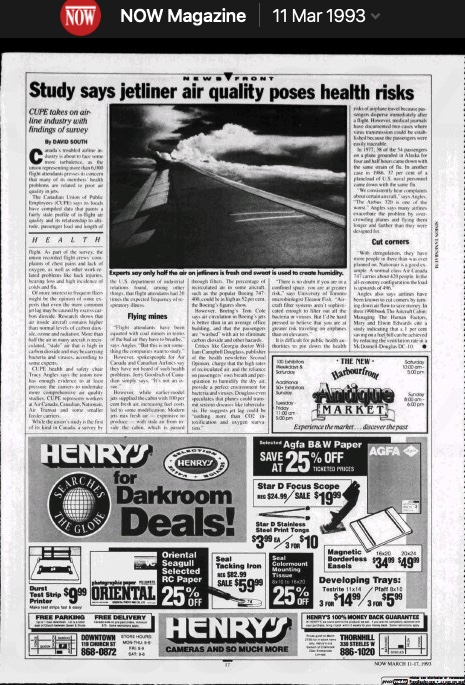
  • Study Says Jetliner Air Quality Poses Health Risks: CUPE Takes On Airline Industry With Findings Of Survey

    Study Says Jetliner Air Quality Poses Health Risks: CUPE Takes On Airline Industry With Findings Of Survey

    By David South

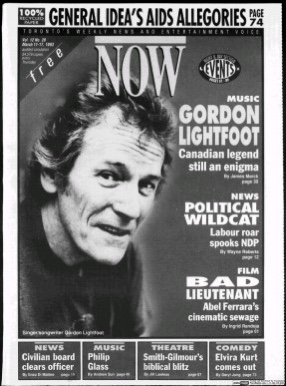
    Now Magazine (Toronto, Canada), March 11-17, 1993

    Canada’s troubled airline industry is about to face some more turbulence, as the union representing more than 6,000 flight attendents presses its concern that many of its members’ health problems are related to poor air quality in jets.

    The Canadian Union of Public Employees (CUPE) says its locals have compiled data that paints a fairly stale profile of in-flight air quality and its relationship to altitude, passenger load and length of flight. As part of the survey, the union recorded flight crews’ complaints of chest pains and lack of oxygen, as well as other work-related problems like back injuries, hearing loss and high incidence of colds and flu.

    Of more interest to frequent fliers might be the opinion of some experts that even the more common jet lag may be caused by excess carbon dioxide, ozone and radiation. More than half the air in many aircraft is recirculated, “stale” air that is high in carbon dioxide and may be carrying bacteria and viruses, according to some experts.

    CUPE health and safety chair Tracy Angles says the union now has enough evidence to at least pressure the carriers to undertake more comprehensive air quality studies. CUPE represents workers at Air Canada, Canadian, Nationair, Air Transat and some smaller feeder carriers.

    While the union’s study is the first of its kind in Canada, a survey by the US department of industrial relations found, among other things, that flight attendents had 20 times the expected frequency of respiratory illness.

    Flying mines

    “Flight attendants have been equated with coal miners in terms of the bad air they have to breathe,” says Angles. “But this is not something the companies want to study.”

    However, spokespeople for Air Canada and Canadian Airlines say they have not heard of such health problems. Jerry Goodrich of Canadian simply says, “It’s not an issue.”

    However, while earlier-model jets supplied the cabin with 100 per cent fresh air, increasing fuel costs led to some modification. Modern jets mix fresh air – expensive to produce – with stale air from inside the cabin, which is passed through filters. The percentage of recirculated air in some aircraft, such as the popular Boeing 747-400, could be as high as 52 per cent, Boeing’s figures show.

    Boeing’s Tom Cole says air circulation in Boeing’s jets is better than in an average office building, and that the passengers are “washed” with air to eliminate carbon dioxide and other hazards.

    Critics like Georgia doctor William Campbell Douglass, publisher of the health newsletter Second Opinion, charge that the high rates of recirculated air, and the reliance on passengers’ own breath and perspiration to humidify the dry air, provide a perfect environment for bacteria and viruses. Douglass even speculates that planes could transmit serious diseases like tuberculosis. He suggests jet leg could be “nothing more than CO2 intoxification and oxygen starvation.”

    “There is no doubt if you are in a confined space, you are at greater risk,” says University of Toronto microbiologist Eleanor Fish. “Aircraft filter systems aren’t sophisticated enough to filter out all the bacteria and viruses. But I’d be hard pressed to believe that you are at greater risk traveling on airplanes than on elevators.”

    It is difficult for public health authorities to pin down the health risks of airplane travel because passengers disperse immediately after a flight. However, medical journals have documented two cases where virus transmission could be established because the passengers were easily traceable.

    In 1977, 38 of the 54 passengers on a plane grounded in Alaska for a four and a half hours came down with the same strain of flu.

    “We consistently hear complaints about certain aircraft,” says Angles. “The Airbus 320 is one of the worst.”

    Angles says many airlines exacerbate the problem by over-crowding planes and flying them longer and farther than they were designed for.

    Cut corners

    “With deregulation, they have more people in there than was ever planned on. Nationair is a good example. A normal class Air Canada 747 carries about 420 people. In the all-economy configuration the load is upwards of 496.”

    Angles also says airlines have been known to cut corners by turning down air flow to save money. In their 1990 book The Aircraft Cabin: Managing the Human Factors, Mary and Elwin Edwards cite a study indicating a 1 per cent saving on a fuel bill can be achieved by reducing the ventilation rate in a McDonnel-Douglas DC-10.

    More resources: 

    April 2021

    Airqualitynews.com Terror at 20,000 feet

    A new global campaign and film asks whether the air we breathe on commercial flights is as safe as we think it is.

    Another issue, which frequently gets overlooked, is the quality of the air passengers breathe onboard

    In February, a global campaign was launched by the Global Cabin Air QualityExecutive (GCAQE), which called for the mandatory introduction of effective filtration and warning systems, to be installed on all commercial passenger jet aircraft.

    According to the GCAQE, there have been 50 recommendations and findings made by 12 air accident departments globally over the last 20 years, directly related to contaminated air exposures on passenger jet aircraft.

    However, commercial aircraft continue to fly, with no contaminated air warning systems to inform passengers and crews when the air they are breathing is contaminated.”

    Jetliner Cabins Are Quickly Cleared of Virus, Pentagon Says

    “Particles the size of the new coronavirus are quickly purged from a commercial aircraft cabin, according to a U.S. Defense Department study touted by United Airlines Holdings Inc. in its effort to reassure wary travelers.

    Filtration systems and rapid air-exchange rates mean that only about 0.003% of infected particles entered a masked passenger’s breathing zone, said the report, released Thursday.”

    Aircraft Air Quality – Protecting Against Contaminants, Association of Flight Attendants

    “On October 5, 2018, a 5-year FAA bill became law. Included in the bill is a study on technologies to combat contaminated bleed air. This is significant progress!”

    ‘Contaminated air’ on planes linked to health problems, 21 June 2017

    AEROTOXIC SYNDROME: A NEW OCCUPATIONAL DISEASE?, Public Health Panorama, Volume 3, Issue 2, June 2017

    Influenza Air Transmission, Influenza A (H1N1) Blog, September 28, 2009

    “What does this tell us? Aerosols, very small particles of saliva containing the virus we exhale when we sneeze or even when we breathe if we have the flu, probably have an important role in the transmission of influenza. In addition to that we have public transportation, with a great number of people circulating in a place that may be closed and badly ventilated at times and we may have a notion of the importance of public campaigns that promote education and awareness of contaminated people to avoid leaving their homes when they have the flu and that they cover their mouth and nose with a disposable tissue when they sneeze and discard it right after that.”

    2006

    Tuberculosis and Air Travel: Guidelines for Prevention and Control

    “The revised International Health Regulations, adopted in 2005, provide a legal framework for a more effective coordinated international response to emergencies caused by outbreaks of infectious diseases. A number of provisions are relevant to the detection and control of TB during air travel, strengthening the authority of WHO and of national public health authorities in this domain. Because of these important developments since the original guidelines were issued in 1998, WHO has prepared this revised version to take account of current public health risks that may arise during air travel and new approaches to international collaboration in dealing with them. The guidelines were developed with the collaboration of international experts in air travel medicine and other authorities. Implementing the recommendations will help to reduce the spread of dangerous pathogens across the globe and decrease the risk of infection among individual travellers.

    An outbreak of influenza aboard a commercial airliner, American Journal of Epidemiology, Volume 110, Issue 1, July 1979

    “A Jet airliner with 54 persons aboard was delayed on the ground for three hours because of engine failure during a takeoff attempt. Most passengers stayed on the airplane during the delay. Within 72 hours, 72 per cent of the passengers became III with symptoms of cough, fever, fatigue, headache, sore throat and myalgia. One passenger, the apparent Index case, was III on the airplane, and the clinical attack rate among the others varied with the amount of time spent aboard. Virus antigenlcally similar to A/Texas/1/ (H3N2) was Isolated from 8 of 31 passengers cultured, and 20 of 22 ill persons tested had serologic evidence of infection with this virus. The airplane ventilation system was inoperative during the delay and this may account for the high attack rate.”

    The Airliner Cabin Environment and the Health of Passengers and Crew.

    “At the end of its review of health data in the 1986 report The Airliner Cabin Environment: Air Quality and Safety, the National Research Council (NRC) committee concluded that “available information on the health of crews and passengers stems largely from ad hoc epidemiologic studies or case reports of specific health outcomes [and] conclusions that can be drawn from the available data are limited to a great extent by self-selection…and lack of exposure information” (NRC 1986). This chapter reviews data on possible health effects of exposure to aircraft cabin air that have emerged since the 1986 report and the emergence of data resources (e.g., surveillance systems) and studies that have particular relevance for the evaluation of potential health effects related to aircraft cabin air quality. Selected earlier sources are also reviewed. The decision to ban tobacco-smoking on domestic airline flights in 1987 and on flights into and out of the United States in 1999 reduces the relevance of some studies of exposures and reported signs and symptoms that clearly could have been related to the products of tobacco smoke.” 

    ORCID iD: https://orcid.org/0000-0001-5311-1052.

    © David South Consulting 2021