Launched in May 2011, the new global magazine Southern Innovator (ISSN 2222-9280) is about the people across the global South shaping our new world, eradicating poverty and working towards the achievement of the Millennium Development Goals (MDGs).
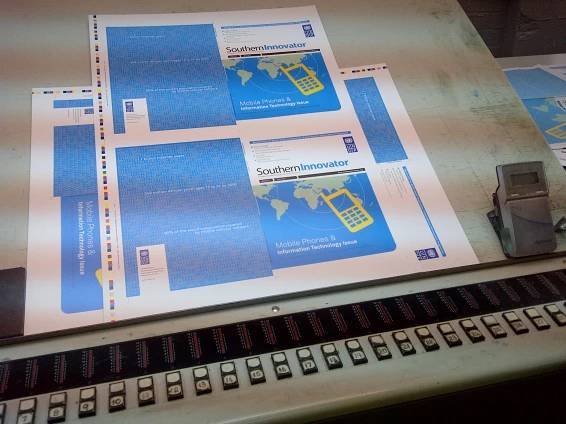
The second issue of Southern Innovator was printed in 2012 in Iceland by Ísafoldarprentsmiðja, a Nordic Ecolabelled printer (ISSN 2227-0523/2222-9280).
Launched in May 2011, the new global magazine Southern Innovator (ISSN 2222-9280) is about the people across the global South shaping our new world, eradicating poverty and working towards the achievement of the Millennium Development Goals (MDGs).
The UN estimates that 500 million people around the world are homeless, and UNICEF estimates India alone has 11 million homeless children on its streets (though it is difficult to pin down the figure). In order to survive another day, these children will work in one way or another. While there are many campaigns to ban children from working, and charities dedicated to getting them off the streets and into shelter, the raw fact remains: many of these children slip through the cracks and remain vulnerable, poor and neglected.
Most street children suffer from malnutrition, hunger, health problems, and abuse. They make ends meet by working various jobs or by stealing. While they have dreams, there is no mechanism for them to save for the future. It is a live-for-now existence that, if they survive to adulthood, means they will probably remain homeless and vulnerable.
Street and working children have money: it is a natural consequence of having to be resourceful to survive. But what they don’t have is access to banking services or trustworthy financial advice that can help them to gain wealth and move out of poverty and into a brighter future.
The Children’s Development Bank in India is one initiative that seeks to turn these neglected children into the next generation of entrepreneurs. The bank works on banking and co-operative principles, where savers are members and joint owners of the bank. Any child can save money with the bank and earn interest, as well as take out loans if they are over 15 years old. It was started in 2001 and was inspired by the Youth Bank in the UK. Interest made by the bank is shared by its members, as with many co-operative banks and credit unions.
The bank is managed jointly by children and adults. The children have a say in how the bank is run and on what conditions it should lend money. They also keep an eye on borrowers to prevent them from running off without repaying loans.
For these vulnerable children, it has many advantages: they can put money aside without fear of it being stolen or lost, save for important things like clothes, or pay for their education.
A key part of the bank’s mandate is helping the children build entrepreneurial skills for business. Mentors help the children choose a business model, select an occupation with minimal risk and more benefits, get training and solve business problems.
The bank has branches in India, Afghanistan, and Sri Lanka.
Ten-year-old Deepak Prahlad, a street child in Delhi, dreams of being a doctor.
“I know what it takes to be a doctor. I need to study hard and need to save a lot of money,” he told the Hindustan Times. For now, he works as a rag picker but has started saving 30 to 40 rupees a day in the Children’s Development Bank. The bank has 1,300 members in the city. It pays 3.5 per cent interest on savings accounts.
“Some of them want to fly very high,” said Rita Panicker, who helped set up the bank in 2001. “We have been working with street children for the past two decades. Some of these children are very talented and have entrepreneur qualities. One of the biggest problems facing these children was that they did not have a safe place to keep their hard-earned money. In fact, it was the children who came up with the idea of the children’s bank. It started with 20 members in 2001 – and now it has 1,300 members in Delhi.”
Sudesh, a 15-year-old manager who looks after the bank’s current accounts, said: “We are extremely careful about whom to offer loans since we do not want to see our members’ savings lost because of bad loans. The skills I have learnt here are going to stand me in good stead in life.” Managers are chosen every six months by the children and they compete for the job.
Published: November 2007
Resources
Making Cents International: “It inspires youth, practitioners, policy makers and funders to more effectively share and develop parnerships, programmes and policies that support youth entrepreneurs.”
Development Challenges, South-South Solutions was launched as an e-newsletter in 2006 by UNDP’s South-South Cooperation Unit (now the United Nations Office for South-South Cooperation) based in New York, USA. It led on profiling the rise of the global South as an economic powerhouse and was one of the first regular publications to champion the global South’s innovators, entrepreneurs, and pioneers. It tracked the key trends that are now so profoundly reshaping how development is seen and done. This includes the rapid take-up of mobile phones and information technology in the global South (as profiled in the first issue of magazine Southern Innovator), the move to becoming a majority urban world, a growing global innovator culture, and the plethora of solutions being developed in the global South to tackle its problems and improve living conditions and boost human development. The success of the e-newsletter led to the launch of the magazine Southern Innovator.
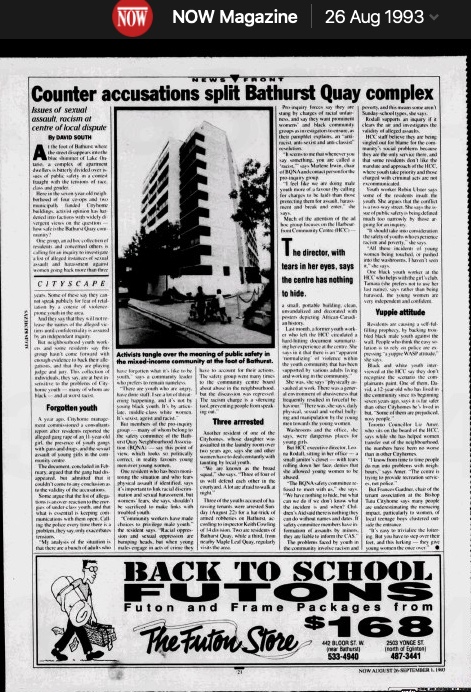
At the foot of Bathurst where the street disappears into the blue shimmer of Lake Ontario, a complex of apartment dwellers is bitterly divided over issues of public safety in a contest fraught with the tensions of race, class and gender.
Here in the seven-year-old neighbourhood of four co-ops and two municipally funded Cityhome buildings, activist opinion has hardened into factions with widely divergent views on one question – how safe is the Bathurst Quay community?
One group, an ad hoc collection of residents and concerned others is calling for an inquiry to investigate a list of alleged instances of sexual assault and harassment against women going back more than three years. Some of these say they cannot speak publicly for fear of retaliation by a coterie of violence-prone youth in the area.
And they say that they will not release the names of the alleged victims until confidentiality is assured by an independent inquiry.
But neighbourhood youth workers and some residents say this group hasn’t come forward with enough evidence to back their allegations, and that they are playing judge and jury. This collection of individuals, they say, are at best insensitive to the problems of Cityhome youth – many of whom are black – and at worst racist.
Forgotten youth
A year ago, Cityhome management commissioned a consultants report after residents reported the alleged gang rape of an 11-year-old girl, the presence of youth gangs with guns and drugs, and the sexual assault of young girls in the community centre.
The document, concluded in February, argued that the gang had disappeared, but admitted that it couldn’t come to any conclusion as to the validity of the accusations.
Some argue that the list of allegations is an over-reaction to the energies of under-class youth, and that what is essential is keeping communications with them open. Calling the police every time there is a problem, they say, only exacerbates tensions.
“My analysis of the situation is that there are a bunch of adults who have forgotten what it’s like to be youth,” says a community leader who prefers to remain nameless.
“There are youth who are angry, have done stuff, I see a lot of threatening happening, and it’s not by young black youth. It’s by articulate, middle-class white women. It’s sexist, ageist and racist.”
But members of the pro-inquiry group – many of whom belong to the safety committee of the Bathurst Quay Neighbourhood Association (BQNA) – say this point of view, which looks so politically correct, in reality favours young men over young women.
One resident who has been mintoring the situation and who fears physical assault if identified, says it’s important to link racial discrimination and sexual harassment, but women’s fears, she says, shouldn’t be sacrificed to make links with troubled youth.
“Community workers have made choices to privilege male youth,” the resident says. “Racial oppression and sexual oppression are bumping heads, but when young males engage in acts of crime they have to account for their actions. The safety group went many times to the community centre board about abuse in the neighbourhood, but the discussion was repressed. The racism charge is a silencing tool, preventing people from speaking out.”
Three arrested
Another resident of one of the Cityhomes, whose daughter was assaulted in the laundry room over two years ago, says she and other women have to deal constantly with taunting by local youth.
“We are known as the broad squad,” she says. “Three or four of us will defend each other in the courtyard. A lot are afraid to walk at night.”
Three of the youths accused of harassing tenants were arrested Sunday (August 22) for a hat-trick of armed robberies on Bathurst, according to Keith Cowling of 14 Division. Two are residents of Bathurst Quay, while a third, from nearby Maple Leaf Quay, regularly visits the area.
Pro-inquiry forces say they are stung by charges of racial unfairness, and say they want prominent womens’ and black community groups as investigators to ensure, as their pamphlet explains, an “anti-racist, anti-sexist and anti-classist” resolution.
“It seems to me that whenever you say something, you are called a ‘racist’,” says Marlene Irwin, chair of BQNA and contact person for the pro-inquiry group.
“I feel we are doing male youth more of a favour (by calling for charges to be laid) than those protecting them for assault, harassment and break and enter,” she says.
Much of the attention of the ad hoc group focuses on the Harbourfront Community Centre (HCC) – a small, portable building, clean, unvandalized and decorated with posters depicting African-Canadian history.
Last month, a former youth worker who left the HCC circulated a hard-hitting document summarizing her experience at the centre. She says in it that there is an “apparent ‘normalizing’ of violence within the youth community that has been supported by various adults living and working in the community.”
She was, she says “physically assaulted at work. There was a general environment of abusiveness that frequently resulted in forceful behaviour.” There was, she says, daily physical, sexual and verbal bullying and manipulation by the young men towards the young women.
Washrooms and the office, she says, were dangerous places for young girls.
But HCC executive director, Leona Rodall, sitting in her office – a small janitor’s closet – with tears rolling down her face, denies that she allowed young women to be abused.
“The BQNA safety committee refused to meet with us,” she says. “We have nothing to hide, but what can we do if we don’t know what the incident is and when? Children’s Aid said there is nothing they can do without names and dates. If safety committee members have information of assaults by minors, they are liable to inform the CAS.”
The problems faced by youth in the community involve racism and poverty, and this means some aren’t Sunday-school types, she says.
Rodall supports an inquiry if it clears the air and investigates the validity of the alleged assaults.
HCC staff believe they are being singled out for blame for the community’s social problems because they are the only service there, and that some residents don’t like the mandate and approach of the HCC, where youth take priority and those charged with criminal acts are not excommunicated.
Youth worker Robin Ulster says some of the residents insult the youth. She argues that the conflict is a two-way street. She says the issue of public safety is being defined much too narrowly by those arguing for an inquiry.
“It should take into consideration the safety of youths who experience racism and poverty,” she says.
“All these incidents of young women being touched, or pushed into the washrooms, I haven’t seen it,” she says.
One black youth worker at the HCC who helps with the girl’s club, Tamara (she prefers not to use her last name), says rather than being harassed, the young women are very independent and confident.
Yuppie attitude
Residents are causing a self-fulfilling prophecy, by backing troubled black male youth against the wall. People who think the easy solution is to rely on police are expressing a “yuppie WASP attitude”, she says.
Black and white youth interviewed at the HCC say they don’t recognize the scenario the complainants paint. One of them, David, a 12-year-old who has lived in the community since its beginning seven years ago, says it is far safer than other Cityhomes he’s lived in, but “Some of them are prejudiced, nosy people.”
Toronto Councillor Liz Amer, who sits on the board of the HCC, says while she has helped women transfer out of the neighbourhood, the numbers have been no worse than in other Cityhomes.
“I know from time to time people do run into problems with neighbours,” says Amer. “The centre is trying to provide recreation services, not police.”
But Francis Gardner, chair of the tenant association at the Bishop Tutu Cityhome says many people are underestimating the menacing impact, particularly for women, of local teenage boys clustered outside the entrance.
“It’s easy to trivialize the loitering. But you have to step over their feet, and this lurking – they give young women the once over.”



















 David South Consulting
You must be logged in to post a comment.