Tag: Youth

  • Ghana Wants to Tap Global Trendy Party Scene

    Ghana Wants to Tap Global Trendy Party Scene

    By David SouthDevelopment Challenges, South-South Solutions

    SOUTH-SOUTH CASE STUDY

    Tourism is big business – and one of the most resilient parts of the global economy. Despite the international economic crisis that has wreaked havoc and increased unemployment and poverty in many countries since 2007, tourism is still going strong.

    The UN’s World Tourism Organization (UNWTO) (http://www2.unwto.org/) found international tourist arrivals grew by 5 per cent during the first half of 2013 from the same period in 2012, reaching 500 million arrivals.

    “The fact that international tourism grew above expectations confirms that traveling is now part of consumer patterns for an increasing number of people in both emerging and advanced economies,” said UNWTO Secretary-General Taleb Rifai. “This underlines the need to rightly place tourism as one of the key pillars of socio-economic development, being a leading contributor to economic growth, exports and jobs.”

    One successful way to lure tourists, especially young tourists, is to nurture hubs of culture, outdoor activities, music and fashion around a holiday destination – generally one involving sun and sand. Such “party scenes” can be found in hotspots as far afield as Florida, the Spanish island of Ibiza and Koh Samui (http://www.kohsamui.com/) in Thailand. While at times annoying to local people, these groups of young tourists do bring significant wealth to smaller towns and seaside communities.

    And now there are some in Africa who want to replicate this successful business formula in beach communities.

    The Ghanaian fishing village of Kokrobrite (http://en.wikipedia.org/wiki/Kokrobite), located west of the capital, Accra, has become a nascent hub for a dance music scene and beach parties.

    “We are organizing an all-day-long beach party with DJs, food and partying, inspired by the kind of summer jams that are held in Miami,” Basil Anthony, Chief Executive of Silky Entertainment (http://www.silkyentertainment.com/), told The Guardian newspaper. Silky Entertainment is organizer of Ghana Summer Beach Rave 2013.

    “We are expecting partygoers in the thousands, and double the number we had last year. It’s going to be big.”

    Other popular events include Tidal Rave (http://www.youtube.com/watch?v=8f5Wy3g9Y7w), aimed at university students, and an upmarket champagne party at Bella Roma beach which attracts expats and wealthy Ghanaians.

    While these events have been very popular locally, ambitious entertainment entrepreneurs want to take the parties to the next level and make them truly global events, attracting tourists from around the world.

    “The next Ibiza will be in Africa. It has already started,” said Andrew Tumi, also known as Won, a singer from the group Supafly.

    “We are trying to recreate the good things about going to Ibiza, the music and the vibes. But more and more we are creating our own sound here, an Afro-house, reggae, African mashup… It’s really blending the African rhythm into a house scene.”

    Dance music is hot right now, and is being refreshed with new trends in Afro-house and Afro-pop from across the continent. This in turn is creating a demand for parties to celebrate and enjoy the music.

    The economic impact is considerable as the parties inspire other businesses to feed off the good vibrations. DJ MoBlack, who works in a nightclub in Accra, told The Guardian, “It’s not just the music, it’s a whole scene that’s on the rise – goods, fashion, jewelry – there is a style revolution happening around it. It’s a unique African vibe, but something that people everywhere can relate to.”

    The impact on the tourism sector is already quantifiable. Tourist visits to Ghana grew from 400,000 a year in 2005 to 1 million in 2011.

    Ben Ohene-Aryeh at the Ghana Tourism Authority (http://www.ghana.travel/) is optimistic bigger things are to come: “[The scene] is catching on well with the youth and now we hope that it will be done on a massive scale,” he said.

    There is, however, a downside to this strategy: drug use is on the increase. According to the West Africa Commission on Drugs (wacommissionondrugs.org), marijuana use is on the rise as well as harder drugs such as cocaine.

    It’s clear there are pitfalls to the youth-tourism strategy, but these can be managed with the right strategy – and the economic opportunities for small communities are substantial.

    Published: November 2013

    Resources

    1) Information on drug tourism from DARA Thailand: DARA is Asia’s first and leading international destination for drug and alcohol rehabilitation. Website: http://alcoholrehab.com/alcohol-rehab/drug-tourism/

    2) 3rd UNWTO International Conference on Tourism and the Media: How new media is shaping the news: With the rise of the new media, both the media landscape and the way stories are being told are changing. Millions of consumers now have the possibility to directly engage in the editorial process due to faster than ever evolving technology. More recently, mobile technology and a myriad of applications for smart phone devices are increasingly influencing communication flows. Website: http://www2.unwto.org/en/event/3rd-unwto-international-conference-tourism-and-media-how-new-media-shaping-news

    3) The UNWTO World Tourism Barometer: A regular publication of the Tourism Trends and Marketing Strategies Programme of UNWTO aimed at monitoring the short-term evolution of tourism and providing the sector with relevant and timely information. Website: http://mkt.unwto.org/en/barometer

    Tourism Investment and Business Forum for Africa: INVESTOUR is an annual tourism business and knowledge exchange platform in which representatives of African tourism and potential Spanish and Portuguese investors/partners meet to discuss about business and cooperation opportunities. Website: http://africa.unwto.org/en/event/v-tourism-investment-and-business-forum-africa-investour-edition-2014-madrid-spain

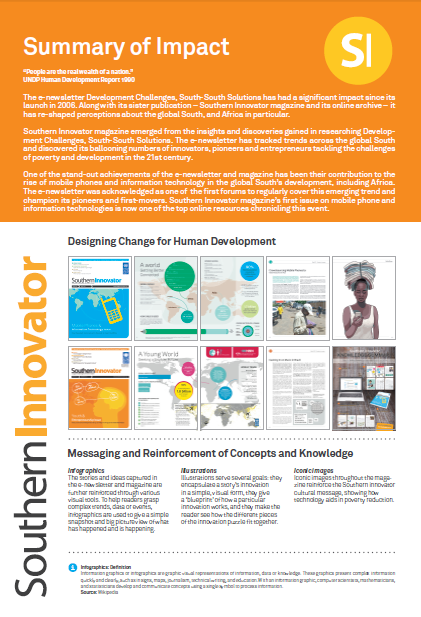
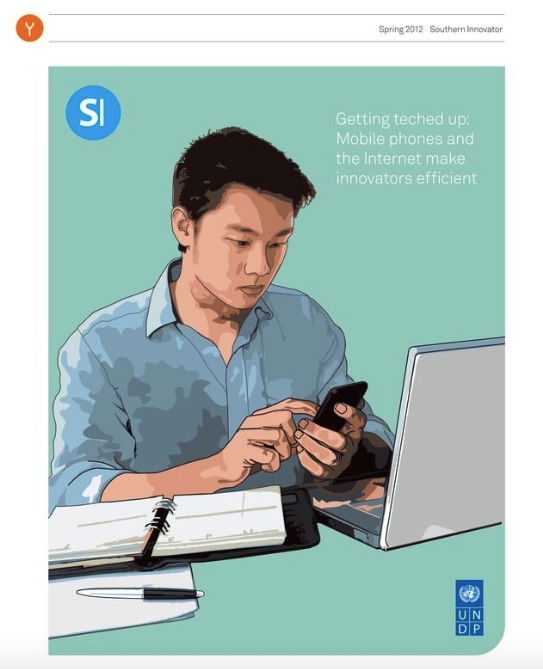
    Development Challenges, South-South Solutions was launched as an e-newsletter in 2006 by UNDP’s South-South Cooperation Unit (now the United Nations Office for South-South Cooperation) based in New York, USA. It led on profiling the rise of the global South as an economic powerhouse and was one of the first regular publications to champion the global South’s innovators, entrepreneurs, and pioneers. It tracked the key trends that are now so profoundly reshaping how development is seen and done. This includes the rapid take-up of mobile phones and information technology in the global South (as profiled in the first issue of magazine Southern Innovator), the move to becoming a majority urban world, a growing global innovator culture, and the plethora of solutions being developed in the global South to tackle its problems and improve living conditions and boost human development. The success of the e-newsletter led to the launch of the magazine Southern Innovator. 
    Creative Commons License

    This work is licensed under a
    Creative Commons Attribution-Noncommercial-No Derivative Works 3.0 License.

    ORCID iD: https://orcid.org/0000-0001-5311-1052.

    © David South Consulting 2023

  • Rwandan Coffee Brand Boost

    Rwandan Coffee Brand Boost

    By David SouthDevelopment Challenges, South-South Solutions

    SOUTH-SOUTH CASE STUDY

    A successful Rwandan company is using coffee shops to promote the nation’s high-quality coffee brands at home and abroad. Started by two Rwandan entrepreneurs three years ago, Bourbon Coffee (http://www.bourboncoffeeusa.com) now has three shops in the country’s capital, Kigali, and a savvily positioned shop in Washington DC.

    While Rwandan coffee has built a good international reputation, the country’s more than 500,000 coffee farmers (mostly small-scale) previously depended on the product’s reputation alone. But Bourbon Coffee joins several other initiatives changing this situation and starting to significantly raise the profile of Rwandan coffee and build the Rwanda brand.

    The East African nation experienced the horrific genocide of almost 1 million people in 1994. Ever since, the country has been on a journey to reconcile with the damage done during this time and move on to a more prosperous future for all its citizens. A key part of the country’s future success will be its economic prosperity. And historically, coffee has played a critical role in Rwanda’s economy.

    The Bourbon Coffee chain of shops (taking its name from the high quality Bourbon coffee varietal (http://en.wikipedia.org/wiki/List_of_coffee_varieties) which accounts for the majority of Rwandan coffee), started with its first shop in Kigali in 2007. Started by Emmanuel Murekezi and Arthur Karuletwa, two Rwandans living in the United States, it is modelled on the popular American brand Starbucks (http://www.starbucks.com). The entrepreneurs admired the coffee culture experience found at Starbucks. Just as Starbucks heavily markets its complete quality control over the coffee experience, their philosophy is to produce great coffee from “crop to cup.”

    “There are over 500,000 farmers that own 100 to 200 trees in the back of their yards, so the only way they can come up with a product is to come together in a cooperative sense,” Karuletwa told the Washington Post. It is a learning experience for the Rwandan coffee farmers: they learn to work together, trust each other and be accountable to each other. “Neighbours that once killed each other and communities that once floated in the same bloodbath are now hand in hand producing one of the most amazing products.”

    “If done right, it could be the platform to re-brand the country,” continued Karuletwa, a former chief executive and now a shareholder in the company. Coffee can “create awareness that there’s recovery, there’s trade, there’s investment opportunities, there’s tourism. There’s life after death.”

    The importance of good design and a strong brand in the success of a business cannot be emphasised enough. That extra effort and thought can take a business from local success to regional and even global success. As consultants KPMG make clear, “For many businesses, the strength of their brands is a key driver of profitability and cash flow.” Yet the majority of small businesses fail to think about their brand values or how design will improve their product or service.

    The shops have a very tasteful modern, African design and feel. African sculpture and furniture are surrounded by African artwork. The shop’s logo is an eye-catching orange and there is an overall recognizable brand identity for the entire Bourbon Coffee concept.

    The founders see it as an opportunity to educate people about the health benefits of coffee culture and the joys of the lifestyle. They proudly serve only Rwandan coffee and promote the national brands they serve, including Akagera, Kivu Lake, Kizi Rift, Muhazi and Virunga.

    Bourbon Coffee, in a clever move, opened the Washington branch in 2009 in a former Starbucks in a neighbourhood packed with aid organizations and NGOs, many of which work with Rwanda on projects.

    Karuletwa says Bourbon Coffee’s ambitious vision “is to stand as a symbol of a new era in African economic development, one in which African nations rise to participate directly in the global marketplace.”

    “Coffee is a very intimate, emotional product,” he said. “The preparation, the processes and the profiling of coffee is similar to wine.”

    The Rwandan branches can be found at the Union Trade Centre (UTC) in Kigali’s city centre, the MTN centre in Nyarutarama and Kigali airport.

    The business is funded by Rwandan investors Tristar (http://www.tri-starinvestments.com/index.html).

    Another initiative is the Rwandan Farmers Brand (http://www.rwandanfarmers.com). It also hopes to raise the profile of Rwandan coffee and drive more of the profits made into the hands of farmers. It is a joint venture between the foundations of former U.S. President Clinton and philanthropist Sir Tom Hunter. They fund all the brand’s creation and operation in partnership with 8,700 farmers. They have started selling Rwanda Medium Roast Ground in the United Kingdom’s Sainsbury’s supermarkets. Sixteen percent of sales are clear profit and returned to the farmers via their own Trust Fund.

    Karuletwa says he doesn’t want Rwandan coffee to be “a pity-driven mission”. It is all about the quality: “The value initiative here is because this coffee tastes great,” he says.

    And Bourbon Coffee is looking further afield to grow the brand: “We hope to expand even further,” Murekezi told Monocle magazine. “Congo, Burundi, Tanzania, but also Europe. We think the concept can work there too.”

    Published: August 2010

    Resources

    • East African Fine Coffees Association: All the latest news on events and initiatives for East Africa’s coffee producers. Website: http://www.eafca.org/
    • Brandchannel: The world’s only online exchange about branding, packed with resources, debates and contacts to help businesses intelligently build their brand. Website: www.brandchannel.com
    • Small businesses looking to develop their brand can find plenty of free advice and resources here. Website: www.brandingstrategyinsider.com
    • The red dot logo stands for belonging to the best in design and business. The red dot is an internationally recognized quality label for excellent design that is aimed at all those who would like to improve their business activities with the help of design. Website: http://www.red-dot.de
    • Dutch Design in Development: The Dutch NGO works with producers to develop skills and adapt producers’ products to present and future demands in Europe. By following this approach, Southern producers can reduce the risk of making products nobody wants, or that lack originality in the marketplace and thus won’t sell. Website: http://www.ddid.nl/english/index.html

    https://davidsouthconsulting.org/2021/03/12/afro-coffee-blending-good-design-and-coffee/

    https://davidsouthconsulting.org/2022/09/29/the-battle-for-indias-coffee-drinkers-in-buzzing-economy/

    https://davidsouthconsulting.org/2021/10/03/civet-cat-coffee-brews-filipino-opportunity/

    https://davidsouthconsulting.org/2021/01/08/haitian-coffee-becoming-a-hit-with-american-connoisseurs/

    Development Challenges, South-South Solutions was launched as an e-newsletter in 2006 by UNDP’s South-South Cooperation Unit (now the United Nations Office for South-South Cooperation) based in New York, USA. It led on profiling the rise of the global South as an economic powerhouse and was one of the first regular publications to champion the global South’s innovators, entrepreneurs, and pioneers. It tracked the key trends that are now so profoundly reshaping how development is seen and done. This includes the rapid take-up of mobile phones and information technology in the global South (as profiled in the first issue of magazine Southern Innovator), the move to becoming a majority urban world, a growing global innovator culture, and the plethora of solutions being developed in the global South to tackle its problems and improve living conditions and boost human development. The success of the e-newsletter led to the launch of the magazine Southern Innovator. 

    https://davidsouthconsulting.org/2021/03/05/southern-innovator-issue-2/

    Creative Commons License

    This work is licensed under a
    Creative Commons Attribution-Noncommercial-No Derivative Works 3.0 License.

    ORCID iD: https://orcid.org/0000-0001-5311-1052.

    © David South Consulting 2022

  • Freaky – The 70s Meant Something

    Freaky – The 70s Meant Something

    By David South

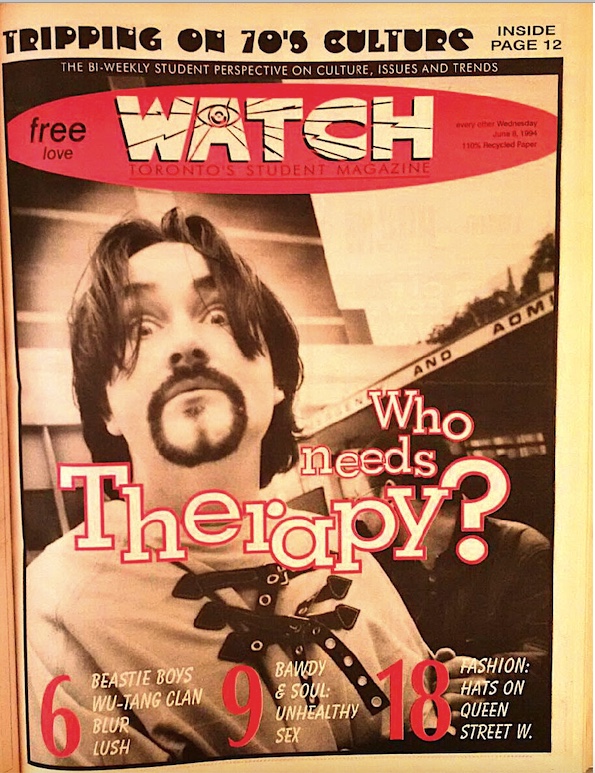
    Watch Magazine (Toronto, Canada), June 8, 1994

    It was the decade of the happy face, bell-bottoms, avocado fridges, disco and the Bay City Rollers; in short, the 70s was a pimple on the ass of history, better evaporated in a pot haze on a waterbed. Not so says 70s-obsessed author Pagan Kennedy, who believes the much-maligned decade is the victim of a bum rap perpetuated by the idolization of the 60s.

    Kennedy says the 70s saw all the radical ideas and culture of the 60s go mainstream and mutate in a way the hippies couldn’t imagine.

    Social relations and culture were profoundly reshaped during this decade as the non-traditional family took form, women flooded the workplace and unions became rich monoliths.

    The social turmoil spawned blue collar red-necks with Confederate flags customizing fuck trucks – vans complete with waterbed, eight-track stereo, bong and sleazy airbrushed exteriors of naked women –  to cruise the nation’s highways enjoying the liberal sexual values while keeping conservative political views. Sexual liberation for these clowns consisted of bumper stickers saying “Ass, gas or grass – nobody rides for free!”. Kennedy remembers it all too well.

    “This was the midst of the energy crisis, so big cars that wasted a lot of gas were really cool,” she says. “I guess it came out of the whole drug culture, sex culture thing. It was like a basement kids have, only it was on wheels – a party on wheels. It’s not just the mattress for the fuck truck, you’re supposed to be doing your bong hits in there – so the police can’t see you.”

    Sex holidays

    “Our lives are much more constrained than they were in the 70s,” continues Kennedy. “I think the 70s must seem like an exotic time to grow up in. One of my favourite parts in Douglas Coupland’s Generation X is when the characters want to take a sex holiday to 1974.

    “There was a lot of obsession in the early 70s with swingers and wife-swapping. It was the one time when suddenly the sexual revolution was kicking in, not just for white, privileged college kids, but for everybody – for the working class. There were discos and orgy clubs. There was Plato’s Retreat in New York City where you would go in and there was an orgy in full progress.”

    In music, the 70s rocketed between extremes. There was nauseating soft rock, concept albums and “progressive” rock. There was the outrageous glam, with artists like Slade and Gary Glitter jacked up on elevator shoes in sequin one-piece flare suits. There was disco and punk. But the sickest phenomena says Kennedy was corporate rock.

    David Cassidy

    “In the 60s, people were just learning how to package rock and make it a big corporate thing. By the 70s they had learned a lot. The Partridge Family was a group that was entirely fabricated. David Cassidy had a bigger fan club than Elvis. This was a guy who didn’t become a rock star until he went on TV. In the 60s, FM was alternative radio – you could play anything. Corporate guys got their hooks into FM by the 70s. They were formatting. It was no longer what the DJ wanted to hear. You were getting playlists. The money came from big rock concerts, so there was a desire to push these mega-groups and superstars.”

    Another truly 70s phenomena was TV as social conscience. Before the 70s, TV variety shows focused on pure entertainment. But now writers, directors and producers schooled in the 60s political milieu were in control.

    Blaxploitation

    “All in the Family, Maude and Good Times were all part of the same world. All in the Family acknowledged the deep rifts in American society – America was at war with itself. Yet it did it in a soft enough way to not offend people.”

    US blacks had been ignored until the civil rights struggle of the 1960s woke up a dopey white America. In the 1970s, blacks were being portrayed like never before in the media and popular culture. But all of this awareness took a twisted turn.

    “I think what happened among blacks was they saw their leaders either killed or put in jail. And that was devastating. Blacks really turned to electoralism in the 70s. A lot of black people started running for office. While trying to change things from outside the system, they realized the price was too high. A lot of black people were involved in making those blaxploitation movies, but so were a lot of white people. Shaft and Superfly are like the bookends of the genre. They were really made by black filmmakers. But then there were all these ripoff versions starring football players – whitebread ideas of what black culture was like.”

    Pagan Kennedy’s latest book, Platforms: A Microwaved Cultural Chronicle of the 1970s, is published by St. Martin’s Press and available in most book shops. She’s got a really cool collection of eight-track tapes and drives a yetch! 1974 Plymouth Valiant.

    Her website is here: https://www.pagankennedy.space/

    “Tripping on 70s Culture”: Watch Magazine was published in Toronto, Canada in the 1990s. “The Bi-Weekly Student Perspective on Culture, Issues and Trends.”

    https://davidsouthconsulting.org/2022/11/16/canadian-magazines-newspapers-1990s/

    https://davidsouthconsulting.org/2021/06/14/case-study-1-investigative-journalism-1991-1997-2/

    https://davidsouthconsulting.org/2021/06/01/case-study-2-watch-magazine-1994-and-1996-2/

    https://davidsouthconsulting.org/2020/12/08/featured-in-new-book-busted-an-illustrated-history-of-drug-prohibition-in-canada-december-2017/

    https://davidsouthconsulting.org/2021/03/25/oasis-has-arrogance-a-pile-of-attitude-and-the-best-album-of-1994/

    https://davidsouthconsulting.org/2022/10/08/time-machines/

    https://davidsouthconsulting.org/2020/11/24/too-black/

    Creative Commons License

    This work is licensed under a
    Creative Commons Attribution-Noncommercial-No Derivative Works 3.0 License.

    ORCID iD: https://orcid.org/0000-0001-5311-1052.

    © David South Consulting 2023
  • Popular Chinese Social Media Chase New Markets

    Popular Chinese Social Media Chase New Markets

    By David SouthDevelopment Challenges, South-South Solutions

    SOUTH-SOUTH CASE STUDY

    China has a vast and growing market for the Internet and mobile devices. Over the past decade that market has been largely confined to China –  most businesses have had enough domestic demand and opportunities inside the country to keep them busy.

    But now companies in China’s dynamic Internet and mobile sector are seeking out new markets outside the country. Both online shopping service Alibaba (alibaba.com) and Weibo (weibo.com), the Chinese version of Twitter (twitter.com), are seeking to list on the New York Stock Exchange. The excitement this news has generated shows how many people want to get a piece of the large Chinese market for technology, social networks and online shopping. It is also sending a chill through America’s Silicon Valley – home to the country’s innovative high technology sector – that they are missing out on China’s fast-growing marketplace. Many American services are banned from operating in China. Even more worrying for Silicon Valley, these home-grown Chinese companies, with the market sewn up at home, are now set to compete globally for customers using their increasingly deep pockets.

    One example is Tencent (http://www.tencent.com/en-us/index.shtml), owner of popular Chinese social messaging application (app) Weixin (weixin.qq.com), known as WeChat (wechat.com) outside China. Used on mobile phones and smartphones, Weixin has gained 300 million users in just three years, becoming the dominant social messaging service in the world’s largest smartphone market. Its has been so successful that many rivals are trying to chip away at its customer base.

    Weixin, pronounced way-shin, allows smartphone users to send messages and share news, photos, videos and web links with friends. One of its selling points is its claim to not store messages on its servers.

    Building on its success in social networking in China, it is looking to expand in other markets, including Southeast Asia, Europe and Latin America. It also wants to grow its offerings in online payment and e-commerce.

    One factor in Weixin’s success is the ability to send messages by recording a voice message rather than just typing in characters: very useful for non-Latin script users, and especially for Chinese-language users, who use thousands of characters in everyday communication.

    One ambitious forecast claims Weixin could reach 400 million users and make US $500 million revenue within a year.

    Cosmetics marketer Jenny Zhao, who uses an iPhone 5, told The New York Times: “I’m probably on Weixin six hours a day. A lot of what I do revolves around it.”

    “I use Weixin every day,” said Zhang Shoufeng, a food and drinks seller. “My friends are on it and my boss is on it. We are talking about where to eat, where to hang out and where to meet for company conferences. This is how we communicate.”

    Analysts believe Weixin has benefitted from not having to compete with banned-in-China American company Facebook (facebook.com).

    “Even if Facebook had permission, it’s probably too late,” said Wang Xiaofeng, an analyst at Forrester Research. “Weixin has all the functionality of Facebook and Twitter, and Chinese have already gotten used to it.”

    Tencent is an example of a wider trend: As Chinese companies and offerings have become stronger, wealthier and more innovative, they increasingly look to build their customer base outside China.

    Founded in November, 1998, Tencent, Inc. has grown into China’s largest and most used Internet service portal. Its most popular services include QQ (QQ Instant Messenger), WeChat, QQ.com, QQ Games, Qzone, 3g.QQ.com, SoSo, PaiPai and Tenpay, as well as Weixin.

    The company claims to put innovation at the heart of its business, with more than half of its employees devoted to research and development. The Tencent Research Institute, established in 2007 with RMB 100 million (US $16 million), calls itself “China’s first Internet research institute, with campuses in Beijing, Shanghai, and Shenzhen.” It has patents for technologies it has developed for instant messaging, e-commerce, online payment services, search, information security, and gaming.

    Tencent was driven to innovate by a fear it could quickly become irrelevant in the information technology space. Weixin is also pioneering ways to book taxis, hotels and airline flights through the service and even ways to control home appliances.

    “Chinese Internet companies are no longer behind,” said William Bao Bean, a managing director at the venture capital firm SingTel Innov8 (http://innov8.singtel.com/). “Now in some areas, they’re leading the way.”

    Published: April 2014

    Resources

    1) Weibo: Sina Weibo is a Chinese microblogging (weibo) website. Akin to a hybrid of Twitter and Facebook, it is one of the most popular sites in China, in use by well over 30 per cent of Internet users, with a market penetration similar to what Twitter has established in the USA. Website: weibo.com

    2) Laiwang: A variation on the WeChat service, its biggest competitor. Website: laiwang.com

    3) WhatsApp: WhatsApp Messenger is a cross-platform mobile messaging app which allows you to exchange messages without having to pay for SMS. Website: whatsapp.com

    4) Southern Innovator Issue 1: Mobile Phones and Information Technology: Pioneering and innovative ways to deploy mobile phones and information technology to tackle poverty. Website: http://www.scribd.com/doc/57980406/Southern-Innovator-Magazine-Issue-1 and here: http://tinyurl.com/q6bfnpz

    https://davidsouthconsulting.org/2022/10/20/china-consumer-market-asian-perspective-helps/

    https://davidsouthconsulting.org/2020/12/10/china-sets-sights-on-dominating-global-smartphone-market/

    https://davidsouthconsulting.org/2021/03/20/computer-gold-farming-turning-virtual-reality-into-real-profits/

    https://davidsouthconsulting.org/2021/01/26/designed-in-china-to-rival-made-in-china/

    https://davidsouthconsulting.org/2022/10/26/tackling-chinas-air-pollution-crisis-an-innovative-solution/

    https://davidsouthconsulting.org/2020/04/17/virtual-supermarket-shopping-takes-off-in-china/

    Citation

    Qianyu, Ji (2014) “Exploring the Concept of QR Code and the Benefits of Using QR Code for Companies,” Lapland University of Applied Sciences, School of Business and Culture Degree Programme in Business Information Technology, 2014.

    Development Challenges, South-South Solutions was launched as an e-newsletter in 2006 by UNDP’s South-South Cooperation Unit (now the United Nations Office for South-South Cooperation) based in New York, USA. It led on profiling the rise of the global South as an economic powerhouse and was one of the first regular publications to champion the global South’s innovators, entrepreneurs, and pioneers. It tracked the key trends that are now so profoundly reshaping how development is seen and done. This includes the rapid take-up of mobile phones and information technology in the global South (as profiled in the first issue of magazine Southern Innovator), the move to becoming a majority urban world, a growing global innovator culture, and the plethora of solutions being developed in the global South to tackle its problems and improve living conditions and boost human development. The success of the e-newsletter led to the launch of the magazine Southern Innovator.  

    Creative Commons License

    This work is licensed under a
    Creative Commons Attribution-Noncommercial-No Derivative Works 3.0 License.

    ORCID iD: https://orcid.org/0000-0001-5311-1052.

    © David South Consulting 2025