Categories
Archive data Harvard Institute for International Development Special Unit for South-South Cooperation UNDP Mongolia 1997-1999 United Nations Development Programme United Nations Office for South-South Cooperation World Bank

Digital Transition (And Transformation) In International Development | 1997 – 2016

UNDP Mongolia Communications Coordinator (1997-1999): David South

I launched this portal in 1997, in the middle of a major economic crisis in Mongolia. This award-winning (winner in 1998 of the People’s Choice WebSite 500 award and the CyberTeddy Top 500 Website award) and pioneering United Nations Mongolia development web portal was singled out by UN headquarters as an example of what a country office website should be like.

At this time, Mongolia was still recovering from the chaotic and turbulent transition from Communism to free markets and democracy begun at the start of the 1990s, called by some “one of the biggest peacetime economic collapses ever” (Mongolia’s Economic Reforms: Background, Content and Prospects, Richard Pomfret, University of Adelaide, 1994). There was a thirst for information: access to the Internet was still limited and access to mobile phones was just the preserve of the rich. As a legacy of the past, information, especially that about the outside world and the country’s true economic and social conditions, was restricted. During the years of Communism, even simple travel from one place to the next was strictly regulated.

While today we can take it for granted the world’s information arrives in seconds via the Internet on mobile and smart phones and devices, this just was not the case in the late 1990s in Mongolia.
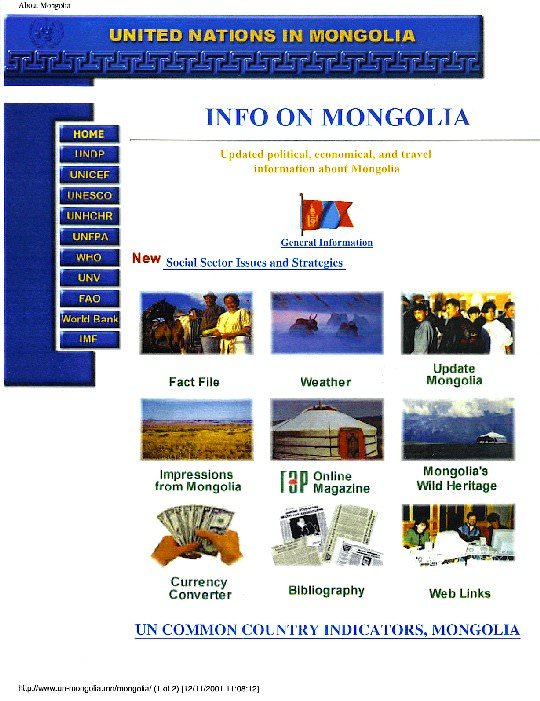
The UN/UNDP Mongolia development web portal addressed the urgent need to communicate what was happening in the country during a major crisis, and to transparently show what the UN was doing to address the crisis. It made critical data on the country’s development easy to find, and informed the wider world about the country and its people and culture. While the Internet had only just arrived in Mongolia, from the start the UNDP Mongolia Communications Office was experimenting with this powerful new technology to reach a global audience. This included Mongolia’s first web magazine, Ger (launched in 1998).
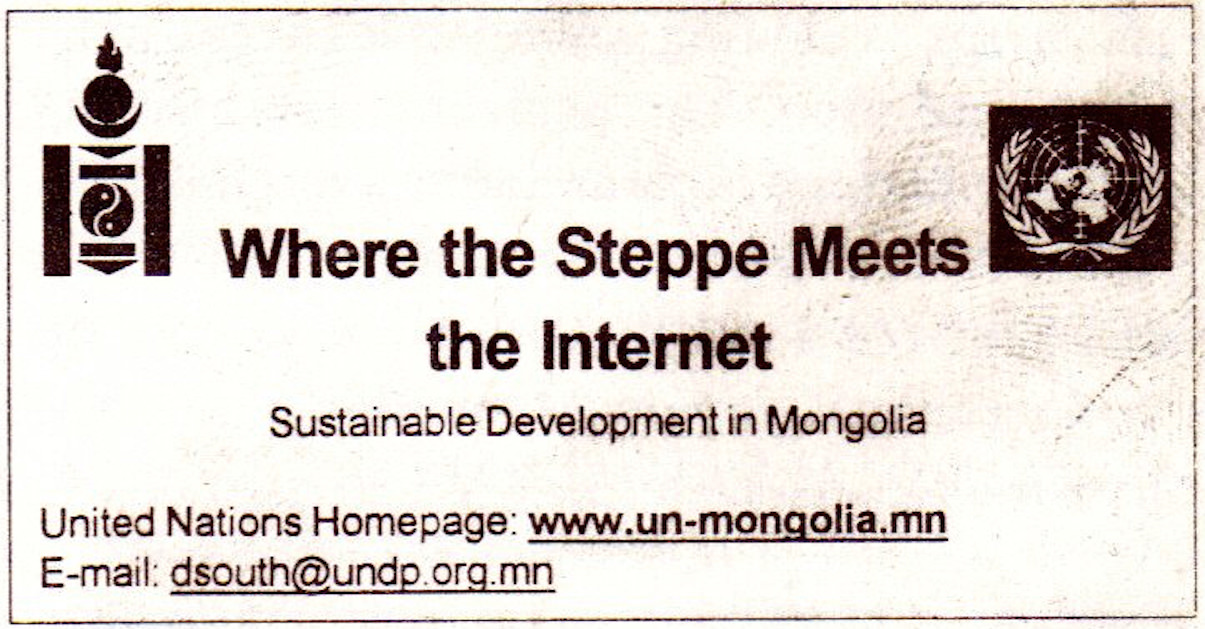
After the http://www.un-mongolia.mn website launched in 1997, a media campaign began to inform readers of its presence. This ad appeared regularly in magazines, newsletters and newspapers.

Ger Magazine was launched on September 9, 1998 (Ger is the Mongolian word for both the traditional tent dwelling and home). The theme of youth in the transition was explored by a combined team of Mongolian and foreign journalists. The Ger Magazine project had basically three goals: first, raise the quality of journalism in the country, secondly, introduce the country to a wider global audience and, thirdly, by being the country’s first online magazine, prove the Internet was an effective way to communicate. 

Issue 1 of the magazine investigated what life was like for youth during the transition years (post-1989). Stories tackled the struggle to find work in the free market, the booming pop music scene and how it is leading the way in business entrepreneurship, reproductive health, the basics on Mongolian culture, and vox pop views from Mongolian youth.
Issue 2 of the magazine investigated modern life in Mongolia during transition. The team of journalists were hitting their stride by this issue. Stories probed the proliferation of bars and the problem of alcoholism, corrupt banking practices and the loss of savings, how the young were the country’s leading entrepreneurs, Mongolia’s meat and milk diet, “girl power” and the strong role played by women, the burgeoning new media, the rise and rise of Buddhism, and Mongolia’s dynamic fashion designers (this article inspired foreign fashion designers to embrace the Mongolian ‘look’ in the next season’s designs).

https://en.wikipedia.org/wiki/Ger_(magazine)

The UN/UNDP Mongolia homepage quickly became the top resource for development news on Mongolia in the late 1990s.
“A UN System site. A very nice, complete, professional site. Lots of information, easily accessible and well laid out. The information is comprehensive and up-to-date. This is a model of what a UNDP CO web site should be.”
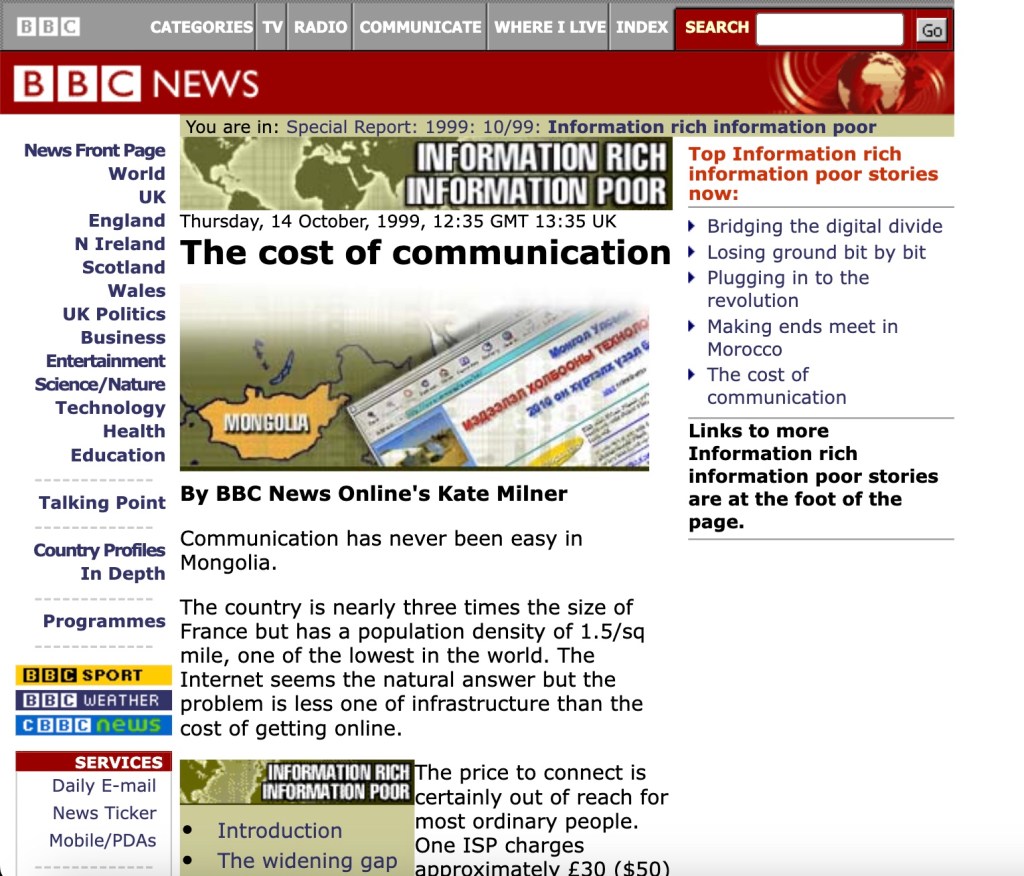
“Information Rich Information Poor: The cost of communication”, BBC News Online, Thursday, 14 October 1999.
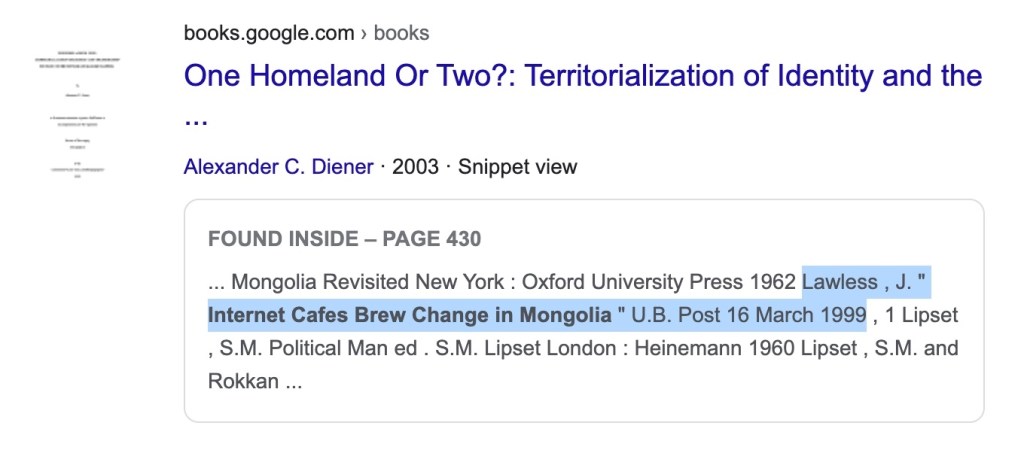
“Internet Cafes Brew Change in Mongolia”, UB Post 16 March 1999 by Jill Lawless, cited in One Homeland or Two?: Territorialization of Identity and the Migration Decision of the Mongolian-Kazakh Diaspora by Alexander C. Diener, 2003.
United Nations Cyber Center Ulaanbaatar, Mongolia: UNDP Mongolia established the first public internet cafe in its former headquarters as part of the UNDP Mongolia Communications Office hub in the late 1990s.
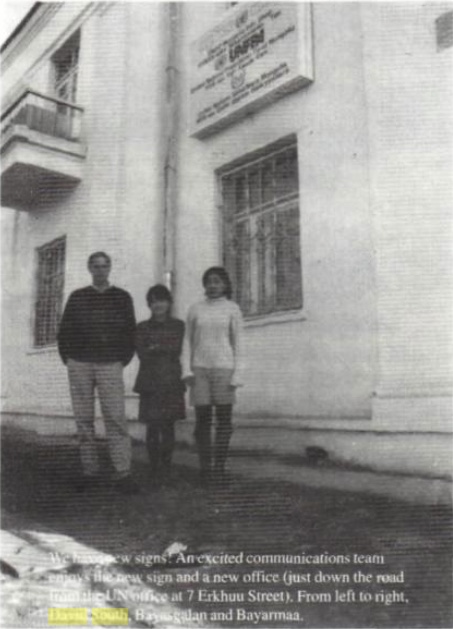
David South photographed outside the UNDP Mongolia Communications Office with team members Bayasgalan and Bayarmaa (Source:Blue Sky Bulletin, October-November 1998). The new sign (above right) accompanied the inauguration of the first UN public access services for Mongolians, including the UN Info Shop and the United Nations Cyber Center. The award-winning team won in 1998 the People’s Choice WebSite 500 award and the CyberTeddy Top 500 Website award for their work on the United Nations portal at http://www.un-mongolia.mn and the pioneering first UN online magazine, Ger.

Consultant (1999-2017): David South

In 2000, the Kiev-based UN Ukraine team had to improve the design and capability of the mission website to handle new content and online services. There was a strong demand for information on country conditions and how to support the UN’s work (for example, on HIV/AIDS). It was a dangerous time to be involved in any online communications and the media and online communicators were routinely threatened with violence and even death.
Whilst with a UK-based international development consultancy, I worked on the drafting and online launch in 2000 of the World Bank’s Task Force on Higher Education and Society report, Higher Education in Developing Countries: Peril and Promise. At the time, it was still rare to see reports made user friendly for the world’s web audience. As a survey in 2014 discovered, a shocking third of the Bank’s publications are never downloaded, 40 per cent were downloaded just 100 times, and only 13 per cent were downloaded more than 250 times in their lifetime (The Washington Post).
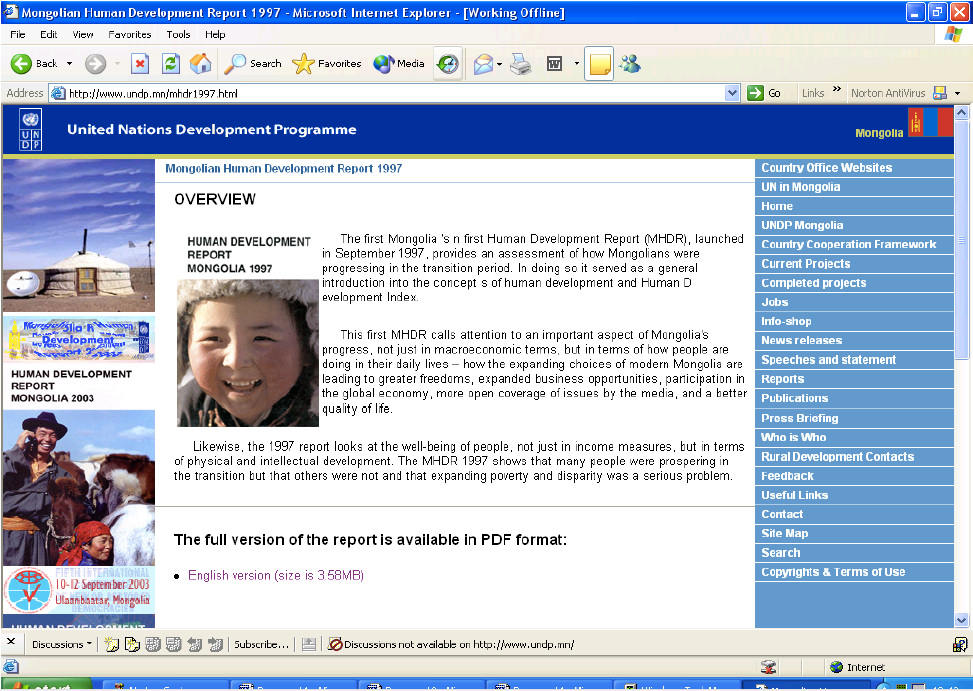
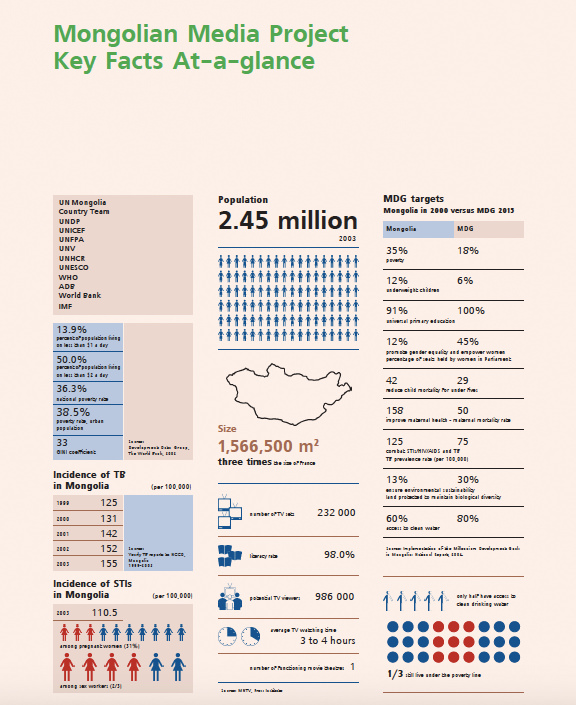
As the Millennium Development Goals (MDGs) were being communicated, the link between the powerful new digital and mobile/information technologies and development goals became explicit in information materials. The cleaner and more modern design introduced with Mongolia’s first human development report in 1997, continued in future publications and online, as can be seen in this screen grab from 2003 and that year’s human development report. The first use of infographics was also introduced in a report on the MDGs for UNDP Mongolia in 2005. Importantly, a country that had been isolated from the non-Communist world for decades, was now routinely using the Internet to tell its stories and post development data.
Human Development Infographics: Infographics have proven a useful visual aid for communicating human development concepts. This example was created for a UNDP Mongolia report during missions undertaken in 2005.
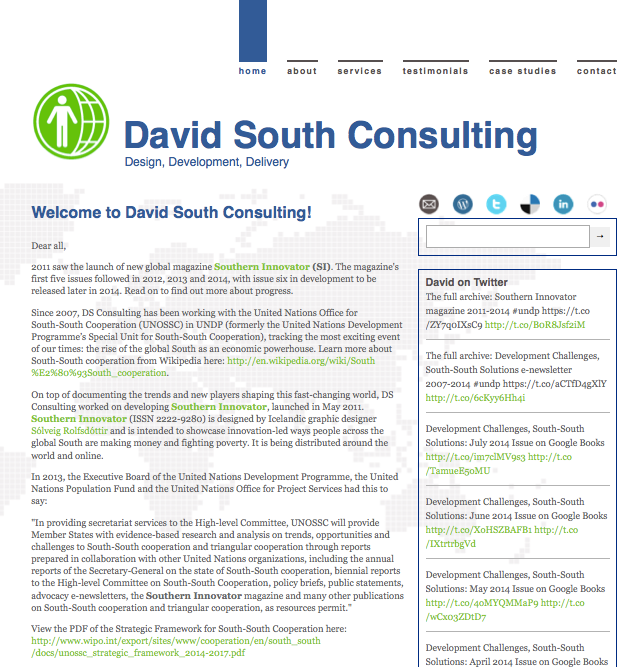
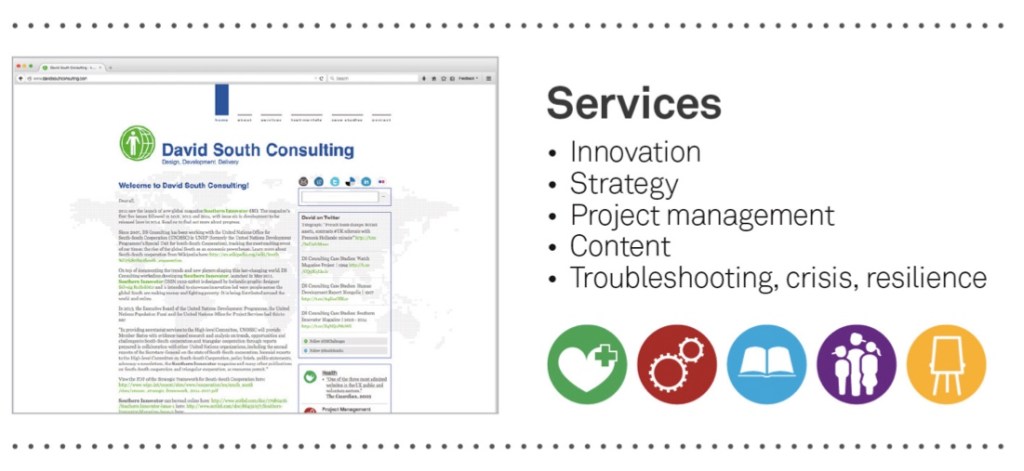
Five years prior to the MDGs deadline in 2015, the David South Consulting website went live (2010). Featuring a new branding and design, it signaled a new design phase more comfortable with developments in social media and online and mobile content sharing. Designed by Solveig Rolfsdottir, one of Iceland’s top graphic designers and illustrators, the website’s design was intentially made compatible with the new global magazine, Southern Innovator (also designed by Solveig Rolfsdottir).
The online story archive for Southern Innovator was launched by the United Nations Office for South-South Cooperation (UNOSSC) in 2011. Organized by theme, the stories were cited in blogs, books and reports around the world.
The new template for the United Nations e-newsletter Development Challenges, South-South Solutions was launched in 2011 and designed by Solveig Rolfsdottir. It included a QR code for mobile and smartphone users to connect to the Southern Innovator website.
In 2016 the mobile-friendly version of the David South Consulting website was launched.
Creative Commons License

This work is licensed under a
Creative Commons Attribution-Noncommercial-No Derivative Works 3.0 License.

ORCID iD: https://orcid.org/0000-0001-5311-1052.

© David South Consulting 2024

Categories
Archive Blogroll

Citing Wild East: The New Mongolia

Books and papers citing Wild East: Travels in the New Mongolia (ECW Press):

The Adrenaline Junkie’s Bucket List: 100 Extreme Outdoor Adventures to Do Before You Die by Christopher Van Tilburg, St. Martin’s Publishing Group, 2013

Beyond Backpacker Tourism: Mobilities and Experiences, Channel View Publications, 2010

Curbing Corruption in Asia: A Comparative Study of Six Countries by Jon S. T. Quah, Eastern Universities Press, 2003

Going Places: A Reader’s Guide to Travel Narratives by Robert Burgin, Libraries Unlimited, 2013

Historical Dictionary of Mongolia by Alan J. K. Sanders, Scarecrow Press, 2010

A History of Russia, Central Asia and Mongolia, Volume II: Inner Eurasia from the Mongol Empire to Today, 1260 – 2000 by David Christian, Wiley, 2018

Modern Mongolia: From Khans to Commissars to Capitalists by Morris Rossabi, University of California Press, 2005

Mongolia: the Bradt travel guide by Jane Blunden, Bradt Travel Guides, 2008

Mongolia: Empire of the Steppes by Claire Sermier, Odyssey, 2002

Moron to Moron: Two Men, Two Bikes, One Mongolian Misadventure by Tom Doig, Allen & Unwin, 2013

Reviewed Work: Wild East: Travels in the New Mongolia by Jill Lawless, Review by: Alicia J. Campi, Mongolian Studies Vol. 25 (2002), pp. 112-114 (3 pages), Published By: Mongolia Society

Alicia J. Campi in Mongolian Studies.

Transiberiana by Simon Richmond, EDT, 2009

Truth, History and Politics in Mongolia: Memory of Heroes by Christopher Kaplonski, Taylor & Francis, 2004

Ulaanbaatar Beyond Water and Grass: A Guide to the Capital of Mongolia by M. A. Aldrich, Hong Kong University Press, 2017

One Steppe Beyond: two years witnessing the birth of a new Asian democracy.

© David South Consulting 2022 © Jill Lawless 2022

Creative Commons License

This work is licensed under a
Creative Commons Attribution-Noncommercial-No Derivative Works 3.0 License.

ORCID iD: https://orcid.org/0000-0001-5311-1052.

© David South Consulting 2022

Categories
Archive

Het wilde oosten : reizen in het moderne Mongolië

Mongolië is voor veel mensen nog een mysterieus land dat vooral beelden oproept van woeste ruiters, uitgestrekte grasvlakten en nomaden. Het is een land waar de tijdstil lijkt te hebben gestaan. Als Jill Lawless arriveert in Mongolië treft ze een hoofdstad aan die veel westerser is dan ze had verwacht. De trendy geklede jongeren en moderne discotheken van Ulaanbaatar staan in schril contrast met de nomadische bevolking die nog in tenten op de ruige vlakten leven.

Het wilde Oosten is het onthullende reisverslag van Lawless’ verblijf in Mongolië waarbij je als lezer alle wetenswaardigheden over de lokale politiek, de diverse tradities en de historie van dit intrigerende land leert kennen.

De Canadese Jill Lawless werkte als redacteur in Mongolië bij de enige Engelstalige en onafhankelijke krant The UB Post. Zij schreef ook diverse artikelen over Mongolië voor internationale dagbladen. Momenteel woont en werkt ze als verslaggeefster in Londen.

Het wilde Oosten, Jill Lawless, net exemplaar (naamstempel op schutblad)
Rainbow Pocket. pocket, 255 pagina’s
ISBN 9789041707291

Amsterdam : Muntinga Pockets

Translation: Gert-Jan Kramer

ISBN: 9789041707291 9041707298

OCLC Number: 230800521

Published: 2008

“Jill Lawless trof enkele jaren terug een land aan dat veel westerser is dan zij dacht: Mongolië. In Het wilde oosten beschrijft ze hoe het land uit een eeuwenoude isolatie probeert te geraken wat tot fascinerende contrasten leidt….” de Volkskrant

s-Gravenhage: Rainbow Pocket

Translation: Gert-Jan Kramer

ISBN: 9055018597 9789055018598

OCLC Number: 67082971

Published: 2001

For most of us, the name Mongolia conjures up exotic images of wild horsemen, endless grasslands, and nomads — a timeless and mysterious land that is also, in many ways, one that time forgot. Under Genghis Khan, the Mongols’ empire stretched across Asia and into the heart of Europe. But over the centuries Mongolia disappeared from the world’s consciousness, overshadowed and dominated by its huge neighbours — first China, which ruled Mongolia for centuries, then Russia, which transformed the feudal nation into the world’s second communist state.

Jill Lawless arrived in Mongolia in the late 1990s to find a country waking from centuries of isolation, at once rediscovering its heritage as a nomadic and Buddhist society and simultaneously discovering the western world.

The result is a land of fascinating, bewildering contrasts: a vast country where nomadic herders graze their sheep and yaks on the steppe, it also has one of the world’s highest literacy levels and a burgeoning high-tech scene. While trendy teenagers rollerblade amid the Soviet apartment blocks of Ulaanbaatar and dance to the latest pop music in nightclubs, and the rich drive Mercedes and surf the Internet, more than half the population still lives in felt tents, scratching out a living in one of the world’s harshest landscapes.

Mongolia, it can be argued, is the archetypal 21st-century nation, a country waking from a tumultuous 20th century in which it was wrenched from feudalism to communism to capitalism, searching for its place in the new millennium.

This is a funny and revealing portrait of a beautiful, troubled country whose fate holds lessons for all of us.

  • Publisher : ECW Press; Illustrated edition (1 Jan. 2000)
  • Language : English
  • Paperback : 230 pages
  • ISBN-10 : 1550224344
  • ISBN-13 : 978-1550224344
  • Dimensions : 15.24 x 1.6 x 22.86 cm
  •  Images © David South and Liz Lawless.

Creative Commons License

This work is licensed under a
Creative Commons Attribution-Noncommercial-No Derivative Works 3.0 License.

ORCID iD: https://orcid.org/0000-0001-5311-1052.

© David South Consulting 2022

Categories
Blogroll

Wildeast.ca | 2003 – 2020

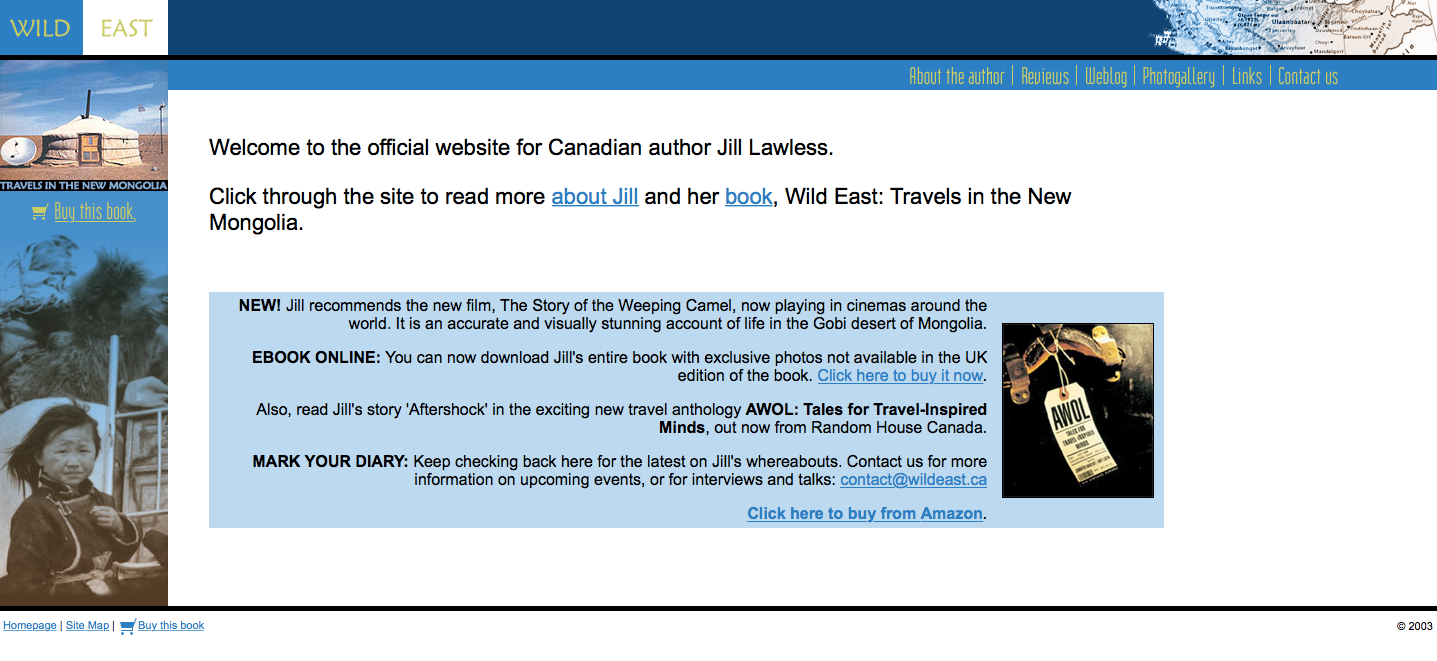
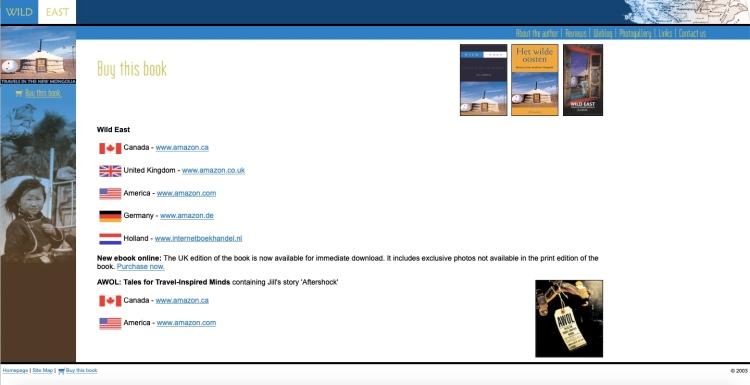
The original website at wildeast.ca (see below) was launched in 2003 and designed and built in London, UK. It served the book very well in the years after but, with the abrupt ending of business trading by the US server host, we have been prompted into revisiting a project that has been on the back burner for some time: to launch the official brand site for Jill Lawless.

“One of the top 10 Canadian travel books of 2000.” The Globe and Mail

For most of us, the name Mongolia conjures up exotic images of wild horsemen, endless grasslands, and nomads — a timeless and mysterious land that is also, in many ways, one that time forgot. Under Genghis Khan, the Mongols’ empire stretched across Asia and into the heart of Europe. But over the centuries Mongolia disappeared from the world’s consciousness, overshadowed and dominated by its huge neighbours — first China, which ruled Mongolia for centuries, then Russia, which transformed the feudal nation into the world’s second communist state.

Jill Lawless arrived in Mongolia in the late 1990s to find a country waking from centuries of isolation, at once rediscovering its heritage as a nomadic and Buddhist society and simultaneously discovering the western world.

The result is a land of fascinating, bewildering contrasts: a vast country where nomadic herders graze their sheep and yaks on the steppe, it also has one of the world’s highest literacy levels and a burgeoning high-tech scene. While trendy teenagers rollerblade amid the Soviet apartment blocks of Ulaanbaatar and dance to the latest pop music in nightclubs, and the rich drive Mercedes and surf the Internet, more than half the population still lives in felt tents, scratching out a living in one of the world’s harshest landscapes.

Mongolia, it can be argued, is the archetypal 21st-century nation, a country waking from a tumultuous 20th century in which it was wrenched from feudalism to communism to capitalism, searching for its place in the new millennium.

This is a funny and revealing portrait of a beautiful, troubled country whose fate holds lessons for all of us.

  • Publisher : ECW Press; Illustrated edition (1 Jan. 2000)
  • Language : English
  • Paperback : 230 pages
  • ISBN-10 : 1550224344
  • ISBN-13 : 978-1550224344
  • Dimensions : 15.24 x 1.6 x 22.86 cm
  •  Images © David South and Liz Lawless.
Launched in 2003, the original wildeast.ca website served us well. Beautifully designed and built in London, it stood out for its clean and crisp look and ease of use.
Author Jill Lawless photographed in Tunisia in 2002. 
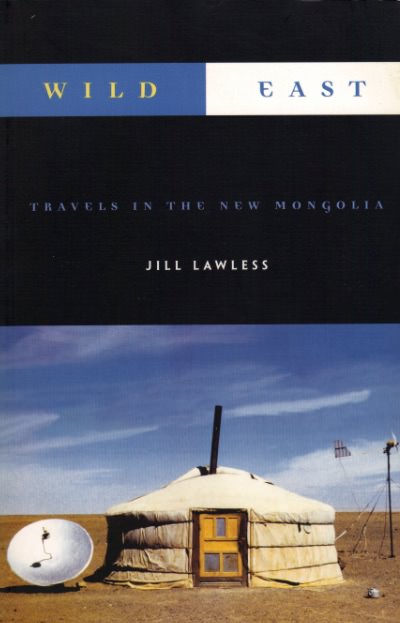
Originally published in Canada in 2000, Wild East: Travels in the New Mongolia was also published in the UK (2002) and the Netherlands (Het Wilde Oosten: Reizen in het moderne Mongolie) and in a large print version in 2012. 
The Dutch edition of Wild East: Travels in the New Mongolia by Jill Lawless.

Mongolië is voor veel mensen nog een mysterieus land dat vooral beelden oproept van woeste ruiters, uitgestrekte grasvlakten en nomaden. Het is een land waar de tijdstil lijkt te hebben gestaan. Als Jill Lawless arriveert in Mongolië treft ze een hoofdstad aan die veel westerser is dan ze had verwacht. De trendy geklede jongeren en moderne discotheken van Ulaanbaatar staan in schril contrast met de nomadische bevolking die nog in tenten op de ruige vlakten leven.

Het wilde Oosten is het onthullende reisverslag van Lawless’ verblijf in Mongolië waarbij je als lezer alle wetenswaardigheden over de lokale politiek, de diverse tradities en de historie van dit intrigerende land leert kennen.

De Canadese Jill Lawless werkte als redacteur in Mongolië bij de enige Engelstalige en onafhankelijke krant The UB Post. Zij schreef ook diverse artikelen over Mongolië voor internationale dagbladen. Momenteel woont en werkt ze als verslaggeefster in Londen.

Het wilde Oosten, Jill Lawless, net exemplaar (naamstempel op schutblad)
Rainbow Pocket. pocket, 255 pagina’s
ISBN 9789041707291

Published in Toronto, Canada by ECW Press (ISBN: 9781550224344).

ORCID iD: https://orcid.org/0000-0001-5311-1052.

© David South Consulting 2021