
By David South, Development Challenges, South-South Solutions

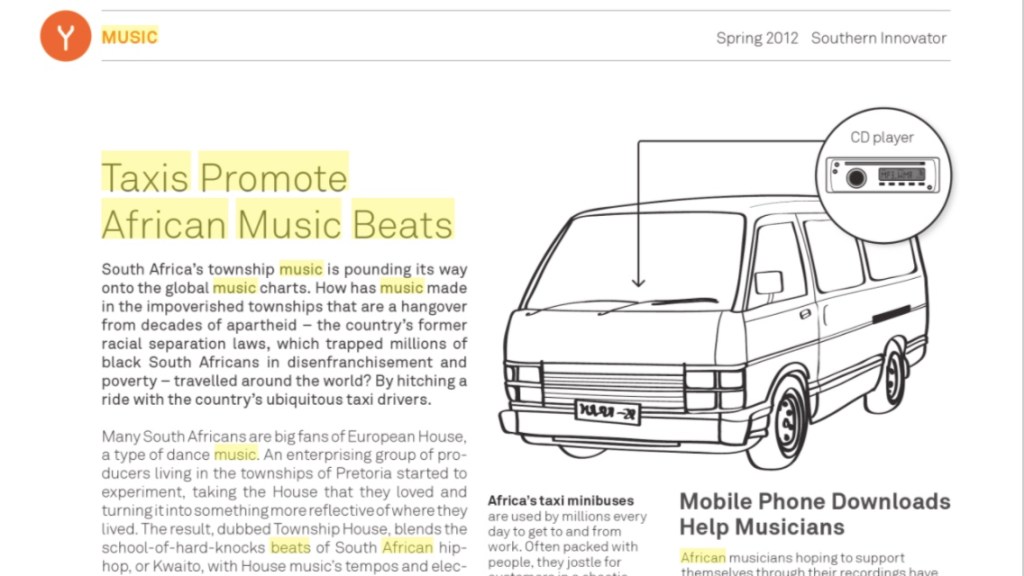
South Africa’s township music is pounding its way into the global music charts. How has music made in the impoverished townships that are a hangover from decades of apartheid – the country’s former racial separation laws, which trapped millions of black South Africans in disenfranchisement and poverty – travelled around the world? By hitching a ride with the country’s ubiquitous taxi drivers.
In the age of digital downloads and rampant pirating of music CDs by bootleggers, musicians in the South face an epic struggle to earn income from their music. It’s estimated 95 percent of digital downloads of music are unauthorized, with no payment to artists and producers (www.ifpi.org).
And for musicians and artists from the world’s poorest places, who are far out of sight of the mainstream music business, life is even harder. The question remains: what on earth do you do to get heard?
Many South Africans are big fans of European House, a type of dance music. An enterprising group of producers living in the townships of Pretoria started to experiment, taking the House they loved and turning it into something more reflective of where they lived. The result, dubbed Township House, blends the school-of-hard-knocks beats of South African hip-hop, Kwaito, with House music’s tempos and electronic sounds.
Being from the townships meant the musicians behind Township House were frozen out of the mainstream music industry. And as every artist knows, if you can’t get heard, then your music will go nowhere. Rejected by radio stations and big record labels, they turned to an unlikely outlet: taxis, the ubiquitous small minibuses that are the only alternative form of transportation for people who do not have a car.
They are heavily used: the University of Pretoria (www.web.up.ac.za) estimates between 5 and 10 million people use minibus taxis every day to get to work or get around.
“In South Africa, the easiest way to the people is through the taxis,” musician DJ Qness told CNN.
The vast network of taxis serving the country represent a captive audience of listeners. Many are simply bored as they endure lengthy commutes. The Township House producers handed out compact discs (CDs) of their tracks to taxi drivers to play. They soon had a hit on their hands. But without any presence in record stores people couldn’t buy the CDs they wanted. And a new source of income was born for taxi drivers: selling CDs from their taxi stands or roadside stalls.
With appetites whetted for Township House, it started to outsell imported dance music.
The biggest hit maker of this pioneering group was DJ Mujava, whose track Township Funk was a global dance club hit in 2008.
“These people created a demand. The Mujava’s ‘Township Funk’ blew up on the streets and everything went crazy,” said Qness, who works for record label Sheer Music.
After all this home-grown success, the record labels jumped in. DJ Mujava landed a record deal with the small label Sheer Music. But the township musicians were still just reaching a local audience. However, by putting together a low-budget video using township dancers, and by posting the video on the YouTube (www.youtube.com) video-sharing website, they attracted the attention of British record labels Warp Records and This is Music, who re-mixed the track for clubs.
The model of using taxis as a music distribution vehicle has been copied by others. Pretoria’s Gospel Taxi Club uses the method to promote their religious music. Political parties are also using music CDs to get their message out.
Other Pretorian township successes are making waves as well. They include Bojo Mujo and Tembisa Funk by McLloyd.
“By combining the electronic sound from European House with the hard drum and the raw snare they’ve created something totally unique. You can’t find it anywhere in the world — only in South Africa,” said Qness.
Published: June 2009
Resources
DJ Mujava: Listen to all of DJ Mujava’s tracks at his website. Website:www.myspace.com/mujavaDigiArts Africa: The DigiArts Africa network is a tool to find people working in Digital Arts in Africa and to provide a collaborative working space to promote digital arts in Africa. Website:http://portal.unesco.org/culture/en/ev.php-URL_ID=5346&URL_DO=DO_TOPIC&URL_SECTION=201.htmlAfrican Musicians Profiles: A lively website featuring profiles of African musicians by alphabetical listing and also reviews African films. Website: www.africanmusiciansprofiles.comRecording Industry of South Africa (RiSA): RiSA is the main body representing the South African recording industry. Website: www.risa.org.za

This work is licensed under a
Creative Commons Attribution-Noncommercial-No Derivative Works 3.0 License.
ORCID iD: https://orcid.org/0000-0001-5311-1052.
© David South Consulting 2023

 David South Consulting
You must be logged in to post a comment.