It was announced in January 2014 that China has surpassed the United States to become the world’s number one trading nation, as measured by the total value of exports and imports. This new economic behemoth also continued to grow its trade relationships with Africa.
US exports and imports of goods totaled US $3.82 trillion in 2013, according to the U.S. Commerce Department. China’s annual trade in goods passed US $4 trillion for the first time in 2013 (Guardian).
Zheng Yuesheng, a spokesman for China’s customs administration, told The Guardian that becoming the world’s number one trading nation was “a landmark milestone for our nation’s foreign trade development.”
Significantly for Africa, 2012 was also a record year for China-Africa trade, which reached 5 per cent of China’s total foreign trade and made up 16 per cent of all of Africa’s international trade, according to a new report from South Africa.
Consultancy Africa Intelligence (consultancyafrica.com), a South African-based organization with more than 200 consultants focused on “expert research and analysis on Africa” highlights the achievements of this strong trade relationship – and also some of its threats and weaknesses – in its report.
Trade between China and Africa has surged during the decade since China joined the World Trade Organization (WTO) (wto.org) in 2001, rising from around US $10 billion in 2000 to US $198.49 billion in 2012, according to China’s Ministry of Commerce. Ambitiously, it could reach US $300 billion by 2015, announced Cheng Zhigang, secretary-general of the China-Africa Industrial Cooperation and Development Forum (www.zfhz.org) (China Daily).
China’s trade and poverty reduction.
The World Bank reported South-South trade now surpasses South-North trade, meaning exports from developing countries to other developing countries exceed exports to wealthy developed countries. South-South trade experienced rapid growth in the 2000s, accounting for 32 per cent of world trade by 2011 (World Bank).
South-South trade and investment between Africa and lower-income and middle-income developing countries rose from 5 per cent in the 1990s to almost 25 per cent in 2010 (Consultancy Africa Intelligence). Before the 1990s, over 90 per cent of trade for Africa was with high-income or developed countries.
China is attractive as a trade partner for many reasons. One of them is the strong admiration for its success in lifting millions out of poverty through an aggressive growth strategy and rapid urbanization with big investments in education, science, technology, infrastructure – modern airports, ports, roads and rail – and research and development.
Since 1978, it is believed China has lifted 500 million people out of poverty, out of a population of 1.3 billion people (World Bank). Incomes have doubled every 10 years with average GDP growth of 10 per cent a year, meaning the country has almost reached all the Millennium Development Goals.
Building a trade relationship with China has led to Zambia’s copper mines running again, Gabon’s oil fields being re-explored, and Sudan becoming a major oil exporter to China. Angola, Democratic Republic of Congo (DRC), Equatorial Guinea, Republic of Congo and South Africa are all benefiting from exporting commodities to China.
The relationship has not been entirely beneficial, according to the Consultancy Africa Intelligence report. Some African industries, such as textiles, have suffered from competition with cheaper Chinese imports, leading to factory closures and job loses.
Non-commodity exports from Africa to China amounted to just 10 per cent of the trade total. Many of the contracts signed for projects also go to Chinese companies, the report found.
Renewed concern has also emerged over rising debt levels in Africa.
In summary, the report finds a growing trade relationship with China has brought to Africa commodity booms, growing GDP (gross domestic product), and lots of foreign investment. On the negative side of the ledger, there have been job loses due to cheaper imports, rising personal and government debt levels and an over-dependence on minerals for economic growth.
Across Africa, new infrastructure has emerged where it probably would not have come about under the continuing debt burdens from the 1970s and 1980s. The continent has received a shot of energy, but it remains to be seen whether governments can sustain this economic jolt and make the wise choices that create African jobs and build liveable cities for the 21st century.
Published: March 2014
Resources
1) Global South-South Development Expo: The Global South-South Development Expo (GSSD Expo) is the only Expo solely from the South and for the South. It showcases successful Southern-grown development solutions (SDSs) addressing the need to meet the Millennium Development Goals (MDGs). Website: southsouthexpo.org
2) World Trade Organization (WTO): There are a number of ways of looking at the World Trade Organization. It is an organization for trade opening. It is a forum for governments to negotiate trade agreements. It is a place for them to settle trade disputes. It operates a system of trade rules. Essentially, the WTO is a place where member governments try to sort out the trade problems they face with each other. Website: http://www.wto.org
3) Djibouti Free Zone: Djibouti Free Zone was created with one primary goal in mind – to bring about a sea-change in the way Africa thinks and does business. No red tape, ruthless efficiency and genuinely exhaustive services – in essence, it offers the ideal conditions for trade and commerce to flourish. Website: djiboutifz.com/
4) Forum on China-Africa Cooperation: Keep up with the busy diplomatic and trade contacts between China and African countries. Website: http://www.focac.org/eng/
5) China-Africa Cooperation Net: China-Africa Industrial Forum (CAIF) is the collective dialogue and cooperation mechanism that was set up by both China and friendly African countries in the year 2000. Website: http://www.zfhz.org/html/en_gywm.html
China has been a member of the WTO (World Trade Organization) since 11 December 2001. The World Trade Organization deals with the global rules of trade between nations. Its main function is to ensure that trade flows as smoothly, predictably and freely as possible.
Weathering the global economic crisis is testing the stability of countries across the global South. But many countries are finding South-South trade and catering to their domestic middle classes can lift incomes and maintain growth rates despite the global turmoil.
A decade of boom in global markets as they became more integrated has brought rising incomes and created growing economies in the so-called emerging markets of the global South. Finance and investment from developed countries flowed into the global South and helped bolster growing economies, boosting incomes and bringing millions of people into the middle classes. But since the start of the global economic crisis in 2008, more and more countries in the global South have experienced turmoil, chaos and crisis.
The export-driven model that had served many Asian countries well – creating products for developed Western markets – is being tested by high unemployment in developed economies and declining purchasing power for the Western middle classes. Two trends that have grown in the past 10 years may offer a solution to this economic crisis. One is to build on the growth in South-South trade, and the other is to tap the growing middle classes of the global South by expanding the products and services available to them and further improving their quality of life.
It is well established that one of the key elements to securing sustainable prosperity is a thriving middle class. Middle classes in many countries in the global South are still classified as vulnerable – at risk of returning to poverty if the economy experiences a short-term crisis. Their resilience to an economic downturn needs to be strengthened, and this can be done by improving the quality of products and services available to them.
Building this market can also strengthen domestic job growth and help reduce a country’s dependence on imports.
One country facing up to this challenge is Indonesia. The New York Times recently reported that ports in Indonesia and other resource-exporting countries are quiet, as China’s demand for resources slows.
But while export markets are experiencing a slowdown, investment is going into Indonesia’s agricultural food-processing industry. Agricultural multinational Cargill (cargill.com) is building a cocoa-bean processing plant in the country, and the PT. Suprama (suprama.co.id/en/) instant-noodle factory is running at full capacity to meet the needs of the country’s growing middle class.
Many countries have experienced significant inflows of investment money as a result of stimulus measures led by the United States Federal Reserve (http://www.federalreserve.gov/faqs/about_12594.htm) to counter the economic contraction caused by the global economic crisis. This money, however, is uncertain and can just as easily disappear as it leaves to chase the next opportunity. Wise countries take measures to avoid being dependent on this fickle and fast investment funding.
Unlike in the Asian Crisis of 1997-1998 (http://en.wikipedia.org/wiki/1997_Asian_financial_crisis), many emerging-market countries now have large foreign currency reserves and robust stock markets. They have also built up their middle classes and increased consumption. Trade links with other countries in the global South have grown enormously since the late 1990s. For example, the trade between China and Africa, as announced by Chinese President Xi Jinping (http://en.wikipedia.org/wiki/Xi_Jinping) in early 2014, has surpassed US $200 billion for the first time, turning China into Africa’s largest trading partner
The relationship between trade and poverty reduction, the case of China.
Despite a raging global crisis, in many emerging economies domestic spending is holding up and, in some cases, has never been stronger.
China now plays a key role in maintaining global economic demand. According to the global bank HSBC, Chinese growth adds “twice as many dollars to annual global demand as growth in the United States economy and far more than the economies of the European Union.”
China is also in the process of altering its economy, from being the low-wage workshop of the world to an increasingly high-tech, high-value economy with growing science, technology and innovation sectors buoyed by heavy investment in research and development, for example China’s Xi’an Hi-tech Industries Development Zone (xdz.com). As China changes, other countries can step in and replace the industries that no longer find China an affordable place to manufacture their goods.
As an example, the Indonesian vice minister of trade, Bayu Krisnamurthi, announced that the Foxconn Technology Group of Taiwan (foxconn.com), which makes components and assembles devices for the popular Apple (apple.com) computer brand, is looking to set up a large factory in Indonesia.
“The other brands will come in their footsteps,” Krisnamurthi told The New York Times.
Other countries are bucking the crisis trend and using greater freedom to boost economic growth.
Cuba has been able to bounce back with free-market reforms. The Caribbean island has had its ups and downs economically since its revolution in the late 1950s. After the revolution, the country had several decades of impressive human development gains and built up enviable education and health care systems. But with the collapse of the Soviet Union in the early 1990s, the country lost its trade relationships and subsidies and was pitched into a major economic crisis.
During the Cold War, the USSR hoovered up almost all of Cuba’s exports of sugar, nickel and citrus fruit, and sold Cuba two-thirds of its food and 98 per cent of its fuel.
What was termed the “special period” after the collapse of the Soviet Union saw petrol become scarce. Many had to turn to cycling and walking to get around. Factories closed and food production declined.
One estimate by Hal Klepak of the Royal Military College of Canada, reported in The Observer newspaper, found the economy collapsed by 50 per cent in the five years to 1993.
Since then, Cuba has endured significant austerity and has struggled to regain its trade relationships and restore economic growth. Tourism has played a key role in keeping the country going.
And since 2008, various economic reforms have started to shift the economy away from over-dependence on the state and towards a more mixed market model.
Its capital, Havana, is a UNESCO world heritage site and is a popular tourist destination with one of the best-preserved former Spanish colonial architecture in the Caribbean.
When President Raul Castro took over from his brother Fidel, he began to slowly experiment with reforms to test how much market freedom could boost the economy and increase incomes. This has included allowing paladares, or privately-run restaurants, which are now flourishing and benefiting from the steady flow of tourists to the island.
The state now allows people to set up as independent traders in 200 occupations. Some have established entertainment businesses such as paint balling, others are running bars, or bookshops. It is now possible to easily change money in Havana and to find accommodation in private homes. Cash machines are spreading throughout the capital and more and more businesses will accept credit cards.
Registered businesspeople rose from 157,000 in October 2011 to more than 442,000 in 2013.
By being flexible, it is possible to discover new ways to grow economies and increase incomes, even in hard times. And increasing South-South trade is the way to go.
1) The China Africa Project: The China Africa Project is a multimedia resource dedicated to exploring every aspect of China’s growing engagement with Africa. Website: chinaafricaproject.com
2) China’s trade and investment in Africa: Resources to contribute to more informed investment and trade policies and decision making in sectors and locations where China is emerging as a major player. Website: http://www.cifor.org/china-africa/home.html
Made-in-China.com: With the continuous and explosive growth of Chinese exports, trade and the number of internet users, Focus Technology launched its online trade platform, Made-in-China.com. Made-in-China.com provides the most complete, accurate and up-to-date information on Chinese products and Chinese suppliers available anywhere on the web. Nowadays, Made-in-China.com is a world-leading B2B portal, specializing in bridging the gap between global buyers and quality Chinese suppliers. Website: made-in-china.com
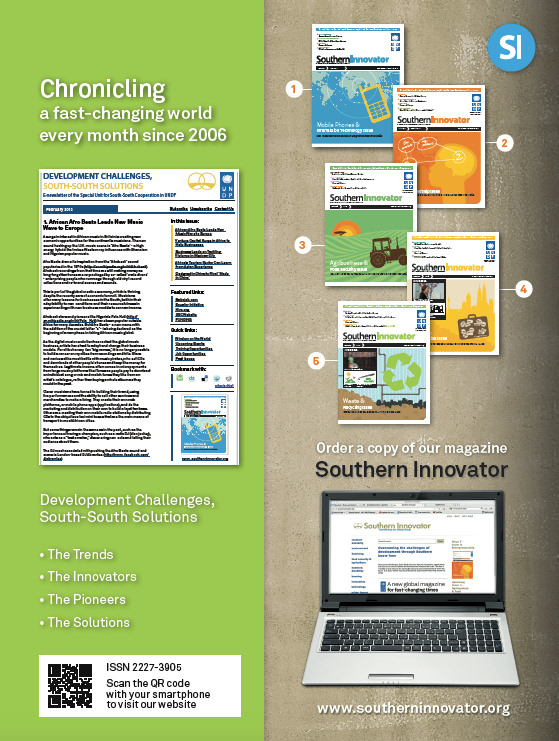
Development Challenges, South-South Solutions was launched as an e-newsletter in 2006 by UNDP’s South-South Cooperation Unit (now the United Nations Office for South-South Cooperation) based in New York, USA. It led on profiling the rise of the global South as an economic powerhouse and was one of the first regular publications to champion the global South’s innovators, entrepreneurs, and pioneers. It tracked the key trends that are now so profoundly reshaping how development is seen and done. This includes the rapid take-up of mobile phones and information technology in the global South (as profiled in the first issue of magazine Southern Innovator), the move to becoming a majority urban world, a growing global innovator culture, and the plethora of solutions being developed in the global South to tackle its problems and improve living conditions and boost human development. The success of the e-newsletter led to the launch of the magazine Southern Innovator.
The question “Do pressure groups increasingly advance the fancies of the middle classes at the expense of the interests of the exploited?” is particularly relevant when applied to the ever-expanding network of international development pressure groups (IDPG) in the United Kingdom. Many of these groups are based in London, making use of its political networks, diplomatic connections (the UK is signed up to more international covenants and organizations than any other country), excellent travel links and centrality to the global financial system. While these groups promote their work and policies utilising sophisticated advertising and media campaigns (Save the Children Fund, for example, spends £14 million annually), they rarely come under scrutiny for their claims that they “speak for the poor” (Edwards and Hulme 1992: 23). In fact, “Many Northern NGOs have assumed the role of ambassadors for the world’s poor” (Clark 1992: 18). This question is of particular importance because governments are turning more and more to non-governmental organizations (NGOs) to administer and deliver international aid projects (Dolen 1992: 19).
In 1989, Graham Hancock’s seminal book Lords of Poverty singled out government development agencies and the United Nations for being “rich and powerful bureaucracies that have hijacked our kindness” (Hancock 1989: xiii). He, however, deliberately “refrained from mounting an offensive against the voluntary agencies … by and large I believe their staff to be well motivated and their efforts worthwhile … They rarely do significant harm; sometimes they do great good” (Hancock 1989: xiii).
One of the major changes to occur since Hancock wrote those words has been the co-opting and drawing in of development NGOs even further into the priorities of the bilateral and multilateral donors. They have been placed on a pedestal as the voice of the world’s exploited, and lead high-profile pressure campaigns to alter and direct aid and foreign policies of the UK (Jubilee 2000’s drop the debt campaign is one example). This paper will explore whether international development groups “advance the fancies of the middle classes”, looking at their role in UK policy formation, and whether they accurately reflect the wishes of the “exploited” of the world, in this case, the poor (Kanbur and Squire 1999: 1).
Development pressure groups in this paper include charitable non-governmental organizations engaged in advocacy or project implementation, or both. I have excluded the plentiful university departments that conduct extensive research into development practice and policy. The reason for this is the mandate of charitable development pressure groups: they appeal both to our heart and our head.
Where we stand now
British development policy has taken on a higher profile under the Labour Government elected in 1997. The Department for International Development (DFID) was set up as a separate department removed from the Foreign Office and given a full-time minister, Clare Short. DFID also released the first white paper in 22 years on international development, Eliminating World Poverty: A Challenge for the 21st Century.
As Short says:
NOW THE DEVELOPMENT INTEREST COMES TO THE TOP LEVEL OF THE BRITISH GOVERNMENT’S CONSIDERATIONS. THE DEPARTMENT IS NO LONGER JUST AN AID DEPARTMENT. IT IS NOW CHARGED WITH THE RESPONSIBILITY OF LOOKING AT ALL ASPECTS OF POLICY: TRADE, DEBT, ENVIRONMENT, AGRICULTURE IN THE GLOBAL SYSTEM AND ENSURING THAT BRITAIN’S POLICY ON THESE TAKES ACCOUNT OF THE DEVELOPMENT INTERESTS. (EARTH TIMES, 1999)
The Labour Government is seeking to play a key role in the global debate on the future of international development. As part of this approach, the government aspires to work more closely with those NGOs who support their conciliatory approach to global institutions such as the International Monetary Fund (IMF), the World Bank and the World Trade Organization (WTO). International development pressure groups are thus presented with a tantalising but difficult decision: work closely with the government on achieving its goals – and so gain access to a steady stream of funding – or remain autonomous but risk being frozen out of the mainstream debate.
The financial stakes are high for the NGOs. According to the Organization for Economic Cooperation and Development (OECD), northern NGOs as a whole spend US $10 billion annually (Smillie 1998: 157). They have evolved into significant economic sectors in their own right, employing thousands, with their tentacles stretching out to the global media and countries around the world.
In the UK, international development spending is currently £2,367 million annually, of which £182 million is channelled through NGOs (DFID 1999). OECD figures show that aid channelled through NGOs rose from 0.7 percent of all aid in 1975 to 5 percent in 1993 (Covey 1992: 4). As well, the number of international NGOs soared in the last century, from nine in 1909 to 28,900 by 1993 (Covey 1992: 3).
If aid is a business, then business is good. Save the Children Fund, to take one example, saw its income increase from £6 million in 1981 to £60 million in 1991 (Dolan 1992: 205), to £97.3 million in 1999 (Save the Children Fund website). Of the current budget, £40.9 million comes from grants given by government development agencies. It also spends £14 million a year on publicity and fundraising.
The “fancies” of the middle class
Interest or pressure groups are in the main a middle-class phenomenon, being largely staffed by the educated middle classes (even so-called ‘working class’ interest groups such as trade union associations can be found to be mainly staffed by the middle classes). They are the product of educated, aspirational citizens who believe they can and should play a role in the world. Moran suggests, “If we are no longer ‘working class’ we can define our social identity and political demands in numerous ways: so groups emerge catering for nuclear pacifists, radical feminists, etc.” (Moran 1985: 236). As Petracca points out, “The rise of citizen groups is probably best explained by a combination of factors: the growth of the middle class in the 1960s, a revolution in communications technology, and the emergence of interest group patrons” (Petracca 1992: 23).
Since the middle class is the core audience for these IDPGs (they vote in large numbers and they have funds to donate), they also colour the priorities of what gets on the development agenda.
Over the past 20 years, IDPGs have used a variety of appeals to raise money and exert pressure on the government. In the beginning appeals were driven by humanitarian disasters such as the famine in Biafra in the 1960s. These appeals struck a strong emotional chord, presenting images of extreme suffering at a time when the UK was enjoying a post-war economic boom. More recently appeals have focused on small-scale development projects such as water wells and classrooms. In the 1980s and 1990s they took on a more economic tone, epitomised in the “ethical shopping” encouraged by Oxfam with its line of Bridgehead products. This coincided with the expansion of a consumer culture and is probably the most graphic example of the marriage between humanitarianism and middle-class consumer lifestyles. It effectively promotes the idea that an alternative and fairer economy can be bought, one rainforest chocolate bar at a time. The environmentalist Dobson is especially critical of social change by shopping: “The Body Shop strategy is a hymn to consumption: in their contribution to the Friends of the Earth Green Consumer Week leaflet (12 and 18 September 1988) they urge people to ‘wield their purchasing power responsibly’ rather than to wield it less often” (Dobson 1995: 135).
In the last couple of years the focus has moved towards the phenomenon of globalisation and a perception that existing internaitonal institutions have failed the poorer countries; that they should be revolutionised or drop-kicked straight out of the global arena. How much are these cries to do with heartfelt concern for the poor of the developing world, and how much to do with middle-class angst over a rapidly changing global order with new economic powers such as China and new uncertainties? Certainly, many of the IDPGs are working both sides of the street, protesting the global institutions and national development agencies while also taking more and more of their grants to fund their activities.
It was once easy to criticise the international development bureaucracy for leading a life of aloof leisure, jetting from conference to conference, inhabiting a world so far removed from the poor that they might as well be living on another planet. More and more this can be said of the parallel world of international NGOs, whose bureaucrats also hop around the world attending conferences and government meetings. Steve Hellinger, co-founder and president of the Development Group for Alternative Policies, notes that NGOs’ dependence on public monies “has affected the way they deal with policy issues. Instead of representing the interests of the people in the South, they are increasingly supporting the interests of the aid institutions” (New Internationalist, 285, 1996).
The relationship between the articulated goals of development pressure groups and the effect they have in the countries of the exploited was the subject of a documentary on Channel 4 Television aired in November 2000. The Hunger Business documents the frustrations felt by Africans who found development NGOs put their own preconceptions ahead of asking Africans what they needed or wanted. This led to aid exacerbating many of the conflicts in the region. As Kenneth Hackett of Catholic Relief Services said, “if food keeps them alive to fight a war, then so be it” (The Hunger Business). Aid donations may have been harder to come by if people knew the messy regional politics.
Pressure and policy
The distinctive nature of the British political and social scene has also contributed greatly to the rise in influence and power of development pressure groups. As far back as the Victorian period, there has been a strong tradition of like-minded individuals banding together to do good works, especially among the poor. Many of today’s British NGOs have their roots in the extensive network of missionary organizations established in this period.
Britain also has a tradition of seeking help when it decides to alter or expand its role in a particular sphere of influence, which was the case at the turn of the 20th century:
THE BRITISH GOVERNMENT DECIDED TO INCREASE ITS INVOLVEMENT IN THE SOCIAL AND ECONOMIC WELL-BEING OF ITS CITIZENS, THE FRIENDLY SOCIETY MOVEMENT WAS A FACTOR TO BE RECKONED WITH. THE MEDICAL PROFESSION ALSO CLAIMED TO SPEAK FOR THE GENERAL PUBLIC AS WELL AS ITS MEMBERS. (VAN DER VALK 1998: 112)
There are strong parellels between this time and the current political climate. Unlike the Conservative government before it, the Labour government under Tony Blair has made it explicit policy to increase funding of, and involvement in, international aid and development. It has broadened its areas of interest (thus needing expertise from NGOs) and is also seeking lobbying power in order to exercise greater influence in the global negotiating game to reform and alter major international institutions such as the World Bank and the International Monetary Fund. Its new priorities include poverty elimination by 2015, empowerment of women, human rights for all, making government work for poor people, including better health care, tackling the water crisis and expanding primary education (DFID).
These priorities dovetail well with those of NGOs such as WaterAid, Oxfam and Save the Children Fund, which also have a storehouse of experience and contacts in these areas.
To have any influence on policy-making in the British parliamentary system like-minded individuals must form interest groups.
OF ALL THE WESTERN DEMOCRACIES, BRITAIN HAS PERHAPS THE LONGEST-ESTABLISHED INTEREST GROUP SYSTEM. THUS, DESPITE THE LACK OF A WRITTEN CONSITUTION, BRITISH POLICY-MAKING HAS CERTAIN WELL-ESTABLISHED PROCEDURES – STANDARD OPERATING PROCEDURES – WHICH GENERALLY ACCORD INTEREST GROUPS A KEY ROLE IN THE POLICY PROCESS. (RICHARDSON 1993: 86)
Nowhere has this become more strongly felt than in international development. NGOs have altered what development means and broadened it to include a wide range of community activities. The symbiotic relationship is mirrored in the policy goals of the Department for International Development.
As Weir and Beetham note: “The relationship between organised interests and departmental officials varies across policy domains, but many interest groups perform an intimate role in the way policies are formulated and are often vital to policies being carried through in practice” (Weir and Beetham 1999: 271).
This is also a game in which presentation and professionalism wield influence. IDPGs invest heavily in a range of publications to communicate their views and use the latest in information technology to influence public opinion. As their funds have grown, they have been in the forefront of adopting the sophisticated marketing techniques developed by major corporations. This becomes a virtuous circle, in which more sophisticated communications and marketing creates a more professional public image and in turn draws in more funds. The more funds available to plough into modern communications and research, the greater the pontential impact on the government. Wealthy organizations “naturally achieve their objectives more readily than poorer pressure groups which do not represent powerful sectional interests whose cooperation government departments require” (Beetham and Weir 1999: 275).
Development pressure groups have in many ways been the beneficiaries of the same neo-liberal propensity to private execution as the UK’s business lobby. Contracting out and privatisation are a reflection of dwindling faith in the public sector’s ability to meet people’s needs.
There is also another factor influencing the IDPGs’ rise in power. Mulgan calls this a period in which “weak” organizations have the advantage over traditionally “strong” orgnisations such as the civil service or political parties (Mulgan 1990: 347). He sees both the marketplace and interest groups of like-minded individuals as offering more choice and opportunity than the traditional institutions of democracy. In this environment the opinionated pressure groups will be able to exert greater influence. They are fleet-footed, able to push the agenda ahead, while civil servants are hampered by protocol and hierarchies: “The most significant factors are the general ascendance of free market economics (Toye 1987) and its corollary, a belief that government agencies are ineffective” (Dolan 1992: 203).
These groups also benefit from the decline of rigid class-based politics in the UK. “As support for the two big class-based parties has diminished, so cause-based pressure group activity has won popular support” (Jones and Kavanagh 1994: 236).
They are quintessentially modern organizations, placing more value in intelligence-gathering and opinion-forming than in traditional project managment. As Clark notes, “The ‘software’ of their trade – ideas, research, empowerment, and networking – are rapidly becoming more important than their ‘hardware’ – the time-bound, geographically fixed projects, such as wells and clinics. In this age, information and influence are the dominant currencies rather than dollars and pounds” (Clark 1992: 193).
Ear to the ground: do the exploited have a voice?
According to the United Nations Development Programme, more than 1.3 billion people live on just US $1 a day (UNDP). Concern for the world’s most exploited is on the official development agenda of all Western governments. Most governments in the developed world explicitly acknowledge that extreme poverty is the most vicious form of exploitation that can be experienced by a human being. Awareness of the plight of people in developing countries is widespread, in that most people generally believe life must be, as Hobbes put it, “poor, nasty, brutish and short.”
One of the key claims of NGOs is that they have an extra ear to the ground when it comes to understanding the needs of the world’s poor. Certainly, the world has become a more vocal place with the rise in freedom of expression and electronic communications in many countries. As Covey remarks, “Democratisation, in its messy evolution in societies around the globe, tugs NGOs toward a more active policy-influencing role as more political space opens for people’s voices in public affairs” (Covey 1992: 167).
But there is now a growing body of evidence that development pressure groups are not as tuned in to the needs of the exploited as they claim. The advocacy role of these NGOs in Northern countries such as the UK has been criticised by NGOs in developing countries, who say they are making policy suggestions without consulting fully the people who would be most affected by them.
Covey adds: “Recent doubts expressed by Southern NGOs about the advocacy role of NGOs in the North (speaking ‘on behalf the poor’) provide one illustration of this difficult issue” (Covey 1992: 14).
Covey calls the devolution of power and funds to NGOs a phenomenon equivalent to the rise of the nation state in the 19th century (Covey 1992: 4). This is called “New Policy Agenda”, and is characterised by neo-liberal economics and liberal democratic theory.
IDPGs may express a concern for the exploited, but in practical terms they are often more accountable to their funders. Smillie notes:
DESPITE THE GROWING CONSENSUS THAT PEOPLE’S PARTICIPATION IS A HALLMARK OF GOOD DEVELOPMENT PROJECTS, NGOS ARE SELDOM FORMALLY STRUCTURED TO ENSURE THEIR ACCOUNTABILITY TO GRASSROOTS ORGANIZATIONS. IN FACT, NGO ACCOUNTABILITY PROCEDURES ARE MOST OFTEN DESIGNED TO MEET DONOR NEEDS RATHER THAN GRASSROOTS OBJECTIVES. (SMILLIE 1998: 170)
Research into social movements and advocacy organizations working with the poor has shown an overarching tendency to seek stability and co-optation over confrontation with elites. A study conducted after the turbulent and socially active late 1960s and 1970s found that:
IN THE LARGEST PART ORGANISERS TENDED TO WORK AGAINST DISRUPTION BECAUSE, IN THEIR SEARCH FOR RESOURCES TO MAINSTREAM THEIR ORGANIZATIONS, THEY WERE DRIVEN INEXORABLY TO ELITES, AND TO THE TANGIBLE AND SYMBOLIC SUPPORTS THAT ELITES COULD PROVIDE. (CLOWARD AND PIVEN: XXII)
The effect development NGOs have on the communities they seek to serve also is not wholly helpful. Many “NGOs are seen as eroding the power of progressive political formations by preaching change without a clear analysis of how that change is to be achieved; by encouraging income-generating projects that favour the advancement of a few poor individuals but not ‘the poor’ as a class; and by competing with political groups for personal and popular action” (Edwards and Hulme 1992: 20).
Hellinger criticises these organizations for often ignoring local views and destroying local initiatives:
THE POLICIES OF AID ARE BEING MADE FROM AFAR AND CREATING AN ENVIRONMENT THAT MAKES LOCAL-LEVEL DEVELOPMENT MORE DIFFICULT THAN EVER. PEOPLE ARE BEING FORCED TO LOOK CONTINUALLY OUTWARD FOR ANSWERS – FOR MONEY, MARKETS, ADVICE, TECHNOLOGY. THE SOLUTIONS ARE BEING FOUND LESS AND LESS OFTEN WITHIN THESE SOCIETIES. IT’S DEBILITATING. (NEW INTERNATIONALIST, 285, 1996)
Conclusion
There is ample evidence that international development pressure groups are in need of even greater scrutiny. Their power grew during the 1990s, and they have been targeted by international institutions and national governments to be the primary delivery mechanism for international aid projects. Much of this process has passed quietly by, with little open debate as to the suitability of these organizations to speak for the poor. The most vocal criticisms have come from NGOs based in developing countries, but they have proven to be a weak match for the generously funded publicity operations of Northern NGOs.
If NGOs represent the next major social and political transformation in the UK and around the world, then an open and vigorous debate is even more urgent. NGO leaders are not elected by universal franchise and are only answerable directly to the boards of their respective organizations. As Hancock informs us, international development is neither benign nor wholly beneficial. It is a major actor in the power dynamics of the world. “At a more general level, foreign aid – now worth almost (US) $60 billion a year – has changed the shape of the world in which we live and had a profound impact on all our thinking. Consciously or unconsciously we view many critical global problems through lenses provided by the aid industry” (Hancock 1989: xiv).
Less than 20 percent of aid actually reaches the poor (Raffer and Singer 1996), and two-thirds of the world’s poor live in 10 countries that together receive less than a third of overseas development aid (Raffer and Singer 1996). Surely this is testament alone to a failure to help the most exploited in their lobbying efforts. It is certainly an unimpressive trickle when taken as whole.
International development pressure groups are a large and wealthy lobbyist of the UK government. They are a vast economic sector with many vested interests, including paid staff, government contracts and the political agendas of their private donors. Their reach is global and they have a significant impact on the economies and societies of countries around the world.
There is ample evidence to suggest international development pressure groups are accountable to many masters; the world’s poor, unfortunately, are not always among them.
“Pranvera Smith, 47, launched Freedom to Stay on Hagley Road in 2014 to supposedly help vulnerable people from her home country Albania gain asylum.
Instead, the greedy crook and partner Flamur Daka, 44, used the Big Lottery-funded charity as a cover for helping people smugglers.
Victims were charged up to £10,000 to be illegally brought into the UK by smuggling gangs. Once here they were persuaded and ‘intimidated’ into paying Smith a further £1-4,000 for benefit and immigration advice – a free service.”
Croydon’s Al-Kahir Foundation was accused of helping migrants reach Europe
Notis Mitarachi, the Greek minister for migration, made the severe allegations
The Minister claims the Muslim charity funds and aids human trafficking gangs
He alleges migrants’ testimonies to Greek authorities show the Foundation paid for a boat crossing in which 34 Somalis drowned sailing from Turkey to Greece
Paper delivered to the School of Politics and Government, Birkbeck College, University of London, London, UK, 2000
“The strongest is never strong enough to maintain his mastery at all times unless he transforms his strength into right and obedience into duty…Yielding to force is an act of necessity, not of will; at the very most, it is an act of prudence (Rousseau 1762).”
This paper analyses the following proposition: the key post-war institutions were neither an intended, nor an adequate, response to the economic and political challenges of the post-1945 world.
There is ample evidence to show that the plethora of post-war institutions were intended, and were a deliberate consequence of American policy-makers seeking to control the geo-political fallout of the most catastrophic conflict of human history, World War II.
In many respects institutions such as the United Nations, the International Monetary Fund and the World Bank were a sophisticated and modern approach to a new global order minus the old imperial powers. They were an act of significant imagination and inspiration drawn from a long tradition in asserting the rule of law over the rule of anarchy; the rights of the weak over the tyranny of the strong.
However, these institutions have repeatedly failed to meet the economic and political challenges of the past 55 years. The commitment of the United States to these bodies tailed off after World War II, and America displayed a lack of will to mature them beyond a dependence on American initiative and action.
There is substantial evidence to support the argument that the hegemony of Pax Americana over the last half century undermined the evolution of these institutions, sustaining a chaotic world order that has not delivered prolonged peace or prosperity for a large number of the world’s citizens and that these institutions were ill prepared to confront the collapse of the Soviet Union at the end of the 1980s.
This paper will explore the inadequacies of the global institutions to meet two key aspirations of the post-war world: conflict resolution and avoidance and economic prosperity based on free markets and democratic regimes.
I will argue that, while this period avoided a major conflagration on the scale of the world wars, it was not a period of peace. Regional conflicts, costly both in terms of human life and of finance, plagued every one of the years since World War II. This has been called a period of Pax Americana (Knutsen 1999). I will argue that, rather than a period of global harmony and prosperity anchored by the American hegemon, it has been a period of Pax Chaotica, a “macabre dance of death in which the rulers of the superpowers mobilize their own populations to support harsh and brutal measures directed against victims within what they take to be their respective domains, where they are ‘protecting their legitimate interests,’” as Noam Chomsky describes it (Chomsky 1995: 207). Pax Chaotica is a period in which there is an illusion of stability offered by a hegemon, but in which the hegemon’s military, economic and moral superiority is unable to secure actual peace and prosperity in the world. The hegemon is out of balance, its military and economic superiority in predominance, while its moral superiority and credibility wanes and withers on the vine.
I will analyse how adequate the global institutions were in the context of the concept of hegemony — in particular the hegemony of the United States, which has not relinquished this hegemony to the global institutions it initially set up. I will conclude that the 1990s has been a period of half measures, incremental attempts at bolstering the concept of international security by the community of nations, but that those attempts, as in the case of the Gulf War or in Kosovo, have been still under the direction of the United States.
Making up a master plan: The deliberate development of the institutions
The post-war master plan was comprehensive, and included the International Bank for Reconstruction and Development (World Bank), the International Monetary Fund, the International Trade Organisation (superseded by the General Agreement on Tariffs and Trade as the instrument of freer trade) and the United Nations. A clutch of security organisations was also established after the war, including NATO. As Knutsen aptly puts it:
WITH MEMORIES OF THE INTERWAR RECESSION AND THE NEW DEAL FRESHLY IN MIND, ALREADY, IN THE FIRST YEARS OF THE WAR THEY BEGAN TO DESIGN STABILISING POSTWAR INSTITUTIONS OF INTERNATIONAL FINANCE AND TRADE — THE IBRD, THE IMF AND THE ITO. … THEY SOUGHT TO SET UP THE MOST IMPORTANT POSTWAR INSTITUTIONS BEFORE THE CONDITIONS OF PEACE WERE EVEN RAISED. THEY RUSHED THE CONFERENCES ON THE UN, IBRD, IMF AND ITO INTO SESSION BEFORE GERMANY AND JAPAN SURRENDERED. (KNUTSEN 1999: 203)
The founding of the United Nations and the Bretton Woods institutions (the International Monetary Fund and the International Bank for Reconstruction and Development, later the World Bank) marked a turning point in world history. The United States had been attempting to exert greater control on the global order since the first 14 proposals of President Woodrow Wilson during World War I. As European powers declined at the beginning of the 20thcentury, liberal American policymakers saw an opportunity for the US to assert its hegemony over the world and re-write the rules of economic engagement along American lines. The two world wars only made the US wealthier and wealthier: in World War I, by providing armaments to both sides of the conflict; in World War II by joining with Canada as the armament and resource engine for the allied war effort.
In many ways, the new institutions represented a forward-thinking and idealistic policy compared to a global order marked by imperial rivalries. It captured contemporary ideas on economic theory, projected a universalist Lockean ideal that all men from all nations are equal, and it was injected with the idealism and energy of the world’s largest democracy and the strongest market economy.
Franklin Roosevelt, like Woodrow Wilson, saw America’s engagement in the world war as a struggle to contain European-style militarism, imperialism and exclusive trade blocs. America’s aim, in both wars, was to preserve the conditions for liberal world order — for a democratic system of politics and an economic system based on free-market principles. Wilson and Roosevelt both sought to liberalize world trade. And they both sought to use America’s leading position in world politics to bring other countries into line with America’s policy. (Knutsen 1999: 193)
These institutions ensured that the US had an influence on every facet of world affairs post World War II. It could merge its political and economic goals and ensure it had a stake in the recovery from the war. This played very well when it came to shoring up domestic support in the United States.
Under a World Bank controlled by Americans, development assistance could be focused precisely where America’s core corporations saw the greatest opportunity. And so long as the recipients of America’s foreign aid used it to buy American exports core corporations could venture into global trade confident of receptive markets. Through such means, the playing field of global commerce was sufficiently tipped in America’s direction so that by the mid-1950s even the National Association of Manufacturers could be persuaded to support tariff reduction. (Reich 1992: 64)
The institutions were philosophically strong, too. Learning from Machiavelli that human relations can be cynical, ruthless and riddled with power agendas, the United Nations offered a peaceful forum to resolve these disputes and a theoretically far more transparent alternative than what had come before. As Weber emphasised, modern states helped to promote capitalist development. With that in mind, the Bretton Woods institutions laid the groundwork for a global financial structure pegged to the US dollar and promoting an American view of free markets.
Hegemony theory and Pax Americana
I argue that these global institutions have shown themselves to be hampered and inadequate when faced with serious political and economic challenges. The root cause is a weakness that is most often cited as their strength: the United States.
Hegemonic stability has been characterised by the emergence of successive dominant liberal powers (Gilpin 1987: 66). What Strange calls “structural power” is essential to the establishment of hegemony over world affairs, since it “confers the power to decide how things shall be done, the power to shape frameworks within which states relate to each other, relate to people, or relate to corporate enterprises (Strange 1998: 25).”
The post-World War II global institutions are an excellent example of the intersection of politics and economy; institutions like the United Nations seek to wield influence in both the political sphere and the economic, most particularly through the Bretton Woods institutions. Hegemonic world order exists, Knutsen suggests, “when the major members of an international system agree on a code of norms, rules and laws which helps govern the behaviour of all. This agreement reflects the rhetorical skills of a particular great power (Knutsen 1999: 49).” This is what happened towards the end of World War II, as the United States wrote the new world order according to its own rules.
As further evidence of US supremacy, the new global rules were constructed so as to force America’s superpower rivals, the USSR and China, to join “its” institutions, not the other way around (though Taiwan stood in for the People’s Republic in the United Nations, against the protests of the USSR, until 1971).
The US became the hegemon because the Soviet Union had very little to offer, either in terms of economic assistance or of political freedoms.
Historians now understand that potential clients encouraged the United States to become a hegemon at the end of World War II: the term “empire by invitation” has come to characterize what happened. The Soviet bid for postwar influence lacked any comparable legitimacy, and so quickly came up against a condition that creates major difficulties for hegemons, which is lack of consent. (Gaddis 1992: 177)
Do as I say, not as I do: The rise and fall of the hegemon’s moral advantage
A large part of the credibility of the US hegemony was bolstered by its moral advantage vis-à-vis other nations. A heady cocktail of democratic freedoms, economic success and military might led many other nations to believe the US and its institutions had got it right where others had failed.
As Strange notes: “President Truman had followed up in his augural address to the Congress with the firm promise of American help to peoples seeking freedom and a better material life. Moral authority based on faith in American intentions powerfully reinforced its other sources of structural power (Strange 1994: 32).”
Supporters of US hegemony, like John G. Ruggie, believe the hegemon must be liberal-minded. Otherwise:
IF THE OTHER STATES BEGIN TO REGARD THE ACTIONS OF THE HEGEMON AS SELF-SERVING AND CONTRARY TO THEIR OWN POLITICAL AND ECONOMIC INTERESTS, THE HEGEMONIC SYSTEM WILL BE GREATLY WEAKENED. IT WILL ALSO DETERIORATE IF THE CITIZENRY OF THE HEGEMONIC POWER BELIEVES THAT OTHER STATES ARE CHEATING, OR IF THE COSTS OF LEADERSHIP BEGIN TO EXCEED THE PERCEIVED BENEFITS. (GILPIN 1987: 73)
The US steadily weakened its credibility and moral advantage in both the areas of conflict resolution and avoidance, and in promoting economic prosperity.
Conflict resolution and avoidance
The US was seen as willing to distort global institutions to fight its ideological — and real — battles with the Soviet Union, and its proxies around the world. The US’s credibility as a promoter of peace and security was severely hampered by the Korean War, the Vietnam War and a dubious record of support for undemocratic regimes and guerrilla movements. These conflicts were intended to “contain” the Soviet Union and the spread of communism and to support regimes that were friendly to free markets. This was played out in a cynical cat-and-mouse game with the Soviet Union, where both sides avoided direct confrontation with each other and used third countries to wage their ideological battles.
Gaddis takes an overly generous view of the Cold War high-wire act, but it is worth being reminded:
BUT THE 1950S AND 1960S DID SEE A REMARKABLE SEQUENCE OF POTENTIALLY DANGEROUS CONFRONTATIONS — DIENBIENPHU, 1954; QUEMOY-MATSA, 1955; HUNGARY-SUEZ, 1956; LEBANON, 1958; BERLIN, 1958-59; THE U2 INCIDENT, 1960; CUBA, 1961; BERLIN, 1961; LAOS, 1961-62; THE CUBAN MISSILE CRISIS, 1962 — EVERYONE OF WHICH WAS RESOLVED WITHOUT MAJOR MILITARY INVOLVEMENT BY EITHER SUPERPOWER. THE SAME COULD NOT BE SAID OF KOREA IN 1950, OR OF VIETNAM AND AFGHANISTAN LATER ON. (GADDIS 1992: 33)
Other than actually being drawn in as a combatant, as in the case of the Korean War, the UN became more of a sideline observer and critic than a robust resolver of conflicts. The UN was critically flawed from the beginning and abrogated its commitment to collective security. It also proved ineffective when confronted with crisis. As Strange points out, one of the biggest weaknesses in the founding of the UN was the Charter. In Article 2, Paragraph 7, all matters of domestic consideration were the business of a state, and in Article 51 states were allowed to form alliances for individual or collective self-defence, “thus reopening the door to a security structure based on alliances and counter-alliance rather than on collective responsibilities for the maintenance of peace between states (Strange 1994: 52).”
The UN was also hampered from developing a collective security maturity by the Security Council. The five permanent members used the veto to control resolutions, with the USSR and the US the most prolific abusers. The US had a total of 69 vetoes from 1945 to 1994; the USSR had 116.
The fall of the Soviet Union at the end of the 1980s marked the beginning of a new period of instability in large parts of the world. The spotlight is once again on the UN to become an arbiter of conflict; once again it is most active when it is pushed by the United States to act when the US feels there is an interest to be served. This has been the case in the major UN missions in the 1990s, from the Gulf War (oil reserves), to the former Yugoslavia (European security). The UN proved to be ineffective where there was no naked US interest putting pressure on the organisation to act, as in the case of Rwanda. Strange remarks that this has had a demoralising effect on those who seek a security structure upholding international law and the universal rights of man.
The fear that either the world organization would merely be the tool of one or other great power (as indeed it was the tool of the United States in the early 1950s) or that it would be ineffectual — as both the League and the UN have proved to be in the face of grave threats to international peace and order — have been enough to kill any realistic hopes of managing a transition from the present security structure to a multilateral or confederal one. (Strange 1994:52)
Economic prosperity
The second half of the 20th century has been hailed as a period of unprecedented global prosperity. Global gross national product rose from US $300 billion to US $2 trillion from 1945 to 1970 (Reich 1992: 64), though much of this was concentrated in a handful of countries. The major challenge of the 20th century has been the task of spreading prosperity around the world; to more evenly distribute the gains than can be reaped from advances in science and technology. The collapse of the colonial powers left large numbers of underdeveloped nations grappling with independence.
With the collapse of the Bretton Woods arrangements in the early 1970s, and the emergence of deregulation in financial flows in the world, the US abrogated much of its responsibility for micro-managing global development. The market was now to do all the work, and being the modern age, rapid capital flows were to make the market work efficiently.
Like the experience with conflict resolution and avoidance, the economic project has been mixed. A dependence on the market has not avoided a dependence on the economic fortunes of the global hegemon. As the US ship rises and sinks, so does the rest of the world. The Global economic system, Panic notes:
WAS RUN BY THE DOMINANT ECONOMIC POWER AFTER THE SECOND WORLD WAR: THE UNITED STATES. IN THAT SENSE, ITS FORTUNES, LIKE THOSE OF THE CLASSICAL GOLD STANDARD, WERE DIRECTLY LINKED TO THOSE OF THE RELATIVE ECONOMIC PERFORMANCE AND POLICIES OF THE COUNTRY RESPONSIBLE FOR THE LARGEST SHARE OF WORLD INDUSTRIAL PRODUCTION, TRADE, AND FINANCE AT THE TIME — PRECISELY THE OUTCOME THAT THOSE ATTENDING THE BRETTON WOODS CONFERENCE HAD BEEN ANXIOUS TO AVOID. (PANIC 1995: 46)
By 1994, total world exports were more than 14 times greater than in 1950; output was five times greater than in 1950 (Dicken 1999: 24). But the economic achievements ring hollow if the well-being of the whole planet is taken into consideration. By 1995, 60 percent of the manufacturing in the world occurred in three countries — the United States, Japan and Germany (UNIDO 1996). While manufacturing in developing countries had quadrupled to 20 percent of global output, it was concentrated in a few developing countries with strong ties to the US.
There is a direct connection between US interests and who does well economically. Western Europe was reconstructed rapidly with US money, and Germany became an industrial powerhouse again. The defeated Japan was restored as Asia’s wealthiest nation with American investment and advice. In 1945, 71 percent of world manufacturing was concentrated in four countries. Developed countries were host to 2/3 of foreign direct investment (Dicken 1999: 21). Most FDI is now concentrated in industrial, developed countries.
There is a direct link between the failures of the UN and the global economy. The weakness of the international security arrangements also have an impact on economies. Vast sums of money are re-directed towards weapons purchases and away from human needs. For many smaller economies, this is a punishing drain on national resources and the funds are often borrowed from elsewhere. As Chomsky noted in the 1980s, “The fact is that both of the superpowers — and many lesser powers as well — are ruining their economies and threatening world peace, indeed human survival, by a mindless commitment to military production for themselves and for export (Chomsky 1995: 209).”
There are concrete examples of developing countries that have achieved significant development gains, reaping the gains of peace and freer world trade. A group of 18 developing countries enjoyed growth rates in the 1990s of over five percent (DFID 2000: 66). This is attributed to more open trade policies compared to other developing countries (though many other countries have been equally open to trade, like Mongolia, but have not reaped the same benefits). China has enjoyed unprecedented growth, but it also has increasing rates of unemployment and violent unrest in its western regions. Sub-Saharan Africa’s 600 million population generates exports no greater than Malaysia’s 20 million (DFID 2000: 67).
In regard to the World Trade Organization (WTO), the majority of its 140 members are developing countries. Not a perfect organisation, its agenda is dominated by a few wealthy nations, but the alternative of a world of bilateral trade deals hangs as a spectre if it fails. As the DFID report, Eliminating World Poverty: Making Globalisation Work for the Poor, points out:
DESPITE PROGRESS OVER THE LAST 50 YEARS, DEVELOPED COUNTRIES MAINTAIN SIGNIFICANT TARIFF AND NON-TARIFF BARRIERS AGAINST THE EXPORTS OF DEVELOPING COUNTRIES…TOTAL DEVELOPING COUNTRY GAINS FROM A 50 PER CENT CUT IN TARIFFS, BY BOTH DEVELOPED AND DEVELOPING COUNTRIES, WOULD BE IN THE ORDER OF $150 BILLION — AROUND THREE TIMES AID FLOWS. (DFID 2000: 69)
Conclusion
The postwar world order and the use of global institutions to build it, was a deliberate policy of the United States. It, however, proved only a half measure and the over-dependence on the United States ensured that these institutions were hampered when confronted with economic and political crises. As I have argued, a state of Pax Chaotica was the result.
For Pax Chaotica to end, there needs to be a renewed effort by the United States to shore up global institutions and to develop a concrete plan to ensure that the global institutions become the global hegemon in every sense of the word. There have been incremental moves in this direction, including attempts to pay dues owed by the US to the UN.
There needs to be a complete shift from the realist American interests of Pax Chaotica to the interests of the community of nations. In fact, there is an opportunity for a convergence of core American values — respect for individual liberty, freedom of expression, democracy — with the goals of the global institutions.
As for international institutions, they must show themselves to not only be just, but also to be seen to be just. Institutions can no longer work in the shadows as they have in the past. Well-educated, wealthy protesters in Western countries will no doubt continue to demand transparency.





 David South Consulting

You must be logged in to post a comment.