Categories
Archive Development Challenges, South-South Solutions Newsletters Southern Innovator magazine

Citing Southern Innovator: Books And Papers | 29 November 2015

Southern Innovator was initially launched in 2011 with the goal of – hopefully – inspiring others (just as we had been so inspired by the innovators we contacted and met). The magazine seeks to profile stories, trends, ideas, innovations and innovators overlooked by other media. The magazine grew from the monthly e-newsletter Development Challenges, South-South Solutions published by the United Nations Office for South-South Cooperation (UNOSSC) since 2006. A selection of books and papers citing stories from the magazine are featured below to aid researchers, in particular those interested in health and human development and the role of innovators in international development. 
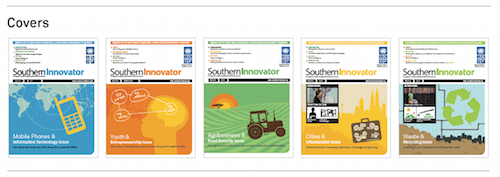
The first five issues of Southern Innovator from 2011 to 2014. Called a “Beautiful, inspiring magazine from UNDP on South-South innovation.”

Books

Innovation Africa: Emerging Hubs of Excellence edited by Olugbenga Adesida, Geci Karuri-Sebina and João Resende-Santos (Emerald Group Publishing: 2016)

“Innovation is critical to growth and development in Africa. In the context of a continent characterized by fast growing economies as well as an array of socioeconomic challenges, such as high levels of poverty and inequality, innovation in Africa must be understood in an encompassing manner. Africa needs to support the emergence of its own Silicon Valleys, but it must also foster the invention and adoption of cleaner technologies that limit respiratory illnesses, deforestation and combat climate change. This book contains a number of analytical case studies that examine the nature and origins of emerging high-end innovation hubs in Africa. These “hubs” or ecosystems are both understudied and little known inside and outside the continent. With this analysis, the book highlights and draws lessons from some of the most promising and successful innovation cases in Africa today, exploring the key factors driving their successful emergence, growth and future prospects. Relevant for scholars, policymakers, and business leaders, the book provides both inspiration and useful policy advice that can inform strategies and concrete measures to speed up the pace of innovation in Africa today.”
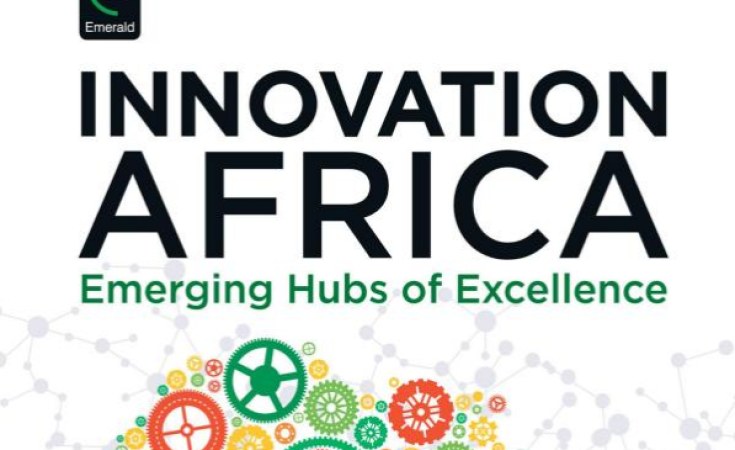
Innovation Africa: Emerging Hubs of Excellence.

Beyond Gated Communities edited by Samer Bagaeen and Ola Uduku (Routledge: 2015)

“Research on gated communities is moving away from the hard concept of a ‘gated community’ to the more fluid one of urban gating. The latter allows communities to be viewed through a new lens of soft boundaries, modern communication and networks of influence.

The book, written by an international team of experts, builds on the research of Bagaeen and Uduku’s previous edited publication, Gated Communities (Routledge 2010) and relates recent events to trends in urban research, showing how the discussion has moved from privatised to newly collectivised spaces, which have been the focal point for events such as the Occupy London movement and the Arab Spring.

Communities are now more mobilised and connected than ever, and Beyond Gated Communities shows how neighbourhoods can become part of a global network beyond their own gates. With chapters on Australia, Canada, Europe, South America, Asia, Africa and the Middle East, this is a truly international resource for scholars and students of urban studies interested in this dynamic, growing area of research.”

Chile in Transition: Prospects and Challenges for Latin America’s Forerunner of Development by Roland Benedikter and Katja Siepmann (Springer: 2015)

“The economic, political and social situation in Chile shows a country in transition. Some observers anticipate a broad “reboot” of the nation. While Chile is still seen by many as an example of progress in South America and of developmental potential in the global South, it faces a complex political constellation, particularly in the aftermath of the re-election of Michelle Bachelet. Many wonder how social and institutional innovations can be incepted without interrupting the country’s remarkable success over the past decades.

This book provides an interdisciplinary analysis of Chile’s situation and perspectives. In particular, it addresses the questions:

  • What is Chile’s real socio-political situation behind the curtains, irrespective of simplifications?
  • What are the nation’s main opportunities and problems?
  • What future strategies will be concretely applicable to improve social balance and mitigate ideological divisions?

The result is a provocative examination of a nation in search of identity and its role on the global stage.

Roland Benedikter, Dr., is Research Scholar at the Orfalea Center for Global and International Studies, University of California, Santa Barbara, Senior Research Scholar of the Council on Hemispheric Affairs Washington D.C., Trustee of the Toynbee Prize Foundation Boston and Full Member of the Club of Rome.

Katja Siepmann, MA, is Senior Research Fellow of the Council on Hemispheric Affairs Washington D.C., Member of the German Council on Foreign Relations, and Lecturer at the Faculty of Interdisciplinary Cultural Sciences of the European University Frankfurt/Oder.

The volume features a Foreword by Ned Strong, Executive Director of the David Rockefeller Center for Latin American Studies, Harvard University, and a Preface by Larry Birns, Director of the Council on Hemispheric Affairs, Washington D.C., and Former Senior Public Affairs Officer of the United Nations’ Economic Commission for Latin America (Santiago, Chile).”

A Sociological Approach to Health Determinants by Toni Schofield (Cambridge University Press: 2015)

“A Sociological Approach to Health Determinants investigates how the social works in determining health and health inequity. Taking a global perspective, the book shines a light on how experiences of health, illness and health care are shaped by a variety of complex social dynamics. Informed primarily by sociology, the book engages with the WHO’s social determinants of health approach and draws on contributions from history, political economy and policy analysis to examine issues such as class, gender, ethnicity and indigeneity, and the impact they have on health. A Sociological Approach to Health Determinants is a comprehensive resource that provides a new perspective on the influence of social structures on health, and how our understanding of the social can ensure improved health outcomes for people all over the globe. Toni Schofield is Associate Professor at the University of Sydney. She specialises in research and teaching in sociology, and public policy and administration.”

New Directions in Children’s and Adolescents’ Information Behavior Research edited by Dania Bilal and Jamshid Beheshti (Emerald Group Publishing: 2014)”This book comprises innovative research on the information behavior of various age groups. It also looks at special populations such as ethnic minorities, indigenous peoples, and users with disabilities. The book presents research and reflections on designing systems that help the new generation cope with a complex knowledge society.

Papers and Reports

Afro-futurism and the aesthetics of hope in Bekolo’s Les Saignantes and Kahiu’s Pumzi by Mich Nyawalo, Journal of the African Literature Association, Volume 10, 2016, Issue 2

Agribusiness strategy and rural development: A case study of Ihunga Sub County, Ntungamo District by Denis, Simpson Singahache, 2018

Autonomous Systems in the Intelligence Community: Many Possibilities and Challenges by Jenny R. Holzer, PhD, and Franklin L. Moses, PhD, Studies in Intelligence Vol 59, No. 1 (Extracts, March 2015)

Autonomous Systems in the Intelligence Community: Many Possibilities and Challenges by Jenny R. Holzer, PhD, and Franklin L. Moses, PhD, Studies in Intelligence Vol 59, No. 1 (Extracts, March 2015).

Decoding the Brand DNA: A Design Methodology Applied to Favela Fashion by Magali Olhats, Universidade Federal de Santa Catarina Florianopolis, 2012

Determinants of Capacity Utilization among Agribusiness Firms in Nigeria by Chukwuma Ume, Patience Ifeyinwa Opata, Kalu Uche Felix, Ukwuaba Charles Ikenna, Sunny Chukwuemeka Ume, Agu Amarachi Jacinta, Asian Journal of Managerial Science, Vol. 10 No. 2 (2021): July-December 2021 (DOI: https://doi.org/10.51983/ajms-2021.10.2.2926).

Determinants of Women Participation in Agribusiness Development Projects in Sotik Sub-County, Bomet County, Kenya by Caroline Chebet Koros, Dr. Moses M. M Otieno and John Bosco Kisimbii, International Journal of Advanced Engineering and Management Research (ISSN: 2456-3676), Vol. 2, Issue 6, 2017
Development of Luffa Cylindrica Nonwoven Structure and assessment of its suitability as a packaging and shopping bag material by C. Wetaka, Moi University School of Engineering, 2020

Economy Reports for APEC Economies on demographics, policies & ICT applications for people with Special Needs (Seniors and People with Disabilities), Asia-Pacific Economic Cooperation, APEC Telecommunications and Information Working Group, January 2013

Edible Insects and the Future of Food: A Foresight Scenario Exercise on Entomophagy and Global Food Security by Dominic Glover and Alexandra Sexton, Institute of Development Studies, King’s College London, Evidence Report No 149, September 2015

Evaluation of Kenyan Film Industry: Historical Perspective by Edwin Ngure Nyutho, School of Journalism and Mass Communication, University of Nairobi, 2015

Evaluation of the Regional Programme for Africa (2008-2013), UNDP Independent Evaluation Office, 2013

Evaluation of the Regional Programme for Africa (2008-2013), UNDP Independent Evaluation Office, 2013.

Evaluation of UNDP Contribution to South-South and Triangular Cooperation (2008-2011), Evaluation Office, UNDP 2013

Exploring the Concept of QR Code and the Benefits of Using QR Code for Companies, Ji Qianyu, School of Business and Culture Degree Programme in Business Information Technology, Lapin AMK Lapland University of Applied Sciences, 2014

Fashion: Tyranny and Revelation, Editor: Damayanthie Eluwawalage, Inter-Disciplinary Press, 2016

Financing Renewable Energy in Developing Countries: Analysis of Business Models and Best Practices, Resources Future Publication, Pakistan Office, July 2018

Gastrodiplomacy: foreign experience and potential of the republic of Uzbekistan by M. Abduazimov, International Relations: Politics, Economics, Law, 2017 

Guidance Note on Recovery: Environment, United Nations Development Programme

High-level Committee on South-South Cooperation Seventeenth Session: Framework of operational guidelines on United Nations support to South-South and triangular cooperation: Note by the Secretary-General22-25 May 2012, New York

Impact of Digital Strategy in Business for Small and Medium Enterprises in Developing Countries by Malik Mustafa, International Journal for Modern Trends in Science and Technology, 7 (09): 205-210, 2021

The Leapfrogging opportunity: role of education in sustainable development and climate change mitigation, Background paper prepared for the 2016 Global Education Monitoring Report: Education for people and planet: Creating sustainable futures for all, 2016
Local Economic Development and Growth Strategy for Prestea Huni-Valley Municipal Assembly by Dr. Steve Manteaw and Nicholas Adamtey, West Africa Governance and Economic Sustainability in Extractive Areas, Global Affairs Canada, World University Service of Canada (WUSC), April 2018

Milk Production Potential and Major Browse Species Consumed by Dromedary Camels in Tshabong by Katsane Kgaudi, Eyassu Seifu and Demel Teketay, A Special Issue on Botswana Notes and Records’ Golden Jubilee Volume in Honour of Sir Ketumile Masire, Volume 50, 2018

Mobilising Finance for Infrastructure: A Study for the UK Department for International Development (DFID), Cambridge Economic Policy Associates Ltd., August 2015

Modelo de Negocio para la Visibilizacion de Atributos Culturales Y Ambientales de Sistemas de Produccion Indigena. Caso de Estudio: Municipio de Puerto Narino – Amazonas (Colombia) by Juan Sebastian Romero Berbeo, Universidad Piloto de Colombia, Facultad de Ciencias Ambientales Programa en Administracion y Gestion Ambiental, 2016
The New Middle Class and Urban Transformation in Africa: A Case Study of Accra, Ghana by Komiete Tetteh, The University of British Colombia, 2016

Planet of slums by S. Cranby, Geodate, Volume 25, Issue 4, Pages 2-5, ISSN: 1835-5099, August 2012

Problems and Prospects of Development of Apitourism in Kazakhstan, Zh. N. Aliyeva, R. M. Baiburiyev, David D. Lorant, A. S. Shagyrbay, Z. K. Kaliaskarova, Al-Farabi Kazakh National University, Almaty, Kazakhstan, Eotvos Lorand University, Budapest, Hungary, Bulletin of National Academy of Sciences of the Republic of Kazakhstan, ISSN 1991-3494, Volume 6, Number 382 (2019), 45-53 (https://doi.org/10.32014/2019.2518-1467.144)

Propagating Gender Struggles Through Nollywood: Towards a Transformative Approach by Nita Byack George Iruobe, Geonita Initiative for Women and Child Development, 17 July 2015

Reberberation: Musicians and the Mobilization of Tradition in the Berber Culture Movement by TMG Wiedenkenner et al, The University of Arizona,  2013

Recasting ‘truisms’ of low carbon technology cooperation through innovation systems: insights from the developing world by Alexandra Mallett, Innovation and Development, 5:2, 297-311, DOI: 10.1080/2157930X.2015.1049851, Routledge Taylor & Francis Group, 2015

“Slam the Slums”: Understanding architecture through the poor by Malini Foobalan, November 26th, 2009

Song Lines: Mapping the South African Live Performance Landscape: Report of the CSA 2013 Live Mapping Project Compiled by Concerts South Africa, Samro Foundation, 2013 

Strategic Framework of the United Nations Office for South-South Cooperation, 2014-2017Executive Board of the United Nations Development Programme, the United Nations Population Fund and the United Nations Office for Project Services, 27 to 31 January 2014, New York

Taming the Tide: Stories from India by Claire Bentley, Vanessa Brombosz, Sofianne Gabrielli, Ga Eun Lee, Vaidehi Nafade, Lindsay Steele and Muhammad Wali, Global Health Case Studies: A Compilation from PPHS 511 Fundamentals of Global Health, McGill Global Health Programs, Case studies – Fall 2015, pages 23 to 32

Using Mobile-Enabled Devices for Engagement and Monitoring of Patient with Chronic Disease: Hypertensive Case by Akinwole A. K., Yekini N.A., Oloyede A.O., Ojo O., International Journal of Scientific & Engineering Research, Volume 10, Issue 4, April 2019, ISSN 2229-5518

Wearing Your Map on Your Sleeve: Practices of Identification in the Creation and Consumption of Philippine Map T-shirts 
by Pamela Gloria Cajilig, paper presented at the 6th Global Conference (2014): Fashion: Exploring Critical Issues, Mansfield College, Oxford, United Kingdom, 15th to 18th September 2014

Young Girls’ Affective Responses to Access and Use of Information and Communication Technology (ICT) in Information-Poor Societies by Dania Bilal et al, New Directions in Children’s and Adolescents’ Information Behavior Research, Library and Information Science, Volume 10, Emerald Group Publishing Limited, 2014

Youth Empowered as Catalysts for Sustainable Human Development: UNDP Youth Strategy 2014-2017United Nations Development Programme, Bureau for Development Policy

Online References

Gastrodiplomacynews: 5th November 2015
Online: https://archive.org/details/Httpsbooks.google.co.ukbooksidAQNt4YmhZagCdqsoutherninnovatorissue3sourcegbs_navlinks_s/page/n9/mode/2up?view=theater&q=gastrodiplomacy.

Southern Innovator can be read online here:

Scribd

Issue 1: http://www.scribd.com/doc/57980406/Southern-Innovator-Issue-1

Issue 2: http://www.scribd.com/doc/86451057/Southern-Innovator-Magazine-Issue-2

Issue 3: http://www.scribd.com/doc/106055665/Southern-Innovator-Magazine-Issue-3-Agribusiness-and-Food-Security

Issue 4: http://www.scribd.com/doc/128283953/Southern-Innovator-Magazine-Issue-4

Issue 5:  http://www.scribd.com/doc/207579744/Southern-Innovator-Magazine-Issue-5-Waste-and-Recycling

Google Books

Issue 1: https://books.google.co.uk/books?id=Q1O54YSE2BgC&dq=southern+innovator&source=gbs_navlinks_s

Issue 2: https://books.google.co.uk/books?id=Ty0N969dcssC&dq=southern+innovator&source=gbs_navlinks_s

Issue 3: https://books.google.co.uk/books?id=AQNt4YmhZagC&dq=southern+innovator&source=gbs_navlinks_s

Issue 4: https://books.google.co.uk/books?id=9T_n2tA7l4EC&dq=southern+innovator&source=gbs_navlinks_s

Issue 5: https://books.google.co.uk/books?id=6ILdAgAAQBAJ&dq=southern+innovator&source=gbs_navlinks_s

Southern Innovator is held in the following library collections:

Biblioteca Nationala a Republicii Moldova: http://cc.sibimol.bnrm.md/opac/bibliographic_view/399949;jsessionid=C516885A73E277718AE64598E869BC70

British Library: http://tinyurl.com/jfudl3z

Centre multimédia sur l’environnement et le développement Dakar, Senegal: http://www.enda-sigie.org/bases/sigie/format_liste.php?lang=fr&onglet=1&link=O&format=court&sort=Date%20DESC&Chp4=CONCEPTION+DE+BATIMENT

Library of Congress: http://catalog.loc.gov/vwebv/holdingsInfo?searchId=15784&recCount=25&recPointer=0&bibId=17462965

Malaysian Academic Library Union: http://malcat.uum.edu.my/kip/Record/ukm.vtls003513851

Princeton University Library: https://catalog.princeton.edu/catalog/9892864

Toronto Public Library: http://vc4kb8yf3q.search.serialssolutions.com/?V=1.0&N=100&L=VC4KB8YF3Q&S=AC_T_B&C=southern+innovator

Uganda Martyrs University: http://library.umu.ac.ug:81/cgi-bin/koha/opac-MARCdetail.pl?biblionumber=33335

United Nations Library Geneva: Issues 2, 4, 5: Click ‘Get It’: http://pmt-eu.hosted.exlibrisgroup.com/primo_library/libweb/action/search.do?SFGlobal=southern+innovator&submitGlobal=Go&fn=search&ct=search&initialSearch=true&mode=Basic&tab=default_tab&indx=1&dum=true&srt=rank&vid=41UNOG_V1&frbg=&vl%28freeText0%29=southern+innovator

Issue 1: http://pmt-eu.hosted.exlibrisgroup.com/primo_library/libweb/action/display.do?tabs=detailsTab&ct=display&fn=search&doc=41UNOG_Alma21105606680002391&indx=1&recIds=41UNOG_Alma21105606680002391&recIdxs=0&elementId=0&renderMode=poppedOut&displayMode=full&frbrVersion=&dscnt=0&frbg=&tab=default_tab&dstmp=1424959330694&srt=rank&mode=Basic&&dum=true&SFGlobal=southern+innovator&vl%28freeText0%29=southern%20innovator&vid=41UNOG_V1&submitGlobal=Go

Universiti Teknologi Malaysia Libraries: http://ent.library.utm.my/client/en_AU/main/search/detailnonmodal/ent:$002f$002fSD_ILS$002f820$002fSD_ILS:820407/ada?qu=Youth&rw=1200&ic=true&ps=300

University of Cape Town Libraries: http://aleph20.calico.ac.za/F/?local_base=uct01pub&func=find-b&find_code=OCLC&request=%28ocolc%29870179464

University of Saskatchewan: http://sundog.usask.ca/search/t?SEARCH=southern+innovator&sortdropdown=-&searchscope=8

If you would like hard copies of the magazine for distribution, then please contact the United Nations Office for South-South Cooperation: Website: https://unsouthsouth.org/2014/12/25/southern-innovator-magazine/.

If you would like to either sponsor an issue of Southern Innovator or place an advertisement in the magazine, then please contact southerninnovator@yahoo.co.uk.

We accept payments and donations. We use any funds received to keep content online, or to create new content. Thank you! https://www.paypal.me/davidsouthconsulting

Scan code with your phone and help us out.

ORCID iD: https://orcid.org/0000-0001-5311-1052

© David South Consulting 2023
Categories
Archive Blue Sky Bulletin UNDP Mongolia 1997-1999

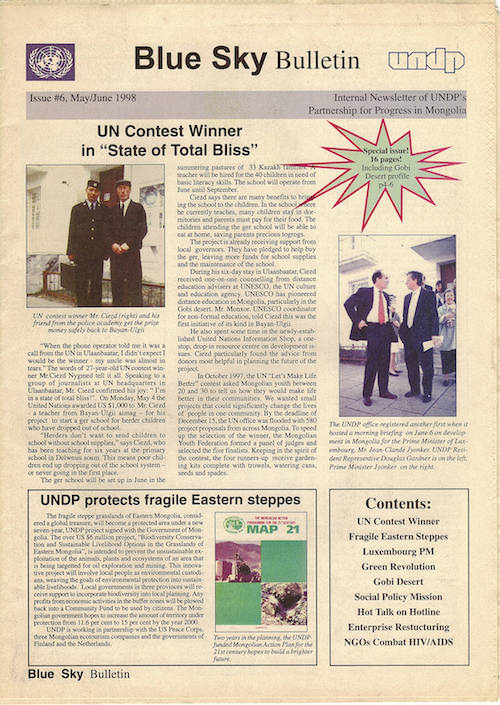
Development Profile: UNDP In The Southern Gobi Desert | May-June 1998

By David South, Blue Sky Bulletin (Dalanzadgad, Mongolia), May-June 1998

Development Profile: UNDP in the Southern Gobi Desert

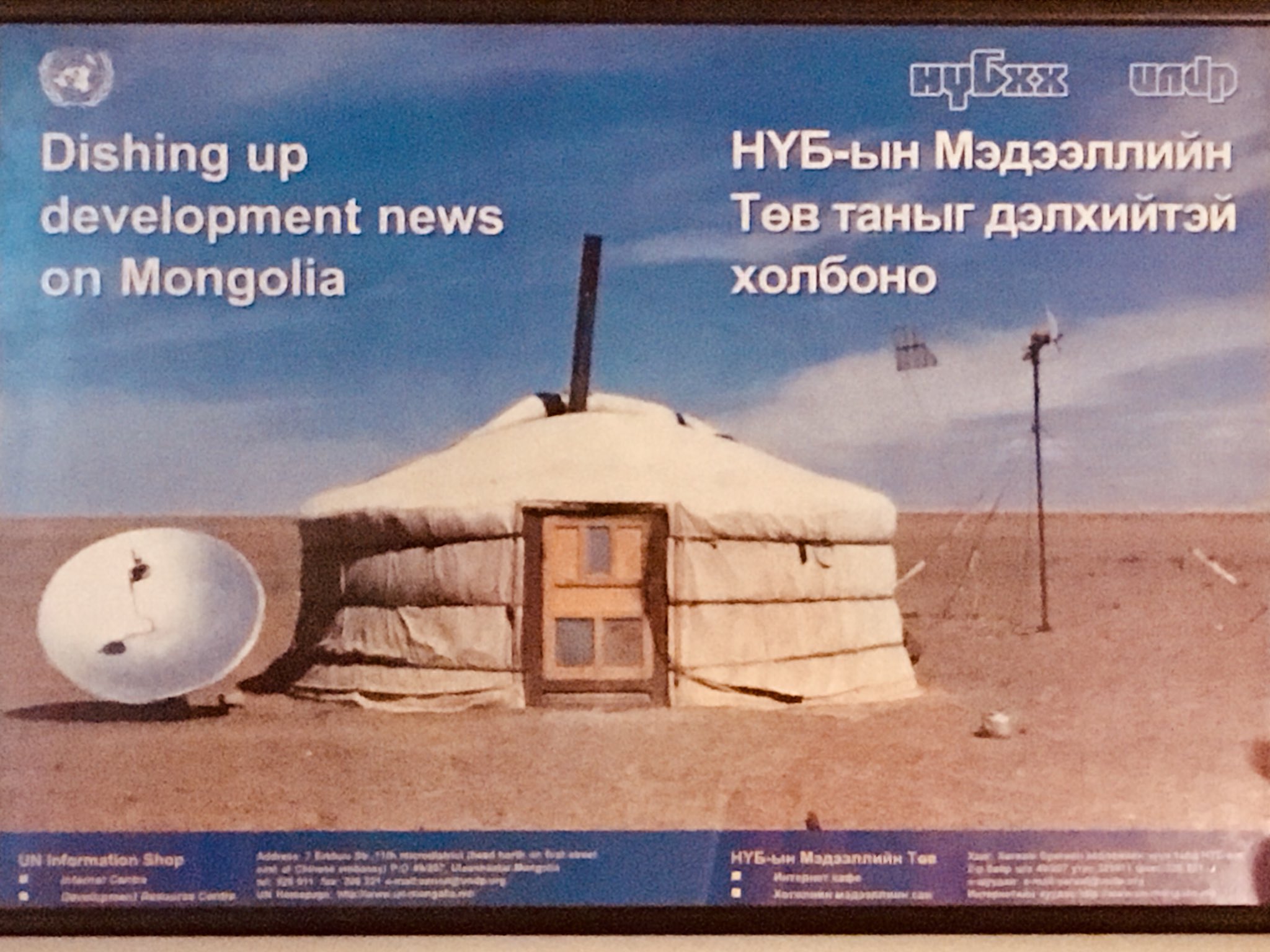
In late May UNDP visited its environment and poverty projects in Omnogobi or South Gobi on the border with China and in the heart of the Gobi Desert. The aimag (province) is home to 45,000 people spread over a territory of 165,000 kilometers. It is a harsh environment where temperatures can plummet to minus 40 degrees Celsius in winter and shoot up to plus 40 in summer. What is striking about the capital of Omnogobi, Dalanzadgad, is how well things are working. It is a garden capital – despite being in the desert the central boulevard is covered in trees – and trade with China has brought a prosperity for some herdsmen, many of whom buzz around the town on Planeta motorcycles. The offices of the Malchin television company are hidden by a bouquet of white satellite dishes – it is not an uncommon sight to see a ger with a satellite dish in South Gobi. 

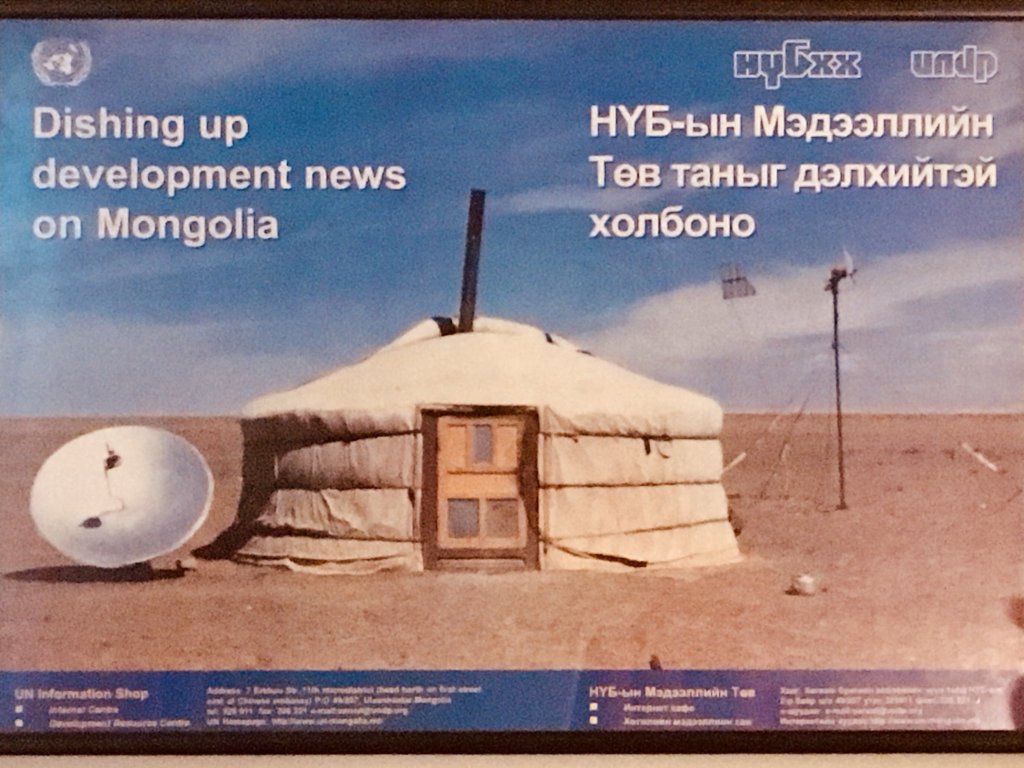
“Dishing up development news on Mongolia”: a UNDP Mongolia Communications Office poster campaign from the late 1990s. Photo: David South.
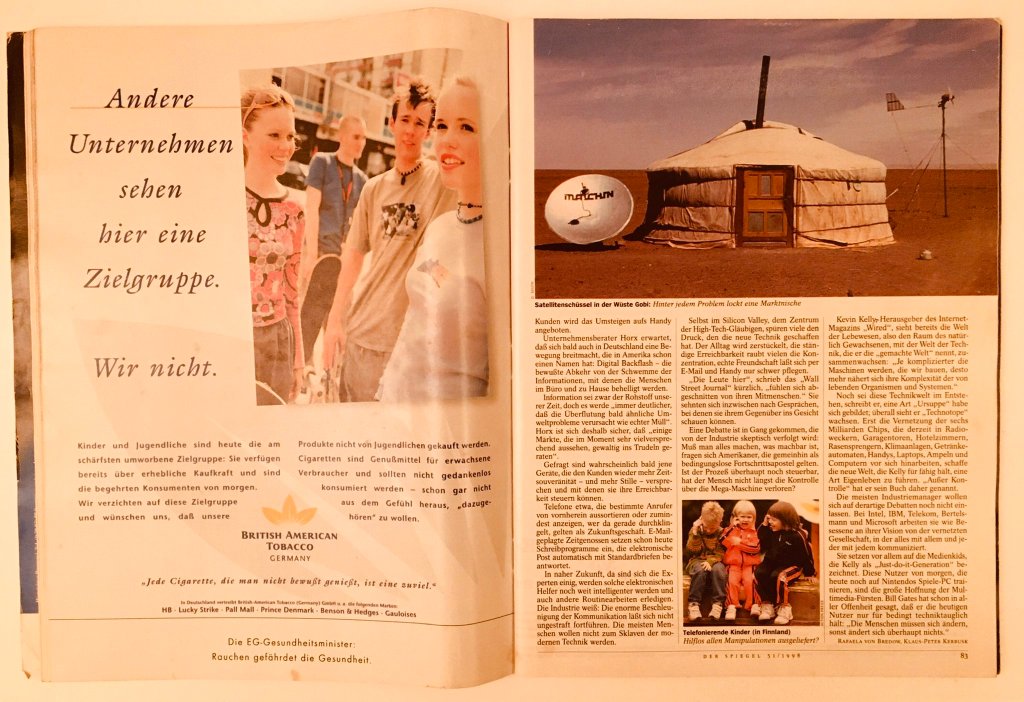
In 1998 Der Spiegel’s “Kommunikation total” issue profiled the global connectivity revolution underway and being accelerated by the Internet boom of the late 1990s. It chose my picture of a satellite dish and a ger in the Gobi Desert to symbolise this historic event.

“The transformation of Mongolia from a largely rural nomadic society of herdsmen to a community dominated by the increasingly ultra-globalized city of Ulan Bator, where almost a third of the population lives, is nothing short of astounding.” The New Mongolia: From Gold Rush to Climate Change, Association for Asian Studies, Volume 18:3 (Winter 2013): Central Asia

Der Spiegel is a German weekly news magazine and is one of Europe’s largest publications of its kind. It chose my photo taken in the Gobi Desert for its profile of the Internet revolution in 1998.

English translation: “Total communication: the seventh continent – 
The cell phone society was just the beginning: Experts see a new continent emerging in the spheres of the Internet. The information elite live here, surrounded by PCs, pagers and power books. The multimedia industry is becoming the key industry of the 21st century – with serious consequences for society.” (http://t-off.khd-research.net/Spiegel/10.html)

Electricity in the air – 85 women discover the Women’s Development Fund

The Mongolian Human Development Report singled out South Gobi for having the highest poverty incidence in Mongolia (41.9 per cent). While this ranking is hotly debated by locals who say it is a statistical anomaly resulting from their low population, there is no question life is hard in the Gobi. 

In a crowded room in the Governor’s building, 85 of the poorest women in Dalanzadgad have gathered to hear about an innovative UNDP-initiated fund. The meeting, organised by the NGO the Liberal Women’s Brain Pool, is introducing the Women’s Development Fund. Many questions are asked as to why some of the women were passed over when the local government started distributing poverty alleviation funds. 

With the assistance of the British Government who donated Tg 12 million, these women are getting a chance. The Women’s Development Fund was founded in partnership with the Poverty Alleviation Programme Office to take account of the unique role women have in the prosperity of families. Support is key and the women will be assisted by community activists as they develop their project ideas and begin to implement them. In early June they started to receive funding for their projects. 

Note: This story was part of a series highlighting life and the state of human development in Mongolia’s Gobi Desert after the publishing of the country’s first human development report in 1997

ORCID iD: https://orcid.org/0000-0001-5311-1052.

© David South Consulting 2020

Categories
Archive Blogroll Blue Sky Bulletin

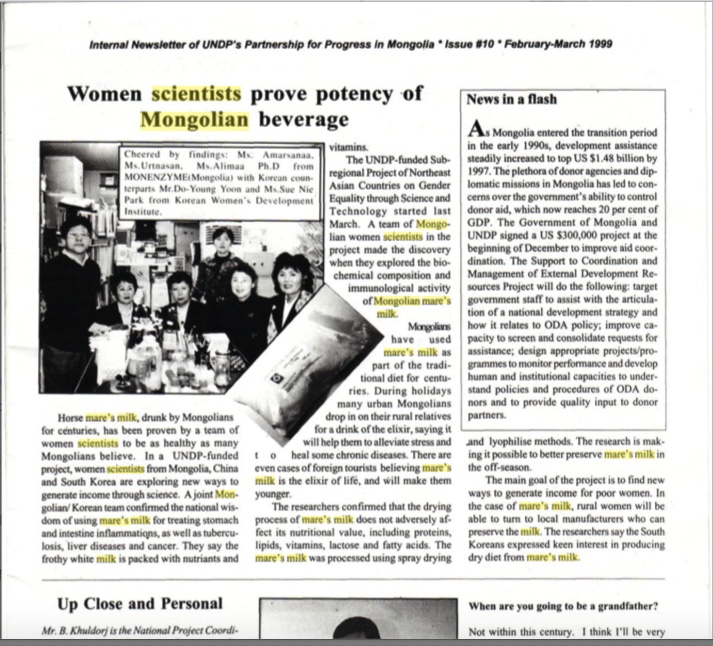
Women scientists prove potency of Mongolian beverage

By David South, Blue Sky Bulletin (Ulaanbaatar, Mongolia), Issue 10, February-March 1999

Horse mare’s milk, drunk by Mongolians for centuries, has been proven by a team of women scientists to be as healthy as many Mongolians believe. In a UNDP-funded project, women scientists from Mongolia, China and South Korea are exploring new ways to generate income through science. A joint Mongolian/Korean team confirmed the national wisdom of using mare’s milk for treating stomach and intestine inflammations, as well as tuberculosis, liver diseases and cancer. They say the frothy white milk is packed with nutrients and vitamins.

The UNDP-funded Subregional Project of Northeast Asian Countries on Gender Equality through Science and Technology started last March. A team of Mongolian women scientists in the project made the discovery when they explored the bio-chemical composition and immunological activity of Mongolian mare’s milk.

Mongolians have used mare’s milk as part of the traditional diet for centuries. During holidays many urban Mongolians drop in on their rural relatives for a drink of the elixir, saying it will help them to alleviate stress and to heal some chronic diseases. There are even cases of foreign tourists believing mare’s milk is the elixir of life, and will make them younger.

The researchers confirmed that the drying process of mare’s milk does not adversely affect its nutritional value, including proteins, lipids, vitamins, lactose and fatty acids. The mare’s milk was processed using spray drying and lyophilise methods. The research is making it possible to better preserve mare’s milk in the off-season.

The main goal of the project is to find new ways to generate income for poor women. In the case of mare’s milk, rural women will be able to turn to local manufacturers who can preserve the milk. The researchers say the South Koreans expressed keen interest in producing dry diet from mare’s milk.

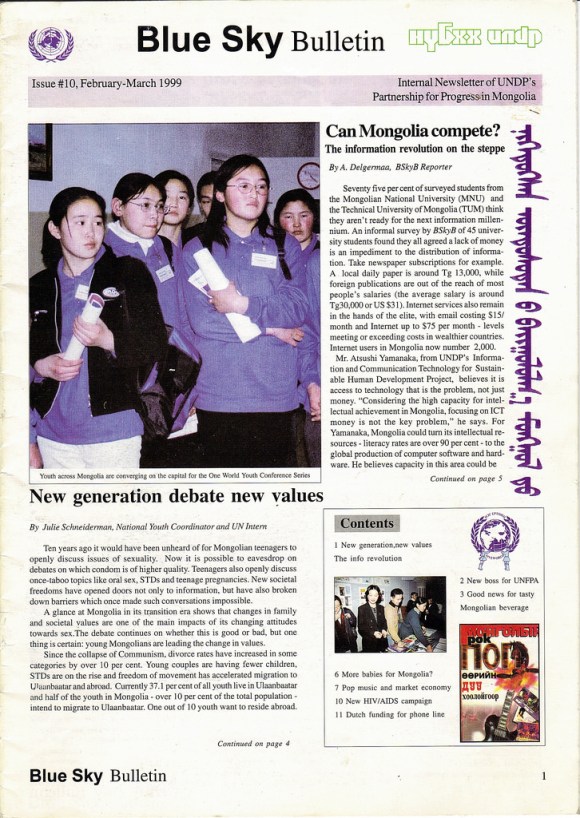
The Blue Sky Bulletin newsletter provided timely and valuable updates on Mongolia in the late 1990s. In particular, it was able to highlight urgent health needs for a population undergoing extreme crisis resulting from food supply disruptions, loss of income, social distress (alcoholism, family breakdown etc.), sexually transmitted diseases, and extreme weather. Stories from the newsletter have been cited in many journals and books since 2000, and the high quality of its contributers is evident in their scholarship and career success since. An example is below:

Poor Nutrition Taking its Toll on the Health of Mongolians By Jacinda Mawson

Rickets very prevalent in Mongolia – 1998

Prevalence of rickets in Mongolia

Asia Pacific J Clin Nutr (1998) 7(3/4): 325-328
U Tserendolgor1 MD pubhealth@magicnet.mn, JT Mawson2 MA, AC MacDonald3 MSc and M Oyunbileg1 MD, PhD

“The high prevalence of rickets in Mongolian children is a serious public health concern. In addition to the adverse effects on growth, development and immune function, it is probably indicative of widespread subclinical vitamin D deficiency.”

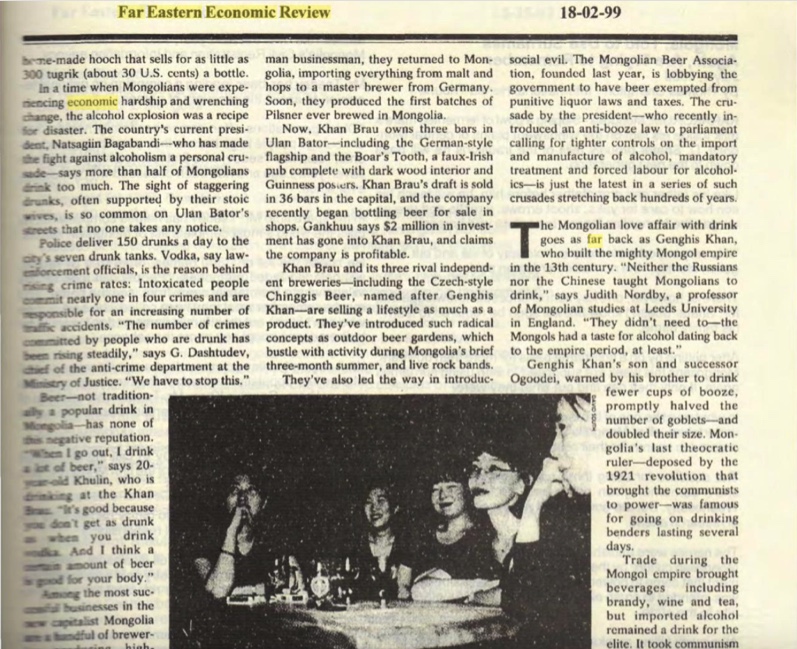
Another beverage was catching the interest of Mongolians in the late 1990s: beer. 

From The Far Eastern Economic Review, February 18, 1999

A New Brew: As Mongolia changes under the influence of economic reforms, the country’s elite are trading fermented mare’s milk and vodka for a new status symbol: beer 

Story by Jill Lawless

Photo by David South

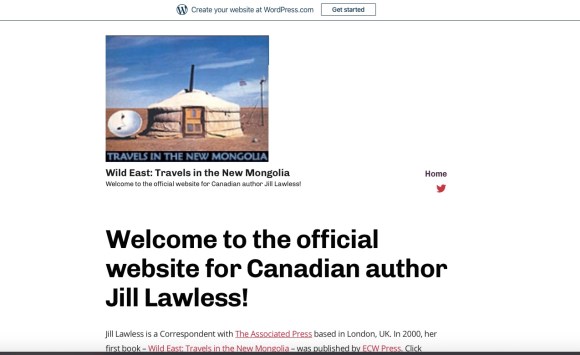
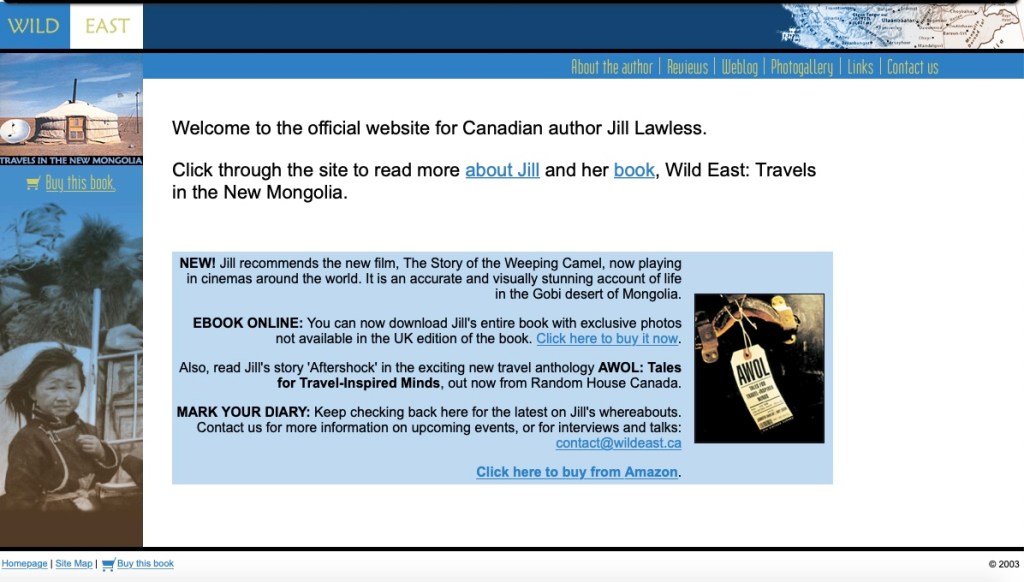
Jill Lawless has two websites about her book, Wild East: Travels in the New Mongolia.

Designed in London, the first website for Wild East: Travels in the New Mongolia launched in 2003.
The new brand site for Jill Lawless is currently under construction.

More of Jill Lawless‘ journalism for The Far Eastern Economic Review here: https://www.google.co.uk/books/edition/Far_Eastern_Economic_Review/SkuvAAAAIAAJ?hl=en&gbpv=1&bsq=david%20south,%20Mongolian%20rock

https://davidsouthconsulting.org/2022/06/24/can-we-talk-hannah-promotes-communication-between-medical-schools/

https://davidsouthconsulting.org/2021/06/02/case-study-5-gosh-ich-child-health-portal-2001-2003/

https://davidsouthconsulting.org/2020/04/25/china-pushing-frontiers-of-medical-research/

https://davidsouthconsulting.org/2021/03/08/the-dawn-of-the-genetics-revolution-2001-2003/

https://davidsouthconsulting.org/2021/05/25/ger-mongolias-first-web-magazine-and-a-pioneering-web-project-for-the-united-nations-12-january-2016/

https://davidsouthconsulting.org/2017/10/18/hannah-institute-for-the-history-of-medicine-1992-1994/

https://davidsouthconsulting.org/2021/05/27/het-wilde-oosten-reizen-in-het-moderne-mongolie%cc%88/

https://davidsouthconsulting.org/2021/03/12/mongolia-prepares-for-a-magazine-explosion-1998/

https://davidsouthconsulting.org/2023/01/09/mongolia-update-1998/

https://davidsouthconsulting.org/2023/02/07/mongolian-rock-and-pop-book-mongolia-sings-its-own-song/

https://davidsouthconsulting.org/2022/11/11/online-free-knowledge-sharing/

https://davidsouthconsulting.org/2020/12/17/philippine-conference-tackles-asias-aids-crisis/

https://davidsouthconsulting.org/2021/10/20/research-reviews-2001-2002/

https://davidsouthconsulting.org/2021/04/19/reviews-wild-east-the-new-mongolia/

https://davidsouthconsulting.org/2022/11/18/southern-drink-challenges-corporate-dominance/

https://davidsouthconsulting.org/2020/04/17/taking-medicine-to-the-people-four-innovators-in-community-health/

Like our content? Help contribute to the costs of keeping it online. 

Scan code with your phone and help us out.

ORCID iD: https://orcid.org/0000-0001-5311-1052

© David South Consulting 2023
Categories
Archive Blogroll Now Magazine

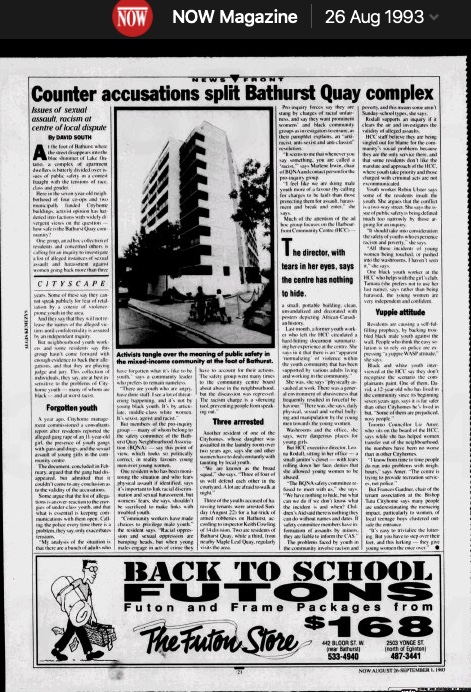
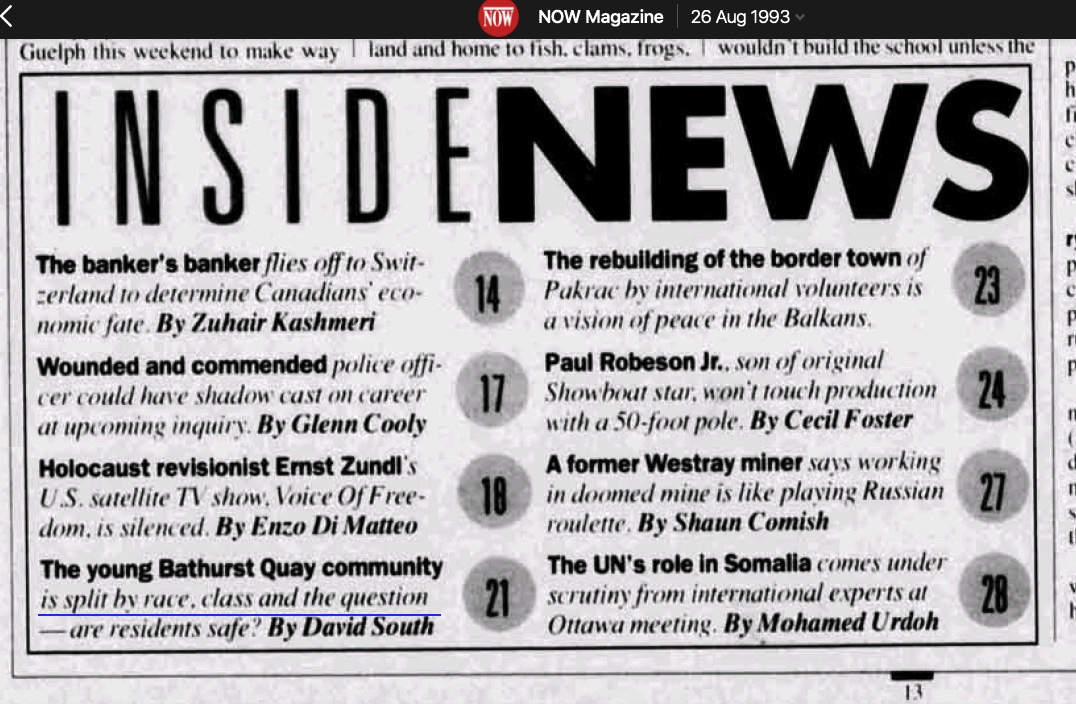
Counter Accusations Split Bathurst Quay Complex: Issues Of Sexual Assault, Racism At Centre Of Local Dispute

By David South

Now Magazine (Toronto, Canada), August 26-September 1, 1993

At the foot of Bathurst where the street disappears into the blue shimmer of Lake Ontario, a complex of apartment dwellers is bitterly divided over issues of public safety in a contest fraught with the tensions of race, class and gender.

Here in the seven-year-old neighbourhood of four co-ops and two municipally funded Cityhome buildings, activist opinion has hardened into factions with widely divergent views on one question – how safe is the Bathurst Quay community?

One group, an ad hoc collection of residents and concerned others is calling for an inquiry to investigate a list of alleged instances of sexual assault and harassment against women going back more than three years. Some of these say they cannot speak publicly for fear of retaliation by a coterie of violence-prone youth in the area.

And they say that they will not release the names of the alleged victims until confidentiality is assured by an independent inquiry.

But neighbourhood youth workers and some residents say this group hasn’t come forward with enough evidence to back their allegations, and that they are playing judge and jury. This collection of individuals, they say, are at best insensitive to the problems of Cityhome youth – many of whom are black – and at worst racist.

Forgotten youth

A year ago, Cityhome management commissioned a consultants report after residents reported the alleged gang rape of an 11-year-old girl, the presence of youth gangs with guns and drugs, and the sexual assault of young girls in the community centre.

The document, concluded in February, argued that the gang had disappeared, but admitted that it couldn’t come to any conclusion as to the validity of the accusations.

Some argue that the list of allegations is an over-reaction to the energies of under-class youth, and that what is essential is keeping communications with them open. Calling the police every time there is a problem, they say, only exacerbates tensions.

“My analysis of the situation is that there are a bunch of adults who have forgotten what it’s like to be youth,” says a community leader who prefers to remain nameless.

“There are youth who are angry, have done stuff, I see a lot of threatening happening, and it’s not by young black youth. It’s by articulate, middle-class white women. It’s sexist, ageist and racist.”

But members of the pro-inquiry group – many of whom belong to the safety committee of the Bathurst Quay Neighbourhood Association (BQNA) – say this point of view, which looks so politically correct, in reality favours young men over young women.

One resident who has been mintoring the situation and who fears physical assault if identified, says it’s important to link racial discrimination and sexual harassment, but women’s fears, she says, shouldn’t be sacrificed to make links with troubled youth.

“Community workers have made choices to privilege male youth,” the resident says. “Racial oppression and sexual oppression are bumping heads, but when young males engage in acts of crime they have to account for their actions. The safety group went many times to the community centre board about abuse in the neighbourhood, but the discussion was repressed. The racism charge is a silencing tool, preventing people from speaking out.”

Three arrested

Another resident of one of the Cityhomes, whose daughter was assaulted in the laundry room over two years ago, says she and other women have to deal constantly with taunting by local youth.

“We are known as the broad squad,” she says. “Three or four of us will defend each other in the courtyard. A lot are afraid to walk at night.”

Three of the youths accused of harassing tenants were arrested Sunday (August 22) for a hat-trick of armed robberies on Bathurst, according to Keith Cowling of 14 Division. Two are residents of Bathurst Quay, while a third, from nearby Maple Leaf Quay, regularly visits the area.

Pro-inquiry forces say they are stung by charges of racial unfairness, and say they want prominent womens’ and black community groups as investigators to ensure, as their pamphlet explains, an “anti-racist, anti-sexist and anti-classist” resolution.

“It seems to me that whenever you say something, you are called a ‘racist’,” says Marlene Irwin, chair of BQNA and contact person for the pro-inquiry group.

“I feel we are doing male youth more of a favour (by calling for charges to be laid) than those protecting them for assault, harassment and break and enter,” she says.

Much of the attention of the ad hoc group focuses on the Harbourfront Community Centre (HCC) – a small, portable building, clean, unvandalized and decorated with posters depicting African-Canadian history.

Last month, a former youth worker who left the HCC circulated a hard-hitting document summarizing her experience at the centre. She says in it that there is an “apparent ‘normalizing’ of violence within the youth community that has been supported by various adults living and working in the community.”

She was, she says “physically assaulted at work. There was a general environment of abusiveness that frequently resulted in forceful behaviour.” There was, she says, daily physical, sexual and verbal bullying and manipulation by the young men towards the young women.

Washrooms and the office, she says, were dangerous places for young girls.

But HCC executive director, Leona Rodall, sitting in her office – a small janitor’s closet – with tears rolling down her face, denies that she allowed young women to be abused.

“The BQNA safety committee refused to meet with us,” she says. “We have nothing to hide, but what can we do if we don’t know what the incident is and when? Children’s Aid said there is nothing they can do without names and dates. If safety committee members have information of assaults by minors, they are liable to inform the CAS.”

The problems faced by youth in the community involve racism and poverty, and this means some aren’t Sunday-school types, she says.

Rodall supports an inquiry if it clears the air and investigates the validity of the alleged assaults.

HCC staff believe they are being singled out for blame for the community’s social problems because they are the only service there, and that some residents don’t like the mandate and approach of the HCC, where youth take priority and those charged with criminal acts are not excommunicated.

Youth worker Robin Ulster says some of the residents insult the youth. She argues that the conflict is a two-way street. She says the issue of public safety is being defined much too narrowly by those arguing for an inquiry.

“It should take into consideration the safety of youths who experience racism and poverty,” she says.

“All these incidents of young women being touched, or pushed into the washrooms, I haven’t seen it,” she says.

One black youth worker at the HCC who helps with the girl’s club, Tamara (she prefers not to use her last name), says rather than being harassed, the young women are very independent and confident.

Yuppie attitude

Residents are causing a self-fulfilling prophecy, by backing troubled black male youth against the wall. People who think the easy solution is to rely on police are expressing a “yuppie WASP attitude”, she says.

Black and white youth interviewed at the HCC say they don’t recognize the scenario the complainants paint. One of them, David, a 12-year-old who has lived in the community since its beginning seven years ago, says it is far safer than other Cityhomes he’s lived in, but “Some of them are prejudiced, nosy people.”

Toronto Councillor Liz Amer, who sits on the board of the HCC, says while she has helped women transfer out of the neighbourhood, the numbers have been no worse than in other Cityhomes.

“I know from time to time people do run into problems with neighbours,” says Amer. “The centre is trying to provide recreation services, not police.”

But Francis Gardner, chair of the tenant association at the Bishop Tutu Cityhome says many people are underestimating the menacing impact, particularly for women, of local teenage boys clustered outside the entrance.

“It’s easy to trivialize the loitering. But you have to step over their feet, and this lurking – they give young women the once over.”

Creative Commons License

This work is licensed under a
Creative Commons Attribution-Noncommercial-No Derivative Works 3.0 License

ORCID iD: https://orcid.org/0000-0001-5311-1052.

© David South Consulting 2022