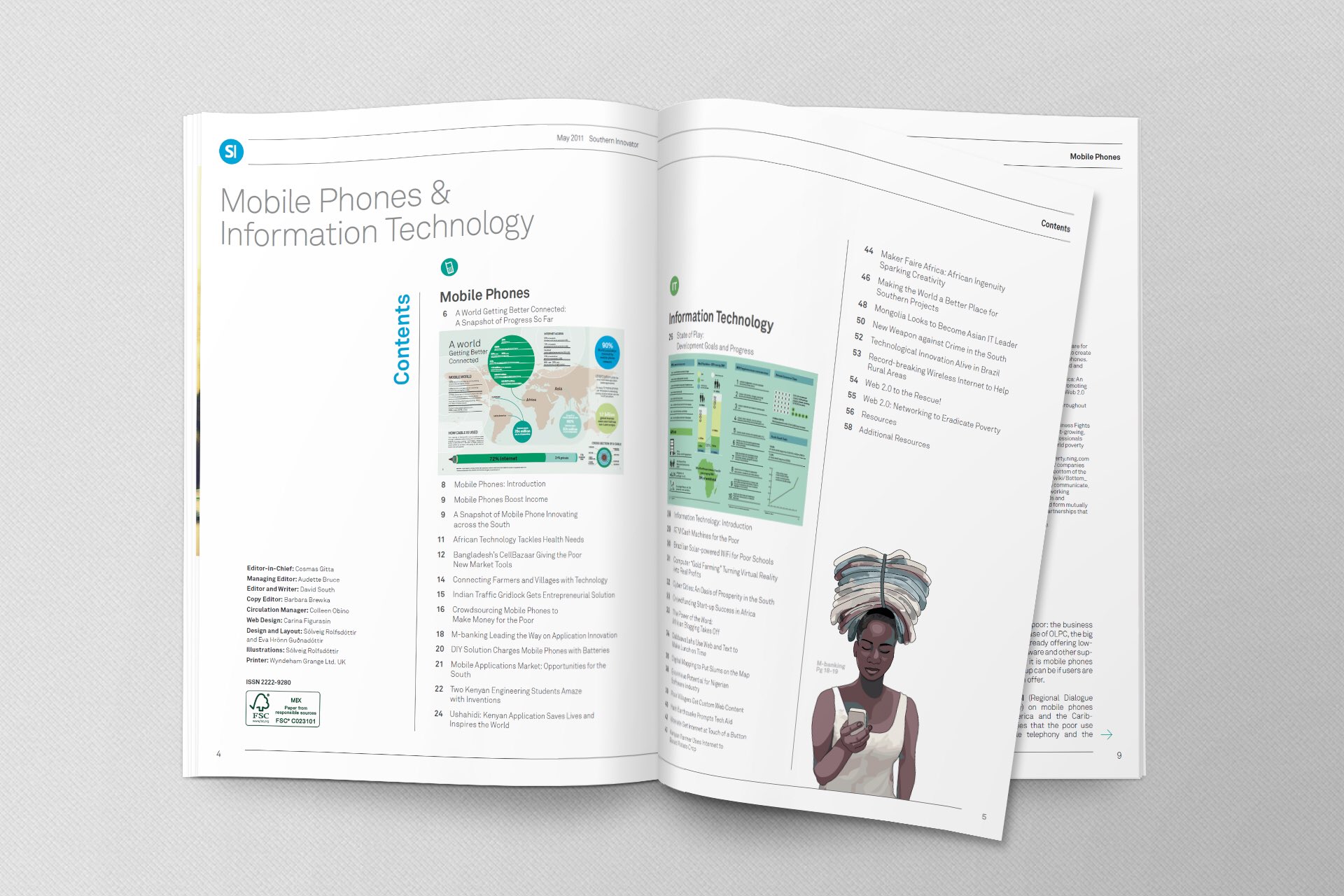
Launched in 2011, Southern Innovator’s first issue on mobile phones and information technology proved highly influential, profiling the work of a new generation of innovators. It has been cited in books, papers and strategic plans.
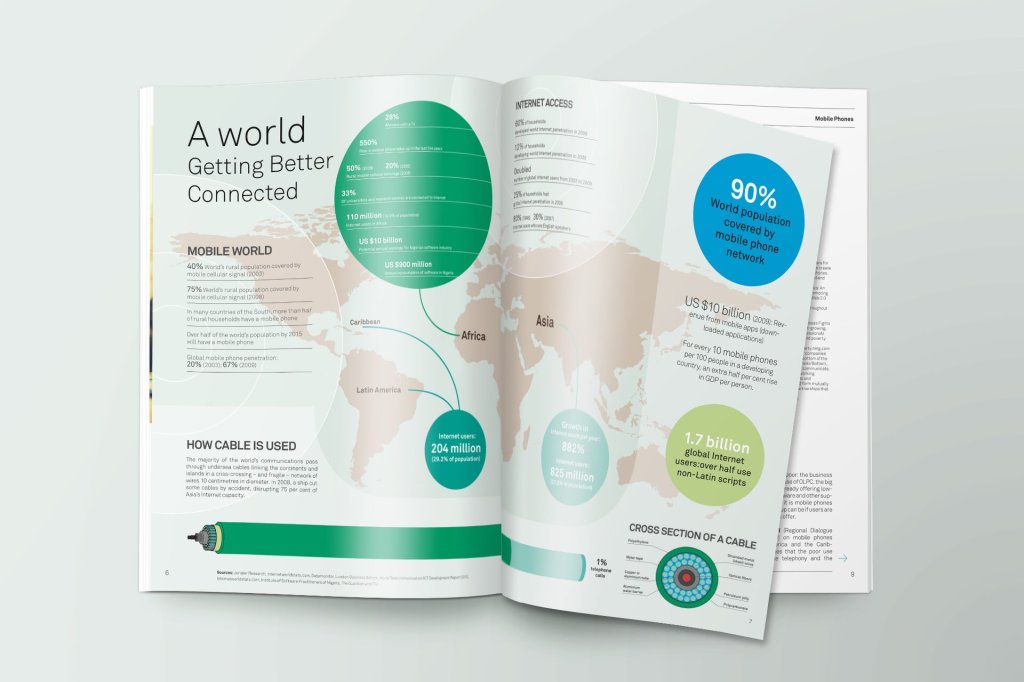
The rise of social networking websites (http://en.wikipedia.org/wiki/List_of_social_networking_websites) during the past few years has swept across the internet. The popular Facebook (www.facebook.com) site alone has over 350 million users worldwide. In Africa, there are more than 67 million people with access to the internet – just over 6 percent of the population (http://www.internetworldstats.com/stats1.htm). And this phenomenon has even begun to penetrate and influence life in poor places with weak internet infrastructure. A farmer in Kenya, Zack Matere, has boosted his potato crop by turning to Facebook for help.
On his farm in Seregeya near Eldoret, Kenya, Matere used the internet to find a cure for his ailing potato crop.
“I cycled 10 kilometres to the local cyber café, Googled (www.google.com) ‘potato disease,’ he told the BBC, “and discovered that ants were eating the potato stems.
“I checked again and found that one of the solutions was to sprinkle wood ash on the crop.”
Matere also used the internet to find a buyer for his rescued crop, and has been able to triple the price he gets for tree seedlings he sells.
Zack believes he is a bit of pioneer: “I think I am the only farmer in the area who uses the internet.”
He uses his mobile phone to access the internet and it costs him about US 0.66cents a day to do it.
This is a lot of money for small-scale farmers so Zack has a plan to tackle the cost. He will share the information he uncovers on the internet with other farmers in the community by posting it on local community notice boards.
He has noticed some important realities about how people he knows interact with the mobile web. He has found most people do much more with the Net than surfing the mobile web alone at home.
“The internet is quite an individual pursuit. But a notice board is more of a group thing.
“So if I post an item on a notice board on potato disease, for example, the community can read it, talk together and come to a decision.”
One example of the kind of intelligence Matere is able to glean from the internet is reports of cartels deceiving farmers by buying potatoes in over-large 130 kg bags instead of 110 kg bags. Matere takes this information and translates it into Swahili and posts it on community notice boards.
Matere also has to fend off other people looking to use his community’s water supply, which he has done by photographing interlopers with his mobile phone and then posting the photographs on Facebook.
“When they came before, I took photos of what they were doing, posted them on my Facebook page and was able to get assistance,” he said.
“I got in touch with Forest Action Network (http://www.fankenya.org/) and they came back to me quickly saying they would help me protect the catchment area.”
He has also discovered there are more profitable ways to make money for farmers.
“There is a lot of money in tree seedlings or bee hives. So if we can get these young people to use the land in an environmentally (friendly) way, they can get even more money than through farming.”
“I have 400 Facebook friends and I think some of them can buy the honey.”
Matere is philosophical about the future: “I am now seeing the practicality of the internet here in rural Kenya. The problem is I am the only one. That is why the notice board is important. All we need is a bit of relevant information to help us.”
“Once it is made simpler and is more in the local language with more local content, people are going to access the internet here,” he predicts.
Development Challenges, South-South Solutions was launched as an e-newsletter in 2006 by UNDP’s South-South Cooperation Unit (now the United Nations Office for South-South Cooperation) based in New York, USA. It led on profiling the rise of the global South as an economic powerhouse and was one of the first regular publications to champion the global South’s innovators, entrepreneurs, and pioneers. It tracked the key trends that are now so profoundly reshaping how development is seen and done. This includes the rapid take-up of mobile phones and information technology in the global South (as profiled in the first issue of magazine Southern Innovator), the move to becoming a majority urban world, a growing global innovator culture, and the plethora of solutions being developed in the global South to tackle its problems and improve living conditions and boost human development. The success of the e-newsletter led to the launch of the magazine Southern Innovator.
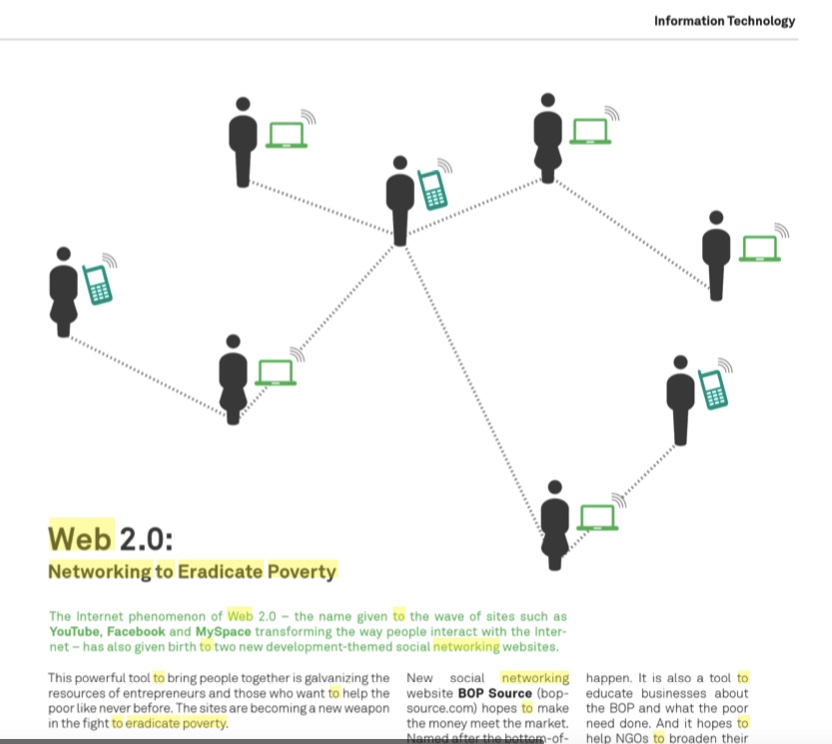
The internet phenomenon of Web 2.0 (http://en.wikipedia.org/wiki/Web_2.0) – the name given to the wave of internet businesses and websites such as YouTube (www.youtube.com), Facebook and MySpace transforming the way people interact with the ‘Net – has also given birth to two new development-themed social networking websites.
This powerful tool to bring people together is galvanizing the resources of entrepreneurs and those who want to help the poor like never before. The sites are becoming a new weapon in the fight to eradicate poverty.
Social networking websites use various tools and applications (or ‘apps’ for short) to enhance the ability of users to connect and get things done. By bringing together a community of like-minded people, they are able to shorten the time it takes to organize and kick-start events. Web 2.0 can be used to build communities and social and business networks. By being able to store vast quantities of information online, it becomes faster to work and reduces the painful delays brought on by slow connections.
All these new tools are making it easier and easier for entrepreneurs to work from home, in internet centres, or anywhere there is a wireless connection – and it is slashing the costs of managing a business. All the applications are online so there is no need to be hidebound by one operating system or hardware capability.
Two newly launched social networking sites are targetting the poverty-eradication community.
One is named after the Bottom of the Pyramid (BOP) concept as conceived by C.K. Prahalad. The BOP is the 4 billion people at the base of the global economic pyramid. As Prahalad sees it, they represent a vast market of unmet needs for entrepreneurs to tackle.
New social networking website BOP Source hopes to make the money meet the market. Started by Jenara Nerenberg, BOP Source wants to put social networking tools into the hands of the world’s poor. It is a place to post business ideas and collaborate with others to make them happen. It is also a tool to educate businesses about the BOP and what the poor need done. And it hopes to help NGOs broaden their relationships with their constituencies and companies.
While marketers can learn about the needs of the BOP, individuals can directly express their needs on the website and seek out the right people to solve problems.
Another social networking website is Business Fights Poverty. Already at 1,000 members, it is a multimedia offering, with podcasts, videos, interviews and discussions about the role of business in addressing development goals.
Published: November 2008
Resources
BOP Source is a platform for companies and individuals at the BOP to directly communicate, ultimately fostering close working relationships, and for NGOs and companies to dialogue and form mutually valuable public-private partnerships that serve the BOP. Website: http://bopsource.ning.com/
Business Fights Poverty: Business Fights Poverty is the free-to-join, fast-growing, international network for professionals passionate about fighting world poverty through good business. Website: http://businessfightspoverty.ning.com/
Afriville is a Web 2.0 service and an African Caribbean social network. Afriville is a community website along the lines of the famous MySpace. Users are free to message and post profiles. The difference is that the user is able to choose how closed or open the networks are. The site features a state of the art music management system which allows African and Caribbean artists to get straight in touch with their fans.
Both Yahoo! And Google offer extensive free online tools for entrepreneurs and businesses that integrate seamlessly with their email services.
Kabissa: Space for Change in Africa: An online African web community promoting and supporting the transition to Web 2.0 services in Africa. Offers lots of opportunities to meet people throughout Africa and learn more.
Global Voices: An initiative from the Reuters news agency to aggregate the global conversation online from countries outside the US and Western Europe.
Information, Knowledge and Communication: Web 2.0 in Development Cooperation Bonn, Germany, 27-28 November 2008, Gustav Heinemann Haus. Website: http://www.eadi.org/index.php?id=994
3rd IEEE/ACM International Conference on Information and Communication Technologies and Development (ICTD2009). Website:http://www.ictd2009.org
Development Challenges, South-South Solutions was launched as an e-newsletter in 2006 by UNDP’s South-South Cooperation Unit (now the United Nations Office for South-South Cooperation) based in New York, USA. It led on profiling the rise of the global South as an economic powerhouse and was one of the first regular publications to champion the global South’s innovators, entrepreneurs, and pioneers. It tracked the key trends that are now so profoundly reshaping how development is seen and done. This includes the rapid take-up of mobile phones and information technology in the global South (as profiled in the first issue of magazine Southern Innovator), the move to becoming a majority urban world, a growing global innovator culture, and the plethora of solutions being developed in the global South to tackle its problems and improve living conditions and boost human development. The success of the e-newsletter led to the launch of the magazine Southern Innovator.
Southern Innovator’s online archive portal was launched in New York City, U.S.A. (home to the UN’s headquarters) in 2011 (southerninnovator.org).
Social networking websites also known as, Web 2.0 – the name given to the new wave of internet businesses and websites such as YouTube and MySpace that are transforming the way people interact with the Web – has been dubbed the social web for its power to bring people together. The label has been derided as a marketing gimmick by some, but many argue there are a number of characteristics to Web 2.0 that make it something different and a valuable tool for entrepreneurs seeking ways out of poverty.
The new Web 2.0 applications offer many free software tools stored online, from accounting and business related tools, to new multimedia ways to communicate for free. Unlike Web 1.0 sites, which offered information to passive users, Web 2.0 sites allow interaction and comment. These qualities have meant Web 2.0 can be used to build communities and social and business networks. By being able to store vast quantities of information online, it becomes faster to work and reduces the painful delays brought on by slow connections.
All these new tools are making it easier and easier for entrepreneurs to work from home, in internet centres, or anywhere there is a wireless connection, and is slashing the costs of managing a business. All the applications are online so there is no need to be hidebound by one operating system or hardware capability. The number of internet centres has increased significantly all over Asia and Africa, bringing the power of Web 2.0 to millions more people.
Linking mobile phones and the internet is also remarkable. It is becoming more and more possible in Africa to send messages to weblogs via text messaging, to post photos and videos, or to stay connected with a community, advocacy or business group via messaging to its website.
“Web 2.0 is a pre-occupation of ours that can be beneficial in fighting poverty,” said Tobias Eigan, founder and co-executive director of Kabissa.org, a web portal dedicated to promoting Web 2.0 in Africa. “It is really relevant for Africa. It makes the internet a read and write function, it is more user-friendly – that dynamic is going to make a big difference. It is so much easier to upload content with Web 2.0. It will build the capacity of local institutions and society and that will improve the lives of people – it will be much easier to fight poverty with this connectivity.”
Two other champions of the Web 2.0 way out of poverty are Waleed al-Shobakky, science and technology reporter for alJazeera.net, and Jack Imsdahl, a consultant and technology commentator. While they admit subsistence farmers and the illiterate will not directly benefit, those who are students or are working in proximity to computers will definitely benefit. They point out how rapidly mobile phones have been taken up by the poor and that this is being driven by the new services they offer.
There are still profound obstacles to more rapid take-up, however. Internet connection speeds will have to get better and more will need to be invested in this area. Web 2.0 tools will also need to be adapted to local languages if they hope to get past those who speak major web languages like English.
Entrepreneurs in the global South can now easily sign up to a vast array of e-newsletters that are sent to email accounts and keep on top of trends and innovations in their field. The relative anonymity of these email lists mean subscribers are less likely to be judged on their physical circumstances.
Published: March 2007
Resources
Afriville is a Web 2.0 service and an African Caribbean social network started by two Nigerian web entrepreneurs in their twenties, Folabi Ogunkoya and Lawrence Bassey-Oden.
Afriville is a community website along the lines of the famous MySpace. Users are free to message and post profiles. The difference is that the user is able to choose how closed or open the networks are. The site features a state of the art music management system which allows African and Caribbean artists to get straight in touch with their fans.
“We have created a solid app(lication) with features that will give the big players a run for their money,” said Ogunkoya.
African entrepreneurs have already stepped in with other Web 2.0 offerings. These include: Mooziko.com (an African YouTube), Afribian.com (news sharing), Afriqueka.com (social networking), Yesnomayb (online dating).
Both Yahoo! And Google offer extensive free online tools for entrepreneurs and businesses that integrate seamlessly with their email services.
Kabissa: Space for Change in Africa: An online African web community promoting and supporting the transition to Web 2.0 services in Africa. Offers lots of opportunities to meet people throughout Africa and learn more.
Alexa: Here can be found a detailed break down by country in Africa of web use and site popularity and trends.
Digital Divide Network: A website linking together initiatives and offering opportunities to debate current issues and problems.
Global Voices: An initiative from the Reuters news agency to aggregate the global conversation online from countries outside the US and Western Europe.
Free Web 2.0 tools for entrepreneurs:
Wikis: Here is a detailed article on wikis – collaborative websites that allow authorised users to rapidly and easily change the content of pages – and a detailed list of free or low-cost wiki services.
>> Blogging (an online diary):
Blogger.com – A free, easy-to-use, online service owned by Google.
Blogsome.com – An easy-to-use, free service with good support for photos.
Movable Type – An open-source, free, easy to use, online publishing system popular with bloggers.
WordPress – Another easy, free, and popular online publishing system popular with bloggers.
>> Aggregators (these are programmes that gather links and resources off the web):
AmphetaDesk – One of the first news aggregators to really catch on, it’s still popular.
Bloglines – Allows bloggers and webmasters to search, subscribe to, publish, and share RSS news feeds online.
Del.icio.us – Aggregate content from your favorite Web sites and share them with others.
Feed Demon – The news you want delivered to your desktop.
Technorati – A real-time search engine that keeps track of what is happening in the world of blogs.
Techsoup.org is an excellent resource for all the latest developments in Web 2.0 and how to access free or low-cost resources. Being based in the US, it gets the inside scoop on cutting edge developments in Silicon Valley.
Development Challenges, South-South Solutions was launched as an e-newsletter in 2006 by UNDP’s South-South Cooperation Unit (now the United Nations Office for South-South Cooperation) based in New York, USA. It led on profiling the rise of the global South as an economic powerhouse and was one of the first regular publications to champion the global South’s innovators, entrepreneurs, and pioneers. It tracked the key trends that are now so profoundly reshaping how development is seen and done. This includes the rapid take-up of mobile phones and information technology in the global South (as profiled in the first issue of magazine Southern Innovator), the move to becoming a majority urban world, a growing global innovator culture, and the plethora of solutions being developed in the global South to tackle its problems and improve living conditions and boost human development. The success of the e-newsletter led to the launch of the magazine Southern Innovator.












 David South Consulting
You must be logged in to post a comment.