
By David South, Development Challenges, South-South Solutions

With the rising awareness of the importance of doing fashion in an ethical and sustainable way, more and more fashion designers in the South are getting very creative. Fashion earns big money around the world: The global clothing industry is estimated to be worth US $900 billion a year.
In Paris, the Ethical Fashion Show, now in its fifth year, showcases fashion that respects people and the environment while still being glamorous, luxurious and trendy. It has attracted designers from around the world, including Mongolia, Thailand, China, Peru and Bolivia. The show demands that all participants adhere to International Labour Organization conventions – including banning forced and child labour – respect for the environment, creating local employment and working with craftspeople to ensure skills are retained and the fashion reflects the diversity of the world’s cultures.
In Abidjan, Ivory Coast, Felicite Mai is using pride in her nation’s top export commodity, cocoa (Ivory Coast is the world’s number one exporter of cocoa), to make smart fashion wear at affordable prices. She has turned the beige-coloured jute sacks used to ship cocoa beans around the world into clothes for men and women.
“Ivory Coast’s economy is based on agriculture, especially cocoa and coffee. So I decided to promote these crops by creating these fashion designs,” Mai, whose real name is Maimouna Camara Gomet, told the Reuters news agency.
“For me, it’s a way of drawing the whole world’s attention to cocoa and coffee,” she said
Mai comes from a family of cocoa planters and is a graduate of a sewing school. She works out of a studio-cum-shop in the Treichville suburb of Abidjan.
The clothes are usually beige, but some are dyed dark brown or blue. They include skirts, tops, trousers, shirts, waistcoats, caps, bags and accessories; she gets the sacks – most emblazoned with “Product of Ivory Coast, Cocoa” — from the city’s port warehouses. She cleans the jute cloth first, before creating the fashions.
“I had this idea from when I was still at sewing school in 1987. Then I opened my own workshop in 1996 and I first launched these kind of designs in 2003 during a fashion contest at Divo (in the south of Ivory Coast)” said Mai, who has several assistants at her shop.
She has been able to attract as clients local celebrities, artists and musicians and even a few from abroad.
In Brazil, it is footwear that is getting the recycled-look treatment. The brand Melissa specializes in plastic shoes that are eco-friendly and made from 100 percent recycled materials. They use a plastic called melflex made from recovered plastic. The shoes are made in injection molds and the factory is so efficient, it has next to no waste as a byproduct. It recycles all the waste and water used in the production process. And as a plus, they make a point of paying the workers well, and supporting social and environmental causes in Brazil.
Their secret to putting zing into recycled plastic shoes is to have high-profile, celebrity designers design some of the shoes. So far, they have had UK fashion mistress Vivienne Westwood, the Campana Brothers, and the UK-based, Iraqi-born architect Zaha Hadid. Hadid is a controversial figure who always stirs up debate, and her rubber shoes have brought attention to the brand.
The Chilean studio Modulab has turned to recycled rubber from the car industry to make bags. The rubber comes in sheets so it is easy to cut and shape into bags, thus reducing the amount of time and energy used to make the bags. The line is called RTA (ready to assemble) and includes three types of bags: an envelope, a handbag and a messenger bag. Each sheet of recycled rubber comes with the specific slots and pins for the consumer to put the bag together at home, without any glue or sewing involved. Energy used in the making of the entire bag is 100 percent human, except in the production of the material itself.
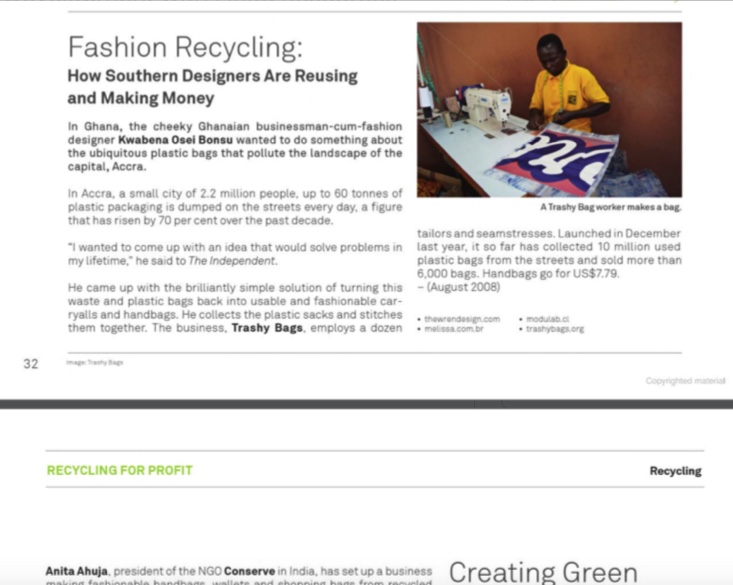
In Ghana, the cheeky Ghanaian businessman-cum-fashion designer Kwabena Osei Bonsu wanted to do something about the ubiquitous plastic bags that pollute the landscape of the capital, Accra.
In Accra, a small city of 2.2 million people, up to 60 tons of plastic packaging is dumped on the streets every day, a figure that has risen by 70 per cent over the past decade.
“I wanted to come up with an idea that would solve problems in my lifetime,” he said to the Independent.
He came up with the brilliantly simple solution of turning these wasted and damaging plastic bags back into usable and fashionable carryalls and handbags. He collects the plastic sacks and stitches them back together. The business, Trashy Bags, employs a dozen tailors and seamstresses. Launched in December last year, it so far has collected 10 million used plastic sachets from the streets, and sold more than 6,000 bags. Handbags go for US $7.79.
Ghana’s huge quantity of discarded plastic water bottles are gathered up for recycling too. A storage room overflows with more than 3 million sachets that have been collected and cleaned ready for recycling.
Bonsu’s business has turned into a source of income for local people, who receive US $3.89 for 1,000 sachets – a good return where the average yearly income is US $495
“I collect sachets because I am jobless and this gives me money,” said Hadiza Ishmael, a 55-year-old grandmother who has delivered 4,000 plastic bags. “It also makes the place look nicer.”
Published: August 2008
Resources
- The Re: Fashion Awards show is a brand new fashion phenomenon, set to transform social and environmental standards in the fashion industry within a decade. The RE:Fashion Awards will take place in London in November 2008. The glittering event will see major faces from the fashion world come together to recognise the most significant development in the fashion industry of the 21st century. The deadline for budding fashion designers to enter their contest is August 20th.
Website: http://www.refashionawards.org/ - A photogallery of the cocoa fashions:
here: Photogallery 1
and here: Photogallery 2
And a video of Mai making the garments here: Video - Ethical Fashion Show: Isabelle Quehe, who established the event, said “You almost never see designers from developing countries doing shows in Paris, so this brings together natural products, local fair labour, respect for the environment and finding sales outlets in Paris.” Potential designers and exhibitors can contact the Ethical Fashion Show by sending collection photos and a brief explanation on how the fashions contribute to the ethical fashion movement.
Send contributions to: 4, rue Trousseau 75011 Paris
Email: unilove@wanadoo.fr - Once inspired to get into the global fashion business, check out this business website for all the latest news, jobs and events.
Website: http://us.fashionmag.com/news/index.php - A creative agency specialising in the promotion of African culture to the world. They organise RUNWAY AFRICA—Africa’s annual Fall Fashion Show featuring five of Africa’s most promising rising design stars on the runway.
Website: http://inspirationafrica.org/aboutus.html - Green fashion must really be making an impact–the BBC, Britain’s venerable public broadcaster, has started an on-line fashion magazine. Called Thread. Fashion Without Victim, it is dedicated to bringing the “latest of eco-fabulous style”. Through a “unique mix of affordable fashion, exclusive videos, photo galleries and thought-provoking features” the site is committed to promoting all aspects of ethical fashion.
Website: http://www.bbc.co.uk/thread/ - Traidcraft fights poverty through trade, helping people in developing countries to transform their lives. Established in 1979 as a Christian response to poverty, we are the UK’s leading fair trade organisation.
Website: http://www.traidcraftshop.co.uk/default.aspx



Development Challenges, South-South Solutions was launched as an e-newsletter in 2006 by UNDP’s South-South Cooperation Unit (now the United Nations Office for South-South Cooperation) based in New York, USA. It led on profiling the rise of the global South as an economic powerhouse and was one of the first regular publications to champion the global South’s innovators, entrepreneurs, and pioneers. It tracked the key trends that are now so profoundly reshaping how development is seen and done. This includes the rapid take-up of mobile phones and information technology in the global South (as profiled in the first issue of magazine Southern Innovator), the move to becoming a majority urban world, a growing global innovator culture, and the plethora of solutions being developed in the global South to tackle its problems and improve living conditions and boost human development. The success of the e-newsletter led to the launch of the magazine Southern Innovator.


This work is licensed under a
Creative Commons Attribution-Noncommercial-No Derivative Works 3.0 License.
ORCID iD: https://orcid.org/0000-0001-5311-1052.
© David South Consulting 2023


 David South Consulting
You must be logged in to post a comment.