Categories
Archive Blogroll Southasiadisasters.net United Nations Office for South-South Cooperation

South–South Cooperation For Cities In Asia

Published: July 2014

Publisher: Southasiadisasters.net

Issue No. 114, July 2014

Theme: Towards Urban Resilience

The coming wave of technological innovations aimed at global South cities will dominate civic debates whether people wish it to or not. Already, futuristic, 21st-century cities are being built around Asia from scratch. I had the privilege of visiting a couple of them in 2012 while researching the fourth issue of our magazine, Southern Innovator (  h t t p : / / w w w . s c r i b d . c o m / SouthernInnovator). Each city had a different focus for its construction – one was seeking to be an “eco-city” and the other one called itself a “smart city,” focused on becoming a regional business and technology hub. Both aimed to use the latest information technologies to make the way Asian cities operate on a day-to-day basis smarter – and greener.

Large information technology companies – including India’s Infosys (infosys.com) – have their sights set on selling all sorts of technological solutions to common problems of urban living. This aspiring revolution is built on two foundations: One is the Internet of Things – in which everyday objects are connected to the
Internet via microchips. The other is Big Data, the vast quantities of data being generated by all the mobile phones and other electronic devices people use these days.

Much of this new technology will be manufactured in Asia, and not just that – it will also be developed and designed in Asia, often to meet the challenges of urban Asia.

By their nature, cities are fluid places. People come and go for work and pleasure, and successful cities are magnets for people of all backgrounds seeking new opportunities. This fluidity puts stress on cities and leads to the constant complaints familiar to any urban dweller – inadequate transport, traffic jams, air pollution, poor housing, and a high cost of living.

If handled well and with imagination, new information technologies can ensure Asian cities do more than pay lip service to aspirations to improve human development. They can make cities resilient places – able to bounce back from disasters, whether man made or natural.

During the late 1990s, I saw first-hand the pressures placed on one Asian city, Mongolia’s capital, Ulaanbaatar. The country endured the worst peacetime economic collapse since World War II while confronting the wrenching social and economic stresses of switching from a command economy during Communism to a free-market democracy. The city’s population grew quickly as rural economies collapsed and poverty shot upwards. I can only imagine now how the response could have been different with the technologies available today.

In 2010, I interviewed one of the editors of the Cities for All book, Charlotte Mathivet (http://globalurbanist.com/2010/08/24/cities-for-all-shows-how-the-worldspoor-are-building-ties-across-theglobal-
south), and she stressed the importance of South-South cooperation to ensuring cities are good places to live for everyone.

“A lot of social initiatives based on the right to the city are coming from these ‘new cities of the South,'” Mathivet said. “The book highlights original social initiatives: protests and organizing of the urban poor, such as the pavement dwellers’ movements in Mumbai where people with nothing, living on the pavements of a very big city, organise themselves to struggle for their collective rights, just as the park dwellers did in Osaka.”

Recently, an Indian restaurant uploaded to the Internet a video of what it claimed to be the first drone delivering a pizza in an Indian city. While this may or may not be a practical solution to traffic congestion, the subsequent negative fallout – angry police and public officials – from this use of new technology highlights the promise
and perils of innovating in the real world of Asian cities (http:/
/www.bbc.co.uk/news/
b l o g s – n e w s – f r o m –
elsewhere-27537120).

Micro electronics are becoming cheaper and more powerful by the month. Small businesses armed with a only laptop computer, access to the Internet and/or mobile phone networks, and cloud computing services, can offer very powerful business and public services solutions. And sharing solutions across the global South via information technologies has never been easier.

The U.S. Pentagon published various reports and studies in the 2000s forecasting a dark future for cities in the global South. As author Mike Davis revealed in his seminal work, Planet of Slums (http://www.amazon.com/exec/obido/ASIN/1844670228/nationbooks08), the Pentagon saw the developing world’s cities as the “battlespace of the twenty-first century.” It imagined sprawling, crime ridden cities full of poverty and slums and needing tiny drones and robots darting back and forth, keeping an eye on everything and suppressing unrest. This threat-based view of future cities is one to be avoided. It is possible, through the right application of quick solutions to the challenges that arise as cities grow, to turn to cooperation across the cities of the global South to avoid this pessimistic fate.


David South, Editor,
United Nations Office for
South-South Cooperation
(UNOSSC), UK

https://reliefweb.int/report/india/southasiadisastersnet-issue-no114-july-2014-towards-urban-resilience

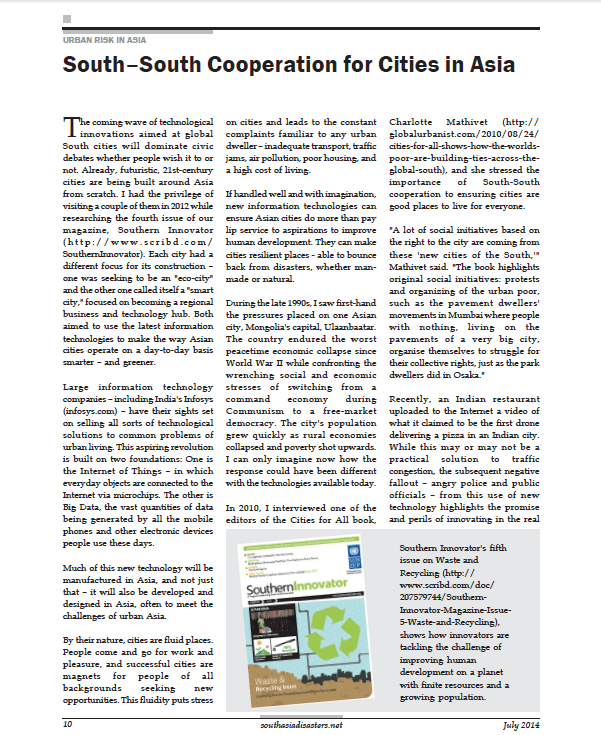
Southern Innovator’s fifth issue on Waste and Recycling (https://books.google.co.uk/books?id=6ILdAgAAQBAJ&dq=southern+innovator&source=gbs_navlinks_s), shows how innovators are tackling the challenge of improving human development on a planet with finite resources and a growing population.

https://davidsouthconsulting.org/2021/10/21/cities-for-all-shows-how-the-worlds-poor-are-building-ties-across-the-global-south/

https://davidsouthconsulting.org/2020/12/14/innovation-in-growing-cities-to-prevent-social-exclusion/

https://davidsouthconsulting.org/2021/10/22/innovations-in-green-economy-top-three-agenda/

https://davidsouthconsulting.org/2021/10/22/lima-to-delhi-what-can-be-learned-on-urban-resilience/

https://davidsouthconsulting.org/2021/02/23/southern-innovator-in-southasiadisasters-net/

https://davidsouthconsulting.org/2021/03/05/southern-innovator-issue-4/

https://davidsouthconsulting.org/2021/03/05/southern-innovator-issue-5/

https://davidsouthconsulting.org/2021/03/12/southern-innovator-magazine/

Creative Commons License

This work is licensed under a
Creative Commons Attribution-Noncommercial-No Derivative Works 3.0 License.

ORCID iD: https://orcid.org/0000-0001-5311-1052.

© David South Consulting 2023
Categories
Archive Development Challenges, South-South Solutions Newsletters Southern Innovator magazine

Turning Human Waste to Fertilizer: An African Solution

By David SouthDevelopment Challenges, South-South Solutions

SOUTH-SOUTH CASE STUDY

While South Africa has been free of the racist Apartheid regime since the mid-1990s, the expected boost to living standards for the majority black population has not been as widespread and as quick as many had expected.

One important aspect of lifting living standards is making sure the entire population has access to adequate sanitation and hygiene services. Another is making sure they have access to adequate and healthy food sources. A bright idea based on intensive research is meeting both goals in an innovative way.

According to the Council for Scientific and Industrial Research (http://www.csir.co.za/), some 11 million South Africans have received access to basic sanitation services since 1994 – but 13.3 million still lacked basic sanitation services by 2008.

The Water Research Commission (WRC) (http://www.wrc.org.za/) believes there is a crisis with South Africa’s toilet pit latrines, which are quickly filling up past their original design capacity. WRC’s solution is to turn the human faeces or faecal sludge deposited in pit latrines into fertilizer for farming and agriculture. The Water Research Commission is advocating using the fertilizer either for fruit trees or for trees that will be turned to income sources like paper and fuel.

The WRC’s project and series of experiments are called “What happens when pit latrines get full?”

“Only one third of municipalities have a budget to maintain on-site sanitation,” WRC researcher and scientist David Still told Inter Press Service (IPS). “If pits fill up, all the hard work that was done to address the sanitation backlog will be wasted. Why not use faecal sludge to address the growing problem of food insecurity by planting fruit trees? Or use the sludge to cultivate trees for fuel or paper production?”

Human faecal sludge contains a variety of nutrients, such as nitrogen, phosphates and potassium. The WRC estimates the average person excretes enough human faecal sludge per year to fertilize 300 to 400 square metres of crops.

The big reason people are reluctant to use human waste as fertilizer is because of the pathogens it contains. Spreading this on edible crops is dangerous and it is also a risk to groundwater when it leaches in to the soil.

The WRC conducted research on two sites: Umlazi and Karkloof, both in KwaZulu-Natal, South Africa. They used property owned by the South African Paper and Pulp Industry (SAPPI) and the local municipality.

The first step in the experiments was to bury the sludge in pits and plant crops on top of it. The pathogens were contained using this method and in time died off.

The test trenches were 0.75 metres in depth and filled with different quantities of sludge. Two control sites did not use faecal sludge. The scientists found the sites where the human waste was used saw plant growth and volume increase by “as much as 80 per cent.”

They then tested for pathogens in the soil. This included looking for the eggs of the large roundworm (http://www.nhs.uk/conditions/Roundworm/Pages/Introduction.aspx), a parasite whose presence would be harmful to humans. The site was tested over a period of 30 months, but none could be found.

Tests for microbes at the Umlazi site also found none. The plants were found to have healthy dark green leaves and the trees grew larger with the sludge present.

Researchers also monitored the groundwater around the sites. They found in flat ground and sandy soil there was no impact. In the site with sloping and shallow soil, small increases in nitrate were observed in the groundwater after rainfall.

They concluded the best place to apply this technique is in places that are flat and where the soil is deep.

One local resident, Lindiwe Khoza, was selected to be part of the test. Citrus and peach trees were planted on top of the buried sludge.

She told IPS: “The fruit grows much faster and it seems to be tastier and juicier than fruit bought at supermarkets. We now enjoy fruit from our own garden.”

WRC’s clever solution to these twin problems could help make life much more pleasant in communities still grappling with poor hygiene services, while dramatically improving the health of crops and their yields.

Published: July 2012

Resources

1) World Bank guide to pit latrines. Website:http://water.worldbank.org/shwresource-guide/infrastructure/menu-technical-options/pit-latrines

2) A video on how to construct a ventilated pit latrine. Website: http://www.youtube.com/watch?v=n4yfAyhiV74

3) A Practical Guide for Building a Simple Pit Latrine: How to Build Your Latrine and Use It Hygienically, for the Dignity, Health, and Well Being of Your Family. Website: http://www.crsprogramquality.org/publications/2011/9/13/a-practical-guide-forbuilding-a-simple-pit-latrine-how-to-b.html

4) The Control of Pathogens from Human Waste and their Aquatic Vectors by L. E. Obeng. Website: http://www.jstor.org/discover/10.2307/4312882?uid=3738032&uid=2129&uid=2&uid=70&uid=4&sid=21100919752851

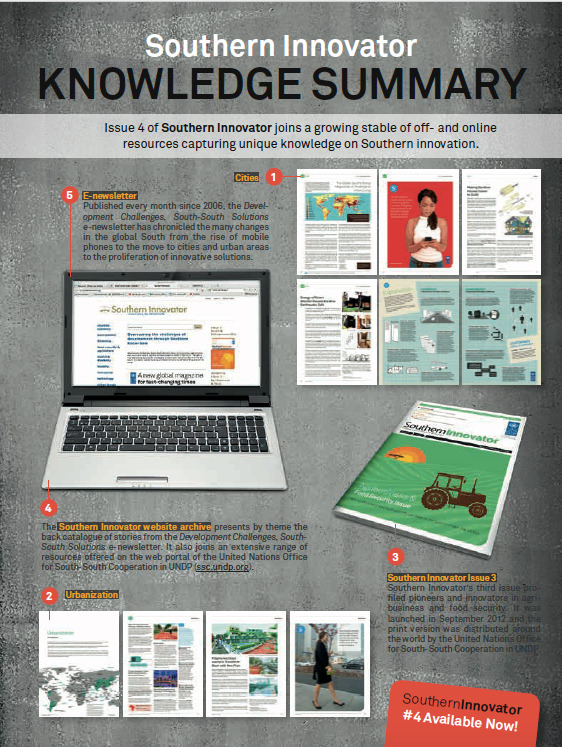
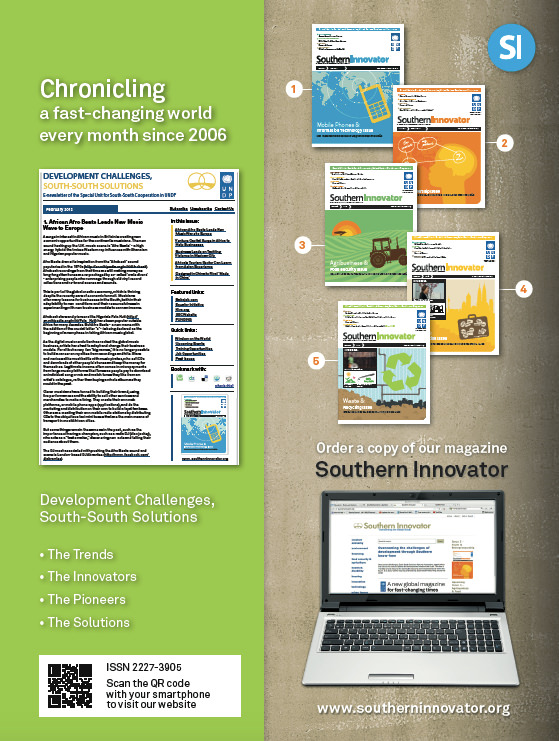
Development Challenges, South-South Solutions was launched as an e-newsletter in 2006 by UNDP’s South-South Cooperation Unit (now the United Nations Office for South-South Cooperation) based in New York, USA. It led on profiling the rise of the global South as an economic powerhouse and was one of the first regular publications to champion the global South’s innovators, entrepreneurs, and pioneers. It tracked the key trends that are now so profoundly reshaping how development is seen and done. This includes the rapid take-up of mobile phones and information technology in the global South (as profiled in the first issue of magazine Southern Innovator), the move to becoming a majority urban world, a growing global innovator culture, and the plethora of solutions being developed in the global South to tackle its problems and improve living conditions and boost human development. The success of the e-newsletter led to the launch of the magazine Southern Innovator.  

Follow @SouthSouth1

Google Books: https://books.google.co.uk/books?id=9fRcAwAAQBAJ&dq=development+challenges+july+2012&source=gbs_navlinks_s

Slideshare: http://www.slideshare.net/DavidSouth1/development-challenges-july-2012-issue

Southern Innovator Issue 1: https://books.google.co.uk/books?id=Q1O54YSE2BgC&dq=southern+innovator&source=gbs_navlinks_s

Southern Innovator Issue 2: https://books.google.co.uk/books?id=Ty0N969dcssC&dq=southern+innovator&source=gbs_navlinks_s

Southern Innovator Issue 3: https://books.google.co.uk/books?id=AQNt4YmhZagC&dq=southern+innovator&source=gbs_navlinks_s

Southern Innovator Issue 4: https://books.google.co.uk/books?id=9T_n2tA7l4EC&dq=southern+innovator&source=gbs_navlinks_s

Southern Innovator Issue 5: https://books.google.co.uk/books?id=6ILdAgAAQBAJ&dq=southern+innovator&source=gbs_navlinks_s

Creative Commons License

This work is licensed under a
Creative Commons Attribution-Noncommercial-No Derivative Works 3.0 License.

ORCID iD: https://orcid.org/0000-0001-5311-1052.

© David South Consulting 2023

Categories
Archive Development Challenges, South-South Solutions Newsletters

Old Boats Become New Furniture In Senegal

By David SouthDevelopment Challenges, South-South Solutions

SOUTH-SOUTH CASE STUDY

Every country has its fair share of waste and the remnants of past economic activity. Old cars nobody wants, discarded tins of food, old plastic bags, spare copper wire, cast-off clothing – all can have a new life in the right hands.

An intriguing twist on recycling is happening in the West African nation of Senegal. The country has a strong fishing tradition, and plenty of boats are used to haul in the catch every day. These boats are elaborately decorated and dazzle the eye when lined up on the beach awaiting the next journey to sea. But what to do with the boats when they have completed their service?

One ingenious social enterprise is turning the weatherbeaten but colorful boats into highly prized pieces of furniture that sell in the boutiques of Europe. The enterprise Artlantique (slogan “Made in Africa”) (http://artlantique.com) gathered together local craft folk, both masters and young apprentices, to tackle the challenge of re-shaping old fishing boats into furniture.

Artlantique’s founder, Spanish designer Ramon Llonch, then sends the furniture back to his shop in Barcelona, Spain where it is in turn distributed to shops around the world. Llonch ploughs Artlantique’s profits back in to expanding the business and hopes to hire more skilled craft folk in Senegal.

The idea is to create a “contemporary, modern design, which is above all 100 per cent African, as much in the material as in the making.”

Each unique piece of furniture is a riot of color, with planks of wood harvested from the boats creating an original and eye-pleasing pattern. The furniture has the weathered look expected of wood battered by years of exposure to salty sea water, and is streaked and branded with colorful patterns from its previous life as a fishing boat. The furniture items include cabinets, tables, benches, work tables, chairs, picture frames, coffee tables and even a fusball game table for lovers of soccer (football).

The catalogue that accompanies the website shows the families of the fisher folk, their boats, the workshop where the furniture is made, and the finished product. As the catalogue says, the boats “are stylish and elegant, their sides covered by many layers of paint, faded, and affected by rust from the salt and sea air, giving the wood a rich texture of different tones. Attracted by their beauty, and their history, we wondered whether after all the sea faring they had undergone, the wood would still be in good enough condition to begin a new life, to be ‘reincarnated’ into furniture.”

Negotiations are made with the fisher folk to acquire boats when they look like they have reached the end of their work life. The purchased boat is taken to a beach-side workshop and the craft folk discuss what to do with it. Young apprentices work alongside skilled craft folk, gaining the skills to make a high-quality wooden product capable of being exported.

The craft folk draw on their years of experience to add value to the final product. “Their contribution is essential as they suggest which type of furniture would be the most suitable to make,” Artlantique’s website explains. “They discuss their past and that of their forefathers: their cultural heritage, how to take full advantage of the wood, according to the size of the boat, and its color combinations.”

The furniture made from the boat wood has a high value because each piece is unique and can not be replicated. The raw “Samba” wood comes from an African tropical tree (http://en.wikipedia.org/wiki/Triplochiton_scleroxylon) and remains untreated by chemicals. It is seasoned naturally by the sea from its years of service as a fishing boat.

“This wood … has certain limitations, not only because it has a shape but also because it’s very damaged by the salt, the sea, the sun and the lime. But these artisans are very talented,” Llonch told CNN.

“Their creativity is not academic, they are like this by nature because [for them] recycling and reusing is not a fashion, it’s not a trend.”

Artlantique-branded furniture is now on sale in boutiques in Barcelona, Spain, Paris, France and Rome, Italy.

In Brazil, artist Sérgio Dido (http://www.artinsurf.com/art-dido.php), who lives in the dynamic beach resort town of Buzios (http://www.lonelyplanet.com/brazil/the-southeast/buzios), also salvages wood from fishing boats to create art with a surfing theme. The work is featured in the Art in Surf shop (http://www.artinsurf.com/index.php).

Published: July 2014

https://davidsouthconsulting.org/2022/11/21/africa/

https://davidsouthconsulting.org/2022/11/19/african-culture-as-big-business/

https://davidsouthconsulting.org/2022/08/02/design-collaborations-revitalize-traditional-craft-techniques/

https://davidsouthconsulting.org/2022/10/09/fashion-closes-gap-between-catwalk-and-crafts/

https://davidsouthconsulting.org/2022/11/17/fashion-recycling-how-southern-designers-are-re-using-and-making-money/

https://davidsouthconsulting.org/2022/11/16/favela-fashion-brings-women-work/

https://davidsouthconsulting.org/2022/10/20/ghanaian-coffins-prove-design-and-craftsmanship-boost-incomes/

https://davidsouthconsulting.org/2022/10/20/online-education-could-boost-african-development/

https://davidsouthconsulting.org/2022/11/22/popular-characters-re-invent-traditional-carving/

https://davidsouthconsulting.org/2021/03/05/southern-innovator-issue-2/

https://davidsouthconsulting.org/2021/03/05/southern-innovator-issue-5/

Development Challenges, South-South Solutions was launched as an e-newsletter in 2006 by UNDP’s South-South Cooperation Unit (now the United Nations Office for South-South Cooperation) based in New York, USA. It led on profiling the rise of the global South as an economic powerhouse and was one of the first regular publications to champion the global South’s innovators, entrepreneurs, and pioneers. It tracked the key trends that are now so profoundly reshaping how development is seen and done. This includes the rapid take-up of mobile phones and information technology in the global South (as profiled in the first issue of magazine Southern Innovator), the move to becoming a majority urban world, a growing global innovator culture, and the plethora of solutions being developed in the global South to tackle its problems and improve living conditions and boost human development. The success of the e-newsletter led to the launch of the magazine Southern Innovator.  

Follow @SouthSouth1

Google Books: https://books.google.co.uk/books?id=qBU9BQAAQBAJ&dq=development+challenges+july+2014&source=gbs_navlinks_s

Slideshare: http://www.slideshare.net/DavidSouth1/development-challenges-july-2014-published

Southern Innovator Issue 1: https://books.google.co.uk/books?id=Q1O54YSE2BgC&dq=southern+innovator&source=gbs_navlinks_s

Southern Innovator Issue 2: https://books.google.co.uk/books?id=Ty0N969dcssC&dq=southern+innovator&source=gbs_navlinks_s

Southern Innovator Issue 3: https://books.google.co.uk/books?id=AQNt4YmhZagC&dq=southern+innovator&source=gbs_navlinks_s

Southern Innovator Issue 4: https://books.google.co.uk/books?id=9T_n2tA7l4EC&dq=southern+innovator&source=gbs_navlinks_s

Southern Innovator Issue 5: https://books.google.co.uk/books?id=6ILdAgAAQBAJ&dq=southern+innovator&source=gbs_navlinks_s

Creative Commons License
This work is licensed under a
Creative Commons Attribution-Noncommercial-No Derivative Works 3.0 License.

ORCID iD: https://orcid.org/0000-0001-5311-1052.

© David South Consulting 2023

Categories
Archive

Indian Entrepreneur Brings Dignity to Poor Women

By David South, Development Challenges, South-South Solutions

SOUTH-SOUTH CASE STUDY

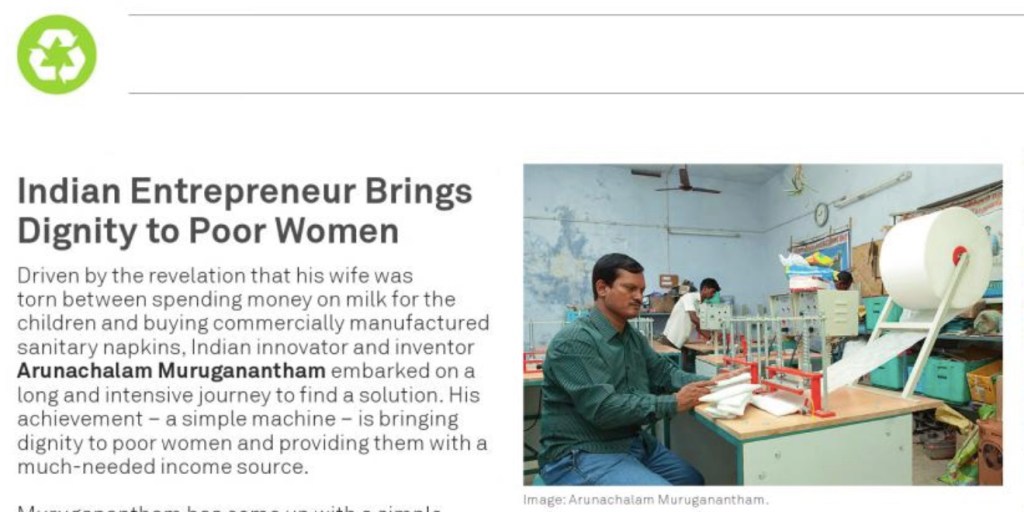
Driven by the revelation that his wife was torn between spending money on milk for the children and buying commercially manufactured sanitary napkins, Indian innovator and inventor Arunachalam Muruganantham embarked on a long and intensive journey to find a solution. His achievement – a simple machine – is bringing dignity to poor women and providing them with a much-needed income source.

This is a story of a man who was considered crazy for his persistence and made many personal sacrifices to achieve his goal. The innovation is both a technological and a business solution. Muruganantham has come up with a simple machine to manufacture affordable hygienic sanitary napkins for poor women. It works by turning the pulp of pine wood into the flat, white sanitary pads (http://en.wikipedia.org/wiki/Sanitary_napkin) commonly used by women during their monthly menstruation. The machine’s simplicity means it can be expanded easily to other communities and is designed to fit well with the way women’s cooperatives work and help them earn an income.

Muruganantham sees it is a business model that “can deliver livelihood, hygiene and dignity to poor women, and help them strengthen society,” according to his website.

The manufacturing process produces the sanitary napkins in just five steps. This simple intervention is revolutionizing women’s health in India by giving them an alternative to using found and unhygienic rags every month when they menstruate.

It took Muruganantham four years of research to create a patented machine that sells for between US $1,332 and US $5,330. It can make 120 sanitary pads an hour. Each one sells for 10 rupees (US 18 cents). By comparison, the multinational company Procter & Gamble sells its product for 30 rupees (US 54 cents) a packet.

Two multinationals dominate the marketplace for sanitary napkins in India: Procter & Gamble and Johnson & Johnson, with the Stayfree and Carefree brands.

Muruganantham’s machine was awarded the best innovation national award by the former President of India, Prathiba Patil, in 2009.

Like many innovators and inventors, his work at first was little understood by others and meant he had to plough a lonely furrow. But his persistence paid off and is now receiving attention from countries across the global South.

Apart from its technological simplicity, the idea is to make it easy for women to form cooperatives and businesses to boost their incomes. India has seen the concept of so-called Ladies Self Help Groups (SHGs) (http://en.wikipedia.org/wiki/Self-help_group_%28finance%29) become more popular as a source of income. One of the problems they encounter is finding a successful business to undertake. The machine invented by Muruganantham is being seen as a good business model for the SHGs to follow. The key is the simplicity of operating the machine, the growing and stable market for the product, and its affordable and competitive price.

Typical businesses that can be set up using the machine can employ 10 women.

Muruganantham set up his main business, Jayaashree Industries (motto: ‘new inventions… small is beautiful’) (http://newinventions.in/aboutus.aspx), after his education was disrupted due to family problems and he took up a job in a welding shop.

At first, he had a difficult time convincing people of the utility of the machine. He enlisted his wife to help with the marketing of the new napkins to nearby women. He says the advantage of his business model is that it turns the making of the napkins into a sustainable, grassroots activity. It provides an essential commodity for poor women at an affordable price, removing middlemen and using a simple, non-chemical technology.

It also cuts down on expensive transport costs by keeping manufacturing local.

Over 225 machines have been delivered to 14 Indian states and also to Nigeria, Ethiopia, Kenya, Uganda, Nepal and Bangladesh.

And while Muruganantham is focused on making the machine a success, he is already looking forward to working on his next big invention. The only question is: what will it be?

Resources

1) Women’s Health: A website packed with facts and advice from the UK’s National Health Service. Website: http://www.nhs.uk/livewell/women1839/Pages/Women1839home.aspx

Creative Commons License

This work is licensed under a
Creative Commons Attribution-Noncommercial-No Derivative Works 3.0 License.

ORCID iD: https://orcid.org/0000-0001-5311-1052.

© David South Consulting 2021