Categories
Archive Development Challenges, South-South Solutions Newsletters

Pay for Pee Keeps Indian Town Clean

By David SouthDevelopment Challenges, South-South Solutions

SOUTH-SOUTH CASE STUDY

The task is huge: 2.6 billion people, or 41 percent of the world’s population, is without access to basic sanitation. As a result, most have to make do and defecate or urinate wherever they can. In crowded urban areas, the result is an unpleasant source of disease and filth that fouls living spaces and sickens or kills many people.

In Indian cities, between one-quarter and one-half of the population, mostly slum-dwellers, has inadequate or no provision for sanitation.

Many government-built communal toilet blocks are in a sad state. They are overburdened by queues of people that can stretch a mile-long in the mornings. They can also be too expensive for many slum dwellers. Often government-built toilet blocks are in disrepair after just three months, and people return to defecating in the streets.

In 2008, the International Year of Sanitation (http://esa.un.org/iys/), more than 330 million people in India do not have access to proper sanitation facilities. And in the case of the remote town of Musiri in Tamil Nadu state, many residents relieve themselves on river banks, leading to infectious diseases like diarrhoea.

But an ingenious scheme is keeping streets clean and people relieved. Rather than viewing human waste as an expensive problem and annoyance, poor residents are being paid up to a dollar a month to use public toilets. By paying people to use the toilets, the government avoids having to run campaigns to get people to change their habits.

“In fact, many of us started using toilets for urination only after the ecosan (ecological sanitation) toilets were constructed in the area,” S. Rajasekaran, a truck cleaner, to The Times of India.

The urine is being collected to be used as a crop fertilizer by the state’s agricultural university (http://www.tnau.ac.in/ ). About 150 residents use the eco-sanitation toilet daily. It is designed to collect faeces as well: it too is used as fertilizer.

“We’re motivating people to know the value of their urine,” Marathi Subburaman, who came up with the novel idea, told CNN. “The urine that is collected goes into fields for paddy crops, and of course the faeces becomes good compost in a matter of months.”

Subburaman’s non-profit Society for Community Organization and People’s Education (SCOPE) has teamed up with Tamil Nadui Agricultural University and are studying how much urine is needed to fertilize a field.

“Next year, we can install urine banks so we can sell the urine to farmers,” he said.

The locals are given cards and each trip is recorded. At the end of the month, the cards are handed in and the money collected.

The average amount paid out is based on the assumption most people need to go twice a day.

If some get cheeky and try to make more money from pretending they need to go to the toilet, there is a solution: “If they ask to go three, four times a day, then something’s wrong,” Subburaman said. “We ask them to go to a doctor.”

Another successful model is the Indian NGO SPARC (Society for Promotion of Area Resource Centres) (http://www.sparcindia.org/). SPARC is an Indian NGO established in Mumbai in 1984 that began working with women pavement dwellers.

It has been designing and building toilet blocks in Indian cities, bringing access to toilets and washing facilities to hundreds of thousands of poor urban Indians. It has built toilet blocks for 400,000 people in eight Indian cities. It trains community groups to build, manage and maintain the toilet blocks. It has also proven that local groups can take on the management and costs of providing toilet facilities.

Resources

  • World Toilet Organization: The global non-profit organization committed to improving toilet and sanitation conditions. Website: http://www.worldtoilet.org
  • World Toilet College: Established in 2005, the World Toilet College (WTC) started as a social enterprise, with the belief that there is a need for an independent world body to ensure the best practices and standards in toilet design, cleanliness, and sanitation technologies are adopted and disseminated through training. Website: http://www.worldtoilet.org/ourwork3.asp
  • Official website for the 2008 International Year of Sanitation. Website: http://esa.un.org/iys/
  • Waste has expert knowledge on domestic solid and liquid waste management and sanitation issues. Its website offers a comparison of designs and methods for toilets. Website: http://www.ecosan.nl/page/353

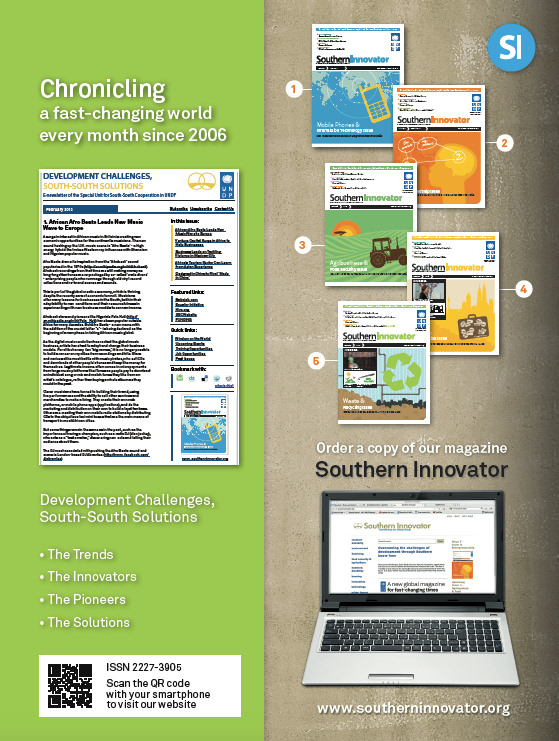
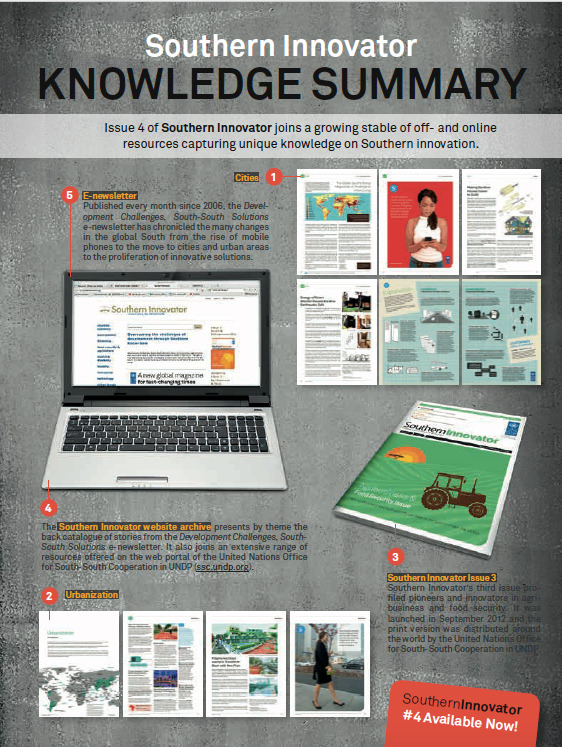
Development Challenges, South-South Solutions was launched as an e-newsletter in 2006 by UNDP’s South-South Cooperation Unit (now the United Nations Office for South-South Cooperation) based in New York, USA. It led on profiling the rise of the global South as an economic powerhouse and was one of the first regular publications to champion the global South’s innovators, entrepreneurs, and pioneers. It tracked the key trends that are now so profoundly reshaping how development is seen and done. This includes the rapid take-up of mobile phones and information technology in the global South (as profiled in the first issue of magazine Southern Innovator), the move to becoming a majority urban world, a growing global innovator culture, and the plethora of solutions being developed in the global South to tackle its problems and improve living conditions and boost human development. The success of the e-newsletter led to the launch of the magazine Southern Innovator.  

Follow @SouthSouth1

Google Books: https://books.google.co.uk/books?id=m5GYBgAAQBAJ&dq=development+challenges+may+2012&source=gbs_navlinks_s

Slideshare: http://www.slideshare.net/DavidSouth1/development-challengessouthsouthsolutionsmay2012issue

Southern Innovator Issue 1: https://books.google.co.uk/books?id=Q1O54YSE2BgC&dq=southern+innovator&source=gbs_navlinks_s

Southern Innovator Issue 2: https://books.google.co.uk/books?id=Ty0N969dcssC&dq=southern+innovator&source=gbs_navlinks_s

Southern Innovator Issue 3: https://books.google.co.uk/books?id=AQNt4YmhZagC&dq=southern+innovator&source=gbs_navlinks_s

Southern Innovator Issue 4: https://books.google.co.uk/books?id=9T_n2tA7l4EC&dq=southern+innovator&source=gbs_navlinks_s

Southern Innovator Issue 5: https://books.google.co.uk/books?id=6ILdAgAAQBAJ&dq=southern+innovator&source=gbs_navlinks_s
https://davidsouthconsulting.org/2022/10/18/indian-initiatives-to-make-travel-safer-for-women/

https://davidsouthconsulting.org/2022/10/25/indian-toilet-pioneer-champions-good-ideas/

https://davidsouthconsulting.org/2022/10/18/indians-fighting-inflation-with-technology/

https://davidsouthconsulting.org/2022/11/18/toilet-malls-make-going-better/

Creative Commons License

This work is licensed under a
Creative Commons Attribution-Noncommercial-No Derivative Works 3.0 License.

ORCID iD: https://orcid.org/0000-0001-5311-1052.

© David South Consulting 2023
Categories
Archive Development Challenges, South-South Solutions Newsletters Southern Innovator magazine

A Solution to Stop Garbage Destroying Tourism

By David SouthDevelopment Challenges, South-South Solutions

SOUTH-SOUTH CASE STUDY

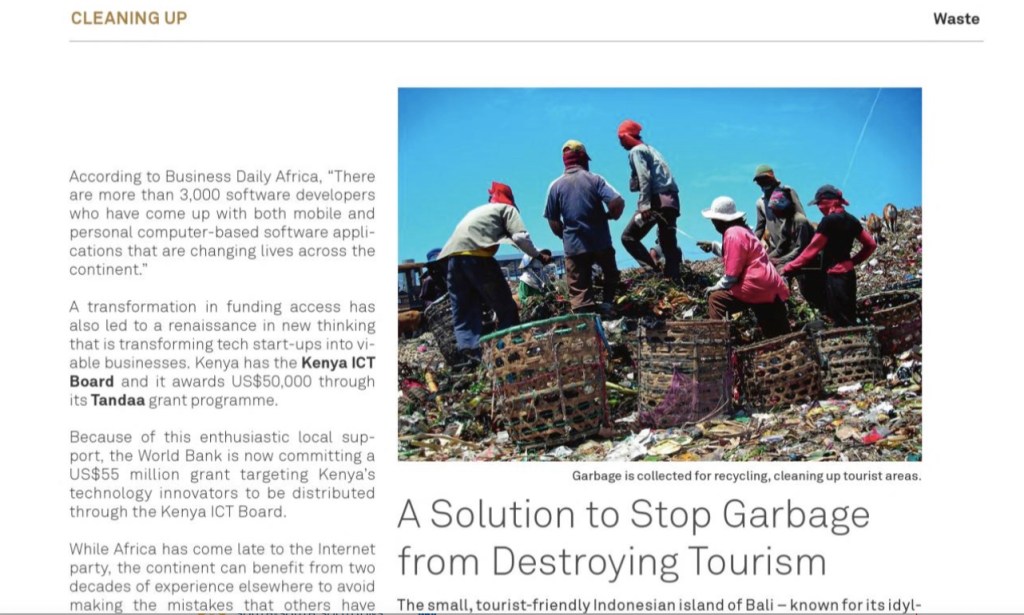
Tourism is an essential source of income for countries across the South. But many put that livelihood in jeopardy when they lose control of garbage collection. A popular tourist spot can represent a ‘paradise’ to visitors, but when it becomes too popular and local garbage collection systems collapse under the burden, ‘paradise’ can soon turn to an environmental hell.

The small, tourist-friendly Indonesian island of Bali (http://en.wikipedia.org/wiki/Bali) – known for its idyllic pleasures of spas, surf and serenity – is being overwhelmed by garbage. A survey of tourists found two-thirds would not return to the island because of the problem.

Tourism took off on the island in the 1970s. The economic benefits are clear: the island went from being economically marginal to ranking second only to the country’s capital, Jakarta, in wealth creation. The island received more than 2.38 million tourists in 2009, up 14.5 percent compared with 2008, according to Ida Komang Wisnu, head of the provincial statistics office. But tourism produces on average five kilograms of waste a day per tourist – 10 times what the average Indonesian produces (Bali Fokus).

In the past, the traditional way of serving food in Indonesia was to wrap it in, or serve it on, a palm leaf: a biodegradable approach. But with the huge expansion in use of plastics and non-biodegradable packaging, the waste disposal problem is out of control.

In Indonesia, government garbage disposal services tend to collect between 30 and 40 percent of solid waste, most of this from high income communities. The majority poor population are left to fend for themselves when it comes to waste disposal.

A solution by Yuyun Ismawati, an environmental engineer and consultant, has since 1996 focused on helping poor communities find ways to safely dispose of waste. In 2000, she started her own NGO – Bali Fokus (http://balifokus.asia/balifokus/) – and opened a waste management facility in the Bali village of Temesi. The recycling plant employs 40 people from the village, who sort garbage into recyclables, compost and residual waste. Income from the recycled waste and compost goes to helping local farmers.

She then expanded her concept to include households around Bali and elsewhere in Indonesia. She concentrated on housewives and targeted reducing the amount of household waste going to dump sites. A core team trains housewives in daily habits that separate waste and compost organic matter like vegetable and fruit scraps. Bali Fokus claims it has been able to reduce waste created by 50 percent in 500 homes. Some of the women sell their compost in local markets; recyclables are turned into sellable items.

From 2001 to 2003, Ismawati turned this approach into a replicable template called SANIMAS. By 2008, the SANIMAS template was being used in hundreds of communities across Indonesia.

Her solution to the deluge of tourist waste can be seen in the luxury Jimbaran Bay area of Bali. Traditionally, the area’s hotels would sell their waste to pig farmers. While the pigs feasted on the fancy scraps, the rest of the waste was put in plastic bags and thrown away in mangrove forests.

“I told hotels: Your job is to sell rooms, not to sell garbage,” Ismawati recalls. “We have to protect Bali or else tourists won’t want to come here anymore.”

Ismawati cleverly turned the relationship around: rather than a pig farmer paying for scraps, she convinced one of them there was money to be made recycling and sorting garbage. For this, the hotels would pay the farmer.

A network of 25 hotels now pays to have their garbage taken away and sorted by hand: an important source of full-time jobs.

The workers sort through paper, plastics, glass, aluminium, food scraps and vegetables. Each week, 140 trucks deliver waste to the facility. Only 10 leave with waste that has to go to a dump site.

Food leftovers are bought by local pig farmers and grass clippings and other organic matter is composted (http://www.recyclenow.com/home_composting/), and eventually makes its way back to the hotels and is distributed in the flower beds.

This system has created 400 jobs where the pig farmer once only employed 10 people.

“If you want a hi-tech solution in a developing country you will wait and wait and wait until you get the money, or big donors to fund it,” Ismawati told the Telegraph newspaper. “And even then it may not work.”

A graphic example of this is a donated waste recycling machine given by the local government. It can’t be used because the electricity to power it costs too much. Human labour is a cheaper option.

Bali Fokus’ successful approach has now been replicated in six other sites on the nearby island of Java. And the government of Indonesia has promised to help create 15 more each year.

In 2009 Ismawati won the Goldman Award (http://www.goldmanprize.org/), which honors grassroots environmental heroes from the six inhabited continental regions: Africa, Asia, Europe, Islands and Island Nations, North America, and South and Central America.

She is also working on using decentralized grassroots approaches to bringing sewage disposal and clean water to communities.

Published: March 2010

Resources

https://davidsouthconsulting.org/2022/11/19/african-culture-as-big-business/

https://davidsouthconsulting.org/2022/10/20/african-tourism-leads-the-world-and-brings-new-opportunities/

https://davidsouthconsulting.org/2022/10/20/africas-tourism-sector-can-learn-from-asian-experience/

https://davidsouthconsulting.org/2022/11/18/bolivia-grabs-world-media-attention-with-salt-hotel/

https://davidsouthconsulting.org/2022/02/07/boosting-tourism-in-india-with-surfing-culture/

https://davidsouthconsulting.org/2022/09/27/caribbean-island-st-kitts-goes-green-for-tourism/

https://davidsouthconsulting.org/2022/11/20/ecotourism-to-heal-the-scars-of-the-past/

https://davidsouthconsulting.org/2022/11/21/from-warriors-to-tour-guides/

https://davidsouthconsulting.org/2022/11/11/havanas-restaurant-boom-augers-in-new-age-of-entrepreneurs/

https://davidsouthconsulting.org/2022/11/15/indonesia-best-for-entrepreneurs/

https://davidsouthconsulting.org/2022/11/01/indonesian-food-company-helps-itself-by-making-farmers-more-efficient/

https://davidsouthconsulting.org/2022/11/15/indonesian-middle-class-recycle-wealth-back-into-domestic-economy/

https://davidsouthconsulting.org/2021/06/11/indonesian-wooden-radio-succeeds-with-good-design/

https://davidsouthconsulting.org/2022/11/23/kenyan-safari-begins-minutes-from-airport/

https://davidsouthconsulting.org/2022/10/26/south-gets-reading-bug-with-more-festivals/

https://davidsouthconsulting.org/2021/03/05/southern-innovator-issue-2/

https://davidsouthconsulting.org/2021/03/05/southern-innovator-issue-5/

https://davidsouthconsulting.org/2022/11/18/tourist-passion-for-quirky-holidays-helps-south/

Development Challenges, South-South Solutions was launched as an e-newsletter in 2006 by UNDP’s South-South Cooperation Unit (now the United Nations Office for South-South Cooperation) based in New York, USA. It led on profiling the rise of the global South as an economic powerhouse and was one of the first regular publications to champion the global South’s innovators, entrepreneurs, and pioneers. It tracked the key trends that are now so profoundly reshaping how development is seen and done. This includes the rapid take-up of mobile phones and information technology in the global South (as profiled in the first issue of magazine Southern Innovator), the move to becoming a majority urban world, a growing global innovator culture, and the plethora of solutions being developed in the global South to tackle its problems and improve living conditions and boost human development. The success of the e-newsletter led to the launch of the magazine Southern Innovator.  

Creative Commons License

This work is licensed under a
Creative Commons Attribution-Noncommercial-No Derivative Works 3.0 License.

ORCID iD: https://orcid.org/0000-0001-5311-1052.

© David South Consulting 2023

Categories
Archive

Turning Animal Waste Into Paper

By David SouthDevelopment Challenges, South-South Solutions

SOUTH-SOUTH CASE STUDY

Animal waste is a messy fact of daily life in rural communities across the global South. This byproduct of life has many uses – but an ingredient for making writing paper is probably not the first that springs to mind.

But animal dung is cleverly being recycled into high-value products in Sri Lanka and Thailand. Both countries have elephants who are under threat. In Sri Lanka (http://en.wikipedia.org/wiki/Sri_Lanka) the large but endangered elephant population is considered a nuisance. They damage crops and are often killed for this reason. There are upwards of 3,000 elephants in the country – down from 14,000 in the 1800s. Nonetheless, they create vast quantities of excrement. In Sri Lanka, they face many threats: ivory poachers, being killed to protect crops and houses, starvation from drought and deforestation.

Animal waste (http://en.wikipedia.org/wiki/Feces) has many uses: it can be turned into fertilizer for crops, fuel for cooking, placed in a digester and fermented into bio-gas for heating and cooking, and if from a herbivore animal, into fibrous products like paper and cardboard. Packing boxes can also be made from the excrement.

As a vegetarian animal, elephants’ excrement and dung is made up of vegetable matter and is rich in cellulose (http://en.wikipedia.org/wiki/Cellulose). And cellulose is what makes up the majority of traditional wood-pulp paper (http://en.wikipedia.org/wiki/Pulp_%28paper%29).

Re-using the waste is also a good way to make elephants valuable to local people, rather than just being perceived as a nuisance.

Dung produces a natural, recycled paper. While harvesting trees for paper is an expensive and energy-wasting process, the elephant’s digestive tract does the hard work by breaking down the cellulose, making it ideal for the next stage in becoming a paper product.

According to the Environmental Paper Network (http://www.environmentalpaper.org/stateofthepaperindustry/confirm.htm), 50 percent of the world’s forests have been destroyed, and 80 percent of the remaining forests are in a degraded state.  By turning to alternative sources to make paper, trees are saved and vast quantities of energy reduced. Traditional paper-making also uses many chemicals in the process, something that is avoided in using animal dung. Vegetable products are used to bind the paper together and water-soluble dyes are used to colour the paper.

Dung paper has earned some high-profile fans as well. The Turner Prize-winning British/Nigerian artist Chris Ofili (http://en.wikipedia.org/wiki/Chris_Ofili), uses elephant dung paper in his works.

The Elephant Dung Paper company (www.elephantdungpaper.com) in Thailand was one of the first to pioneer the technique. This business was started by dung paper pioneer Mr. Wan Chai. He tells a story of how he became enchanted by the paper-making process when he walked past a paper factory one day. Later, when he was at the Thai Elephant Conservation Center in Lampang, northern Thailand (http://www.changthai.com), he noticed the elephant dung was rich in fibres like those used in making paper from wood pulp.

Inspired, he embarked on a process of trial and error using his wife’s food processor to turn elephant dung into a fibrous stew that is then shaped, dyed and dried to make paper (http://www.elephantdungpaper.com/process.html).

Wan Chai has gone on to be a formative influence in the founding of a sheep dung paper making operation in Britain, Creative Paper Wales.

Another dung paper business is Mr. Ellie Pooh (http://www.mrelliepooh.com/) in Sri Lanka. Established with the goal of reducing conflict between humans and elephants, it has turned to making paper products to boost local incomes and create a direct economic incentive to protect the elephants. It is setting up handmade paper workshops in rural areas and teaming them with artisans to add value to the products and make them more desirable. Design is critical to making any product – no matter how ethically produced and how green – desirable to consumers.

The dung products Mr. Ellie Pooh makes include a wide variety of coloured papers, scrapbooks, note boxes, stationery pouches, greeting cards, ‘to do’ list pads, memo books, and a children’s book.

The process of making elephant dung paper takes about 13 days – three days of sorting, boiling and disinfecting, followed by 10 days to pulp, mix, press and dry the paper. Mr. Ellie Pooh makes about 1,000 sheets a day and 30,000 a month. Each sheet makes six A4-size pieces of paper.

The company was founded by Dr. Karl Wald and Thusitha Ranasinghe, and is managed by recycled paper firm Ecomaximus (http://www.ecomaximus.com/) based in Colombo, Sri Lanka, with a workshop in Kegalle.

Ecomaximus was started in 1997 by its Managing Director, Ranasinghe, who was following a family tradition going back three generations of working in printing.

The business started recycling waste printing paper and then moved into recycling a wide variety of other cellulose waste: rice paddy straw, cinnamon and banana bark. It now employs over 35 people on two sites.

It is proof that it just takes creativity and a new perspective to turn something considered as waste into wealth: and jobs and sustainable incomes.

Resources

1) Creative Paper Wales: Makers of Sheep Poo Paper, this company in Wales uses sheep dung to make a range of paper products. Sheep are plentiful in Wales and are found all over the hills grazing. Website: http://www.creativepaperwales.co.uk/index.aspx

2) Paper High sells online paper products made from Sri Lankan elephant dung. This includes note books, greeting cards, photo frames, and photo albums. Website: http://www.paperhigh.com/products/srilanka/srilanka.htm?gclid=CKbHrdaZv6YCFQkf4Qod-hzaHg

3) Red Dot: Red dot stands for belonging to the best in design and business. It champions design in business through awards and events. Website: http://en.red-dot.org/

Creative Commons License

This work is licensed under a
Creative Commons Attribution-Noncommercial-No Derivative Works 3.0 License.

ORCID iD: https://orcid.org/0000-0001-5311-1052.

© David South Consulting 2022

Categories
Archive

Egyptian Youth Turns Plastic Waste into Fuel

By David SouthDevelopment Challenges, South-South Solutions

SOUTH-SOUTH CASE STUDY

The challenge of finding alternate fuel sources is capturing the imagination of innovators across the global South. As the world’s population increases – it recently reached 7 billion (UN) – and the number of people seeking a better life grows in turn, the energy demands on the planet are pushing up competition for existing conventional fuel sources.

The modern lifestyle that many aspire to requires energy, whether it’s using electronic products which consume large quantities of electricity, driving personal vehicles or living in homes that are artificially heated and cooled.

This energy hunger has opened up a whole new market demand that needs to be met. The scale of this market is enormous, but the solutions are ultimately limited only by people’s imaginations. An award-winning Egyptian teenage scientist is capturing attention for the imaginative solution of turning waste plastic into biofuel, sparking interest in the creation of a whole new source of wealth for her country.

Sixteen-year-old Azza Abdel Hamid Faiad (http://tinyurl.com/dysemjg) has found a new way to take waste plastic and break it down into fuel. She has discovered aluminosilicate minerals (http://en.wikipedia.org/wiki/Aluminosilicate) – which contain aluminium, silicon and oxygen and are found in clays – can break down the polymers that make up plastic (http://en.wikipedia.org/wiki/Polymer) to produce the gases methane, propane and ethane, all of which can be turned into ethanol (http://en.wikipedia.org/wiki/Ethanol), which is useful as a biofuel.

According to Inhabitat (inhabitat.com), a website dedicated to “green design, innovation, and the future of clean technology,” her solution could turn the country’s annual consumption of 1 million tonnes of plastic into a year’s supply of biofuel worth US $78 million.

Clever innovators are sitting on a goldmine if they can come up with renewable energy solutions. The U.S. Army alone is looking to spend US $7 billion on renewable energy sources and is accepting bids from the private sector to meet its needs (http://www.forbes.com/sites/toddwoody/2012/08/08/u-s-army-opens-bids-to-buy-7-billionin-renewable-energy/). The army is looking to sign contracts stretching up to 30 years for buying electricity generated by solar, wind, geothermal and biomass projects.

The options are numerous for renewable energy – from solar power to wind power to algae as a source of biofuels (http://en.wikipedia.org/wiki/Biofuel). The challenge is to find a fuel source that is plentiful, renewable, and crucially, doesn’t harm other needs.

Using biofuel as a replacement for conventional petroleum-based fuels like gasoline and diesel appears to be an attractive solution, but it can lead to other problems. Some people are using used cooking oils to convert into biodiesels, but sometimes there is not enough used cooking oil to meet demand. In short, a constant supply source is required to meet ever-increasing energy demand.

A famous example of where the use of renewable plant-based fuel sources can go wrong is the case of corn. The widespread use of corn as a source for biofuels – rather than for animal feed or human food – has led to accusations this is contributing to the global food crisis. The current drought in the United States is damaging corn crops and only making this problem more acute. The U.S. is the world’s largest producer of corn (US Department of Agriculture) and much of it is used as livestock feed around the world.

Faiad’s solution is appealing because the fuel does not come from biomass – derived from plant matter – but turns waste plastic into the raw material for biofuel.

Plastic waste is a common byproduct of modern life. Plastic is used extensively in packaging, bottles, bags and electronic products. It fills up landfill sites and is a blight on the landscape in many countries. It is also a product made from petrochemicals (http://en.wikipedia.org/wiki/Plastic), the very source of conventional fuel used by most of the world’s vehicles.

Breaking down waste plastic from bottles, packaging and other products into what is called ‘biofuel feedstock’ – the substance necessary to start the creation of biofuel – requires a means to turn the plastic into fuel.

According to Green Prophet (greenprophet.com), Faiad believes her technological breakthrough “can provide an economically efficient method for production of hydrocarbon fuel namely: cracked naphtha (http://en.wikipedia.org/wiki/Petroleum_naphtha) of about 40,000 tons per year and hydrocarbon gases of about 138,000 tons per year equivalent to US $78 million.”

This could be a big economic boost to Egypt’s economy, simultaneously reducing dependence on petroleum-based fuels and creating a new source of income. Egypt’s economy has been hit hard since the start of the Arab Spring (http://en.wikipedia.org/wiki/Arab_Spring). The number of tourists fell 33 per cent in 2011 and revenue dropped by US $3.7 billion from 2010 (Egyptian Tourism Minister). In 2009 about 12.5 million tourists visited Egypt, bringing revenue of US $10.8 billion. The tourism sector is one of the country’s top sources of foreign revenue, accounting for more than 11 per cent of GDP, and offers jobs in a country beset by high unemployment – for Egypt, tourism makes up 11 per cent of its GDP (gross domestic product) (Reuters).

Faiad’s innovation has not gone unnoticed. She received the European Fusion Development Agreement award (http://www.efda.org/) at the 2011 23rd European Union Contest for Young Scientists (http://ec.europa.eu/research/youngscientists/index_en.cfm). She is also receiving interest from the Egyptian Petroleum Research Institute (http://www.epri.sci.eg/), according to Inhabitat.

Ambitious Faiad is also seeking to take ownership of her innovation by getting a patent from the Egyptian Patent Office (http://www.egypo.gov.eg/english/default.htm).

Published: August 2012

Resources

1) Biofuel: A website with a good overview of biofuel options and directions on how to make biofuel. Website: http://biofuel.org.uk/

2) Biogasmax: Biogas Highway – waste to energy concept, 18-19 September in Gothenburg, Sweden. Participate in an intensive two-day programme with complete focus on biogas at the Water and Wastewater Fair. Meet with exhibiting Swedish biogas companies and companies within the water and wastewater sectors. Participate at the “International biogas business opportunities” seminar and learn more about biogas concepts and strategies. Website: http://www.biogasmax.eu/

3) New Techniques Create Butanol, A Superior Biofuel: A story from Science Daily about new techniques to produce a biofuel superior to ethanol. Website: http://www.sciencedaily.com/releases/2008/01/080123153142.htm

4) Biofuels Digest: The Digest covers producer news, research, policy, policymakers, conferences, fleets and financial news. Website: http://www.biofuelsdigest.com/bdigest/

Follow @SouthSouth1

Slideshare: http://www.slideshare.net/DavidSouth1/development-challengessouthsouthsolutionsnovember2010issue

Southern Innovator Issue 1: https://books.google.co.uk/books?id=Q1O54YSE2BgC&dq=southern+innovator&source=gbs_navlinks_s

Southern Innovator Issue 2: https://books.google.co.uk/books?id=Ty0N969dcssC&dq=southern+innovator&source=gbs_navlinks_s

Southern Innovator Issue 3: https://books.google.co.uk/books?id=AQNt4YmhZagC&dq=southern+innovator&source=gbs_navlinks_s

Southern Innovator Issue 4: https://books.google.co.uk/books?id=9T_n2tA7l4EC&dq=southern+innovator&source=gbs_navlinks_s

Southern Innovator Issue 5: https://books.google.co.uk/books?id=6ILdAgAAQBAJ&dq=southern+innovator&source=gbs_navlinks_s

Creative Commons License

This work is licensed under a
Creative Commons Attribution-Noncommercial-No Derivative Works 3.0 License.

ORCID iD: https://orcid.org/0000-0001-5311-1052.

© David South Consulting 2023