“I think you [David South] and the designer [Solveig Rolfsdottir] do great work and I enjoy Southern Innovator very much!”
Ines Tofalo, Programme Specialist, United Nations Office for South-South Cooperation
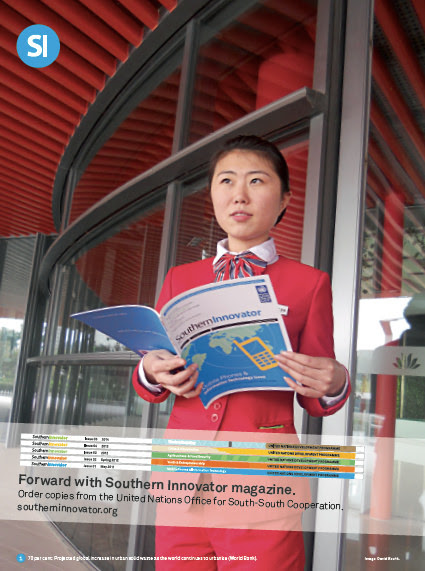
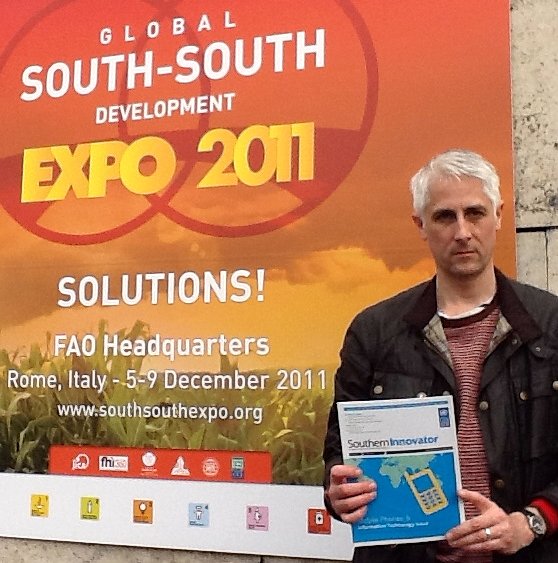
Southern Innovator in Tianjin, China.Issue 5 of Southern Innovator at the Global South-South Development Expo (GSSD Expo) 2014 held in Washington, D.C.Volunteers in Nairobi, Kenya pose with Southern Innovator Issue 4 at the Global South-South Development Expo (GSSD Expo) in 2013.Southern Innovator Editor and Writer David South in Australia.Southern Innovator Graphic Designer and Illustrator Sólveig Rolfsdóttir in Iceland.
Some comments that have come in so far about SI’s first issue:
“What a tremendous magazine your team has produced! It’s a terrific tour de force of what is interesting, cutting edge and relevant in the global mobile/ICT space… Really looking forward to what you produce in issues #2 and #3. This is great, engaging, relevant and topical stuff.”, to “Looks great. Congratulations. It’s Brill’s Content for the 21st century!”
What they are saying about SI on Twitter: From @CapacityPlus Nice job RT @ActevisCGroup: RT @UNDP: Great looking informative@SouthSouth1 mag on South-South Innovation; @UNDP Great looking informative @SouthSouth1 mag on South-South Innovation; @JeannineLemaireGraphically beautiful & informative @UNDP Southern Innovator mag on South-South Innov.
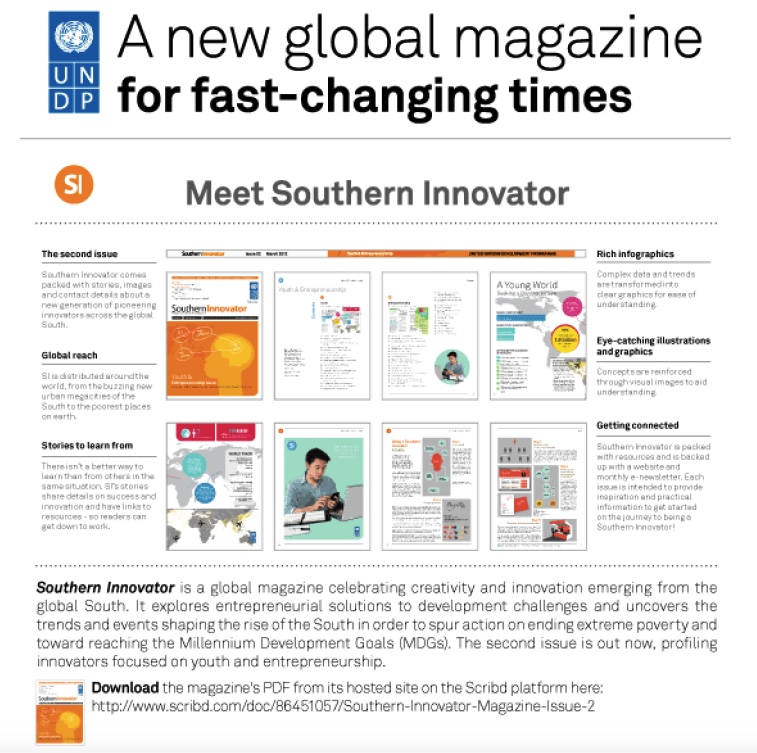
Development Challenges, South-South Solutions was launched as an e-newsletter in 2006 by UNDP’s South-South Cooperation Unit (now the United Nations Office for South-South Cooperation) based in New York, USA. It led on profiling the rise of the global South as an economic powerhouse and was one of the first regular publications to champion the global South’s innovators, entrepreneurs, and pioneers. It tracked the key trends that are now so profoundly reshaping how development is seen and done. This includes the rapid take-up of mobile phones and information technology in the global South (as profiled in the first issue of magazine Southern Innovator), the move to becoming a majority urban world, a growing global innovator culture, and the plethora of solutions being developed in the global South to tackle its problems and improve living conditions and boost human development. The success of the e-newsletter led to the launch of the magazine Southern Innovator.
Beginning in 2011 and ending in 2014, each issue of Southern Innovator was launched at the annual Global South-South Development Expo (GSSD Expo) run by the United Nations Office for South-South Cooperation (UNOSSC). The issues (there were five) would connect with that year’s Expo theme and were intended to reinforce the solutions presented at the Expo, as well as those solutions discovered through research for the influential United Nations e-newsletter Development Challenges, South-South Solutions. An Expo was not run in 2015 for the following reason: U.S. Finds Macau Billionaire Guilty in U.N. Bribery Case.
Studies have shown the importance of reading to real change. Not just online, but in paper form. The retention of information and knowledge is greater when a person reads something in a book or a magazine. Another factor is quality design (which makes the published material both attractive and effective). Trashy, gaudy or slap-dash design, while it has its place and context, is not suitable for well-funded, transparent, public organizations seeking to communicate across borders in a professional manner. Southern Innovator was designed following the UN and UNDP design guidelines at the time, while also adhering to the UN Global Compact and the UN Consultants Remuneration Guidelines. The content was also written to follow those guidelines as well as the Plain English Campaign, which seeks to reduce the presence of “gobbledygook, jargon and misleading public information”. On top of this, the magazine benefited from experience: the experience of one of Iceland’s top graphic designers and illustrators, the team based at the UNOSSC in New York who oversaw the editing and proof reading, and the researcher, editor and writer who has led many successful and award-winning publishing ventures, including during “one of the biggest peacetime economic collapses ever”.
“What a tremendous magazine your team has produced! It’s a terrific tour de force of what is interesting, cutting edge and relevant in the global mobile/ICT space… This is great, engaging, relevant and topical stuff.” Rose Shuman, Founder & CEO, Open Mind and Question Box, Santa Monica, CA, U.S.A.
Southern Innovator Issue 1: Mobile Phones and Information Technology was published in 2011 and launched at the Expo in Rome, Italy.
Southern Innovator Issue 2: Youth and Entrepreneurship was published in 2012 and launched at the Expo in Vienna, Austria.Southern Innovator Issue 3: Agribusiness and Food Security was published in 2012 and launched at the Expo in Vienna, Austria.Southern Innovator Issue 4: Cities and Urbanization was published in 2013 and launched at the Expo in Nairobi, Kenya (the first time in Africa).
Issue 6 of Southern Innovator was to be on the theme of science, technology and innovation. Southern Innovator Issue 5: Waste and Recycling was published in 2014 and launched at the Expo in Washington, D.C.
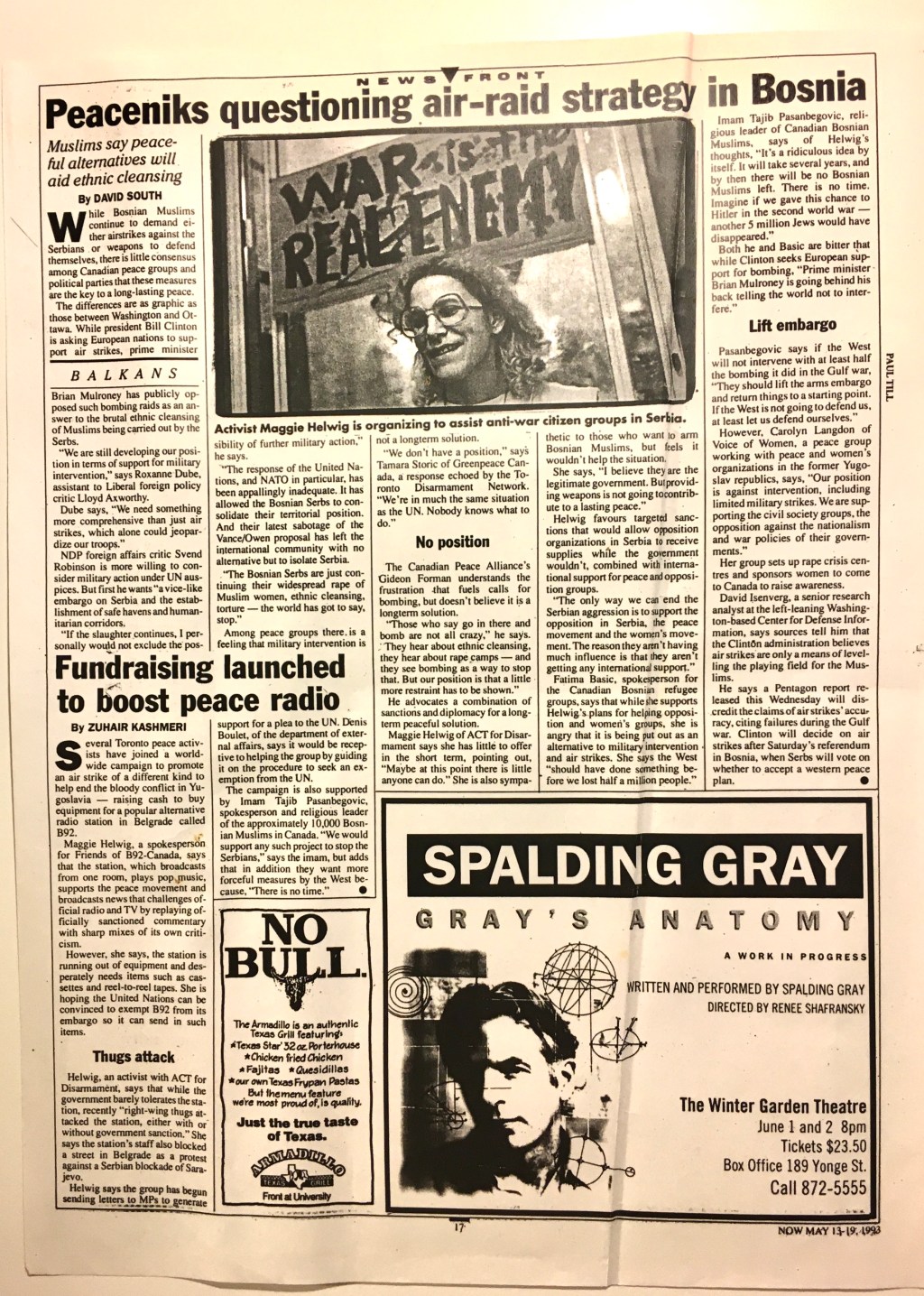
While Bosnian Muslims continue to demand either airstrikes against the Serbians or weapons to defend themselves, there is little consensus among Canadian peace groups and political parties that these measures are the key to a long-lasting peace.
The differences are as graphic as those between Washington and Ottawa. While president Bill Clinton is asking European nations to support air strikes, prime minister Brian Mulroney has publicly opposed such bombing raids as an answer to the brutal ethnic cleansing of Muslims being carried out by the Serbs.
“We are still developing our position in terms of support for military intervention,” says Roxanne Dube, assistant to Liberal foreign policy critic Lloyd Axworthy.
Dube says, “We need something more comprehensive than just airstrikes, which alone could jeopardize our troops.”
NDP foreign affairs critic Svend Robinson is more willing to consider military action under UN auspices. But first he wants “a vice-like embargo on Serbia and the establishment of safe havens and humanitarian corridors.
“If the slaughter continues, I personally would not exclude the posibility of further military action,” he says.
“The response of the United Nations, and NATO in particular, has been appallingly inadequate. It has allowed the Bosnian Serbs to consolidate their territorial position. And their latest sabotage of the Vance/Owen proposal has left the international community with no alternative but to isolate Serbia.
“The Bosnian Serbs are just continuing their widespread rape of Muslim women, ethnic cleansing, torture – the world has got to say, stop.”
Among peace groups there is a feeling that military intervention is not a longterm solution.
“We don’t have a position,” says Tamara Storic of Greenpeace Canada, a response echoed by the Toronto Disarmament Network. “We’re in much the same situation as the UN. Nobody knows what to do.”
No position
The Canadian Peace Alliance’s Gideon Forman understands the frustration that fuels calls for bombing, but doesn’t believe it is a longterm solution.
“Those who say go in there and bomb are not all crazy,” he says. “They hear about ethnic cleansing, they hear about rape camps – and they see bombing as a way to stop that. But our position is that a little more restraint has to be shown.”
He advocates a combination of sanctions and diplomacy for a longterm peaceful solution.
Maggie Helwig of ACT for Disarmament says she has little to offer in the short term, pointing out, “Maybe at this point there is little anyone can do.” She is also sympathetic to those who want to arm Bosnian Muslims, but feels it wouldn’t help the situation.
She says, “I believe they are the legitimate government. But providing weapons is not going to contribute to a lasting peace.”
Helwig favours targeted sanctions that would allow opposition organizations in Serbia to receive supplies while the government wouldn’t, combined with international support for peace and opposition groups.
“The only way we can end the Serbian aggression to to support the opposition in Serbia, the peace movement and the women’s movement. The reason they aren’t having much influence is that they aren’t getting any international support.”
Fatima Basic, spokesperson for the Canadian Bosnian refugee groups, says that while she supports Helwig’s plans for helping opposition and women’s groups, she is angry that it is being put out as an alternative to military intervention and air strikes. She says the West “should have done something before we lost half a million people.”
Imam Tajib Pasanbegovic, religious leader of Canadian Bosnian Muslims, says of Helwig’s thoughts, “It’s a ridiculous idea by itself. It will take several years, and by then there will be no Bosnian Muslims left. There is not time. Imagine if we gave this chance to Hitler in the second world war – another 5 million Jews would have disappeared.”
Both he and Basic are bitter that while Clinton seeks European support for bombing, “Prime minister Brian Mulroney is going behind his back telling the world not to interfere.”
Life embargo
Pasanbegovic says if the West will not intervene with at least half the bombing if did in the Gulf War, “They should life the arms embargo and return things to a starting point. If the West is not going to defend us, at least let us defend ourselves.”
However, Carolyn Langdon of Voice of Women, a peace group working with peace and women’s organizations in the former Yugoslav republics, says, “Our position is against intervention, including limited military strikes. We are supporting the civil society groups, the opposition against the nationalism and war policies of their governments.”
Her group sets up rape crisis centres and sponsors women to come to Canada to raise awareness.
David Isenverg, a senior research analyst at the left-leaning Washington-based Center for Defense Information, says sources tell him that the Clinton administration believes air strikes are only a means of levelling the playing field for the Muslims.
He says a Pentagon report released this Wednesday will discredit the claims of air strikes’ accuracy, citing failures during the Gulf War. Clinton will decide on air strikes after Saturday’s referendum in Bosnia, when Serbs will vote on whether to accept a Western peace plan.




















 David South Consulting
You must be logged in to post a comment.