Categories
Archive Blogroll data Development Challenges, South-South Solutions Newsletters digital ID

Cyber Cities: An Oasis of Prosperity in the South

By David SouthDevelopment Challenges, South-South Solutions

SOUTH-SOUTH CASE STUDY

The future is arriving in the South even faster than many think: so-called “cyber cities” are being created to become this century’s new Silicon Valleys. Well-known ‘cyber cities’ like India’s Hyderabad and Bangalore have been joined by many other cities across the global South. But two places are set to make big waves with their ambition and drive in 2008: Mauritius and China.

Mauritius, an island in the Indian Ocean strategically close to Africa, better known for tourism and luxury hotels, wants to become the world’s “cyber island”. Armed with the first 3G network in Africa (the third generation of mobile phone technology – offering high-speed internet access and video telephony), Mauritius is moving fast to make good on this advantage. And it is even moving to the next level of mobile-phone speed, something called High-speed Download Packet Access (HSDPA) – allowing even greater quantities of information to be exchanged.

Mauritius joins a select few countries, including Japan and South Korea, at the forefront of access to 3G. Wireless – or wi-fi – computer access is available in three-quarters of the island.

Outside the capital of Port Louis, former sugar cane plantations are being turned into a “cyber city”. The centrepiece of the development is the 12-story Cyber Tower, home to young technology start-ups. The country is also investing heavily in education from primary school to university, to make sure the country’s 1.2 million people are cyber-ready.

Computer novices in remote villages are being visited by a Cyber Caravan with a classroom teaching housewives, children, the unemployed and the disabled basic computing and world processing.

Mauritius built its wealth on tourism, sugar plantations and textile manufacturing. But it is worried that trading arrangements that helped the sugar and textile industries to flourish, will be taken away. So it is focusing on the future: it sees itself as the world centre for disaster recovery computing services for the world’s companies in event of a disaster in their own country that destroys computer networks.

In China, its largest Cyber Park is under construction in Wujin New and High-tech Development Zone of Changzhou. It will be a technology incubator, a research and development centre, and a place for small and medium-sized enterprises to innovate.

What is truly making people stop and think is another far-reaching project: the Beijing Cyber Recreation District (CRD) – China’s most ambitious digital media industry development: a virtual worlds’ initiative with digital media academies and company incubators. It is spread over 100 square kilometres, creating the world’s largest virtual world development. It is already home to more than 200 game and multimedia content producers in western Beijing.

The CRD says its goal is “to create a virtual economy providing infrastructure and platforms through which any business – not just those based in China – can come in and sell their real-world products and services. While a concerted effort will be placed on bringing Chinese businesses and consumers in, the effort is worldwide and open to businesses and consumers from any country.”

The idea is to create a vast virtual economy for commerce where manufacturers can directly connect with billions of customers – bypassing middlemen.

It claims it will be “the world’s one-stop shop for customers and producers.” It will host billions of avatars – or virtual people – surpassing the capability of the very popular Second Life virtual world game’s 40,000.

Published: January 2008

Resources

  • The Atlas of Ideas is an 18-month study of science and innovation in China, India and Republic of Korea Korea, with a special focus on new opportunities for collaboration with Europe. It is a comprehensive account of the rising tide of Asian innovation. Special reports on China, India and Korea, introducing innovation policy and trends in these countries can be downloaded for free.
  • The Cyber Cities Reader: the first book to bring together a
    vast range of debates and examples of ICT-based city changes.
  • Entrepreneurship Development Institute of India
  • Innovation China: A website linking all stories on the fast-breaking world of Chinese innovation.

https://davidsouthconsulting.org/2022/02/09/african-health-data-revolution/

https://davidsouthconsulting.org/2020/12/04/big-data-can-transform-the-global-souths-growing-cities/

https://davidsouthconsulting.org/2020/04/25/china-looking-to-lead-on-robot-innovation/

https://davidsouthconsulting.org/2020/12/10/china-sets-sights-on-dominating-global-smartphone-market/

https://davidsouthconsulting.org/2021/03/20/computer-gold-farming-turning-virtual-reality-into-real-profits/

https://davidsouthconsulting.org/2020/12/04/data-surge-across-global-south-promises-to-re-shape-the-internet/

https://davidsouthconsulting.org/2021/01/26/designed-in-china-to-rival-made-in-china/

https://davidsouthconsulting.org/2017/11/08/eco-cities-up-close-2013/

https://davidsouthconsulting.org/2020/12/11/false-data-makes-border-screening-corruptible/

https://davidsouthconsulting.org/2022/09/28/model-cities-across-the-south-challenge-old-ways/

https://davidsouthconsulting.org/2022/10/04/popular-chinese-social-media-chase-new-markets/

https://davidsouthconsulting.org/2017/11/08/smart-cities-up-close-2013/

https://davidsouthconsulting.org/2021/02/18/what-is-the-un-doing-with-your-data/

Check out award-winning cyber and digital work here: http://www.davidsouthconsulting.com/blog/2020/2/26/awards-1998-2003-february-2020.html

More stories on cyber innovation from e-newsletter Development Challenges, South-South Solutions and magazine Southern Innovator

China Sets Sights on Dominating Global Smartphone Market

China Looking to Lead on Robot Innovation

Crowdsourcing Mobile Phones To Make The Poor Money

Mobile Phones: Engineering South’s Next Generation of Entrepreneurs

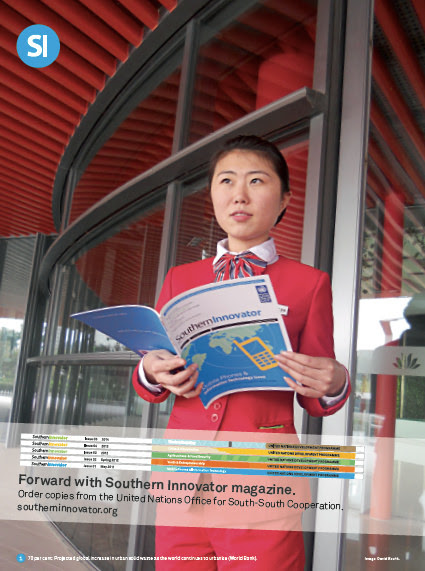
Development Challenges, South-South Solutions was launched as an e-newsletter in 2006 by UNDP’s South-South Cooperation Unit (now the United Nations Office for South-South Cooperation) based in New York, USA. It led on profiling the rise of the global South as an economic powerhouse and was one of the first regular publications to champion the global South’s innovators, entrepreneurs, and pioneers. It tracked the key trends that are now so profoundly reshaping how development is seen and done. This includes the rapid take-up of mobile phones and information technology in the global South (as profiled in the first issue of magazine Southern Innovator), the move to becoming a majority urban world, a growing global innovator culture, and the plethora of solutions being developed in the global South to tackle its problems and improve living conditions and boost human development. The success of the e-newsletter led to the launch of the magazine Southern Innovator.  

Follow @SouthSouth1

Google Books: https://books.google.co.uk/books?id=dKaXBgAAQBAJ&dq=Development+Challenges+January+2008&source=gbs_navlinks_s

Slideshare: http://www.slideshare.net/DavidSouth1/development-challengessouthsouthsolutionsjanuary2008issue

Southern Innovator Issue 1: https://books.google.co.uk/books?id=Q1O54YSE2BgC&dq=southern+innovator&source=gbs_navlinks_s

Southern Innovator Issue 2: https://books.google.co.uk/books?id=Ty0N969dcssC&dq=southern+innovator&source=gbs_navlinks_s

Southern Innovator Issue 3: https://books.google.co.uk/books?id=AQNt4YmhZagC&dq=southern+innovator&source=gbs_navlinks_s

Southern Innovator Issue 4: https://books.google.co.uk/books?id=9T_n2tA7l4EC&dq=southern+innovator&source=gbs_navlinks_s

Southern Innovator Issue 5: https://books.google.co.uk/books?id=6ILdAgAAQBAJ&dq=southern+innovator&source=gbs_navlinks_s

https://davidsouthconsulting.org/2021/03/05/southern-innovator-issue-1/

https://davidsouthconsulting.org/2021/03/05/southern-innovator-issue-4/

Creative Commons License
This work is licensed under a
Creative Commons Attribution-Noncommercial-No Derivative Works 3.0 License.

ORCID iD: https://orcid.org/0000-0001-5311-1052.

© David South Consulting 2023
Categories
Archive Blogroll Development Challenges, South-South Solutions Newsletters

Virtual Supermarket Shopping Takes off in China

By David SouthDevelopment Challenges, South-South Solutions

SOUTH-SOUTH CASE STUDY

An ingenious use of technological innovation and savvy trend-spottingis radically transforming the way people do their grocery shopping in China. Busy urban dwellers with time-poor lifestyles can now do their grocery shopping as they pass through Shanghai’s subway system and have their weekly shopping delivered to their home.

The country has experienced breakneck economic growth in the past 15 years, heading towards becoming the world’s largest economy. Much of this growth and new wealth has come from the transformation of China into the world’s manufacturing and exporting hub. But this also leaves an urban population of very busy people who need time-saving solutions to improve their quality of life.

China’s premier Wen Jiabao has now pledged to aid the world economy during the current economic crisis by boosting domestic Chinese consumption. And this new focus on consumption will open up opportunities for entrepreneurs.

“I believeChina’s economy can achieve longer-term, better-quality growth. This will be our new contribution to strong, sustainable global growth,” he told the Wall Street Journal.

And a big part of the boost in domestic consumption will come from modern retailers and supermarkets. Supermarkets were almost non-existent in China before the 1990s. The country sold food in a mix of small shops, open-air markets and through wholesale networks. It was a complex system overlaid with government bodies, marketing boards, brokers, wholesalers, distributors and government-licensed and government-run shops and vendors.

But this has radically changed as the country has moved to a modern retail system. Chinese cities now boast modern supermarkets, convenience stores, hypermarkets and warehouse clubs. There was just one modern supermarket in the country in 1990; by 2003, there were 60,000 (Chinese Chain Store and Franchise Association).

The supermarket model offers many benefits to anyone looking to sell products in the Chinese marketplace. Supermarkets are very competitive with each other and are always looking for new angles and new products to get the edge and win over new consumers. If they offer new tastes and variety, the chances are high they will attract more customers.

Supermarkets tend to offer a greater variety of food products than traditional markets. They are also cleaner, the quality control is better and more standardised, there is no need to haggle over prices and measurements and units for products are clearly labelled and controlled.

But supermarkets can also be criticized for monopolizing distribution networks, hurting small farmers by driving down prices and destroying independent retailers unable to compete with the economies of scale supermarkets can bring to bear.

In Shanghai- a city that has long been a retail pioneer in China- the Yihaodian online grocery company (http://www.yihaodian.com/product/index.do?merchant=1) is radically altering how people buy food by using “virtual supermarkets” in subway stations.

It is a convergence of several technological innovations to make something even better.

Shoppers download an app – or application – on to their mobile phones. This allows them to interact with large LED screens (http://en.wikipedia.org/wiki/LED_display) in subway stations which display images of products – from soap to noodle soup to nuts– just like in a catalogue. The shopper scrolls through the products and finds what they want to buy. Beside the images are barcodes. The shopper scans the product barcode with the phone and Yihaodian then delivers the products straight to their home within hours.

It is a very convenient service for busy workers trying to juggle the many demands of daily life.

The Yihaodian system is based on a similar technology pioneered inSouth Korea.

Yihaodian is riding a wave of growth for the company because of its innovative approach. It has seen sales rise by 28 percent each month and it hopes to make Euro 325 million (US $443 million) in 2011, four times its 2010 revenues. Proof of the value of investing in innovation.

Yihaodian is also showing how clever it is to offer a new way of doing things. It is pioneering a new business model while also recognising the reality of people’s busy lives in modern urban environments. Lily Yu, director of the company’s wireless application department, says it is about something bigger than just profits. “Changing people’s lifestyles is what we are striving for,” she told Monocle magazine.

Yu, founder of the Wireless Application Department at Yihaodian, joined the company in 2010 and leads the team to develop and introduce this technology and new way of buying products.

The only question remaining is this: how long before all retail will follow Yu’s lead?

Published: November 2011

Resources

1) Mobile Active: MobileActive.org connects people, organizations, and resources using mobile technology for social change. Website: http://mobileactive.org

2) How QR Codes Can Grow Your Business: A story on how to use these scannable codes. Website: http://www.socialmediaexaminer.com/how-qr-codes-can-grow-your-business/

3) Southern Innovator magazine: New global magazine’s first issue tackles the boom in mobile phone and information technologies across the global South. Website: www.scribd.com/doc/57980406/Southern-Innovator-Issue-1

https://davidsouthconsulting.org/2022/11/02/african-online-supermarket-set-to-boost-trade/

https://davidsouthconsulting.org/2022/10/26/african-trade-hub-in-china-brings-mutual-profits-2/

https://davidsouthconsulting.org/2021/12/20/better-by-design-in-china/

https://davidsouthconsulting.org/2022/10/20/china-consumer-market-asian-perspective-helps/

https://davidsouthconsulting.org/2020/12/10/china-sets-sights-on-dominating-global-smartphone-market/

https://davidsouthconsulting.org/2022/10/04/chinas-booming-wine-market-can-boost-south/

https://davidsouthconsulting.org/2021/01/25/creating-green-fashion-in-china/

https://davidsouthconsulting.org/2021/01/26/designed-in-china-to-rival-made-in-china/

https://davidsouthconsulting.org/2021/05/14/the-ethics-of-soup-grading-supermarket-shelves-for-profit/

https://davidsouthconsulting.org/2022/10/24/kenyan-products-a-global-success-story/

https://davidsouthconsulting.org/2020/12/12/mobile-phone-shopping-to-create-efficient-markets-across-borders/

https://davidsouthconsulting.org/2022/10/31/rainforest-gum-gets-global-market/

https://davidsouthconsulting.org/2022/11/17/sos-shops-keep-food-affordable-for-poor-unemployed/

https://davidsouthconsulting.org/2022/11/16/thai-organic-supermarkets-seek-to-improve-health/

Development Challenges, South-South Solutions was launched as an e-newsletter in 2006 by UNDP’s South-South Cooperation Unit (now the United Nations Office for South-South Cooperation) based in New York, USA. It led on profiling the rise of the global South as an economic powerhouse and was one of the first regular publications to champion the global South’s innovators, entrepreneurs, and pioneers. It tracked the key trends that are now so profoundly reshaping how development is seen and done. This includes the rapid take-up of mobile phones and information technology in the global South (as profiled in the first issue of magazine Southern Innovator), the move to becoming a majority urban world, a growing global innovator culture, and the plethora of solutions being developed in the global South to tackle its problems and improve living conditions and boost human development. The success of the e-newsletter led to the launch of the magazine Southern Innovator.

https://davidsouthconsulting.org/2021/03/05/southern-innovator-issue-2/

Creative Commons License

This work is licensed under a
Creative Commons Attribution-Noncommercial-No Derivative Works 3.0 License.

ORCID iD: https://orcid.org/0000-0001-5311-1052.

© David South Consulting 2023