Categories
Archive Blogroll Development Challenges, South-South Solutions Newsletters

Innovation Villages Tackling MDGs

By David SouthDevelopment Challenges, South-South Solutions

SOUTH-SOUTH CASE STUDY

The global economic crisis that began to roll across the world in September 2008 is threatening gains made against poverty and hunger all over the South. As Kevin Watkins from UNESCO’s Global Monitoring Report told the Financial Times, “With the slowdown in growth in 2009, we estimate that the average income of the 391 million Africans living on less than US $1.25 a day will take a 20 percent hit.”

How well millions of people survive the economic turmoil will depend on how local communities respond. And there are innovating communities across the South that show it is possible to succeed. By studying the microcosm of test villages, where quantifiable results are being tracked, lessons are being learned on how to achieve the Millennium Development Goals (http://www.undp.org/mdg/).

The challenge of matching improving living standards and quality of life with environmental sustainability has been taken up by one village in Colombia. The technologies it has developed over the past few decades have been adopted around the country.

In Las Gaviotas, Colombia a unique experiment was hatched at the end of the 1960s: to see if a village could survive – and even thrive – while eschewing fossil fuels and industrial agriculture. It found its first test in the oil crisis of the early 1970s. For Las Gaviotas’ survival, meeting energy needs became paramount.

One of the simple concepts the community applied is a take on the physical reality that energy is never created or destroyed, it just moves from one medium to another. Las Gaviotas believes in using all the sources for energy that can be found in a local area first, before seeking out others.

Founded by development specialist Paolo Lugari,Las Gaviotas(http://www.friendsofgaviotas.org) is located in a desert region of Colombia. The area covers a vast territory comprising three-fifths of the country but is home to just 10 percent of the population. To Lugari, the harsh environment is a challenge to be overcome. To begin to reverse the arid environment at Las Gaviotas, the villagers reversed the dry climate by planting trees.

This had the effect of increasing local rainfall by 10 percent, making it possible to do other economic activities.”The only deserts that exist in this world are deserts of the imagination,” Lugari told the New York Times.

The 200 people living in Las Gaviotas have been able to get by without guns, police, a mayor, cellphones, television or the Internet. Nobody uses a job title — instead the adults in the community rotate jobs.

While the villagers do not use many of the technological tools people associate with modern life and prosperity, they do have a culture of invention. The inventions they have come up with include a solar kettle for sterilizing water and a 8,012 hectare pine forest which is harvested for resin to make biofuel for trucks and motorcycles. The resin is also used to make varnishes and linseed oil.

For years Colombia’s ongoing civil war raged around the community. Violent drug traffickers and private armies destabilized the country for decades. But despite this mayhem, Las Gaviotas has attracted rural peasants seeking to double their wages (US $500 a month) and enjoy the quiet life away from the war.

“We try to live a quiet life, depending on nothing but our own labor and ingenuity,” said Teresa Valencia, a teacher who has lived in Las Gaviotas for three decades.

Other products developed by the village included a turbine powered by a small, one metre high dam that produced 10 kilowatts of electricity, a windmill that was able to spin despite light breezes, and a pump strong enough to draw water from the hard-to-reach savannah water table.

Pride of place was the village’s hospital. Despite hot temperatures and high humidity, the hospital used clever technologies like subsurface tunnels and double ventilation systems in the walls to cool its operating theatre. The roof slid off to allow ultraviolet sunlight to disinfect rooms. After healthcare reforms in Colombia, the hospital was closed. Undefeated, the village turned the hospital’s kitchen into a potable water bottling facility, and reduced the need for hospital visits by making sure everyone in the area had access to clean water.

The community’s approach inspired scientists and architects, who came to design homes, laboratories and factories for Las Gaviotas.

One significant success has been the windmill-driven water pumps developed by Las Gaviotas. Invented by Jorge Zapp, head of the mechanical engineering department of Bogota’s Universidad de Los Andes, it is a lightweight windmill unit weighing barely 45 kilograms. The blades use the airfoil found on airplane propellers to make the most of light breezes.

In the 1980s, UNDP hired the Gaviotas team to install water and windmill pumps in other places in Colombia. Thousands have now been installed in Colombia and the design has been copied throughout Latin America.

Other inventions include a solar-powered kitchen, a water pump powered by a children’s see-saw, and a zeppelin that floats above the savannah plains to detect forest fires.

While the community has been able to forge a success, it can’t avoid the ups and downs of the global economy entirely. Competition from cheap imports of pine resin have pushed down the price the community can charge.

But in a topsy-turvy world, and surrounded by a civil war, what Las Gaviotas has achieved still seems impressive. “We have survived,” said Andrea Beltran. “Maybe, at this time and place in Colombia, that is enough.”

More recently, a much-publicized experiment is also underway in the Millennium villages. The Millennium Villages (http://www.millenniumvillages.org/index.htm) is a joint project between Columbia University’s The Earth Institute and UNDP, and is a bold experiment working with villages in Africa to identify and test solutions to help in achieving the Millennium Development Goals (http://www.undp.org/mdg/).

Britain’s Guardian newspaper has also been sponsoring and tracking changes in the villages of Katine sub-county in Uganda (http://www.guardian.co.uk/katine). Comprising 25,000 people, the project began in October 2007, and is conducted in partnership with the African Medical and Research Foundation (Amref) and Farm-Africa in Katine.

What is useful to people looking for solutions is the way the project is being tracked in detail on the newspaper’s website.

In India, the Model Village India (www.modelvillageindia.org.in) concept pioneered by Rangeswamy Elango, a head of the village of Kuthampakkam near Chennai, has now expanded to 30 model villages. Its approach is about being positive, eschewing griping about problems and instead getting down to work to solve them. Its success is based on an ancient Indian self-organizing model, the Panchayat, and Elango has modernized it to become what he calls The “Network Growth Economy Model” – a direct challenge to the “special economic zones that benefit only capitalist owners,” he said.

Gaviotas: A Village to Reinvent the World – 10th Anniversary Edition by Alan Weisman details further the achievements of the village (www.amazon.com)

Published: November 2009

Resources

1) Unleashing India’s Innovation: Toward Sustainable and Inclusive Growth, a report by the World Bank. Website: http://www.worldbank.org/

2) NextBillion.net: Hosted by the World Resources Institute, it identifies sustainable business models that address the needs of the world’s poorest citizens. Website: http://www.nextbillion.net/news

3) Model Village India: Drawing on self-organizing methods used in India since 1200 BC, the Model Village India is based around India’s democratic system of Panchayats: a village assembly of people stemming back to pre-colonial times. Website: http://www.modelvillageindia.org.in

4) Maker Faire: The African Maker Faire has tapped into Africa’s well-entrenched do-it-yourself development culture. It went looking for more inventors like those celebrated on the website AfriGadget (http://www.afrigadget.com/), with its projects that solve “everyday problems with African ingenuity.” The Faire works with the participants to share their ideas and to find ways to make money from their ideas. Website: http://makerfaireafrica.com/

5) eMachineShop: This remarkable service allows budding inventors to download free design software, design their invention, and then have it made in any quantity they wish and shipped to them: Amazing! Website: http://www.emachineshop.com/

6) The red dot logo stands for belonging to the best in design and business. The red dot is an internationally recognized quality label for excellent design that is aimed at all those who would like to improve their business activities with the help of design. Website: http://www.red-dot.de

https://davidsouthconsulting.org/2022/05/02/landmark-study-finds-simple-toys-key-to-boosting-educational-development-and-meeting-mdgs/

https://davidsouthconsulting.org/2021/12/20/press-release-1-southern-innovator/

https://davidsouthconsulting.org/2021/12/20/press-release-2-southern-innovator/

https://davidsouthconsulting.org/2021/12/20/press-release-3-southern-innovator/

https://davidsouthconsulting.org/2021/03/05/southern-innovator-issue-1/

https://davidsouthconsulting.org/2021/03/05/southern-innovator-issue-2/

https://davidsouthconsulting.org/2021/03/05/southern-innovator-issue-3/

https://davidsouthconsulting.org/2021/03/05/southern-innovator-issue-4/

https://davidsouthconsulting.org/2021/03/05/southern-innovator-issue-5/

https://davidsouthconsulting.org/2020/12/09/study-finds-simple-toys-key-to-boosting-educational-development-january-2007/

https://davidsouthconsulting.org/2023/01/17/war-peace-and-development-may-2018/

Development Challenges, South-South Solutions was launched as an e-newsletter in 2006 by UNDP’s South-South Cooperation Unit (now the United Nations Office for South-South Cooperation) based in New York, USA. It led on profiling the rise of the global South as an economic powerhouse and was one of the first regular publications to champion the global South’s innovators, entrepreneurs, and pioneers. It tracked the key trends that are now so profoundly reshaping how development is seen and done. This includes the rapid take-up of mobile phones and information technology in the global South (as profiled in the first issue of magazine Southern Innovator), the move to becoming a majority urban world, a growing global innovator culture, and the plethora of solutions being developed in the global South to tackle its problems and improve living conditions and boost human development. The success of the e-newsletter led to the launch of the magazine Southern Innovator.

Creative Commons License

This work is licensed under a
Creative Commons Attribution-Noncommercial-No Derivative Works 3.0 License.

ORCID iD: https://orcid.org/0000-0001-5311-1052.

© David South Consulting 2023

Categories
Archive Blogroll Development Challenges, South-South Solutions Newsletters Southern Innovator magazine

Rammed-Earth Houses: China Shows how to Improve and Respect Traditional Homes

By David SouthDevelopment Challenges, South-South Solutions

(Havana, Cuba), November 2008

SOUTH-SOUTH CASE STUDY

The pace of change across the South has been blistering. Over the past decade, the overall population has moved from being primarily rural to majority urban. In the process, rural communities have suffered, as they have seen their young and ambitious leave in droves seeking a better life in cities.

More than 200 million Chinese farmers have moved to cities in recent years. It’s easy to see why. Chinese farms are tiny, with the average rural household farming just 0.6 hectares. And incomes are low compared to the cost of living: average annual income was just US$606 in 2007, a third of city salaries.

But it is possible to improve the quality of life in rural areas and in turn boost economic fortunes.

In China, projects that upgrade homes to modern standards while respecting traditional designs and architecture are breathing new life into rural communities. A return to the age-old technique of using earth as the principal building material is saving energy and keeping house costs low.

The tradition of packing earth to build a wall dates back to some of the earliest stretches of the Great Wall of China in 220 BC.

Currently it is estimated that half the world’s population-approximately 3 billion people on six continents – lives or works in buildings constructed of earth.

This traditional building technique is being used in the reconstruction effort to build new homes after the May 12, 2008 earthquake in Sichuan Province. The earthquake left millions of people homeless in the country’s worst natural disaster in 30 years, and has made low-cost but efficient house building critical.

In western China, villages have been entirely rebuilt from scratch. The application of research and science to the traditional designs – roofs in the pagoda style, with buildings arranged around courtyards – enabled the development of homes that are energy efficient to run, and are more hygienic and earthquake safe. In Yongren County of Yunnan Province, over 7,000 mountain dwellers were moved to better farming land and over 2,000 homes were built in the new village of BaLaWu. Over 30 of the homes were built using rammed earth by the Xi-an team. 

“The original homes had very low living quality,” said team member Hu Rong Rong of the Green Building Research Centre of Xi’an University of Architecture and Technology (http://www.xauat.edu.cn/jdeg/about.html), which oversees building of the new homes. “The architecture layout of the indoor space and courtyard was not reasonable. In the courtyard the areas for living, raising livestock, storing and processing crops were mixed up. The indoor environment was not comfortable. It was cold in the houses during winter and hot during summer. Most of the rooms lacked natural lighting and were dark in the daytime.

“In the poor areas, many people still live in earth houses because of the low cost. However, most of the earth houses have low living quality.

“After we finished the project, through our design, the living quality was improved very much. The dwellers were satisfied with their new houses.”

Land reform in China has brought more hope to the country’s 750 million rural poor, many of whom live on less than US$1 a day. It is hoped that giving the rural poor more control over their lives will bring an improvement in agricultural production, food security and economic prosperity. Reforms also mean the poor have more secure land rights.

Hu said gaining the trust and buy-in of the villagers was critical to the success of the project.

“We built the first home as a demonstration. After we finished, the villagers could experience the advantages of the new home. Most of them decided to use our design and they could choose the one they liked from several proposals.”

Poverty is a big problem in the villages. Incomes are very low, at 2000 RMB per year (US $290). Hu said “families were given a house-building allowance of 8000 RMB (US $1,160) to meet the cost of building materials – and the land was free for them to use.”

“The villagers built the houses by self-help. We helped them to design and build the houses for free,” Hu said.

The houses are pioneering in using natural sources to provide light, heat, waste disposal and gas for cooking and heating.

“We used natural material like earth as a main building material to get good thermal mass and also to reduce CO2 emission,” Hu said.

“We designed a simple family sewage-purge-pool and marsh-gas-well system to reduce pollution and get energy from wastes.”

Using rammed earth has a long history in China. Across Western China, there are many buildings constructed with rammed earth. And using earth has many advantages when resources are scarce or expensive: “Earth buildings avoid deforestation and pollution, and can achieve low energy costs throughout their lifetime,” said Hu.

“With living standards increasing, more and more people would like to use burned bricks and concrete to build new houses, which will consume more energy and bring pollution,” said Hu.

But like any technology, the application of modern science and environmental knowledge to the traditional designs, can reap huge improvements in the quality of the homes and comfort levels. And win people back to the benefits of rammed earth dwellings.

“Building with earth materials can be a way of helping with sustainable management of the earth’s resources,” said Hu.

And Hu is adamant the new, environmentally designed homes respect the wisdom of traditional design.

“The new earth house design should consider the local culture. It should be proved that both the house style and the construction technique can be accepted by the users.”

Published: December 2008

Resources

  • The Rural Development Institute focuses on land rights for the poor and has a series of articles on China’s land reforms. Website: www.rdiland.org
  • Rural DeveIopment Institute has recently been given an award from the World Bank’s Development Marketplace competition to create Legal Aid and Education Centres in China’s countryside. Website:www.rdiland.org/PDF/092808_WorldBankComp.pdf
  • A blog gives more details on the Chinese rammed earth project. 
    Website:www.51xuewen.com
  • Earth Architecture, a book and blog on the practice of building with earth, including contemporary designs and projects. 
    Website: www.eartharchitecture.org

https://davidsouthconsulting.org/2022/05/23/debt-free-homes-for-the-poor/

https://davidsouthconsulting.org/2021/11/12/energy-efficient-wooden-houses-are-also-earthquake-safe/

https://davidsouthconsulting.org/2022/10/26/making-bamboo-houses-easier-to-build/

https://davidsouthconsulting.org/2021/02/12/rebuilding-after-chinese-earthquake-beautiful-bamboo-homes/

https://davidsouthconsulting.org/2022/05/23/solar-bottle-bulbs-light-up-dark-homes/

https://davidsouthconsulting.org/2022/09/26/3d-home-printing-landmark-10-houses-in-a-day/

https://davidsouthconsulting.org/2022/11/17/tiny-homes-to-meet-global-housing-crisis/

Sponsored by BSHF. BSHF is now called World Habitat and it aims to seek out and share the best solutions to housing problems from around the world.

https://davidsouthconsulting.org/2021/03/05/southern-innovator-issue-4/

Creative Commons License

This work is licensed under a
Creative Commons Attribution-Noncommercial-No Derivative Works 3.0 License.

ORCID iD: https://orcid.org/0000-0001-5311-1052.

© David South Consulting 2023

Categories
Archive Blogroll Development Challenges, South-South Solutions Newsletters Southern Innovator magazine

Model Indian Villages to Keep Rural Relevant

By David SouthDevelopment Challenges, South-South Solutions

(Havana, Cuba), November 2008

SOUTH-SOUTH CASE STUDY

The world’s rush to urban centres is the great challenge of the 21st century. In 2007, the world became a majority urban place. The consequences of this shift can be seen in the blight of urban poverty, with its slums and squalor, environmental degradation, and rising social tensions. But there are people working on keeping rural areas relevant and pleasant places to live. These rural advocates see a vibrant countryside as part of the solution to the world’s plethora of crises.

In India, a pioneering initiative is reviving impoverished rural villages. Drawing on self-organizing methods used in India since 1200 BC, the Model Village India (www.modelvillageindia.org.in) is based around India’s democratic system of Panchayats: a village assembly of people stemming back to pre-colonial times.

“Decentralizing is necessary if development is to reach the grassroots,” said the concept’s founder, Rangeswamy Elango, a head of the village of Kuthampakkam, 20 kilometres (12 miles) from the bustling city of Chennai, and one of the 12,600 Panchayats in the Indian state of Tamil Nadu.

While all villages have the ability to use the Panchayat system to improve their lives, few are making the most of this system. The model villages are about showing other villages the true power they have at their disposal. And that with a plan and determination, they can increase their income and improve their quality of life, attracting more money from government and other sources to do so.

The concept has now expanded to 30 model villages. At its core it is about being positive, eschewing griping about problems and instead getting down to work to solve them.

“We demonstrate the basic infrastructure, sustainable housing, food security,” said Elango. “If the government is not bothering, maybe through the local people’s efforts, we can try to demonstrate a variety of development models.”

As India’s economy has boomed, its small towns and villages have withered. Home to the majority of the country’s population, they are in crisis, with declining populations and high suicide rates. India’s urban slums are where people are going – they are growing 250 percent faster than the country’s population. India is a country in danger of neither having a viable rural economy, nor viable cities, but just vast tracts of slums.

Originally left out of the first draft of India’s constitution, Panchayats became legitimized in 1992. They are now elected in every one of the 260,000 villages in India. If they use them, the local Panchayats have extensive powers to transform the destiny of a village, with control of budgets, and decision-making power on how services are to be delivered. This ranges from the provision of clean water, to burying the dead and building roads. The trick is in getting people to realize the power they wield over their destiny and how it can transform their economic situation.

“The village-level local governments are constitutionally important bodies,” said Elango, “but the way it is implemented is not good. The system is unable to deliver the goods to the people.”

The model village approach has revived once-declining villages plagued with high unemployment, chronic alcohol abuse, and domestic violence. The residents are involved in the building of new and healthier homes, providing clean drinking water, waste facilities, education services – including an academy dedicated to teaching the skills and lessons leaned by the villagers to other villages – and even trying to break down the barriers between people because of India’s caste social hierarchy.

“Instead of having a big college, this is a practical people’s model,” Elango said. “It is not done by an academic but by a layman. The learning is spontaneous and emotional.”

Elango is driven by making his village a model that works, and in turn, becoming a magnet for others wishing to improve their lives and their villages.

Elango’s village was not able to support itself with its two crop harvests a year and the villagers resorted to illegal alcohol production instead to make a living. Despite being well connected by highway with nearby Chennai, the village was socially and economically dying.

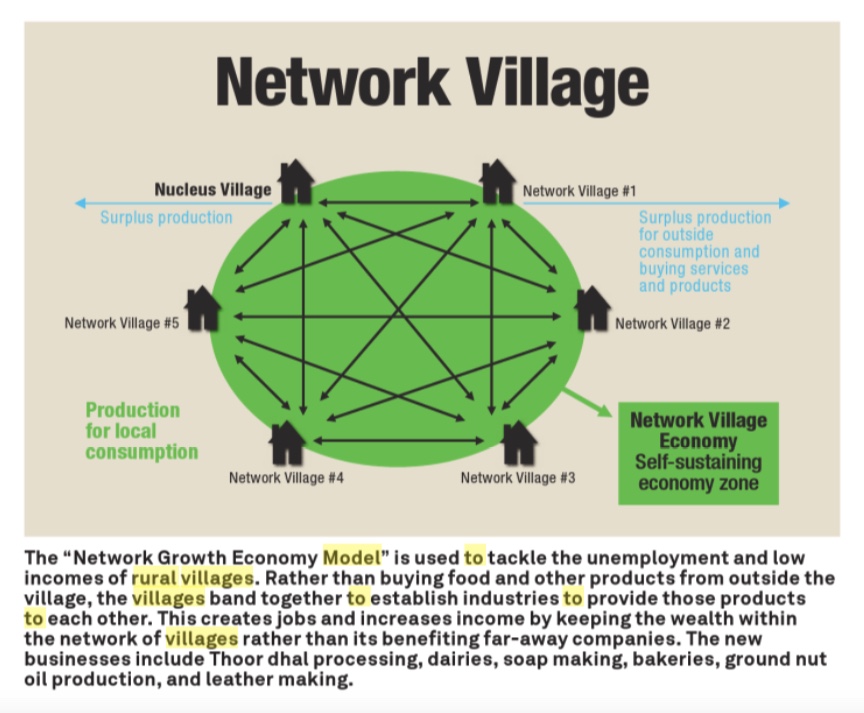
Like a spreading ink spot, the concept is to create a network of like-minded villages that act as self-reinforcing positive role models, spreading the prosperity and stability outwards. The “Network Growth Economy Model” is a direct challenge to the “special economic zones that benefit only capitalist owners,” said Elango.

Ambitious, Elango is hoping to draw in 2,000 villages over the next 10 years, until a tipping point is reached, and the model explodes across India.

A native of the village, Elango became saddened by the community’s decline, including widespread domestic violence against women. The booming city of Chennai’s prosperity had not rippled out to the village, and it was still lacking good infrastructure and sanitation. A trained chemical engineer, he was elected the President of the Kuthambakkam Panchayat in 1996, and set about using his engineer’s perspective to draft the village’s five-year plan from 1996 to 2001.

But the budget was tight. And he had to turn to innovative solutions: recycling building materials, conserving water and reducing electricity consumption. But the resourcefulness paid off, and the state of Tamil Nadu provided the money to upgrade roads, drains, build a community centre, child care facilities, 200 low cost toilets, and work sheds for the village’s industries. By the end of 2001, most basic needs were being met. He then turned to providing good quality housing for the villagers still living in thatch huts.

He has used the “Network Growth Economy Model” to tackle the unemployment and low incomes. It works like this: rather than buying food and other products from outside the village, the villages band together to establish industries to provide those products to each other. This creates jobs and increases income by keeping the wealth within the network of villages, rather than it benefiting far-away companies. The new businesses include Thoor dhal processing, dairies, soap making, bakeries, ground nut oil production, and leather making.

“India was strong when this model was in place – we had strong villages,” said Elango. “Globalization’s trickle down is not working for India.”

Published: November 2008

Resources

  • Unleashing India’s Innovation: Toward Sustainable and Inclusive Growth, a report by the World Bank. Website: http://web.worldbank.org/WBSITE/EXTERNAL/COUNTRIES/SOUTHASIAEXT/0,,contentMDK:21490203~pagePK:146736~piPK:146830~theSitePK:223547,00.html
  • NextBillion.net: Hosted by the World Resources Institute, it identifies sustainable business models that address the needs of the world’s poorest citizens. Website:http://www.wri.org
  • CIDEM and Ecosur specialise in building low-cost community housing using eco-materials. They have projects around the world and are based in Cuba. Website: http://www.ecosur.org

Sponsored by BSHF. BSHF is now called World Habitat and it aims to seek out and share the best solutions to housing problems from around the world.

https://davidsouthconsulting.org/2022/11/22/bio-ethanol-from-sturdy-and-once-unwanted-indian-plant/

https://davidsouthconsulting.org/2022/09/29/cheap-indian-tablet-seeks-to-bridge-digital-divide/

https://davidsouthconsulting.org/2022/10/09/entrepreneurs-use-mobiles-and-it-to-tackle-indian-traffic-gridlock/

https://davidsouthconsulting.org/2021/08/29/indian-business-model-makes-green-energy-affordable/

https://davidsouthconsulting.org/2022/10/25/indian-city-slum-areas-become-newly-desirable-places-to-live/

https://davidsouthconsulting.org/2021/08/28/indian-entrepreneur-brings-dignity-to-poor-women/

https://davidsouthconsulting.org/2021/03/04/indian-id-project-is-foundation-for-future-economic-progress/

https://davidsouthconsulting.org/2022/10/18/indian-initiatives-to-make-travel-safer-for-women/

https://davidsouthconsulting.org/2022/06/15/indian-mobile-phone-application-innovators-empower-citizens/

https://davidsouthconsulting.org/2022/11/01/indian-newspapers-thrive-with-economy/

https://davidsouthconsulting.org/2022/10/06/indian-solar-economy-brings-new-vocation-for-women/

https://davidsouthconsulting.org/2022/10/06/indian-solar-power-pack-powers-villages/

https://davidsouthconsulting.org/2022/10/25/indian-toilet-pioneer-champions-good-ideas/

https://davidsouthconsulting.org/2022/10/18/indians-fighting-inflation-with-technology/

Development Challenges, South-South Solutions was launched as an e-newsletter in 2006 by UNDP’s South-South Cooperation Unit (now the United Nations Office for South-South Cooperation) based in New York, USA. It led on profiling the rise of the global South as an economic powerhouse and was one of the first regular publications to champion the global South’s innovators, entrepreneurs, and pioneers. It tracked the key trends that are now so profoundly reshaping how development is seen and done. This includes the rapid take-up of mobile phones and information technology in the global South (as profiled in the first issue of magazine Southern Innovator), the move to becoming a majority urban world, a growing global innovator culture, and the plethora of solutions being developed in the global South to tackle its problems and improve living conditions and boost human development. The success of the e-newsletter led to the launch of the magazine Southern Innovator.

https://davidsouthconsulting.org/2021/03/05/southern-innovator-issue-3/

Creative Commons License

This work is licensed under a
Creative Commons Attribution-Noncommercial-No Derivative Works 3.0 License.

ORCID iD: https://orcid.org/0000-0001-5311-1052.

© David South Consulting 2023