Categories
Archive Development Challenges, South-South Solutions Newsletters

Popular Characters Re-invent Traditional Carving

By David SouthDevelopment Challenges, South-South Solutions

SOUTH-SOUTH CASE STUDY

The popular cartoon characters from the long-running series The Simpsons are breathing new life into traditional African stone carvings.

A traditional craft in many cultures, carving adds value to local resources and provides an excellent source of income for local artisans and entrepreneurs. While wood or stone carvings are a popular tourist souvenir throughout Africa, Asia and Latin America, most carvers stick to traditional subjects.

However, a group of villagers in western Kenya have transformed their economy by swapping carvings of elephants and Cleopatra for Homer, Marge and Sideshow Bob.

According to the book Carving out a Future by the Centre for International Forestry Research (CIFOR), carving exports from the island of Bali in Indonesia total US $100 million per year. India’s industry is worth US $65 million. In Oaxaca, Mexico, carvings earn US $2,500 per household, increasing access to education and health. In Kenya, carving involves more than 60,000 people and provides household income for more than 300,000. In some communities in South Africa, households can earn between US $500 and US $2,000 per year from carvings – 80 per cent of a household income.

Research into carving has identified several factors that are critical to maximising profits: quality is critical, and the best woods and stone must be used. Diversity is an important element: too much of the same thing being made available damages the market. And sustainability: the wood and stone resources must not be used up.

It is this novelty and diversity that The Simpsons carvings address. By tapping into the global market for official licensed merchandise, the Tabaka carvers of the Abagusi tribe – well-known carvers in western Kenya – have significantly increased their income. And they are cashing in on the global popularity of the first Simpsons movie released this year.

Tabaka is a village three hours by bus from Kenya’s capital, Nairobi. In Nairobi, the carvers would sell their soap stone carvings to middlemen, often for a pittance compared to what they would in turn charge tourists. Negotiations with these vendors could take days and waste the precious income of the carvers as they waited around for the deal to come through.

Craft Village UK has organised the carvers to produce Simpsons statuettes for the worldwide market. The carvers were able to win the official merchandise license from The Simpsons’ owners, Twentieth Century Fox, after its vice-president saw a video of the carvers. They were initially awarded the license to craft 12 of the show’s characters for the US and UK markets, but last month they gained the worldwide license.

Craft Village’s founder, UK-based Paul Young, had the idea three years ago when his sister returned from living in Uganda with soap stone carvings. Impressed by the quality of the workmanship, he thought they would sell better in a western market if they reproduced popular images from films and TV. In 2005, he made contact with the carvers through a crafts company in Nairobi. He sent initial plastic figurine models and photos to help the carvers get the statues right. He flew to Kenya in 2005 to meet the carvers for the first time and video the carving process.

Initial prototypes were too heavy and some would break. And it took 12 months of trial and error to get the quality high enough to approach Twentieth Century Fox.

“Familiarizing the carvers with The Simpsons was difficult,” said Young. “Making the carvers understand the importance of quality control and the need for benchmark standards and uniform carvings was – and still is – a challenge.”

“I don’t know who they are,” said Pauline Kemunto, who helps her husband with the carvings. “But I like them because I earn from them.”

In a community known for growing bananas, David Atang’a, master carver and former soldier, supports five children. “If this Simpsons project succeeds, I hope to educate my children in university,” he said.

Two groups of 15 members each are divided between Tabaka Master Carvers and Tabaka Classic Carvers. Women take over and wash, polish and shine the pieces. Each piece is numbered and signed (Craft Village UK products).

The carvers now make 450 Kenyan shillings per statue (UK £3) – between four and six times what they would have got for a traditional carving. Where work before was sporadic, it is now regular and employs 80 people. The extra income means the carvers can now send their children to secondary school.

Enosh Onsombi grew up with no electricity and no television. But since the community started carving the Simpsons characters, “Life has changed so much,” he told The Independent newspaper. “The Simpsons has changed everything.”

Published: October 2007

Resources

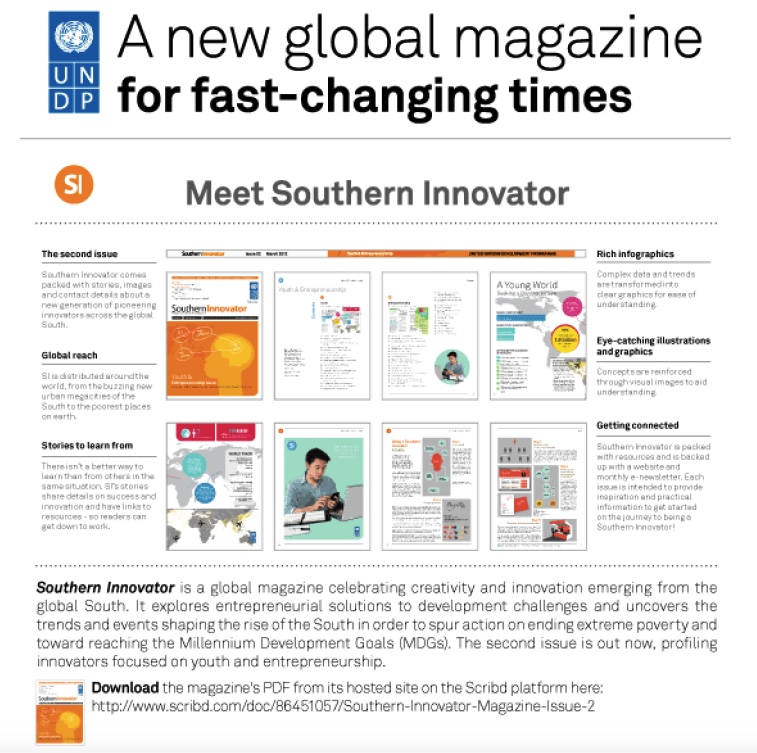
Development Challenges, South-South Solutions was launched as an e-newsletter in 2006 by UNDP’s South-South Cooperation Unit (now the United Nations Office for South-South Cooperation) based in New York, USA. It led on profiling the rise of the global South as an economic powerhouse and was one of the first regular publications to champion the global South’s innovators, entrepreneurs, and pioneers. It tracked the key trends that are now so profoundly reshaping how development is seen and done. This includes the rapid take-up of mobile phones and information technology in the global South (as profiled in the first issue of magazine Southern Innovator), the move to becoming a majority urban world, a growing global innovator culture, and the plethora of solutions being developed in the global South to tackle its problems and improve living conditions and boost human development. The success of the e-newsletter led to the launch of the magazine Southern Innovator.

Creative Commons License

This work is licensed under a
Creative Commons Attribution-Noncommercial-No Derivative Works 3.0 License.

ORCID iD: https://orcid.org/0000-0001-5311-1052.

© David South Consulting 2022

Categories
Archive Development Challenges, South-South Solutions Newsletters

Preserving Beekeeping Livelihoods in Morocco

By David SouthDevelopment Challenges, South-South Solutions

SOUTH-SOUTH CASE STUDY

The clever combining of tourism and long-standing beekeeping skills has revived a local craft and is also helping to preserve the ecology of Morocco.

Beekeeping, or apiculture (http://en.wikipedia.org/wiki/Beekeeping), has two clear benefits. Bee products, including honey, beeswax, propolis, pollen and royal jelly can be a valuable source of income. The other benefit is the critical role bees play in the ecology by pollinating flowers and plants as they go about their daily business.

Bees are at risk around the world, as reports of the dying-off of bees from colony collapse disorder (http://en.wikipedia.org/wiki/Colony_collapse_disorder) raise concerns about the impact on the earth’s ecology and plant life should bees disappear.

North Africa and the Middle East are considered the cradle of beekeeping, with records showing beekeeping going back to 2400 BC in Egypt. According to “A review of beekeeping in Arab countries” by Moustafa H. Hussein, “The total number of honey bee colonies in Arab countries is approximately 42 million, the total number of beekeepers is 321,700”.

In the paper “The Future of Bees and Honey Production in Arab Countries” by Moustafa A. EL-Shehawy, Egypt has the largest number of bee colonies in Arab countries (48 per cent), with Algeria in second place and Morocco with 9 per cent of the bee colonies.

Support for beekeeping comes from the Arab Beekeepers Union (http://abu.saudibi.com/index.php?page_id=115), which was established in 1994 with the aim to improve “the beekeeping profession all over the Arab World”, according to its website, and the Arab Apicultural Congress, first launched in 1996.

Beekeeping has significant potential for further development, many argue, and can be a great source of income and sustainable livelihoods for communities with a long history of beekeeping.

In Morocco, one solution to preserve beekeeping as a skill and source of income is to turn beekeeping into a tourist destination and event, which has the dual aim of boosting a local food product and reviving a traditional craft and skill.

The Berber heartland of the Agadir region is an area with a reputation for beauty, filled with waterfalls and mountains – and plentiful flowers, which attract bees. As a result, the area is home to the proud local specialty of honey, as well as for its argan nuts and oil, almonds, palm, juniper and olive production.

Now a “Honey Road” route for tourists, combined with community honey festivals, is helping preserve local skills and give a boost to this long-standing economic activity.

Beekeeping is a centuries old skill for the Berber people of North Africa. Berbers (http://en.wikipedia.org/wiki/Berber_people) are spread out across North Africa and were traditionally nomadic herders. Most now live in Morocco and Algeria, but Berbers can also be found in Tunisia, Libya, Mauritania, Mali and Niger.

Starting at the beginning of May, a honey festival takes place in the Moroccan village of Imouzzer des Ida Outanane (http://en.wikipedia.org/wiki/Imouzzer_Ida_Ou_Tanane), 60 kilometres from Agadir.

The honey festival brings together the region’s beekeepers. Tourists can sample honey and prizes are offered based on the quality of the product. It is part of the “Honey Road” route that tourists are encouraged to journey along.
The villagers share responsibility for the care of the bees. Demonstrations take place showing the basics of honey production and the keeping of queen bees.

A few kilometres away on the Honey Road is the village of Izourki Oufella, which produces honey perfumed with thyme and lavender.

The Honey Road runs a triangular pattern south and west of Marrakech between Argana, Oued Tinkert, Asif Tamraght, Agadir and Imouzzer. Argana is reputed to have the “largest and oldest collective beehive in the world” (http://www.morocco.com/blog/tantalizing-tastes-of-the-honey-festival).

Abdelhakim Sabri, owner of Auberge Zolado (aubergezolado.com) – a hilltop hotel with a restaurant and spa – is located in Agadir on the Honey Road.

Sabri works to preserve local culture. “Rural beekeepers struggle, so we’re introducing visitors to apiculturists like Ahmed – and Morocco’s finest honey,” he told High Life magazine.

Ahmed is a Berber beekeeper. He builds cylindrical hives for the bees by rolling sheets of woven reed and then caking them in earth. When the earth has dried, the bees quickly make it their home.

The region’s honey is prized for its distinctive flavour, infused with the aroma of herbs such as thyme, or flowers such as lavender, orange blossom or cactus. A mixture is made of honey, argan oil and almonds and is usually given to couples on their honeymoon.

“Different flowers bloom during different periods, so honey changes through the year,” said Sabri.

It sounds like the Honey Road is worth regular visits to sample the honey as it changes with the seasons!

Published: April 2013

Resources

1) A documentary on the Honey Route from Morocco’s travel promotion agency. Website: http://www.visitmorocco.com/index.php/eng/content/view/full/3975

2) Apinews: Latest apiculture news. Website: http://www.apinews.com/en/

3) Saudi Beekeeping Industry: An association to coordinate efforts to promote and support apiculture. Website: http://www.saudibi.com/?page_id=115
4) Laboratory of Apiculture and Social Insects (LASI): The Laboratory of Apiculture and Social Insects (LASI) at the University of Sussex is the largest research group in the UK studying honey bees and other social insects. Website: http://www.sussex.ac.uk/lasi/

5) Apimondia 2013: This year’s International Apicultural Congress will take place in Kiev, Ukraine from 29 September to 4 October 2013. Website: http://apimondia2013.org.ua/en/

6) International Bee Research Association: Founded in 1949, the International Bee Research Association (IBRA) is a not for profit organisation. It collects, collates and disseminates information on all species of bees.  It is a publishing house, producing a varied and extensive selection of bee publications. Website: http://www.ibra.org.uk/

Southern Innovator logo

London Edit

31 July 2013

Development Challenges, South-South Solutions was launched as an e-newsletter in 2006 by UNDP’s South-South Cooperation Unit (now the United Nations Office for South-South Cooperation) based in New York, USA. It led on profiling the rise of the global South as an economic powerhouse and was one of the first regular publications to champion the global South’s innovators, entrepreneurs, and pioneers. It tracked the key trends that are now so profoundly reshaping how development is seen and done. This includes the rapid take-up of mobile phones and information technology in the global South (as profiled in the first issue of magazine Southern Innovator), the move to becoming a majority urban world, a growing global innovator culture, and the plethora of solutions being developed in the global South to tackle its problems and improve living conditions and boost human development. The success of the e-newsletter led to the launch of the magazine Southern Innovator. 

Creative Commons License

This work is licensed under a
Creative Commons Attribution-Noncommercial-No Derivative Works 3.0 License.

ORCID iD: https://orcid.org/0000-0001-5311-1052.

© David South Consulting 2022

Categories
Archive

Solar Powered Village Kick-Starts Development Goals

By David South, Development Challenges, South-South Solutions

More than 1.7 billion people around the world have no domestic electricity supply, of whom more than 500 million live in sub-Saharan Africa (World Bank). Without electricity, many development goals remain dreams that will never be achieved.

But in a first for India, a village is now entirely powered by solar energy, kick-starting its development and reversing the decline common to many villages.

Rampura village in the state of Uttar Pradesh (http://en.wikipedia.org/wiki/Uttar_Pradesh) had previously been without electricity. But its move to solar power has boosted school performance, brought new economic opportunities for women, and even made the buffalo produce more milk! By getting up early, the buffalo can be fed more before day breaks.

Being able to see at night unleashes a vast range of possibilities, but for the very poor, lighting is often the most expensive household expense, soaking up 10 to 15 percent of income.

There’s a direct link between lighting and economic development. Each 1 per cent increase in available power will increase GDP by an estimated 2 to 3 per cent.

In India, 600,000 villages still lack electricity. Despite the country’s impressive economic gains – growth of over 9 percent per year for the last three years, although that rate is now slowing – the levels of poverty in the country’s villages have driven millions to flee to the sprawling slum zones of India’s cities.

Rampura was set up with solar power by a project of Development Alternatives (http://www.devalt.org/), a New Delhi-based NGO working on promoting “sustainable national development”. Using US $1,406,000 from Norwegian solar power company Scatec Solar (http://www.scatecsolar.no/), it installed 60 solar panels to power 24 batteries. The village’s 69 houses are directly connected to the solar plant.

According to Greenpeace (http://www.greenpeace.org/international/), India could generate 10 percent of its electricity from solar power by 2030.

Manoj Mahata, the project’s programme director, said half of India’s 600,000 villages without electricity can now have the option of solar power.

A steady electricity supply means children are extending their study time past daylight hours. Nine-year-old Aja told the Sunday Times: “I like watching television and the light at night means I can read.”

For women, the light brought by electricity means they can take on new business opportunities to boost income. “I want to start a sewing business with other women to make tablecloths and blouses,” said mother of three Gita Dave.

“Even the buffalo are producing more milk because people can feed before dawn,” said Ghanshyam Singh Yadav, president of Rampura’s energy committee.

“This is not rocket science. This is simple,” says Katja Nordgaard, director for off-grid projects at Scatec.

“The model is relatively cheap, and it is easy to operate and maintain. It can be built in three to four weeks, and can easily be scaled up if the demand for electricity increases.

“People in India are already paying when they need to charge cell phones, and for the kerosene they use in their lamps. The willingness to pay for energy is relatively high here, especially when that energy is reliable.”

In Bangladesh, more than 230,000 households are now using solar power systems thanks to the government’s Infrastructure Development Company Ltd. (IDCOL), giving rise to opportunities for a whole new generation of entrepreneurs to make use of this new power supply for the poor. IDCOL is run by the Ministry of Finance, and is on course to install 1 million Solar Household Systems (SHS) using solar panels by 2012. The Bangladeshi government is hoping to bring electricity to all its citizens by 2020 – meaning this is now a prime time for entrepreneurs specializing in providing energy efficient products to the poor.

Another initiative to boost development in India’s rural villages is the concept of the Model Village India (www.modelvillageindia.org.in), previously profiled by Development Challenges (November 2008).

Resources

Creative Commons License

This work is licensed under a
Creative Commons Attribution-Noncommercial-No Derivative Works 3.0 License.

ORCID iD: https://orcid.org/0000-0001-5311-1052.

© David South Consulting 2021