Tag: urbanism

  • New Apps Make Driving and Travelling in Egypt Easier, Safer

    New Apps Make Driving and Travelling in Egypt Easier, Safer

    By David SouthDevelopment Challenges, South-South Solutions

    SOUTH-SOUTH CASE STUDY

    Mobile phones are ubiquitous across the global South. They have spawned whole new business opportunities and changed the way people solve problems and find solutions.

    Sub-Saharan Africa is now home to approximately 650 million mobile phone subscribers, more than the United States and the European Union (World Bank).  A recent World Bank report estimated mobile phones led directly to the creation of 5 million jobs in Africa in 2012, contributing to seven per cent of Africa’s gross domestic product (GDP).

    Mobile phones have also led to contests and challenges, set up to spark further innovation in this area and spur the development of so-called “apps”, or applications, to run on these electronic devices.

    These prizes encourage and reward useful innovation that directly tackles the problems and challenges of the South.

    In Cairo, Egypt – a city notorious for some of the worst traffic congestion in the world – many have been trying to find smart solutions to the gridlock. The World Bank says in its Cairo Traffic Congestion Study that the annual cost of congestion in Cairo is estimated at up to US $8 billion. This is four per cent of Egypt’s gross domestic product (GDP) – four times the impact on national GDP experienced by other comparable large cities. The study found that at least 1,000 Cairo residents die each year in traffic-related accidents, more than half of them pedestrians. And rapid growth in the city is making it ever-harder to get on top of the problem.

    Rising traffic congestion is a problem around the world. In the United States, traffic jumped 236 per cent as the population grew by 20 per cent between 1982 and 2001 (IBM).

    The IBM Commuter Pain Study conducted in 2011, ranking the emotional and economic toll of commuting in 20 international cities, found that the commute in Beijing is four times more painful than the commute in Los Angeles or New York, and seven times more painful than the commute in Stockholm.

    Commuter pain leads to productivity loss as people lose time stuck in traffic and fuel is wasted as engines idle in traffic jams – not to mention damage to the environment from the increased pollution.

    According to the World Business Council for Sustainable Development, 95 per cent of congestion growth in the coming years will be in developing countries. Even in developed countries like the United States, in 2000, the average driver experienced 27 hours of delays (up seven hours from 1980) (MIT Press). This ballooned to 136 hours in Los Angeles.

    Developing countries are seeing vehicle numbers rise by between 10 and 30 per cent per year (World Bank). In economic hotspots, growth is even faster.

    The Cairo Transport App Challenge (https://www.facebook.com/CairoTransportAppChallenge) is a contest aimed at taming the city’s traffic chaos. It is hosted by the Technology Innovation Entrepreneurship Center (TIEC) (http://www.tiec.gov.eg/en-us/Pages/default.aspx) and is organized by the World Bank in collaboration with others.

    The contest’s press release says it aims to connect transport and urban development experts with volunteer technology communities to build “applications to address pressing transport challenges in Cairo through leveraging the new information and communication technologies (ICT) – such as mobile phones, smartphones and GPS-enabled devices – as well as the talent of Egyptian software developers and innovators.”

    The first winner of the US $3,000 in prize money is a mobile phone app that helps drivers get help on the road and with car maintenance.

    Users can use the Belya app to find the best routes, and to get help if their vehicle breaks down. The app is essentially a portable virtual car mechanic. It uses Global Positioning System (GPS) technology to locate service centres, which are then contacted when somebody needs help. The app gives details to the repair shop on what is wrong, the date and time.

    “It is also linked to the General Traffic Administration, to provide quick and regular updates of the traffic situation,” according to a statement from Egypt’s Ministry of Communications and Information Technology, which awarded the prize.

    The content’s second prize was won by E-mokhalfa (http://www.emokhalfa.com/emokhalfa/),which helps communities create safer roads by using peer pressure to make drivers behave better. Third place went to the app called “Where is my bus?” (https://twitter.com/AutobeesyFeen). It helps passengers find bus stations, routes, journey times and all mass transport options on their mobile phones.

    Published: February 2013

    Resources

    1) A guide to making mobile phone apps: Here are some resources to building your own phone app online or through a provider. Website:http://www.brandignity.com/2011/03/building-mobile-iphone-phone-app-onlin/

    2) Android: Android is the world’s most popular mobile platform. Website: android.com

    3) Arab Republic of Egypt, Ministry of Communications and Information Technology. Website: http://www.mcit.gov.eg/

    4) IBM Smart Traffic: IBM Intelligent Transportation, a compliment to the Intelligent Operations Center for Smarter Cities, enables advanced analysis of the many factors that make up traffic flow, and gives planners and responders a comprehensive look at the state of their city’s roadways on ground level. Website:http://www.ibm.com/smarterplanet/eg/en/traffic_congestion/ideas/index.html

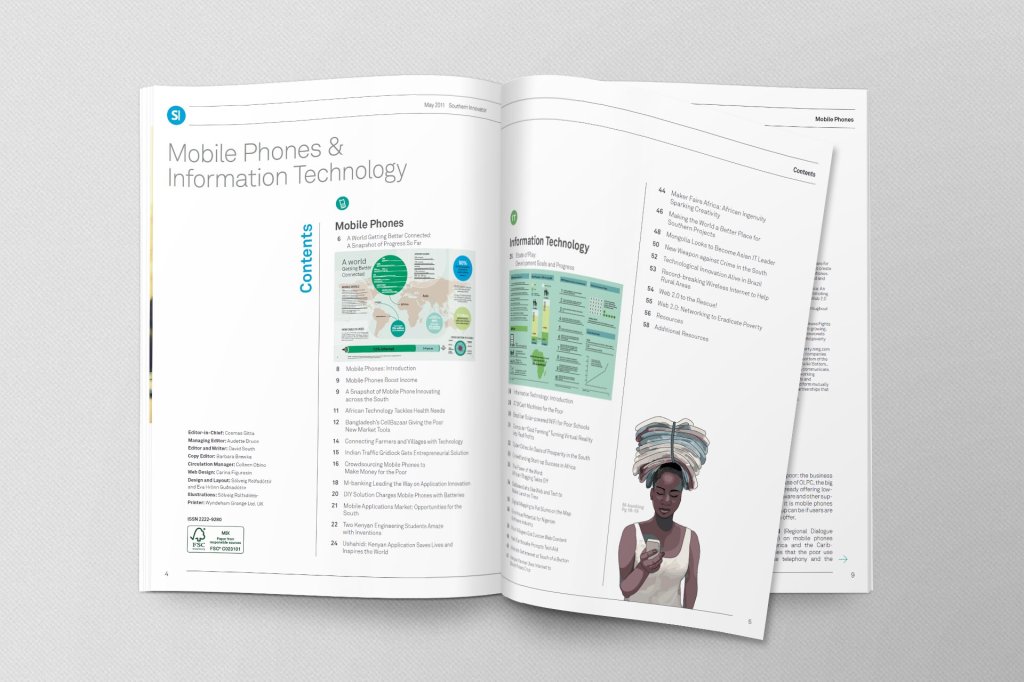
    5) Southern Innovator Magazine Issue 1: Mobile Phones and Information Technology. Website:http://www.scribd.com/doc/95410448/Southern-Innovator-Magazine-Issue-1-Mobile-Phones-and-Information-Technology

    Southern Innovator logo

    London Edit

    31 July 2013

    Development Challenges, South-South Solutions was launched as an e-newsletter in 2006 by UNDP’s South-South Cooperation Unit (now the United Nations Office for South-South Cooperation) based in New York, USA. It led on profiling the rise of the global South as an economic powerhouse and was one of the first regular publications to champion the global South’s innovators, entrepreneurs, and pioneers. It tracked the key trends that are now so profoundly reshaping how development is seen and done. This includes the rapid take-up of mobile phones and information technology in the global South (as profiled in the first issue of magazine Southern Innovator), the move to becoming a majority urban world, a growing global innovator culture, and the plethora of solutions being developed in the global South to tackle its problems and improve living conditions and boost human development. The success of the e-newsletter led to the launch of the magazine Southern Innovator. 

    Creative Commons License

    This work is licensed under a
    Creative Commons Attribution-Noncommercial-No Derivative Works 3.0 License.

    ORCID iD: https://orcid.org/0000-0001-5311-1052.

    © David South Consulting 2023

  • Global South Experiencing Transportation Revolution

    Global South Experiencing Transportation Revolution

    By David SouthDevelopment Challenges, South-South Solutions

    SOUTH-SOUTH CASE STUDY

    Away from the news headlines, a quiet revolution has been taking place in public transportation across the global South. As cities have expanded and grown, they have also been putting in place public transport systems to help people get around and get to work.

    One proven, efficient way to move large numbers of people quickly through dense urban areas is to use underground subway or metro systems. Subway systems have a profound effect on local economies and wealth creation. They allow people to quickly cover distances that may once have meant hours stuck in traffic. Once people can move around a city quickly and over large distances, they can change how they work, shop, enjoy themselves. It allows people living in poor outlying neighbourhoods to travel to jobs in the city centre, improving their income prospects.

    As many countries in the global South have enjoyed healthy growth rates despite the global economic crisis, and with the global financial system being flooded with stimulus funds to spur growth, the resources have become available to invest in expensive and long-term public transport solutions such as metro systems. Another factor is the scale of urbanization in the global South, which is driving governments to turn to new solutions that will help in avoiding the mistakes made in the past.

    The world’s first urban underground railway system was built in 19th-century London, England. It was the product of a country that had been experiencing rapid, large-scale industrialization and urbanization unseen before in human history. Since then, the now 150-year-old London Underground (http://www.tfl.gov.uk/modalpages/2625.aspx) has acted as the arteries coursing through the city’s economic body, criss-crossing the city and delivering millions of people to work and play every day. It is now impossible to imagine Britain’s economy functioning without this efficiency tool.

    Now, as the global South engages in the greatest urbanization project in human history, more cities are turning to underground metro systems to keep people, and the economy, moving. Lessons have been learned from the first generation of global South cities, which expanded rapidly in the 1960s, 1970s and 1980s. Many became quickly clogged in traffic and cloaked in pollution, and saw economic opportunity and social mobility slowed down as a consequence.

    Three of the biggest metro systems in the world are now in China – Beijing, Shanghai and Guangzhou (The Economist). Beijing (http://www.explorebj.com/metro/) has a metro system stretching 442 kilometres and is used every day by 5.97 million people. By 2020, Beijing is hoping to boast 1,000 kilometres of metro network in the city. In Shanghai (http://www.shmetro.com/EnglishPage/EnglishPage.jsp), the 423 kilometre metro system carries 5.16 million people every day, while Guangzhou (http://www.gzmtr.com/en/) carries 4.49 million people a day.

    From the 1960s, the building of metros increased around the world. More than 190 cities now have metro systems. In China, Suzhou (http://www.livingsu.com/guide_detail.asp?id=7), Kunming (http://www.urbanrail.net/as/cn/kunming/kunming.htm) and Hangzhou (http://www.urbanrail.net/as/cn/hang/hangzhou.htm) opened metro systems in 2012. Elsewhere in the global South, Lima in Peru and Algiers (http://www.metroalger-dz.com/) in Algeria recently acquired new metro systems. This means Africa now has two cities with metro systems – Algiers and Cairo in Egypt.

    In India, Bangalore opened a metro system two years ago and Mumbai is close to finishing its metro. Bhopal and Jaipur also plan to build metros. In Brazil, the metros in Sao Paulo and Rio de Janeiro are being expanded and new systems are being built in Salvador and Cuiaba. In the Gulf states of the Middle East, Dubai (http://dubaimetro.eu/) opened a system in 2009 and Mecca (http://meccametro.com/) in Saudi Arabia in 2010. Abu Dhabi, Doha, Riyadh and Kuwait City are also working on building metro systems.

    Paraguay’s capital, Asuncion, is working on one, as is Kathmandu in Nepal. Jakarta in Indonesia has attempted to build an underground metro several times and is now trying to getting one built.

    But how are many of these countries funding this splurge on metro systems? According to Roland Berger Strategy Consultants (rolandberger.co.uk), global government stimulus programmes to fight the current financial crisis have increased available funding for rail systems. There are also increased resources available for transport solutions that avoid the high pollution rates that come with automobiles.

    According to Mass Transit Magazine, China is using domestic consumption and increasing urbanization to spur economic growth and is hoping to increase investment in metro systems in the country by 10 per cent per year.

    The target is to spend 280 billion yuan to 290 billion yuan (US $44.91 to US $46.51 billion) on metro systems in 2013, up from 260 billion yuan in 2012.

    The knock-on economic boost will be felt by domestic businesses as trains and train systems are purchased. It is estimated sales of Chinese-made trains will go from 10.9 billion yuan in 2012 to 28 billion yuan by 2017.

    All this new building will expand the country’s metro lines by 846 kilometres in 24 cities.

    Ten Chinese cities are expecting soon to receive permission to begin work on building new metro systems: Xian, Tianjin, Chongqing, Chengdu, Hangzhou, Ningbo, Kunming, Tsingdao, Wuxi and Dongguan.

    In 2013, 12 Chinese cities will complete new metro systems including Harbin, Changsha, Ningbo and Zhengzhou.

    If this trend continues and expands, then the future cities of the global South could be modern, urban places that raise living standards, while avoiding damaging human health with environmental pollution and over-crowding and social exclusion.

    Published: February 2013

    Resources

    1) Life Guangzhou: Guangzhou Awarded World’s Best Metro System. Website: http://tinyurl.com/ajdcsur

    2) Inhabitat: Parisian Building Taps Metro System as a Heat Source.
    Website: http://inhabitat.com/body-heat-from-paris-metro-to-heat-residential-building/

    3) Digital Construction: Top Ten Metro Systems: Design and efficiency in the world of mass transit. Website:http://www.constructiondigital.com/top_ten/top-10-business/top-ten-metro-systems

    4) Six of the world’s best metro systems – in pictures: A look at six metro systems around the world, from the archaeological treasures on display in Athens to the spectacular halls of Moscow’s underground system via continental Europe’s oldest network. Website:http://www.guardian.co.uk/travel/gallery/2013/jan/09/six-worlds-best-metro-systems

    Development Challenges, South-South Solutions was launched as an e-newsletter in 2006 by UNDP’s South-South Cooperation Unit (now the United Nations Office for South-South Cooperation) based in New York, USA. It led on profiling the rise of the global South as an economic powerhouse and was one of the first regular publications to champion the global South’s innovators, entrepreneurs, and pioneers. It tracked the key trends that are now so profoundly reshaping how development is seen and done. This includes the rapid take-up of mobile phones and information technology in the global South (as profiled in the first issue of magazine Southern Innovator), the move to becoming a majority urban world, a growing global innovator culture, and the plethora of solutions being developed in the global South to tackle its problems and improve living conditions and boost human development. The success of the e-newsletter led to the launch of the magazine Southern Innovator. 

    Creative Commons License

    This work is licensed under a
    Creative Commons Attribution-Noncommercial-No Derivative Works 3.0 License.

    ORCID iD: https://orcid.org/0000-0001-5311-1052.

    © David South Consulting 2022

  • Business Leads on Tackling Violence in Mexican City

    Business Leads on Tackling Violence in Mexican City

    By David SouthDevelopment Challenges, South-South Solutions

    SOUTH-SOUTH CASE STUDY

    The damaging affects of crime and violence can ruin a city. They act as a drag on efforts to increase wealth and improve living conditions, and a city that gets a bad reputation, especially in the age of the Internet, will lose investment opportunities.

    The North American nation of Mexico has been struggling against drug and gang-related violence that has left an estimated 47,000 people dead over the past five years. It is a casualty rate worthy of a war.

    In Monterrey, the capital of Nuevo Leon state (http://en.wikipedia.org/wiki/Nuevo_Le%C3%B3n), an innovative initiative has brought together local businesses to tackle the root causes of violence and crime. The initiative – called Red SumaRSE, which means ‘joining a network’ – was born from anger and disgust at the situation in the city. And it was ignited by a prominent member of the business community expressing this frustration on the social media outlet Twitter (twitter.com).

    The chief executive of the Cemex cement company had had enough one day. Lorenzo Zambrano tweeted a blunt message to other companies in the city: “He who leaves Monterrey is a coward.” It was to be a rallying cry for the campaign to take back the city from the violent gangs.

    Monterrey is embroiled in violent drug-related gang crime. Just one incident shows how bad the situation had become. In August 2011 members of the Zetas drug gang torched a casino over a dispute over non-payment of extortion money, killing 52 people.

    Law enforcement measures can often only go so far to curb violence in a community. Little impact can be made without addressing the underlying economic causes of much of the violence – poor employment opportunities, drug turf wars between rival gangs, economic instability and more.

    “Violence is an expression of social inequality,” Zambrano told The New York Times.

    Tragedies like the casino fire provoked the city’s business community to take action. Private companies in the city have stepped up to design and fund a recruitment campaign for the police force and are paying part of the cost for government-backed community redevelopment plans.

    Corporate philanthropy in Mexico has a history of being very limited. Apart from distribution of gifts at holiday time,there was little else. But this is changing, with Red SumaRSE showing the way.

    “In the last five or 10 years there has been progress both in terms of the quantity of the money and the quality,” Michael Layton, director of the Philanthropy and Civil Society Project at the Autonomous Technological Institute of Mexico, told The New York Times. “But I don’t think Mexico has caught up to Brazil and other countries where the business sector has taken corporate philanthropy to heart.”

    The Red SumaRSE alliance of Monterrey’s companies is directing support to non-governmental organizations working on community development. Examples include telephone company Axtel and the tortilla maker Gruma (gruma.com/vEsp) taking charge of 20 other companies to invest in schools, building up infrastructure and reversing drop-out rates.

    The Oxxo company (oxxo.com/index.php), Mexico and Latin America’s largest chain store, has started to work at improving conditions in the neighbourhood immediately behind its headquarters. The company is working on building parks, increasing job opportunities and finding ways to prevent teenagers from joining gangs in the first place.

    Cemex has also opened a new community centre in a violent neighbourhood where shootings were a regular occurrence. It was based on some Latin American knowledge sharing: inspired by the case of the Colombian city of Medellin, where libraries were strategically located in violent slum areas.

    And there is more good work in the pipeline. The business community has drawn up a list of 70 neighbourhoods in the city needing re-development.

    Red SumaRSE has not been without its critics. They have attacked the focus on security, education and victims while ignoring corruption, which many believe is the source of many of the city’s problems.

    Published: February 2012

    Resources

    1) Medellin: Walking between slums and dreamworlds of neoliberalism: More on the complexities of the situation in this Colombian city.Website: http://www.a0n.com/medellin/dreamworlds.htm

    Development Challenges, South-South Solutions was launched as an e-newsletter in 2006 by UNDP’s South-South Cooperation Unit (now the United Nations Office for South-South Cooperation) based in New York, USA. It led on profiling the rise of the global South as an economic powerhouse and was one of the first regular publications to champion the global South’s innovators, entrepreneurs, and pioneers. It tracked the key trends that are now so profoundly reshaping how development is seen and done. This includes the rapid take-up of mobile phones and information technology in the global South (as profiled in the first issue of magazine Southern Innovator), the move to becoming a majority urban world, a growing global innovator culture, and the plethora of solutions being developed in the global South to tackle its problems and improve living conditions and boost human development. The success of the e-newsletter led to the launch of the magazine Southern Innovator. 

    Creative Commons License

    This work is licensed under a
    Creative Commons Attribution-Noncommercial-No Derivative Works 3.0 License.

    ORCID iD: https://orcid.org/0000-0001-5311-1052.

    © David South Consulting 2023

  • African Hotel Boom Bringing in New Investment and Creating Jobs

    African Hotel Boom Bringing in New Investment and Creating Jobs

    By David SouthDevelopment Challenges, South-South Solutions

    SOUTH-SOUTH CASE STUDY

    Africa is experiencing a boom not seen for decades. The IMF forecasts economic growth in sub-Saharan Africa of 6 per cent in 2014, compared to global growth of 3.6 per cent.

    And this boom is getting an additional jolt of support from the world’s multinational hotel chains. January 2014 saw Africa’s largest hotel chain bought by global giant Marriott (marriott.com). For decades major global multinationals shied away from Africa, but today they are battling to get a place in Africa’s fast-growing economies and to serve the growing middle classes.

    Marriott is leading the way by investing US $1.5 billion in 25 new hotels equalling 5,000 rooms. To boost capacity further, Marriott is taking over South Africa’s Protea group (proteahotels.com) and its 116 African hotels.

    “We have 25 Marriott brand hotels under construction in seven countries in Africa that will come on stream over the next four years,” Alex Kyriakidis, the chain’s president for the Middle East and Africa, told Bloomberg (bloomberg.com).

    The new hotels “are going to bring us into Benin, Gabon, Ghana, Ethiopia and Mauritius. With our existing hotels plus those in the pipeline and those Protea operates today, we will be in 16 countries in Africa by 2017.”

    Bloomberg calls what Africa is experiencing the “fastest pace of hotel development in the world”.
    “Our mission here is to grow, grow, grow,” according to Kyriakidis.

    Meanwhile, a further boost is coming from the US $5 billion Angolan sovereign wealth fund, Fundo Soberano de Angola (fundosoberano.ao/language/en/). It will be investing in hotels and commercial infrastructure in sub-Saharan Africa, according to Bloomberg. This could include 50 sub-Saharan African hotels in the next three years.

    “We believe there’s a lot of investment interest in Africa,” said Chairman Jose Filomeno dos Santos. “It has a lot of mineral potential, almost a commodity hub. We believe this interest will remain there for the coming years.”

    Little thought is given to the role hotels play in development, yet they are a critical development tool for any country wishing to move up the economic ladder. As the quality of hotels improves, they tend to become key gathering and meeting places. Conferences and seminars can act as catalysts for change, attracting people from around the world. When quality hotels are in place, then the top-drawer global conferences will come to town, in turn bringing new tourist income for local businesses.

    Anyone who has stayed in a hotel in Africa knows that standards are variable: the pool with dirty water, the power cuts, the food hygiene standards that might not match what people are used to at home. This is what international hotel chains can change. Not only do they demand the highest standards in their own establishments, they also push up standards at local competitors, as all of them battle for the attention of visitors.

    Africa has been overlooked by the large global hotel chains and brands since the end of the colonial period in the 1960s and 70s. Africa was considered too poor, too chaotic, too dangerous and too much hard work for it to be worth the effort.

    But now the tune has changed. With Africa’s population over a billion, and many of the continent’s economies experiencing rapid growth while also urbanizing, conditions are fortuitous for the hotel trade.

    The situation has changed in the last decade, for a variety of reasons: debt relief, a rise in commodity prices, expanding trade and investment with China and the global South, and a growing middle class — all slowing the growth of poverty. Africa is still notorious for under-investment in infrastructure and has a long way to go to catch up to the fast-moving economies of Asia. But greater optimism is leading to greater real investment. And the world’s large hotel brands are the latest to join in the rush to Africa.

    Large chains including Four Seasons, Ritz-Carlton, Hyatt and Kempinski hope to open 300 new hotels in Africa over the next five years. The number of hotel beds is set to increase by 30 per cent by 2018.

    Four Seasons Safari Lodge Serengeti in Tanzania (http://www.fourseasons.com/serengeti/) is the first investment in Africa by the Canadian brand. Four Seasons is known for its luxury, upmarket city hotels and has kept with this tradition by building the largest and most luxurious safari lodge ever built in Africa.

    This is having a knock-on effect on African hotel operators. The surge in investment is giving these local operators the right incentives to create African brands and to raise their game.

    Nairobi in Kenya has become something of a test market for high-end boutique hotels. Already a city benefiting from its status as an international development hub, home to many agencies including the UN Environment Programme’s sprawling and verdant headquarters (unep.org), it has also become a corporate headquarters for Africa and has a large U.S. presence (nairobi.usembassy.gov). This means lots of people coming to the city to do business and attend events, creating a market for better quality accommodation.

    The Kenyan-owned, 156-room Sankara Nairobi Hotel (sankara.com) boasts of having the best wine list in Africa and claims to be a five-star hotel. It also capitalizes on being close to the international airport and the UN’s Nairobi headquarters.

    “There’s an appetite for something local that’s different and, for the first time, there’s the confidence and funding to bankroll new developments,” said Sankara Hotel Group director Rohan Patel to Wallpaper Magazine. “Africans don’t want a theme-park African hotel, with prints of ‘the big five’ on the wall. That’s condescending. Nor do they want a New York-style hotel. They’ve probably been to New York. They want modern, connected Africa.”

    Elsewhere in Nairobi, the Kenyan-owned Tribe Hotel (tribe-hotel.com) is looking to expand to meet growing market demand.

    “The market for new, authentic, yet modern African hotels is growing,” manager Michael Flint, who previously ran New York’s Ritz-Carlton, told Wallpaper.

    “We’ve been so successful here we are building a new 187-room hotel in Nairobi. We’ve taken over a boutique hotel called Westhouse (westhouse.co.ke). And we’re looking to expand further, with properties at the airport and on the coast. Who knows what will be next? Tribe will be a mini empire.”

    In Rwanda’s capital Kigali, the Rwanda Marriott has ambitious plans. Rwanda was ripped apart by ethnic genocide in the 1990s that killed an estimated 500,000 to 1 million people (http://en.wikipedia.org/wiki/Rwandan_Genocide). Now, the country’s economy is booming and its hotels are getting an upgrade.

    The Akilah Institute for Women (akilahinstitute.org) in Kigali has been helping in training women for the hotel sector. They sent trainees to Dubai and Doha to learn how to do hotel service the Marriott way.

    Starwood (starwoodhotels.com), a competitor to Marriott, is hoping to grow its African hotel investment by 30 per cent as well. It will be done through the Sheraton, Aloft, Le Meridien, St Regis and Four Points brands. The first St Regis has already opened in Mauritius.

    Neil George, Starwood’s head of African development, believes “Africa is the final frontier. It’s adventurous.

    “I would rather arrive in Kinshasa and work out how to do a hotel there than do it in Frankfurt,” he told Wallpaper.

    The Hyatt (hyatt.com) brand is now running the Hyatt Kilimanjaro Hotel in Dar es Salaam (http://daressalaam.kilimanjaro.hyatt.com/en/hotel/home.html), Tanzania. Peter Norman, Hyatt’s African head, is working on opening a Park Hyatt in Zanzibar (http://zanzibar.park.hyatt.com/en/hotel/home.html) and another Hyatt Regency (http://investors.hyatt.com/phoenix.zhtml?c=228969&p=irol-newsArticle&ID=1863203&highlight=) will open in Arusha and a further 140-room Hyatt in Senegal (http://investors.hyatt.com/phoenix.zhtml?c=228969&p=irol-newsArticle&ID=1863204&highlight=).

    The 200-room Villa Rosa Kempinski in Nairobi (http://www.kempinski.com/en/nairobi/hotel-villa-rosa/welcome/), boasting an outdoor heated pool, and the Olare Mara Kempinski (http://www.kempinski.com/en/masai-mara/olare-mara/welcome/) luxury camp in the Maasai Mara will also be joined by projects in Ghana and Equatorial Guinea.

    Kempinski also has properties in Chad and the Congo, has bought the Hotel des Mille Collines (https://www.millecollines.net/) in Kigali and aims to operate 20 hotels across sub-Saharan Africa.

    British entrepreneur Richard Branson has the Mahali Mzuri in the Maasai Mara and it is seen as a stylish role model for other hotels. The local landowners and herdsmen have been included in the business, benefiting from the hotel and helping to preserve the local ecosystem.

    EasyHotel (http://www.easyhotel.com/news/2011/africa0.html), a low budget hotelier, is also rapidly expanding across southern Africa.

    Published: May 2014

    Resources

    1) Catererglobal.com: Catererglobal.com offers a unique service that provides an easy-to-use, specific recruitment website for vacancies in the world’s best hotels and cruise ships. Website: http://www.catererglobal.com/jobs/africa/hotel/

    2) South African hotel jobs: HotelJobs South Africa is an industry specific job website for the hotel, hospitality and catering industry. Website: http://www.hoteljobs.co.za/

    3) Hotel Staff Africa: Many hotel jobs across Africa. Website: http://www.hotelstaff.co.za/

    4) Hotel Career: Many hotel jobs for the Middle East and Africa. Website: http://www.hotelcareer.com/jobs/middle-east-africa

    Development Challenges, South-South Solutions was launched as an e-newsletter in 2006 by UNDP’s South-South Cooperation Unit (now the United Nations Office for South-South Cooperation) based in New York, USA. It led on profiling the rise of the global South as an economic powerhouse and was one of the first regular publications to champion the global South’s innovators, entrepreneurs, and pioneers. It tracked the key trends that are now so profoundly reshaping how development is seen and done. This includes the rapid take-up of mobile phones and information technology in the global South (as profiled in the first issue of magazine Southern Innovator), the move to becoming a majority urban world, a growing global innovator culture, and the plethora of solutions being developed in the global South to tackle its problems and improve living conditions and boost human development. The success of the e-newsletter led to the launch of the magazine Southern Innovator. 

    Creative Commons License

    This work is licensed under a
    Creative Commons Attribution-Noncommercial-No Derivative Works 3.0 License.

    ORCID iD: https://orcid.org/0000-0001-5311-1052.

    © David South Consulting 2023