Categories
Archive Development Challenges, South-South Solutions Newsletters Southern Innovator magazine

Africa’s Fast-Growing Cities: A New Frontier of Opportunities

By David SouthDevelopment Challenges, South-South Solutions

SOUTH-SOUTH CASE STUDY

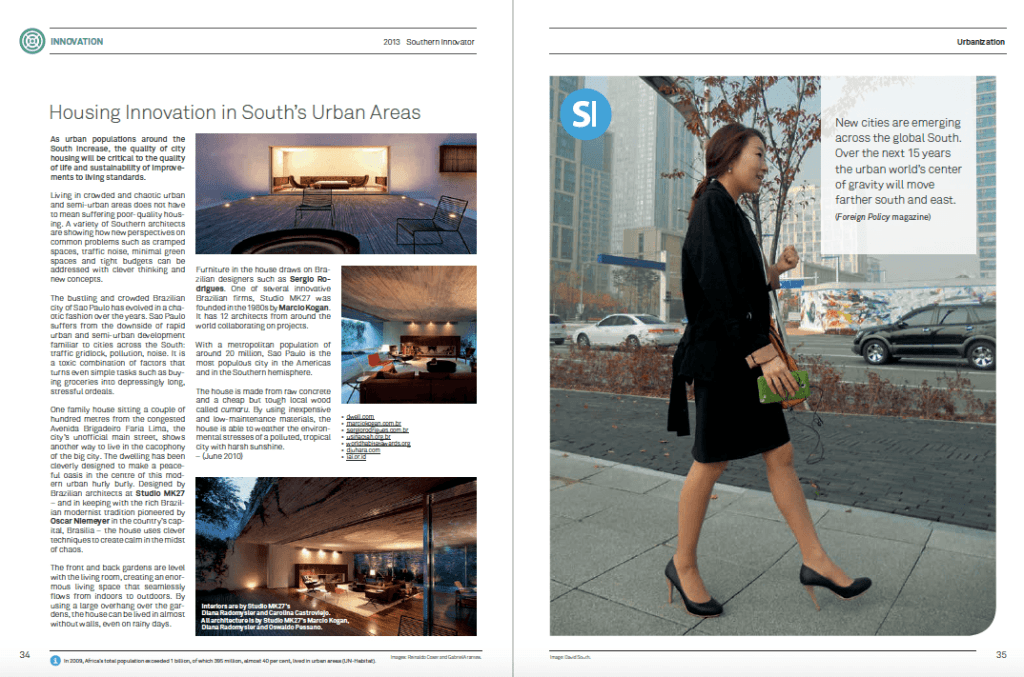
According to a new report by the International Institute for Environment and Development, Africa now has a larger urban population than North America and 25 of the world’s fastest growing big cities. Europe’s share of the world’s 100 largest cities has fallen to under 10 percent in the past century.

Counter to common misperceptions about what is luring people to big cities, the report’s author, David Satterthwaite, said it isn’t because governments and aid are attracting them: government “policies leave much to be desired as they tend to neglect the urban poor, leading to high levels of urban poverty, overcrowding in slums and serious health problems. Governments should see urbanisation as an important part of a stronger economy and their expanding urban population as an asset, not as a problem.”

But global perceptions of Africa are changing. The Mo Ibrahim Foundation has listed the most efficiently run African economies, with a strong correlation between good governance and higher growth rates (Mauritius, Seychelles, Botswana, South Africa, Namibia, Ghana and Senegal).

In most of urban French West Africa, extensive interviews with micro-entrepreneurs and micro-finance practitioners found that most operating micro-enterprises in the informal economy are entrepreneurs by necessity, and that their most basic needs drove their business activities and behaviours. Success was held back by lack of capital, poor training, and a general aversion to risk (Faculty of Management, Dalhousie University).

While access to capital has been identified as the key factor in opportunity, entrepreneurs aren’t even waiting for microfinance institutions to help them. “I started this business of selling chips (French fries) two years ago using money we raised as a group of 30 women,” said Mary Mwihaki, 27, who lives in the Mathare slum area outside Nairobi.

Each member of her group of women contributes about US 30 cents a day and the resulting US $9 is given to a different member of the group on a rotating basis, she told IRIN news agency. Mwihaki waited three months to raise the US $27 she needed. She joins many other women across the country taking the same approach to raising capital.

For some entrepreneurs, it is just the proximity to a buzzing urban atmosphere that is a spur to action. One clothes seller told the African Executive he has been able to make enough money to get a house built just selling second hand clothing. Twenty-three-year-old Henry Mutunga in Nairobi, Kenya takes advantage of the high turnover of the city’s Machakos Country bus terminal to sell second hand clothes.

“After months of searching for a job, I asked myself, ‘Why am I wasting the business studies knowledge I acquired in school?’ I was not comfortable being left in the house every morning, with nothing to do, while my uncle went to work in order to feed me and pay the house rent. I got hooked to the urban mentality and tried my hand at selling trousers.”

Now with two employees, he is able to rent his own house, and is able to use extra money to have his own house built. He urges other youth to become employers, not employees.

At the technological end of entrepreneurship, in Nairobi, Kenya, Mumbi’s Dial-a-Cab company is joining 20 fleet firms in the country to adopt a new mobile phone-based vehicle-tracking technology developed by two young African IT entrepreneurs, Waweru Kimani and Paul Mahiaini. The technology allows management to know how low fuel is, which car has gone where, when a car has been hijacked, what car doors are open, how long it has been stopped, and where it is located. Impressively, it also allows management to stop the car at the touch of a button if it has been stolen. It costs US $570 to install, and costs US $40/month to use.

Other entrepreneurs are piggy backing their success on the booming housing markets in Angola, Ivory Coast, Liberia, Nigeria, Congo, Mali, Morocco, Tunisia, Botswana, Ghana, Mozambique, Rwanda, Kenya, Mauritius, Uganda, Algeria, Egypt, Senegal: all creating enormous opportunities for entrepreneurs providing other services, like furniture, appliances, insurance, landscaping, security, architecture etc.

And the giant US internet search engine Google is now setting up operations in West Africa, based in Dakar – a sure sign that they see this as a new boom market. And Indian investment in Africa has also dramatically shot up this year, according to mergers and acquisitions magazine, The Deal. In 2005, US $81 million was invested in Africa. In 2006, US $340 million; and in 2007, US $294 million.

Published: November 2007

Resources

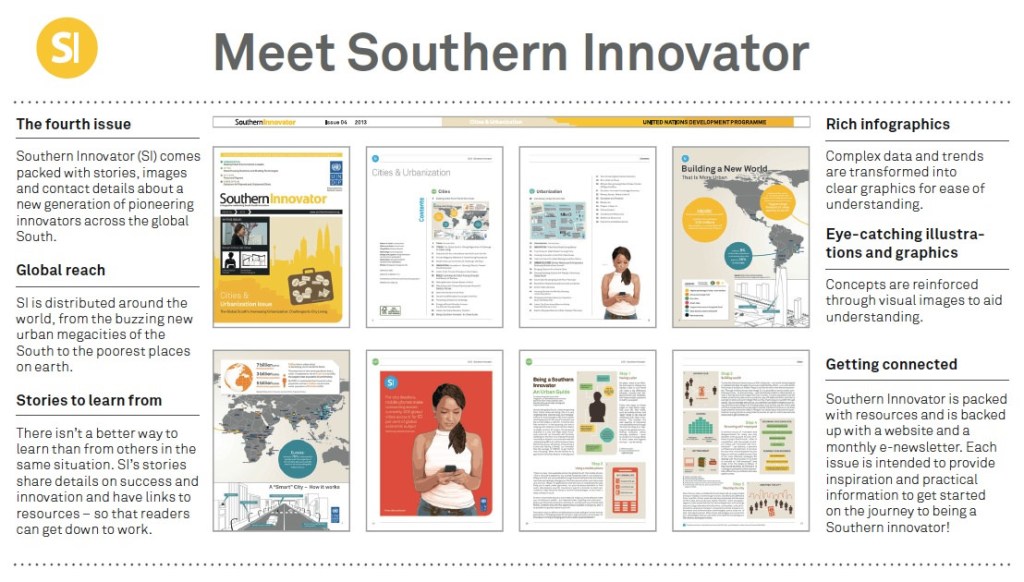
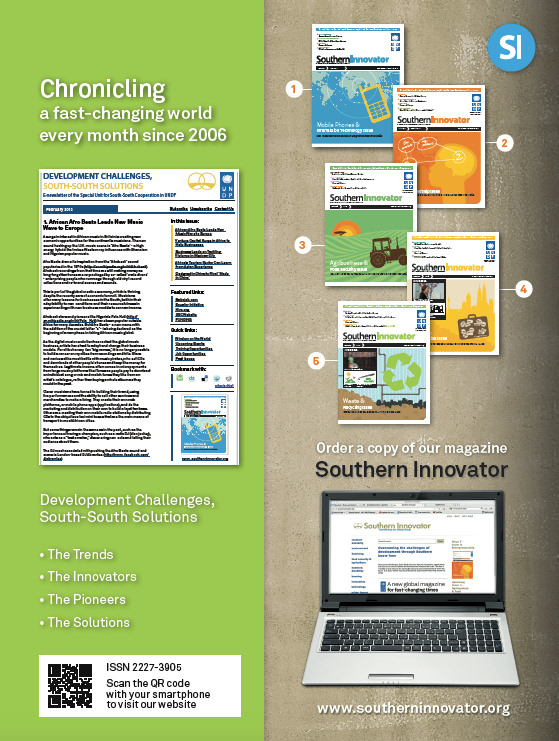
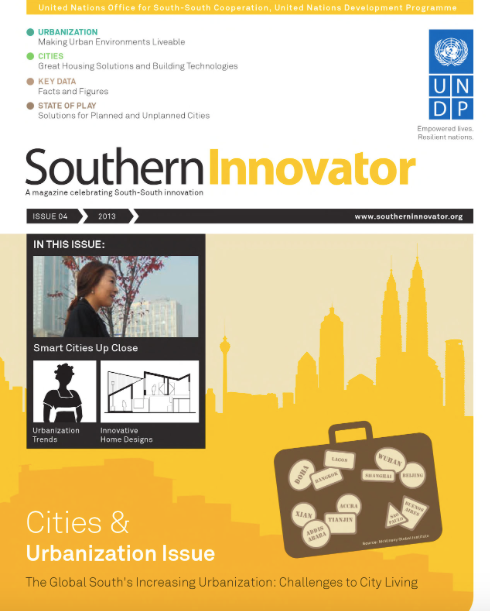
Development Challenges, South-South Solutions was launched as an e-newsletter in 2006 by UNDP’s South-South Cooperation Unit (now the United Nations Office for South-South Cooperation) based in New York, USA. It led on profiling the rise of the global South as an economic powerhouse and was one of the first regular publications to champion the global South’s innovators, entrepreneurs, and pioneers. It tracked the key trends that are now so profoundly reshaping how development is seen and done. This includes the rapid take-up of mobile phones and information technology in the global South (as profiled in the first issue of magazine Southern Innovator), the move to becoming a majority urban world, a growing global innovator culture, and the plethora of solutions being developed in the global South to tackle its problems and improve living conditions and boost human development. The success of the e-newsletter led to the launch of the magazine Southern Innovator.  
Creative Commons License

This work is licensed under a
Creative Commons Attribution-Noncommercial-No Derivative Works 3.0 License.

ORCID iD: https://orcid.org/0000-0001-5311-1052.

© David South Consulting 2023

Categories
Archive Development Challenges, South-South Solutions Newsletters Southern Innovator magazine

Global South Urbanization Does Not Have to Harm Biodiversity

By David SouthDevelopment Challenges, South-South Solutions

SOUTH-SOUTH CASE STUDY

How to balance fragile ecosystems with rapid urbanization will be the challenge for planners and governments across the global South in the coming years. The urbanization trend is clear: the world’s total urban area is expected to triple between 2000 and 2030, with urban populations set to double to around 4.9 billion in the same period (UNEP). This urban expansion will draw heavily on water and other natural resources and will consume prime agricultural land.

Global urbanization will have significant implications for biodiversity and ecosystems if current trends continue, with knock-on effects for human health and development, according to a new assessment by the United Nations Convention on Biological Diversity (CBD).

Cities and Biodiversity Outlook – the first global analysis of how projected patterns of urban land expansion will affect biodiversity and crucial ecosystems – argues that promoting low-carbon, resource-efficient urban development can counter urbanization’s adverse effects on biodiversity while improving quality of life.

“The way our cities are designed, the way people live in them and the policy decisions of local authorities, will define, to a large extent, future global sustainability,” said Braulio Dias, Executive Secretary of the CBD.

“The innovation lies not so much in developing new infrastructural technologies and approaches but to work with what we already have. The results often require fewer economic resources and are more sustainable,” he added.

The report says urban expansion is occurring fast in areas close to biodiversity ‘hotspots’ and coastal zones. And rapidly urbanizing regions, such as large and mid-size settlements in sub-Saharan Africa, India and China, often lack resources to implement sustainable urban planning.

But the study found that cities do not need to be in conflict with plant and animal species and ecosystems. They can, in fact, protect species, as is the case with Belgium, where 50 per cent of the country’s floral species are found in Brussels, or Poland, where 65 per cent of the country’s bird species occur in Warsaw.

At the Alexander von Humboldt Research Institute in Bogota, Colombia (humboldt.org.co) researchers have been thinking about how to get this balance right and make sure the growing cities of the future are not ecological disasters.

According to Juana Marino and Maria Angélica Mejia at the Institute’s Biological Resources Policy Program – which investigates “Biodiversity, Ecosystem Services and Urban-Regional Environments” – how cities grow and develop must change.

They believe cities need to take into account the resources they require to function and the impact this has on biodiversity and ecosystems.

“The more people who arrive in cities, the more they demand goods and services (in a massive way!): roads, housing, infrastructure, food, water – (creating) an impressive amount of waste, challenging traditional waste management and sanitation policies,” said Marino.

In short, “Cities enhance consumption.”

The Humboldt researchers believe common patterns can be seen across the global South, where ecosystems “surrounding urban areas are deforested and have significant levels of water and air pollution; they also become deeply transformed by informal settlements.”

This process means cities “lose their ability to be resilient, they become highly vulnerable to global change and they decrease their production of ecosystem services to maintain human well-being in cities.”

They argue that human settlements must be sustainably planned for, with ecological resilience and human well-being. If this is not done, areas suitable for agricultural production and biodiversity preservation will be harmed.

While better planning is needed there also needs to be long-term thinking.

But planning and managing are not the only things required: “it is a matter of design” if new “resilient” urban-rural landscapes are to be created.

And what can be done? They believe better analysis is required and it needs to take on social and cultural knowledge, and take in the border regions around cities, the “suburban, peri-urban and other ‘transition’ landscapes should become main actors in these relationships, not mere by-products; (they are) compromise territories between a lack of definition and low governance.”

These complex relationships with the border ecosystems of cities need to be communicated to the general public in simple, user-friendly ways so they can understand how important these areas are to the overall health of the city.

In Latin America, the cities of Curitiba (Brazil) and Bogotá and Medellin (Colombia) have made great strides in managing and planning for biodiversity and ecosystem services, they say. But it is not just as simple as recording the number of native species and the percentage of protected areas in urban places. Links need to be created between “social, scientific and political” elements to create “socio-ecological indicators” that can be developed and turned into “easy-to-adopt mechanisms” for people to use.

And they see innovation as the way to do this. Innovation is critical if cities and urban areas are to avoid widespread destruction of biodiversity as urbanization increases.

“Innovation is not just an option – it is a ‘must’,” said Marino. “Not just the technical innovation already being carried on by infrastructure, transport and building sectors that are rapidly changing their patterns based on mitigation technologies.

“Innovation is also needed in terms of biodiversity, biotechnology, information and knowledge production; appropriation, use and management. Knowledge turns into innovation when appropriated by social spheres; when it enters the social and political arenas.”

Environmental governance can be strengthened “when promoting top-down and bottom-up innovations.”

Published: December 2012

Resources

1) Environmental Public Awareness Handbook: Case Studies and Lessons Learned in Mongolia. Website: http://tinyurl.com/yhjyd7h

2) Hyderabad Case Study: During the recent UN biodiversity talks in Hyderabad, the International Union for Conservation of Nature gave journalists the opportunity to see how biodiversity can thrive in the middle of a bustling metropolis. Website: http://www.rtcc.org/hyderabad-a-showcase-of-urban-biodiversity/

3) UNEP: A Global Partnership on Cities and Biodiversity was launched by UNEP, the Secretariat of the Convention on Biological Diversity (CBD), UN-HABITAT, ICLEI, IUCN Countdown 2010, UNITAR, UNESCO and a Steering Group of Mayors from Curitiba, Montreal, Bonn, Nagoya and Johannesburg to bring together existing initiatives on cities and biodiversity. Website: http://www.unep.org/urban_environment/issues/biodiversity.asp

4) Nature in the City: Nature in the City, a project of Earth Island Institute, is San Francisco’s first organization wholly dedicated to ecological conservation, restoration and stewardship of the Franciscan bioregion. Website: http://natureinthecity.org/urbanbiodiversity.php

Development Challenges, South-South Solutions was launched as an e-newsletter in 2006 by UNDP’s South-South Cooperation Unit (now the United Nations Office for South-South Cooperation) based in New York, USA. It led on profiling the rise of the global South as an economic powerhouse and was one of the first regular publications to champion the global South’s innovators, entrepreneurs, and pioneers. It tracked the key trends that are now so profoundly reshaping how development is seen and done. This includes the rapid take-up of mobile phones and information technology in the global South (as profiled in the first issue of magazine Southern Innovator), the move to becoming a majority urban world, a growing global innovator culture, and the plethora of solutions being developed in the global South to tackle its problems and improve living conditions and boost human development. The success of the e-newsletter led to the launch of the magazine Southern Innovator.  
Creative Commons License

This work is licensed under a
Creative Commons Attribution-Noncommercial-No Derivative Works 3.0 License.

ORCID iD: https://orcid.org/0000-0001-5311-1052.

© David South Consulting 2023

Categories
Archive Development Challenges, South-South Solutions Newsletters Southern Innovator magazine

Global South’s Rising Megacities Challenge Idea of Urban Living

By David SouthDevelopment Challenges, South-South Solutions

SOUTH-SOUTH CASE STUDY

The world crossed the threshold from being a majority rural world to a majority urban one at the end of the first decade of the 21st century. The reason for this is the fast-growing urban areas of the global South. And this is having a profound affect on how the world’s people live.

Across the global South, there are many examples of unchecked growth leading to squalor and poor housing conditions, and in turn to poor health and high rates of crime and disorder. Yet, the urbanization happening today across the global South is unprecedented for both its speed and its scale.

And, unlike previous surges in urbanization, it is this quality that is far more challenging for governments and policymakers.

Many countries and regions are experiencing highly stressed environmental conditions, with poor access to water and rising air pollution damaging human health, for example. But on the other side, there is also unprecedented change in technology and communications taking place. Every year, more and more of the world’s population gain access to 21st century communications such as smart phones and the Internet or ‘apps’ (applications), allowing the exchange of solutions and ideas at a rapid pace.

Many are weighing up the benefits and downsides of such an urban, dense world. Denser cities make it easier and more efficient to deliver services, and proponents see a rapid rise in living standards in these megacities. Others see wide-scale poverty and vicious fights over resources in crime-ridden, unhealthy packed megacities. These pessimists point to current conditions in many megacities across the global South.

No matter what perspective, many agree there has to be a cultural change in how people live and behave to make the megacities work.

The contrasting approaches taken by two giants of the global South – India and China – provides lessons and ideas.

The first big push from rural to urban took place in Europe in the 19th century. In 1800, just three per cent of the world’s population lived in cities. All the cities now seen as cosmopolitan hubs of economic and creative energy were just shadows of themselves prior to the 19th-century industrial revolution.

Lessons were learned from hard experience and one of the most important lessons was this: if a city is to grow – and grow quickly – then it must plan for this growth and put the well-being of people at the centre of this plan. This is critical to ensure public health is improved and that the transition to more dense living conditions improves human well-being, rather than making it worse.

A megacity is a city with a population greater than 10 million people (http://en.wikipedia.org/wiki/Megacity). The number of such cities will double over the next 10 to 20 years and many of these cities are in south and east Asia. By 2025, seven of the world’s top 10 megacities will be in Asia. Whole new cities are rising up that most people across the world have never heard about – yet.

One of the most rapidly urbanizing countries in the world is China. At the beginning of 2012, Chinese authorities announced the country was now a majority urban place, with most citizens living in cities. This population of 690.79 million people outpaced the rural population of 656.56 million people.

China is exploring a variety of solutions to making high-density city living work. Some of these solutions include creating multiplexes containing modern shopping, leisure, recreational and housing in one location. One example of this is The New Century Global Centre (http://cd.qq.com/a/20101018/000099.htm) in Chengdu, the capital of Sichuan. It is being called the world’s largest standalone complex. Chengdu is now a city of 14 million people and projected to be heading to 20 million people.

It includes design by noted Iraqi architect Zaha Hadid (zaha-hadid.com).

There are 1.5 million square metres of floor plans, two 1,000-room five-star hotels, an ice-skating rink, a 20,000 capacity marine park with 400 meters of artificial coastline and 5,000 square metres of artificial beach, including hot springs.

In contrast, the more chaotic and unplanned approach taken in India – also a country experiencing rapid growth in its cities – has come under intense criticism. Dr Rumi Aijaz of the Delhi-based Observer Research Foundation (observerindia.com) told The Guardian that Indian infrastructure improvements will be difficult to achieve: “Our urban areas are in a raw form.

All the basics are at a very low level. And the Indian state has been trying for a very long time to address this but a lack of capacity and endemic corruption has meant not much success.”

In 2001, India had 290 million people living in cities. By 2008, this reached 340 million. It is predicted this will reach 590 million people – 40 per cent of the population – by 2030. McKinsey and Company (mckinsey.com) believe by 2030 India will have 68 cities of more than one million people, 13 will have four million people and six megacities will be greater than 10 million people.

India faces an urban infrastructure crisis of epic proportions, McKinsey believes. Many millions will not have access to clean drinking water, adequate sewage, and will have to cope with poor transport.

China, on the other hand, has invested seven times more in urban infrastructure than India. And one example of how this investment pays off is Chengdu.

The fast-growing city of Chengdu’s mayor is trying to manage growth directly through the city’s policies. This involves managing the push and pull incentives driving people to cities and lifting the standard of living in the surrounding countryside.

Chengdu’s mayor Ge Honglin told The Guardian: “The first thing I did was to improve the conditions – schools, shops, garbage collection, the sewage system. We had to cut the gap between rural and urban areas. If people could have a brighter future in the countryside, they’d stay there. So we’re not seeing people swarm into the city= Instead there are people in the city considering moving to the country.”

“Chengdu is the only super-large central city that has narrowed the urbanrural income gap alongside rapid economic growth in China,” Ge said.

Hundreds of schools have been built surrounding Chengdu and partnerships made between rural and urban schools to help raise standards.

Chengdu is also pioneering new ways to address urban squalor with new information technologies. Patrols use mobile phones and cameras to document broken infrastructure and health and safety problems, and to locate and assist the homeless.

“You can barely see a begger in Chengdu,” said Gu. “We have a special system for monitoring them, and it works. Beggars are taken to the assistance centre, where they are given food and shelter and money to take them back to their home. If I say there are no more than 10 beggars on the street you will think there’s some sort of tyranny, but there isn’t. We’re trying to solve their problems.”

Published: May 2012

Resources

1) Endless City and Living in the Endless City: LSE Cities is an international centre at the London School of Economics and Political Science that carries out research, education and outreach activities in London and abroad. Its mission is to study how people and cities interact in a rapidly urbanizing world, focussing on how the design of cities impacts on society, culture and the environment. Website: http://lsecities.net/publications/books/the-endless-city/

2) Planet of Slums by Mike Davis: According to the United Nations, more than one billion people now live in the slums of the cities of the South. Mike Davis explores the future of a radically unequal and explosively unstable urban world. Website: http://books.google.co.uk/books/about/Planet_Of_Slums.html?id=FToaDLPB2jAC

3) An infographic from The Guardian newspaper showing the rise of the megacity in world history. Website: http://image.guardian.co.uk/sysimages/Observer/Pix/pictures/2012/01/21/urban2.jpg

4) Arrival City by Doug Saunders: A third of humanity is on the move. History’s largest migration is creating new urban spaces that are this century’s focal points of conflict and change — unseen districts of rapid transformation and febrile activity that will reshape our cities and reconfigure our economies.Website: http://arrivalcity.net/

5) Global Urbanist: The Global Urbanist is an online magazine reviewing urban affairs and urban development issues in cities throughout the developed and developing world. Website: http://globalurbanist.com/

6) The Spirit of Cities: Why the Identity of a City Matters in a Global Age by Daniel A. Bell and Avner de-Shalit. Website: amazon.com

7) Rise of the Asian Megacity: Website: http://www.bbc.co.uk/news/worldasia-pacific-13800944

8) Capitals of the Connected World: Mapping the New Global Power Structure. Website: http://www.theatlantic.com/special-report/capitalsconnected-world/

Creative Commons License

This work is licensed under a
Creative Commons Attribution-Noncommercial-No Derivative Works 3.0 License.

ORCID iD: https://orcid.org/0000-0001-5311-1052.

© David South Consulting 2023

Categories
Archive Development Challenges, South-South Solutions Newsletters Southern Innovator magazine

Brazilian Design For New Urban, Middle-Class World

By David SouthDevelopment Challenges, South-South Solutions

SOUTH-SOUTH CASE STUDY

Countries across the global South are experiencing rapid urbanization as people move to cities for better economic opportunities — and this massive social change is creating new business opportunities. Those who recognize how fundamentally people’s lifestyles are changing will be those who will benefit from this big shift in populations.

Finding ways to live well in urban areas will be critical to determining whether this move repeats past urban failures — from the favelas of Brazil to the slums of India — or introduces a new way of living that is exciting and colorful. Design and designers will be critical to this change.

One young design company in Brazil, Sao Paulo-based furniture studio NUUN  (nuun.nu), is attempting to resolve a dilemma common across the rapidly urbanizing global South: How to create a design aesthetic that fits with the new way of living and being?

The company consists of designer and founder João Eulálio Kaarah and architects Renato Périgo and Carolina Sverner.

Périgo specializes in furniture and interior design, while Carolina Sverner worked with respected Japanese architect, Shigeru Ban (shigerubanarchitects.com), who is well known for designing buildings and houses made from paper and for creating easy-to-build homes for people after a disaster has struck (http://www.ted.com/talks/shigeru_ban_emergency_shelters_made_from_paper).

A collaboration among upcoming artists, designers and architects, NUUN tries to infuse its designs with a sense of “brazilianness”. Brazilianness is a modern aesthetic, made for modern lifestyles in the new urban landscape, that draws on aspects of Brazil’s culture and environment.

The young studio’s first collection of furniture offers simplicity. Called Eos, it tries to blend urban cosmopolitanism with raw nature. Brazil is known for its jam-packed urban cities as well as its vast expanse of Amazon rainforest. In practice, NUUN’s look is a mix of contrasts redolent of what used to be called brutalism: concrete mixed with glass, steel, wood and semi-precious gems. NUUN takes inspiration from NASA’s Earth Observation System (EOS): the collection vibes off of space satellites, antennae and the dry soil of the backwoods. NUUN says that “despite its Martian features, [the collection] is as Brazilian as it comes”. There is the modular Panorama sofa (http://nuun.nu/products/panorama) in five colors, capable of being re-shaped to fit a variety of living arrangements. A glass-topped coffee table with a concrete base and a side table with a carbon steel metallic structure to complement the sofa.

Elsewhere in the world of Brazilian design, footwear brand Grendene S.A. (http://ri.grendene.com.br/EN/Company/Profile) has become one of the world’s largest producers of footwear and made one of its founders a billionaire. And Grendene has boosted its international success by turning to another Brazilian success: supermodel Gisele Bündchen (giselebündchen.com.br).

Grendene began in 1971 and owns various successful shoe brands, including Melissa (melissa.com.br/en/), Grendha, Ilhabela, Zaxy, Cartago, Ipanema, Pega Forte, Grendene Kids and Grendene Baby.

It has six industrial zones with 13 footwear factories and can produce 240 million pairs of shoes a year. It undertakes all areas of production— from making its own moulds for the shoes to creating PVC (polyvinyl chloride) (http://en.wikipedia.org/wiki/Polyvinyl_chloride) – and handles its own distribution.

While Grendene is already a well-known shoe brand in Brazil, it wanted to expand its presence overseas to increase profits. Named after the two brothers who founded the company, Alexandre Grendene Bartelle and Pedro Grendene Bartelle, Grendene started working with supermodel Gisele Bündchen in 2002 to help her launch her own line of affordable flip-flops, iPanema (ipanemaflipflops.co.uk). The brightly colored sandals with elaborate patterns became an instant success.

But do celebrity endorsements really work? In the case of Bündchen and Grendene, the answer is yes. According to Forbes, 25 million pairs of the flip-flops and sandals are sold every year, accounting for 60 per cent of Grendene’s annual exports of about US $250 million.

Brazil was able to produce 864 million pairs of shoes in 2012, up 5.5 per cent from 2011.

Of these, 113 million pairs were exported to the United States, Argentina and France.

Brazil, like many other countries, has had to work out how it could compete with cheaper shoe imports from China. The strategy it chose was to target the growing number of middle-class people both in Brazil and elsewhere, as well as the high end of the market.

In 1979, Grendene created the Melissa brand, which has now become a coveted style leader. It collaborates with top design names such as Karl Lagerfeld and architect Zaha Hadid.

Making a partnership with Bündchen is part of the company’s strategy to reach higher-income buyers.

And it is working: Grendene increased its export revenue by 50 per cent in 2013.

Co-founder Alexandre Grendene Bartelle became a billionaire according to Forbes World’s Billionaires list and is worth US $1.4 billion. He owns 41 per cent of Grendene S.A. and close to 40 per cent of the Dell Anno brand.

This is a critical lesson for manufacturers in the global South. Grendene had achieved strong market dominance at home, and was already benefiting from growing wealth among Brazil’s middle classes. But it was the overseas market that had the potential to clinch even more profits for the company.

Bündchen’s high brand profile has enabled the company to compete head-to-head with the well-known Brazilian flip-flop brand, Havaianas (havaianas-store.com).

Another modern design leader owned by Grendene, Dell Anno (lojasdellanno.com.br), is a maker of modernist cabinets and furniture.

Dell Anno only use wood from renewable forest sources, to protect and preserve the Amazon and other native forests. Dell Anno tries to recycle as much as possible: up to 80 per cent of the water used in manufacturing is recycled, and byproducts from the production process such as a sawdust, wood, plastic and cardboard are also reused.

Dell Anno makes a full range of furniture for kitchens, bedrooms, closets, home theatres, home offices, service areas, restrooms and commercial environments. Dell Anno uses research and development to study trends and advise customers on the best options. The brand offers its staff training to help standardize customer service, and also has an excellent blog covering developments in modern design around the world (http://www.lojasdellanno.com.br/blog/).

Published: May 2014

Development Challenges, South-South Solutions was launched as an e-newsletter in 2006 by UNDP’s South-South Cooperation Unit (now the United Nations Office for South-South Cooperation) based in New York, USA. It led on profiling the rise of the global South as an economic powerhouse and was one of the first regular publications to champion the global South’s innovators, entrepreneurs, and pioneers. It tracked the key trends that are now so profoundly reshaping how development is seen and done. This includes the rapid take-up of mobile phones and information technology in the global South (as profiled in the first issue of magazine Southern Innovator), the move to becoming a majority urban world, a growing global innovator culture, and the plethora of solutions being developed in the global South to tackle its problems and improve living conditions and boost human development. The success of the e-newsletter led to the launch of the magazine Southern Innovator.  

Follow @SouthSouth1

Google Books: https://books.google.co.uk/books?id=NhQ9BQAAQBAJ&dq=development+challenges+may+2014&source=gbs_navlinks_s

Slideshare: http://www.slideshare.net/DavidSouth1/may-2014-development-challenges

Southern Innovator Issue 1: https://books.google.co.uk/books?id=Q1O54YSE2BgC&dq=southern+innovator&source=gbs_navlinks_s

Southern Innovator Issue 2: https://books.google.co.uk/books?id=Ty0N969dcssC&dq=southern+innovator&source=gbs_navlinks_s

Southern Innovator Issue 3: https://books.google.co.uk/books?id=AQNt4YmhZagC&dq=southern+innovator&source=gbs_navlinks_s

Southern Innovator Issue 4: https://books.google.co.uk/books?id=9T_n2tA7l4EC&dq=southern+innovator&source=gbs_navlinks_s

Southern Innovator Issue 5: https://books.google.co.uk/books?id=6ILdAgAAQBAJ&dq=southern+innovator&source=gbs_navlinks_s

Creative Commons License
This work is licensed under a
Creative Commons Attribution-Noncommercial-No Derivative Works 3.0 License.

ORCID iD: https://orcid.org/0000-0001-5311-1052.

© David South Consulting 2023