Tag: urban

  • Model Indian Villages to Keep Rural Relevant

    Model Indian Villages to Keep Rural Relevant

    By David SouthDevelopment Challenges, South-South Solutions

    (Havana, Cuba), November 2008

    SOUTH-SOUTH CASE STUDY

    The world’s rush to urban centres is the great challenge of the 21st century. In 2007, the world became a majority urban place. The consequences of this shift can be seen in the blight of urban poverty, with its slums and squalor, environmental degradation, and rising social tensions. But there are people working on keeping rural areas relevant and pleasant places to live. These rural advocates see a vibrant countryside as part of the solution to the world’s plethora of crises.

    In India, a pioneering initiative is reviving impoverished rural villages. Drawing on self-organizing methods used in India since 1200 BC, the Model Village India (www.modelvillageindia.org.in) is based around India’s democratic system of Panchayats: a village assembly of people stemming back to pre-colonial times.

    “Decentralizing is necessary if development is to reach the grassroots,” said the concept’s founder, Rangeswamy Elango, a head of the village of Kuthampakkam, 20 kilometres (12 miles) from the bustling city of Chennai, and one of the 12,600 Panchayats in the Indian state of Tamil Nadu.

    While all villages have the ability to use the Panchayat system to improve their lives, few are making the most of this system. The model villages are about showing other villages the true power they have at their disposal. And that with a plan and determination, they can increase their income and improve their quality of life, attracting more money from government and other sources to do so.

    The concept has now expanded to 30 model villages. At its core it is about being positive, eschewing griping about problems and instead getting down to work to solve them.

    “We demonstrate the basic infrastructure, sustainable housing, food security,” said Elango. “If the government is not bothering, maybe through the local people’s efforts, we can try to demonstrate a variety of development models.”

    As India’s economy has boomed, its small towns and villages have withered. Home to the majority of the country’s population, they are in crisis, with declining populations and high suicide rates. India’s urban slums are where people are going – they are growing 250 percent faster than the country’s population. India is a country in danger of neither having a viable rural economy, nor viable cities, but just vast tracts of slums.

    Originally left out of the first draft of India’s constitution, Panchayats became legitimized in 1992. They are now elected in every one of the 260,000 villages in India. If they use them, the local Panchayats have extensive powers to transform the destiny of a village, with control of budgets, and decision-making power on how services are to be delivered. This ranges from the provision of clean water, to burying the dead and building roads. The trick is in getting people to realize the power they wield over their destiny and how it can transform their economic situation.

    “The village-level local governments are constitutionally important bodies,” said Elango, “but the way it is implemented is not good. The system is unable to deliver the goods to the people.”

    The model village approach has revived once-declining villages plagued with high unemployment, chronic alcohol abuse, and domestic violence. The residents are involved in the building of new and healthier homes, providing clean drinking water, waste facilities, education services – including an academy dedicated to teaching the skills and lessons leaned by the villagers to other villages – and even trying to break down the barriers between people because of India’s caste social hierarchy.

    “Instead of having a big college, this is a practical people’s model,” Elango said. “It is not done by an academic but by a layman. The learning is spontaneous and emotional.”

    Elango is driven by making his village a model that works, and in turn, becoming a magnet for others wishing to improve their lives and their villages.

    Elango’s village was not able to support itself with its two crop harvests a year and the villagers resorted to illegal alcohol production instead to make a living. Despite being well connected by highway with nearby Chennai, the village was socially and economically dying.

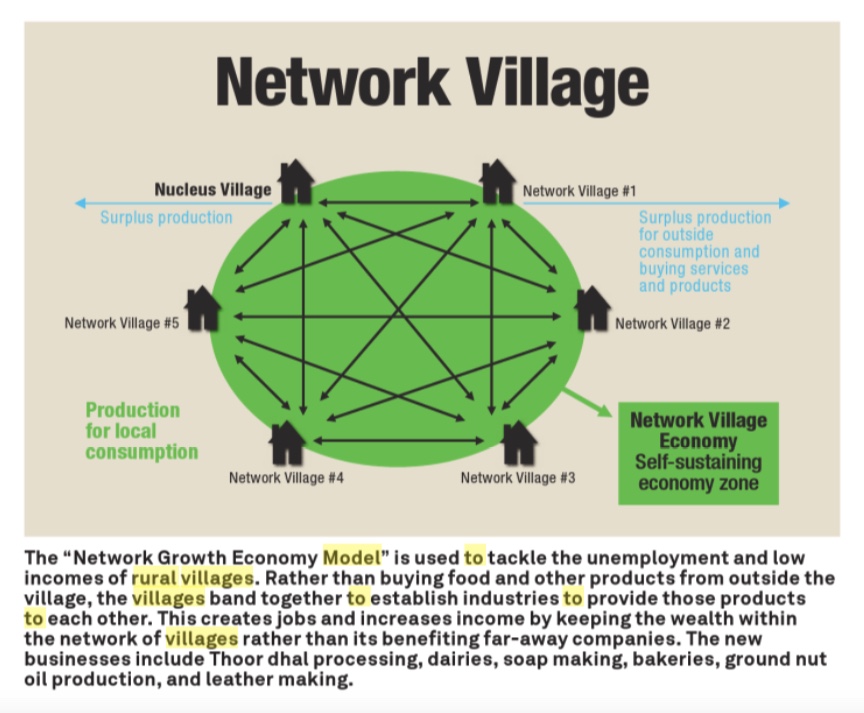
    Like a spreading ink spot, the concept is to create a network of like-minded villages that act as self-reinforcing positive role models, spreading the prosperity and stability outwards. The “Network Growth Economy Model” is a direct challenge to the “special economic zones that benefit only capitalist owners,” said Elango.

    Ambitious, Elango is hoping to draw in 2,000 villages over the next 10 years, until a tipping point is reached, and the model explodes across India.

    A native of the village, Elango became saddened by the community’s decline, including widespread domestic violence against women. The booming city of Chennai’s prosperity had not rippled out to the village, and it was still lacking good infrastructure and sanitation. A trained chemical engineer, he was elected the President of the Kuthambakkam Panchayat in 1996, and set about using his engineer’s perspective to draft the village’s five-year plan from 1996 to 2001.

    But the budget was tight. And he had to turn to innovative solutions: recycling building materials, conserving water and reducing electricity consumption. But the resourcefulness paid off, and the state of Tamil Nadu provided the money to upgrade roads, drains, build a community centre, child care facilities, 200 low cost toilets, and work sheds for the village’s industries. By the end of 2001, most basic needs were being met. He then turned to providing good quality housing for the villagers still living in thatch huts.

    He has used the “Network Growth Economy Model” to tackle the unemployment and low incomes. It works like this: rather than buying food and other products from outside the village, the villages band together to establish industries to provide those products to each other. This creates jobs and increases income by keeping the wealth within the network of villages, rather than it benefiting far-away companies. The new businesses include Thoor dhal processing, dairies, soap making, bakeries, ground nut oil production, and leather making.

    “India was strong when this model was in place – we had strong villages,” said Elango. “Globalization’s trickle down is not working for India.”
    Published: November 2008

    Resources

    • Unleashing India’s Innovation: Toward Sustainable and Inclusive Growth, a report by the World Bank. Website: http://web.worldbank.org/WBSITE/EXTERNAL/COUNTRIES/SOUTHASIAEXT/0,,contentMDK:21490203~pagePK:146736~piPK:146830~theSitePK:223547,00.html
    • NextBillion.net: Hosted by the World Resources Institute, it identifies sustainable business models that address the needs of the world’s poorest citizens. Website:http://www.wri.org
    • CIDEM and Ecosur specialise in building low-cost community housing using eco-materials. They have projects around the world and are based in Cuba. Website: http://www.ecosur.org

    Sponsored by BSHF. BSHF is now called World Habitat and it aims to seek out and share the best solutions to housing problems from around the world.

    https://davidsouthconsulting.org/2022/11/22/bio-ethanol-from-sturdy-and-once-unwanted-indian-plant/

    https://davidsouthconsulting.org/2022/09/29/cheap-indian-tablet-seeks-to-bridge-digital-divide/

    https://davidsouthconsulting.org/2022/10/09/entrepreneurs-use-mobiles-and-it-to-tackle-indian-traffic-gridlock/

    https://davidsouthconsulting.org/2021/08/29/indian-business-model-makes-green-energy-affordable/

    https://davidsouthconsulting.org/2022/10/25/indian-city-slum-areas-become-newly-desirable-places-to-live/

    https://davidsouthconsulting.org/2021/08/28/indian-entrepreneur-brings-dignity-to-poor-women/

    https://davidsouthconsulting.org/2021/03/04/indian-id-project-is-foundation-for-future-economic-progress/

    https://davidsouthconsulting.org/2022/10/18/indian-initiatives-to-make-travel-safer-for-women/

    https://davidsouthconsulting.org/2022/06/15/indian-mobile-phone-application-innovators-empower-citizens/

    https://davidsouthconsulting.org/2022/11/01/indian-newspapers-thrive-with-economy/

    https://davidsouthconsulting.org/2022/10/06/indian-solar-economy-brings-new-vocation-for-women/

    https://davidsouthconsulting.org/2022/10/06/indian-solar-power-pack-powers-villages/

    https://davidsouthconsulting.org/2022/10/25/indian-toilet-pioneer-champions-good-ideas/

    https://davidsouthconsulting.org/2022/10/18/indians-fighting-inflation-with-technology/

    Development Challenges, South-South Solutions was launched as an e-newsletter in 2006 by UNDP’s South-South Cooperation Unit (now the United Nations Office for South-South Cooperation) based in New York, USA. It led on profiling the rise of the global South as an economic powerhouse and was one of the first regular publications to champion the global South’s innovators, entrepreneurs, and pioneers. It tracked the key trends that are now so profoundly reshaping how development is seen and done. This includes the rapid take-up of mobile phones and information technology in the global South (as profiled in the first issue of magazine Southern Innovator), the move to becoming a majority urban world, a growing global innovator culture, and the plethora of solutions being developed in the global South to tackle its problems and improve living conditions and boost human development. The success of the e-newsletter led to the launch of the magazine Southern Innovator.

    https://davidsouthconsulting.org/2021/03/05/southern-innovator-issue-3/

    Creative Commons License

    This work is licensed under a
    Creative Commons Attribution-Noncommercial-No Derivative Works 3.0 License.

    ORCID iD: https://orcid.org/0000-0001-5311-1052.

    © David South Consulting 2023

  • Two-stroke Engine Pollution Solution

    Two-stroke Engine Pollution Solution

    By David SouthDevelopment Challenges, South-South Solutions

    SOUTH-SOUTH CASE STUDY

    Cities across the South choke on the pollution made by the small two-stroke engines (http://www.howstuffworks.com/two-stroke.htm) powering motor scooters, motorcycles, auto rickshaws, tuk-tuks and other vehicles. People choose these vehicles to get around because they are cheap, powerful and easy to fix. But the environment – and human health – suffers as a result. And as cities balloon and populations grow, the number of journeys and two-stroke engines grows with it.

    In large cities across Asia, 1 million three-wheeled auto-rickshaws form an important means of daily transportation, and a source of income for their drivers. And the Asian Development Bank estimates there are over 100 million vehicles using two-stroke engines in Southeast Asia. But these vehicles cause serious air pollution and emissions of carbon dioxide (CO2), which contributes to global warming.

    Because two-stroke engines burn an oil-gasoline mixture, they also emit more smoke, carbon monoxide, hydrocarbons and particulate matter than the gas-only, four-stroke engines found in newer vehicles.

    In the Philippines, auto rickshaw drivers are pioneering specially adapted two-stroke engines that reduce particulate emissions by 70 percent and carbon dioxide emissions by 76 percent.

    Tim Bauer, the 31-year-old American mechanical engineer who developed the technology, said auto rickshaws “play an essential role in the social and economic fabric. But their impact on public health is disastrous.”

    Motorized tricycles produce an astonishing amount of pollution: each one is equivalent to 50 cars. In Bangkok, Thailand, two-stroke engines contribute 47 percent of pollution particulates in the air.

    The World Health Organization (www.who.org) ranks urban outdoor air pollution as the 13th greatest contributor to disease burden and death worldwide. It has been estimated that the air pollution leads to the deaths of more than half a million people a year. About two-thirds of the residents of Delhi and Calcutta suffer from respiratory symptoms such as common cold and dry and wet cough, much of this caused by two-stroke engine emissions.

    Two-stroke engines are highly inefficient users of fuel: up to 40 percent of the fuel and oil goes out of the exhaust pipe unburned. This exhaust is packed with oxides of carbon, nitrogen, sulphur, hydrocarbons and fine dust – all toxic contributors to air pollution.

    But the attraction of these engines remains strong. “They are powerful, simple, reliable and robust,” said Bauer, “and spare parts are easy to find. They also have a long lifetime.”

    Bauer faced some strict constraints in developing the technology.

    “It had to substantially reduce emissions without impairing the engine’s performance. It had to be installed without machining the engine crankcase, and with only a basic tool set. Of course, it also had to be affordable for Filipino drivers.”

    Using off-the-shelf components, Bauer developed a kit that turns two-stroke engines into fuel-injection machines. This adjustment reduced particulate emissions by 70 percent and carbon dioxide emissions by 76 percent. He now sells the kits through Envirofit, a non-profit organization (http://www.envirofit.org/). It has been pilot tested at two Filipino holiday resorts, Vigan and Puerto Princesa.

    Auto-rickshaw drivers tend to be poor and earn on average US $3 to US $4 a day. The cost of fitting vehicles with Bauer’s new technology is met by microcredit.

    “Drivers earn money daily, so it’s easy for them to pay back their loan, and 90 percent of them do it in less than a year,” he said. Over 260 taxi drivers have already installed the new kit.

    “These drivers are at the base of the economic pyramid and these tricycles are a testament to their ingenuity and work ethic. At the end of the day, we can improve their lives with a cylinder head, a few brackets and, of course, hard work.”

    Bauer pioneered his solution while working on fuel injection in snowmobiles at the Engines and Energy Conservation Lab at Colorado State University. He started to market the solution in Asia in 2004. Bauer has won a Rolex Award for Enterprise to pay for the distribution of the kits throughout Asia.

    There is, of course, another solution: an outright ban or measures to push the vehicles off the road. In the Philippines’ San Fernando City, economic incentives were what drove the transition from two-stroke to four-stroke (less polluting) tricycles. In 2001, three-quarters of the city’s 1,600 registered tricycles ran on two-stroke engines. But after a city council mandate to totally phase out the vehicles by 2004, and offers of interest-free loans for down-payments on four-stroke models, more than 400 four-stroke tricycles had replaced the older two-stroke models.

    When Bangkok toughened up vehicle inspections and emissions standards in 2000, two-wheelers made up over 96 percent of the city’s traffic. But by March 2004, they made up only 40 percent, according to Supat Wangwongwatana, deputy director general of Thailand’s Pollution Control Department.

    Published: December 2008

    Resources

    • Tukshop is a website selling auto rickshaws and tuk-tuks.  Website:http://www.tukshop.biz/
    • A wide range of auto rickshaws for sale.  Website: http://www.auto-rickshaw.com/ 
    • The Hybrid Tuk Tuk Battle is a competition to come up with less polluting auto rickshaws, clean up the air in Asian cities, and improve the economic conditions for auto rickshaw drivers. 
      Website:http://hybridtuktuk.com/
    • The Clean Air Initiative for Asian Cities promotes and demonstrates innovative ways to improve the air quality of Asian cities through partnerships and sharing experiences. It is run by the Asian Development Bank together with the World Bank and the US Agency for International Development. 
      Website: http://www.cleanairnet.org/

    https://davidsouthconsulting.org/2023/02/03/environmental-public-awareness-handbook-case-studies-and-lessons-learned-in-mongolia/

    https://davidsouthconsulting.org/2021/01/02/a-undp-success-story-grassroots-environmental-campaign-mobilizes-thousands-in-mongolia-1998/

    https://davidsouthconsulting.org/2022/10/26/tackling-chinas-air-pollution-crisis-an-innovative-solution/

    Creative Commons License

    This work is licensed under a
    Creative Commons Attribution-Noncommercial-No Derivative Works 3.0 License.

    A new book launched in April 2019 by journalist Beth Gardiner (@Gardiner_Beth), “Choked: The Age of Air Pollution and the Fight for a Cleaner Future” (Granta) (University of Chicago Press), explores today’s global air pollution crisis in the world’s cities. Gardiner is an environmental journalist who writes for The New York Times, The Guardian and other publications (bethgardiner.com).  

    Called “One of the Guardian’s Best Books of 2019“. The UK cover for Choked: The Age of Air Pollution and the Fight for a Cleaner Future (Granta, 2019).
    Creative Commons License

    This work is licensed under a
    Creative Commons Attribution-Noncommercial-No Derivative Works 3.0 License.

    ORCID iD: https://orcid.org/0000-0001-5311-1052.

    © David South Consulting 2022

  • Will The Megacity Mean Mega-Privatization?

    Will The Megacity Mean Mega-Privatization?

    Annex Gleaner (Toronto, Canada), March 1997

    As the provincial government tries to shoehorn six municipalities into one megacity, opponents of the plan worry that one of the results of amalgamation will be widespread privatization of public services.

    References to contracting out and tendering municipal services in order to achieve savings run through the provincial government’s much-maligned report supporting a megacity, produced by consultants KPMG.

    Many observers feel the new city will have no choice, while others argue privatization won’t be nearly as extensive as some fear. Still others think it is far from a foregone conclusion that a future amalgamated council will push privatization.

    “Who knows if the council will have an interest in privatization?” says a senior bureaucrat at the City of Toronto, who did not want to go on record. “People are running around saying they will privatize everything, but who knows what the political make-up will be of the new council? They are assuming there will always be savings to be had from privatization – that doesn’t automatically follow. The financial pressures on the megacity can’t be avoided by privatization.”

    Among the six current Metro municipalities, it is Etobicoke that has most fully embraced contracting out. The City of Etobicoke’s experiments with contracting out – 60 per cent of public works contracts are performed by private-sector companies – calls into question the estimates of substantial savings being bandied about by the provincial government.

    According to the senior bureaucrat in charge of running that city, acting city manager and commissioner of public works Tom Denes, contracting out isn’t the tax-saving nirvana some believe.

    “I think we are finding in contracting out,” says Denes, “that the higher the skills of the workforce, the less sense it makes to contract out. For example, it would be very expensive to contract out water treatment.”

    Denes says the city’s pride and joy is its privatized garbage collection handled by Waste Management Inc. and BFI. The WMI contract is worth $6 million a year, down from the $7.5 million a year it was costing to publicly run garbage collection. The price is fixed for five years, when it must be negotiated again. While the city made $1.9 million selling its old trucks, councillors set up a $4 million fund so Etobicoke could go back to collecting garbage itself if private companies tried to gouge the city.

    Denes, who has been meeting with counterparts at other cities and the provincial government, believes the new Toronto will be divided up into several districts which private garbage collectors will have to compete for.

    “Based on what I know, if you were to divide the city up into waste contracts, it would be at least four areas,” claims Denes. “No company can handle the whole city. You just can’t find a company that could handle a megacity. It would become a monopoly.”

    Denes thinks the likely suspects for contracting out would be any manual labour work and the TTC. He thinks a megacity would be mistaken to contract out skilled work like surveying, arguing that skilled workers would use their desirability to their advantage and charge high consulting fees.

    “The US cities have all gone through these exercises. They are in fact contracting services back in,” says Denes.

    While the Tories have been slipperier than a scoop of ice cream about their specific privatization plans, one thing is clear: An essential element of the Tory economic vision is a greater role for the private sector in delivering public services. The $100,000 KPMG report plays to this, making it clear contracting out is a key means to saving money in the new megacity. The report claims between $28 million and $43 million per year could be saved from contracting out computer operations and some management; between $38.5 million and $68 million by contracting out fraud investigations; between $29.6 million and $54.5 million by contracting out road and electrical maintenance, snow removal and data collection; between $21 million and $39.4 million by contracting out garbage pick-up and processing.

    The report also offers this proviso: “There is no such thing as automatic, cost-free savings from organizational change. The implementation process must be tightly managed to produce the savings suggested here.”

    Ron Moreau is the administrator for Local 43 of the Metro Toronto Civic Employees Union, which represents over 3,000 public works workers and ambulance drivers at Metro.

    “How will the megacity and municipalities cope with pressure from the public to hold the line on taxes? Where will councils find the difference between spending and revenues?” asks Moreau. “The level of service will suffer. When you contract out, public policy is held hostage by private enterpise.”

    Moreau threatens that labour will play hardball with the new city. Most of the contracts for Moreau’s members run out on Dec. 31 of this year.

    “Assuming the government doesn’t tamper with the labour legislation on our books, the unions can be organized into two large locals, one clerical/technical, the other outside workers. They would have effective bargaining clout.”

    One major player looking for government contracts in a megacity will be Laidlaw Inc. While the company recently sold its garbage collection operations to an American firm, USA Waste, it still has interests in operating school buses and ambulances. Laidlaw is a heavy contributor to the Ontario Progressive Conservative Party, according to records kept by the Commission on Election Financing. Laidlaw has also made an influential new friend: in January, it hired former Metro chief administrative officer Bob Richards as its vice-president.

    Ward 13 city councillor John Adams is definitely in the privatization-if-necessary-but-not-necessarily-privatization camp. “I don’t see everything being contracted out, but more stuff being put out for competitive bids.”

    Adams thinks contracting out could be a good tactic to help modernize garbage collection, for example. He points to the City of Toronto’s deal with WMI to collect garbage at apartment buildings. In that deal, costs were reduced by $2.5 million over a five-year contract, and the crews on trucks were reduced from two to one. Instead of an extra crew member, closed-circuit television cameras were installed on trucks to speed up pick-up. Adams points out the crews are still unionized, but instead of CUPE it is the Teamsters.

    “The way we pick up garbage from households is back-breakingly stupid. I think we need to rethink how we do it, to use machines more than people’s backs.”

    But Adams doesn’t believe a megacity is a money-saver. “There will be a leveling up of wages. How long will two firefighters work side-by-side for different salaries? You can bet the union will negotiate an increase at the first opportunity.”

    Adams thinks a megacity will be more prone to the slick lobbying efforts of companies like Laidlaw because councillors will be dependent on political parties to get elected. “The provincial government will contract out municipal government to Laidlaw,” he says sarcastically.

    More on megacities:

    African Megacity Makeovers Tackle Rising Populations

    Artists Fear Indifference From Megacity

    Cities For All Shows How The World’s Poor Are Building Ties Across The Global South

    Global South’s Rising Megacities Challenge Idea of Urban Living

    Safety At Stake

    Southern Innovator Issue 4

    David South Consulting business card
    In 2010, David South Consulting was relaunched with a new logo and branding for the 21st century. It represented a new phase, as work became global and very high-profile and influential. The foundations have been laid for future growth and expansion.
    Creative Commons License

    This work is licensed under a
    Creative Commons Attribution-Noncommercial-No Derivative Works 3.0 License.

    ORCID iD: https://orcid.org/0000-0001-5311-1052.

    © David South Consulting 2021