Tag: urban

  • Africa’s Fast-Growing Cities: A New Frontier of Opportunities

    Africa’s Fast-Growing Cities: A New Frontier of Opportunities

    By David SouthDevelopment Challenges, South-South Solutions

    SOUTH-SOUTH CASE STUDY

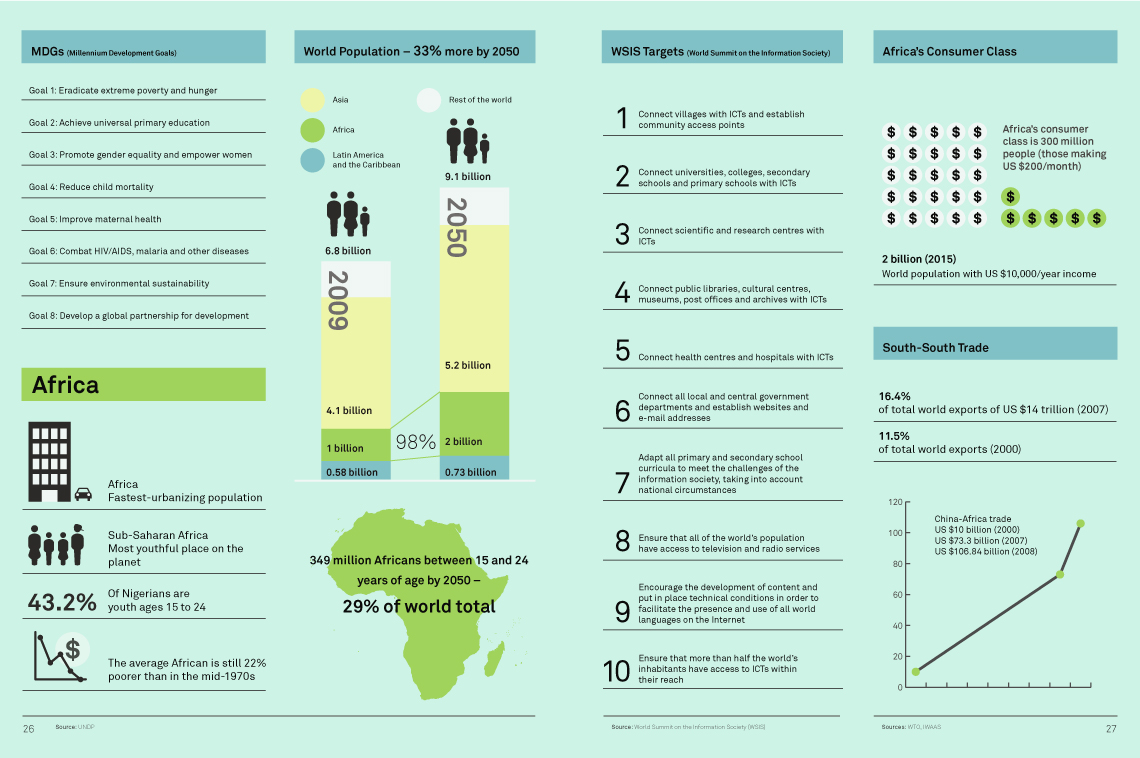
    According to a new report by the International Institute for Environment and Development, Africa now has a larger urban population than North America and 25 of the world’s fastest growing big cities. Europe’s share of the world’s 100 largest cities has fallen to under 10 percent in the past century.

    Counter to common misperceptions about what is luring people to big cities, the report’s author, David Satterthwaite, said it isn’t because governments and aid are attracting them: government “policies leave much to be desired as they tend to neglect the urban poor, leading to high levels of urban poverty, overcrowding in slums and serious health problems. Governments should see urbanisation as an important part of a stronger economy and their expanding urban population as an asset, not as a problem.”

    But global perceptions of Africa are changing. The Mo Ibrahim Foundation has listed the most efficiently run African economies, with a strong correlation between good governance and higher growth rates (Mauritius, Seychelles, Botswana, South Africa, Namibia, Ghana and Senegal).

    In most of urban French West Africa, extensive interviews with micro-entrepreneurs and micro-finance practitioners found that most operating micro-enterprises in the informal economy are entrepreneurs by necessity, and that their most basic needs drove their business activities and behaviours. Success was held back by lack of capital, poor training, and a general aversion to risk (Faculty of Management, Dalhousie University).

    While access to capital has been identified as the key factor in opportunity, entrepreneurs aren’t even waiting for microfinance institutions to help them. “I started this business of selling chips (French fries) two years ago using money we raised as a group of 30 women,” said Mary Mwihaki, 27, who lives in the Mathare slum area outside Nairobi.

    Each member of her group of women contributes about US 30 cents a day and the resulting US $9 is given to a different member of the group on a rotating basis, she told IRIN news agency. Mwihaki waited three months to raise the US $27 she needed. She joins many other women across the country taking the same approach to raising capital.

    For some entrepreneurs, it is just the proximity to a buzzing urban atmosphere that is a spur to action. One clothes seller told the African Executive he has been able to make enough money to get a house built just selling second hand clothing. Twenty-three-year-old Henry Mutunga in Nairobi, Kenya takes advantage of the high turnover of the city’s Machakos Country bus terminal to sell second hand clothes.

    “After months of searching for a job, I asked myself, ‘Why am I wasting the business studies knowledge I acquired in school?’ I was not comfortable being left in the house every morning, with nothing to do, while my uncle went to work in order to feed me and pay the house rent. I got hooked to the urban mentality and tried my hand at selling trousers.”

    Now with two employees, he is able to rent his own house, and is able to use extra money to have his own house built. He urges other youth to become employers, not employees.

    At the technological end of entrepreneurship, in Nairobi, Kenya, Mumbi’s Dial-a-Cab company is joining 20 fleet firms in the country to adopt a new mobile phone-based vehicle-tracking technology developed by two young African IT entrepreneurs, Waweru Kimani and Paul Mahiaini. The technology allows management to know how low fuel is, which car has gone where, when a car has been hijacked, what car doors are open, how long it has been stopped, and where it is located. Impressively, it also allows management to stop the car at the touch of a button if it has been stolen. It costs US $570 to install, and costs US $40/month to use.

    Other entrepreneurs are piggy backing their success on the booming housing markets in Angola, Ivory Coast, Liberia, Nigeria, Congo, Mali, Morocco, Tunisia, Botswana, Ghana, Mozambique, Rwanda, Kenya, Mauritius, Uganda, Algeria, Egypt, Senegal: all creating enormous opportunities for entrepreneurs providing other services, like furniture, appliances, insurance, landscaping, security, architecture etc.

    And the giant US internet search engine Google is now setting up operations in West Africa, based in Dakar – a sure sign that they see this as a new boom market. And Indian investment in Africa has also dramatically shot up this year, according to mergers and acquisitions magazine, The Deal. In 2005, US $81 million was invested in Africa. In 2006, US $340 million; and in 2007, US $294 million.

    Published: November 2007

    Resources

    Development Challenges, South-South Solutions was launched as an e-newsletter in 2006 by UNDP’s South-South Cooperation Unit (now the United Nations Office for South-South Cooperation) based in New York, USA. It led on profiling the rise of the global South as an economic powerhouse and was one of the first regular publications to champion the global South’s innovators, entrepreneurs, and pioneers. It tracked the key trends that are now so profoundly reshaping how development is seen and done. This includes the rapid take-up of mobile phones and information technology in the global South (as profiled in the first issue of magazine Southern Innovator), the move to becoming a majority urban world, a growing global innovator culture, and the plethora of solutions being developed in the global South to tackle its problems and improve living conditions and boost human development. The success of the e-newsletter led to the launch of the magazine Southern Innovator.  
    Creative Commons License

    This work is licensed under a
    Creative Commons Attribution-Noncommercial-No Derivative Works 3.0 License.

    ORCID iD: https://orcid.org/0000-0001-5311-1052.

    © David South Consulting 2023

  • African Megacity Makeovers Tackle Rising Populations

    African Megacity Makeovers Tackle Rising Populations

    By David SouthDevelopment Challenges, South-South Solutions

    SOUTH-SOUTH CASE STUDY

    Nigeria’s largest, busiest and most congested city, Lagos, has long had a reputation for dynamism mixed with chaos. Its sprawling slums and ballooning population have for decades stretched governments’ ability to provide services.

    The 2006 census placed the city’s population at close to 8 million, making it the most populous city in the country and the second largest in Africa after Cairo. One forecast saw the population reaching 23 million by 2015. It was called the fastest growing city in Africa by UNHABITAT (2008). The city is Nigeria’s economic and financial hub and critical to the country’s future.

    According to a report by the International Institute for Environment and Development, Africa now has a larger urban population than North America and 25 of the world’s fastest growing big cities. Getting to grips with urban development will be critical for the future of the continent and the wellbeing of its people.

    In West Africa, an OECD study found the area stretching along the Gulf of Guinea in the Atlantic Ocean had a network of 300 cities larger than 100,000 people and the biggest collection of urban poverty on the planet.

    It is a common problem across the South as fast-growing city populations surge past the ability of institutions and infrastructure to cope.

    By 2025, Asia could have 10 or more cities with populations larger than 20 million (Far Eastern Economic Review).

    It is a development challenge that urgently needs solutions.

    In Lagos, the Oluwole district – formerly a crime-plagued slum – has been transformed into a new marketplace, and the plan is to follow this with new offices, homes and shops. The brainchild of the Lagos state governor Babatunde Fashola (http://en.wikipedia.org/wiki/Babatunde_Fashola), redevelopment of the 20,000 square metre site is part of his multi-stage plan to bring more order to the chaos that is daily life in Lagos. There are also ambitious plans afoot to build new roads and bridges. The area’s traffic congestion is also being targeted for solutions. The former slum is now re-branded as the Oluwole Urban Market and Multifunctional City Centre (http://tinyurl.com/2wmrscq) and is being re-developed in partnership with the private sector.

    The re-developed slum is part of the much-larger Lagos Island Central Business District (CBD) Revitalisation/Marina City Project, a five-year project, jointly executed by the Lagos government and private sector players. This project has already begun with the redesigning and reconstruction of roads and infrastructure within the CBD and the adjoining axes.

    Another fast-growing African city is Addis Ababa. The capital of the East African nation of Ethiopia, it has been in the grip of a building boom for the past few years. But much of this building has been unplanned and, to many, is ugly. The current building boom’s architectural legacy has been criticized for leaving buildings that are too hot for the climate and require expensive air conditioning systems. They also use imported cement and steel and are not earthquake-proof.

    Addis Ababa (http://en.wikipedia.org/wiki/Addis_Ababa) was founded in 1886 by Emperor Menelik II. It is now host to the African Union (http://www.africa-union.org/) and it is this important role that has architects advocating for a new approach to the city’s development.

    Addis is home to some of the highest density urban slums in the world, according to the UN. Some estimates place the population at of the city at 4.6 million people and that it could double by 2020. But its pattern is unusual for an African city. Dirk Hebel of Addis Ababa’s architecture school  (http://www.eiabc.edu.et/managing-board/scientific-director.html) told The Economist it defies the usual pattern of rich centre and poor periphery. Instead, because crime is low and the rich seem to tolerate the poor living among them, the slums are jammed between office buildings and flats in the wealthy parts of the city.

    Architects favour smaller buildings that stay true to local stone and traditional guttering to collect the rain. Hebel believes turning local would cut building costs by a third and save on costly imports.

    The architecture school has received funding from a technical institute in Zurich, Switzerland called ETH (http://www.ethz.ch/index_EN) to help develop new ideas.

    Hebel and ETH’s head, Marc Angelil, have written a book profiling the architectural styles of the city. The city has gone through various phases: during its Marxist period (1974-1991) government buildings mimicked the Soviet Union. During the Italian fascist occupation (1935-1941) they followed the styles favoured by Italian dictator Benito Mussolini. Political problems aside, the architects believe the Italians brought good planning, allowing streets to radiate out from landmark buildings.

    The city is plagued – like so many in the South – by pollution and traffic gridlock. Growth is on projection to be so large by 2050, the country would need 20 new cities of 5 million people each to accommodate it (UN). This is an epic challenge requiring imaginative thinking and new ways.

    Published: November 2010

    https://davidsouthconsulting.org/2022/10/17/ambitious-schemes-hope-to-advance-economic-development/

    https://davidsouthconsulting.org/2020/04/22/artists-fear-indifference-from-megacity/

    https://davidsouthconsulting.org/2020/12/04/big-data-can-transform-the-global-souths-growing-cities/

    https://davidsouthconsulting.org/2022/10/19/chinese-building-solution-for-rapidly-urbanizing-global-south/

    https://davidsouthconsulting.org/2021/10/21/cities-for-all-shows-how-the-worlds-poor-are-building-ties-across-the-global-south/

    https://davidsouthconsulting.org/2020/12/11/cyber-cities-an-oasis-of-prosperity-in-the-south/

    https://davidsouthconsulting.org/2021/11/04/filipino-architect-wants-to-transform-slum-with-new-plan/

    https://davidsouthconsulting.org/2022/03/20/global-south-eco-cities-show-how-the-future-can-be/

    https://davidsouthconsulting.org/2021/11/12/global-souths-rising-megacities-challenge-idea-of-urban-living/

    https://davidsouthconsulting.org/2022/09/28/model-cities-across-the-south-challenge-old-ways/

    https://davidsouthconsulting.org/2022/10/10/more-futuristic-african-cities-in-the-works/

    https://davidsouthconsulting.org/2021/11/12/new-cities-offering-solutions-for-growing-urban-populations/

    https://davidsouthconsulting.org/2017/11/08/smart-cities-up-close-2013/

    https://davidsouthconsulting.org/2021/10/22/south-south-cooperation-for-cities-in-asia/

    https://davidsouthconsulting.org/2020/04/22/will-the-megacity-mean-mega-privatization/

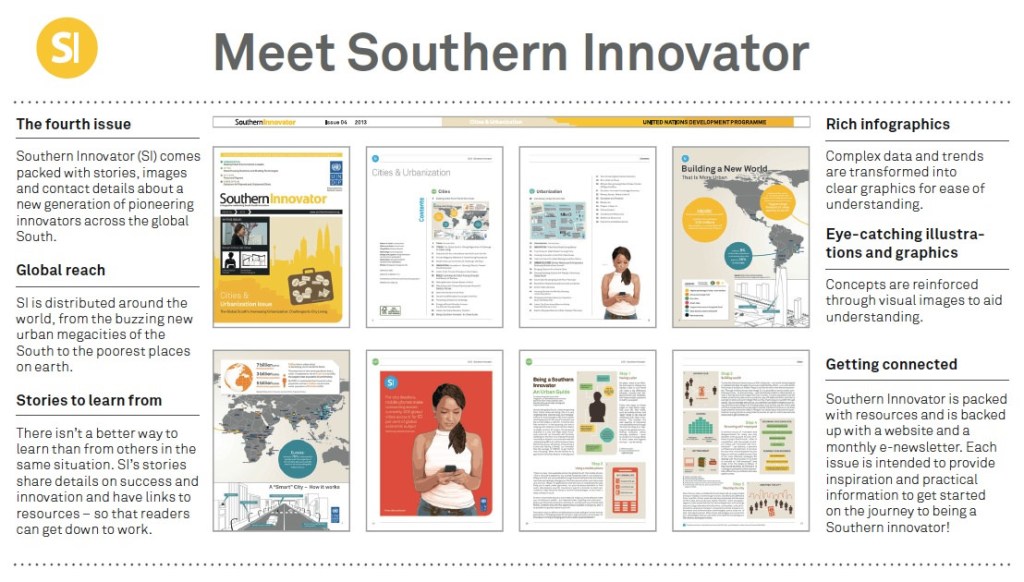
    Development Challenges, South-South Solutions was launched as an e-newsletter in 2006 by UNDP’s South-South Cooperation Unit (now the United Nations Office for South-South Cooperation) based in New York, USA. It led on profiling the rise of the global South as an economic powerhouse and was one of the first regular publications to champion the global South’s innovators, entrepreneurs, and pioneers. It tracked the key trends that are now so profoundly reshaping how development is seen and done. This includes the rapid take-up of mobile phones and information technology in the global South (as profiled in the first issue of magazine Southern Innovator), the move to becoming a majority urban world, a growing global innovator culture, and the plethora of solutions being developed in the global South to tackle its problems and improve living conditions and boost human development. The success of the e-newsletter led to the launch of the magazine Southern Innovator.  
    Follow @SouthSouth1

    Slideshare: http://www.slideshare.net/DavidSouth1/development-challengessouthsouthsolutionsnovember2010issue

    Southern Innovator Issue 1: https://books.google.co.uk/books?id=Q1O54YSE2BgC&dq=southern+innovator&source=gbs_navlinks_s

    Southern Innovator Issue 2: https://books.google.co.uk/books?id=Ty0N969dcssC&dq=southern+innovator&source=gbs_navlinks_s

    Southern Innovator Issue 3: https://books.google.co.uk/books?id=AQNt4YmhZagC&dq=southern+innovator&source=gbs_navlinks_s

    Southern Innovator Issue 4: https://books.google.co.uk/books?id=9T_n2tA7l4EC&dq=southern+innovator&source=gbs_navlinks_s

    Southern Innovator Issue 5: https://books.google.co.uk/books?id=6ILdAgAAQBAJ&dq=southern+innovator&source=gbs_navlinks_s

    https://davidsouthconsulting.org/2021/03/05/southern-innovator-issue-4/

    Creative Commons License
    This work is licensed under a
    Creative Commons Attribution-Noncommercial-No Derivative Works 3.0 License.

    ORCID iD: https://orcid.org/0000-0001-5311-1052.

    © David South Consulting 2022

  • Mongolian Enterprises Target Healthy Urban Lifestyles

    Mongolian Enterprises Target Healthy Urban Lifestyles

    By David SouthDevelopment Challenges, South-South Solutions

    SOUTH-SOUTH CASE STUDY

    In the Northeast Asian nation of Mongolia – landlocked between Russia and China – the traditional diet is based on the nomadic ways of its herders. Rich in meat and milk products, it is a diet that has evolved from the need to survive in a harsh climate doing hard physical labour – winter temperatures can drop below minus 50 degrees Celsius.

    Social changes brought about by Mongolia’s economic journey since embracing free markets and democracy in the early 1990s have led to a growing urban population. The capital, Ulaanbaatar, has seen its population balloon for a variety of reasons – from collapsing rural economies to environmental disasters to the need to find work and opportunities – and is estimated to be over a million, out of a national population of just 2.6 million (World Bank).

    Mongolia is experiencing serious food security problems due to factors including economic inflation and weather-related disasters, and is also confronting problems common to many countries in the age of globalization. According to the World Diabetes Foundation, 10 percent of the population is at risk of the disease, which it calls a lurking catastrophe.

    As the paper “Lessons from a small country about the global obesity crisis” by Kelly D. Brownell and Derek Yach notes: “Globalization changes many features of modern life, including diets. As trade changes, diets can become more secure (hunger becomes less of a problem), but the cheapening of calories, the reliance on imported food, and the influence of food marketing drive up consumption and drive down nutrient density. Obesity, diabetes, and other chronic diseases are not far behind.”

    In response to these problems, increasing awareness of healthy lifestyles has led to some new business ventures in Ulaanbaatar. This past summer, saw the opening of an organic vegetarian restaurant and shop: the Organic Café Shop, reports Green Traveler Guides.

    Started by business partner-sisters  Bayarmaa Jarantai and Enkhmaa Jarantai with nephew Lkhagvasuren, the modest four-table restaurant and shop is a mini-revolution for a country as meat-loving as Mongolia. It serves up organic vegetarian meals and sells certified organic products. The spark of inspiration came when Bayarmaa read three books on the macrobiotic diet translated into Mongolian. The macrobiotic diet (http://en.wikipedia.org/wiki/Macrobiotic_diet) avoids highly processed foods and uses grains, beans and vegetables as its staples.

    The cafe’s menu includes: vegetable salads (shredded cabbage, bell peppers, carrots and seasoning), stir-fried vegetables with tofu and asparagus soup, 10-grain soup, eggplant, and Mongolian vegetarian fried vegetables. Prices range between 2,500 Mongolian tugrug and 4,500 tugrug (US $1.75 and US $3.00).

    The vegetables are sourced locally from Mongolian farmers and gardeners and are chemical-free. While not officially certified as organic, they are effectively that.

    The shop sells certified organic products from China. The products include rice, grains, sugars and jams. (Made-in-Mongolia organic produce is a business opportunity waiting to happen: so far there are no certified organic packaged-product producers in the country).

    The sisters import the products from Lohao City (http://www.lohaocity.com/eshow.asp) organic food market in Beijing, China.

    But despite the Organic Café Shop’s good intentions, it is not immune to the country’s food security issues: Bayarmaa admits to being puzzled about how she will be able to continue to source the fresh vegetables she needs during the harsh winter months. Ulaanbaatar is the coldest national capital in the world and fresh produce has to be imported at considerable expense.

    Another enterprise promoting healthy living in Ulaanbaatar is the Ananda Café and Meditation Centre (http://www.anandacenter.org/), a vegetarian restaurant and yoga (http://en.wikipedia.org/wiki/Yoga) centre. Yoga is the traditional physical and mental discipline from ancient India used to keep physically fit. It is a form of exercise that appeals to a wide age range and can be done pretty well anywhere.

    The Ananda Centre offers courses in yoga and meditation, vegetarian cooking classes and nature retreats.

    Published: November 2010

    Resources

    Creative Commons License

    This work is licensed under a
    Creative Commons Attribution-Noncommercial-No Derivative Works 3.0 License.

    ORCID iD: https://orcid.org/0000-0001-5311-1052.

    © David South Consulting 2023
  • New Cities Offering Solutions for Growing Urban Populations

    New Cities Offering Solutions for Growing Urban Populations

    By David SouthDevelopment Challenges, South-South Solutions

    SOUTH-SOUTH CASE STUDY

    Across the global South, new cities are being dreamed up by architects, city planners and governments, or are already under construction. Two new urban areas being built offer lessons for others in the global South. They both deploy intelligent solutions to the combined demands of urbanization, growing populations and rising expectations.

    An eco city in China and a smart city in the Republic of Korea are tackling today’s – and tomorrow’s – challenges.

    A joint initiative between China and Singapore, the Sino-Singapore Tianjin Eco-City project (tianjinecocity.gov.sg) – located on reclaimed land some 45 kilometres from the booming Chinese city of Tianjin and 150 kilometres from Beijing – is an attempt to create a replicable model for other cities in China and the global South. Already well underway, with the first phase of construction nearly complete, the Eco-City’s hallmarks include encouraging walking, reducing reliance on private vehicles and aiming to generate 20 per cent of the city’s energy from renewable sources. It is run from the Chinese end by Tianjin TEDA Investment Holding Co., Ltd and in Singapore by the Keppel Group.

    It is located 10 kilometres from the Tianjin Economic Technological Development Area (TEDA), a fast-growing high-tech business hub in its own right.

    Called an “integrated work, live, play and learn environment,” it is a mix of public and private housing based on the highly successful model developed in Singapore.

    The concept of an “eco city” was first raised by Richard Register in his 1987 book Ecocity Berkeley: Building Cities for a Healthy Future. It was to be a place that minimizes inputs of energy, water, and food and outputs of waste heat, air pollution, carbon dioxide, methane and water pollution. Like smart cities, eco cities are taking shape in various forms around the world. Some are applying the concept and principles of an eco city to an existing place, while others are being built from scratch.

    The Tianjin Eco-City is a mix of elements designed to make it sustainable in the long-term. It includes an “EcoValley” running through the development as its centrepiece green space to encourage walking and cycling between the major centres of the city. It has the usual urban services – from schools to shops and restaurants – but also, critically, a growing range of business parks to support employment.

    Unlike green initiatives in wealthy, developed countries, it is hoped the Tianjin Eco-City will prove a more relevant model for the global South. It has factored in the need to make an eco city pay its way and generate new business and innovations. It is trying to address the pressing urgency of China’s growing population and rapid urbanization, while balancing people’s expectations of rising living standards. As in other countries in the global South, people aspire to a higher standard of living and this needs to be taken into consideration when planning eco cities.

    Ho Tong Yen, Chief Executive Officer of Sino-Singapore Tianjin Eco-City, says its aim is “sustainable development packaged in a way that is uniquely Asian.”

    He says the project is intended to be “practical, replicable and scalable.”

    “Practical at its core is building something that the market can support, something that is affordable given the economic development of the region,” he said. “The idea is that this model must be one that is replicable and scalable in other parts of China. Now, strictly speaking, there is no reason it needs to be just for China – it really might be replicable in other developing countries as well. Our starting point, however, is to find a model that might work for China.

    “I think it is still a work in progress – a bold experiment – and it is a long-term experiment. The idea is to create an eco city that can support a population of 350,000 over a 10 to 15 year horizon.

    “In some ways it is a city that does not look all that much different from other Chinese cities. But if you look at the subtleties – the building orientation, the renewable energy, the transit oriented developments, the walkability concepts – these are all the elements we built into this project.

    “An eco city is not necessarily a science-fiction-like concept; it is something that is very real, very do-able. It looks a lot like a normal city – it is not a special city in a glass dome.”

    The explosion in information technologies in the past decade has re-shaped the way cities can be planned, run and developed. The connectivity brought about by now-ubiquitous electronic devices such as mobile phones and the ever-expanding information networks connected by fibre optic cables is giving rise to so-called “smart cities.” These urban areas draw on information technologies to use resources more efficiently and reduce waste, while – it is hoped – better serving the needs of residents. Real-time information can be gleaned to monitor energy use, or traffic congestion, or crime, while constant online connectivity enables the efficient delivery of a multitude of services to residents.

    Smart cities vary in their scope and ambition. Some are existing urban areas given a modern upgrade, while others, such as the Songdo International Business District (IBD) (songdoibd.com) smart city in the Republic of Korea, are planned and built from scratch.

    Built on 1,500 acres (607 hectares) of reclaimed land from the Yellow Sea in Incheon, Songdo International Business District is being built by Gale International and POSCO E&C of Korea. It is considered one of the largest public/private real estate ventures in the world. Due to be completed in 2017, it will be home to 65,000 people (22,000 currently live there), while 300,000 people will commute in daily to work. Fifteen years in the making and costing over US $35 billion, it is called a “synergistic city” because it contains all the elements necessary for people to live a high-quality life.

    Currently 50 percent complete, Songdo IBD is considered one of Asia’s largest green developments and a world leader in meeting LEED (Leadership in Energy and Environmental Design) (https://new.usgbc.org/leed) standards for green buildings. For example, it has the first LEED-certified hotel in Korea, the Sheraton Incheon. These high green standards have led to the United Nations Green Climate Fund Secretariat establishing its headquarters in Songdo, with a slated opening in 2013.

    Songdo is “smart” because information technology connects all its systems – residences, buildings, offices, schools, hospitals, hospitality and retail outlets. This includes more than 10,000 Cisco TelePresence units (http://www.cisco.com/en/US/products/ps7060/index.html)– menu-driven video screens – being installed in the residences to connect them to all the services available in Songdo.

    It also benefits from proximity to Incheon International Airport – consistently voted one of the best in the world – giving residents quick access to other Asian cities such as Shanghai, Tokyo and Hong Kong. This connection between urban development and a highly connected airport is being called an “aerotropolis.”

    Songdo smart city is just one part of a massive regional development plan, using reclaimed land from the sea and marshlands. The residential and business developments are all being linked to IncheonInternationalAirport, which is being positioned as a transport hub and gateway to Northeast Asia – it boasts of being a three-and-a-half hour flight to one-third of the world’s population. The idea is to create a thriving international business hub that is a short flight away from Asia’s booming and fast-growing economic centres.

    “The beauty is you are doing everything from scratch – you are using newer building technology, newer systems,” said Scott Summers, Vice President of Foreign Investment for developers Gale International Korea LLC.

    “You are not going into a city and ripping up old things and then put in new systems. You have a greater opportunity to install this technology, the backbone (information technology from Cisco), to allow these services and connectivity to work properly because you are laying wires in buildings from the get-go rather than going in afterwards.”

    Summers believes it is the high-tech component of Songdo that will set it apart from other cities in the future. Songdo is being built with a combination of innovative sustainable development technologies and the latest in information technologies provided by Cisco.

    “That is one of the reasons we are pushing this technology, because it is how a city operates that is important,” Summers said.

    “The operation of a city, to do it well, is going to improve the success of it. (To) embed into the development of the city some of the technologies of sustainable development – to put in the pneumatic waste system, grey water system, the co-generation – all of those things are much easier to do on raw land.”

    Sojeong Sylvia Sohn, owner of Songdo’s Kyu, a Korean fusion cuisine restaurant, was attracted to Songdo and is banking on its future growth.

    Sohn said Seoul’s “existing commercial area was just saturated.”

    “Songdo International City in Incheon is the future for the region and early business tenants are coming here for investment purposes. It has uncluttered streets and modern buildings, being an international city – this makes it attractive.”

    Published: December 2012

    Resources

    1) Eco Cities World Summit: The International Ecocity Conference Series brings together the key innovators, decision makers, technologists, businesses and organizations shaping the conversation around ecological and sustainable city, town and village design, planning and development. Website: http://www.ecocityworldsummit.org/

    2) Richard Florida: The Creative Class Group is a boutique advisory services firm composed of leading next-generation researchers, academics, and strategists. Website:http://www.creativeclass.com/richard_florida

    3) Global Urbanist: The Global Urbanist is an online magazine reviewing urban affairs and urban development issues in cities throughout the developed and developing world. Website: http://globalurbanist.com/

    4) UN-Habitat: The United Nations Human Settlements Programme, UN-HABITAT, is the United Nations agency for human settlements. It is mandated by the UN General Assembly to promote socially and environmentally sustainable towns and cities with the goal of providing adequate shelter for all. Website: http://www.unhabitat.org

    5) Eco-Cities: A Planning Guide by Zhifeng Yang. Website: http://tinyurl.com/d26rxdx

    https://davidsouthconsulting.org/2022/10/06/africas-fast-growing-cities-a-new-frontier-of-opportunities/

    https://davidsouthconsulting.org/2020/12/04/big-data-can-transform-the-global-souths-growing-cities/

    https://davidsouthconsulting.org/2022/11/17/book-boom-rides-growing-economies-and-cities/

    https://davidsouthconsulting.org/2022/10/19/chinese-building-solution-for-rapidly-urbanizing-global-south/

    https://davidsouthconsulting.org/2021/10/21/cities-for-all-shows-how-the-worlds-poor-are-building-ties-across-the-global-south/

    https://davidsouthconsulting.org/2020/12/11/cyber-cities-an-oasis-of-prosperity-in-the-south/

    https://davidsouthconsulting.org/2017/11/08/eco-cities-up-close-2013/

    https://davidsouthconsulting.org/2022/03/20/global-south-eco-cities-show-how-the-future-can-be/

    https://davidsouthconsulting.org/2021/11/12/global-souths-rising-megacities-challenge-idea-of-urban-living/

    https://davidsouthconsulting.org/2022/11/16/housing-innovation-in-souths-urban-areas/

    https://davidsouthconsulting.org/2020/12/14/innovation-in-growing-cities-to-prevent-social-exclusion/

    https://davidsouthconsulting.org/2022/09/28/model-cities-across-the-south-challenge-old-ways/

    https://davidsouthconsulting.org/2022/03/29/model-city-to-test-the-new-urbanism-concept-in-india/

    https://davidsouthconsulting.org/2022/10/10/more-futuristic-african-cities-in-the-works/

    https://davidsouthconsulting.org/2017/11/08/smart-cities-up-close-2013/

    https://davidsouthconsulting.org/2021/10/22/south-south-cooperation-for-cities-in-asia/

    https://davidsouthconsulting.org/2021/03/05/southern-innovator-issue-4/

    Creative Commons License

    This work is licensed under a
    Creative Commons Attribution-Noncommercial-No Derivative Works 3.0 License.

    ORCID iD: https://orcid.org/0000-0001-5311-1052.

    © David South Consulting 2023