Categories
Archive Development Challenges, South-South Solutions Newsletters

African Hotel Boom Bringing in New Investment and Creating Jobs

By David SouthDevelopment Challenges, South-South Solutions

SOUTH-SOUTH CASE STUDY

Africa is experiencing a boom not seen for decades. The IMF forecasts economic growth in sub-Saharan Africa of 6 per cent in 2014, compared to global growth of 3.6 per cent.

And this boom is getting an additional jolt of support from the world’s multinational hotel chains. January 2014 saw Africa’s largest hotel chain bought by global giant Marriott (marriott.com). For decades major global multinationals shied away from Africa, but today they are battling to get a place in Africa’s fast-growing economies and to serve the growing middle classes.

Marriott is leading the way by investing US $1.5 billion in 25 new hotels equalling 5,000 rooms. To boost capacity further, Marriott is taking over South Africa’s Protea group (proteahotels.com) and its 116 African hotels.

“We have 25 Marriott brand hotels under construction in seven countries in Africa that will come on stream over the next four years,” Alex Kyriakidis, the chain’s president for the Middle East and Africa, told Bloomberg (bloomberg.com).

The new hotels “are going to bring us into Benin, Gabon, Ghana, Ethiopia and Mauritius. With our existing hotels plus those in the pipeline and those Protea operates today, we will be in 16 countries in Africa by 2017.”

Bloomberg calls what Africa is experiencing the “fastest pace of hotel development in the world”.
“Our mission here is to grow, grow, grow,” according to Kyriakidis.

Meanwhile, a further boost is coming from the US $5 billion Angolan sovereign wealth fund, Fundo Soberano de Angola (fundosoberano.ao/language/en/). It will be investing in hotels and commercial infrastructure in sub-Saharan Africa, according to Bloomberg. This could include 50 sub-Saharan African hotels in the next three years.

“We believe there’s a lot of investment interest in Africa,” said Chairman Jose Filomeno dos Santos. “It has a lot of mineral potential, almost a commodity hub. We believe this interest will remain there for the coming years.”

Little thought is given to the role hotels play in development, yet they are a critical development tool for any country wishing to move up the economic ladder. As the quality of hotels improves, they tend to become key gathering and meeting places. Conferences and seminars can act as catalysts for change, attracting people from around the world. When quality hotels are in place, then the top-drawer global conferences will come to town, in turn bringing new tourist income for local businesses.

Anyone who has stayed in a hotel in Africa knows that standards are variable: the pool with dirty water, the power cuts, the food hygiene standards that might not match what people are used to at home. This is what international hotel chains can change. Not only do they demand the highest standards in their own establishments, they also push up standards at local competitors, as all of them battle for the attention of visitors.

Africa has been overlooked by the large global hotel chains and brands since the end of the colonial period in the 1960s and 70s. Africa was considered too poor, too chaotic, too dangerous and too much hard work for it to be worth the effort.

But now the tune has changed. With Africa’s population over a billion, and many of the continent’s economies experiencing rapid growth while also urbanizing, conditions are fortuitous for the hotel trade.

The situation has changed in the last decade, for a variety of reasons: debt relief, a rise in commodity prices, expanding trade and investment with China and the global South, and a growing middle class — all slowing the growth of poverty. Africa is still notorious for under-investment in infrastructure and has a long way to go to catch up to the fast-moving economies of Asia. But greater optimism is leading to greater real investment. And the world’s large hotel brands are the latest to join in the rush to Africa.

Large chains including Four Seasons, Ritz-Carlton, Hyatt and Kempinski hope to open 300 new hotels in Africa over the next five years. The number of hotel beds is set to increase by 30 per cent by 2018.

Four Seasons Safari Lodge Serengeti in Tanzania (http://www.fourseasons.com/serengeti/) is the first investment in Africa by the Canadian brand. Four Seasons is known for its luxury, upmarket city hotels and has kept with this tradition by building the largest and most luxurious safari lodge ever built in Africa.

This is having a knock-on effect on African hotel operators. The surge in investment is giving these local operators the right incentives to create African brands and to raise their game.

Nairobi in Kenya has become something of a test market for high-end boutique hotels. Already a city benefiting from its status as an international development hub, home to many agencies including the UN Environment Programme’s sprawling and verdant headquarters (unep.org), it has also become a corporate headquarters for Africa and has a large U.S. presence (nairobi.usembassy.gov). This means lots of people coming to the city to do business and attend events, creating a market for better quality accommodation.

The Kenyan-owned, 156-room Sankara Nairobi Hotel (sankara.com) boasts of having the best wine list in Africa and claims to be a five-star hotel. It also capitalizes on being close to the international airport and the UN’s Nairobi headquarters.

“There’s an appetite for something local that’s different and, for the first time, there’s the confidence and funding to bankroll new developments,” said Sankara Hotel Group director Rohan Patel to Wallpaper Magazine. “Africans don’t want a theme-park African hotel, with prints of ‘the big five’ on the wall. That’s condescending. Nor do they want a New York-style hotel. They’ve probably been to New York. They want modern, connected Africa.”

Elsewhere in Nairobi, the Kenyan-owned Tribe Hotel (tribe-hotel.com) is looking to expand to meet growing market demand.

“The market for new, authentic, yet modern African hotels is growing,” manager Michael Flint, who previously ran New York’s Ritz-Carlton, told Wallpaper.

“We’ve been so successful here we are building a new 187-room hotel in Nairobi. We’ve taken over a boutique hotel called Westhouse (westhouse.co.ke). And we’re looking to expand further, with properties at the airport and on the coast. Who knows what will be next? Tribe will be a mini empire.”

In Rwanda’s capital Kigali, the Rwanda Marriott has ambitious plans. Rwanda was ripped apart by ethnic genocide in the 1990s that killed an estimated 500,000 to 1 million people (http://en.wikipedia.org/wiki/Rwandan_Genocide). Now, the country’s economy is booming and its hotels are getting an upgrade.

The Akilah Institute for Women (akilahinstitute.org) in Kigali has been helping in training women for the hotel sector. They sent trainees to Dubai and Doha to learn how to do hotel service the Marriott way.

Starwood (starwoodhotels.com), a competitor to Marriott, is hoping to grow its African hotel investment by 30 per cent as well. It will be done through the Sheraton, Aloft, Le Meridien, St Regis and Four Points brands. The first St Regis has already opened in Mauritius.

Neil George, Starwood’s head of African development, believes “Africa is the final frontier. It’s adventurous.

“I would rather arrive in Kinshasa and work out how to do a hotel there than do it in Frankfurt,” he told Wallpaper.

The Hyatt (hyatt.com) brand is now running the Hyatt Kilimanjaro Hotel in Dar es Salaam (http://daressalaam.kilimanjaro.hyatt.com/en/hotel/home.html), Tanzania. Peter Norman, Hyatt’s African head, is working on opening a Park Hyatt in Zanzibar (http://zanzibar.park.hyatt.com/en/hotel/home.html) and another Hyatt Regency (http://investors.hyatt.com/phoenix.zhtml?c=228969&p=irol-newsArticle&ID=1863203&highlight=) will open in Arusha and a further 140-room Hyatt in Senegal (http://investors.hyatt.com/phoenix.zhtml?c=228969&p=irol-newsArticle&ID=1863204&highlight=).

The 200-room Villa Rosa Kempinski in Nairobi (http://www.kempinski.com/en/nairobi/hotel-villa-rosa/welcome/), boasting an outdoor heated pool, and the Olare Mara Kempinski (http://www.kempinski.com/en/masai-mara/olare-mara/welcome/) luxury camp in the Maasai Mara will also be joined by projects in Ghana and Equatorial Guinea.

Kempinski also has properties in Chad and the Congo, has bought the Hotel des Mille Collines (https://www.millecollines.net/) in Kigali and aims to operate 20 hotels across sub-Saharan Africa.

British entrepreneur Richard Branson has the Mahali Mzuri in the Maasai Mara and it is seen as a stylish role model for other hotels. The local landowners and herdsmen have been included in the business, benefiting from the hotel and helping to preserve the local ecosystem.

EasyHotel (http://www.easyhotel.com/news/2011/africa0.html), a low budget hotelier, is also rapidly expanding across southern Africa.

Published: May 2014

Resources

1) Catererglobal.com: Catererglobal.com offers a unique service that provides an easy-to-use, specific recruitment website for vacancies in the world’s best hotels and cruise ships. Website: http://www.catererglobal.com/jobs/africa/hotel/

2) South African hotel jobs: HotelJobs South Africa is an industry specific job website for the hotel, hospitality and catering industry. Website: http://www.hoteljobs.co.za/

3) Hotel Staff Africa: Many hotel jobs across Africa. Website: http://www.hotelstaff.co.za/

4) Hotel Career: Many hotel jobs for the Middle East and Africa. Website: http://www.hotelcareer.com/jobs/middle-east-africa

Development Challenges, South-South Solutions was launched as an e-newsletter in 2006 by UNDP’s South-South Cooperation Unit (now the United Nations Office for South-South Cooperation) based in New York, USA. It led on profiling the rise of the global South as an economic powerhouse and was one of the first regular publications to champion the global South’s innovators, entrepreneurs, and pioneers. It tracked the key trends that are now so profoundly reshaping how development is seen and done. This includes the rapid take-up of mobile phones and information technology in the global South (as profiled in the first issue of magazine Southern Innovator), the move to becoming a majority urban world, a growing global innovator culture, and the plethora of solutions being developed in the global South to tackle its problems and improve living conditions and boost human development. The success of the e-newsletter led to the launch of the magazine Southern Innovator. 

Creative Commons License

This work is licensed under a
Creative Commons Attribution-Noncommercial-No Derivative Works 3.0 License.

ORCID iD: https://orcid.org/0000-0001-5311-1052.

© David South Consulting 2023

Categories
Archive Development Challenges, South-South Solutions Newsletters

Ghana: Oil-rich City Sparks Entrepreneurs and Debate

By David SouthDevelopment Challenges, South-South Solutions

SOUTH-SOUTH CASE STUDY

Commodity booms can seem like the answer to a poor nation’s prayers, a way to fulfil all their development dreams and goals. The reality, however, is far more complex. More often than not, the discovery of resources sparks a mad scramble for profits and patronage, as politicians and politically connected elites carve out their slice of the new resource boom before anyone else.

The twin cities of Sekondi-Takoradi (http://en.wikipedia.org/wiki/Sekondi-Takoradi) in the Western Region of Ghana are now experiencing an oil boom. Ghana’s oil production went online in December 2010 and the government is hoping it will double the country’s growth rate.

Large supplies of oil were found off the coast in 2007, transforming Takoradi from a sleepy, rundown port city into the hub for the oil boom.

Local man Peter Abitty told the BBC he was renting out an eight-bedroom house for US $5,000 a month. The house overlooks the sea and comes with banana and coconut trees.

“Tenants that come here can take the coconuts for free! We don’t charge anything,” Abitty said.

He put the strong interest in the house down to a simple fact: “It’s out there: oil, oil, oil.”

People’s hopes are being raised in Ghana’s case because it has built a reputation as a better-governed country than other African petro states like Nigeria and Angola.

But others argue that price increases caused by the boom are destroying local businesses. A report on the Ghana Oil news website found popular local businesses suffering. One example it gave was the Unicorn Internet Café, an employer of local youth, which shut down in 2010 because of high rents.

It found businesses have shut down in the following sectors: timber, sawmilling, super markets, mobile phone shops, boutiques and trading shops. But it also found many new businesses opening up, including banks, insurance companies and hotels.

The challenge facing Ghana is to ensure oil brings a long-term change to a higher value business environment and economy, rather than just an unequal and temporary boom.

Another challenge is to connect the many youth leaving education in the city with the jobs and opportunities being created by the oil industry. The twin cities are a regional educational centre with a lot of technical colleges and secondary schools.

To counter these concerns, a Regional Coordinating Council is promising to place the growth of small and medium enterprises at the centre of regional development.

The dreams and promises for Takoradi are very ambitious. “In five years time, I see Takoradi becoming one of the modern cities of the world,”  Alfred Fafali Adagbedu, the owner of Seaweld Engineering (www.seaweldghana.com), a new local company set up to service the oil sector, told the BBC.

“I can imagine skyscrapers, six-lane highways and malls.”

“The transport industry is going to improve, because workers on the rig are going to need to be transported. Agriculture is going to see a boom because all those people on the rig will need to be fed.

“Even market women are going to see more business, because a lot of workers are going to have very fat paychecks. Everyone in this city is going to gain in business.”

How far Takoradi has to travel to come close to meeting these dreams and expectations can be seen in its current state. The railway station has a train with laundry hanging from it because it hasn’t moved in years, reported the BBC. People are living in the sleeping car of the train.

But the typical signs of a boom are all visible: traffic jams, booked hotels, rising rents and prices, and it is already hurting people on fixed salaries.

Local authorities have plans to demolish rundown parts of the city and rebuild with modern office environments for the new businesses resulting from the oil economy.

An estimated US $1 billion a year in revenue will go to the Ghanaian government and local authorities want 10 percent of this to be ring-fenced for regional development.

“Many resources are coming from the western region. From years back, gold is here, timber is here, diamonds are here,” said Nana Kofi Abuna V, one of the few female chiefs in the area.

“But when they share the cake up there, they leave out the western region. This time, if there is oil and gas in the region we should benefit more than everybody else.”

But Adagbedu at Seaweld Ghana believes Ghana will see real improvements.

“I’m very sure we will avoid the mistakes,” he said. “Ghana is a democracy, everyone is watching, so there is going to be a lot of improvement here.”

And to help in keeping these promises, the BBC will continue to return to Sekondi-Takoradi to track its changes and see how things improve.

Published: September 2011

Resources

1) BarCamp Takoradi: BarCamp is an international network of user-generated conferences (or unconferences). They are open, participatory workshop-events, the content of which is provided by participants. Website:http://twitter.com/#!/barcamptakoradi

2) Ghana Ports and Harbours Authority: The Authority overlooks the Takoradi port. Website:http://www.ghanaports.gov.gh/GPHA/takoradi/index.html

3) Friends of the Nation (FON): The NGO serves as a catalyst towards increased action for sustainable natural resource management and health environment in the Takoradi region. Website: http://www.fonghana.20m.com/aboutus1.htm

4) Takoradi City: A website packed with information and photos on the city. Website:http://www.takoradicity.com/pages/sections.php?siteid=takoradicity&mid=39

Development Challenges, South-South Solutions was launched as an e-newsletter in 2006 by UNDP’s South-South Cooperation Unit (now the United Nations Office for South-South Cooperation) based in New York, USA. It led on profiling the rise of the global South as an economic powerhouse and was one of the first regular publications to champion the global South’s innovators, entrepreneurs, and pioneers. It tracked the key trends that are now so profoundly reshaping how development is seen and done. This includes the rapid take-up of mobile phones and information technology in the global South (as profiled in the first issue of magazine Southern Innovator), the move to becoming a majority urban world, a growing global innovator culture, and the plethora of solutions being developed in the global South to tackle its problems and improve living conditions and boost human development. The success of the e-newsletter led to the launch of the magazine Southern Innovator. 

Creative Commons License

This work is licensed under a
Creative Commons Attribution-Noncommercial-No Derivative Works 3.0 License.

ORCID iD: https://orcid.org/0000-0001-5311-1052.

© David South Consulting 2023

Categories
Archive Development Challenges, South-South Solutions Newsletters Southern Innovator magazine

Free Magazine Boosts Income for Rickshaw Drivers

By David SouthDevelopment Challenges, South-South Solutions

SOUTH-SOUTH CASE STUDY

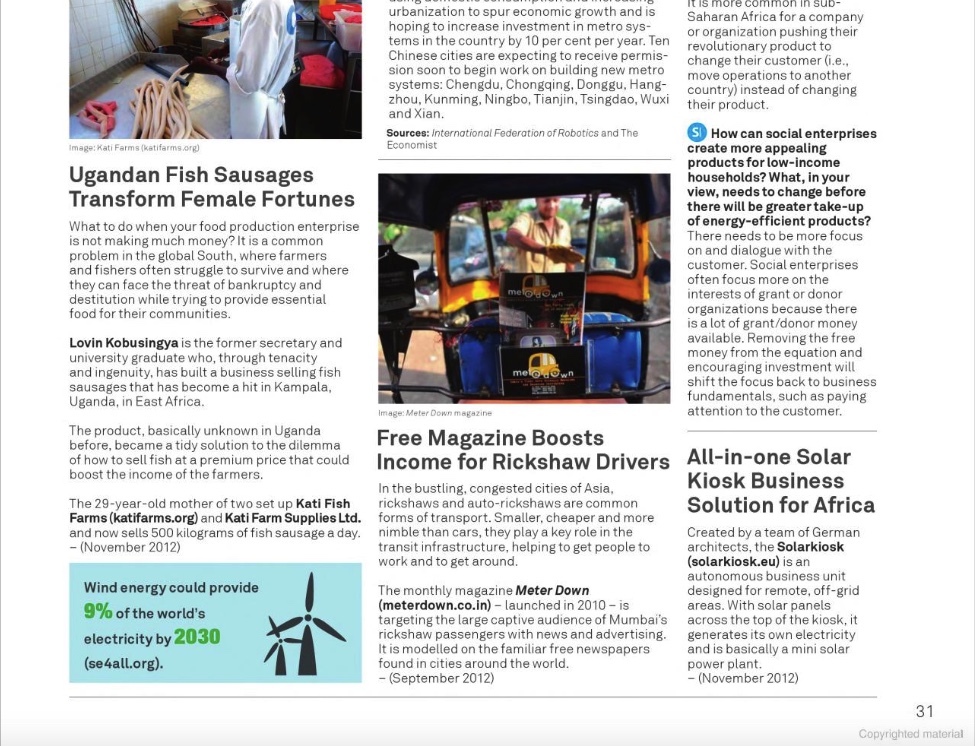
In the bustling, congested cities of Asia, rickshaws and auto-rickshaws are common forms of transport. Smaller, cheaper and more nimble than cars, they play a key role in the transit infrastructure, helping to get people to work and to get around.

According to a report by the World Resources Institute (wri.org) and EMBARQ – a global network of experts on sustainable transport solutions – India’s auto rickshaws are “an increasingly important part of urban transport in cities.”

The report estimates the number of auto rickshaws at between 15,000 and 30,000 in medium-sized cities and over 50,000 in large cities. The report found they make up between 10 and 20 per cent of daily motorized road transport trips for people in Bangalore, Mumbai, Pune and Rajkot.

And it’s not just the economic role played in transporting people: auto rickshaws are made in India and their production there doubled between 2003 and 2010, making them a source of manufacturing jobs too.

As India’s cities continue to grow – estimates forecast urban populations surging from 340 million in 2008 to 590 million by 2030 – auto rickshaws could have a bright future as they remain an affordable and safe transport solution.

The monthly magazine Meter Down (http://meterdown.co.in/) – launched in 2010 – is targeting the large captive audience of Mumbai’s rickshaw passengers with news and advertising. It is modelled on the familiar free newspapers found in cities around the world. Usually, these newspapers are distributed at subway and metro stations or in metal boxes at bus stops. Meter Down takes a different twist on this concept, distributing the publication directly to rickshaw passengers.

Mumbai is a crowded and very busy Indian city with an estimated 14 million people. Many residents spend a lot of time commuting – and a lot of time stuck in traffic jams. They need something to occupy them and to keep them informed about the news. This also presents a significant opportunity for businesses to communicate messages and advertising products and services.

Founded by three university graduates, Meter Down is trying to reach young professionals with a bit of money who can afford to ride to work in auto rickshaws.

It is distributed through 7,000 auto rickshaws in Mumbai, according to The Guardian newspaper, and is also being distributed in Pune and Ahmedabad.

The clever bit is the incentive for the drivers to carry the magazine: they receive 35 to 40 per cent of the profit from advertising sales.

This is added to the 400 to 500 rupees they make in a normal shift, according to the Mumbai Autorickshawmen’s Union.

But isn’t it a challenge to read a printed publication while bouncing along the road? The publishers came up with a solution: no story is to be longer than 300 words and the magazine has many large-size photographs to make it visually appealing and easy on the eye. Then there is the issue of passengers leaving with a copy of the magazine, denying the next passenger their read. The solution they came up for this is to tie the magazine to the rickshaw.

One of the biggest problems for any new start-up publication is how to scale up and reach more readers. Meter Down cleverly has the mechanism to scale built into its business model: “The market for this is as big as the total number of auto-rickshaws in each city,” Dedhia told The Guardian. “We have successfully scaled the model and tweak it as per different specific needs. Since auto-rickshaws are present in every part of the country, we can expand the network everywhere.”

Meter Down’s founders estimate that each rickshaw makes 90 to 95 trips every day. They have calculated this leads to a potential readership of 600,000 people. To increase revenue sources, the magazine also sells advertising space on the back and inside of the rickshaws.

For people in wealthier countries, rickshaws may seem like a rough way to get to work, but they are actually, for Indians, the more expensive option. A three-mile ride in Mumbai costs 68 rupees (US $1.27), according to The Guardian, which is 10 times the cost of a second-class train ticket.

For Meter Down, this means targeting the magazine and the ads at a market of readers with money and a willingness to buy products and services. It looks like things could be on the up for Meter Down!

Published: September 2012

Resources

1) Sustainable Urban Transport in India: Role of the Auto-Rickshaw Sector.
Website: http://www.embarq.org/en/sustainable-urban-transport-india-role-auto-rickshaw-sector 

2) A fleet of auto rickshaws for sale from Bajaj. Website: http://www.bajajauto.com/commercial_vehicle.asp

Development Challenges, South-South Solutions was launched as an e-newsletter in 2006 by UNDP’s South-South Cooperation Unit (now the United Nations Office for South-South Cooperation) based in New York, USA. It led on profiling the rise of the global South as an economic powerhouse and was one of the first regular publications to champion the global South’s innovators, entrepreneurs, and pioneers. It tracked the key trends that are now so profoundly reshaping how development is seen and done. This includes the rapid take-up of mobile phones and information technology in the global South (as profiled in the first issue of magazine Southern Innovator), the move to becoming a majority urban world, a growing global innovator culture, and the plethora of solutions being developed in the global South to tackle its problems and improve living conditions and boost human development. The success of the e-newsletter led to the launch of the magazine Southern Innovator. 

Creative Commons License

This work is licensed under a
Creative Commons Attribution-Noncommercial-No Derivative Works 3.0 License.

ORCID iD: https://orcid.org/0000-0001-5311-1052.

© David South Consulting 2023
Categories
Archive Development Challenges, South-South Solutions Newsletters Southern Innovator magazine

More Futuristic African Cities in the Works

By David SouthDevelopment Challenges, South-South Solutions

SOUTH-SOUTH CASE STUDY

It has been well documented that China is undergoing the largest migration in human history from rural areas to cities. But this urbanization trend is occurring across the global South, including in Africa, as well. According to the UN, more than half the world’s population already lives in cities, and 70 per cent will live in urban areas by 2050. Most of the world’s population growth is concentrated in urban areas in the global South.

These emerging urban areas represent vast opportunities for innovators. Innovators will be needed to build them, and in turn they will provide modern facilities for innovators to operate in and engage with the global economy. And they will connect innovators to 21st-century information technology.

But while the government in China engages in significant planning and preparation to facilitate movements to urban areas – often building entire cities from scratch (http://www.time.com/time/photogallery/0,29307,1975397,00.html) – that has not been the case in Africa. People in Africa are on the move because they are seeking out opportunities, but much of this movement has been poorly planned and not well thought out.

But now more and more African governments are grappling with how to call time on chaotic and haphazard development and build sustainable, planned cities that will significantly improve human development and quality of life.

Across Africa, a host of ambitious new cities and urban developments are in the works.

Kenya’s Konza Technology City (konzacity.co.ke) is planned as a new centre 60 kilometres from the capital, Nairobi. Calling itself a “world-class technology hub and a major economic driver for the nation”, it offers a high-tech vision full of ultra-modern buildings and houses in order to spur the future growth of Kenya’s technology industry.

It is hoped Konza will create 100,000 jobs by 2030. There will be a central business district, a university campus for 1,500 students, a residential community, and parks and wildlife in green corridors.

The groundbreaking ceremony occurred on January 2013 but the Kenyan Ministry of Lands and Housing has halted operations to allow for greater community engagement, according to Urban Africa. A dispute had erupted with the current landowners who wanted to be better consulted about the development and had accused the government of locking them out of the physical planning process.

Tatu City, Kenya (tatucity.com) bills itself as “by Kenyans, for Kenyans”. It is being built by Rendeavour (rendeavour.com), the urban development division of Moscow-based Renaissance Group (rengroup.com), one of the largest urban developers of land in Africa. It joins Konza Technology City as a flagship project for the government’s Vision 2030, hoping to turn Kenya into a middle-income country and a role model for other countries in East Africa.

Tatu City is 15 kilometres from Nairobi. It will take up 1,035 hectares and will be completed in 10 phases. Construction began in May 2012 and is scheduled to be completed by 2022.

It is selling safety and a “beautiful urban environment” just a short journey away from Nairobi’s existing Central Business District. Tatu City wants to be “a model of the African city of the future” as a “dynamic mixed-use, mixed-income environment that will be home to an estimated 70,000 residents and 30,000 day visitors”.

Just 25 minutes from Jomo Kenyatta International Airport, it promises to be one of “the most modern, well-planned urban developments in East Africa”.

In Ghana, a number of innovative projects in development reflect the country’s impressive economic growth and information technology achievements in the past decade.

Two cities are being designed by Rendeavour. One, Appolonia, is being built in the Greater Accra area while the second, King City, is being built on the west coast of the country where there is an oil and gas boom underway.

Both will have houses, retail and commercial centres, schools, healthcare facilities and other social services.

“Our objective is to provide the basic infrastructure, planning and necessary management framework in creating satellite cities that reverses the current trend of unplanned development and urban congestion in most of Africa’s growing cities,” Tim Beighton of Rendeavour told CNN.

These projects are in an advanced stage, with all plans completed and approved by the government, according to their websites.

Appolonia City of Light near Accra (appolonia.com.gh) – due to break ground in the third quarter of 2013 – capitalizes on Accra’s status as one of Africa’s fastest-growing urban areas. The Appolonia development will be a “planned, sustainable, mixed-use and mixed-income city” to build a “work-live-play” community for 88,000 people living in 22,000 homes.

It will be built 30 kilometres northeast of Accra’s central business district and will have retail, commercial and industrial space combined with tourism, social and recreation facilities.

King City in Takoradi (kingcity.com.gh) calls itself “Western Ghana’s new holistic city”. It will offer homes, shops, offices, industries and public places. The plan includes building 25,000 new homes and, importantly, over 30 per cent of the city will be allocated for green space. It will take up 1,000 hectares on the outskirts of Sekondi-Takoradi.

Elsewhere in Accra, the Hope (Home Office People Environment) City (http://www.rlgghana.com/index.php/2013-02-07-11-25-04.html) is a much more ambitious concept. It is one of a cluster of projects in Africa focused on building the infrastructure for a 21st century, high-tech future. Costing US $10 billion, it will be built outside Accra and is focused on boosting Ghana’s already established reputation in the field of information and communications technology. It will be home to 25,000 people and create jobs for 50,000. There will be six towers including a 75-storey, 270 metre building that hopes to be the highest in Africa.

It is being financed by RLG Communications, a mix of investors and a stock-buying scheme.

There will be an assembly plant for high-tech products, business offices an information technology university, a hospital and restaurants, theaters and sports centres.

The design is hyper-modern and tries to create a vertical office environment that is dense and reduces the amount of time it takes to get around and circulate between businesses in the complex.

Eko Atlantic on Victoria Island in Lagos, Nigeria (ekoatlantic.com) is a coastal residential and business development that calls itself “The New Gateway to Africa”. To ease pressure in an already crowded city, it is being built on 10 square kilometres of reclaimed land from the Atlantic Ocean. It will be able to house 250,000 people and give work to 150,000.

The story began in 2003 when the Lagos State government was looking for a solution to protect the Bar Beach area of the city from coastal erosion. Land is being reclaimed from the sea and it will make up an area the equivalent of Manhattan in New York City. Just like Manhattan, it is hoped Eko Atlantic will become the new financial centre for West Africa by the year 2020.

Kilamba, or Nova Cidade de Kilamba (https://www.facebook.com/media/set/?set=a.231897596836631.80284.228497773843280), 30 kilometres outside Luanda, Angola is being built by the China International Trust and Investment Corporation (http://www.citic.com/wps/portal). It is on a vast scale and is designed to be home to 500,000 people with apartment blocks and commercial spaces. It has cost so far US $3.5 billion and is part of a government pledge to provide a million new homes within four years. Kilamba has come in for criticism for not being affordable enough for ordinary Angolans and for having much of the site unoccupied. With the apartments too expensive for ordinary Angolans, the government has decided to take action and ordered the prices to be reduced and made more affordable, according to Angola Press .

La Cite du Fleuve in the Democratic Republic of Congo (lacitedufleuve.com) is  a more conventional luxury housing development built on two islands in the capital, Kinshasa. Kinshasa, despite its problems and the turmoil from an ongoing civil war, is one of the continent’s fastest-growing cities. Developed by Hawkwood Properties, La Cite du Fleuve will need to reclaim 375 hectares of sandbanks and swamps to be able to build a collection of riverside villas, offices and shopping centres. It is is planned to take 10 years to complete.

And finally, Kigali, the capital of Rwanda, wants to transform itself into the “center of urban excellence in Africa”.

The 2020 Kigali Conceptual Master Plan (http://www.kigalicity.gov.rw/spip.php?article494) hopes to create a regional hub for business, trade and tourism, by building a mix of commercial and shopping districts with glass skyscrapers and modern hotels, parks and entertainment facilities.

Critics, however, believe these new cities and modern developments are tackling the problems of urban development by bypassing most of the population. They argue they are just developments for those with money who can buy their way out of the chaos and lack of planning of current African cities.

“They are essentially designed for people with money,” Vanessa Watson, professor of city planning at the University of Cape Town, told CNN. She believes most of the plans are unsustainable “urban fantasies” detached from the reality of African poverty and informal living.

But while it is easy to criticize these ambitious projects, they reflect not only optimism for the continent’s future but also a clear recognition the continent will not be able to get wealthier without modern cities and infrastructure in keeping with a 21st-century economy.

Published: August 2013

Resources

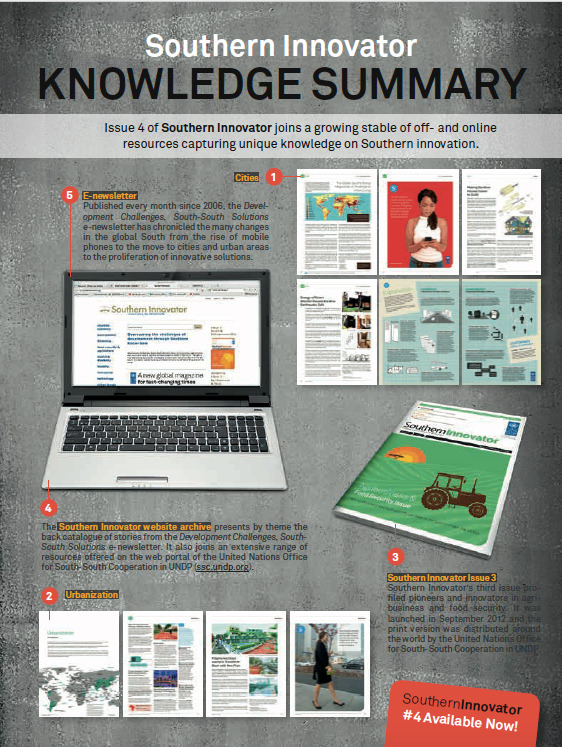
1) Southern Innovator Issue 4: Cities and Urbanization: SI’s fourth issue goes to the many new cities under construction to build the new 21st century world emerging in the global South. Website: http://www.scribd.com/doc/133622315/Southern-Innovator-Magazine-Issue-4-Cities-and-Urbanization

2) Urban Africa: Urban Africa is a digital entry point for knowledge sharing, interactive exchange and information dissemination on urbanization in Africa. Website: http://urbanafrica.net/

3) Arrival City: A third of humanity is on the move. History’s largest migration is creating new urban spaces that are this century’s focal points of conflict and change — unseen districts of rapid transformation and febrile activity that will reshape our cities and reconfigure our economies. Website: http://arrivalcity.net/

4) Global Urbanist: The Global Urbanist is an online magazine reviewing urban affairs and urban development issues in cities throughout the developed and developing world. Website: globalurbanist.com

5) Africa Renewal: The Africa Renewal information programme, produced by the Africa Section of the United Nations Department of Public Information, provides up-to-date information and analysis of the major economic and development challenges facing Africa today. Website: http://www.un.org/africarenewal/

Citations

Cited in Beyond Gated Communities by Samer Bagaeen and Ola Uduku (2015).

https://davidsouthconsulting.org/2022/02/09/african-megacity-makeovers-tackle-rising-populations/

https://davidsouthconsulting.org/2022/10/19/chinese-building-solution-for-rapidly-urbanizing-global-south/

https://davidsouthconsulting.org/2022/05/23/debt-free-homes-for-the-poor/

https://davidsouthconsulting.org/2022/10/17/east-africa-to-get-its-first-dedicated-technology-city/

https://davidsouthconsulting.org/2022/03/20/global-south-eco-cities-show-how-the-future-can-be/

https://davidsouthconsulting.org/2021/11/12/global-souths-rising-megacities-challenge-idea-of-urban-living/

https://davidsouthconsulting.org/2022/03/29/model-city-to-test-the-new-urbanism-concept-in-india/

https://davidsouthconsulting.org/2017/11/08/smart-cities-up-close-2013/

https://davidsouthconsulting.org/2022/09/26/3d-home-printing-landmark-10-houses-in-a-day/

https://davidsouthconsulting.org/2022/11/17/tiny-homes-to-meet-global-housing-crisis/

Development Challenges, South-South Solutions was launched as an e-newsletter in 2006 by UNDP’s South-South Cooperation Unit (now the United Nations Office for South-South Cooperation) based in New York, USA. It led on profiling the rise of the global South as an economic powerhouse and was one of the first regular publications to champion the global South’s innovators, entrepreneurs, and pioneers. It tracked the key trends that are now so profoundly reshaping how development is seen and done. This includes the rapid take-up of mobile phones and information technology in the global South (as profiled in the first issue of magazine Southern Innovator), the move to becoming a majority urban world, a growing global innovator culture, and the plethora of solutions being developed in the global South to tackle its problems and improve living conditions and boost human development. The success of the e-newsletter led to the launch of the magazine Southern Innovator. 

https://davidsouthconsulting.org/2021/03/05/southern-innovator-issue-4/

Creative Commons License

This work is licensed under a
Creative Commons Attribution-Noncommercial-No Derivative Works 3.0 License.

ORCID iD: https://orcid.org/0000-0001-5311-1052.

© David South Consulting 2022