Categories
Archive Development Challenges, South-South Solutions Newsletters Southern Innovator magazine

Electric Bicycles Become Urban Transport Success

By David SouthDevelopment Challenges, South-South Solutions

SOUTH-SOUTH CASE STUDY

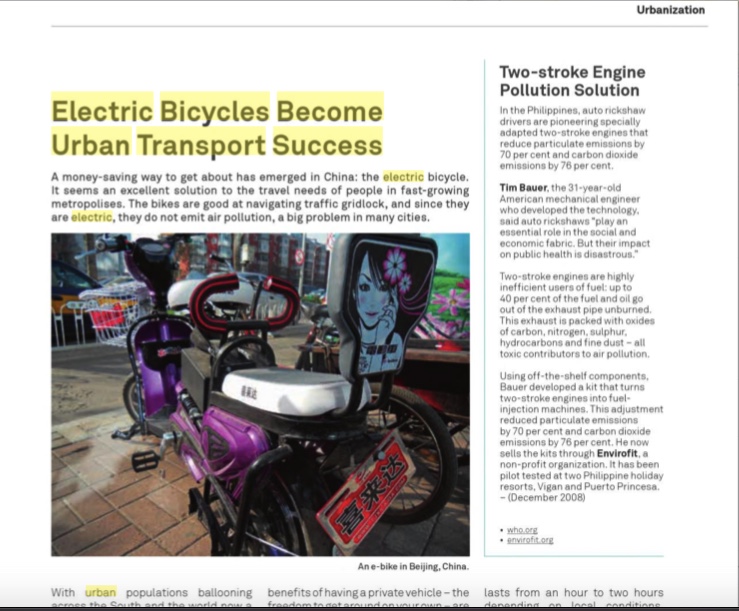
A money-saving way to get about has emerged in China: the electric bicycle. It seems an excellent solution to the travel needs of people in fast-growing metropolises. The bikes are good at navigating traffic gridlock, and since they are electric they do not emit air pollution, a big problem in many cities.

With urban populations ballooning across the South – and the world now a majority urban place – the challenge of moving people around economically and cleanly is a big issue. While turning to cars seems an appealing option for people who have raised their incomes, the resulting traffic jams and pollution are a major drawback. Gridlock (http://en.wikipedia.org/wiki/Gridlock) is a daily reality in cities across Asia and Africa.

The success of e-bikes in China is striking: It is estimated there are four times more electric bikes than cars in the country, 120 million in all. According to the Electric Bikes website (www.electricbikee.com), the number of electric bicycles produced each year has grown from 200,000 eight years ago to 22 million in 2008. It is estimated to be a US $11 billion a year business: a true Southern success story that is going around the world.

A typical electric bicycle has a rechargeable power pack, with a battery that takes up to four hours to charge and lasts from an hour to two hours depending on local conditions, like hills. The batteries can range from heavy lead acid models (around only 100 charges) to nickel metal to lightweight, long-lasting lithium batteries. The batteries range from 12 volts to 36 volts. How long a battery lasts depends on its energy retention ability, road and temperature conditions and the rider’s weight.

And while some cities are turning to encouraging more peddle power with human-powered bicycles, this is an unappealing option in hot or humid climates. Who wants to turn up at work hot and sweaty?

In China, a highly competitive market of manufacturers has sprung up in the last 10 years to provide e-bikes for every taste and need.

China has a long tradition as a cycling nation: in the 1980s, four out of five commuters used bicycles. But that changed dramatically as people bought cars with their rising incomes.

In the capital, Beijing, rapid economic development and rising incomes have led to serious traffic congestion. There are over 4 million cars on Beijing’s roads. The pollution in the city is very bad and has led to various campaigns to ban high-polluting vehicles.

The ensuing traffic gridlock means the benefits of having a private vehicle – the freedom to get around on your own – are eroded as a driver wastes time in long commutes. So, many have turned to the nimble electric bicycles.

One resident, David Dai, told the BBC “It takes only 10 minutes to ride my electric bike from home to work.”

“If I took the bus, I’d have to spend time waiting for it, and then I could be trapped in a traffic jam. It could take me half an hour to make the same journey.”

Competition is fierce in the electric bike market, with shops sometimes sitting side-by-side.

A manager of a Beijing electric bicycle store, Zhang Zhiyong, puts the success down to this: “Beijing is not like other smaller cities – it’s big. If people ride their bicycles to work, they get really tired. If they drive to work, the roads are often congested,” he told the BBC.

“But an electric bike is environmentally friendly and convenient. Promoting the use of these bikes would benefit us all.”

And the price is a definite incentive: just 2,680 yuan (US $390), while cars sell for thousands of dollars.

The electric bicycles are so successful they are now growing faster than cars in a country that has become the fastest growing car market in the world.

Some believe the bikes are just a stop gap before people get enough money to buy automobiles. But the bigger trend of growing urban populations and the ensuing traffic jams will ensure they remain a practical option to get around the gridlock.

Published: April 2010

Resources

1) Electric Bike Website: Home to news and links to manufacturers. Also lots of resources on how to convert peddle bikes into electric bikes. Website:http://www.electricbikee.com/

2) The Luyuan Electric Vehicle Company of Jinhua City in China has been making the bikes for 10 years. They come fully equipped with lights, baskets, fenders and in many colours. Website: http://en.luyuan.cn/?gclid=CJXu_tr576ACFclr4wodG1GsGQ

3) Empowered Ebikes: An online retailer of e-bikes specializing in urban commuters. Website:http://www.empoweredebikes.com/index.php

4) Made-in-China.com: A large list of e-bike manufacturers in China and how to contact the dealers and manufacturers. Website: http://www.made-in-china.com/products-search/hot-china-products/E-bike.html

5) Pedego: An American company making high-end e-bikes. Website: http://www.pedegoelectricbikes.com/index.php

Development Challenges, South-South Solutions was launched as an e-newsletter in 2006 by UNDP’s South-South Cooperation Unit (now the United Nations Office for South-South Cooperation) based in New York, USA. It led on profiling the rise of the global South as an economic powerhouse and was one of the first regular publications to champion the global South’s innovators, entrepreneurs, and pioneers. It tracked the key trends that are now so profoundly reshaping how development is seen and done. This includes the rapid take-up of mobile phones and information technology in the global South (as profiled in the first issue of magazine Southern Innovator), the move to becoming a majority urban world, a growing global innovator culture, and the plethora of solutions being developed in the global South to tackle its problems and improve living conditions and boost human development. The success of the e-newsletter led to the launch of the magazine Southern Innovator. 
Creative Commons License

This work is licensed under a
Creative Commons Attribution-Noncommercial-No Derivative Works 3.0 License.

ORCID iD: https://orcid.org/0000-0001-5311-1052.

© David South Consulting 2023

Categories
Archive Development Challenges, South-South Solutions Newsletters Southern Innovator magazine

Global South Experiencing Transportation Revolution

By David SouthDevelopment Challenges, South-South Solutions

SOUTH-SOUTH CASE STUDY

Away from the news headlines, a quiet revolution has been taking place in public transportation across the global South. As cities have expanded and grown, they have also been putting in place public transport systems to help people get around and get to work.

One proven, efficient way to move large numbers of people quickly through dense urban areas is to use underground subway or metro systems. Subway systems have a profound effect on local economies and wealth creation. They allow people to quickly cover distances that may once have meant hours stuck in traffic. Once people can move around a city quickly and over large distances, they can change how they work, shop, enjoy themselves. It allows people living in poor outlying neighbourhoods to travel to jobs in the city centre, improving their income prospects.

As many countries in the global South have enjoyed healthy growth rates despite the global economic crisis, and with the global financial system being flooded with stimulus funds to spur growth, the resources have become available to invest in expensive and long-term public transport solutions such as metro systems. Another factor is the scale of urbanization in the global South, which is driving governments to turn to new solutions that will help in avoiding the mistakes made in the past.

The world’s first urban underground railway system was built in 19th-century London, England. It was the product of a country that had been experiencing rapid, large-scale industrialization and urbanization unseen before in human history. Since then, the now 150-year-old London Underground (http://www.tfl.gov.uk/modalpages/2625.aspx) has acted as the arteries coursing through the city’s economic body, criss-crossing the city and delivering millions of people to work and play every day. It is now impossible to imagine Britain’s economy functioning without this efficiency tool.

Now, as the global South engages in the greatest urbanization project in human history, more cities are turning to underground metro systems to keep people, and the economy, moving. Lessons have been learned from the first generation of global South cities, which expanded rapidly in the 1960s, 1970s and 1980s. Many became quickly clogged in traffic and cloaked in pollution, and saw economic opportunity and social mobility slowed down as a consequence.

Three of the biggest metro systems in the world are now in China – Beijing, Shanghai and Guangzhou (The Economist). Beijing (http://www.explorebj.com/metro/) has a metro system stretching 442 kilometres and is used every day by 5.97 million people. By 2020, Beijing is hoping to boast 1,000 kilometres of metro network in the city. In Shanghai (http://www.shmetro.com/EnglishPage/EnglishPage.jsp), the 423 kilometre metro system carries 5.16 million people every day, while Guangzhou (http://www.gzmtr.com/en/) carries 4.49 million people a day.

From the 1960s, the building of metros increased around the world. More than 190 cities now have metro systems. In China, Suzhou (http://www.livingsu.com/guide_detail.asp?id=7), Kunming (http://www.urbanrail.net/as/cn/kunming/kunming.htm) and Hangzhou (http://www.urbanrail.net/as/cn/hang/hangzhou.htm) opened metro systems in 2012. Elsewhere in the global South, Lima in Peru and Algiers (http://www.metroalger-dz.com/) in Algeria recently acquired new metro systems. This means Africa now has two cities with metro systems – Algiers and Cairo in Egypt.

In India, Bangalore opened a metro system two years ago and Mumbai is close to finishing its metro. Bhopal and Jaipur also plan to build metros. In Brazil, the metros in Sao Paulo and Rio de Janeiro are being expanded and new systems are being built in Salvador and Cuiaba. In the Gulf states of the Middle East, Dubai (http://dubaimetro.eu/) opened a system in 2009 and Mecca (http://meccametro.com/) in Saudi Arabia in 2010. Abu Dhabi, Doha, Riyadh and Kuwait City are also working on building metro systems.

Paraguay’s capital, Asuncion, is working on one, as is Kathmandu in Nepal. Jakarta in Indonesia has attempted to build an underground metro several times and is now trying to getting one built.

But how are many of these countries funding this splurge on metro systems? According to Roland Berger Strategy Consultants (rolandberger.co.uk), global government stimulus programmes to fight the current financial crisis have increased available funding for rail systems. There are also increased resources available for transport solutions that avoid the high pollution rates that come with automobiles.

According to Mass Transit Magazine, China is using domestic consumption and increasing urbanization to spur economic growth and is hoping to increase investment in metro systems in the country by 10 per cent per year.

The target is to spend 280 billion yuan to 290 billion yuan (US $44.91 to US $46.51 billion) on metro systems in 2013, up from 260 billion yuan in 2012.

The knock-on economic boost will be felt by domestic businesses as trains and train systems are purchased. It is estimated sales of Chinese-made trains will go from 10.9 billion yuan in 2012 to 28 billion yuan by 2017.

All this new building will expand the country’s metro lines by 846 kilometres in 24 cities.

Ten Chinese cities are expecting soon to receive permission to begin work on building new metro systems: Xian, Tianjin, Chongqing, Chengdu, Hangzhou, Ningbo, Kunming, Tsingdao, Wuxi and Dongguan.

In 2013, 12 Chinese cities will complete new metro systems including Harbin, Changsha, Ningbo and Zhengzhou.

If this trend continues and expands, then the future cities of the global South could be modern, urban places that raise living standards, while avoiding damaging human health with environmental pollution and over-crowding and social exclusion.

Published: February 2013

Resources

1) Life Guangzhou: Guangzhou Awarded World’s Best Metro System. Website: http://tinyurl.com/ajdcsur

2) Inhabitat: Parisian Building Taps Metro System as a Heat Source.
Website: http://inhabitat.com/body-heat-from-paris-metro-to-heat-residential-building/

3) Digital Construction: Top Ten Metro Systems: Design and efficiency in the world of mass transit. Website:http://www.constructiondigital.com/top_ten/top-10-business/top-ten-metro-systems

4) Six of the world’s best metro systems – in pictures: A look at six metro systems around the world, from the archaeological treasures on display in Athens to the spectacular halls of Moscow’s underground system via continental Europe’s oldest network. Website:http://www.guardian.co.uk/travel/gallery/2013/jan/09/six-worlds-best-metro-systems

Development Challenges, South-South Solutions was launched as an e-newsletter in 2006 by UNDP’s South-South Cooperation Unit (now the United Nations Office for South-South Cooperation) based in New York, USA. It led on profiling the rise of the global South as an economic powerhouse and was one of the first regular publications to champion the global South’s innovators, entrepreneurs, and pioneers. It tracked the key trends that are now so profoundly reshaping how development is seen and done. This includes the rapid take-up of mobile phones and information technology in the global South (as profiled in the first issue of magazine Southern Innovator), the move to becoming a majority urban world, a growing global innovator culture, and the plethora of solutions being developed in the global South to tackle its problems and improve living conditions and boost human development. The success of the e-newsletter led to the launch of the magazine Southern Innovator. 

Creative Commons License

This work is licensed under a
Creative Commons Attribution-Noncommercial-No Derivative Works 3.0 License.

ORCID iD: https://orcid.org/0000-0001-5311-1052.

© David South Consulting 2022

Categories
Archive Development Challenges, South-South Solutions Newsletters

Ghana: Oil-rich City Sparks Entrepreneurs and Debate

By David SouthDevelopment Challenges, South-South Solutions

SOUTH-SOUTH CASE STUDY

Commodity booms can seem like the answer to a poor nation’s prayers, a way to fulfil all their development dreams and goals. The reality, however, is far more complex. More often than not, the discovery of resources sparks a mad scramble for profits and patronage, as politicians and politically connected elites carve out their slice of the new resource boom before anyone else.

The twin cities of Sekondi-Takoradi (http://en.wikipedia.org/wiki/Sekondi-Takoradi) in the Western Region of Ghana are now experiencing an oil boom. Ghana’s oil production went online in December 2010 and the government is hoping it will double the country’s growth rate.

Large supplies of oil were found off the coast in 2007, transforming Takoradi from a sleepy, rundown port city into the hub for the oil boom.

Local man Peter Abitty told the BBC he was renting out an eight-bedroom house for US $5,000 a month. The house overlooks the sea and comes with banana and coconut trees.

“Tenants that come here can take the coconuts for free! We don’t charge anything,” Abitty said.

He put the strong interest in the house down to a simple fact: “It’s out there: oil, oil, oil.”

People’s hopes are being raised in Ghana’s case because it has built a reputation as a better-governed country than other African petro states like Nigeria and Angola.

But others argue that price increases caused by the boom are destroying local businesses. A report on the Ghana Oil news website found popular local businesses suffering. One example it gave was the Unicorn Internet Café, an employer of local youth, which shut down in 2010 because of high rents.

It found businesses have shut down in the following sectors: timber, sawmilling, super markets, mobile phone shops, boutiques and trading shops. But it also found many new businesses opening up, including banks, insurance companies and hotels.

The challenge facing Ghana is to ensure oil brings a long-term change to a higher value business environment and economy, rather than just an unequal and temporary boom.

Another challenge is to connect the many youth leaving education in the city with the jobs and opportunities being created by the oil industry. The twin cities are a regional educational centre with a lot of technical colleges and secondary schools.

To counter these concerns, a Regional Coordinating Council is promising to place the growth of small and medium enterprises at the centre of regional development.

The dreams and promises for Takoradi are very ambitious. “In five years time, I see Takoradi becoming one of the modern cities of the world,”  Alfred Fafali Adagbedu, the owner of Seaweld Engineering (www.seaweldghana.com), a new local company set up to service the oil sector, told the BBC.

“I can imagine skyscrapers, six-lane highways and malls.”

“The transport industry is going to improve, because workers on the rig are going to need to be transported. Agriculture is going to see a boom because all those people on the rig will need to be fed.

“Even market women are going to see more business, because a lot of workers are going to have very fat paychecks. Everyone in this city is going to gain in business.”

How far Takoradi has to travel to come close to meeting these dreams and expectations can be seen in its current state. The railway station has a train with laundry hanging from it because it hasn’t moved in years, reported the BBC. People are living in the sleeping car of the train.

But the typical signs of a boom are all visible: traffic jams, booked hotels, rising rents and prices, and it is already hurting people on fixed salaries.

Local authorities have plans to demolish rundown parts of the city and rebuild with modern office environments for the new businesses resulting from the oil economy.

An estimated US $1 billion a year in revenue will go to the Ghanaian government and local authorities want 10 percent of this to be ring-fenced for regional development.

“Many resources are coming from the western region. From years back, gold is here, timber is here, diamonds are here,” said Nana Kofi Abuna V, one of the few female chiefs in the area.

“But when they share the cake up there, they leave out the western region. This time, if there is oil and gas in the region we should benefit more than everybody else.”

But Adagbedu at Seaweld Ghana believes Ghana will see real improvements.

“I’m very sure we will avoid the mistakes,” he said. “Ghana is a democracy, everyone is watching, so there is going to be a lot of improvement here.”

And to help in keeping these promises, the BBC will continue to return to Sekondi-Takoradi to track its changes and see how things improve.

Published: September 2011

Resources

1) BarCamp Takoradi: BarCamp is an international network of user-generated conferences (or unconferences). They are open, participatory workshop-events, the content of which is provided by participants. Website:http://twitter.com/#!/barcamptakoradi

2) Ghana Ports and Harbours Authority: The Authority overlooks the Takoradi port. Website:http://www.ghanaports.gov.gh/GPHA/takoradi/index.html

3) Friends of the Nation (FON): The NGO serves as a catalyst towards increased action for sustainable natural resource management and health environment in the Takoradi region. Website: http://www.fonghana.20m.com/aboutus1.htm

4) Takoradi City: A website packed with information and photos on the city. Website:http://www.takoradicity.com/pages/sections.php?siteid=takoradicity&mid=39

Development Challenges, South-South Solutions was launched as an e-newsletter in 2006 by UNDP’s South-South Cooperation Unit (now the United Nations Office for South-South Cooperation) based in New York, USA. It led on profiling the rise of the global South as an economic powerhouse and was one of the first regular publications to champion the global South’s innovators, entrepreneurs, and pioneers. It tracked the key trends that are now so profoundly reshaping how development is seen and done. This includes the rapid take-up of mobile phones and information technology in the global South (as profiled in the first issue of magazine Southern Innovator), the move to becoming a majority urban world, a growing global innovator culture, and the plethora of solutions being developed in the global South to tackle its problems and improve living conditions and boost human development. The success of the e-newsletter led to the launch of the magazine Southern Innovator. 

Creative Commons License

This work is licensed under a
Creative Commons Attribution-Noncommercial-No Derivative Works 3.0 License.

ORCID iD: https://orcid.org/0000-0001-5311-1052.

© David South Consulting 2023

Categories
Archive Development Challenges, South-South Solutions Newsletters Southern Innovator magazine

Free Magazine Boosts Income for Rickshaw Drivers

By David SouthDevelopment Challenges, South-South Solutions

SOUTH-SOUTH CASE STUDY

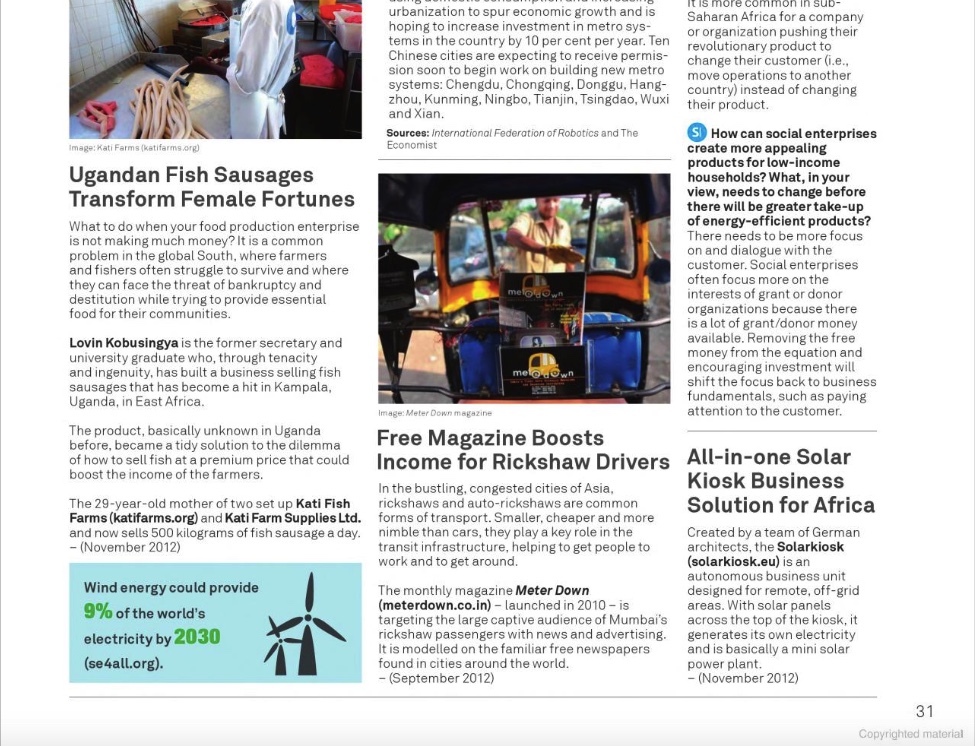
In the bustling, congested cities of Asia, rickshaws and auto-rickshaws are common forms of transport. Smaller, cheaper and more nimble than cars, they play a key role in the transit infrastructure, helping to get people to work and to get around.

According to a report by the World Resources Institute (wri.org) and EMBARQ – a global network of experts on sustainable transport solutions – India’s auto rickshaws are “an increasingly important part of urban transport in cities.”

The report estimates the number of auto rickshaws at between 15,000 and 30,000 in medium-sized cities and over 50,000 in large cities. The report found they make up between 10 and 20 per cent of daily motorized road transport trips for people in Bangalore, Mumbai, Pune and Rajkot.

And it’s not just the economic role played in transporting people: auto rickshaws are made in India and their production there doubled between 2003 and 2010, making them a source of manufacturing jobs too.

As India’s cities continue to grow – estimates forecast urban populations surging from 340 million in 2008 to 590 million by 2030 – auto rickshaws could have a bright future as they remain an affordable and safe transport solution.

The monthly magazine Meter Down (http://meterdown.co.in/) – launched in 2010 – is targeting the large captive audience of Mumbai’s rickshaw passengers with news and advertising. It is modelled on the familiar free newspapers found in cities around the world. Usually, these newspapers are distributed at subway and metro stations or in metal boxes at bus stops. Meter Down takes a different twist on this concept, distributing the publication directly to rickshaw passengers.

Mumbai is a crowded and very busy Indian city with an estimated 14 million people. Many residents spend a lot of time commuting – and a lot of time stuck in traffic jams. They need something to occupy them and to keep them informed about the news. This also presents a significant opportunity for businesses to communicate messages and advertising products and services.

Founded by three university graduates, Meter Down is trying to reach young professionals with a bit of money who can afford to ride to work in auto rickshaws.

It is distributed through 7,000 auto rickshaws in Mumbai, according to The Guardian newspaper, and is also being distributed in Pune and Ahmedabad.

The clever bit is the incentive for the drivers to carry the magazine: they receive 35 to 40 per cent of the profit from advertising sales.

This is added to the 400 to 500 rupees they make in a normal shift, according to the Mumbai Autorickshawmen’s Union.

But isn’t it a challenge to read a printed publication while bouncing along the road? The publishers came up with a solution: no story is to be longer than 300 words and the magazine has many large-size photographs to make it visually appealing and easy on the eye. Then there is the issue of passengers leaving with a copy of the magazine, denying the next passenger their read. The solution they came up for this is to tie the magazine to the rickshaw.

One of the biggest problems for any new start-up publication is how to scale up and reach more readers. Meter Down cleverly has the mechanism to scale built into its business model: “The market for this is as big as the total number of auto-rickshaws in each city,” Dedhia told The Guardian. “We have successfully scaled the model and tweak it as per different specific needs. Since auto-rickshaws are present in every part of the country, we can expand the network everywhere.”

Meter Down’s founders estimate that each rickshaw makes 90 to 95 trips every day. They have calculated this leads to a potential readership of 600,000 people. To increase revenue sources, the magazine also sells advertising space on the back and inside of the rickshaws.

For people in wealthier countries, rickshaws may seem like a rough way to get to work, but they are actually, for Indians, the more expensive option. A three-mile ride in Mumbai costs 68 rupees (US $1.27), according to The Guardian, which is 10 times the cost of a second-class train ticket.

For Meter Down, this means targeting the magazine and the ads at a market of readers with money and a willingness to buy products and services. It looks like things could be on the up for Meter Down!

Published: September 2012

Resources

1) Sustainable Urban Transport in India: Role of the Auto-Rickshaw Sector.
Website: http://www.embarq.org/en/sustainable-urban-transport-india-role-auto-rickshaw-sector 

2) A fleet of auto rickshaws for sale from Bajaj. Website: http://www.bajajauto.com/commercial_vehicle.asp

Development Challenges, South-South Solutions was launched as an e-newsletter in 2006 by UNDP’s South-South Cooperation Unit (now the United Nations Office for South-South Cooperation) based in New York, USA. It led on profiling the rise of the global South as an economic powerhouse and was one of the first regular publications to champion the global South’s innovators, entrepreneurs, and pioneers. It tracked the key trends that are now so profoundly reshaping how development is seen and done. This includes the rapid take-up of mobile phones and information technology in the global South (as profiled in the first issue of magazine Southern Innovator), the move to becoming a majority urban world, a growing global innovator culture, and the plethora of solutions being developed in the global South to tackle its problems and improve living conditions and boost human development. The success of the e-newsletter led to the launch of the magazine Southern Innovator. 

Creative Commons License

This work is licensed under a
Creative Commons Attribution-Noncommercial-No Derivative Works 3.0 License.

ORCID iD: https://orcid.org/0000-0001-5311-1052.

© David South Consulting 2023