
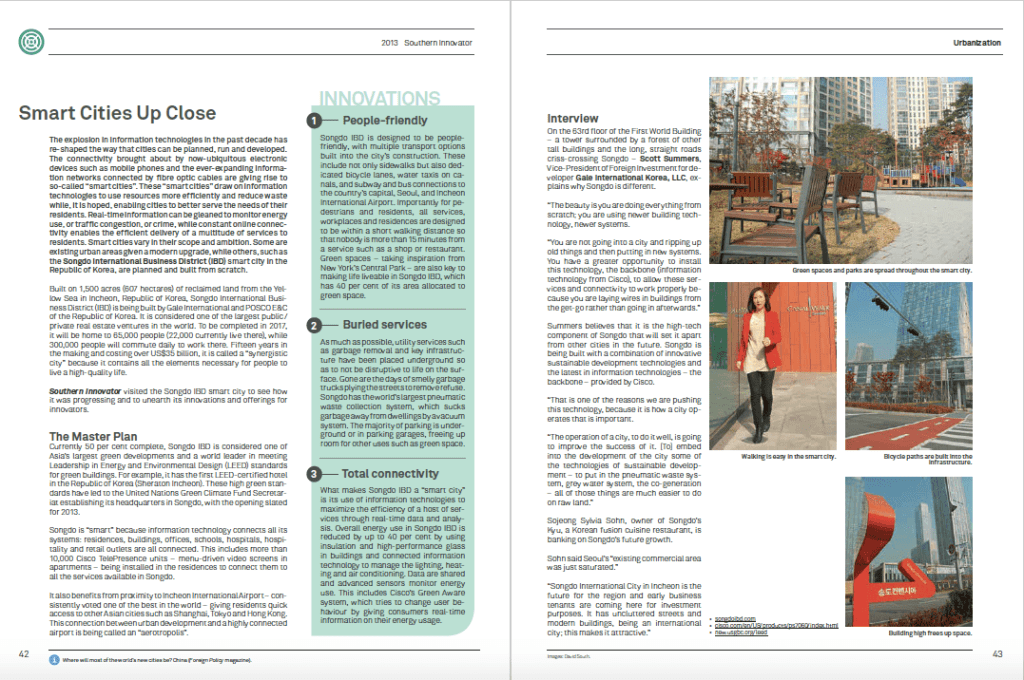
By David South, Development Challenges, South-South Solutions

The world crossed the threshold from being a majority rural world to a majority urban one at the end of the first decade of the 21st century. The reason for this is the fast-growing urban areas of the global South. And this is having a profound affect on how the world’s people live.
Across the global South, there are many examples of unchecked growth leading to squalor and poor housing conditions, and in turn to poor health and high rates of crime and disorder. Yet, the urbanization happening today across the global South is unprecedented for both its speed and its scale.
And, unlike previous surges in urbanization, it is this quality that is far more challenging for governments and policymakers.
Many countries and regions are experiencing highly stressed environmental conditions, with poor access to water and rising air pollution damaging human health, for example. But on the other side, there is also unprecedented change in technology and communications taking place. Every year, more and more of the world’s population gain access to 21st century communications such as smart phones and the Internet or ‘apps’ (applications), allowing the exchange of solutions and ideas at a rapid pace.
Many are weighing up the benefits and downsides of such an urban, dense world. Denser cities make it easier and more efficient to deliver services, and proponents see a rapid rise in living standards in these megacities. Others see wide-scale poverty and vicious fights over resources in crime-ridden, unhealthy packed megacities. These pessimists point to current conditions in many megacities across the global South.
No matter what perspective, many agree there has to be a cultural change in how people live and behave to make the megacities work.
The contrasting approaches taken by two giants of the global South – India and China – provides lessons and ideas.
The first big push from rural to urban took place in Europe in the 19th century. In 1800, just three per cent of the world’s population lived in cities. All the cities now seen as cosmopolitan hubs of economic and creative energy were just shadows of themselves prior to the 19th-century industrial revolution.
Lessons were learned from hard experience and one of the most important lessons was this: if a city is to grow – and grow quickly – then it must plan for this growth and put the well-being of people at the centre of this plan. This is critical to ensure public health is improved and that the transition to more dense living conditions improves human well-being, rather than making it worse.
A megacity is a city with a population greater than 10 million people (http://en.wikipedia.org/wiki/Megacity). The number of such cities will double over the next 10 to 20 years and many of these cities are in south and east Asia. By 2025, seven of the world’s top 10 megacities will be in Asia. Whole new cities are rising up that most people across the world have never heard about – yet.
One of the most rapidly urbanizing countries in the world is China. At the beginning of 2012, Chinese authorities announced the country was now a majority urban place, with most citizens living in cities. This population of 690.79 million people outpaced the rural population of 656.56 million people.
China is exploring a variety of solutions to making high-density city living work. Some of these solutions include creating multiplexes containing modern shopping, leisure, recreational and housing in one location. One example of this is The New Century Global Centre (http://cd.qq.com/a/20101018/000099.htm) in Chengdu, the capital of Sichuan. It is being called the world’s largest standalone complex. Chengdu is now a city of 14 million people and projected to be heading to 20 million people.
It includes design by noted Iraqi architect Zaha Hadid (zaha-hadid.com).
There are 1.5 million square metres of floor plans, two 1,000-room five-star hotels, an ice-skating rink, a 20,000 capacity marine park with 400 meters of artificial coastline and 5,000 square metres of artificial beach, including hot springs.
In contrast, the more chaotic and unplanned approach taken in India – also a country experiencing rapid growth in its cities – has come under intense criticism. Dr Rumi Aijaz of the Delhi-based Observer Research Foundation (observerindia.com) told The Guardian that Indian infrastructure improvements will be difficult to achieve: “Our urban areas are in a raw form.
All the basics are at a very low level. And the Indian state has been trying for a very long time to address this but a lack of capacity and endemic corruption has meant not much success.”
In 2001, India had 290 million people living in cities. By 2008, this reached 340 million. It is predicted this will reach 590 million people – 40 per cent of the population – by 2030. McKinsey and Company (mckinsey.com) believe by 2030 India will have 68 cities of more than one million people, 13 will have four million people and six megacities will be greater than 10 million people.
India faces an urban infrastructure crisis of epic proportions, McKinsey believes. Many millions will not have access to clean drinking water, adequate sewage, and will have to cope with poor transport.
China, on the other hand, has invested seven times more in urban infrastructure than India. And one example of how this investment pays off is Chengdu.
The fast-growing city of Chengdu’s mayor is trying to manage growth directly through the city’s policies. This involves managing the push and pull incentives driving people to cities and lifting the standard of living in the surrounding countryside.
Chengdu’s mayor Ge Honglin told The Guardian: “The first thing I did was to improve the conditions – schools, shops, garbage collection, the sewage system. We had to cut the gap between rural and urban areas. If people could have a brighter future in the countryside, they’d stay there. So we’re not seeing people swarm into the city= Instead there are people in the city considering moving to the country.”
“Chengdu is the only super-large central city that has narrowed the urbanrural income gap alongside rapid economic growth in China,” Ge said.
Hundreds of schools have been built surrounding Chengdu and partnerships made between rural and urban schools to help raise standards.
Chengdu is also pioneering new ways to address urban squalor with new information technologies. Patrols use mobile phones and cameras to document broken infrastructure and health and safety problems, and to locate and assist the homeless.
“You can barely see a begger in Chengdu,” said Gu. “We have a special system for monitoring them, and it works. Beggars are taken to the assistance centre, where they are given food and shelter and money to take them back to their home. If I say there are no more than 10 beggars on the street you will think there’s some sort of tyranny, but there isn’t. We’re trying to solve their problems.”
Published: May 2012
Resources
1) Endless City and Living in the Endless City: LSE Cities is an international centre at the London School of Economics and Political Science that carries out research, education and outreach activities in London and abroad. Its mission is to study how people and cities interact in a rapidly urbanizing world, focussing on how the design of cities impacts on society, culture and the environment. Website: http://lsecities.net/publications/books/the-endless-city/
2) Planet of Slums by Mike Davis: According to the United Nations, more than one billion people now live in the slums of the cities of the South. Mike Davis explores the future of a radically unequal and explosively unstable urban world. Website: http://books.google.co.uk/books/about/Planet_Of_Slums.html?id=FToaDLPB2jAC
3) An infographic from The Guardian newspaper showing the rise of the megacity in world history. Website: http://image.guardian.co.uk/sysimages/Observer/Pix/pictures/2012/01/21/urban2.jpg
4) Arrival City by Doug Saunders: A third of humanity is on the move. History’s largest migration is creating new urban spaces that are this century’s focal points of conflict and change — unseen districts of rapid transformation and febrile activity that will reshape our cities and reconfigure our economies.Website: http://arrivalcity.net/
5) Global Urbanist: The Global Urbanist is an online magazine reviewing urban affairs and urban development issues in cities throughout the developed and developing world. Website: http://globalurbanist.com/
6) The Spirit of Cities: Why the Identity of a City Matters in a Global Age by Daniel A. Bell and Avner de-Shalit. Website: amazon.com
7) Rise of the Asian Megacity: Website: http://www.bbc.co.uk/news/worldasia-pacific-13800944
8) Capitals of the Connected World: Mapping the New Global Power Structure. Website: http://www.theatlantic.com/special-report/capitalsconnected-world/



This work is licensed under a
Creative Commons Attribution-Noncommercial-No Derivative Works 3.0 License.
ORCID iD: https://orcid.org/0000-0001-5311-1052.
© David South Consulting 2023



 David South Consulting

You must be logged in to post a comment.