Tag: urban areas

  • Pay for Pee Keeps Indian Town Clean

    Pay for Pee Keeps Indian Town Clean

    By David SouthDevelopment Challenges, South-South Solutions

    SOUTH-SOUTH CASE STUDY

    The task is huge: 2.6 billion people, or 41 percent of the world’s population, is without access to basic sanitation. As a result, most have to make do and defecate or urinate wherever they can. In crowded urban areas, the result is an unpleasant source of disease and filth that fouls living spaces and sickens or kills many people.

    In Indian cities, between one-quarter and one-half of the population, mostly slum-dwellers, has inadequate or no provision for sanitation.

    Many government-built communal toilet blocks are in a sad state. They are overburdened by queues of people that can stretch a mile-long in the mornings. They can also be too expensive for many slum dwellers. Often government-built toilet blocks are in disrepair after just three months, and people return to defecating in the streets.

    In 2008, the International Year of Sanitation (http://esa.un.org/iys/), more than 330 million people in India do not have access to proper sanitation facilities. And in the case of the remote town of Musiri in Tamil Nadu state, many residents relieve themselves on river banks, leading to infectious diseases like diarrhoea.

    But an ingenious scheme is keeping streets clean and people relieved. Rather than viewing human waste as an expensive problem and annoyance, poor residents are being paid up to a dollar a month to use public toilets. By paying people to use the toilets, the government avoids having to run campaigns to get people to change their habits.

    “In fact, many of us started using toilets for urination only after the ecosan (ecological sanitation) toilets were constructed in the area,” S. Rajasekaran, a truck cleaner, to The Times of India.

    The urine is being collected to be used as a crop fertilizer by the state’s agricultural university (http://www.tnau.ac.in/ ). About 150 residents use the eco-sanitation toilet daily. It is designed to collect faeces as well: it too is used as fertilizer.

    “We’re motivating people to know the value of their urine,” Marathi Subburaman, who came up with the novel idea, told CNN. “The urine that is collected goes into fields for paddy crops, and of course the faeces becomes good compost in a matter of months.”

    Subburaman’s non-profit Society for Community Organization and People’s Education (SCOPE) has teamed up with Tamil Nadui Agricultural University and are studying how much urine is needed to fertilize a field.

    “Next year, we can install urine banks so we can sell the urine to farmers,” he said.

    The locals are given cards and each trip is recorded. At the end of the month, the cards are handed in and the money collected.

    The average amount paid out is based on the assumption most people need to go twice a day.

    If some get cheeky and try to make more money from pretending they need to go to the toilet, there is a solution: “If they ask to go three, four times a day, then something’s wrong,” Subburaman said. “We ask them to go to a doctor.”

    Another successful model is the Indian NGO SPARC (Society for Promotion of Area Resource Centres) (http://www.sparcindia.org/). SPARC is an Indian NGO established in Mumbai in 1984 that began working with women pavement dwellers.

    It has been designing and building toilet blocks in Indian cities, bringing access to toilets and washing facilities to hundreds of thousands of poor urban Indians. It has built toilet blocks for 400,000 people in eight Indian cities. It trains community groups to build, manage and maintain the toilet blocks. It has also proven that local groups can take on the management and costs of providing toilet facilities.

    Resources

    • World Toilet Organization: The global non-profit organization committed to improving toilet and sanitation conditions. Website: http://www.worldtoilet.org
    • World Toilet College: Established in 2005, the World Toilet College (WTC) started as a social enterprise, with the belief that there is a need for an independent world body to ensure the best practices and standards in toilet design, cleanliness, and sanitation technologies are adopted and disseminated through training. Website: http://www.worldtoilet.org/ourwork3.asp
    • Official website for the 2008 International Year of Sanitation. Website: http://esa.un.org/iys/
    • Waste has expert knowledge on domestic solid and liquid waste management and sanitation issues. Its website offers a comparison of designs and methods for toilets. Website: http://www.ecosan.nl/page/353

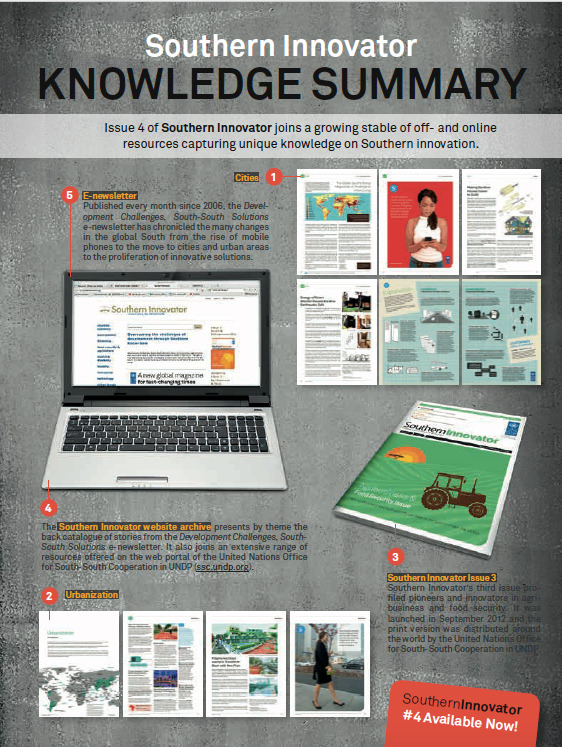
    Development Challenges, South-South Solutions was launched as an e-newsletter in 2006 by UNDP’s South-South Cooperation Unit (now the United Nations Office for South-South Cooperation) based in New York, USA. It led on profiling the rise of the global South as an economic powerhouse and was one of the first regular publications to champion the global South’s innovators, entrepreneurs, and pioneers. It tracked the key trends that are now so profoundly reshaping how development is seen and done. This includes the rapid take-up of mobile phones and information technology in the global South (as profiled in the first issue of magazine Southern Innovator), the move to becoming a majority urban world, a growing global innovator culture, and the plethora of solutions being developed in the global South to tackle its problems and improve living conditions and boost human development. The success of the e-newsletter led to the launch of the magazine Southern Innovator.  

    Follow @SouthSouth1

    Google Books: https://books.google.co.uk/books?id=m5GYBgAAQBAJ&dq=development+challenges+may+2012&source=gbs_navlinks_s

    Slideshare: http://www.slideshare.net/DavidSouth1/development-challengessouthsouthsolutionsmay2012issue

    Southern Innovator Issue 1: https://books.google.co.uk/books?id=Q1O54YSE2BgC&dq=southern+innovator&source=gbs_navlinks_s

    Southern Innovator Issue 2: https://books.google.co.uk/books?id=Ty0N969dcssC&dq=southern+innovator&source=gbs_navlinks_s

    Southern Innovator Issue 3: https://books.google.co.uk/books?id=AQNt4YmhZagC&dq=southern+innovator&source=gbs_navlinks_s

    Southern Innovator Issue 4: https://books.google.co.uk/books?id=9T_n2tA7l4EC&dq=southern+innovator&source=gbs_navlinks_s

    Southern Innovator Issue 5: https://books.google.co.uk/books?id=6ILdAgAAQBAJ&dq=southern+innovator&source=gbs_navlinks_s
    https://davidsouthconsulting.org/2022/10/18/indian-initiatives-to-make-travel-safer-for-women/

    https://davidsouthconsulting.org/2022/10/25/indian-toilet-pioneer-champions-good-ideas/

    https://davidsouthconsulting.org/2022/10/18/indians-fighting-inflation-with-technology/

    https://davidsouthconsulting.org/2022/11/18/toilet-malls-make-going-better/

    Creative Commons License

    This work is licensed under a
    Creative Commons Attribution-Noncommercial-No Derivative Works 3.0 License.

    ORCID iD: https://orcid.org/0000-0001-5311-1052.

    © David South Consulting 2023
  • Securing Land Rights for the Poor Now Reaping Rewards

    Securing Land Rights for the Poor Now Reaping Rewards

    By David SouthDevelopment Challenges, South-South Solutions

    SOUTH-SOUTH CASE STUDY

    The hotly debated issue of land rights for the poor has never been more relevant. There is mounting evidence that access to land rights can catapult the poor out of poverty and spur growth for the economy. Experience in India and China is now showing the economic power unleashed when the poor gain full legal rights over their land. But it can be a thornier issue in Africa, where much land is still held under customary law, with people either holding it through their clan or tribe, or being considered as owners of where they live, without formal documents. Many countries are now adapting their laws to switch to a system of formal titles, but the process is very uneven and some question whether western-style property titles are appropriate in an African context.

    While there are many schemes to alleviate or eliminate poverty through micro-credit, grants or aid, some believe the secret is in creating a sound framework of property rights, giving poor people important collateral to raise money against the value of the land on which they live. The Peruvian economist, Hernando de Soto, has calculated that the total value of informal urban dwellings and rural land owned under customary law is around three times greater than Africa’s entire gross domestic product and 100 times greater than its foreign direct investment.

    But the urgency of this problem can be seen in the numbers of rural poor – many of whom will migrate to the world’s fast-growing cities. In China there are 800 million, in India the rural poor number 270 million and 70 percent of Africa’s 888 million (2005,UN) are rural poor.

    The Rural Development Institute (www.rdiland.org), an NGO based in Seattle, Washington, USA – and with offices and projects in India, China, Indonesia, Russia, Africa – uses lawyers to advocate and fight for land rights for the rural poor. To date, RDI has helped provide land rights to more than 100 million poor families worldwide. Their approach is called micro-owning whereby the poor are helped to acquire land assets. These are often small plots of land – sometimes 1/10th acre – that can provide the nutritional needs for a family and help them on the road to the virtuous cycle of long-term, sustainable and generational poverty alleviation.

    “Micro-ownership transforms the lives of the rural poor,” according to Radha Friedman, Associate Director, Development and Communication, just back from visiting RDI’s Indian projects. “Outside Bangalore in the state of Karnataka one woman who was landless worked two shifts a day in the hot sun. She was barely able to feed her children. She was making 8 to 10 rupees a day – when a bottle of water costs 10 rupees. We helped her secure a plot of land to grow jasmine flowers which she sells in the market. She now makes between 85 to 200 rupees a day. She can eat three times a day and her kids can afford to go to school. She said she had not thought about how far she had come, but it clearly showed she had such pride in what she had achieved. A number of Indian states have adopted this program, enabling people to purchase micro-gardens and micro-plots of land. It has been such a success that other Indian states are now showing interest.”

    “All of this didn’t happen overnight,” said Lincoln Miller, Chief Operations Officer at RDI. “We conducted lots of research and surveyed the rural poor. We analyzed how the laws were affecting them. It took a long time to change government attitudes. We hopefully find a voice in the government who will listen to us. They need to recognize that land rights are one of the best routes out of poverty. In Africa we are primarily working in Burundi, Rwanda and Angola. In addition to working with government to change national policy and laws, we also conduct awareness-raising and education at the grassroots level, especially targeting women. Land rights are a political issue. The majority of the world’s poor is rural. By giving them land rights this process can help mitigate migration to the city.”

    The benefits of owning land include improved family status, pride and hope, reduced hunger and improved family nutrition from crops produced on land , increased income from sale of excess production, improved rural health, including reduction in infant mortality and reduction in death from disease or infection due to malnutrition, labor-intensive and productivity-enhancing, investments in land motivated by secure land rights, increased family savings as a result of ability to invest in land improvements, ability of poor to benefit from any market increases in land values, enhanced capacity to conduct micro-enterprise activities, empowerment of women, and decreased pressure to migrate to already crowded urban areas.

    However in South Africa, land rights have been further complicated by the legacy of apartheid. In 1994, 80 percent of farmland was in white hands. The ruling African National Congress (ANC) want to see 30 percent of that transferred to black ownership by 2015. Blacks are also able to claim ownership for land as long as they live on it.

    The strong reaction against past experiments in collectivizing land can be understood in the experience of Zambia. Under President Kenneth Kaunda, everything was nationalized, from copper mines to corner shops. Average annual incomes almost halved in 40 years despite the country receiving more aid per head of population than virtually any other in the world.

    Any organizations or individuals seeking land rights need only to contact the RDI by email to get the legal ball rolling.

    Published: February 2007

    Resources

    • The Centre on Housing Rights and Evictions tracks forcible evictions from land. In its latest global survey of forced evictions from 2003-2006 reveals that nearly 2 million people in Africa and over 2.1 million people in Asia and the Pacific have been forcibly evicted from their homes since 2003. http://www.cohre.org/
    • Based in Cape Town, South Africa, the Shack/Slum Dwellers International targets the plight of people living in semi-urban and urban areas: http://www.sdinet.org/
    • The Cities Alliance: Cities without Slums links together a global coalition of cities and their development partners committed to scaling up successful approaches to poverty reduction: http://www.citiesalliance.org/index.html
    • Rural Development Institute: Email: info@rdiland.org Website: http://www.rdiland.org

    Development Challenges, South-South Solutions was launched as an e-newsletter in 2006 by UNDP’s South-South Cooperation Unit (now the United Nations Office for South-South Cooperation) based in New York, USA. It led on profiling the rise of the global South as an economic powerhouse and was one of the first regular publications to champion the global South’s innovators, entrepreneurs, and pioneers. It tracked the key trends that are now so profoundly reshaping how development is seen and done. This includes the rapid take-up of mobile phones and information technology in the global South (as profiled in the first issue of magazine Southern Innovator), the move to becoming a majority urban world, a growing global innovator culture, and the plethora of solutions being developed in the global South to tackle its problems and improve living conditions and boost human development. The success of the e-newsletter led to the launch of the magazine Southern Innovator.

    Creative Commons License

    This work is licensed under a
    Creative Commons Attribution-Noncommercial-No Derivative Works 3.0 License.

    ORCID iD: https://orcid.org/0000-0001-5311-1052.

    © David South Consulting 2022