Categories
Archive Development Challenges, South-South Solutions Newsletters Southern Innovator magazine

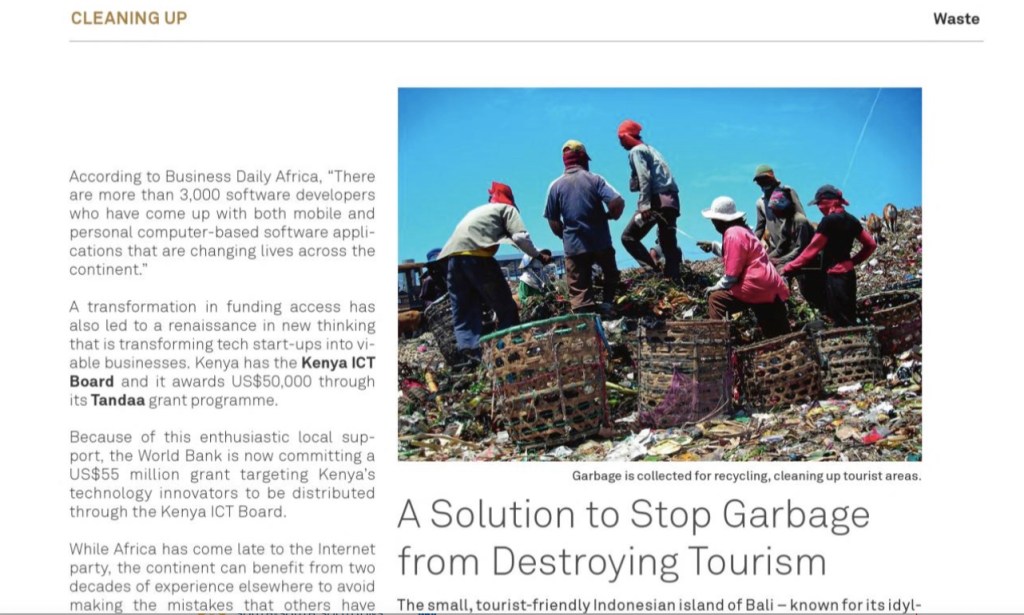
A Solution to Stop Garbage Destroying Tourism

By David SouthDevelopment Challenges, South-South Solutions

SOUTH-SOUTH CASE STUDY

Tourism is an essential source of income for countries across the South. But many put that livelihood in jeopardy when they lose control of garbage collection. A popular tourist spot can represent a ‘paradise’ to visitors, but when it becomes too popular and local garbage collection systems collapse under the burden, ‘paradise’ can soon turn to an environmental hell.

The small, tourist-friendly Indonesian island of Bali (http://en.wikipedia.org/wiki/Bali) – known for its idyllic pleasures of spas, surf and serenity – is being overwhelmed by garbage. A survey of tourists found two-thirds would not return to the island because of the problem.

Tourism took off on the island in the 1970s. The economic benefits are clear: the island went from being economically marginal to ranking second only to the country’s capital, Jakarta, in wealth creation. The island received more than 2.38 million tourists in 2009, up 14.5 percent compared with 2008, according to Ida Komang Wisnu, head of the provincial statistics office. But tourism produces on average five kilograms of waste a day per tourist – 10 times what the average Indonesian produces (Bali Fokus).

In the past, the traditional way of serving food in Indonesia was to wrap it in, or serve it on, a palm leaf: a biodegradable approach. But with the huge expansion in use of plastics and non-biodegradable packaging, the waste disposal problem is out of control.

In Indonesia, government garbage disposal services tend to collect between 30 and 40 percent of solid waste, most of this from high income communities. The majority poor population are left to fend for themselves when it comes to waste disposal.

A solution by Yuyun Ismawati, an environmental engineer and consultant, has since 1996 focused on helping poor communities find ways to safely dispose of waste. In 2000, she started her own NGO – Bali Fokus (http://balifokus.asia/balifokus/) – and opened a waste management facility in the Bali village of Temesi. The recycling plant employs 40 people from the village, who sort garbage into recyclables, compost and residual waste. Income from the recycled waste and compost goes to helping local farmers.

She then expanded her concept to include households around Bali and elsewhere in Indonesia. She concentrated on housewives and targeted reducing the amount of household waste going to dump sites. A core team trains housewives in daily habits that separate waste and compost organic matter like vegetable and fruit scraps. Bali Fokus claims it has been able to reduce waste created by 50 percent in 500 homes. Some of the women sell their compost in local markets; recyclables are turned into sellable items.

From 2001 to 2003, Ismawati turned this approach into a replicable template called SANIMAS. By 2008, the SANIMAS template was being used in hundreds of communities across Indonesia.

Her solution to the deluge of tourist waste can be seen in the luxury Jimbaran Bay area of Bali. Traditionally, the area’s hotels would sell their waste to pig farmers. While the pigs feasted on the fancy scraps, the rest of the waste was put in plastic bags and thrown away in mangrove forests.

“I told hotels: Your job is to sell rooms, not to sell garbage,” Ismawati recalls. “We have to protect Bali or else tourists won’t want to come here anymore.”

Ismawati cleverly turned the relationship around: rather than a pig farmer paying for scraps, she convinced one of them there was money to be made recycling and sorting garbage. For this, the hotels would pay the farmer.

A network of 25 hotels now pays to have their garbage taken away and sorted by hand: an important source of full-time jobs.

The workers sort through paper, plastics, glass, aluminium, food scraps and vegetables. Each week, 140 trucks deliver waste to the facility. Only 10 leave with waste that has to go to a dump site.

Food leftovers are bought by local pig farmers and grass clippings and other organic matter is composted (http://www.recyclenow.com/home_composting/), and eventually makes its way back to the hotels and is distributed in the flower beds.

This system has created 400 jobs where the pig farmer once only employed 10 people.

“If you want a hi-tech solution in a developing country you will wait and wait and wait until you get the money, or big donors to fund it,” Ismawati told the Telegraph newspaper. “And even then it may not work.”

A graphic example of this is a donated waste recycling machine given by the local government. It can’t be used because the electricity to power it costs too much. Human labour is a cheaper option.

Bali Fokus’ successful approach has now been replicated in six other sites on the nearby island of Java. And the government of Indonesia has promised to help create 15 more each year.

In 2009 Ismawati won the Goldman Award (http://www.goldmanprize.org/), which honors grassroots environmental heroes from the six inhabited continental regions: Africa, Asia, Europe, Islands and Island Nations, North America, and South and Central America.

She is also working on using decentralized grassroots approaches to bringing sewage disposal and clean water to communities.

Published: March 2010

Resources

https://davidsouthconsulting.org/2022/11/19/african-culture-as-big-business/

https://davidsouthconsulting.org/2022/10/20/african-tourism-leads-the-world-and-brings-new-opportunities/

https://davidsouthconsulting.org/2022/10/20/africas-tourism-sector-can-learn-from-asian-experience/

https://davidsouthconsulting.org/2022/11/18/bolivia-grabs-world-media-attention-with-salt-hotel/

https://davidsouthconsulting.org/2022/02/07/boosting-tourism-in-india-with-surfing-culture/

https://davidsouthconsulting.org/2022/09/27/caribbean-island-st-kitts-goes-green-for-tourism/

https://davidsouthconsulting.org/2022/11/20/ecotourism-to-heal-the-scars-of-the-past/

https://davidsouthconsulting.org/2022/11/21/from-warriors-to-tour-guides/

https://davidsouthconsulting.org/2022/11/11/havanas-restaurant-boom-augers-in-new-age-of-entrepreneurs/

https://davidsouthconsulting.org/2022/11/15/indonesia-best-for-entrepreneurs/

https://davidsouthconsulting.org/2022/11/01/indonesian-food-company-helps-itself-by-making-farmers-more-efficient/

https://davidsouthconsulting.org/2022/11/15/indonesian-middle-class-recycle-wealth-back-into-domestic-economy/

https://davidsouthconsulting.org/2021/06/11/indonesian-wooden-radio-succeeds-with-good-design/

https://davidsouthconsulting.org/2022/11/23/kenyan-safari-begins-minutes-from-airport/

https://davidsouthconsulting.org/2022/10/26/south-gets-reading-bug-with-more-festivals/

https://davidsouthconsulting.org/2021/03/05/southern-innovator-issue-2/

https://davidsouthconsulting.org/2021/03/05/southern-innovator-issue-5/

https://davidsouthconsulting.org/2022/11/18/tourist-passion-for-quirky-holidays-helps-south/

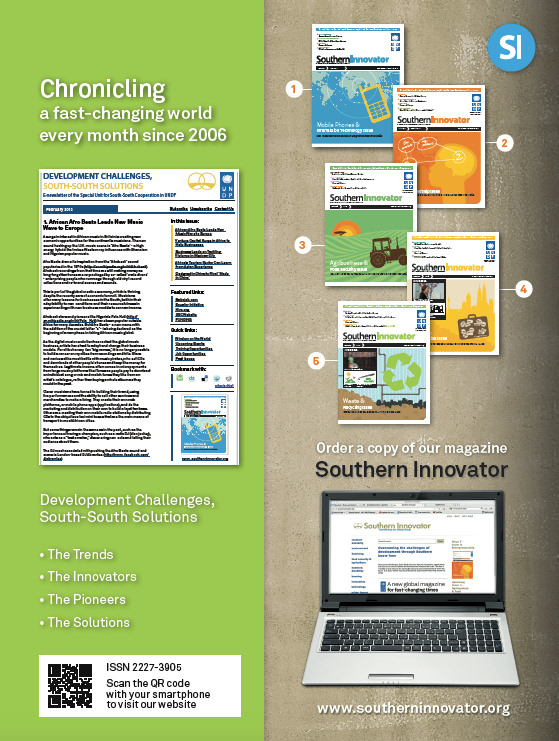
Development Challenges, South-South Solutions was launched as an e-newsletter in 2006 by UNDP’s South-South Cooperation Unit (now the United Nations Office for South-South Cooperation) based in New York, USA. It led on profiling the rise of the global South as an economic powerhouse and was one of the first regular publications to champion the global South’s innovators, entrepreneurs, and pioneers. It tracked the key trends that are now so profoundly reshaping how development is seen and done. This includes the rapid take-up of mobile phones and information technology in the global South (as profiled in the first issue of magazine Southern Innovator), the move to becoming a majority urban world, a growing global innovator culture, and the plethora of solutions being developed in the global South to tackle its problems and improve living conditions and boost human development. The success of the e-newsletter led to the launch of the magazine Southern Innovator.  

Creative Commons License

This work is licensed under a
Creative Commons Attribution-Noncommercial-No Derivative Works 3.0 License.

ORCID iD: https://orcid.org/0000-0001-5311-1052.

© David South Consulting 2023

Categories
Archive

Women Mastering Trade Rules

By David SouthDevelopment Challenges, South-South Solutions

SOUTH-SOUTH CASE STUDY

Market trading is a vital lifeline for most people in the South. Plenty of delights usually await people in the market, where live animals, herbs and spices, fresh fruits and vegetables, and life’s necessities compete for customers’ money. The formal and informal food sector plays a crucial role in empowering women and providing food to the poor. Women are often those mostly responsible for selling fresh products and street food, and running small catering operations. By being a vendor and getting food at a lower cost, they are able to contribute to their families’ food security.

Trading and selling in the marketplace can be one of the best options for poor women. By trading, women gain economic independence, learn vital business skills and enjoy the social benefits of interacting with others. But the highly individualistic nature of market trading has its downside: traders must do everything themselves and a day not spent at market is a day’s income lost. They also can only buy in small quantities, and usually pay a higher price. Or don’t know what the competitive price is, so are in a weaker bargaining position with wholesalers.

Making market trading more efficient has huge advantages, the primary one being more money for the trader.

Women market traders in Nigeria are improving their efficiency and income with mobile phones. Rural women market traders in the Obiaruku market are using mobile phones to call their suppliers, access information like commodity prices, and contact customers. A survey of the traders found 95 per cent thought mobile phones had a big impact on their business. This has included fewer trips to suppliers, a quicker way to get help when they have been robbed, and opportunities to top-up incomes by selling airtime, handsets or mobile phone accessories.

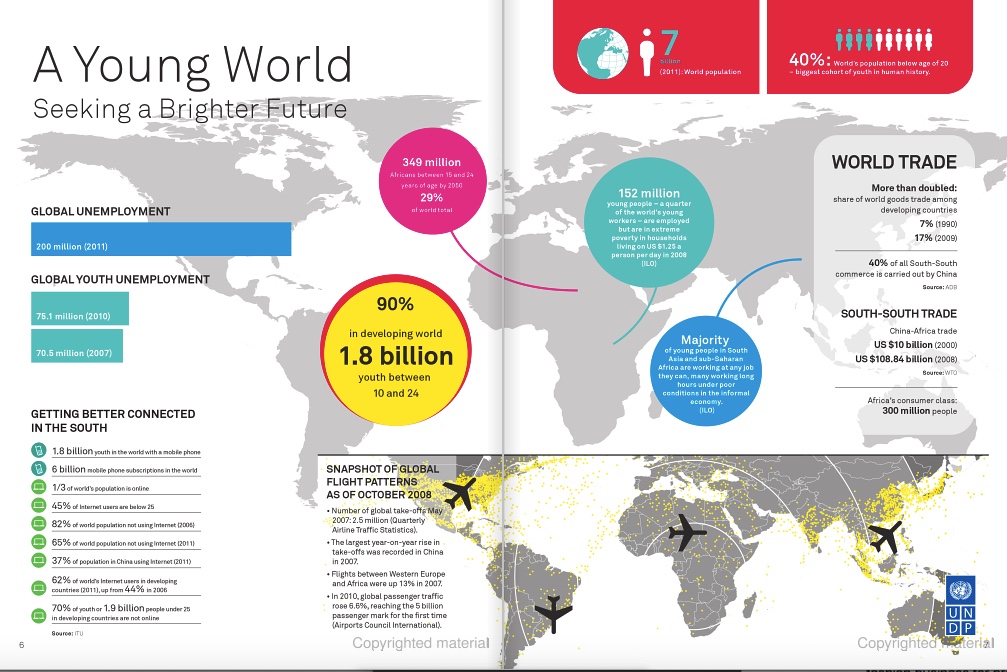
In Nigeria, mobile phone use has shot up at a rate of 25 per cent a year. A recent study found that out of a population of 140 million, 12.1 million now have mobile phones and 64 million use mobile phones through street-side phone centres. Phones are also helping women market traders to keep tabs on price fluctuations – giving them an advantage when bargaining with crafty – mostly male – suppliers. A weak bargaining position is a common problem: In Ghana, for example, product producers are forced to sell through “market queens” who take advantage of the lack of price transparency and do not always pay producers fairly (De Lardemelle, 1995).

In the Madurai region in southern India, women market traders are using a system called CAM. It allows them to record all their business transactions. CAM uses a Nokia 6600 mobile phone to record daily transactions. This includes small loans, buying livestock, or operating tiny retail businesses. The phone’s camera takes pictures of bookkeeping forms to identify and track all documents. The phone then asks the user to input numbers to the data fields. At the last key, the data is sent via text message to a central server. According to Tapan Parikh, a professor at the University of California at Berkeley School of Information in the United States, the most successful technological solutions work because they include village leaders, customers, NGOs, and others in the design process. “This is the only way to ensure long-term sustainability and benefit,” he said.

In Soweto, South Africa a simple solution to a chronic problem for women market traders has emerged. After seeing hundreds and sometimes thousands of women selling their goods in the marketplace, it became clear they all had one thing in common: they closed on Mondays. They did this because they needed to go to the wholesaler to buy their goods. And they mostly did this by piling into taxis to get there. It hurt the profitability of their businesses in many ways: there was the cost of the taxi, the fact they could only buy small amounts to squeeze in the taxi, a day’s business was lost, and the lack of a discounted, bulk price.

But the solution to this problem is a bright one: the women place a bulk, wholesale order with a go-between who works with a computer out of a former shipping container. He logs the orders into his computer and sends one big order. The wholesaler is happy with the big order, and delivers it and gives him a 15 per cent discount. This is his profit. The women pay the same price as before, but do not have to pay for the taxi and the goods are delivered directly to them. On top of this, the women can stay open on Monday and make more money!

Published: May 2008

Resources

Creative Commons License

This work is licensed under a
Creative Commons Attribution-Noncommercial-No Derivative Works 3.0 License.

ORCID iD: https://orcid.org/0000-0001-5311-1052.

© David South Consulting 2023
Categories
Archive Development Challenges, South-South Solutions Newsletters

Boosting Tourism in India with Surfing Culture

By David SouthDevelopment Challenges, South-South Solutions

SOUTH-SOUTH CASE STUDY

Tourism has experienced decades of growth and diversification and is now considered one of the fastest-growing economic sectors in the world. According to the UNWTO – the United Nations World Tourism Organization – modern tourism is “a key driver for socio-economic progress.”

The scale of global tourism means it rivals other sectors, such as oil exports, food products and automobiles in terms of economic clout. With such an important role to play in global commerce, it has become a top income source for developing countries in the global South.

International tourist arrivals grew by 4 per cent in 2012, reaching a record 1.035 billion worldwide (UNWTO). Emerging economies led the growth in tourism, with Asia and the Pacific showing the strongest gains. Tourism outpaced growth in the wider world economy in 2012, contributing US $2.1 trillion to global GDP and supporting 101 million jobs (WTTC).

“2012 saw continued economic volatility around the globe, particularly in the Eurozone. Yet international tourism managed to stay on course” said UNWTO Secretary-General Taleb Rifai. “The sector has shown its capacity to adjust to the changing market conditions and, although at a slightly more modest rate, is expected to continue expanding in 2013. Tourism is thus one of the pillars that should be supported by governments around the world as part of the solution to stimulating economic growth.”

One country that has found tourism becoming a key contributor to its national income is India. The country’s travel and tourism industry is now three times larger than its automotive manufacturing industry, and generates more jobs than chemical manufacturing, communications and the mining sector combined (World Travel and Tourism Council).

Indian Tourism Minister Subodh Kant Sahai called for the sector to create 25 million new jobs over the next five years and it is hoping to grow the market by 12 per cent by 2016 (The Economic Times).

Travel and tourism now contributes 6.7 billion rupees (US $124 million) – or 6.4 per cent – of the country’s total GDP (gross domestic product). The sector supports 39 million jobs directly and indirectly.

But competition for global tourist dollars is fierce. As more flight routes open up – Africa for example, is seeing new airlines and routes emerge every year – a person looking for somewhere to holiday has an ever-growing range of options to choose from. Will it be Africa this year, or shall we go to Asia?
One way to attract tourists and gain an extra edge in the global travel marketplace is to show imagination and innovation. Being different and novel can be the clincher for a tourist, especially one who is widely travelled and is searching for new experiences.

In Southern India, the state of Kerala is well known for its ayurvedic medicine (http://en.wikipedia.org/wiki/Ayurveda) and food tradition going back centuries, combined with its laid-back beach culture. It is a heady combination that successfully attracts many people, who come to relax and boost their health.
Now, Kerala is offering a new dimension to this experience: surfing. Surfing is a water sport involving a person riding ocean waves (https://en.wikipedia.org/wiki/Surfing), usually on a long board. India has enormous and mostly untapped potential as a surfing destination, with its hot weather and 7,000 kilometres of coastline.

Soul and Surf (http://soulandsurf.com) in Golden Beach, Varkala is within walking distance of the Varkala Cliff tourist area and an hour away from the closest major airport, Trivandrum International Airport.

The founders of Soul and Surf, Ed and Sofie Templeton, were captivated by “surfing warm, empty waves, eating wonderful fresh, cheap seafood, practicing yoga and receiving ayurvedic treatments”, according to their website.

“Enchanted by India’s magical, spiritual atmosphere, the warmth of the local people and the raw natural beauty of the area,” they set up a combined surfing and yoga retreat in 2010.

They have become part of a growing surfing scene in Kerala, and an increasing awareness in the country that its long ocean coastline is perfect for water sports.

As surfing grows in India, the owners wanted to create a business that supported the local area, particularly coastal fishing communities surrounding Varkala.

They have also expanded to run a luxury surf and yoga retreat in Sri Lanka and guided trips to the Andaman Islands.

Soul and Surf was inspired by the Surfing India Surf Ashram (surfingindia.net), a 12-hour trip up the coast from Surf and Soul in Karnataka.

Their so-called “Surfing Swamis” have discovered the best places to surf in India and are spirited champions of the whole surfing lifestyle. A swami (http://en.wikipedia.org/wiki/Swami) is a Hindu male religious teacher.
Surfing India promotes adventure sport in India and was started in 2004. At the time, surfing in India had a very low profile. Surfing India offers a sophisticated experience to travellers, including Wi-Fi Internet access, vegetarian food and all the equipment required.

All the staff are volunteers and work for room and board. Profits are plowed back into keeping the surf ashram going and helping its activities, which include adventure tours, a surf camp, surf school, yoga retreat, bodyboarding, snorkelling and wakeboarding.

The Surfing Swamis Foundation is a non-profit organization whose goal is to “teach surfing and environmental awareness to children, orphans, and handicapped persons of any age or gender.”

It also sponsors the All India Surf Team for boys and girls across India.

Published: April 2013

Resources

1) India Surf Festival: Taking place at the beginning of the year. Website: http://www.surfingindia.net/random-stuff/india-surf-festival-2013

2) A guide to the best places to surf in India. Website:http://www.surfingindia.net/india-surf-spots

3) Surfing Federation of India. Website:http://www.surfingfederationofindia.org/

4) United Nations World Tourism Organization: The World Tourism Organization (UNWTO) is the United Nations agency responsible for the promotion of responsible, sustainable and universally accessible tourism. Website: unwto.org

Southern Innovator logo

London Edit

31 July 2013

https://davidsouthconsulting.org/2022/10/20/african-tourism-leads-the-world-and-brings-new-opportunities/

https://davidsouthconsulting.org/2022/10/20/africas-tourism-sector-can-learn-from-asian-experience/

https://davidsouthconsulting.org/2022/09/27/caribbean-island-st-kitts-goes-green-for-tourism/

https://davidsouthconsulting.org/2022/11/20/ecotourism-to-heal-the-scars-of-the-past/

https://davidsouthconsulting.org/2022/11/23/kenyan-safari-begins-minutes-from-airport/

https://davidsouthconsulting.org/2022/10/10/a-solution-to-stop-garbage-destroying-tourism/

Creative Commons License

This work is licensed under a
Creative Commons Attribution-Noncommercial-No Derivative Works 3.0 License.

ORCID iD: https://orcid.org/0000-0001-5311-1052.

© David South Consulting 2023