Categories
Archive Blogroll id magazine

State Of Decay: Haiti Turns To Free-Market Economics And The UN To Save Itself

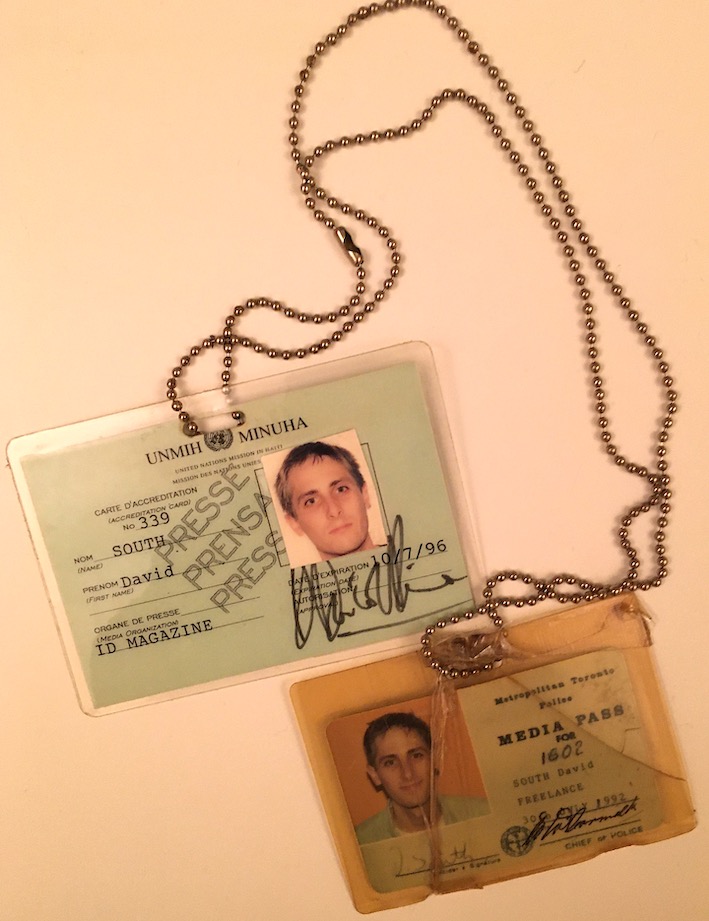
By David South

Id Magazine (Canada), July 11-25, 1996

Port-au-Prince – Brand-new four-by-four jeeps in various shapes and sizes bounce over the moon-like craters of Port-au-Prince’s roads. The presence of so many expensive vehicles in a country unable to feed all its citizens is hard to take, but it is not one of the worst paradoxes of Haiti.

The appalling state of the roads – more like occassional stretches of asphalt to break up the monotony of potholes – is an apt symbol of Haiti, a reminder with every jar of the tailbone of the public squalor of the many and the private wealth of the few. The shiny new jeeps are not a sign of recent good times, but reveal who has all the money in this nation of almost seven million: the tiny Haitian elite, thieves, the United Nations and the multitude of non-governmental aid agencies.

When democratically-elected president Jean-Bertrand Artistide, deposed in a 1991 coup, returned to complete his term in office in 1994, many Haitians hoped that this country would at last begin to shake off centuries of exploitation at the hands of a selfish elite backed by American corporate masters and begin to build a democratic future.

The United Nations mission in Haiti, which includes 700 Canadian troops, is intended to support the country’s fledgling democracy. But Haiti’s future remains uncertain – as does the role the UN will play in shaping it.

Despite negotiating a peaceful and democratic transition last February 7 from Aristide – a firebrand former priest and passionate advocate of Haiti’s poor – to successor Rene Garcia Preval, Haiti hasn’t stopped its economic freefall. Economists predict the country won’t match 1991 earning levels until the next century. Political unrest resulting from opposition to the government’s privatization plans could also spell trouble ahead.

The United Nations presence, due to end June 30, has been extended another five months at the request of the Haitian government. The newly-minted UN Support Mission in Haiti, a military force of 600 UN troops supported by 700 soldiers paid through voluntary contributions, is being assembled. It will replace the current force of 1900.

Lousy loans

Meanwhile, the government of Rene Preval is negotiating with the International Monetary Fund (IMF), the World Bank and the United States to get much-needed loans to help balance the budget. Critics say the world’s banks are trying to lock the poorest country in the Western hemisphere further into crippling debt. The Haitian budget is US $750 million, 60 per cent of which the government hopes to raise from loans.

But there is a condition. Haiti must embark on a structural adjustment programme: widespread firings of the public service, privatization of most of the public sector, loosening of controls over foreign capital, adherance to the ethos of global trading blocks espoused by the North American Free Trade Agreement (NAFTA). Some call this neo-liberalism, others neo-conservatism. Either way, it forces this impoverished country to limit how it can address rebuilding a crumbling infrastructure.

The government’s hands are tied, though, as the conditions were part of the deal to return Aristide to power.

A Canadian public relations company, Gervais-Gagnon-Covington Associates, has been paid US $800,000 by the American government to sell the idea of privatization of Haiti’s handful of idle and near-bankrupt state enterprises.

In order to plunge deep into this Haitian quagmire, I pitch up at the legendary Hotel Oloffson – made famous by novelist Graham Greene in The Comedians – and begin interviewing in the languid atmosphere by the pool.

“Aristide has put Haitians in a giant trap with the IMF plan,” says Jane Regan, who runs an independent news service based in Port-au-Prince. “The US $1 billion in loans will double the national debt.

“Haiti used to be self-sufficient in rice – last year they bought US $56 billion in US rice. The roads are worse now than a year ago. Right now the UN mission is of questionable worth and Canadians are getting taken advantage of.  They have been sent to clean up after the Americans. These are the same neo-liberal economic policies that hurt Canadian workers – just imagine what Haitians are feeling!”

Regan thinks that, so far, the only people to make any money out of this arrangement are businesses and the more than 800 NGOs operating in Haiti. And on that note, the feisty Regan disrobes and plunges into the Hotel’s pool.

According to Kim Ives, a reporter with the Haitian newspaper Haiti Progres, there are a few cracks in the solidarity between Preval and Aristide: “Aristide is hitting out against privatizations. In a two-hour TV interview, he drew a line between himself and Preval.”

One of the few visible signs of change in Haiti is the dusty Octobre 15 road leading from the airport past former president Aristide’s palatial home on its way to the wealthy suburb of Petionville. It is bordered on one side by Camp Maple Leaf, and on the other by dilapidated shanty towns and desperate street vendors.

Cynics point out the road conveniently serves the interests of the elite once again. It offers a direct and more or less pothole-free route from the secluded mansions of Petionville to the airport – a crucial escape route in a politically volatile developing country. In fact, a development of monster homes that would make a Canadian suburbanite blush is going up near the airport to capitalise on this.

Canadian troops

Caught between the Haitian government and its people is the United Nations, including Canada’s troops. Canadian troops form the first line of defence – along with Preval’s personal secuity guards – to defend the National Palace. They accompany the president wherever he goes, 24 hours a day.

Some fear growing resentment among Haitians for government policies will pitch the population against the soldiers.

At Camp Maple Leaf, the home base of Canada’s military contingent in Haiti, the troops are scrambling to adjust to a new mission sanctioned by the United Nations. As of June 30, they must take a back seat to the troubled Haitian police force as it tries to prove that the intensive training provided by police from around the world has paid off.

In the first week of July, the Canadian soldiers of the Royal 22nd Regiment – the famous Vandoos  – receive confusing news about a change in their firing orders or Rules of Engagement. ROEs dictate the tone and behaviour of peacekeepers on a UN mission and, as the experience of Somalia demonstrates, they can be the difference between success and disaster.

As the new mandate starts, the Canadians are first told they will be only able to use deadly force to defend themselves and not Haitians. If a member of the government is assassinated, they must stand by. If a Haitian is clubbed to death before their eyes, they must stand back. It is a qualitative change from their ROEs prior to June 30.

Ottawa military spokesman Captain Conrad Bellehumour says the change is indicative of an evolving mandate. But a military spokesman in Haiti says the old ROEs are now back in force, and Canadians can intervene to save a Haitian’s life.

“Maybe somebody’s been listening to Jean-Luc Picard too much,” quips retired Brigadier-General Jim Hanson, in a reference to TV show Star Trek’s prime directive of non-interference in a culture.

Preval’s police

A large banner hangs over a Port-au-Prince street: “Police + Population = Securite + Paix”. The UN has placed its greatest emphasis on reforming Haiti’s policing and justice system. The Police Nationale d’Haiti (PNH) was formed, and the RCMP and the American Federal Bureau of Investigation (FBI) were asked to provide training. The idea is to break from the past – when the military used policing as an opportunity to terrorize the population – and establish a police force to serve and protect.

But the efforts of the Haitians and their international police advisers have had a mixed success. According to Canadian soldiers, the Haitian police need to be coaxed into conducting routine patrols and have not given up patrolling in large numbers in the back of a pick up truck with rifles at the ready. To be fair, seven police officers have been killed since January, in what many believe is an organized campaign of terror orchestrated by sympathizers of the old dictatorship and drug gangs.

According to Sergeant Serge Martin of the Vandoos, “The PNH use 15 police officers to patrol and don’t talk to anybody.”

“You don’t depend on police to protect you,” claims Regan. “The Haitian government has no control over them. You don’t know if there is going to be a coup tomorrow.”

Jean-Yves Urfie, editor of the pro-democracy Libete newspaper in Port-au-Prince, believes the campaign to kill police goes back to the United States. “I am convinced the coup d’etat was financed by the Republican administration. I believe the Republicans want to destroy things here to show (President) Clinton wasted his time bringing Aristide back.

“The government was forced to incorporate former members of the military into the police force. And it would be terrible if the population develops the impression all cops are bad.”

“They are 10 years away from a viable police force,” concludes Hanson.

A stop at the fourth precinct police station shows just how far things still need to go. At the counter is a lone police officer, sharply turned out in his beige shirt and yellow-striped navy pants, courtesy of the Royal Canadian Mounted Police. But this proves to be a veneer of change. Canadian soldiers ask if everything is alright. They then ask to see tonight’s prisoners. The officer sheepishly leads the troops down a narrow corridor to 9 ‘ by 12 ‘ foot cell stuffed with nine prisoners. It is very hot and the stench from an open drain overflowing with sewage is nauseating.

Outside the Penitencier National in downtown Port-au-Prince, a yellow concrete structure with peeling pain, Haitians lined up to feed the inmates, talk about their frustrations with a justice system that has collapsed. Many complain that only the rich, who can hire lawyers, can enjoy the fruits of democracy. While state-directed beatings and killings have been dramatically reduced, most prisoners rot on remand until they are charged with a crime. Heiner Rosentdahl, the UN representative in Haiti in charge of prison reform, tries to be upbeat. “There have been no changes in conditions in Haiti’s prisons. Treatment of the prisoners is better, though there have been some abuses. We have developed a nation-wide register book of prisoners to help keep track of who is in prison.”

Another mixed blessing, according to Rosendahl, is the new requirement that all prisoners be fed two meal a day. The food is so poor, prisoners have been getting sick.

He is frustrated with the pace of penal reform. “The Haitian prison system hasn’t had a budget since October 1995, because of battles within the parliament,” he says. “The Haitian government didn’t ask for a plan to change this situation despite the minister of justice visiting the prison for the first time.”

According to Rosendahl, it is not the routine killing of thieves by mobs that worries the elite. Nor is it the assassination of police officers, or the untold thousands dying of disease and hunger. The only thing that is beginning to rock their world is a new phenomenon for Haiti: kidnapping and extortion.

Voodoo economics

For such a seriously depressed economy, there is an astonishingly large number of lottery booths – or Borlettes – on Haitian streets. They are so plentiful, they join gas stations as the main landmarks of the streets.

The industrial park which is now home to the remaining American troops stationed in Port-au-Prince, is a good monument to Haiti’s economic problems. Dilapidated and only barely functioning, this facility once supported, directly and indirectly, a large portion of the city’s population. As crummy as the sweatshop jobs were, they provided valuable income for the capital’s poor.

The Haitian economy under Francois Duvalier and his son, Jean-Claude, before the chaos of the late 1980s and 1990s, was based on assembling manufactured goods for the US market. Haiti was the world’s largest producer of baseballs, and ranked as “top three in the assembly of such diverse products as stuffed toys, dolls and apparel, especially brassieres. All told, the impact of international subcontracting was considerable,” according to author Paul Farmer in his book, The Uses of Haiti.

Today, Pierre Joseph, a Haitian-American from New York City, has a new job: he screens the ID cards of Haitian workers as they enter the park. He says there were once over 50 factories operating here; now there are 30.

Evidence of Haiti’s economic collapse is everywhere. On the walls outside the National Palace is scrawled Aba Preval Granhanje – Preval is a liar. Across the wide boulevard in a square are around 75 homeless children. They joke with the Canadian soldiers, especially boyish 2nd Lt. Marc Verret, who looks like a baby in soldiers clothes. The kids beg him for water and money.

In the market area, the piles of garbage, rotting meat and excrement make a muddy devil’s stew. Homeless children sleep on top of the abandoned crates. One small child is curled up in an American flag, asleep.

Desecrating dead

The dead also suffer the indignities of economic ruin. Outside the gates of the Hopital Generale, a man lies dead on a broken trolley in the yard. Others still alive, with limbs missing, are sprawled out on the ground. Chickens and goats roam the grounds. In the back is the main morgue for Port-au-Prince. The odour just 25 feet from the entrance to the morgue is normal for this city strewn with rotting garbage and stewed by a hot sun.

Inside, an overpowering odour like rotten chicken meat is the product of 450 human cadavers. Like rag dolls laid out in a ghoulish toy store, row upon row of children dead from starvation and disease – Haiti’s infant mortality rate is 127 per 1,000 babies born – are stacked almost to the ceiling. There are also adults. Old women, young men badly mutilated for stealing, are strewn out on the dirty concrete floor and on shelves.

There is no refrigeration, and according to military doctor Major Tim Cook, “something really nasty is going to come out of there if they don’t do something.”

Proving peacekeeping

More is at stake in Haiti than the re-building of a politically and economically devastated nation. For Canada’s armed forces, shaken and little stirred by the Somalia scandal, it is an opportunity to make amends. This time around, the peacekeepers are keeping the needs of the local population foremost in their gun sights. When the Vandoos head out on another one of their 24-hour patrols, the atmosphere is friendly and filled with gentle ribbing with the locals. They have the advantage of being able to speak French, a language understood to varying degrees by most of the population.

The approach of the individual soldiers varies widely. On a routine patrol, Alpha Company engaged in good-natured kidding around, with splashing the locals the worst offence. But a day out with Charlie Company, led by Sergeant Serge Martin, proved another story. The two privates assigned to accompany a group of journalists were a couple of operators. The day included a visit to a perfume shop, a trip through the wharf area looking for prostitutes and constant propositioning of the local women.

One Canadian corporal with the Vandoos, Eric Charbonneau, has been trying to make a small difference to the lives of the 400 people living in the community of Cazeau, a shanty town near the international airport. He has started literacy and hygiene lessons and raised money to help the residents build concrete houses to replace the mud dwellings they currently inhabit.

“I was walking along the fence and started to build a relationship with the kids,” he explains. “Some guy approached me and needed some help. It took three weeks to build a relationship. They are too used to white people giving away things for doing nothing. They were surprised when they had to work for it.”

At the gates to Camp Maple Leaf is a spray-painted sign. In Creole, French and English beside a Canadian flag, it says “No More Jobs.” While it could look at home back in Canada, it illustrates how important the presence of soldiers, the United Nations and charities are right now to the economy.

Some observers see the UN presence as part of a slide back into dependency on foreign money, restricting Haiti’s ability to assert itself. But others believe the turn to the international community is Haiti’s last hope of breaking with a past littered with dictatorships and poverty.

According to Captain Roberto Blizzard – an erudite and wise observer of the situation – the base has been stampeded with desperate Haitians looking for work. Blizzard has tried to find work for as many Haitians as he can, even helping them to form a laundry co-operative he hopes will survive long past the Canadians’ stay.

“There is a danger of the Haitian people turning into full-time beggars,” he says with sadness.

Further reading:

Failed States and Institutional Decay: Understanding Instability and Poverty in the Developing World by Natasha M. Ezrow and Erica Frantz, Bloomsbury Academic, 18 July 2013.

Towards a taxonomy of failed states in the New World Order: decaying Somalia, Liberia, Rwanda and Haiti by Jean-Germain Gros, Third World Quarterly, Vol. 17 No. 3 September 1996 Section 5 Page 455

https://davidsouthconsulting.org/2021/10/28/ending-gang-violence-while-cleaning-the-streets-in-haiti/

https://davidsouthconsulting.org/2021/09/01/haiti-earthquake-prompts-tech-aid/

https://davidsouthconsulting.org/2021/01/08/haitian-coffee-becoming-a-hit-with-american-connoisseurs/

https://davidsouthconsulting.org/2021/10/28/milk-co-operatives-help-hungry-haiti/

https://davidsouthconsulting.org/2022/09/23/opinion-canada-is-allowing-u-s-to-dictate-haitis-renewal-more-news-and-opinion-on-what-the-un-soldiers-call-the-haitian-vacation/

https://davidsouthconsulting.org/2021/01/26/u-s-elections-update-clinton-is-using-canada-to-keep-control-of-haiti/

Creative Commons License

This work is licensed under a
Creative Commons Attribution-Noncommercial-No Derivative Works 3.0 License.

ORCID iD: https://orcid.org/0000-0001-5311-1052.

© David South Consulting 2025
Categories
Archive Blogroll UNDP Mongolia 1997-1999

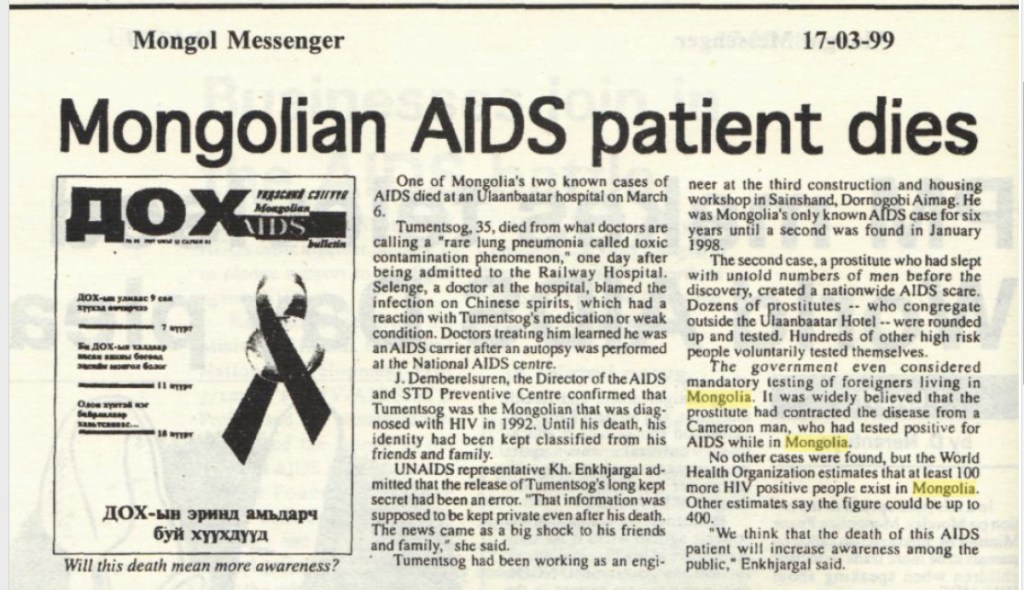
Mongolian AIDS Bulletin

English Translation of the Magazine

Mongolian AIDS Bulletin
Issue No.1-December 1,1997

This is the English translation of the original Mongolian text

Contents:

About red stripe…

Red stripe is a symbol of solidarity with millions and millions of AIDS-infected, to take care after them and to join in a battle against of this disease.

Message from the Editor

“Information and education are the most powerful instruments to protect our planet from AIDS”. This quotation is found in the introduction of one of the international organisation against AIDS.

The Mongolian delegation participated in the 4th Conference on the AIDS issue in Manila on 24-29 October brought this idea back home. Mongolians admit a lack of adequate information. Therefore we have decided to publish this magazine to support efforts AIDS . Also it would be the bridge in the battle against AIDS between Mongolian Government and Mongolian people.

We would like to acknowledge the UNDP Resident Representative Mr. Douglas Gardner, Support Officer to Resident Co-ordinator, UNDP Mr. Jerry van Mourik and Mr. Nicholas Bates for the financial support and Mr. David South, Information Specialist UNDP for the initiative to produce this magazine and for their valuable professional assistance.

We also acknowledge Mr. Sh. Enkhbat, Secretary of the National AIDS Committee, Mr. H. Davaajav, Head of the department against AIDS/STD of the Infection Dicease Research Centre, Ms. Narantuya, correspondent of the newspaper “Mongol Messenger” for their encouragement and support.

Since this is our first issue, we recognise there will be mistakes. Your comments and valuable criticism are very welcome. We hope that with your assistance our magazine would have its own feature stories in the near future and we look forward receiving letters and photos from you.

We wish you good health and success in your work.

D. Altanchimeg

AIDS update news

According to the latest report from UNAIDS Programme a number of AIDS virus infected people has reached to more than 30 millions. Comparing with the number of infected people in 1996 – 22,6 millions it increases by 19 %.

It is said in a report that “this is much large number”.

CNN news reports that 1 out of 100 sexually active population of age from 16 to 49 is infected by AIDS virus. Only 1 out of 10 AIDS virus infected is aware of this fact.

National newsbulletin

Prime Minister called for parents to talk about AIDS hazard with children at least one time

On a World day of battling against AIDS the Prime Minister of Mongolia called for parents to talk about AIDS danger with children at least one time in order to prevent from the epidemic of this century – AIDS.

Prior to the World day of battling against AIDS a first session of the National Committee to battle against AIDS took place in Ulaanbaatar. Prime minister of Mongolia underlined in his speech on this session the importance given by Mongolia to the need to battle against this disease through a setting of National Committee headed by the Prime Minster in a full awareness of the hazard of the disease encountered by the world community:

“ International experts have identified that in nations facing socio-economic transitions there is a base for AIDS dissemination. On the other hand, although a great experience has bee accumulated by Mongolia in battling of sexually-transmitted diseases (STD,) in circumstances of this time it becomes vital to change the ways and methods of battling”.

The first session of the National Committee has advised to youth and health organizations to consider the establishing of mutual trust and understanding with the people of risk group (vulnerable group) who are vulnerable to this disease one of areas of battling activities, .as well as stressed the need for cooperation and participation of citizenry, institutions of all levels of the society.

Also the Prime Minister pointed out that since of its dissemination the “disease put on a stake the existence or collapse of a specific nation”, that’s why AIDS battling it is not a matter of health sector employees.

Prime Minster highly appreciated UN cooperation in provided support and participation to the Government of Mongolia in battling of AIDS and STD.

Government of Mongolia is to cooperate with UN in battling against AIDS

In June of 1997 the Government of Mongolia and UN organizations concluded a Memorandum of understanding to undertake joint activities in battling against AIDS, STD and Human Immuno Deficiency Virus (HIV).

At late of November the Project team was established to undertake this joint Programme. The team comprises of H. Enhjargal, National Coordinator, Nicholas Bates, Health Consultant and B. Oyun, Project staff member.

According to Enhjargal, the main objective of the Team is to coordinate health, education, media and NGOs in implementing of the Programme, to increase public participation in battling of AIDS, to change a wrong approach considering this matter a matter of few doctors and to move it to public-oriented.

AIDS battling National Committee established

By a Resolution of the Government of October 29, 1997 National Committee to battle against AIDS was set up headed by Prime Minister M. Enhsaihan; L. Zorig, Minister of Health and Social Welfare is a deputy Chair; Also Ministers of Finance, Justice, Education, Chief of Radio and TV as well as other key relevant officials.

Sub regional session took place in Ulaanbaatar

On November 11-13 1997, a consultative session of North Eastern Asian nations such as People’s Republic of China and Mongolia was taken place in Ulaanbaatar to discuss issues of AIDS. The session arranged jointly by UNDP Office Mongolia and Ministry of Health and Social Welfare discussed a project to prevent from battle against AIDS in North Eastern Asian nations. Within the frame of this UN-funded worth 400.000 US D for a duration of 3 year the activities to speed up research work against AIDS; to exchange the staff; to provide with publicity materials and to enroll into training media representatives in this area will be undertaken.

Mongolia first ever time participated in Regional Conference

Mongolian delegation first ever time participated in 4th Conference of Asia and Pacific Region nations on AIDS issue taken place in Manila, capital city of Philippines on October 25-29.

Although only one person is officially registered as AIDS virus infected in Mongolia, with regard to the following real reasons: less than 3% of total population was involved in AIDS analysis; number of STD infected people – as a basis for AIDS infection – in increasing every year; number of prostitutes and street children – as representatives of risk group (vulnerable group) is also increasing as well as a fact that in Russia and China – two actions where many Mongolians travel for business and private purposes – a number of infected people is growing the professionals are doubtful that only one person in Mongolia is infected by this virus. Therefore, it is understood that at such a crucial stage of encountered internal and external factors the participation of Mongolian delegation comprised from representatives of legislative body, ministry and NGO in Manila Conference is a sign that Mongolia is to undertake thorough battle activities against AIDS.

As soon as one is infected and the disease is spread out it requires a large amount of funds, therefore, in circumstances of Mongolia it is vital to conduct preventive training programs based on a concrete analysis and in accordance with Mongolian mentality; to undertake publicity activities about use of condom as one of most reliable way to prevent from AIDS – presented participants of the Conference.

On a press conference held as a follow-up activity of Manila Conference, Ms. B. Delgermaa, MP said:”This issue is new for Mongolian society. The Conference gave us an opportunity to learn from experience of ways of battling against AIDS and preventive measures taken by nations of Asia Pacific Region”.

Events on AIDS 

THE AIDS/STD TEST

By the order of the Ministry of Health and Social Welfare, AIDS/STD tests were carried out among people aged 15-40 from May to October, 1997. The test have not released as of 20 November, as aimags statistics have not arrived.

According to the results of the tests carried out in Ulaanbaatar, the 84% of all people targeted to be tested have been covered in the campaign. The Minister of Health and Social Welfare, Zorig reported that 63518 people have been tested in Ulaanbaatar and 1300 have STD. Bayanzurkh, Chingeltei district the city Ulaanbaatar have the highest number of people with STD. “ It is because a lot of young people live in those districts and the infrastructure is not well developed comparing with other districts.” Said Minister Zorig. The printed decree by the Ulaanbaatar city governor Narantsatsaralt gave the permission to doctors to use force if a person is not willing to be tested.

However the Ministry of Health and Social Welfare is denying the use of force for testing. Before 19980, the Ministry of Health and the local authorities co-operated with medical organisations used to conduct medical examinations and tests, including STD tests and covered 80% of the population.

40 MILLION CHILDREN ARE ORPHANS

Reuters news agency reports that according to the USAID estimation about 40 million children are orphaned since their parents have died of AIDS. Those children are under high risk to starve to death or to become sick or to become involved in child labour. It means the social welfare system has to be responsible for the care of those orphan children.

AIDS AND INFANT MORTALITY

The infant mortality rate is increasing in many countries because of AIDS. If the number of people infected by HIV does decrease the infant mortality rate, will triple over the next 15 years in countries such as Thailand and Zimbabwe.

DEMOGRAPHIC EFFECTS OF AIDS

The average life expectancy of the population of countries can be an important index of development. But in countries seriously affected by AIDS/HIV this index is changing dramatically. For instance, the life expectancy has decreased to 37 years in Uganda placing this country in last place. Scientists calculated that life expectancy will decreased to 25 years in some Asian and African countries by the year 2010. For example, the life expectancy of Zimbabwe is projected to decrease from 70 to 40 by 2010.

The sudden death of the princess Diana was a great loss for people infected by HIV/AIDS. How could we forget her humanistic attitude towards the people with HIV /AIDS. She shook their hands and held children suffering from AIDS and participated actively in the battle against AIDS.

In his condolence Dr. Roi Chan has said that Diana was an outstanding fighter against AIDS and against discrimination of those with HIV and AIDS. She was an active organiser of charity activities.

SOON WOMEN WOULD USE CONDOMS

Until recently condoms were only for men. According to numerous surveys carried out in many countries, it showed that woman are powerless in having safe sexual relations with men. The research work experimenting with condoms for women is in the final stage and the results are promising. Currently 10 countries are ordered the product and more than 30 countries are expressed their interest to purchase the product.

The price of the new condom would not be more than 1 $ promised the NUAIDS program.

Countries from Asia and Pacific region

AUSTRALIA

Australia has been one of the countries most affected by AIDS in the region. Since 1987 as a result of the Government action giving priority to people’s participation against AIDS, AIDS infection is now under control. The number of newly infected people is reducing.

CAMBODIA

AIDS infection is spreading rapidly in Cambodia and its future is not very rosy According to the official statistics data 600 people are AIDS virus infected . However it is estimated that this number is at least 100 thousand. The study carried out in 1997 shows that 40% of prostitutes, 6% of police and army people, 3% of pregnant women of are infected by AIDS virus.

CHINA

Xinhua news agency informed that the number of people registered as HIV infected and suffering from AIDS reached to 8277 in September, most were people are intervenous drug users. The joint UNAIDS program estimated that this year 400 thousand more people may have been infected by AIDS virus.

INDIA

AIDS is spreading dramatically in India. There are currently 5000 people living with AIDS according to official studies. Specialists think 2.5 million people are suspected or being infected by AIDS.

JAPAN

1,521 people are suffering from AIDS virus and 3,665 people are infected, by AIDS in Japan. Most of those unfortunate people got infected from imported donor blood and blood products.

SOUTH KOREA

AIDS is spread in Korea extremely slowly. The situation is changing. In June, 1997 679 people were HIV infected and 83 people are suffering from AIDS.

PHILIPPINES

There are 922 people infected with HIV and 312 people are experiencing AIDS symptoms. Most of those people are young people aged 20-49. However about 175000 more people are likely infected by AIDS.

What is UNAIDS ?

In December 1994 UNAIDS program was established as the United NAtion AIDS joint program UNICEF, UNDP, UNESCO, UNFPA, WHO and the World Bank. The main goal of this program to attract attention to the integration all efforts against AIDS. In order to fulfil its objective, a global policy against AIDS should be developed including support in planning, research studies and development amongst all nations.

Dr. Peter Piot, executive director of UNAIDS program, gave a speech at the Manila Conference. In his speech he underlined that, “ Asia has the highest density of population in the world. Therefore, countries from this region facing the danger of AIDS should wake up from their passiveness and accelerate the battle against AIDS.” He has identified the action plan of the UNAIDS program for this region in the following four steps:

  • 1. The countries and their leaders should realise the necessity of an effective battle against AIDS2. In order to make an effective effort against AIDS, the proven experiences and methods from different countries should be shared.3. To activate community initiatives in the battle against AIDS4. To involve all countries and nations spontaneously in the campaign against AIDS.

“ The battle against AIDS is progressing. Only our enemy is to do nothing” emphasised Mr. Peter in the Manila conference.

Children of the AIDS Era

Every year, on December 1 the world community has a tradition to undertake measures to be solidary in a battle against AIDS, to do publicity work about the harm and hazard of the disease, to offer moral and humanitarian aid to infected and ill people and their relatives. A slogan of battle of each year is different. 1997 year’s battle against AIDS has a slogan:”Children of AIDS Era”.

According to the latest data, 90% of AIDS-infected children under the 15 age are in developing countries. Only in 1996 more 400000 children under age of 15 were infected by AIDS virus.

Children are not only infected but they also experience the consequences of this disease. In many nations of the world children lose their parents and other members of the family given to this fatal disease. By the mid of the last year 9million children under the age 15 became orphans due to this disease. This figure can make one’s heart feel ill, but it is just a small part of the social grievance. In other words, there is a number ill mother or a father or sometimes both ill are waiting in anguish for a fatal end; at the same time so much pain and suffer the children carry. These children are very different from those who lose their parents because of other reasons. These children suffer seeing how their mother or father is getting worse and worse day by day with no way of treatment. In addition to it the cool attitude from other children make them suffer more.

Since AIDS transfers through STD, so that it is very often that children lose both parents. Leon, Ugandan woman says:”I have 11 orphan children. My older sister died of AIDS and left me 6 orphan children. The other 5 are my daughter’s children who also died of AIDS.

The below examples demonstrate the presence of poverty and violation of human rights toward children who lose parents due to AIDS. Since it is heard that one of family members is infected it is common that guests avoid visiting that family; classmates become cool. According to a survey conducted in Thailand for AIDS-infected children it it taboo to play together with other children at a play-yard. Also it was revealed fro from this survey that parents might be fired, the host lady stops visiting , thus the income of the family falls down encountering poverty. There is a number of such examples reported from different corners of the world. Fortunately, there is also a number of individuals and institutions who would like to help. UNICEF, Children Protection Foundation, some religious missions and other voluntary organizations. It is vital to help those families while AIDS-infected parents are alive. Because the children suffer from a very beginning day of parents’infection.

The World Conference held in 1996 “Against violent involvement of children in prostitution and pornography” reported that every year more than 1 million children become prostitutes. Besides, there is a number of hidden violations both moral and physical against them from their relatives or strange people. Today more than 100 million children are called “street children” living on an edge of knife. The thorough preventive program based on the specific needs and demands of street and drug-addicted children is really needed.

Let’s save children who live in Era of AIDS.

PERSONAL VIEW – SHALL WE WAIT FOR THE “SILENT” EPIDEMIC?

You might say we are a little bit exaggerating things. You might also ask “Is AIDS

really threatening Mongolia?” In some countries there is a belief that the Asian people have an immunity against AIDS and it’s not a secret that some Mongolians are also subject to this naive and false understanding. It would be really wonderful if God could have blessed us with such a rare destiny but…

Dramatically, today about 5.2 mln or 25 per cent of all 22.6 mln HIV positive live in the Asia-Pacific region. According to the officil data in Thailand where AIDS was regarded as an alien’s disease, the number of HIV-positive reached 700-800 thousand, in China 8200. So, what’s the situation in Mongolia? The Mongolians proudly say that there is only 1case of AIDS was officially registered in Mongolia. Some sceptically say that there should be more than 1 case… And I am among those who think that AIDS is enevitably threatening Mongolia and is always scared to think of a day when this silent epidemic might completely demolish the country’s 2 mln population.

The term “silent” epidemic was given to the disease because unlike other infectious diseases AIDS has no distinct symptoms and it takes many years before the disease gets exposed and the last ”resort” is always death. So, it is obvious that the HIV positive victims can infect others being completely unaware of their sickness.

Mongolia has all favourable conditions for AIDs to progress like the recent development of tourism, international trade, increase of drunkness, prositution, spread of sexual perversions, street kids, rape, etc. In addition, the increase of STDs gives solid grounds for AIDs development. We, the Mongolians, have very strange attitude towards destroying ourselves with our own hands. It is common to be hospitalized and have intravenous injections and even curse the doctors who didn’t prescribe intravenous injections. There are cases of getting hepatitis B through poor sterilized syringes because of the desire to be hospitalized while being almost healthy. How many patients, nurses do we have who are really scared of getting AIDs through injections? Do we have many doctors who really care of their job’s safety? They only think of curing the diseases and don’t think of getting infected. The HIV positives mostly suffer from pneumonia, TB and lung tumours. The number of TB cases in Mongolia has sharply increased during the last years. Does the medical personnel think about it? The questions like this arouse and scare me among other problems.

Hasn’t the time for us Mongolians come to make considerable efforts and bold steps to stay less exposed to this “silent” epidemic. To lay the AIDS burden on the shoulders of the Ministry of Health would certyainly result in unforgivable mistakes. The AIDS virus doesn’t distinguish between the rich and poor, women and men as well as doesn’t accept any bribes and corruption.

Any of us can become the next victim, so the whole society is not guaranted against it. Since there is no vaccination, no medicine against the virus everybody needs to foster their knowledge , learn more and choose safe means. In that case we can prevent ourselves against the deadly virus.

We need the sound voices of mass media representatives and prominant figures to join our battle against AIDs. Shall we, the Mongolians wait for the “silent” epidemic?

D. Altanchimeg

New generation – AIDS

Sexual Education as the most reliable means against AIDS

The first AIDS case was registered in 1981 the victim being an American homosexual and about 6.4 mln people died of AIDS since the first AIDS virus was found in 1983.

Until now no effective medicine was found and everyone infected with AIDS virus is doomed to die. According to the WHO data every day 8500 people get AIDS virus of whom 7500 are adults and 1000 are children.

However, the most reliable prevention is to remember that AIDS is not that dangerous if the person takes proper care of himself. It has become a worldwide trend to teach the younger generation about AIDS transmissons ways and give them sexual education. This would allow us not only protect our 20th century future but also make a feasible contribution to the coming future. At present, 50 per cent of the world and 70 per cent of Mongolia’s population are people under 25. In Mongolia the cases of STDs and prostitution in volve more younger people as compared to previous years and this contributes to the AIDS development and indicates the importance of promoting sexual education among young people especially at secondary schools.

Historically the Mongols never talk about sex to children although the time has gone when they used to learn about sex from their communal living in one dwelling together with their parents, grandparents and also watching the livestock habits.

The nationwide survey “Young generation knowledge, attitude and experiences towards reproductive health” conducted by Mongolian Ministry of Health and WHO covering 5000 young people in between the age of 13-20 showed that 53.6 per cent of them expressed the readiness to learn about family planning, STDs and AIDS from secondary schools, 23.9 from TV and mass media and 13.1 per cent from books and magazines.

At present, the information on sexual education given at secondary schools during biology classes didn’t prove to be fully informative and complete. According to Dr.Lhagwasuren, Head of the National Medical University, a special project should be elaborated focusing on how the sexual education should be taught and when and at what age and in what context.

Recently, the lecturer of the National Medical University B. Ayush and Gynecologist Bayarmaa founded the “Young generation – future” centre.The centre aims at giving basic education about reproductive health to 10-24 year olds, unexpected pregnancy, prevention of STDs and AIDS, as well as rendering qualified medical assistance. The consultancy hot-line “Trusty phone” is to start operating soon and will help to solve urgent problems of the youth. This is the beginning of active actions.

On the other hand, it is time for parents to give up the old fashioned understanding of “secret subject” and join efforts in teaching basic knowledge about sex. It should be also noted that in reality the parents tend to think that teaching sexual education is the duty of school teachers, so the parents also need a special training considering this subject. In other words, the parents- chidlren-school triangle is very important to ensure the success of developing sexual education to children.

It is certain that we won’t solve today’s problems by only introducting sexual education at secondary schools. There are many street kids missing the schools and and this number is increasing, the kids have no supervision and enter the sexual life without any knowledge.

The survey held by the Ministry of Health and UN Human Fund showed the increasing number of street teenagers (girsl) who get involved in sexual relations at the very early age. According to the results out of 92 street teenagers (girls) 71 or 77 per cent already started sexual life and 50.4 per cent of them were raped. The average age is 14. The experts emphasized that these figures are higher as compared to other kids who have homes. Recently, some Asian countries with the same problem of street kids have been successfully passing the sexual education through the so called “leaders” of the groups.

The doctors involved in the survey also noted that when the sreet kids (Ulaanbaatar) get STDs they inject each other with penicillinum instead of going to hospitals.

Another thing that should be considered is that the sexual education should be taught in line with the kids’ interests and habits. For example, some methods like enrolling famous pop singers, rock bands , basketball stars or using the most popular FM channells in STDs and AIDS pevention campaigns could have more effect on city kids while in countryside the prominent young wrestlers with national titles could participate in these campaigns and make them more fruitful.

D. Narantuya

MAY I BE THE FIRST AND LAST AIDS VICTIM IN MONGOLIA

The only Mongolian with HIV positive for the first time spoke to mass media addressing the teenagers and youth. This decision was motivated by his desire to warn the Mongolian youth of the danger of AIDS widely spreading all over the world and Asian countries and toprotest against some false information related to him and published in some papers. In its October issue one of the papers published an “interview” with him which read that the Mongolian HIV positive had sexual relations with 6 partners and was going to get married soon. However, it was found out that the journalist who rote it never met the HIV positive. Dr. Davaajav, head of the National STD and AIDS Centre, acted as a liason between the press and HIV positive and stressed that his patient had never had sexual relations with anybody since he knew he was HIV positive. He also emphasized that his patient expressed his will to be the first and the last AIDS victim in Mongolia.

The interview was given to Ardyn Erkh paper, the most popular national daily distributed both in urban and rural areas. According to Dr. Davaajav the HIV positive’s health state is satisfactory and the AIDS symptoms have not shown up. “Of course he needs a moral and human support as he feels really down” says Dr. Davaajav. Right now, the HIV positive has no job and has no place of his own.

THREE REASONS WHY THE YOUTH IS EXPOSED TO AIDS

Dr. John Chittick who has been working on AIDS projects for the last 10 years and conducted “AIDS, Teenagers and the Youth” survey, founded a Teen AIDS-PeerCorps charity fund. Dr. Chittick thinks that the campaigns on AIDS prevention among the teenagers are really insufficient and the governments neglect this problem. According to him, there are 3 reasons why the youth has wrong understanding about AIDS regarding it as an adults’ disease. The reasons are as the following:

  • They don’t realize AIDS as a real threat The youth and teenagers have no opportunity to see HIV positives among themselves because AIDS virus appears after 10 years the person gets infected.
  • They don’t receive enough information on AIDS.The adults, especially in Asian countries don’t talk much about AIDS and sex. They always say “Don’t” but rarely explain why it is prohibited. And the youth actually disregards these don’ts.
  • They don’t talk about AIDS among themselves. Acording to Dr. John Chittick’s studies the young people in Asian countries don’t talk much about sex and AIDS. The situation is a little bit better in European countries. If you are interested in Dr. John Chittick’s activities on staging AIDS preventive campaigns please refer to his e-mail or write a letter.
  • http://www. Teenaids-peercorps.com
    e-mail: chittick@tiac.net43 Charles St, Boston, MA 02144 USAFax: (617) 742-3499

Note: The national magazine on AIDS is available on Internet at information centres sponsored by UNDP. These centeres function in Ulaanbaatar, Tuv and Uvurhangai aimags.

Means of prevention

To stay with one sexual partner is one of the most reliable and handy means.

  • Avoid using alcohol and drugs which lead to loosing self control.
  • Make sure you have a condomn just in case. Don’t get ashamed to use it and remember it is very important for the couples to learn how to use it properly.
  • Make it a habit to use only sterilized syringes.
  • Use only analyzed blood or blood substances in treatment.
  • It is not very difficult, isn’t it? Once you discuss these means within your family or with your friends, don’t forget that you protect not only yourself, but also help to protect others from AIDs virus.

Questions and answers about HIV-AIDS

Q: If I know (suspect) that somebody is HIV positive how should I react to it?

A: First thing is to remember that you won’t get infected through sharing dishes, toilet, shaking hands, kissing, etc. Make sure you keep the person’s secret and avoid gossip ping about it. Try to be human because AIDS is like TB or dysentery and nobody is guaranteed against it.

Q: How can a person know that he is not infected?

A: It is difficult to say if the person is infected or not just looking at him, so the couples should get AIDS tests after 5 months they had sexual relations. This will allow you to be more self confident.

Q: Can I get infection through kissing?

A: Normally, the AIDS virus was not found in saliva. So, there is less danger but in cases of bleeding or damaged cavity there is a possibility for the AIDS virus to penetrate.

Q: Is there any place in Mongolia to get consultancy on AIDS and STDs?

A: The consultancy service was founded in 1992 and is located in the western wing of the Infectious Diseases Hospital AIDs/STDs Centre, 1st floor, Room 104.

MAGAZINES

AIDS action

Quarterly magazine, comes out in English, France, Portugeuse and Spanish. Free distribution to developing countries.

Address:

HAIN No.9 Cabanatuan Road,
Philam Homes 1104, Quezon City
Philippinnes

http://www.hain.org./

Exchange

Comes out in English in Holland. Exchange of AIDS and STDs information.

Address:

Information, Library and Documentation Department
Royal Tropical Institute
P.O.Box 95001
1090 HA Amsterdam
The Netherlands

Free network

If you send your address and job description to the following address you will get updated information.

gender-aids@hists.inet.co.th

sea-aids@lists.inet.co.th

You can get the information on AIDS and related organizations by the following internet address.

http://www.afa.org.sg/

http://www.afao.org.au/

http://www.aidsorg.hk/

http://www.safersex.org/

EVENTS CALENDAR

Dec 1, 1997World AIDS Day
Dec 3-6 19975th Meeting of America against AIDS. Lima, Peru.
Mid of DecemberReport on UNICEF Guidelines and report on AIDS actions.
Dec 7-11, 1997The World 10th Congress against AIDS, Africa.
Dec 21, 1997Activities of elaborating guidelines for management of Chinese NGOs programmes against AIDS
If you need more information please refer to the Hong Kong AIDS Centre e-mail:
http://www.aids.org.hk/
Jan 12-15, 1998The 2nd European Conference on AIDS surveys, results and methods.
Feb 1-5, 1998The 5th Congress on retro virus, Chicago.
mailto:kiyoshhi@%20cripath.org
July 28-Aug 3, 1998The World 12th Congress on AIDS, Geneva, Switzerland
Mongolian AIDS Bulletin, 1997
In 1997 I reported from the Fourth International Congress on HIV/AIDS in Asia and the Pacific.

Philippine Conference Tackles Asia’s AIDS Crisis

Lamas Against AIDS

Further Reading:

Sexually transmitted diseases in Ulaanbaatar, Mongolia

J R Schwebke, MD,1T Aira, MD,2N Jordan, MPH,1P E Jolly, PhD,1 and  S H Vermund, MD PhD1

“Despite rising rates of HIV infection in Asia, there is no evidence to suggest that HIV is currently a problem in Mongolia6. However, our study suggests that there is a significant problem with STDs, including antimicrobial resistant N. gonorrhoeae in this region. STDs are known to be an important factor in HIV transmission and outbreaks of STDs have been associated with significant increases in HIV in specific geographic regions15.”

Int J STD AIDS. Author manuscript; available in PMC 2009 Sep 28.Published in final edited form as:Int J STD AIDS. 1998 Jun; 9(6): 354–358. doi: 10.1258/0956462981922269

Fourth International Congress on AIDS in Asia and the Pacific

Abstract

AIDS: The Fourth International Congress on AIDS and Asia in the Pacific convened 3,000 scientists, people working in the communities, and people living with HIV/AIDS to discuss the state of AIDS in Asia and the Pacific and how the problem is being addressed now and into the future. The following topics addressed at the Congress are explored: the extent of the HIV epidemic, HIV risk behaviors, women and HIV, clinical manifestations of HIV infection, antiretroviral therapy, and perinatal HIV transmission. HIV is spread differently among these countries and a nation’s wealth largely determines its ability to execute prevention programs and patient access to therapy. Most patients in Asia pay for their own medications. It is hoped that more prosperous and technologically advanced nations will demonstrate stronger leadership and commitment in the fight against AIDS in the region.

Feds Call For AIDS, Blood System Inquiry: Some Seniors Infected

This work is licensed under a Creative Commons Attribution 4.0 International License.

ORCID iD: https://orcid.org/0000-0001-5311-1052.

© David South Consulting 2021